Director Governance Provisions In Articles Of Association In The United Kingdom
Director Governance Item | Typical Provision | Usual Source | Operational Importance | Drafting Consideration |
|---|---|---|---|---|
Director appointment | ||||
First directors on incorporation | Initial directors are named during incorporation and then governed by the articles. | Statutory rule Articles of association | High | Ensure incorporation details match the intended board structure. |
Board power to appoint directors | Directors may appoint a person as director, often subject to later member approval. | Articles of association Board resolution | High | State whether board appointees must retire or be confirmed by shareholders. |
Shareholder power to appoint directors | Members may appoint directors by ordinary resolution or written resolution. | Articles of association Shareholder resolution | High | Align appointment thresholds with shareholder control and investor rights. |
Minimum number of directors | Private companies must have at least one director public companies need at least two. | Statutory rule Articles of association | High | Do not draft quorum or appointment rules that make compliance impossible. |
Natural person director requirement | Every company must have at least one director who is a natural person. | Statutory rule | High | Check any corporate director wording against current statutory restrictions. |
Minimum director age | A person must usually be at least 16 to be appointed director. | Statutory rule | Medium | Avoid bespoke eligibility wording inconsistent with the statutory minimum age. |
Director consent to act | Appointment filings confirm the person has consented to act as director. | Statutory rule Board resolution | Medium | Keep written evidence of consent before filing the appointment. |
Share qualification for directors | Modern private company articles usually do not require directors to hold shares. | Articles of association | Low | Only require shareholding if ownership alignment is intended. |
Investor director nomination rights | Certain shareholders may appoint or remove a nominated director while holding specified shares. | Articles of association Shareholder resolution | High | Tie rights to shareholding thresholds and transfer events. |
Alternate directors | Articles may permit a director to appoint an alternate to act in their place. | Articles of association Board resolution | Medium | Define voting rights, notice rights, conflicts and automatic termination. |
Shadow and de facto director risk | Governance documents rarely appoint them, but conduct may create director-like duties or risks. | Statutory rule | Medium | Avoid giving non-directors uncontrolled board-level authority. |
Director removal | ||||
Removal by ordinary resolution | Members may remove a director by ordinary resolution despite anything in the articles. | Statutory rule Shareholder resolution | High | Do not assume entrenchment wording can override statutory removal rights. |
Special notice for director removal | Special notice is required for a resolution to remove a director. | Statutory rule Shareholder resolution | High | Build timetable requirements into removal and meeting procedures. |
Director representations against removal | A director facing removal may make written representations to members. | Statutory rule | Medium | Ensure articles and notices do not curtail statutory representation rights. |
Automatic vacation of office | Office ends on resignation, incapacity, prohibition, bankruptcy-related grounds or prescribed events. | Articles of association Statutory rule | High | Use clear triggers and avoid discriminatory or uncertain wording. |
Director resignation procedure | A director resigns by notice to the company, followed by Companies House filing. | Articles of association Board resolution | High | State when resignation takes effect and who may receive notice. |
Director disqualification | A disqualified person cannot act as a company director during the disqualification period. | Statutory rule | High | Make office automatically vacate if holding office becomes unlawful. |
Bankruptcy or insolvency-related vacation | Articles may vacate office if a director becomes bankrupt or subject to similar insolvency measures. | Articles of association | Medium | Use up-to-date insolvency terminology and proportionate triggers. |
Removal of nominated directors | The appointing shareholder may remove and replace its nominated director. | Articles of association Shareholder resolution | High | Clarify whether statutory removal affects nomination replacement rights. |
Employment termination and board office | Ending employment does not always end directorship unless documents say so. | Articles of association Service agreement | High | Link employment termination, resignation obligations and Companies House filings. |
Board meetings | ||||
Calling board meetings | Any director may call a directorsu0027 meeting by giving notice to the other directors. | Articles of association | High | Specify who may call meetings and how urgent meetings are handled. |
Notice of board meetings | Notice must state proposed date, time, place and communication method. | Articles of association | High | Define reasonable notice and permitted electronic delivery methods. |
Short-notice board meetings | Meetings may be held on shorter notice if all directors agree or urgency requires it. | Articles of association | Medium | Balance speed against fairness to absent or minority-appointed directors. |
Telephone and video board meetings | Directors may participate if they can communicate with each other during the meeting. | Articles of association | High | Permit hybrid and electronic meetings without requiring a physical venue. |
Chair of directorsu0027 meetings | Directors may appoint a chair to chair board meetings. | Articles of association Board resolution | Medium | State whether the chair has a casting vote. |
Board agenda circulation | Agenda and papers are circulated before meetings, though model articles are often brief. | Articles of association Board resolution | Medium | Consider mandatory circulation for reserved or material matters. |
Board minutes and records | Minutes of directorsu0027 meetings must be kept for at least 10 years. | Statutory rule Board resolution | High | Record conflicts, quorum, votes and key reasons for decisions. |
Location of board meetings | Articles may allow meetings anywhere or by electronic means. | Articles of association | Medium | Consider tax residence, management location and cross-border participation. |
Adjournment of board meetings | Meetings may be adjourned if business cannot be completed or quorum is absent. | Articles of association | Medium | State notice and quorum rules for adjourned meetings. |
Decision making | ||||
Collective board decision making | Directors make decisions collectively by majority vote or unanimous decision. | Articles of association | High | Make clear when individual directors may act alone. |
Majority voting at board meetings | Each director usually has one vote and decisions pass by simple majority. | Articles of association | High | Consider weighted votes only where commercially justified. |
Unanimous written board decisions | A decision may be made if all eligible directors indicate agreement in writing or electronically. | Articles of association Board resolution | High | Define eligible directors and acceptable electronic approvals. |
Chairu0027s casting vote | Some articles give the chair a second or casting vote on deadlocked board votes. | Articles of association | Medium | Use cautiously where equal founder or investor control is intended. |
Reserved board matters | Specified decisions require special approval, unanimous consent or investor director approval. | Articles of association Board resolution Shareholder resolution | High | Keep the list precise to avoid blocking ordinary management. |
Board deadlock procedure | Deadlocks may be escalated, mediated, referred to shareholders or resolved by buy-sell mechanisms. | Articles of association Shareholder resolution | High | Choose mechanisms suitable for 50:50 companies and investor-backed boards. |
Majority written board decisions | Bespoke articles may allow written board decisions by majority rather than unanimity. | Articles of association | Medium | Protect absent directors with notice and circulation requirements. |
Decision making, Delegation of powers | ||||
Authority limits for individual directors | Individual directors may bind the company only within delegated or apparent authority. | Articles of association Board resolution Service agreement | High | Set monetary thresholds and approval matrices for contracts and spending. |
Decision making | ||||
Duty to promote company success | Directors must act in the way they consider most likely to promote company success. | Statutory rule | High | Board papers and minutes should show relevant factors were considered. |
Decision making, Delegation of powers | ||||
Duty to act within powers | Directors must act according to the companyu0027s constitution and proper purposes. | Statutory rule Articles of association | High | Ensure reserved matters and authority limits are easy to identify. |
Conflicts of interest | ||||
Declaration of interest in proposed transactions | A director must declare the nature and extent of any interest in a proposed transaction. | Statutory rule | High | State how declarations are made and minuted. |
Declaration of interest in existing transactions | A director must declare an interest in an existing transaction or arrangement. | Statutory rule | High | Maintain a conflicts register and update it regularly. |
Duty to avoid conflicts of interest | Directors must avoid situations where they have conflicting interests or duties. | Statutory rule Articles of association | High | Include a workable authorisation process for common conflict situations. |
Board authorisation of conflicts | Private company directors may authorise conflicts if the constitution does not prohibit it. | Statutory rule Articles of association Board resolution | High | Specify quorum, voting exclusions and conditions for authorisation. |
Conflicts of interest, Decision making, Quorum | ||||
Conflicted director voting | Conflicted directors are often barred from voting unless an exception or authorisation applies. | Articles of association | High | List permitted interests and decide whether conflicted directors count in quorum. |
Conflicts of interest | ||||
Permitted conflict categories | Articles may permit group roles, investor appointments or indemnity arrangements subject to disclosure. | Articles of association | Medium | Avoid blanket waivers that undermine statutory duties. |
Benefits from third parties | Directors must not accept third-party benefits given because of their role or actions. | Statutory rule | Medium | Consider gifts, hospitality and anti-bribery policies alongside articles. |
Conflicts of interest, Decision making | ||||
Substantial property transactions with directors | Certain substantial property transactions involving directors require member approval. | Statutory rule Shareholder resolution | High | Flag transactions needing shareholder approval before signing. |
Loans to directors | Loans, quasi-loans and credit transactions for directors may require member approval. | Statutory rule Shareholder resolution | High | Coordinate articles with finance controls and director loan account practices. |
Conflicts of interest, Remuneration and expenses | ||||
Long-term directorsu0027 service contracts | Guaranteed employment terms over two years generally require member approval. | Statutory rule Shareholder resolution Service agreement | Medium | Check notice, fixed terms and renewal provisions before approval. |
Delegation of powers | ||||
General delegation of board powers | Directors may delegate powers to committees, directors, employees or others on chosen terms. | Articles of association Board resolution | High | Set scope, duration, reporting duties and revocation rights. |
Delegation of powers, Decision making | ||||
Board committees | Committees may exercise delegated powers subject to board-imposed rules. | Articles of association Board resolution | Medium | Define composition, quorum, authority and reporting to the full board. |
Delegation of powers | ||||
Managing director or CEO powers | The board may delegate executive authority to a managing director or CEO. | Articles of association Board resolution Service agreement | High | Separate constitutional authority from employment title and job description. |
Delegated signing authority | Board resolutions may authorise named persons to sign contracts or documents. | Board resolution Articles of association | High | Use clear financial limits and dual-signature rules where needed. |
Delegation of powers, Decision making | ||||
Execution of documents by directors | A company may execute documents by authorised signatories, including directors. | Statutory rule Articles of association Board resolution | High | Match signing provisions with Companies Act execution methods. |
Delegation of powers | ||||
Use of company seal | A company may have a common seal, but it is not generally compulsory. | Statutory rule Articles of association | Low | If used, state custody and authority for affixing the seal. |
Sub-delegation of powers | Delegates may sub-delegate only if the board or articles permit it. | Articles of association Board resolution | Medium | Control onward delegation to prevent unmanaged authority chains. |
Revocation of delegated authority | The board may revoke or vary delegated authority at any time. | Articles of association Board resolution | High | Require written revocation and notify banks, counterparties and staff. |
Remuneration and expenses | ||||
Directorsu0027 fees and remuneration | Directors may receive remuneration determined by the directors or shareholders under the articles. | Articles of association Board resolution Service agreement | High | Decide whether conflicted directors may vote on their own pay. |
Reimbursement of directorsu0027 expenses | Directors may be reimbursed for reasonable expenses incurred in connection with company business. | Articles of association Board resolution | Medium | Require evidence, approval thresholds and tax-compliant expense policies. |
Remuneration and expenses, Director removal | ||||
Executive director service agreements | Executive directors often have employment or service agreements separate from board office. | Service agreement Board resolution | High | Align pay, duties, termination and resignation obligations with the articles. |
Remuneration and expenses | ||||
Non-executive director fees | Non-executive directors may receive fixed fees under appointment letters or board approval. | Service agreement Board resolution Articles of association | Medium | Clarify tax status, role scope, confidentiality and termination. |
Director benefits and pensions | Benefits, pension contributions and bonuses are usually approved by board or contract. | Service agreement Board resolution | Medium | Check conflict rules and shareholder approval requirements for unusual benefits. |
Remuneration and expenses, Director removal | ||||
Payments for loss of office | Certain compensation payments to directors for loss of office require member approval. | Statutory rule Shareholder resolution Service agreement | Medium | Review severance clauses before agreeing exit packages. |
Remuneration and expenses | ||||
Directorsu0027 indemnity | Articles often provide indemnities, subject to statutory restrictions on exempting liability. | Articles of association Statutory rule | Medium | Do not purport to exempt directors from prohibited liabilities. |
Directorsu0027 and officersu0027 insurance | Companies may purchase insurance for directors against certain liabilities. | Statutory rule Articles of association Board resolution | Medium | Allow purchase of cover while respecting statutory exclusions. |
Quorum | ||||
General board quorum | The quorum for directorsu0027 meetings is usually fixed by the directors or defaults to two. | Articles of association Board resolution | High | Set a quorum that works for single-director and multi-director companies. |
Single-director company quorum | Articles should permit one director to act where the company has only one director. | Articles of association | High | Avoid default wording that creates uncertainty for sole-director companies. |
Investor or founder director quorum | Certain nominated directors must be present for specified board business. | Articles of association | High | Include fallback rules if required directors repeatedly fail to attend. |
Quorum, Conflicts of interest | ||||
Conflicted directors and quorum | Conflicted directors may be excluded from quorum for the relevant decision unless articles permit otherwise. | Articles of association | High | Ensure conflicts do not leave the board unable to approve routine matters. |
Quorum | ||||
Quorum at adjourned board meetings | Adjourned meeting quorum may remain the same or reduce after proper notice. | Articles of association | Medium | Use reduction provisions carefully to prevent deliberate bypassing of directors. |
Quorum, Director appointment | ||||
Continuing directors below quorum | Continuing directors may act only to appoint directors or call a general meeting if below quorum. | Articles of association | High | Provide a rescue mechanism when vacancies prevent normal board action. |
Quorum, Board meetings | ||||
Electronic participation counting for quorum | Directors participating by permitted electronic means count toward quorum. | Articles of association | High | Define participation by ability to hear, speak and be heard. |
Quorum, Director appointment | ||||
Alternate directors counting in quorum | Articles may allow alternates to count in quorum when acting for appointing directors. | Articles of association | Medium | Prevent one person counting twice unless expressly intended. |
What Director Governance Provisions Should UK Articles Of Association Cover?
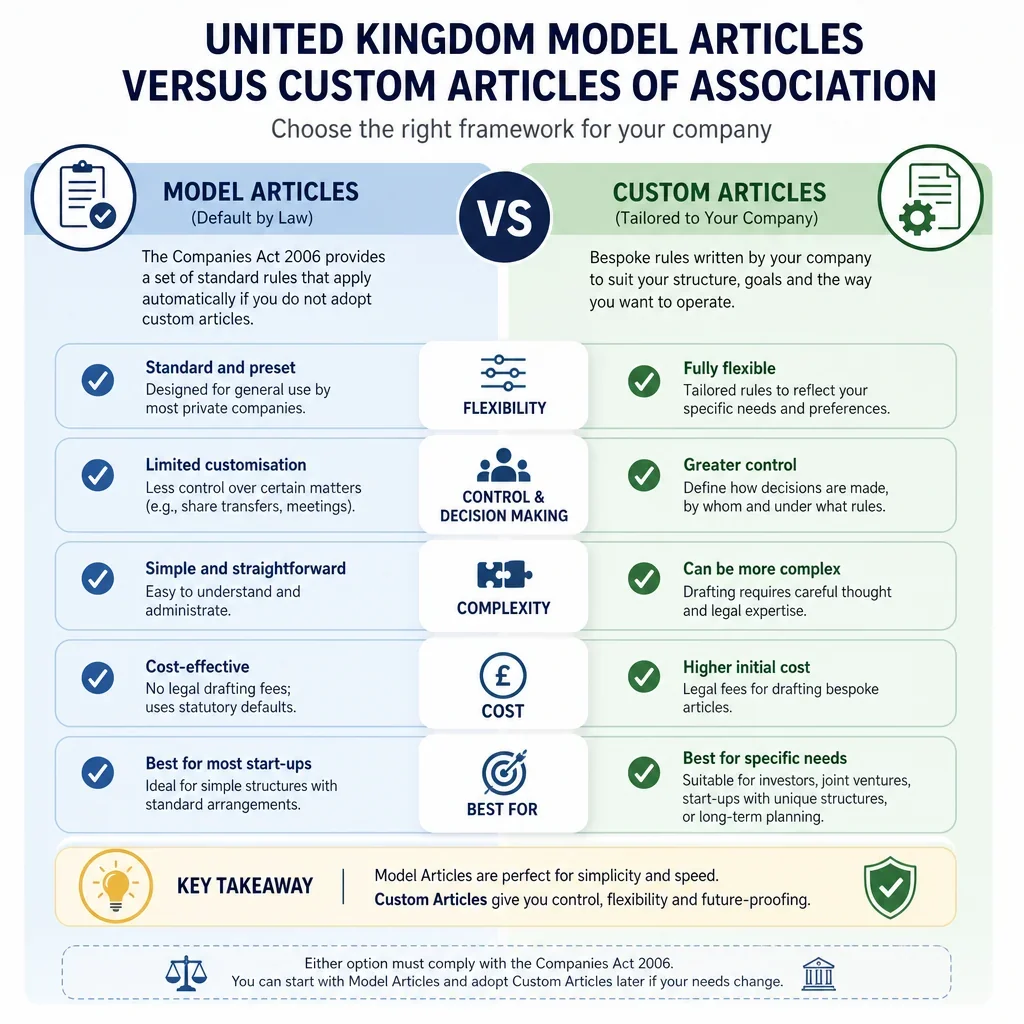
UK articles of association should clearly deal with who can appoint and remove directors, how board meetings are called and chaired, what quorum is required, how directors vote, and how conflicts of interest are authorised. These provisions are particularly important because the statutory model articles contain default rules, but many private companies need tailored wording for investor rights, founder control, deadlock protection, or group company governance.
Why Do Conflict Provisions Need Particular Care?
Directors owe statutory duties under the Companies Act 2006, including duties to avoid conflicts and declare interests. Articles commonly permit directors or shareholders to authorise certain conflicts, but the drafting should specify who may approve the conflict, whether the conflicted director counts in quorum, and whether they may vote. Poor drafting can make board approvals vulnerable to challenge.
How Do Quorum And Decision Rules Affect Day-To-Day Control?
Quorum and voting provisions determine whether directors can validly make decisions. A low quorum may improve speed but can allow a small group to act without broader input. A higher quorum, special quorum, or class/investor director presence requirement can protect stakeholders, but may also create deadlock if directors are unavailable.
When Should Articles Be Supplemented By Resolutions Or Service Agreements?
Articles set the constitutional framework, but appointments, resignations, delegations, remuneration approvals and employment terms are often implemented through board resolutions, shareholder resolutions, or service agreements. Companies should ensure those documents align with the articles so that director authority, pay, notice periods and delegated powers are legally coherent.

FAQs
You Might Also Be Interested In