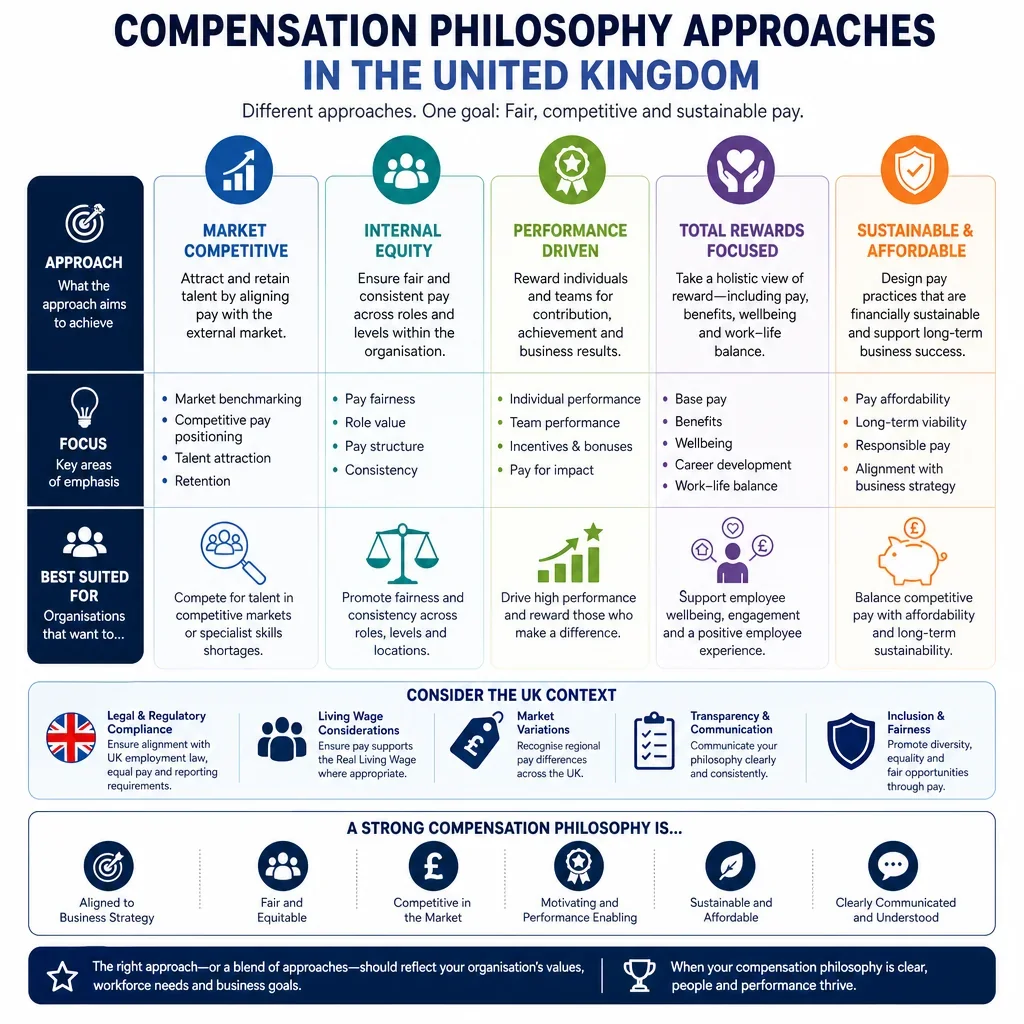
Compensation Philosophy Approaches In The United Kingdom
Approach Category | Definition | Example Statement Wording | Typical Organisation Type | Drafting Considerations |
|---|---|---|---|---|
Market-Median Pay | ||||
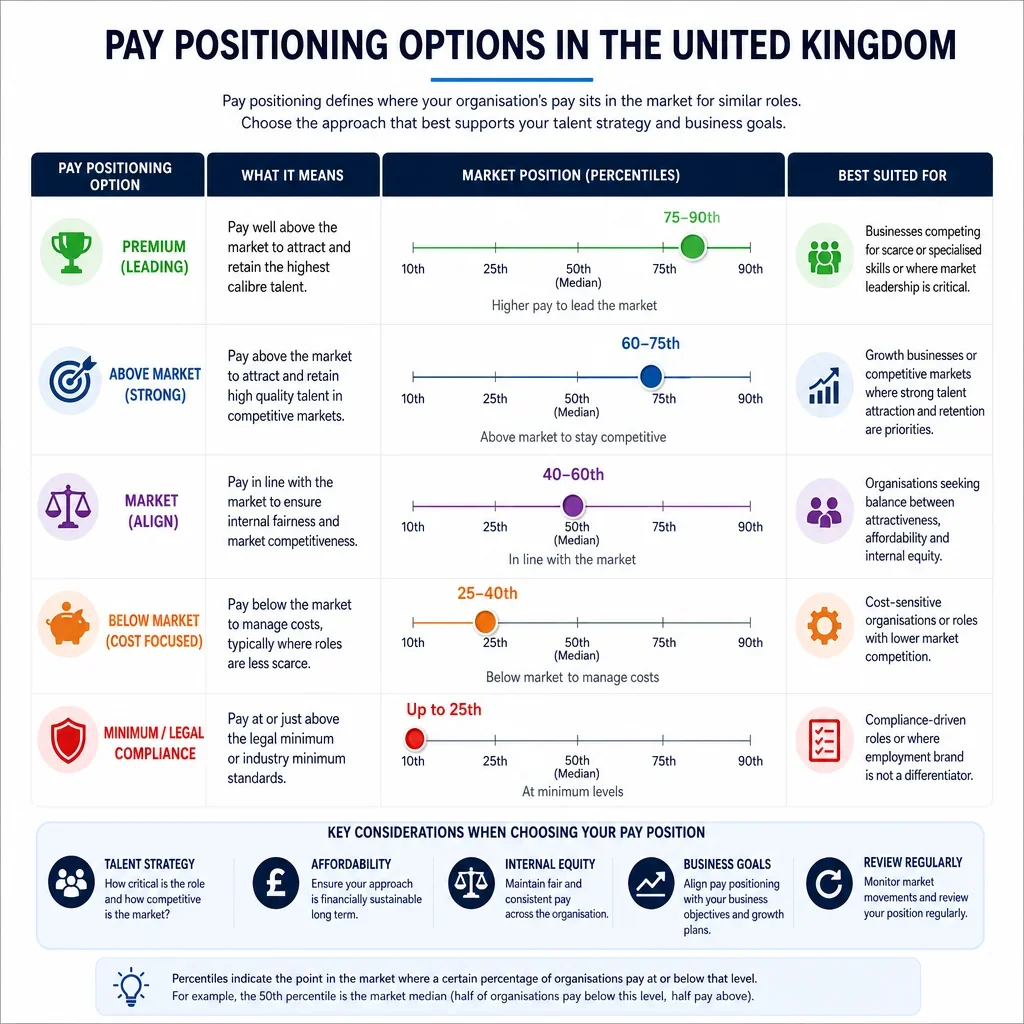
Market-led | Pay is positioned around the median of the relevant external labour market. | We aim to provide pay that is broadly aligned with the median of the relevant UK market for comparable roles. | Medium-sized private company Large private company Listed company Charity or not-for-profit | Define the comparator market, data source, review frequency and how exceptions will be approved. |
Upper-Quartile Market Pay | ||||
Market-led | Pay is targeted above typical market levels to attract and retain scarce skills. | For critical and hard-to-fill roles, we may target upper-quartile market pay where this is justified by skills scarcity and business need. | Large private company Listed company Medium-sized private company | Avoid broad promises require evidence, affordability checks and equal pay impact review. |
Cost-Conscious Market Pay | ||||
Market-led | Pay is kept competitive enough to operate while prioritising affordability and financial sustainability. | We seek to offer fair and sustainable pay within our financial means, supported by a wider total reward package. | Small private company Charity or not-for-profit Public sector body | Check minimum wage compliance and retention risk avoid implying pay below fair or lawful levels. |
Survey-Benchmarked Salary Ranges | ||||
Market-led | Salary ranges are set and updated using external pay survey data for comparable jobs. | Our salary ranges are informed by reputable market data for comparable roles, locations and sectors. | Medium-sized private company Large private company Listed company Public sector body | Use robust data, avoid over-reliance on small samples and document benchmark matching decisions. |
Local Labour Market Pay | ||||
Market-led | Pay reflects rates in the geographic labour market where employees are recruited or based. | Where roles are location-specific, we consider local labour market conditions when setting pay. | Small private company Medium-sized private company Public sector body Charity or not-for-profit | Be clear on location rules for hybrid work and monitor indirect discrimination risks. |
London Weighting Or Location Allowance | ||||
Market-led | Additional pay is provided to reflect higher costs or market rates in London or specific locations. | We may apply location allowances where local market conditions or cost pressures materially affect recruitment and retention. | Large private company Listed company Public sector body Charity or not-for-profit | Define eligibility, remote-working treatment and whether allowances are pensionable or temporary. |
Sector-Comparator Pay | ||||
Market-led | Pay is compared against organisations in the same sector or talent market. | We benchmark pay against appropriate sector comparators to remain competitive for relevant talent. | Large private company Listed company Charity or not-for-profit Public sector body | Select comparators carefully and avoid using sector norms to justify unequal outcomes. |
Scarce-Skills Premium | ||||
Market-led | Additional pay is used for roles where skills scarcity creates recruitment or retention pressure. | Market premiums may be applied to scarce-skill roles where objective evidence shows sustained recruitment or retention pressure. | Medium-sized private company Large private company Listed company Public sector body | Set review dates, objective criteria and withdrawal rules to reduce equal pay and employee relations risk. |
Retention Allowance | ||||
Market-led | Targeted additional pay is used to retain key employees or roles during defined risk periods. | Retention payments may be used selectively where there is a demonstrable business need and a clear retention risk. | Large private company Listed company Public sector body Medium-sized private company | State eligibility, repayment terms, tax treatment and objective approval criteria. |
Internal Equity | ||||
Equity-led | Pay decisions are guided by fairness between roles of similar size, value and responsibility. | We aim to maintain fair internal pay relationships based on role size, responsibility and contribution. | Small private company Medium-sized private company Large private company Listed company Charity or not-for-profit Public sector body | Support with job evaluation, consistent grading and documented exceptions. |
Analytical Job Evaluation | ||||
Equity-led | Roles are evaluated using defined factors to support consistent grading and equal pay compliance. | We use structured role evaluation to support fair grading and consistent pay decisions across comparable roles. | Large private company Listed company Public sector body Charity or not-for-profit | Keep evaluations current and ensure factors do not disadvantage protected groups. |
Single Pay Spine | ||||
Equity-led | Roles sit on a common pay spine with incremental points linked to grade or service. | We operate a common pay structure to promote consistency, transparency and fair progression across roles. | Public sector body Charity or not-for-profit | Clarify progression rules, collective agreements and affordability of increments. |
Grade-Based Pay Bands | ||||
Equity-led | Jobs are grouped into grades with defined minimum, midpoint and maximum salary ranges. | Each role is assigned to a pay grade with a defined salary range reflecting role scope and market context. | Medium-sized private company Large private company Listed company Public sector body Charity or not-for-profit | Set rules for range penetration, promotions, red-circling and out-of-range salaries. |
Transparent Pay Ranges | ||||
Equity-led | Employees and candidates are given clear information about pay ranges and progression criteria. | We provide clear pay range information and explain the factors that influence pay progression. | Medium-sized private company Large private company Listed company Charity or not-for-profit Public sector body | Ensure published ranges are accurate and supported by manager training and equal pay analysis. |
Equal Pay Compliance | ||||
Equity-led | Pay practices are designed to support equal pay for equal work and avoid unlawful discrimination. | We are committed to equal pay for equal work and to making pay decisions using fair, objective and evidence-based criteria. | Small private company Medium-sized private company Large private company Listed company Charity or not-for-profit Public sector body | Avoid absolute guarantees unless supported by audits review bonuses, allowances and benefits as well as salary. |
Gender Pay Gap Conscious Reward | ||||
Equity-led | Reward decisions are reviewed for their effect on gender pay gap outcomes and representation. | We monitor reward outcomes to identify and address unjustified gender pay disparities within our workforce. | Large private company Listed company Public sector body Charity or not-for-profit | Reporting is mandatory for many employers with 250 or more employees align wording with published data and action plans. |
Real Living Wage Commitment | ||||
Equity-led | The organisation aims to pay at least the voluntary real Living Wage rather than only statutory minimum rates. | We aim to provide base pay that meets or exceeds the real Living Wage where this is affordable and operationally sustainable. | Charity or not-for-profit Public sector body Medium-sized private company Large private company | Do not imply accreditation unless obtained distinguish voluntary rates from statutory National Minimum Wage. |
National Minimum Wage Compliance | ||||
Equity-led | Pay practices are designed to comply with statutory minimum wage and living wage requirements. | We will meet all applicable statutory minimum pay obligations and review rates when legal thresholds change. | Small private company Medium-sized private company Large private company Charity or not-for-profit Public sector body | Check deductions, unpaid working time, salaried-hours rules, apprentices and accommodation offset issues. |
Merit Pay Progression | ||||
Performance-led | Salary increases are linked to assessed individual performance, contribution or achievement. | Pay progression is informed by individual performance, contribution, role scope and position within the salary range. | Medium-sized private company Large private company Listed company | Use objective criteria, moderation and appeal routes to reduce bias and discrimination risk. |
Annual Performance Bonus | ||||
Performance-led | A discretionary or formula-based annual award links reward to individual, team or business performance. | Eligible employees may participate in an annual bonus plan linked to business results and individual contribution. | Medium-sized private company Large private company Listed company | Clarify discretion, eligibility, leavers, payment timing and whether targets create contractual rights. |
Sales Commission-Led Pay | ||||
Performance-led | A material part of pay is linked to sales revenue, margin, bookings or other commercial outcomes. | For eligible sales roles, variable pay is designed to reward sustainable revenue growth and customer-focused performance. | Small private company Medium-sized private company Large private company Listed company | Define commission triggers, clawback, territory changes, holiday pay treatment and conduct expectations. |
Team-Based Incentives | ||||
Performance-led | Variable pay is linked to team or unit results rather than only individual performance. | Where collaboration is critical, incentives may reflect team performance and shared objectives. | Medium-sized private company Large private company Charity or not-for-profit Public sector body | Balance collective reward with individual accountability and avoid unfair treatment of part-time workers. |
Profit Sharing | ||||
Performance-led | Employees share in organisational profits through cash bonuses or similar arrangements. | Where business performance allows, we may share a proportion of profits with employees through a defined reward arrangement. | Small private company Medium-sized private company Large private company | Define profit measure, discretion, eligibility, leavers and interaction with dividends or partner drawings. |
Gainsharing | ||||
Performance-led | Employees receive a share of measurable productivity, quality or efficiency gains. | We may reward teams for measurable productivity or efficiency improvements that create sustainable organisational value. | Medium-sized private company Large private company Public sector body | Use credible baselines and avoid incentives that compromise safety, quality or customer outcomes. |
Long-Term Incentive Plan | ||||
Performance-led | Senior employees receive equity, cash or share-based awards linked to multi-year performance or value creation. | Long-term incentives are intended to align senior leadership reward with sustained performance and long-term stakeholder value. | Listed company Large private company Medium-sized private company | Address vesting, malus, clawback, shareholder expectations and tax treatment. |
Shareholder-Aligned Executive Pay | ||||
Performance-led | Executive reward is structured to align leadership incentives with shareholder value and company strategy. | Executive remuneration is designed to support strategy, reward long-term value creation and align leaders with shareholders. | Listed company | Consider remuneration policy votes, workforce pay context, pension alignment and disclosure duties. |
All-Employee Share Ownership | ||||
Performance-led | Employees are offered opportunities to own shares and participate in business growth. | Where appropriate, we support employee share ownership to help employees participate in the long-term success of the business. | Listed company Large private company Medium-sized private company | Check scheme type, tax rules, eligibility, dilution, employee communications and leaver provisions. |
Values-Based Reward | ||||
Performance-led | Reward decisions consider how results are achieved, not only what results are achieved. | Reward outcomes reflect both performance results and behaviours that are consistent with our values and conduct expectations. | Medium-sized private company Large private company Listed company Charity or not-for-profit Public sector body | Define behaviours clearly and moderate ratings to reduce subjectivity and bias. |
Skills-Based Pay | ||||
Skills-led | Pay progression reflects acquisition, certification or use of valuable skills. | We may recognise the acquisition and application of skills that increase capability, flexibility and organisational value. | Medium-sized private company Large private company Public sector body | Define eligible skills, evidence standards, assessment methods and whether skills must be used in role. |
Competency-Based Pay | ||||
Skills-led | Pay decisions reflect demonstrated competencies needed for effective role performance. | Pay progression may reflect demonstrated competence against defined role expectations and career framework criteria. | Medium-sized private company Large private company Public sector body Charity or not-for-profit | Use observable criteria and assessor calibration to limit bias and inconsistent decisions. |
Professional Qualification Premium | ||||
Skills-led | Additional pay recognises required or strategically valuable professional qualifications. | We may recognise professional qualifications where they are required for the role or materially increase organisational capability. | Medium-sized private company Large private company Listed company Public sector body Charity or not-for-profit | Specify qualifying bodies, maintenance requirements, reimbursement rules and repayment terms for funded study. |
Career Framework Progression | ||||
Skills-led | Pay progression is linked to movement through defined role levels or career pathways. | Progression through pay ranges is linked to role level, capability, performance and readiness for increased responsibility. | Medium-sized private company Large private company Listed company Public sector body | Align levels with job evaluation and avoid creating unrealistic promotion expectations. |
Apprentice And Trainee Progression Pay | ||||
Skills-led | Pay increases as apprentices or trainees meet learning, qualification or role-readiness milestones. | Apprentice and trainee pay reflects statutory requirements, learning stage, capability development and progression milestones. | Small private company Medium-sized private company Large private company Public sector body Charity or not-for-profit | Check apprentice minimum wage rules, working time for training and age-related rate changes. |
Multi-Skilling Premium | ||||
Skills-led | Additional pay recognises employees who can perform multiple roles, tasks or specialist functions. | We may recognise multi-skilling where employees are trained, competent and regularly required to perform additional duties. | Medium-sized private company Large private company Public sector body | Define skill levels, operational need, health and safety training and review criteria. |
Certification-Based Progression | ||||
Skills-led | Pay steps are linked to gaining and maintaining recognised certifications or licences. | Certain roles may progress through pay levels when required certifications are achieved and applied in the role. | Medium-sized private company Large private company Public sector body | Specify whether certification is mandatory, employer-funded, time-limited or subject to renewal. |
Total Reward | ||||
Total reward | The organisation considers salary, benefits, wellbeing, development, recognition and work environment together. | Our reward philosophy considers the full value of pay, benefits, wellbeing, development and the employee experience. | Small private company Medium-sized private company Large private company Listed company Charity or not-for-profit Public sector body | Avoid using benefits language to mask weak pay where recruitment or fairness risks are material. |
Flexible Benefits | ||||
Total reward | Employees can choose from a range of benefits to suit personal circumstances and preferences. | We aim to offer benefits that provide meaningful choice and support diverse employee needs. | Medium-sized private company Large private company Listed company | Check tax treatment, salary sacrifice rules, accessibility and communication of benefit value. |
Wellbeing-Led Reward | ||||
Total reward | Reward includes financial, physical, mental and social wellbeing support as part of value to employees. | Our total reward offering supports employee wellbeing through fair pay, benefits, flexibility and access to support services. | Medium-sized private company Large private company Listed company Charity or not-for-profit Public sector body | Be specific about benefits offered and avoid implying clinical or financial advice beyond the scheme scope. |
Pension-Enhanced Reward | ||||
Total reward | The employer emphasises pension contributions and retirement benefits as a major part of reward value. | Our reward package includes pension provision intended to support long-term financial security in retirement. | Large private company Listed company Public sector body Charity or not-for-profit | Meet auto-enrolment duties and clearly explain contribution levels, eligibility and salary sacrifice effects. |
Flexibility-As-Reward | ||||
Total reward | Flexible, hybrid or remote working is treated as part of the overall employee value proposition. | We recognise flexibility, where operationally feasible, as an important part of our total reward proposition. | Small private company Medium-sized private company Large private company Charity or not-for-profit Public sector body | Do not promise flexibility for all roles align with statutory flexible working rights and business reasons. |
Recognition-Led Reward | ||||
Total reward | Formal and informal recognition is used to reinforce contribution, values and engagement. | We recognise employees for meaningful contributions, positive behaviours and achievements that support our purpose and values. | Small private company Medium-sized private company Large private company Charity or not-for-profit Public sector body | Ensure recognition is inclusive, consistently accessible and not a substitute for fair base pay. |
Benefits Parity | ||||
Equity-led | Benefits access is designed to be fair across employee groups, work patterns and locations. | We seek to provide benefits access fairly across our workforce, taking account of role, eligibility and legal requirements. | Medium-sized private company Large private company Listed company Charity or not-for-profit Public sector body | Review part-time, fixed-term and indirect discrimination risks when setting eligibility rules. |
Purpose-Led Reward | ||||
Total reward | Reward is framed around mission, fairness, sustainability and non-financial value rather than pay leadership. | Our reward approach supports our purpose by balancing fair pay, responsible use of resources and meaningful work. | Charity or not-for-profit Public sector body | Ensure senior pay is defensible to trustees, funders, donors, service users and regulators. |
Balanced Scorecard Reward | ||||
Hybrid | Reward reflects a mix of financial, operational, customer, people and risk measures. | Incentive outcomes are based on a balanced assessment of financial results, customer outcomes, operational delivery and behaviours. | Large private company Listed company Public sector body | Weight measures clearly and avoid incentives that reward one outcome at the expense of risk or service quality. |
Market Plus Performance | ||||
Hybrid | Base pay is market-informed while progression or variable pay is linked to performance. | We set base pay with reference to the market and differentiate reward outcomes based on performance and contribution. | Medium-sized private company Large private company Listed company | Explain the relative weight of market position, performance, affordability and internal fairness. |
Market And Internal Equity Balance | ||||
Hybrid | Pay decisions balance external competitiveness with consistent internal relativities. | We balance market competitiveness with fair internal pay relationships when making compensation decisions. | Medium-sized private company Large private company Listed company Charity or not-for-profit Public sector body | Document how conflicts are resolved when market rates exceed internal grade norms. |
Broad-Banded Pay | ||||
Hybrid | Wide pay bands allow flexibility across role scope, market value, skills and performance. | Our broad pay bands provide flexibility to recognise role scope, market conditions, capability and sustained contribution. | Large private company Listed company Medium-sized private company | Requires strong governance to avoid hidden inequities and unexplained pay dispersion. |
Cash-Equity Trade-Off | ||||
Hybrid | Lower or moderate cash pay is supplemented by equity or options with potential future value. | Where appropriate, we may balance cash compensation with equity participation to align employees with long-term growth. | Small private company Medium-sized private company | Avoid overstating equity value explain vesting, tax, dilution, leavers and liquidity risks. |
Founder-Led Pragmatic Pay | ||||
Hybrid | Pay decisions are simple, affordable and flexible while the organisation is small or scaling. | At our current stage, compensation decisions balance affordability, role impact, market awareness and fairness across the team. | Small private company | Introduce governance before headcount growth creates inconsistency, bias or equal pay exposure. |
Affordability-Led Reward | ||||
Hybrid | Compensation is set within sustainable budget limits while maintaining lawful and fair treatment. | Reward decisions are made within sustainable financial limits while seeking to remain fair, lawful and competitive for key roles. | Small private company Charity or not-for-profit Public sector body Medium-sized private company | Do not use affordability alone to justify unequal pay maintain minimum wage and discrimination compliance. |
Collectively Bargained Pay | ||||
Equity-led | Pay rates and increases are determined or influenced by negotiation with recognised trade unions or employee representatives. | For recognised bargaining groups, pay arrangements are determined through the relevant collective bargaining process. | Large private company Public sector body Charity or not-for-profit | Reflect the status of collective agreements and avoid conflicting individual contractual wording. |
Public Sector Pay Framework | ||||
Equity-led | Pay is governed by public sector rules, pay remit guidance, transparency duties or national frameworks. | Our pay approach reflects applicable public sector pay frameworks, affordability requirements and principles of fairness and transparency. | Public sector body | Check applicable pay remit guidance, national terms, approvals, senior pay controls and publication duties. |
Charity Stewardship Pay | ||||
Equity-led | Pay is set to attract capability while demonstrating responsible stewardship of charitable resources. | We set remuneration to secure the skills needed to deliver our charitable purposes while ensuring responsible use of charitable funds. | Charity or not-for-profit | Document trustee decisions, conflicts, comparators and rationale for senior remuneration. |
Remuneration Committee Governance | ||||
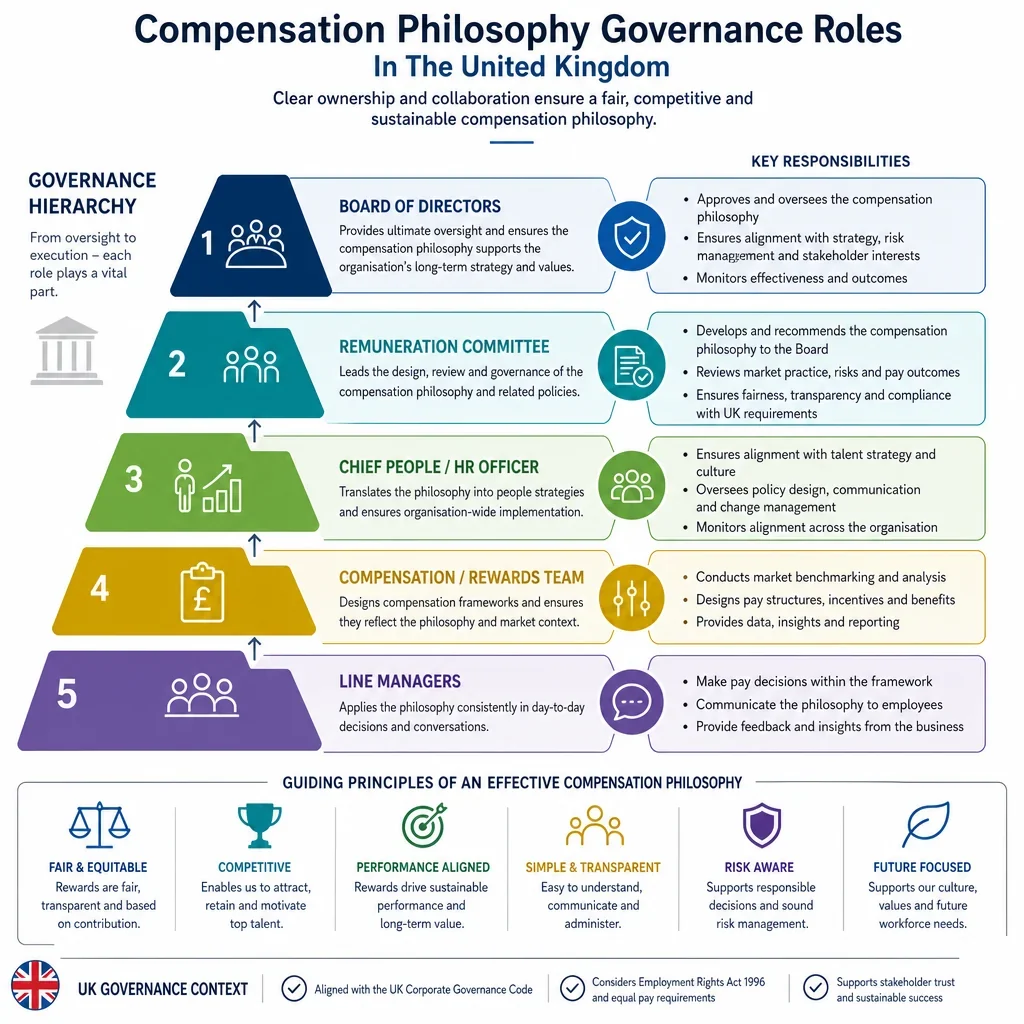
Hybrid | Compensation decisions are overseen by a board committee using defined principles, controls and approvals. | Reward governance is overseen through appropriate approval processes to ensure consistency, accountability and alignment with strategy. | Listed company Large private company Charity or not-for-profit Public sector body | Define delegated authorities, conflicts of interest, executive pay oversight and workforce pay context. |
Pay For Role | ||||
Equity-led | Base pay is primarily determined by the role rather than personal negotiation history or incumbent identity. | Base salary is determined principally by role scope, responsibility, required skills and position within the relevant pay range. | Small private company Medium-sized private company Large private company Listed company Charity or not-for-profit Public sector body | Limit ad hoc negotiation exceptions and record objective reasons for pay differences. |
Pay For Person | ||||
Skills-led | Pay recognises individual expertise, reputation, portability or strategic value beyond the standard role rate. | In limited cases, compensation may reflect exceptional expertise or strategic value where objectively justified and approved. | Medium-sized private company Large private company Listed company Small private company | Use sparingly document objective justification to avoid equal pay and bias concerns. |
Promotion-Based Pay Growth | ||||
Skills-led | Material pay growth is mainly achieved through promotion to higher responsibility roles. | Significant salary growth generally reflects progression into roles with greater responsibility, scope or complexity. | Medium-sized private company Large private company Listed company Public sector body | Ensure promotion access is fair, transparent and not indirectly discriminatory. |
Cost-Of-Living Adjustment | ||||
Equity-led | Pay awards consider inflation or cost-of-living pressures, usually alongside affordability. | Annual pay review decisions may consider affordability, market movement, performance and relevant cost-of-living indicators. | Small private company Medium-sized private company Large private company Charity or not-for-profit Public sector body | Avoid automatic indexation unless intended specify that inflation is one factor, not a guaranteed increase. |
Annual Pay Review | ||||
Hybrid | Pay is reviewed periodically against market, performance, affordability and internal equity factors. | We review pay periodically, considering market data, affordability, role changes, performance and internal fairness. | Small private company Medium-sized private company Large private company Listed company Charity or not-for-profit Public sector body | State that review does not guarantee an increase unless that is the intended contractual position. |
Discretionary Reward | ||||
Hybrid | Management retains discretion over awards, timing and amounts within stated governance principles. | Certain reward decisions may be discretionary and will be made fairly, consistently and in line with business circumstances. | Small private company Medium-sized private company Large private company Listed company | Discretion must not be exercised irrationally, perversely or discriminatorily avoid conflicting contractual promises. |
Formulaic Incentive Pay | ||||
Performance-led | Variable pay is calculated using pre-defined metrics, targets and payout formulas. | Eligible incentive awards are calculated by reference to defined performance measures, targets and plan rules. | Medium-sized private company Large private company Listed company | Ensure formulas are precise and include adjustment rights for errors, misconduct or exceptional events. |
Risk-Adjusted Reward | ||||
Performance-led | Reward outcomes are adjusted for risk, conduct, compliance and sustainability of performance. | Variable reward reflects not only results achieved but also risk management, conduct, compliance and sustainability of outcomes. | Listed company Large private company Medium-sized private company | Regulated firms should align with applicable FCA, PRA or sector remuneration requirements. |
Malus And Clawback | ||||
Performance-led | Variable awards may be reduced, withheld or recovered in defined circumstances. | Variable awards may be subject to malus or clawback where performance, conduct or risk outcomes justify adjustment. | Listed company Large private company Medium-sized private company | Define triggers, time limits, process and contractual enforceability clearly. |
Deferred Variable Pay | ||||
Performance-led | Part of variable pay is delayed to support retention, risk alignment or long-term performance. | A portion of variable reward may be deferred to support sustainable performance, retention and appropriate risk alignment. | Listed company Large private company | Set vesting, leaver, forfeiture, tax and regulatory rules clearly. |
Employee Ownership Trust Reward | ||||
Total reward | Reward philosophy reflects employee ownership, shared success and potentially qualifying tax-free bonuses. | As an employee-owned organisation, we aim to share success fairly and involve employees in long-term value creation. | Small private company Medium-sized private company Large private company | Check EOT qualifying conditions, bonus limits, equality requirements and governance arrangements. |
Simple Flat Structure | ||||
Equity-led | A small number of simple rates or bands are used to keep pay easy to administer. | We maintain a simple pay structure that is easy to understand, administer and review as the organisation grows. | Small private company Charity or not-for-profit | Review regularly as complexity grows simplicity must not create unjustified pay differences. |
Harmonised Pay Structure | ||||
Equity-led | The organisation seeks consistent pay structures across legacy employee groups over time. | We aim to move towards consistent pay principles across the organisation while respecting applicable contractual and legal obligations. | Medium-sized private company Large private company Listed company Public sector body Charity or not-for-profit | TUPE can restrict changes connected with a transfer obtain legal advice before harmonising terms. |
Red-Circling Legacy Pay | ||||
Equity-led | Employees above the normal range retain pay protection while future increases are limited or managed. | Where legacy pay exceeds the current range, we may manage it through pay protection, limited increases or transition arrangements. | Medium-sized private company Large private company Public sector body Charity or not-for-profit | Document objective reasons and review equality impacts, morale and progression constraints. |
Green-Circling Below-Range Pay | ||||
Equity-led | Employees below the normal pay range are prioritised for adjustment towards the range minimum. | Where pay falls below the relevant range minimum, we aim to move employees towards the range subject to affordability and performance considerations. | Medium-sized private company Large private company Listed company Charity or not-for-profit Public sector body | Set a realistic timetable and ensure immediate statutory minimum wage compliance. |
National Remote-First Pay | ||||
Market-led | Remote roles are paid using national or role-based rates rather than local office rates. | For remote-first roles, pay is generally based on role scope and national market data rather than office location. | Small private company Medium-sized private company Large private company | Explain treatment of London staff, international moves, tax presence and location changes. |
Geographic Pay Differentials | ||||
Market-led | Pay ranges vary by location to reflect labour market or cost differences. | Pay ranges may vary by location where market evidence shows material differences in relevant labour rates. | Large private company Listed company Medium-sized private company | Define location zones and reassessment rules when employees relocate or work remotely. |
Premium Pay For Unsocial Hours | ||||
Market-led | Additional pay recognises overtime, night work, weekend work, standby or unsocial hours. | Premium payments may apply where employees are required to work overtime, standby, night or other unsocial hours. | Small private company Medium-sized private company Large private company Public sector body Charity or not-for-profit | Check working time, holiday pay and minimum wage calculations for variable hours and premiums. |
Shift Allowance | ||||
Market-led | Additional pay compensates employees for working defined shift patterns or inconvenient schedules. | Shift allowances may be paid for approved shift patterns where working arrangements create additional inconvenience or market pressure. | Medium-sized private company Large private company Public sector body Charity or not-for-profit | Define qualifying shifts, pensionability, holiday pay treatment and removal if shift patterns change. |
On-Call Allowance | ||||
Market-led | Additional pay recognises availability outside normal working hours for call-out or urgent work. | On-call allowances may apply where employees are required to remain available outside normal working hours under approved arrangements. | Medium-sized private company Large private company Public sector body Charity or not-for-profit | Assess working time, rest breaks, call-out pay, minimum wage and health and safety impacts. |
Mobility And Relocation Allowance | ||||
Total reward | Financial support is provided for relocation, mobility or temporary assignment requirements. | We may provide relocation or mobility support where business needs require employees to move or work in another location. | Medium-sized private company Large private company Listed company Public sector body | Set eligibility, repayment terms, tax treatment and family support limits. |
International Assignment Pay | ||||
Total reward | Pay and allowances are adapted for employees working abroad or moving into the UK. | International assignment packages are designed to support business mobility while addressing tax, benefits and cost considerations. | Large private company Listed company Public sector body | Review tax residency, social security, immigration, equalisation and local employment law. |
ESG-Linked Incentives | ||||
Performance-led | Incentive outcomes include environmental, social, governance, workforce or sustainability measures. | Where relevant, incentives may include sustainability, workforce, governance or social impact measures aligned with strategy. | Listed company Large private company Charity or not-for-profit Public sector body | Use measurable targets and avoid vague metrics that create greenwashing or reporting risk. |
Customer Outcome Reward | ||||
Performance-led | Reward considers service quality, customer outcomes or client satisfaction alongside financial results. | Incentive measures may include customer outcomes and service quality as well as financial and operational performance. | Medium-sized private company Large private company Listed company Public sector body | Particularly important in regulated sectors avoid incentives that encourage mis-selling or poor service. |
Safety-Linked Reward | ||||
Performance-led | Reward outcomes include safe working practices, risk management or health and safety leadership. | Performance reward may reflect safe working, risk awareness and leadership behaviours that protect employees and others. | Medium-sized private company Large private company Public sector body | Avoid rewarding under-reporting of incidents focus on leading indicators and safe behaviours. |
DEI-Conscious Reward | ||||
Equity-led | Reward decisions are assessed for fairness across protected characteristics and workforce groups. | We review reward decisions to support fair outcomes and reduce unjustified differences across workforce groups. | Medium-sized private company Large private company Listed company Charity or not-for-profit Public sector body | Use evidence-based reviews avoid quotas or criteria that could create unlawful discrimination. |
Low-Pay Progression Pathway | ||||
Skills-led | Entry-level employees have defined routes to higher pay through skills, responsibility or progression milestones. | We aim to provide clear progression routes from entry-level roles through skills development, responsibility and performance. | Small private company Medium-sized private company Large private company Charity or not-for-profit Public sector body | Ensure starting rates and deductions comply with statutory minimum wage rules. |
High-Performance Culture Reward | ||||
Performance-led | Reward is intentionally differentiated to recognise sustained high contribution and business impact. | We differentiate reward to recognise sustained high performance, critical contribution and impact on organisational success. | Medium-sized private company Large private company Listed company | Requires credible performance management, calibration and safeguards against bias or excessive pay gaps. |
Public Accountability Pay | ||||
Equity-led | Pay and related payments are designed to withstand public scrutiny and value-for-money review. | Compensation decisions are made with regard to fairness, value for money, transparency and public accountability. | Public sector body Charity or not-for-profit | Consider publication duties, approvals, senior pay controls and severance payment guidance. |
Executive-To-Workforce Fairness | ||||
Equity-led | Executive pay decisions consider wider workforce pay, conditions and stakeholder expectations. | Senior remuneration is considered in the context of workforce pay, conditions, performance and stakeholder expectations. | Listed company Large private company Charity or not-for-profit Public sector body | Listed companies should consider pay ratio reporting and remuneration report expectations. |
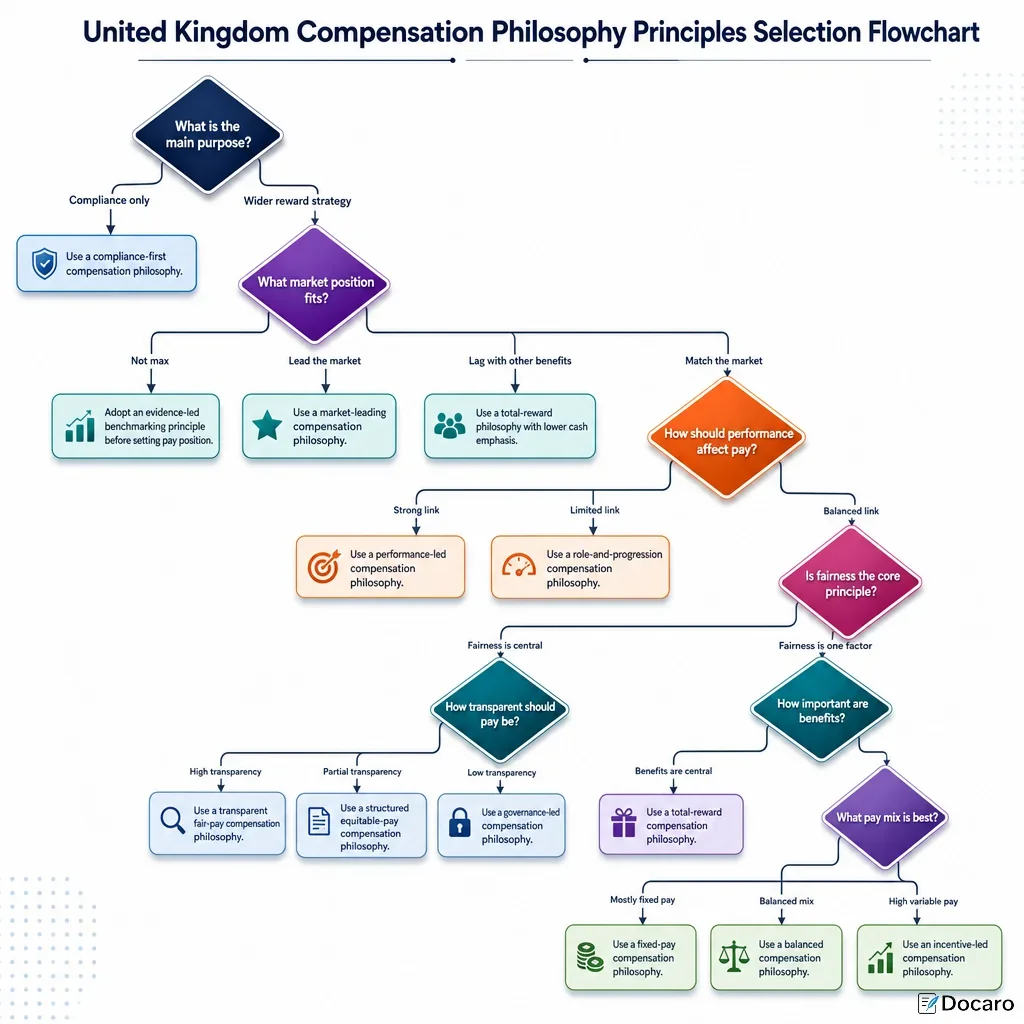
How Should A UK Compensation Philosophy Be Chosen?
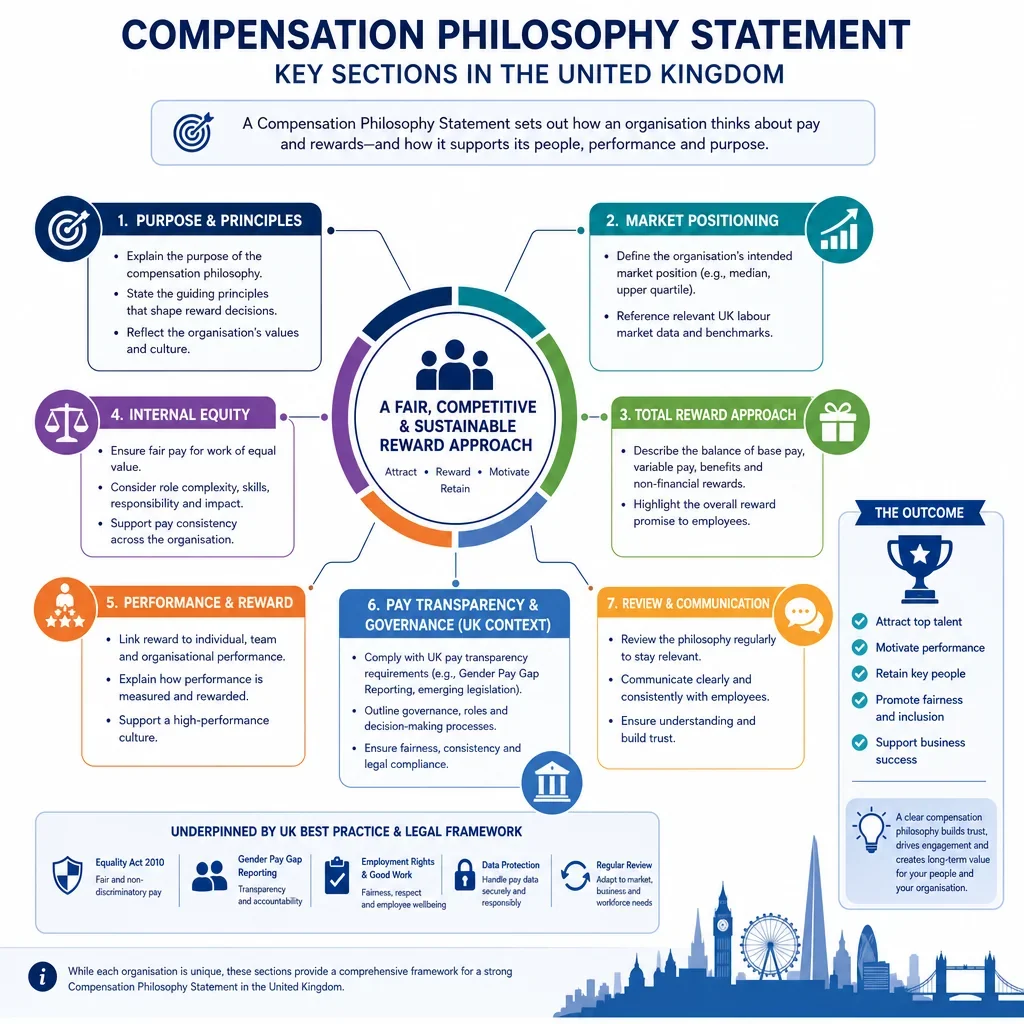
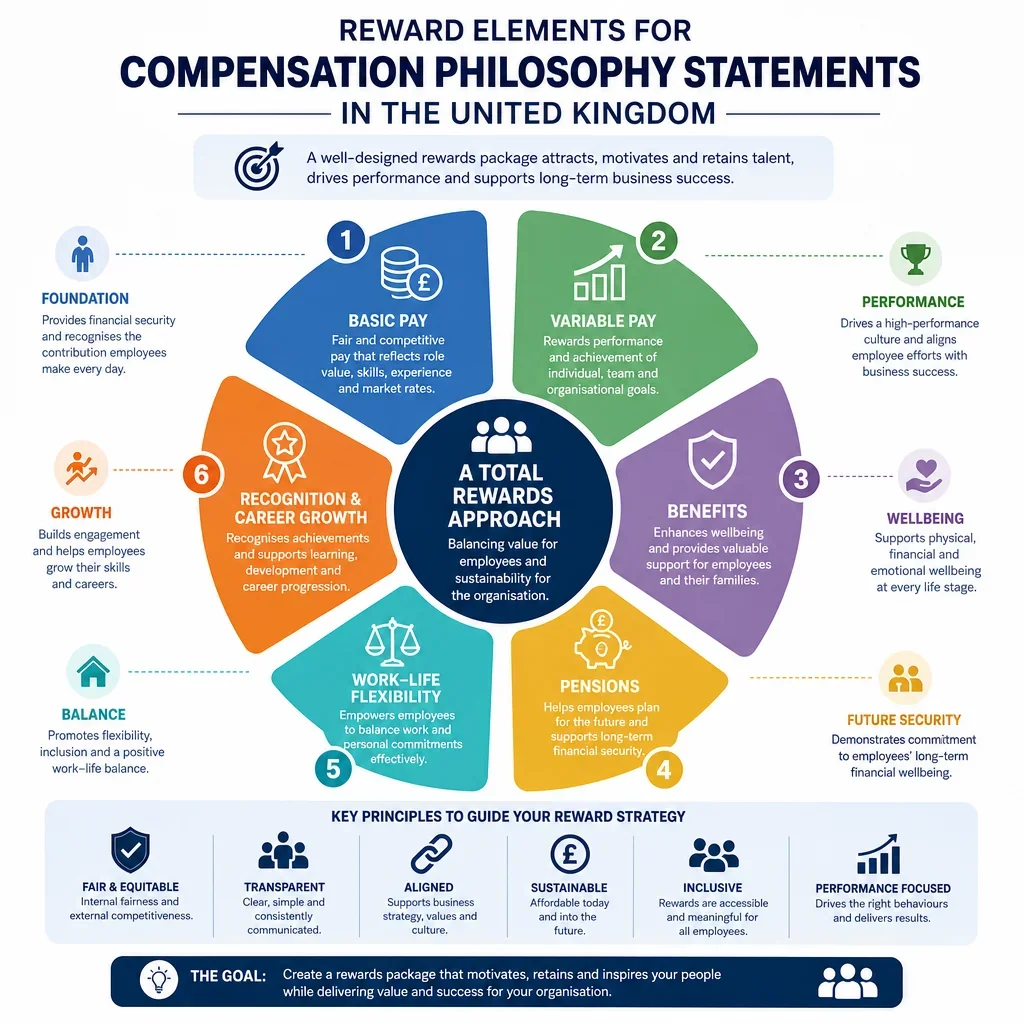
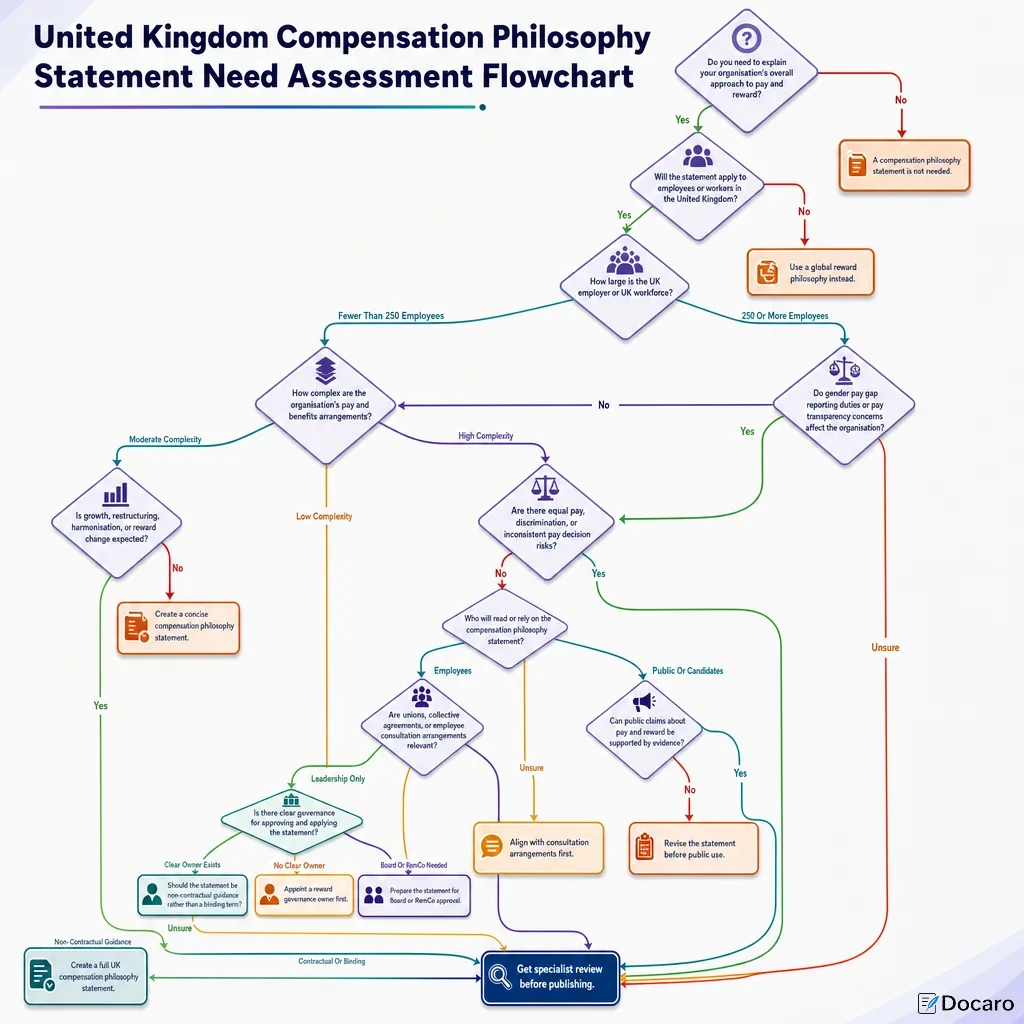
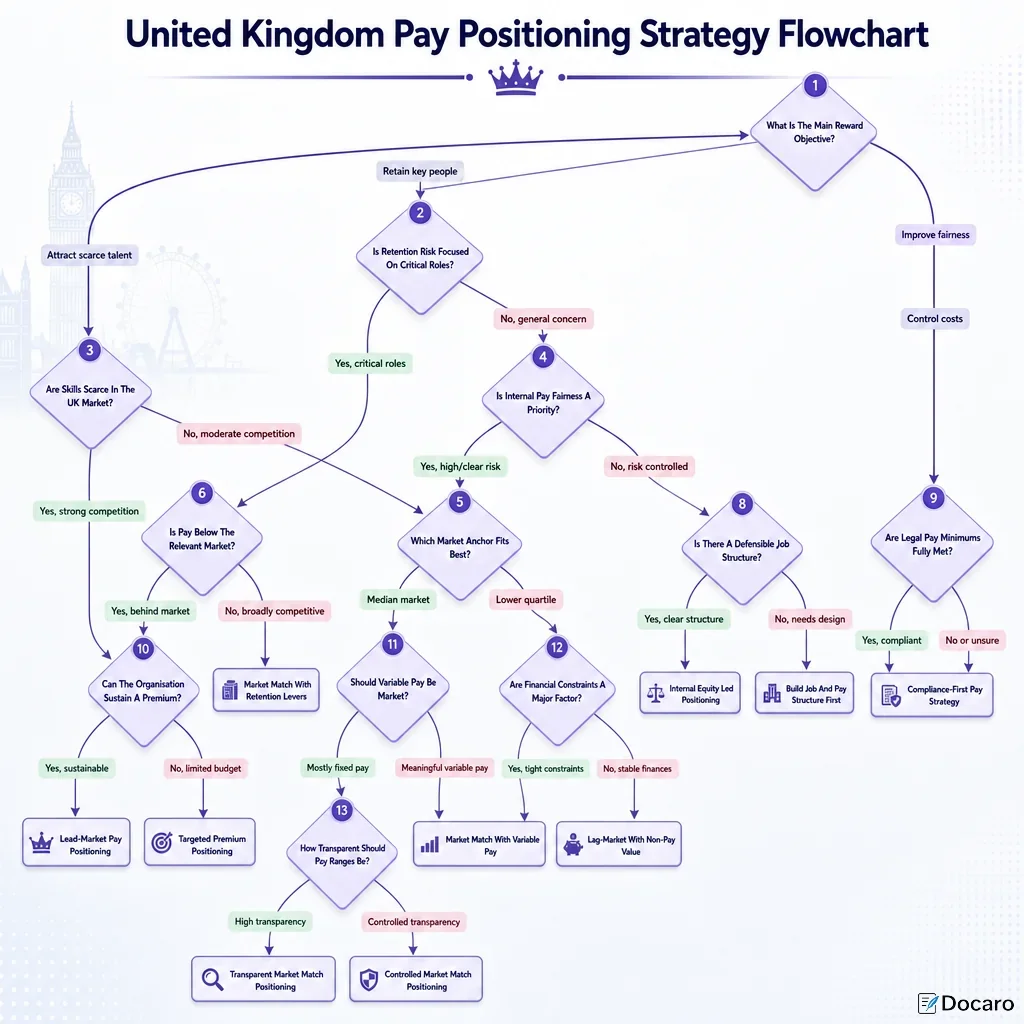
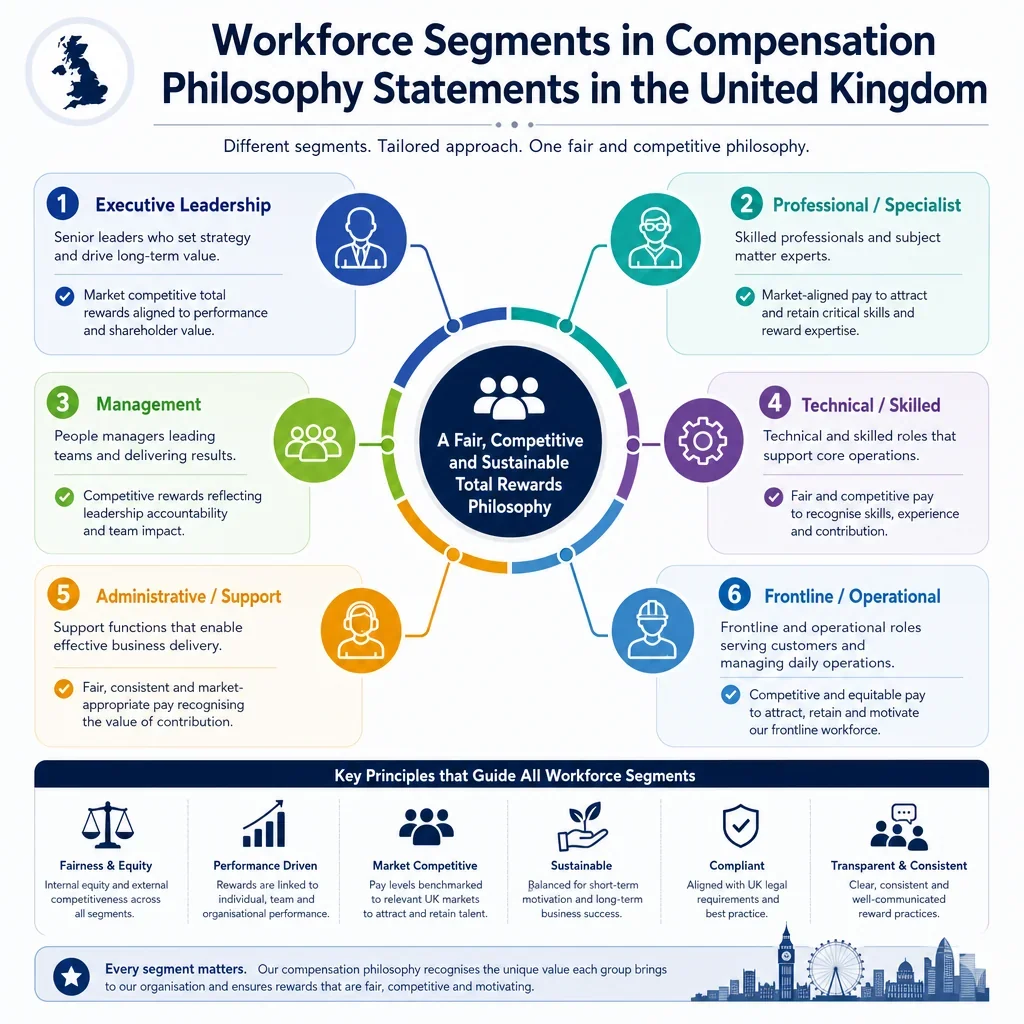
A UK compensation philosophy should identify whether the organisation primarily wants to compete with the labour market, reward performance, protect internal fairness, build skills, or emphasise total reward. In practice, many UK employers use a hybrid approach because pay decisions must balance attraction, retention, affordability, equal pay risk, transparency expectations and governance.
What Legal Risks Should UK Employers Consider?
- Equal pay and discrimination: equity-led, job-evaluation and pay-gap-conscious approaches help manage risk under the Equality Act 2010, but variable pay, discretionary bonuses and market premiums should still be checked for objective justification.
- Minimum pay compliance: any market-led, apprentice, trainee or entry-level approach must be checked against the National Minimum Wage and National Living Wage rules before implementation.
- Listed company governance: listed companies normally need a clearer executive remuneration philosophy, including performance linkage, shareholder alignment and disclosure through the directors\u0027 remuneration report regime.
- Public and charity sector restraint: public bodies and charities often need a stronger emphasis on fairness, affordability, transparency and stakeholder trust rather than aggressive upper-quartile market positioning.
Which Approaches Are Most Useful For Drafting?
Market-led wording is useful where recruitment competition is acute, but it should specify the target market and pay position. Performance-led wording is useful where outputs are measurable, but it needs safeguards against unfairness and short-term behaviour. Skills-led and career-progression approaches work well for organisations investing in capability, apprenticeships or professional pathways. Total reward wording is particularly useful where base pay cannot always lead the market but benefits, flexibility, pension, development and wellbeing form a meaningful part of the employee value proposition.
FAQs
You Might Also Be Interested In