

Commercial Lease Rent And Payment Provisions In The UK
Created:
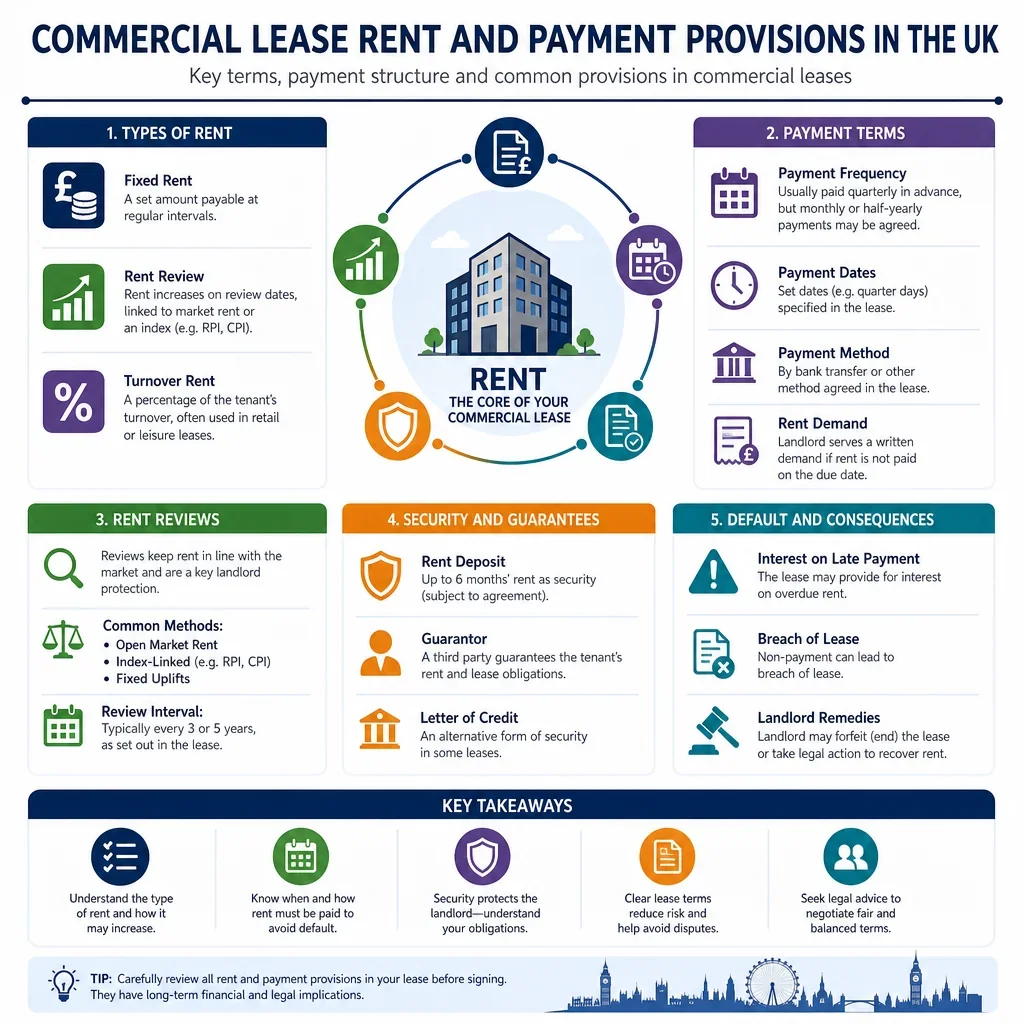
Understand key rent and payment provisions in commercial leases and why they matter for landlords and tenants. This structured dataset supports clearer drafting, review, and comparison within an AI Generated British Commercial Tenancy Agreement.
Financial provision | Description | Calculation method | Tenant considerations | Landlord considerations |
|---|---|---|---|---|
Rent | ||||
Principal rent | The main rent payable for occupation of the premises. | Usually stated as an annual sum, paid quarterly or monthly in advance. | Check affordability, payment dates, rent-free periods and review increases. | Ensure clear due dates, no set-off and robust recovery rights. |
Monthly rent | Rent collected each month rather than on traditional quarter days. | Annual rent divided by 12, usually payable monthly in advance. | Improves cash flow but confirm direct debit and due date rules. | May reduce arrears size but increases administration. |
Quarterly rent | Rent paid on the usual English quarter days or specified lease dates. | Annual rent divided by four, commonly payable in advance. | Creates larger cash outflows seek monthly payment if needed. | Provides predictable income and reduces collection frequency. |
Rent commencement date | The date from which principal rent first becomes payable. | Fixed calendar date or triggered by completion, access or fit-out expiry. | Align with trading start, fit-out completion and funding availability. | Avoid uncertainty and document any conditional rent start clearly. |
Rent-free period | An agreed period when principal rent is not payable. | Specified number of weeks or months, sometimes split across the term. | Confirm whether service charge, insurance and VAT remain payable. | Tie incentives to no early break or require clawback on default. |
Stepped rent | Rent increases by fixed amounts on specified dates. | Schedule lists rent for each period or step date. | Model future liabilities and interaction with rent review dates. | Gives certainty and may avoid review disputes. |
Fixed rent increase | A pre-agreed rent uplift at set points in the term. | Specified percentage or monetary increase on each review date. | Avoid increases that exceed realistic business growth. | Provides predictable income without valuation cost. |
Open market rent review | Rent is reset by reference to market rent for comparable premises. | Valuation assumptions and disregards, agreed or determined by expert or arbitrator. | Challenge upward-only wording, assumptions, disregards and evidence. | Preserve market growth and use clear dispute resolution machinery. |
Upward-only rent review | Review rent can rise or stay the same, but not fall. | Reviewed rent is the greater of current rent and assessed market or indexed rent. | Creates downside risk in weak markets seek cap or mutual review. | Protects income and investment value. |
RPI-linked rent review | Rent changes by reference to the Retail Prices Index. | Base rent multiplied by index movement, often with cap and collar. | Seek caps, collars, substitution rules and worked examples. | Protects against inflation but needs fallback if index changes. |
CPI-linked rent review | Rent changes by reference to the Consumer Prices Index. | Base rent adjusted by CPI movement, commonly subject to caps and collars. | Usually preferable to uncapped RPI check minimum increases. | Offers transparent inflation linkage with official data. |
Turnover rent | Rent based partly or wholly on the tenant's trading turnover. | Percentage of gross or net turnover, sometimes above a threshold. | Define turnover exclusions, online sales, returns and audit rights carefully. | Require reporting, audit access, confidentiality and anti-avoidance terms. |
Base rent plus turnover top-up | Minimum fixed rent with an additional turnover-based payment. | Fixed base rent plus percentage of turnover above an agreed breakpoint. | Ensure base rent is sustainable if turnover falls. | Balances secure income with upside from strong trading. |
Turnover certificate and audit cost | Costs of verifying turnover figures used to calculate rent. | Tenant provides certificates audit cost may be recoverable if under-reporting exceeds threshold. | Limit audit frequency, confidentiality scope and cost recovery triggers. | Need accurate reporting and remedies for material misstatement. |
Concession turnover rent | Rent linked to sales by concessions or sub-operators from the premises. | Percentage of concession receipts or gross sales attributable to the premises. | Avoid double-counting and exclude VAT, refunds and internal recharges. | Capture all value generated from permitted concessions. |
Rent, Service charge, Insurance | ||||
Inclusive rent | Single rent amount that includes certain services or outgoings. | Fixed sum covering rent plus listed items, with exclusions stated. | Confirm exactly what is included and when increases apply. | Avoid absorbing rising costs unless price includes margin. |
Rent | ||||
Apportioned rent | Rent adjusted for a part period at lease start or end. | Daily rate based on annual rent and number of days in period or year. | Check refund rights if lease ends between payment dates. | Specify whether rent paid in advance is refundable on break or expiry. |
Interim rent | Rent payable during statutory continuation or renewal proceedings under the 1954 Act. | Determined by court if not agreed, broadly reflecting appropriate market rent. | Budget for possible backdated adjustment during renewal disputes. | Use interim rent applications to avoid under-renting during continuation. |
Holding over payment | Payment for occupation after contractual expiry where no new lease is completed. | Existing rent, market rent or agreed licence fee during holding over. | Avoid inadvertently accepting new obligations without clarity. | Reserve rights and avoid unintended periodic tenancy where inappropriate. |
Licence fee for early access | Payment for access before lease completion, often for fit-out works. | Daily, weekly or fixed fee, sometimes rent-free if access is for fitting out. | Ensure fee, insurance and reinstatement duties are clear. | Preserve control and ensure no tenancy is unintentionally granted. |
Rent, Tax and VAT | ||||
Lease premium | Upfront capital payment for the grant or assignment of a lease. | Fixed lump sum may affect SDLT and VAT treatment. | Check SDLT, VAT, funding and refund position if completion fails. | Clarify timing, tax treatment and whether premium is non-refundable. |
Key money | Upfront payment for lease opportunity, goodwill or transfer value. | Negotiated lump sum, often payable on completion or assignment. | Check valuation, VAT, SDLT and enforceability of payment trigger. | Document purpose and tax treatment clearly. |
Tax and VAT | ||||
VAT on rent | VAT charged on rent if the landlord has opted to tax or another VAT rule applies. | VAT added to taxable rent at the applicable rate. | Confirm option to tax and ability to recover input VAT. | Ensure valid option to tax and invoice wording. |
Option to tax notification | Landlord's election making supplies of land taxable for VAT purposes. | VAT applies to rent and related taxable payments after effective option. | Request evidence before signing and budget for VAT cash flow. | Maintain evidence and comply with HMRC notification requirements. |
Tax and VAT, Service charge | ||||
VAT on service charge | VAT charged on service charge where the supply is taxable. | VAT added to service charge demands if taxable under VAT rules. | Check VAT invoices and recoverability as input tax. | Issue compliant VAT invoices and account correctly. |
Tax and VAT | ||||
Stamp Duty Land Tax on lease rent | Tax potentially payable by the tenant on lease rent and premium. | Calculated on net present value of rent and any premium using HMRC rates. | File return and pay on time if thresholds are met. | Ensure lease terms support tenant compliance and completion timetable. |
Land Transaction Tax on Welsh lease | Welsh tax that can apply to commercial leases of land in Wales. | Calculated under Welsh LTT rules on rent and any premium. | Use Welsh rates and filing rules for Welsh premises. | Identify jurisdiction correctly in heads of terms. |
Land and Buildings Transaction Tax on Scottish lease | Scottish tax that can apply to leases of land in Scotland. | Calculated under LBTT lease rules, including three-year returns where required. | Budget for Scottish tax and ongoing filing obligations. | Recognise Scottish leases use different tax and property law rules. |
Business rates | Local tax on non-domestic property usually payable by the occupier. | Based on rateable value and multiplier, subject to reliefs. | Check rateable value, reliefs and liability from occupation. | Address empty rates and liability during voids or works. |
Tax and VAT, Service charge | ||||
Business Improvement District levy | Levy charged in areas with an approved Business Improvement District. | Usually percentage of rateable value under the BID arrangements. | Confirm whether tenant or landlord pays and whether levy is recoverable. | Reserve right to recover levies affecting the property. |
Service charge | ||||
Service charge | Contribution to costs of managing, maintaining and servicing shared property. | Fixed percentage, fair proportion or floor-area apportionment of recoverable costs. | Seek budget, cap, exclusions, accounts and consultation rights. | Draft broad but fair recovery and comply with RICS expectations. |
Fixed service charge | Predetermined service charge sum payable regardless of actual costs. | Fixed annual amount, sometimes index-linked or reviewed periodically. | Offers certainty but may overpay if services are limited. | Risk of under-recovery if costs exceed fixed charge. |
Service charge cap | Maximum annual service charge recoverable from the tenant. | Monetary cap or indexed cap, with listed exclusions if agreed. | Ensure cap covers all controllable costs and cannot be bypassed. | Exclude exceptional, utilities, insurance or statutory costs if needed. |
Service charge on account | Advance payments towards estimated service charge costs. | Budgeted annual amount paid monthly, quarterly or on demand in advance. | Request annual budget and challenge unreasonable estimates. | Maintain cash flow for services and year-end reconciliation. |
Service charge balancing payment | Adjustment after accounts compare actual costs with payments on account. | Tenant pays shortfall or receives credit after annual certificate. | Seek time limit, accounts, audit rights and credit repayment rules. | Keep certification process final except for manifest error or fraud. |
Reserve fund contribution | Forward fund for future major repairs or replacements. | Annual contribution based on planned expenditure and tenant apportionment. | Ask how fund is held, used and credited on lease end. | Reduces shock costs but needs transparent accounting. |
Sinking fund contribution | Fund accumulated for specific replacement works, such as lifts or roof plant. | Regular contributions linked to expected lifecycle replacement cost. | Limit to identified items and avoid funding landlord improvements. | Supports long-term asset management and avoids large one-off demands. |
Management fee | Fee for managing services, suppliers, accounts and common parts. | Fixed fee or percentage of service charge budget or expenditure. | Seek reasonableness, transparency and no duplication with admin fees. | Recover professional management costs and define scope. |
Common parts utilities | Electricity, gas, water or heat used in shared areas or systems. | Metered cost, floor-area proportion or fair and reasonable apportionment. | Ask for metering, efficiency measures and exclusion of vacant units. | Recover volatile energy costs and comply with procurement duties. |
Direct utilities | Utilities consumed within the tenant's own premises. | Tenant contracts directly or reimburses metered consumption to landlord. | Prefer separate meters and control over suppliers where possible. | Ensure reimbursement if landlord remains account holder. |
Heating and cooling charge | Cost of communal HVAC, heating, cooling or ventilation systems. | Metered usage, hours of use, floor area or service charge proportion. | Check out-of-hours charges and performance standards. | Recover plant running, maintenance and energy costs. |
Out-of-hours service charge | Extra cost for services outside normal building operating hours. | Hourly rate, call-out fee or metered additional energy and staff cost. | Agree rates and notice periods for extended access. | Recover incremental costs caused by individual tenants. |
Lift maintenance charge | Cost of maintaining, inspecting and repairing shared lifts. | Shared by benefited tenants, often by floor area or weighted floor usage. | Ground floor tenants may seek exclusion or reduced share. | Allocate cost to occupiers benefiting from lifts. |
Cleaning charge | Cost of cleaning common parts, windows, yards or shared facilities. | Contract cost apportioned by area, use or fair proportion. | Specify service levels and avoid paying for non-benefited areas. | Maintain standards and recover supplier costs. |
Security charge | Cost of guards, CCTV, access control and security systems. | Shared cost or specific recharge for tenant-requested security. | Check necessity, hours, data protection and proportionality. | Recover reasonable costs of protecting the building and occupiers. |
Waste disposal charge | Cost of collecting, storing and disposing of business waste. | Shared contract cost, bin usage, volume, weight or specific recharge. | Confirm trade waste duties and charges for special waste streams. | Recover waste costs and enforce compliance with waste rules. |
Landscaping charge | Cost of maintaining external landscaped areas and estate grounds. | Estate cost apportioned by unit, area or fair proportion. | Check whether premises genuinely benefit from estate landscaping. | Preserve estate appearance and recover maintenance costs. |
Car park maintenance charge | Cost of maintaining shared parking areas, barriers, lighting and markings. | Per space, allocated bay share or estate apportionment. | Ensure cost matches allocated spaces and access rights. | Recover maintenance from occupiers benefiting from parking. |
Marketing levy | Contribution to promotion of a shopping centre, estate or destination. | Fixed annual amount, percentage of rent or service charge proportion. | Seek budget, plan, exclusions and evidence of benefit. | Fund collective marketing that supports footfall and asset value. |
Promotional fund contribution | Ring-fenced fund for events, advertising or customer engagement. | Annual fixed contribution or proportionate share of approved fund budget. | Request reporting and limits on landlord branding costs. | Maintain flexibility for centre-wide campaigns. |
Major works service charge | Recovery of significant repair, replacement or renewal works. | Actual cost apportioned, sometimes amortised or funded from reserve. | Exclude improvements and seek amortisation or caps for large works. | Ensure lease permits recovery of renewal, not just repair. |
Improvement cost recovery | Recovery of improvements, upgrades or efficiency works through service charge. | Only if expressly recoverable may be amortised over useful life. | Exclude enhancements unless they reduce costs or are legally required. | Draft express wording for upgrades and compliance works. |
Statutory compliance costs | Costs of complying with laws affecting the building or estate. | Actual costs apportioned through service charge or charged directly if tenant-specific. | Exclude costs caused by landlord breach or pre-existing non-compliance. | Recover unavoidable compliance costs and allocate tenant-caused costs. |
Service charge, Default payments | ||||
Administration charge | Landlord's administrative fee for consents, notices or lease management. | Fixed fee, reasonable cost or professional charge depending on event. | Require fees to be reasonable and evidenced. | Recover time and professional costs for tenant requests. |
Insurance | ||||
Insurance rent | Tenant's contribution to landlord's building insurance premium and related costs. | Whole premium for premises or fair proportion of building or estate policy. | Check insured risks, excesses, commissions and evidence of premium. | Recover full premium, valuation fees and taxes on insurance. |
Building insurance premium | Premium for insuring the structure against agreed insured risks. | Annual premium demanded in advance or on renewal, apportioned if multi-let. | Request policy summary and proportion calculation. | Ensure obligation covers market premium changes and lender requirements. |
Terrorism insurance | Additional cover for terrorism-related damage or loss. | Separate or included premium, apportioned as part of insurance rent. | Confirm whether cover is required and cost is proportionate. | Protect reinstatement funding and lender security. |
Insurance, Tax and VAT | ||||
Insurance Premium Tax | Tax charged on most UK general insurance premiums. | Added to insurance premium at the applicable IPT rate. | Budget for IPT as part of insurance rent. | Ensure IPT is recoverable with the premium. |
Insurance | ||||
Loss of rent insurance | Insurance covering rent lost after insured damage makes premises unusable. | Premium based on insured rent and indemnity period, recovered as insurance rent. | Ensure rent suspension matches the insured loss period. | Set adequate indemnity period for reinstatement delay. |
Public liability insurance recharge | Cost of liability insurance for common areas or landlord-controlled parts. | Included in service charge or insurance rent by fair proportion. | Avoid duplication with tenant's own public liability cover. | Recover liability cover required for building operations. |
Insurance valuation fee | Cost of valuing rebuilding cost for insurance purposes. | Professional fee recovered periodically through insurance rent or service charge. | Check frequency and whether valuation benefits the tenant. | Supports adequate reinstatement insurance and lender compliance. |
Insurance excess | Uninsured first part of a claim under the landlord's policy. | Fixed excess per claim, allocated to responsible tenant or shared if common. | Limit liability for excess not caused by tenant or its visitors. | Recover excess and allocate tenant-caused claims clearly. |
Uninsured risks contribution | Payment towards damage or costs not covered by available insurance. | Actual cost apportioned where risk is uninsurable or insurance is unavailable. | Seek rent suspension or termination if uninsured damage is severe. | Preserve flexibility to reinstate and recover unavoidable uninsured costs. |
Tenant contents insurance | Tenant's own insurance for stock, equipment, fixtures and business assets. | Tenant arranges and pays premium directly to insurer. | Landlord's building policy will not usually cover tenant contents. | Require adequate tenant insurance where activities create risk. |
Tenant public liability insurance | Tenant's cover for injury or damage claims arising from its business. | Tenant pays premium directly lease may specify minimum cover level. | Check required indemnity limit and insurer rating. | Require evidence of cover and indemnity protections. |
Security and deposits | ||||
Rent deposit | Security sum held for rent, service charge or other tenant defaults. | Usually 3 to 12 months' rent, sometimes plus VAT and service charge. | Negotiate release triggers, interest entitlement and permitted withdrawals. | Protect against credit risk and ensure separate deposit deed. |
Security and deposits, Tax and VAT | ||||
VAT element of rent deposit | Additional deposit amount to cover VAT if rent would be taxable. | Deposit calculated on rent plus VAT, or VAT charged on withdrawal if due. | Clarify whether VAT is paid upfront or only on appropriation. | Ensure deposit covers gross default exposure. |
Security and deposits, Default payments | ||||
Rent deposit top-up | Tenant must restore the deposit after landlord withdraws sums. | Top-up to original or revised required deposit within specified days. | Seek notice, evidence and reasonable time to top up. | Maintain security throughout the lease term. |
Security and deposits | ||||
Interest on rent deposit | Interest earned on the deposit while held by landlord or stakeholder. | Credited to tenant, retained by landlord or held under deed terms. | Seek interest entitlement and separate account wording. | Avoid administrative burden and define ownership of interest. |
Rent deposit release amount | Return of all or part of deposit when release conditions are met. | Release on expiry, assignment, accounts test, guarantee, or no-default period. | Agree objective triggers and deadline for repayment. | Retain deposit until all liabilities are settled. |
Security and deposits, Default payments | ||||
Guarantor payment liability | Third party promises to pay if tenant defaults under the lease. | Covers rent and other sums due, subject to guarantee wording. | Limit guarantee amount, duration and post-assignment exposure. | Ensure enforceable guarantee and adequate guarantor covenant strength. |
Authorised guarantee agreement liability | Outgoing tenant may guarantee an assignee's lease obligations after assignment. | Liability depends on AGA terms and Landlord and Tenant Covenants Act 1995 rules. | Resist AGA unless reasonable and required by assignment conditions. | Use AGA to protect against weak assignee covenant. |
Security and deposits | ||||
Bank guarantee | Bank-backed security for tenant payment obligations. | Fixed guaranteed amount, often reducing after performance milestones. | Check fees, expiry, demand conditions and impact on banking facilities. | Prefer on-demand, reputable bank and expiry beyond risk period. |
Security and deposits, Default payments | ||||
Parent company guarantee | Parent company guarantees subsidiary tenant's lease payments. | Covers all sums or capped liabilities as set out in guarantee. | Limit guarantee and avoid cross-defaults where possible. | Check parent strength, jurisdiction and enforceability. |
Default payments | ||||
Contractual interest on late payment | Interest payable when rent or other sums are paid late. | Usually percentage above base rate, accruing daily from due date. | Seek grace period and commercially reasonable rate. | Compensate for delay and deter persistent late payment. |
Statutory interest on late commercial debts | Statutory interest may apply to qualifying late business-to-business debts. | Statutory rate is 8% plus Bank of England base rate, subject to the regime. | Understand statutory exposure if payment terms are not met. | Consider whether statutory rights supplement or are excluded by contract. |
Fixed debt recovery compensation | Fixed compensation for late commercial payments under the statutory regime. | Fixed sum based on debt size, with reasonable extra recovery costs possible. | Avoid automatic extra costs by paying within agreed terms. | Use as additional leverage for qualifying overdue debts. |
Default administration fee | Fee for handling arrears, reminders, returned payments or default notices. | Fixed fee or reasonable administrative cost per default event. | Require proportionality and no penalty-style charges. | Recover internal and agent costs caused by default. |
Returned payment charge | Charge for failed direct debit, bounced cheque or rejected transfer. | Fixed charge plus bank fees and administrative costs. | Limit to actual reasonable costs. | Recover costs and discourage unreliable payment methods. |
Enforcement legal costs | Landlord's legal costs incurred enforcing lease payment obligations. | Indemnity or reasonable costs basis, depending on lease wording and court rules. | Seek reasonableness and exclude costs where landlord acts unreasonably. | Draft express indemnity for arrears and enforcement costs. |
Commercial Rent Arrears Recovery costs | Costs associated with statutory recovery of commercial rent arrears. | CRAR applies to qualifying principal rent arrears under statutory conditions. | Know CRAR can target goods but has notice and eligibility limits. | Use only where statutory requirements are met not for all sums. |
Forfeiture and re-entry costs | Costs linked to enforcing the right to forfeit for tenant default. | Recoverable if lease provides section 146 rules affect many non-rent breaches. | Understand rent arrears can trigger serious remedies quickly. | Preserve forfeiture rights and avoid waiver after knowledge of breach. |
Rent, Default payments | ||||
Break option payment | Payment required as a condition of exercising a break clause. | Fixed sum or rent-equivalent amount due by break notice or break date. | Comply exactly with timing, vacant possession and payment conditions. | Use clear conditions to avoid disputes and compensate early termination. |
Rent | ||||
Rent refund after break | Repayment of rent paid for the period after a valid break date. | Express lease wording needed for refund of advance rent, VAT and service charge. | Include express refund clause do not assume automatic repayment. | State whether payments are refundable and on what conditions. |
Default payments | ||||
Dilapidations payment | Payment for breach of repairing, reinstatement or yielding-up obligations. | Assessed by schedule of dilapidations, costed works and diminution principles. | Use schedule of condition, caps and early exit surveys. | Preserve repair standard and evidence loss properly. |
Reinstatement cost | Cost of removing tenant alterations and restoring premises. | Actual or estimated cost of works required by licence or lease terms. | Clarify which alterations must be removed and notice deadlines. | Reserve right to require reinstatement or retain useful alterations. |
Default payments, Service charge | ||||
Tenant default repair recharge | Landlord's cost of remedying tenant repair failures. | Actual works cost plus professional fees after notice or emergency action. | Seek notice, cure period and evidence except in emergencies. | Maintain self-help rights and recover all associated costs. |
Default payments | ||||
Indemnity payment | Payment reimbursing landlord for losses caused by tenant breach or use. | Actual loss, liability, cost or expense within indemnity wording. | Limit to direct losses caused by tenant or occupiers. | Draft broad indemnities for tenant acts and omissions. |
Default payments, Service charge | ||||
Consent costs | Professional and administrative costs for licences to assign, alter or underlet. | Reasonable legal, surveyor and management costs payable on request or completion. | Ask for estimates and reasonableness controls before applying. | Ensure costs are payable whether or not consent completes. |
Rent, Default payments | ||||
Assignment premium sharing | Landlord may require share of premium received on assignment where permitted. | Percentage of net premium or profit, subject to lease alienation terms. | Resist profit-sharing that restricts exit value. | Capture value where lease is under-rented or assignment creates windfall. |
Rent | ||||
Underletting rent differential | Control over rent payable under an underlease of the premises. | Underlease rent must be market rent or not less than passing rent proportion. | Avoid conditions that make underletting commercially impossible. | Prevent artificial under-renting and protect investment value. |
Rent, Insurance | ||||
Rent suspension after insured damage | Suspension or reduction of rent if premises cannot be used after insured damage. | Suspended proportion based on unusable area or loss of access until reinstatement or insurance period ends. | Ensure suspension covers rent, service charge and insurance where appropriate. | Align suspension with loss of rent insurance recovery. |
Rent | ||||
Temporary rent concession | Short-term rent reduction, deferral or waiver agreed for exceptional circumstances. | Side letter or lease variation specifying reduced amount, period and repayment. | Confirm waiver versus deferral and impact on default or break rights. | Preserve rights and document any concession as personal and temporary. |
Rent, Service charge | ||||
Access disruption rent abatement | Rent reduction if landlord works or events materially restrict access. | Percentage reduction or daily abatement during qualifying disruption. | Seek objective triggers for loss of access or trading impact. | Limit abatement to severe disruption within landlord control. |
Security and deposits, Service charge | ||||
Utilities deposit | Security for utility consumption where landlord supplies or recharges utilities. | Fixed sum or estimated months of utility charges, reconciled on account. | Seek reconciliation, interest and release on direct supplier account. | Protect against unpaid consumption and supplier liability. |
Service charge | ||||
Meter installation cost | Cost of installing or upgrading utility meters or sub-meters. | Direct charge to benefited tenant or apportioned capital cost. | Clarify ownership, maintenance and whether installation is mandatory. | Improve accurate recovery and energy management. |
Service charge, Default payments | ||||
Energy performance compliance cost | Costs linked to energy efficiency and minimum standards for let commercial property. | Direct works cost or service charge recovery if lease expressly allows. | Avoid funding landlord's MEES compliance unless agreed and beneficial. | Need drafting for energy improvement recovery and data sharing. |
Service charge | ||||
Green lease cost contribution | Contribution to sustainability measures, data systems or energy reduction projects. | Agreed proportion of qualifying costs, often linked to savings or payback. | Require cost-benefit test, savings allocation and no open-ended liability. | Enable building upgrades and compliance with sustainability targets. |
Rent, Default payments | ||||
Payment method charges | Costs or requirements linked to paying rent by bank transfer or direct debit. | Lease specifies cleared funds, account details and who pays transfer fees. | Ensure payment details changes are notified securely to avoid fraud. | Require cleared funds and reliable payment reference details. |
No deduction or set-off payment obligation | Tenant must pay sums gross without withholding, deduction or set-off. | Full amount due on payment date, subject only to required legal deductions. | Preserve rights to claim separately for landlord breaches. | Protect rental cash flow and lender income expectations. |
Tax and VAT, Rent | ||||
Tax gross-up | Tenant pays extra if withholding would reduce landlord's net receipt. | Gross-up formula restores landlord to amount receivable without deduction. | Limit to deductions legally required from tenant payments. | Protect net income where tenant withholding obligations arise. |
Rent | ||||
Rent review surveyor costs | Professional fees for determining or negotiating reviewed rent. | Each party pays own costs third-party determination costs shared or allocated. | Avoid automatic liability for landlord's valuation costs. | Ensure determination costs can be recovered where tenant acts unreasonably. |
Rent, Service charge | ||||
Expert determination fee | Fee of independent expert appointed to decide rent or cost disputes. | Shared equally, decided by expert, or borne by unsuccessful party. | Ensure expert has proper qualifications and cost allocation is fair. | Use efficient mechanism to avoid court proceedings. |
Rent, Service charge, Default payments | ||||
Arbitration costs | Costs of arbitration used to resolve rent review or lease payment disputes. | Allocated under arbitration agreement, lease wording and Arbitration Act 1996 principles. | Consider cost exposure before referring disputes. | Can provide binding determination but may be costlier than expert referral. |
Rent | ||||
Renewal lease rent | Rent for a new business tenancy ordered or agreed under renewal rights. | Court may determine rent under Landlord and Tenant Act 1954 section 34. | Prepare market evidence and consider interim rent consequences. | Use statutory valuation assumptions to support market rent. |
Rent, Default payments | ||||
Contracting-out notice cost | Administrative or legal costs for excluding 1954 Act security of tenure. | Fixed or legal cost for serving notice and completing tenant declaration. | Understand loss of statutory renewal rights before signing declaration. | Follow prescribed procedure exactly before lease grant. |
Service charge, Tax and VAT | ||||
Planning obligation recharge | Contribution to costs arising from planning obligations affecting the property. | Direct recharge or service charge apportionment if lease permits. | Exclude historic developer obligations unless tenant benefits or causes cost. | Recover ongoing estate obligations and tenant-caused planning costs. |
Tax and VAT, Service charge | ||||
Community Infrastructure Levy recharge | Possible recharge of CIL connected with development or alterations. | Usually based on chargeable development area and local charging schedule. | Avoid liability for landlord development unless tenant works trigger it. | Allocate CIL risk for tenant alterations or development. |
Service charge, Rent | ||||
Wayleave or telecoms charge | Charges for installing or maintaining telecoms equipment or cabling. | Fixed licence fee, operator payment or landlord administration cost. | Check installation costs, service continuity and removal obligations. | Control routes, income allocation and reinstatement obligations. |
Rent | ||||
Parking rent | Separate rent or licence fee for parking spaces. | Fixed amount per space per month or year, sometimes reviewed separately. | Confirm exclusivity, number of spaces and VAT treatment. | Keep flexibility to relocate spaces and charge market rates. |
Storage area rent | Additional rent for basement, yard, archive or storage space. | Fixed amount or rate per square foot or square metre. | Check access, security, service charge and repair obligations. | Separate ancillary space value from main premises rent. |
Area-based rent | Rent calculated by reference to measured floor area. | Rate per square foot or square metre using agreed measurement basis. | Verify measurement standard, exclusions and measured area before signing. | Use consistent measurement and avoid disputes over area. |
Rent, Tax and VAT | ||||
Rent in kind or non-cash consideration | Non-cash value provided instead of, or alongside, monetary rent. | Valued by agreed monetary equivalent or specified deliverables. | Clarify tax, VAT, default and valuation consequences. | Ensure consideration is enforceable and valuation is certain. |
Rent | ||||
Rent review collar | Minimum increase or minimum reviewed rent at a review date. | Minimum percentage uplift or minimum monetary rent specified in lease. | Avoid guaranteed increases if trading or market rent may fall. | Provides minimum growth and supports valuation assumptions. |
Rent review cap | Maximum increase or maximum reviewed rent at a review date. | Maximum percentage uplift, maximum index movement or fixed ceiling. | Useful for budgeting and limiting inflation risk. | May reduce income growth and investment value. |
Rent, Default payments | ||||
Side letter concession clawback | Loss or repayment of concession if tenant breaches conditions. | Discount ends or arrears recalculated at full lease rent after trigger event. | Limit triggers to material breach and avoid retrospective cliff-edge liability. | Protect conditional incentives and enforce performance requirements. |
Default payments, Rent | ||||
Rent acceleration clause | Future rent becomes immediately payable after serious default. | Specified future instalments accelerated, subject to enforceability and penalty risk. | Resist as potentially severe and disproportionate. | Use carefully to avoid unenforceable penalty arguments. |
Default payments | ||||
Liquidated damages for late completion or access | Agreed sum payable for specified delay or breach affecting lease payments. | Daily or fixed amount representing genuine commercial allocation of risk. | Ensure amount is proportionate and not punitive. | Set defensible amount reflecting likely loss and commercial interests. |
Default payments, Rent | ||||
Lease preparation costs | Legal or surveyor costs for preparing and completing the lease. | Each party pays own costs or tenant contributes fixed agreed amount. | Agree any contribution in heads of terms and cap it. | Recover transaction costs for low-rent or short leases. |
Rent, Default payments | ||||
Engrossment fee | Charge for producing final execution copies of lease documents. | Fixed administrative fee payable on completion if agreed. | Check whether fee is still justified for electronic signing. | Use only where expressly agreed and reasonable. |
Tax and VAT | ||||
Land Registry fee | Fee for registering a registrable lease at HM Land Registry. | Fee depends on application type and value under Land Registry fee scale. | Budget for registration if lease is registrable or voluntarily registered. | Require tenant to register and provide title information where needed. |
Security and deposits, Tax and VAT | ||||
Companies House charge registration cost | Cost of registering security, such as certain rent deposit charges, against a company. | Companies House filing fee plus legal costs where registration is required. | Check if deposit deed creates registrable security. | Register security on time to preserve enforceability against insolvency risk. |
Security and deposits, Default payments | ||||
Deposit withdrawal on insolvency | Landlord's right to use deposit after tenant insolvency or payment default. | Withdrawal up to unpaid liabilities, subject to deposit deed and insolvency constraints. | Understand deposit may be used before disputes are resolved. | Draft trust or charge structure to maximise protection. |
Rent, Default payments, Security and deposits | ||||
Rent during administration or insolvency | Treatment of rent and lease liabilities when tenant enters insolvency procedure. | Depends on insolvency procedure, occupation, expenses principles and lease rights. | Directors should assess ongoing occupation liabilities carefully. | Act quickly to protect arrears, deposits and enforcement options. |
Default payments | ||||
Compound interest on arrears | Interest charged on unpaid interest as well as unpaid principal sums. | Compounded monthly, quarterly or annually only if lease expressly states it. | Resist compounding or require a cap and grace period. | Express wording needed if compounding is intended. |
Base rate replacement for interest | Fallback if the referenced interest benchmark changes or is unavailable. | Interest margin applied to Bank of England base rate or replacement rate. | Ensure replacement benchmark is objective and not landlord-controlled. | Avoid uncertainty if bank base rate reference becomes unsuitable. |
Rent, Service charge, Insurance, Default payments | ||||
Payment demand requirement | Whether sums are payable automatically or only after landlord demand. | Principal rent often payable without demand variable sums usually on demand. | Require clear invoices for variable sums and VAT. | State when demand is unnecessary to avoid arrears arguments. |
Rent, Default payments | ||||
Time of payment clause | Specifies when payment must be received and whether time is critical. | Due by specified date and time in cleared funds. | Allow banking delays and weekends or public holidays. | Make payment deadline precise for enforcement and accounting. |
Non-business day payment rule | Adjusts payment timing if due date falls on weekend or bank holiday. | Payment due on previous or next business day as specified. | Prefer next business day to avoid accidental default. | Prefer previous business day for advance rent certainty. |
Rent | ||||
Rent review memorandum cost | Cost of documenting the reviewed rent after agreement or determination. | Each party bears own costs or tenant pays reasonable landlord costs if stated. | Require short-form memorandum and cap landlord costs. | Record reviewed rent for title, accounting and future enforcement. |
Rent review back payment | Arrears payable if reviewed rent is agreed after review date. | Difference between old and new rent from review date to determination date. | Budget for lump-sum back rent and interest risk. | Include interest on back rent from review date or determination date. |
Rent, Default payments | ||||
Interest on rent review arrears | Interest on back rent after a delayed rent review determination. | Rate above base rate from review date, demand date or determination date. | Prefer interest only from demand or determination date. | Compensate for delayed receipt of market rent. |
1954 Act statutory compensation | Compensation may be payable where renewal is opposed on certain no-fault grounds. | Based on rateable value and length of occupation under the 1954 Act. | Check entitlement if landlord opposes renewal for redevelopment or occupation. | Budget compensation when relying on no-fault opposition grounds. |
What Rent And Payment Terms Should A UK Commercial Lease Cover?
A well-drafted commercial lease should separate principal rent, VAT, service charge, insurance rent, deposits and default interest. Treating these as separate payment streams helps avoid disputes about what is recoverable, when it is due and whether VAT is payable.
How Can Tenants Limit Unexpected Lease Costs?
- Service charge: seek a cap, exclusions, audited accounts, consultation rights and compliance with the RICS service charge code.
- Insurance rent: check the insured risks, excesses, commissions, terrorism cover and whether the landlord can recover only a fair proportion.
- VAT: confirm whether the landlord has opted to tax before completion, as VAT can materially increase cash flow costs.
- Rent review: understand whether the review is open market, index-linked or fixed, and whether it is upward-only.
- Late payment: check the interest rate, grace periods and whether statutory debt recovery costs may apply.
Why Do Landlords Need Clear Payment Machinery?
Landlords usually need precise due dates, apportionment rules, rent review machinery, service charge recovery wording, insurance rent provisions and default remedies. Clear drafting reduces the risk that recovery of management costs, insurance premiums, VAT, interest or enforcement expenses will be challenged.
Which UK Legal Points Most Often Affect Commercial Lease Payments?
- VAT: commercial property rent is usually exempt unless the landlord has made an option to tax.
- Late commercial debts: statutory interest and fixed compensation may apply under the Late Payment of Commercial Debts regime.
- Rent deposits: tenancy deposit protection rules generally apply to assured shorthold residential tenancies, not ordinary commercial leases.
- Forfeiture and CRAR: non-payment provisions should be drafted with awareness of commercial rent arrears recovery and forfeiture rules.
- Landlord and Tenant Act 1954: renewal and termination strategy can affect rent, interim rent and security of tenure.
Want to Generate Your own Commercial Lease Agreement?
Docaro AI can help you write your own Commercial Lease Agreement for use in the United Kingdom in minutes.
FAQs
A UK commercial lease should state the annual rent, payment frequency, due dates, payment method, VAT position, rent review mechanism, interest on late payments, and any service charge, insurance rent or other sums payable by the tenant.
Show All FAQs
You Might Also Be Interested In
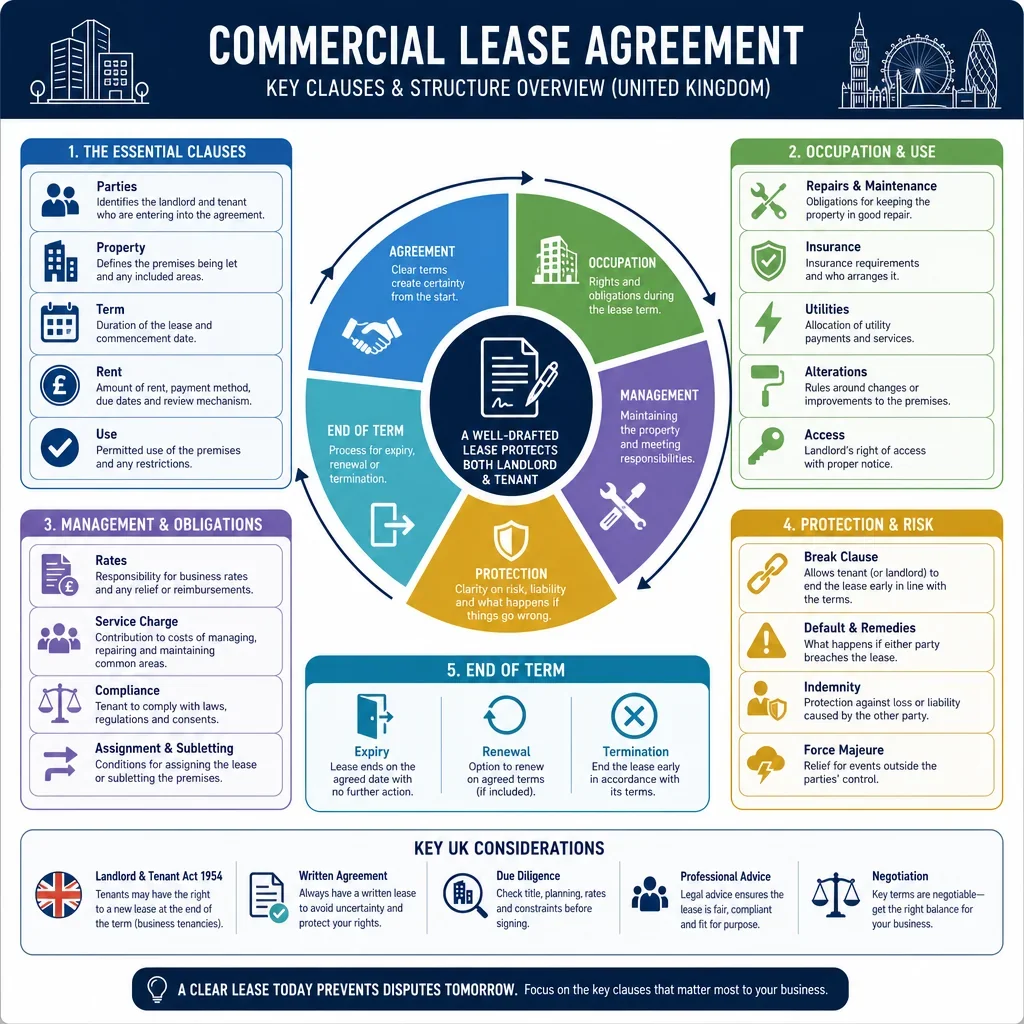
Explore a United Kingdom commercial lease clause library with practical wording for tenancy agreements, landlords and tenants.
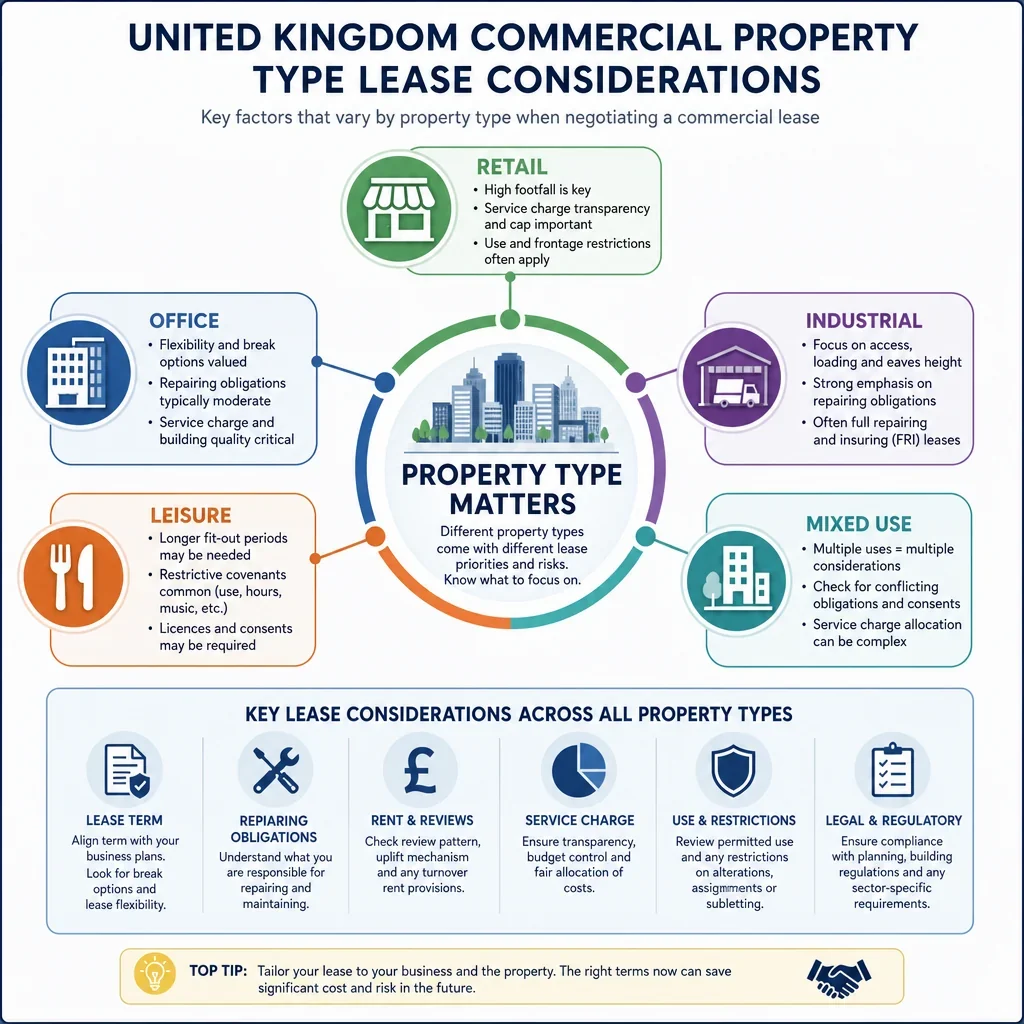
United Kingdom commercial lease considerations by property type, helping landlords and tenants understand key tenancy terms.
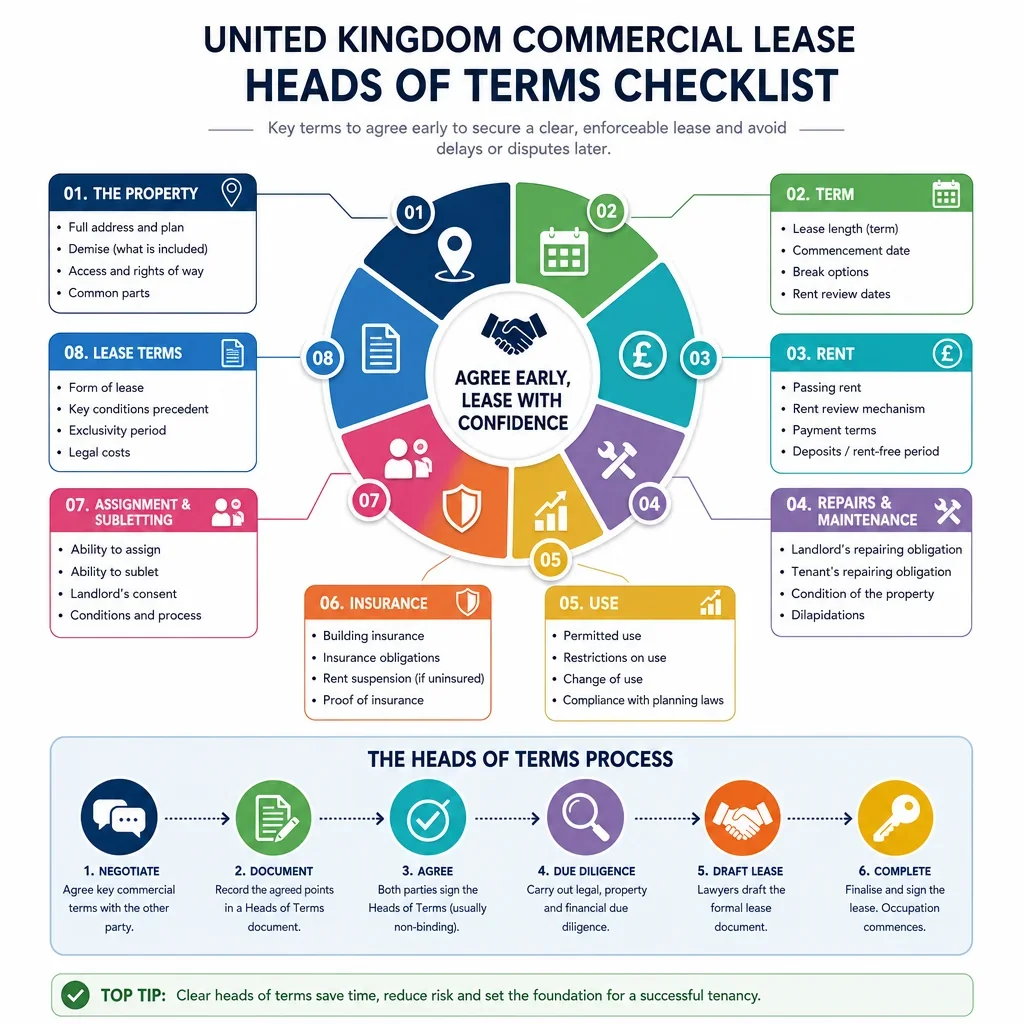
UK commercial lease heads of terms checklist covering key points for landlords and tenants before drafting a lease.
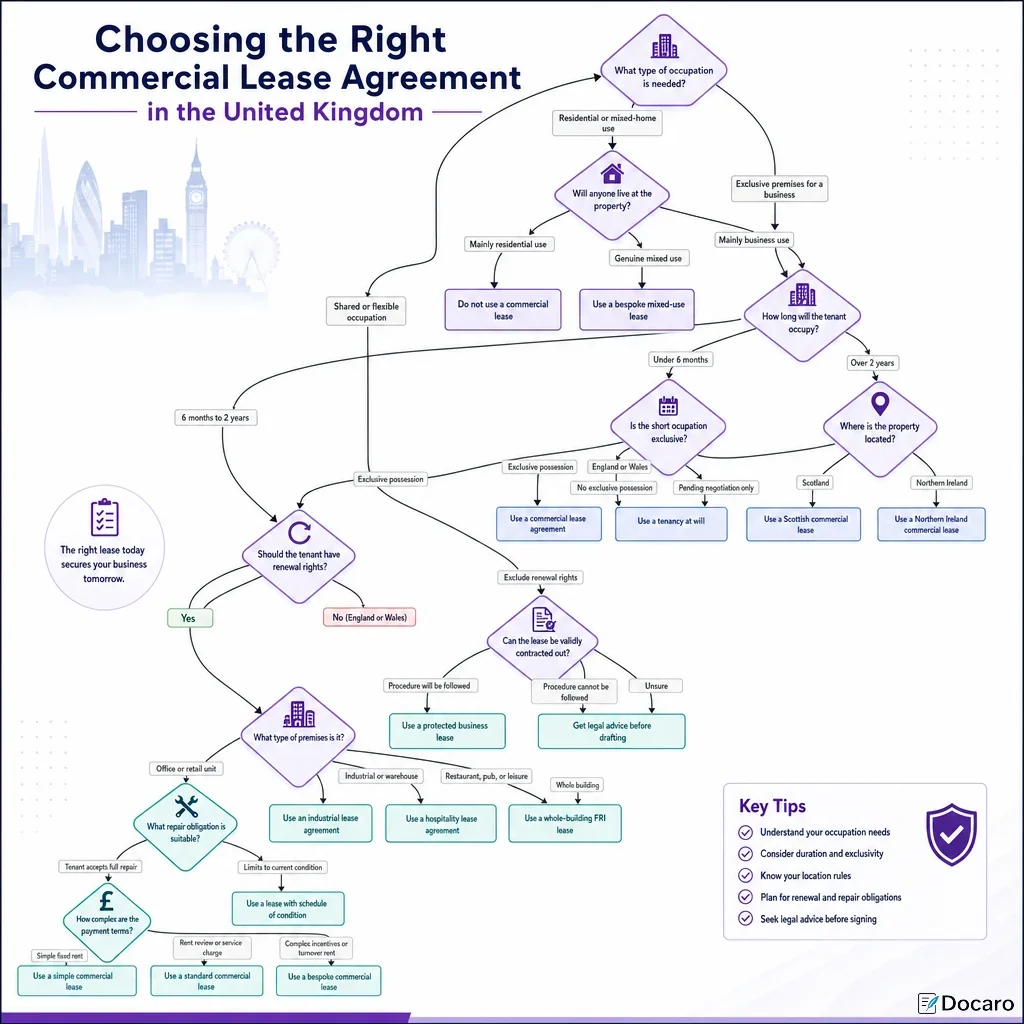
Choose the right commercial lease agreement in the United Kingdom with key factors, risks, and practical decision guidance.
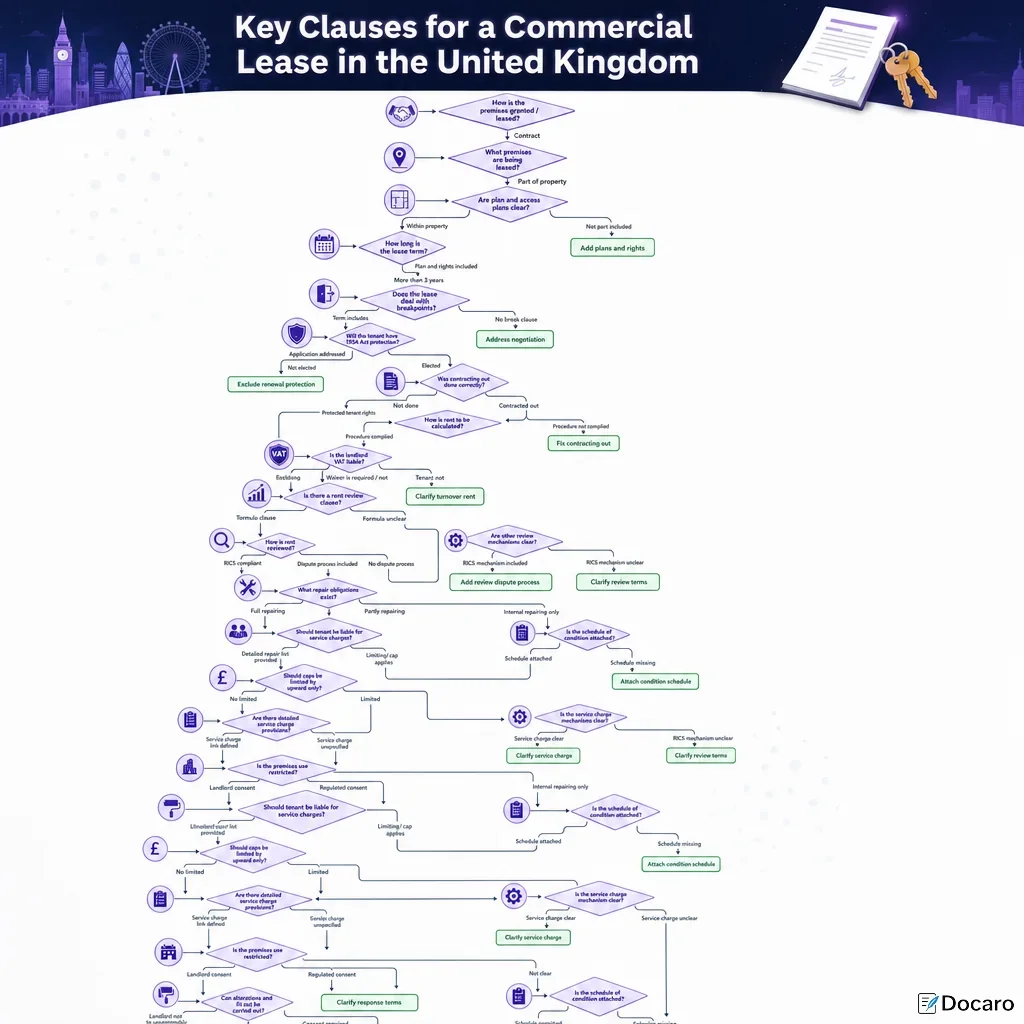
Key commercial lease clauses in the United Kingdom explained for tenants and landlords reviewing essential UK lease terms.
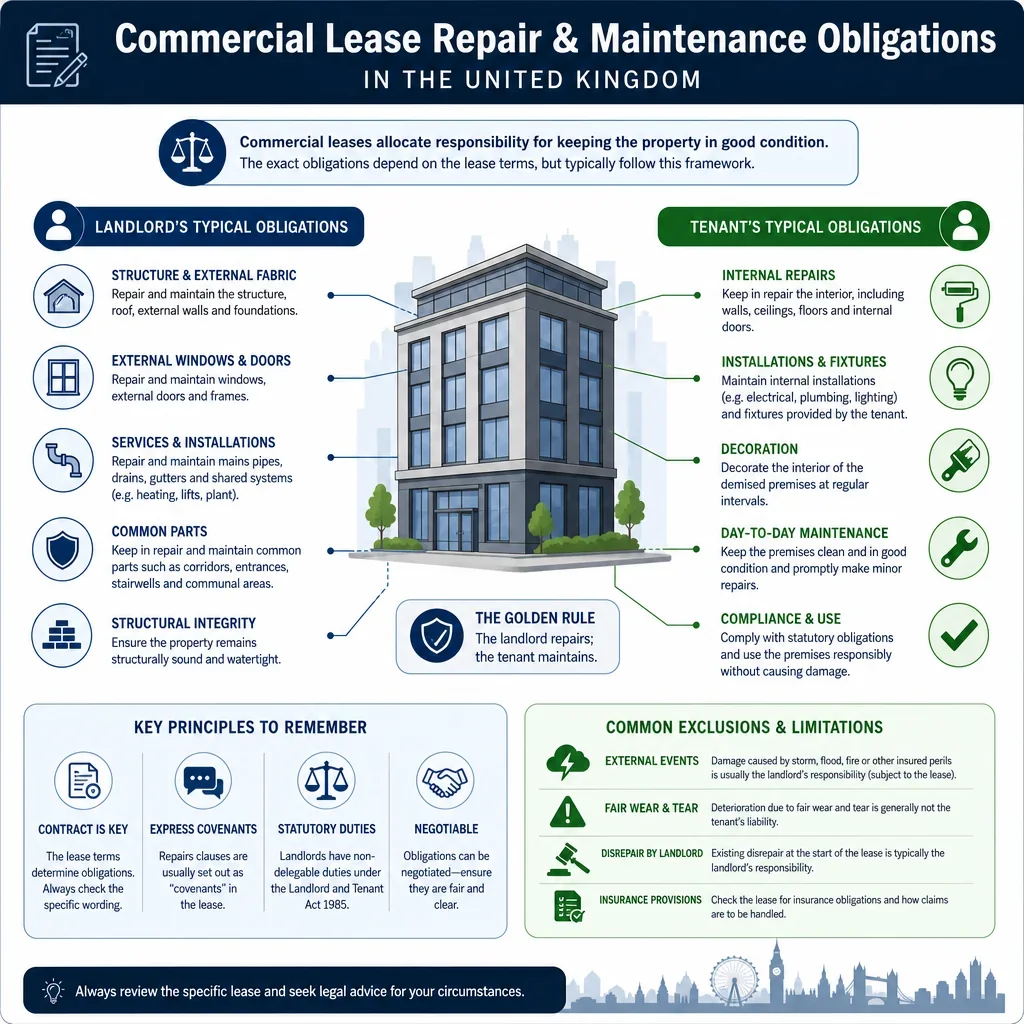
United Kingdom guide to commercial lease repair and maintenance duties for landlords and tenants. Understand key obligations clearly.
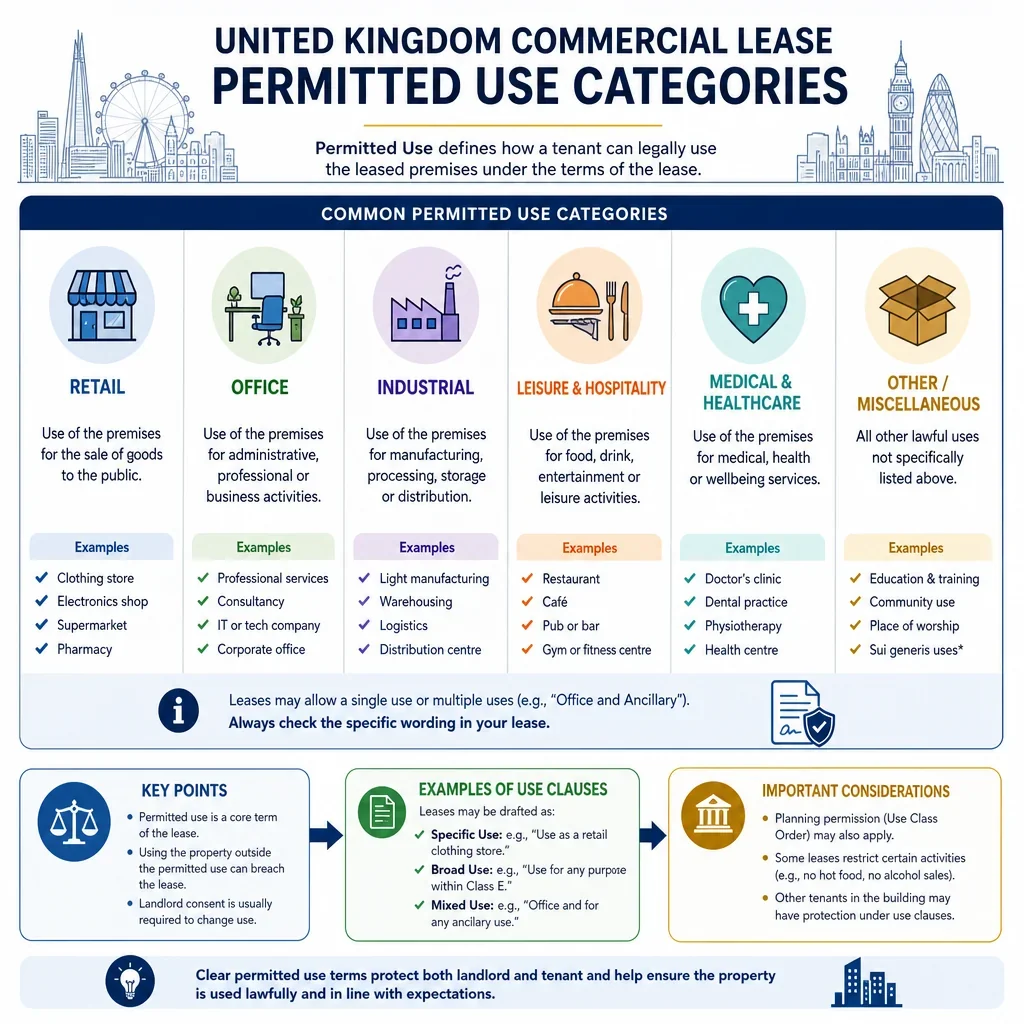
Explore UK commercial lease permitted use categories and how they affect tenancy agreements, tenant rights, and property restrictions.
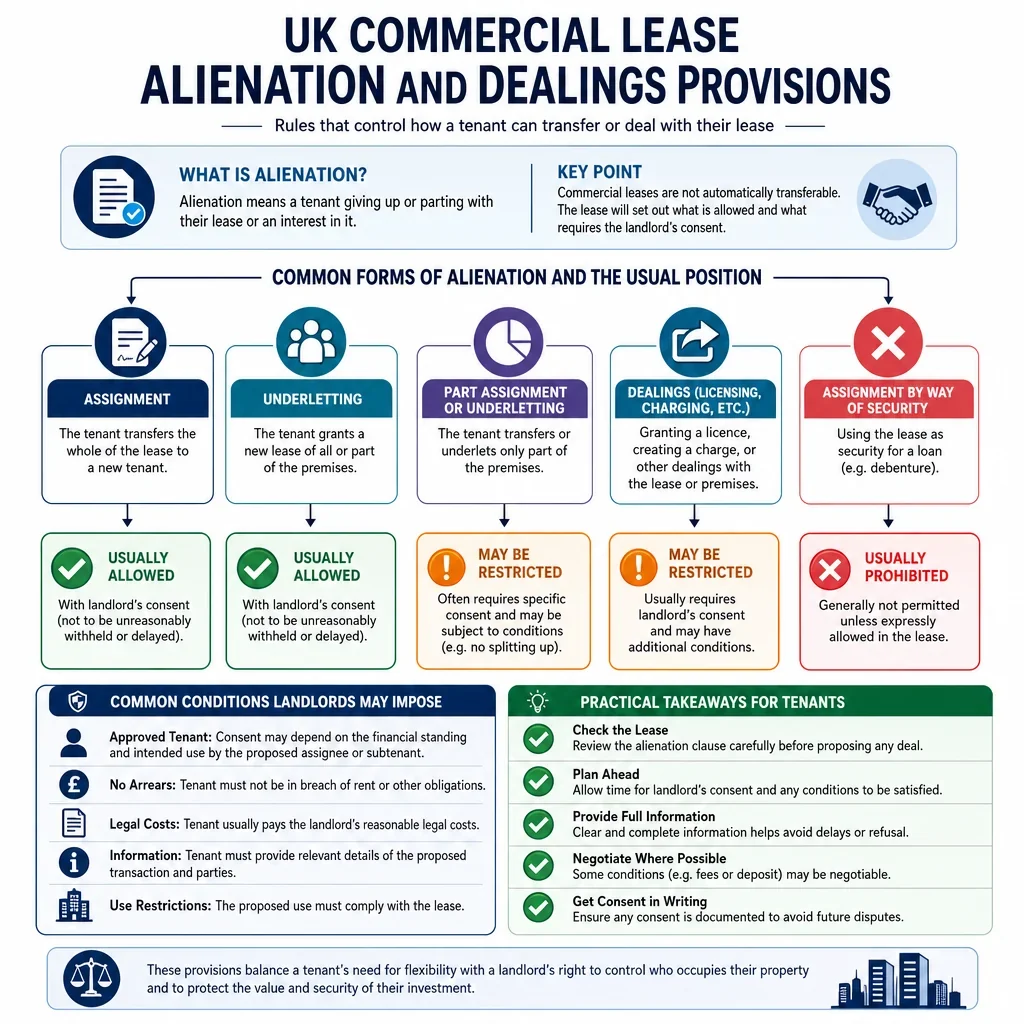
UK guide to commercial lease alienation and dealings provisions, covering assignment, underletting, consent and tenant restrictions.
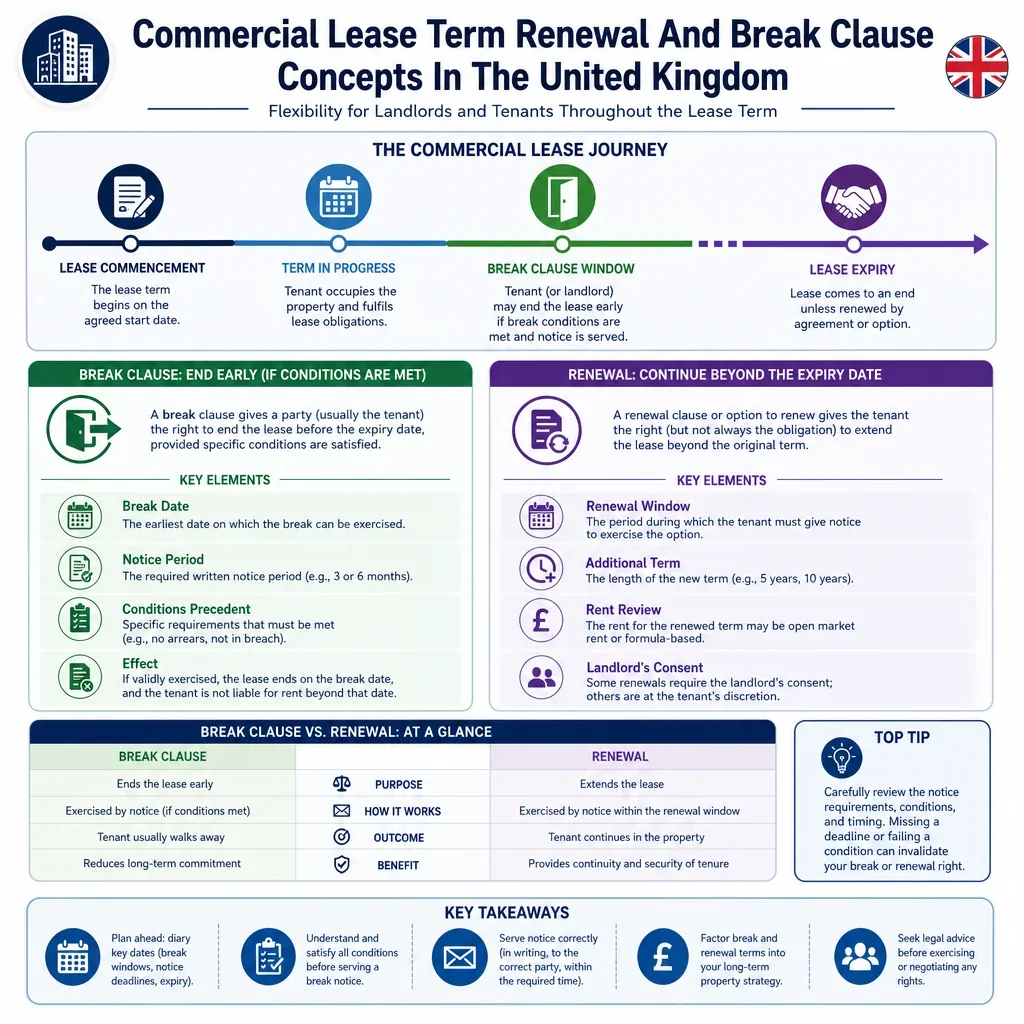
United Kingdom guide to commercial lease renewal terms and break clauses, helping tenants and landlords understand key concepts.
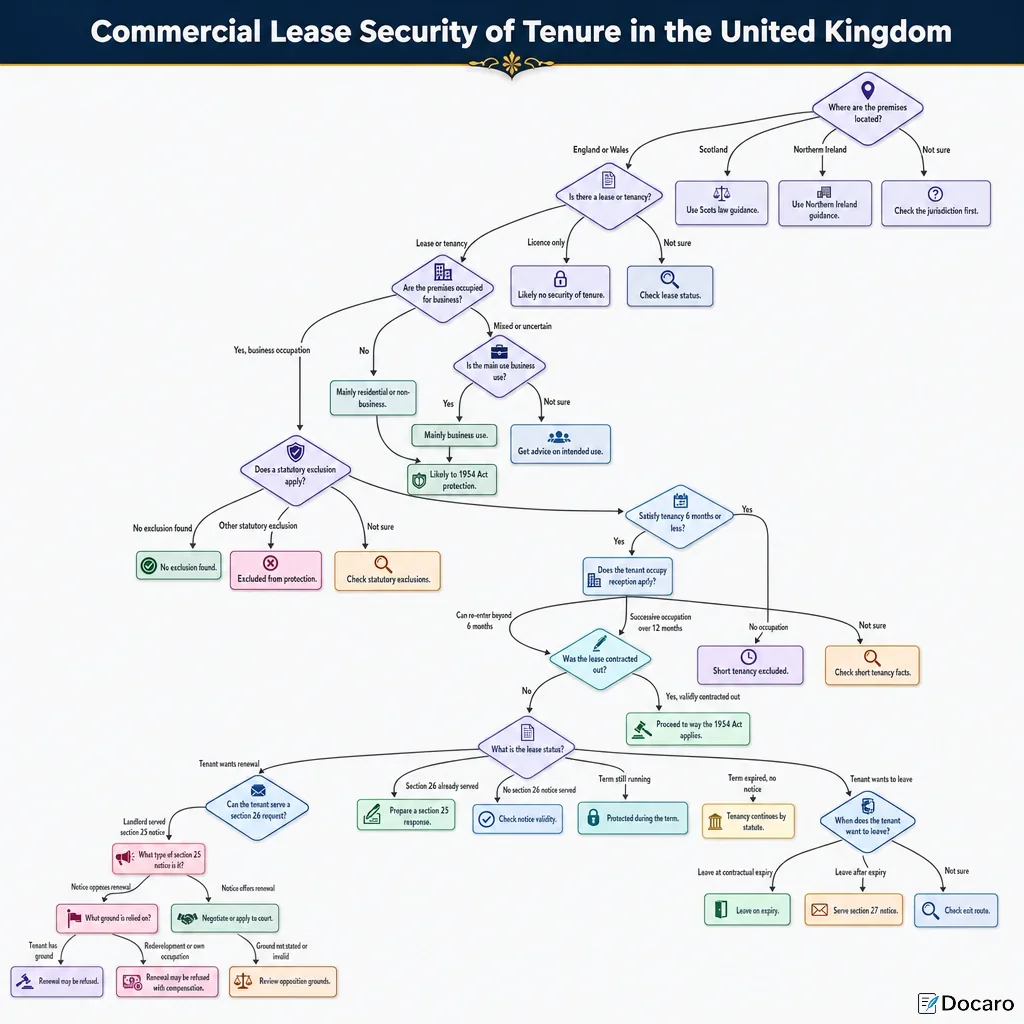
Understand commercial lease security of tenure in the United Kingdom, key rights, exclusions, and practical steps for landlords and tenants.