UK Commercial Lease Alienation And Dealings Provisions
Dealing type | Meaning | Common conditions | Landlord concerns | Tenant concerns |
|---|---|---|---|---|
Allowed with landlord consent | ||||
Assignment of the whole | Transfer of the tenantu0027s entire lease to a new tenant. | Consent required assignee financial strength no arrears AGA may be required deed of assignment. | Loss of covenant strength, arrears, management issues, poor assignee reputation. | Avoiding an absolute bar, delay, unreasonable conditions and continuing liability. |
Usually prohibited | ||||
Assignment of part | Transfer of only part of the demised premises to another party. | If allowed, landlord approval, plan, apportionment of rent, service charge and rights. | Fragmented ownership, enforcement difficulty, valuation impact and estate management problems. | Need for flexibility to dispose of surplus space or sell part of a business. |
Allowed with landlord consent | ||||
Underletting of the whole | Grant of a sublease of all the premises while the tenant remains liable under the headlease. | Consent, underlease in approved form, no premium, market rent, direct covenant by undertenant. | Undertenant quality, underlease terms, rent undercutting and future control of premises. | Ability to mitigate rent exposure without surrendering valuable lease rights. |
Allowed subject to conditions | ||||
Underletting of part | Grant of a sublease of part only of the premises. | Consent, permitted parts only, approved plan, separate access, no security of tenure, market rent. | Multiple occupiers, service charge complexity, security, repair boundaries and redevelopment constraints. | Need to monetise spare space and keep practical sharing arrangements workable. |
Usually prohibited | ||||
Underletting below market rent | Granting a sublease at a rent lower than open market rent. | Lease often requires open market rent and prohibits reverse premiums or rent concessions. | Depressed rental evidence, valuation harm and weakened rent review comparables. | Market may require incentives to secure an undertenant quickly. |
Underletting at a premium | Grant of an underlease where the undertenant pays an upfront premium. | Premiums normally banned landlord may require underlease rent not less than market rent. | Capital value extraction, reduced rent evidence and disguised assignment risk. | May want a premium to recover fit-out or goodwill value. |
Allowed subject to conditions | ||||
Excluded underletting | Sublease contracted out of statutory renewal rights under the Landlord and Tenant Act 1954. | Tenant must follow statutory notice and declaration procedure before grant of the underlease. | Avoiding statutory renewal rights binding the landlord after headlease expiry. | Contracting-out process can delay completion and deter undertenant. |
Allowed with landlord consent | ||||
Charging the lease | Using the lease as security for borrowing by granting a legal charge. | Consent or notice approved lender mortgagee deed compliance with forfeiture notice requirements. | Lender enforcement, priority, delay in forfeiture and unwanted mortgagee control. | Lease must be bankable and acceptable to commercial lenders. |
Allowed subject to conditions | ||||
Equitable charge or debenture | Security over leasehold interest or business assets without full legal mortgage formalities. | Notice to landlord Companies House registration where applicable no transfer of possession. | Hidden security interests, insolvency complications and enforcement by lender. | Need freedom to grant business-wide security without repeated landlord negotiation. |
Usually permitted | ||||
Group company occupation | Occupation by a company in the same corporate group as the tenant. | No tenancy created tenant remains in occupation and liable notice to landlord group link maintained. | Loss of control, weak group occupier and de facto assignment without consent. | Operational flexibility for subsidiaries, parent companies and reorganisations. |
Allowed subject to conditions | ||||
Concession or kiosk occupation | Allowing another business to trade from part of the premises under a concession arrangement. | Consent, written concession agreement, no exclusive possession, brand approval, termination rights. | Unauthorised occupier, brand mismatch, nuisance, insurance and turnover reporting issues. | Need flexibility for retail partnerships and income-generating concessions. |
Business collaborator sharing | Sharing space with a partner, contractor or collaborator without granting a lease. | No exclusive possession, no rent, ancillary use only, tenant remains in control. | Creation of unintended tenancy and difficulty removing the collaborator. | Avoiding breach while allowing flexible commercial collaboration. |
Occupational licence | Permission for another occupier to use space without exclusive possession. | Landlord consent short term personal permission no exclusive possession termination on notice. | Licence being recharacterised as a lease and creating statutory rights. | Keeping licences flexible but legally robust and compliant with headlease. |
Usually permitted | ||||
Employees and contractors occupation | Use of the premises by staff, consultants or contractors working for the tenant. | Occupation must be for tenantu0027s business and under tenantu0027s control. | Security, overcrowding, health and safety and unauthorised separate business use. | Avoiding consent requirements for ordinary workforce and outsourced staff. |
Allowed with landlord consent | ||||
Franchisee occupation | A franchisee operates from the premises using the tenantu0027s brand or business system. | Consent, no tenancy, brand and operator approval, tenant guarantee and step-in rights. | Operator quality, reputational risk and loss of direct covenant control. | Franchise model may be impractical if every franchisee needs full landlord approval. |
Allowed subject to conditions | ||||
Management agreement occupation | Third party manages and operates the premises for the tenant. | No estate granted operator approved tenant retains possession and liability. | Control of operator, compliance failures and disguised assignment. | Need to outsource operations without triggering alienation restrictions. |
Allowed with landlord consent | ||||
Business sale assignment | Assignment of the lease as part of a sale of the tenantu0027s business. | Consent, buyer covenant strength, business sale evidence, AGA and payment of landlord costs. | Buyer creditworthiness and continuity of lease covenant performance. | Landlord delay can jeopardise business sale timetable. |
Intra-group assignment | Transfer of the lease to another company within the same corporate group. | Consent or deemed consent group company covenant parent guarantee no weakening of covenant. | Covenant strip, insolvency planning and transfer to weaker group company. | Corporate reorganisations should not need full market assignment conditions. |
Usually permitted | ||||
Intra-group sharing | A group company uses space without becoming tenant or undertenant. | Notice to landlord, no lease, occupation ends when group relationship ends. | Difficulty monitoring occupiers and preserving direct tenant responsibility. | Need fast internal flexibility without formal alienation process. |
Allowed with landlord consent | ||||
Assignment to connected person | Transfer to a director, partner, LLP member or other connected person. | Consent, financial checks, guarantee, no tax or insolvency avoidance motive. | Artificial transfer to weaker covenant or asset-light vehicle. | Succession planning and professional practice restructuring flexibility. |
Allowed subject to conditions | ||||
Change of control | Change in ownership or control of the tenant company treated like a restricted dealing. | Notice or consent if control changes exceptions for listed companies or group reorganisations. | Backdoor assignment and loss of covenant without formal lease transfer. | May restrict investment, share sale, refinancing or corporate transactions. |
Merger or reconstruction | Lease ownership or occupation changes as part of corporate merger, demerger or reconstruction. | Landlord notice, equivalent covenant strength, guarantees preserved, no arrears. | Covenant dilution and uncertainty over liabilities after restructuring. | Need transactions to proceed without landlord veto over corporate restructuring. |
Allowed with landlord consent | ||||
Insolvency sale assignment | Administrator or liquidator seeks to assign the lease to realise value. | Consent, arrears treatment, assignee covenant strength, AGA where lawful and practical. | Arrears, weak purchaser and reduced control during insolvency moratorium. | Preserving lease value for creditors and business rescue. |
Allowed subject to conditions | ||||
Assignment by operation of law | Lease transfers automatically under law, such as on death, insolvency or statutory vesting. | Notice to landlord successor must observe covenants registration if title is registered. | Unknown successor and uncertain covenant strength. | Successors need continuity without breaching alienation provisions. |
Usually prohibited | ||||
Declaration of trust | Tenant declares it holds the lease for another beneficial owner. | If permitted, landlord consent and full disclosure of beneficial owner. | Hidden ownership, enforcement uncertainty and anti-money laundering risk. | May need trust structure for investment or partnership arrangements. |
Parting with possession | Giving another person control or possession of the premises or part of them. | Only permitted through expressly allowed assignment, underletting, sharing or licence routes. | Loss of control and unauthorised occupier acquiring rights. | Broad wording may catch ordinary commercial arrangements. |
Allowed subject to conditions | ||||
Sharing possession | Tenant and another occupier both use premises, potentially with shared control. | Tenant must retain possession and control no exclusive possession for sharer. | Blurring between permitted sharing and unauthorised subletting. | Need clear carve-outs for normal co-working or operational sharing. |
Allowed with landlord consent | ||||
Exclusive room or desk occupation | Giving another occupier exclusive use of defined desks, rooms or suites. | Use licence carefully avoid exclusive possession unless an underlease is approved. | Arrangement may be a lease despite being called a licence. | Co-working income may require certainty for occupiers. |
Serviced office or co-working | Tenant allows multiple flexible occupiers to use space with services. | Express permission, occupier rules, no security of tenure, insurance and compliance controls. | High churn, building security, services load and statutory occupier rights. | Business model needs broad alienation and sharing rights. |
Allowed subject to conditions | ||||
Storage licence | Allowing a third party to store goods at the premises. | No occupation rights, no hazardous goods, insurance, compliance with permitted use. | Fire risk, insurance breach, nuisance and prohibited use. | Logistics and fulfilment arrangements may require third-party storage access. |
Allowed with landlord consent | ||||
Telecoms or equipment licence | Allowing third-party apparatus, plant or equipment on the premises. | Consent, no code rights without landlord approval, removal obligations and reinstatement. | Electronic communications code rights, access, interference and removal difficulty. | Need connectivity and operational equipment without excessive consent hurdles. |
Advertising licence | Granting rights for a third party to place adverts or signage at the premises. | Consent, planning compliance, design approval, no estate or exclusive possession. | Planning breach, appearance, nuisance and brand incompatibility. | Monetising frontage or enabling sponsor and partner branding. |
Allowed subject to conditions | ||||
ATM or vending machine licence | Allowing another operator to place and service machines at the premises. | Consent, no tenancy, service access, insurance, utilities and removal obligations. | Security, customer flow, utilities, damage and competing estate policy. | Ancillary services may improve customer experience and revenue. |
Allowed with landlord consent | ||||
Pop-up occupation | Short-term occupation by a temporary trader, brand or event operator. | Short-form licence, consent, no exclusive possession, use limits, insurance and reinstatement. | Reputational risk, nuisance, safety, insurance and unintended tenancy. | Need quick approvals for seasonal or promotional arrangements. |
Assignment to shell company | Transfer to a newly incorporated, dormant or asset-light company. | Consent commonly refused or conditioned on guarantee, rent deposit or stronger security. | No trading history, weak covenant and high default risk. | Start-up buyers may need guarantees rather than outright rejection. |
Allowed subject to conditions | ||||
Authorised guarantee agreement | Outgoing tenant guarantees the immediate assigneeu0027s lease obligations after assignment. | May be required where reasonable and permitted by the lease and 1995 Act. | Preserving covenant strength after tenant release on assignment. | Continuing guarantee liability can undermine the commercial benefit of assignment. |
Guarantor on assignment | A third party guarantees the assigneeu0027s obligations as a condition of assignment. | Required if assignee covenant is weak guarantee deed approved by landlord. | Ensuring enforceable security if assignee defaults. | Buyer may resist providing guarantor, delaying disposal. |
Rent deposit on assignment | Cash security provided by assignee as a condition of consent. | Deposit deed, minimum amount, top-up obligations and release tests. | Protection against weak covenant and early default. | Additional security may reduce purchaser appetite or price. |
Consent costs undertaking | Tenant pays landlordu0027s legal and surveyor costs for dealing consent. | Costs must usually be reasonable and properly incurred under lease wording. | Avoiding unrecovered professional costs from reviewing applications. | Open-ended costs can make small transactions uneconomic. |
Allowed with landlord consent | ||||
Reasonable consent duty | Qualified alienation covenants are read as requiring consent not to be unreasonably withheld. | Applies to licences or consents to assign, underlet, charge or part with possession. | Refusal reasons must be reasonable and defensible. | Tenant needs evidence and a clear application to trigger protections. |
Consent application timing | Landlord must give consent except where reasonable not to, and respond within a reasonable time. | Written application landlord must serve written notice of decision and reasons if refusing. | Delay or inadequate reasons can create damages exposure. | Needs a complete written request and evidence to avoid consent timetable disputes. |
Usually prohibited | ||||
Absolute prohibition | Lease bans a dealing completely, with no right to request consent. | No consent mechanism unless landlord voluntarily agrees to vary or waive the covenant. | Maximum control over occupiers and lease ownership. | No statutory reasonableness protection if there is no consent right. |
Allowed with landlord consent | ||||
Qualified covenant | Dealing is prohibited unless landlord consent is obtained. | Consent not to be unreasonably withheld where statutory rules apply. | Need to retain discretion while avoiding unreasonable refusal. | Consent process may still cause cost and delay. |
Fully qualified covenant | Dealing requires consent, which must not be unreasonably withheld or delayed. | Lease expressly states consent not to be unreasonably withheld or delayed. | Less discretion to refuse for commercial preference alone. | Still needs clear deemed consent or timing controls if urgency matters. |
Allowed subject to conditions | ||||
Deemed consent mechanism | Consent is treated as given if landlord does not respond within a set period. | Complete application, reminders, fixed response period and specified information requirements. | Accidental consent through administrative delay. | Valuable protection against stalled assignments or underlettings. |
Landlord pre-emption right | Tenant must first offer surrender or underlease opportunity to landlord before dealing. | Offer notice, response period, matching terms and release if landlord declines. | Opportunity to recover premises for reletting or redevelopment. | Can delay market disposal and weaken negotiating position. |
Surrender as alternative | Tenant gives up the lease to the landlord instead of transferring it to another party. | Landlord agreement, deed of surrender, payment terms and release of liabilities. | Vacancy risk, dilapidations, arrears and reletting costs. | May need premium payment but gives cleaner exit than assignment. |
Registration of assignment or charge | Certain lease transfers and legal charges must be completed by registration at HM Land Registry. | Post-completion registration, notice to landlord and compliance with title restrictions. | Ensuring title records and notices reflect the current tenant or mortgagee. | Unregistered dealing may be incomplete or breach lease notice requirements. |
Notice of assignment or charge | Formal notice to landlord after a permitted assignment or charge. | Notice within lease deadline, copy deed, registration fee and address for service. | Knowing who is liable and where notices should be served. | Missing notice deadline may create technical breach. |
Land Registry restriction compliance | A title restriction may require landlord certificate or consent before registration of a dealing. | Provide certificate of compliance, consent evidence or restriction consent form. | Preventing registration of unauthorised assignments or charges. | Registration can fail if consent evidence is not planned early. |
Security of tenure underletting | Undertenant may gain statutory renewal rights unless the underlease is contracted out. | Headlease often requires underlease to be excluded from 1954 Act protection. | Undertenant rights may survive or complicate recovery of possession. | Exclusion may make underletting less attractive to potential undertenant. |
Underlease term length | Length of any sublease granted by the tenant. | Must expire before headlease term, often by at least a few days. | Avoiding underlease surviving or conflicting with headlease expiry. | Short remaining term may make underletting difficult. |
Underlease rent review alignment | Matching underlease rent review pattern with the headlease. | Same review dates and upwards-only basis no terms undermining headlease rent review. | Protecting rental evidence and avoiding inconsistent rent review assumptions. | Market undertenant may resist headlease-style rent review terms. |
Direct covenant by undertenant | Undertenant covenants directly with landlord to observe underlease and headlease controls. | Deed of covenant before underlease completion landlord may enforce key obligations. | Need direct enforcement against occupier in control of premises. | Undertenant may resist direct landlord obligations. |
Alienation in underlease | Restrictions on the undertenant assigning, underletting or sharing its underlease. | Underlease must contain restrictions at least as strict as the headlease. | Preventing uncontrolled sub-subletting and occupier fragmentation. | Overly strict terms may reduce underletting marketability. |
Permitted part underletting | Lease allows underletting only of specified whole floors, units or lettable areas. | No arbitrary divisions approved plans separate access and services if required. | Avoiding impractical layouts and service charge disputes. | Need enough flexibility to underlet genuinely surplus areas. |
Multiple underlettings | Tenant grants more than one sublease of different parts. | Limit on number of underleases landlord approval for layout and management regime. | Estate management, security, service load and redevelopment inflexibility. | Large premises may require several subtenants to manage cost exposure. |
Assignment where arrears exist | Tenant seeks to assign while rent, service charge or other sums are unpaid. | Payment of arrears before completion is commonly required. | Recoverability of existing debt and default risk. | Cashflow issues may make arrears clearance difficult before disposal. |
Assignment with subsisting breach | Tenant seeks to assign despite unresolved lease breaches. | Breach remedy, undertaking, retention or landlord-approved works before completion. | Historic breach becoming harder to enforce after transfer. | Disputes over breach may delay or block assignment. |
Usually prohibited | ||||
Unauthorised assignment | Tenant transfers the lease without required landlord consent. | May require retrospective consent landlord may reserve rights and seek remedies. | Breach, unknown tenant and enforcement of forfeiture rights. | Risk of forfeiture, damages and registration problems. |
Unauthorised underletting | Tenant grants a sublease without required landlord consent. | Retrospective licence, breach remedy, direct undertenant covenant or termination. | Unapproved occupier, statutory rights and breach management. | May face forfeiture, costs and need to unwind underlease. |
Allowed subject to conditions | ||||
Waiver after breach | Landlord conduct may waive the right to forfeit for an alienation breach. | Landlord may reserve rights and avoid demanding rent after knowledge of breach. | Accidentally losing forfeiture remedy. | Uncertainty while landlord decides whether to waive or enforce. |
Relief from forfeiture | Court may relieve tenant from forfeiture after breach, including alienation breach. | Tenant usually must remedy breach if capable and pay compensation and costs. | Forfeiture may not produce immediate possession if relief is granted. | Relief is uncertain, costly and not a substitute for consent. |
Allowed with landlord consent | ||||
Assignment to different use occupier | Assignee wants to use premises for a different use than permitted by the lease. | Consent to assignment and separate consent to change of use may both be needed. | Planning, estate mix, nuisance, insurance and value impact. | Buyer may require use flexibility before taking assignment. |
Underletting for different use | Undertenant proposes a use different from tenantu0027s permitted use. | Landlord consent, planning compliance and use covenant variation if needed. | Change in character, nuisance, planning enforcement and insurance premium increases. | Narrow use clauses reduce underletting market. |
Allowed subject to conditions | ||||
Dealing with competitor | Assignment, underletting or sharing with a business competing with landlord or estate occupiers. | Estate exclusivity, tenant mix and prohibited occupier restrictions may apply. | Breach of exclusivity promises and adverse tenant mix. | Competitor restrictions can narrow disposal market significantly. |
Shopping centre tenant mix restriction | Landlord controls assignments or underlettings to protect centre tenant mix. | Consent may consider trade type, brand standard, opening hours and exclusivity commitments. | Maintaining footfall, retail balance and existing occupier covenants. | Restrictions may make assignment or underletting harder in weak retail markets. |
Allowed with landlord consent | ||||
Assignment of short-term lease | Transfer of a lease with a short remaining term. | Consent, no arrears, assignee covenant checks and notice after completion. | Limited time to assess assignee and manage expiry obligations. | Consent cost may be disproportionate to remaining lease value. |
Assignment of valuable long lease | Transfer of a long leasehold interest with capital value. | Consent, title investigation, registration, lender requirements and landlord certificate. | Compliance with estate covenants and preserving reversion value. | Alienation restrictions affect marketability and financing value. |
Public body sharing | Occupation by a public authority, NHS body, charity or similar service provider. | Consent, use compliance, safeguarding, access, insurance and no tenancy unless approved. | Public access, security, use intensity and reputational issues. | Community or service delivery partnerships may need occupation flexibility. |
Charity occupier arrangement | Charity occupies or shares premises under licence, concession or underlease. | Consent, use approval, insurance, no tenancy unless expressly granted. | Use class, brand fit, public access and covenant strength. | Charitable projects may need low-cost flexible occupation. |
Industrial third-party operation | Third party operates warehousing, manufacturing or logistics from part of premises. | Consent, health and safety controls, environmental compliance, no exclusive possession unless underlet. | Contamination, machinery, nuisance, insurance and regulatory compliance. | Operational outsourcing and logistics partnerships may be essential. |
Allowed subject to conditions | ||||
Data centre customer rights | Customers place servers or equipment in racks or suites within data centre premises. | Express carve-out for customer equipment, access rights, no tenancy, security rules. | Security, resilience obligations, access control and unintended occupational rights. | Core business requires customer access and equipment hosting rights. |
Allowed with landlord consent | ||||
Hotel or leisure operator arrangement | Third party operates hotel, gym, restaurant or leisure facility at the premises. | Operator approval, brand standard, no tenancy unless approved, performance obligations. | Brand risk, licensing, nuisance, covenant performance and building reputation. | Management or operating model may depend on specialist operator. |
Dark kitchen sharing | Another food operator uses kitchen space for delivery or preparation. | Consent, food safety compliance, extraction approval, insurance and no exclusive possession. | Odour, fire risk, deliveries, nuisance and regulatory compliance. | Delivery partnerships may be key to restaurant profitability. |
Allowed subject to conditions | ||||
Medical room sessional use | Clinicians or therapists use rooms for sessions without taking a lease. | No exclusive possession, regulatory compliance, insurance, safeguarding and appointment-only access. | Patient access, regulatory risk, waste, insurance and building suitability. | Sessional professionals need flexible room rights without underlease formalities. |
Educational room hire | Third party hires rooms for classes, training or events. | Short-term hire terms, no exclusive possession, safeguarding, insurance and permitted use compliance. | Public access, noise, safety, safeguarding and use intensity. | Room hire may be important ancillary income. |
Event hire | Temporary use by third parties for events, exhibitions or functions. | Consent if required, no tenancy, capacity limits, licences, insurance and reinstatement. | Noise, crowd control, alcohol licensing, damage and neighbour complaints. | Need practical flexibility for occasional events without full alienation consent. |
Car parking licence | Tenant permits another person to use parking spaces included in the lease. | No exclusive possession beyond licence, vehicle rules, insurance and estate regulations. | Estate control, security, obstruction and unauthorised commercial parking. | May want to allocate unused spaces to staff, visitors or neighbouring occupiers. |
Allowed with landlord consent | ||||
Mortgagee enforcement transfer | Lease is transferred by lender or receiver after enforcing security. | Consent, compliance with charge documents, assignee approval and notice to landlord. | Unwanted purchaser and enforcement process overriding ordinary dealings. | Lenders require workable enforcement routes for leasehold security. |
Sale and leaseback of long lease | Tenant sells leasehold interest to investor and takes back occupational underlease. | Consent to assignment and underlease, covenant approval, registration and direct covenants. | Investor covenant, occupational structure and enforcement complexity. | Important financing route may be blocked by strict alienation clauses. |
Joint venture occupation | Joint venture company or partner uses the premises with the tenant. | Consent, no tenancy unless approved, tenant control, liability and termination when JV ends. | Occupier control, covenant strength and business continuity if JV fails. | Commercial collaborations may require shared premises access. |
Allowed subject to conditions | ||||
Agent or distributor occupation | Agent, distributor or sales partner operates from tenantu0027s premises. | No exclusive possession, ancillary to tenant business, compliance with use and insurance. | Separate business use and loss of control over occupier conduct. | Sales and distribution channels may need on-site presence. |
Brand licensee occupation | Brand licensee uses premises to sell or demonstrate licensed products. | Consent, brand approval, no tenancy, use compliance and tenant liability. | Brand conflict, reputation and customer-facing control. | Commercialising brand partnerships may require occupier access. |
Allowed with landlord consent | ||||
Short-stay guest occupation | Guests occupy premises or units temporarily as serviced accommodation. | Express use rights, planning compliance, no tenancy, guest terms, insurance and management rules. | Planning, nuisance, security, wear and tear and building reputation. | Hospitality model needs guest occupation not treated as prohibited sharing. |
Usually prohibited | ||||
Short-term holiday letting | Letting premises or units for very short-term visitor stays. | Only allowed if lease use, planning, insurance and building rules expressly permit. | Security, nuisance, planning breach and rapid occupier turnover. | Can be high-value but often conflicts with commercial lease controls. |
Allowed subject to conditions | ||||
Underletting with side letter | Tenant grants an underlease plus side concessions to the undertenant. | Side letter disclosure no rent concession or terms breaching headlease restrictions. | Hidden concessions undermining market rent and covenant control. | Commercial incentives may be necessary to secure undertenant. |
Reverse premium on assignment | Outgoing tenant pays assignee to take the lease. | Lease may restrict incentives landlord may assess assignee covenant and commercial reality. | Signals over-rented lease, weak assignee or default risk. | May be essential to exit an onerous lease. |
Usually prohibited | ||||
Transfer of ancillary rights | Separately transferring rights such as storage, parking, signage or access. | Usually only transferable with the lease or with landlord consent. | Estate rights becoming detached from occupational interest. | May want to monetise unused rights or support neighbouring premises. |
Allowed subject to conditions | ||||
Shared access rights | Allowing another occupier or business to use access routes serving the premises. | Consent, no obstruction, security, compliance with estate regulations and indemnity. | Security, congestion, safety and interference with other occupiers. | Operational collaboration may require third-party access. |
Personal permission only | Permission is personal and does not create a lease, assignment or proprietary right. | No exclusive possession, terminable permission, tenant remains in control. | Substance may override label if exclusive possession exists. | Needs drafting that reflects practical control, not just licence wording. |
Allowed with landlord consent | ||||
Licence to assign | Formal landlord deed consenting to an assignment. | Execution by landlord, tenant, assignee and guarantors completion deadline. | Capturing conditions, costs, AGA and release terms clearly. | Licence negotiation may delay completion and increase costs. |
Licence to underlet | Formal landlord deed consenting to grant of an underlease. | Approved underlease form, direct covenant, contracting-out steps and completion deadline. | Ensuring underlease does not undermine headlease controls. | Documentation burden may be heavy for small underlettings. |
Licence to charge | Formal landlord consent to mortgage or charge the lease. | Approved chargee, notice arrangements, cure rights and restrictions on possession. | Mortgagee rights interfering with landlord remedies. | Lender may require consent as condition of funding. |
Reassignment to original tenant | Lease is transferred back to a previous tenant. | Consent, covenant assessment, release and guarantee implications checked. | Effect on existing guarantees and prior releases. | Historic liabilities and guarantees may revive or remain complex. |
Allowed subject to conditions | ||||
Assignment to guarantor | Lease is assigned to the tenantu0027s guarantor or former guarantor. | Needs careful 1995 Act analysis direct guarantor assignment may be problematic. | Guarantee structure may be invalid or release liabilities unexpectedly. | Complex structuring may delay assignment or rescue transactions. |
Allowed with landlord consent | ||||
Old tenancy assignment liability | Pre-1996 leases may retain different continuing liability rules after assignment. | Check whether lease is an old or new tenancy under the 1995 Act. | Preserving recovery against original tenant where legally available. | Original tenant may remain liable long after assignment under old leases. |
New tenancy release on assignment | For new tenancies, tenant is generally released from covenants when assigning. | Release subject to any valid AGA or excluded arrangements. | Outgoing tenant release increases reliance on assignee covenant and AGA. | Tenant wants clean release and narrow AGA obligations. |
Usually prohibited | ||||
Residential occupation within commercial premises | Allowing someone to live at commercial premises or mixed-use space. | Only if use, planning, building insurance and housing law position permit. | Planning breach, insurance, statutory residential rights and safety obligations. | Caretaker or live-work needs require express drafting. |
Allowed subject to conditions | ||||
Caretaker or security staff occupation | Employee occupies part of premises for security or operational purposes. | Service occupancy only, tied to employment, no tenancy, planning and safety compliance. | Creation of residential rights and regulatory obligations. | Operational security may require on-site staff accommodation. |
Allowed with landlord consent | ||||
Underletting to connected company | Tenant grants an underlease to a group or connected company. | Market rent, proper underlease form, direct covenant and no artificial weakening. | Artificial rent setting and covenant manipulation within the group. | Internal occupation may not justify full external underletting conditions. |
Assignment to overseas entity | Lease is transferred to a company or entity incorporated outside the UK. | Consent, financial information, UK process agent, guarantee and registration compliance. | Enforcement difficulty, transparency, sanctions and covenant assessment. | International buyers may face extra due diligence and timing issues. |
Allowed subject to conditions | ||||
Overseas entity registration issue | Overseas entities dealing with UK registered land may need registration and ID compliance. | Register of Overseas Entities compliance before registrable dispositions where applicable. | Invalid or delayed registration and transparency risks. | Completion may be delayed if overseas entity requirements are not met. |
Allowed with landlord consent | ||||
Assignment to SPV | Lease is transferred to a special purpose vehicle set up for one transaction. | Parent guarantee, rent deposit, financial support evidence and business plan. | Asset isolation and weak standalone covenant. | Common investment structures may need acceptable security package. |
Allowed subject to conditions | ||||
Occupation during administration | Administrator allows trading, sale or third-party occupation while company is in administration. | Administrator powers, landlord consent if alienation occurs, court or moratorium issues checked. | Rent priority, inability to forfeit without consent or court permission, occupier control. | Business rescue may need rapid trading or disposal arrangements. |
Floating charge over company assets | Company grants security over assets, potentially including leasehold interests. | Companies House charge registration lease may require notice or consent if lease specifically charged. | Security may affect insolvency and enforcement strategy. | General corporate financing should not be unintentionally blocked. |
Utility operator occupation | Utility provider uses space for meters, substations, pipes or apparatus. | Landlord consent, statutory powers checked, access rights, removal and reinstatement. | Permanent apparatus, access rights and development constraints. | Utility infrastructure may be necessary for the premises to function. |
Allowed with landlord consent | ||||
Wayleave or easement grant | Granting rights for cables, pipes, access or services over leasehold land. | Landlord consent, no permanent burden beyond lease term, plans and reinstatement. | Encumbrances on reversion and development restrictions. | May need rights for connectivity, utilities or neighbouring operational land. |
Rooftop or airspace licence | Allowing equipment, solar panels, telecoms or advertising on roof or airspace. | Structural approval, planning, access, insurance, removal and no code rights unless agreed. | Structural risk, access, development constraints and statutory telecoms rights. | Energy, telecoms or advertising revenue may depend on rooftop rights. |
Solar panel operator rights | Third party installs or operates solar panels at the premises. | Consent, roof rights, power purchase terms, repair access, removal and reinstatement. | Roof integrity, repair access, title burden and redevelopment limits. | Energy savings may require long-term third-party equipment rights. |
Usually permitted | ||||
Customer access | Customers, clients or visitors enter premises for the tenantu0027s ordinary business. | Use must remain within permitted use and tenant control. | Overcrowding, nuisance, public access risks and use intensity. | Alienation wording should not accidentally restrict normal customer access. |
Allowed subject to conditions | ||||
Contractor site compound | Contractor uses part of premises for works storage, welfare or site management. | Works consent, temporary licence, health and safety, insurance and reinstatement. | Damage, safety, nuisance and duration creep. | Fit-out and repair projects need contractor occupation rights. |
Superior landlord consent | Tenantu0027s landlord needs consent from its own superior landlord before approving a dealing. | Application must satisfy both headlease and superior lease consent requirements. | Breach of superior lease and inability to give effective consent alone. | Extra consent layer can increase time, cost and uncertainty. |
Headlease covenant flow-down | Underlease requires undertenant to comply with relevant headlease covenants. | Underlease incorporates use, repair, alterations, insurance and regulations obligations. | Ensuring actual occupier observes estate controls. | Tenant remains liable if undertenant breaches headlease obligations. |
Usually permitted | ||||
Professional adviser access | Lawyers, accountants, surveyors or consultants attend premises for tenant business. | Access ancillary to tenant business and under tenant control. | Usually low, unless access becomes separate occupation. | Should not need alienation consent for ordinary professional visits. |
Delivery and logistics access | Couriers, delivery partners or fulfilment providers access premises for tenant operations. | Access ancillary to permitted use, no storage occupation unless approved. | Traffic, obstruction, security and nuisance. | Modern retail and logistics need routine third-party access. |
What Alienation Clauses Should A UK Commercial Lease Cover?
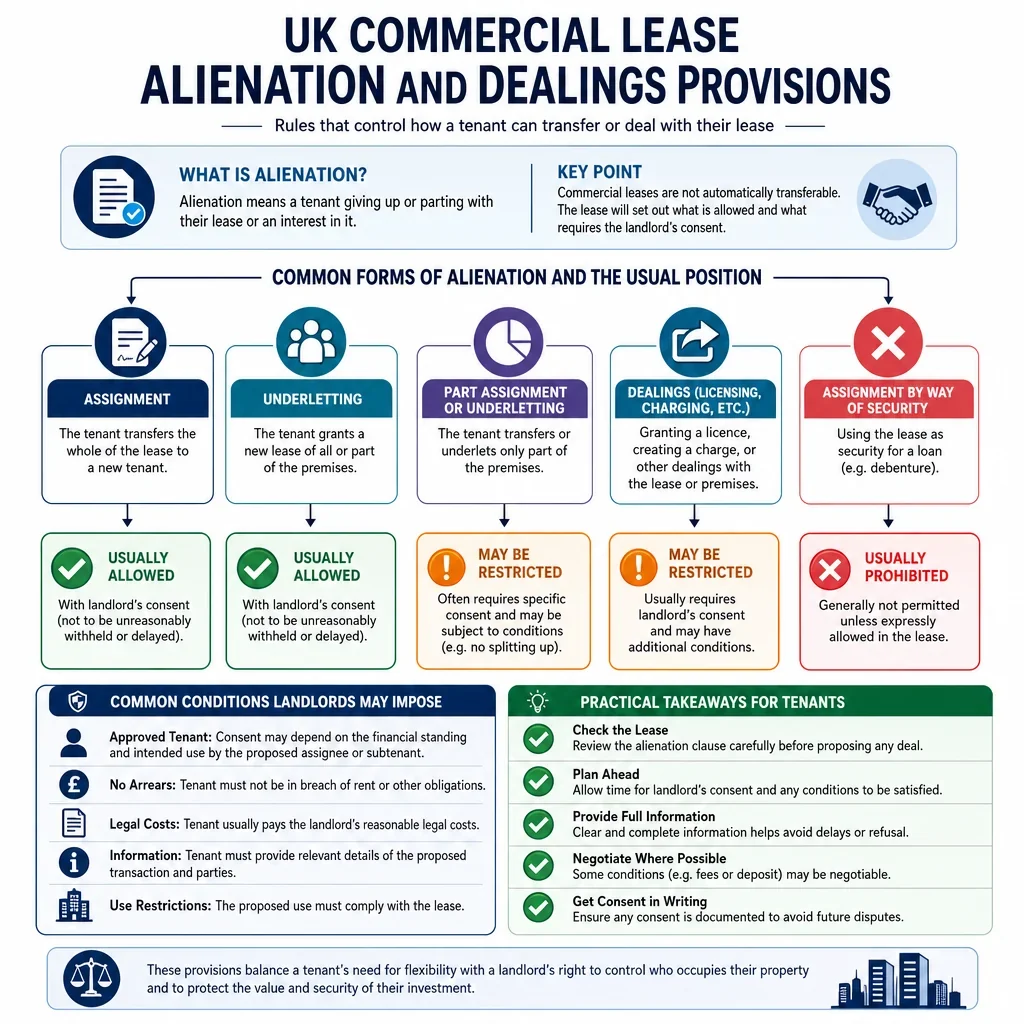
A commercial lease should separate assignment, underletting, charging, sharing occupation and group company occupation, because each dealing creates different risks for the landlord and different flexibility needs for the tenant.
When Can A Landlord Refuse Consent To Dealings?
Where the lease requires consent to assignment, underletting or charging, the landlord is commonly subject to statutory controls requiring consent not to be unreasonably withheld and, for qualifying applications, to be given within a reasonable time. Conditions should therefore be clear, objective and linked to the landlord\u0027s legitimate property, financial and management concerns.
Which Dealings Are Most Negotiated?
- Assignment of the whole is commonly allowed with consent, often subject to financial tests, authorised guarantee agreements and compliance with lease covenants.
- Underletting of part is more sensitive than underletting of the whole because it can fragment occupation, create management issues and affect future redevelopment.
- Sharing occupation and group company occupation are often permitted only if no tenancy is created, occupation is temporary or ancillary, and the original tenant remains fully liable.
- Charging the lease is usually permitted with consent or notice, but landlords often require any mortgagee to respect forfeiture, notice and priority arrangements.
What Should Tenants Check Before Signing?
Tenants should check whether the lease gives enough exit and restructuring flexibility. Absolute bans on assignment, underletting, sharing, group occupation or intra-group transfers can materially reduce the value and usefulness of the premises, especially for growing businesses, group structures, franchise models and tenants expecting to fund, sell or reorganise their business.
FAQs
You Might Also Be Interested In