United Kingdom Commercial Lease Heads Of Terms Checklist
Heads of terms item | Information required | Information source | Risk if unclear | Example questions |
|---|---|---|---|---|
Parties and premises | ||||
Parties | Full legal names, company numbers, registered offices, trading names and signatories. | Both parties | Wrong party may be bound or lease may need correction before completion. | Who is the landlord? Who is the tenant? Are they companies, individuals, trustees or a partnership? |
Landlord title and capacity | Title number, ownership basis, superior lease details and power to grant the lease. | Professional adviser | Lease may breach title restrictions or require superior landlord or lender consent. | What is the title number? Is the landlord freeholder or tenant? Are any consents needed? |
Tenant status and covenant strength | Tenant identity, accounts position, group structure, guarantor need and insolvency history. | Landlord | Landlord may accept inadequate security or later delay completion for checks. | Does the tenant need a guarantor, rent deposit or parent company support? |
Financial terms | ||||
Guarantor | Guarantor name, relationship to tenant, guarantee scope and duration. | Both parties | Security may be unenforceable or wider than commercially agreed. | Who guarantees the tenant obligations? Does the guarantee cover renewals, assignments and arrears? |
Rights and restrictions | ||||
Authorised guarantee agreement | Whether outgoing tenant must give an AGA on assignment and any guarantor support. | Landlord | Assignment provisions may not reflect intended post-assignment liability. | Will an outgoing tenant be required to guarantee the immediate assignee? |
Parties and premises | ||||
Premises address | Postal address, unit number, floor, building, estate and postcode. | Landlord | Lease may identify the wrong property or omit estate elements. | What exact address and unit is being let? Is it part of a larger building or estate? |
Lease plan | Accurate plan showing demise, boundaries, access, shared areas and excluded areas. | Professional adviser | Boundary, access and repair disputes registration requisitions for registrable leases. | Is there a Land Registry compliant plan? What is included and excluded? |
Extent of demise | Whether structure, roof, foundations, windows, shopfront, plant and voids are included. | Landlord | Repair, insurance and alteration obligations may attach to unintended areas. | Does the demise include the structure, roof, plant, services or only internal surfaces? |
Floor area and measurement basis | Area, measurement standard, measured survey date and whether rent depends on area. | Professional adviser | Rent, service charge apportionment and valuation assumptions may be disputed. | What is the floor area? Is it measured on NIA, GIA or another basis? |
Rights and restrictions | ||||
Common parts | Shared entrances, lifts, stairs, yards, toilets, loading areas and management rules. | Landlord | Tenant may lack necessary access or landlord may lack management control. | Which parts are shared? Are there building or estate regulations? |
Rights granted to tenant | Access, services, support, signage, parking, loading, bin storage and emergency rights. | Both parties | Tenant may be unable to operate or landlord may grant excessive rights. | What rights does the tenant need to use and operate from the premises? |
Rights reserved to landlord | Entry, inspection, repair, redevelopment, service media access and neighbouring works rights. | Landlord | Landlord may be unable to manage, repair or redevelop retained property. | What access and works rights must the landlord retain? |
Existing easements and third-party rights | Known rights of way, service rights, covenants, restrictions and occupational rights. | Professional adviser | Lease may conflict with title burdens or omit necessary exceptions. | Are there rights or restrictions on title that affect the proposed letting? |
Lease duration | ||||
Term length | Fixed term, start date, expiry date and whether any holding-over is intended. | Both parties | Uncertain term, registration errors or unintended periodic occupation may arise. | How long is the lease? What are the start and end dates? |
Commencement date | Date rent, term, repair and insurance obligations begin. | Both parties | Disputes may arise over rent start, liability start and expiry date. | Does the lease start on completion, access, practical completion or a fixed date? |
Completion requirements | ||||
Agreement for lease requirement | Whether completion depends on works, consents, planning, funding or pre-conditions. | Professional adviser | Parties may be committed too early or lack enforceable pre-completion obligations. | Is a lease to be granted immediately or only after conditions are satisfied? |
Lease duration | ||||
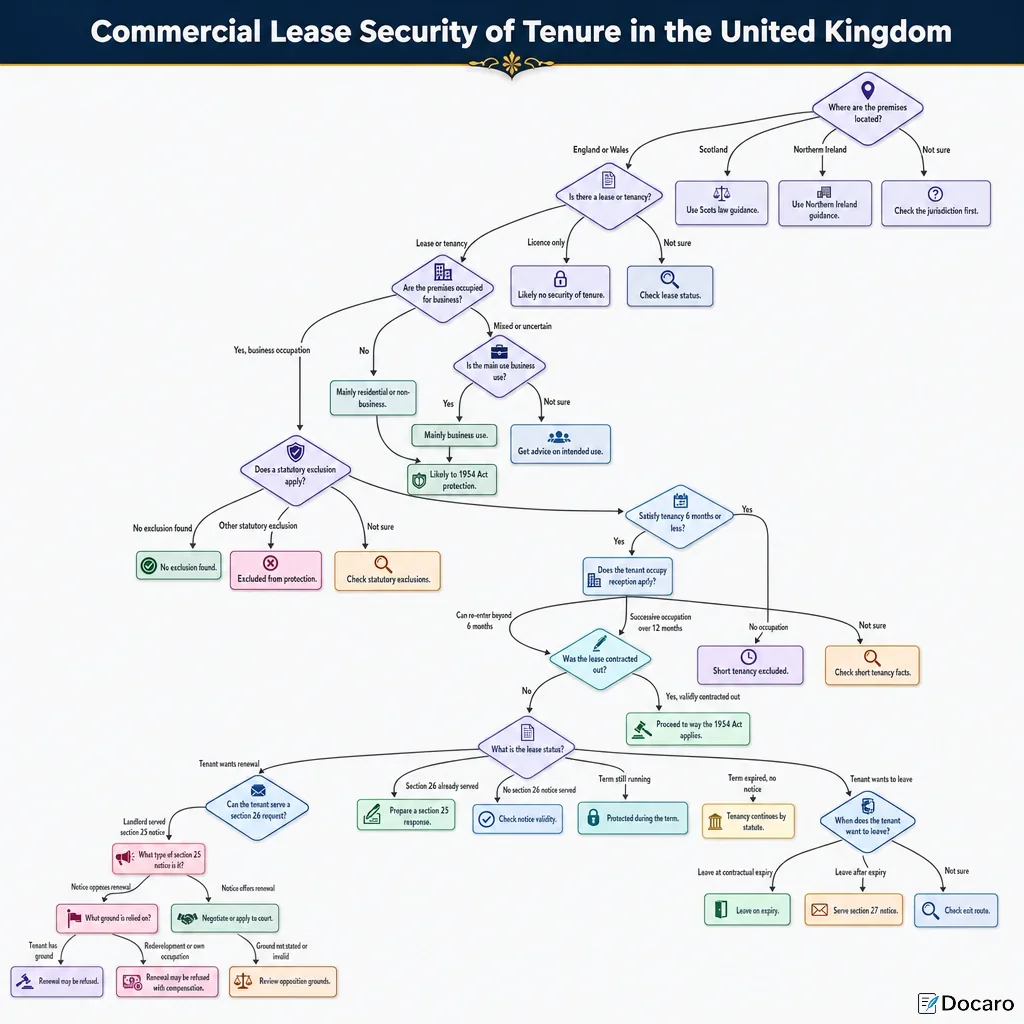
Security of tenure status | Whether lease is inside or excluded from Part II of the Landlord and Tenant Act 1954. | Both parties | Tenant may gain or lose renewal rights contrary to commercial intention. | Will the lease be contracted out of the 1954 Act? |
Completion requirements | ||||
1954 Act contracting-out process | Warning notice timing, tenant declaration type and completion sequencing. | Professional adviser | Contracting-out may be invalid if statutory procedure is not completed correctly. | Has the warning notice been served and has the tenant made the correct declaration? |
Lease duration | ||||
Break rights | Break dates, who may break, notice period, service method and conditions. | Both parties | Break may be ineffective or commercially unusable due to uncertain conditions. | Who can break? On what date? How much notice and what conditions apply? |
Financial terms | ||||
Principal rent | Annual rent, payment dates, payment frequency, review pattern and apportionment. | Both parties | Payment obligations, arrears and rent review drafting may be disputed. | What is the annual rent and when is it payable? |
Rent-free period | Length, start date, end date, covered rents and repayment triggers. | Both parties | Tenant may receive unintended concessions or repay obligations may be missing. | How long is the rent-free period? Does it apply to rent only or other sums too? |
Incentives and contributions | Premiums, reverse premiums, capital contributions, fit-out payments and conditions. | Both parties | Tax, VAT, accounting and repayment treatment may be missed. | Is either party paying a premium, contribution or incentive? What conditions apply? |
VAT on rent | Whether landlord has opted to tax and whether rent is plus VAT or VAT-inclusive. | Landlord | Tenant cashflow and SDLT calculations may be wrong. | Has the landlord opted to tax? Are all rents and charges plus VAT? |
Rent review | Review dates, method, assumptions, disregards, cap, collar and dispute process. | Both parties | Review may be unworkable or fail to reflect market bargain. | Is review open market, index-linked, stepped or turnover-based? Are caps or collars agreed? |
Index-linked review details | Index, base month, review month, formula, cap, collar and replacement index. | Professional adviser | Formula may produce unintended rent or fail if index changes. | Which index applies? What base month and cap or collar should be used? |
Turnover rent | Base rent, turnover percentage, exclusions, reporting, audit rights and confidentiality. | Both parties | Sales reporting and rent calculation disputes may arise. | Is any rent linked to turnover? What sales are included or excluded? |
Service charge | Services, budget, apportionment, caps, exclusions, reserve funds and audit rights. | Landlord | Unexpected costs, recovery gaps or disputes over reasonableness and apportionment. | What services are recoverable? Is there a cap or current budget? |
Insurance rent | Insured risks, premium recovery, excesses, rent loss period and uninsured risks. | Landlord | Gaps may arise over premium recovery, reinstatement and rent suspension. | Who insures the building? What risks and excesses are covered? |
Rent deposit | Amount, holder, account type, release tests, top-up duty and interest treatment. | Both parties | Deposit may not secure intended liabilities or release at intended time. | How much is the deposit? When can it be drawn and released? |
Late payment interest | Contractual interest rate, default trigger and whether statutory late payment rights are excluded or supplemented. | Landlord | Default interest may be unenforceable, excessive or inconsistent with statutory rights. | What interest applies to overdue rent and other sums? |
Completion requirements | ||||
SDLT responsibility | Tenant filing responsibility, rent assumptions, premium and VAT treatment for SDLT. | Professional adviser | Late filing, incorrect tax calculation or registration delay may result. | Will SDLT be payable? Who files the return and pays any tax? |
Land Registry registration | Whether lease term triggers registration and what plans, consents and certificates are needed. | Professional adviser | Legal estate may not be properly registered or protected. | Is the lease for more than seven years or otherwise registrable? |
Use and occupation | ||||
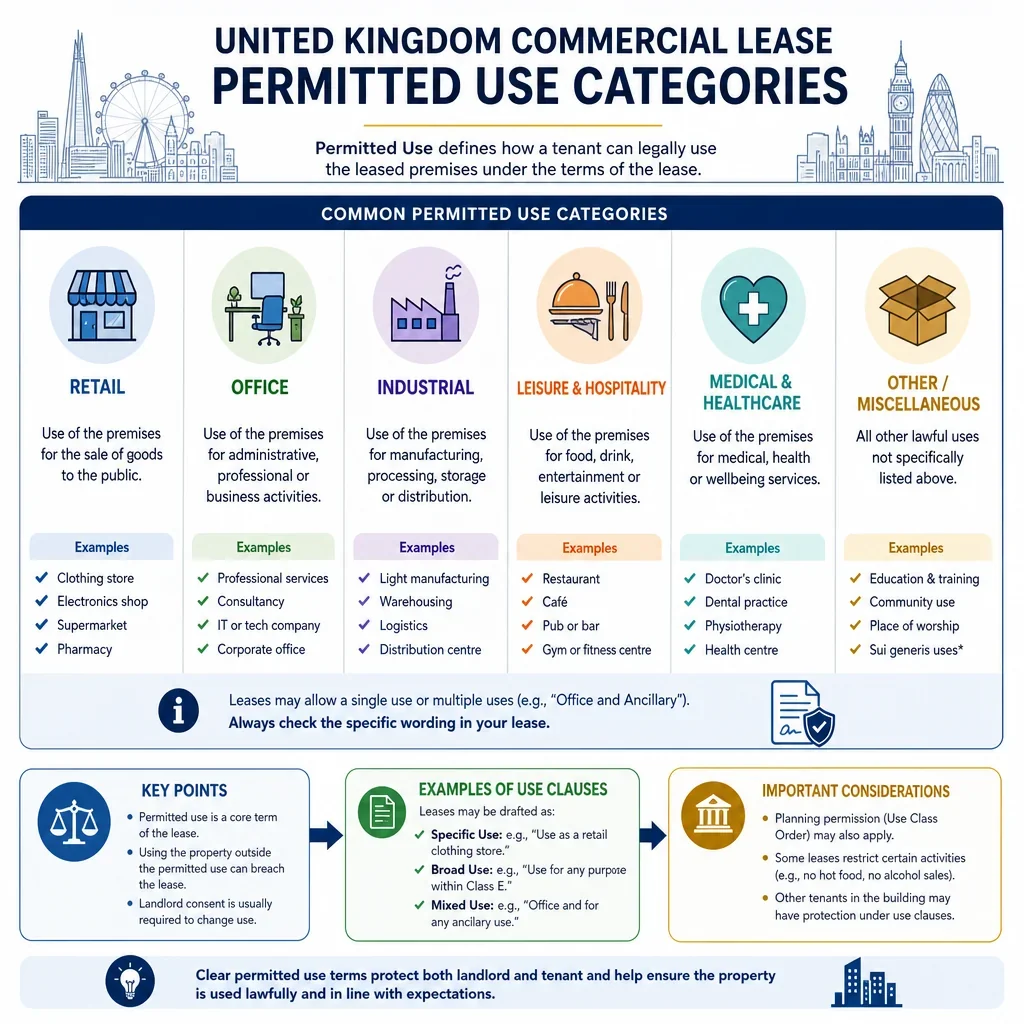
Permitted use | Specific business use, ancillary uses, prohibited uses and flexibility required. | Tenant | Use covenant may conflict with planning, title or tenant operations. | What will the tenant do at the premises? Are ancillary uses needed? |
Planning use class | Current lawful planning use, required use class and need for planning permission. | Professional adviser | Tenant may be unable to trade lawfully or landlord may face enforcement risk. | What is the current planning use and does the proposed use need permission? |
Operational licences | Alcohol, late night, food, environmental, HMO, gambling or other licences required. | Tenant | Tenant may commit to premises it cannot lawfully operate from. | What licences or permits does the business need before opening? |
Occupation by group companies or concessionaires | Permitted occupiers, sharing rights, concessions and conditions for occupation. | Tenant | Normal business arrangements may breach alienation or sharing covenants. | Will any group company, franchisee, concessionaire or contractor occupy space? |
Trading and opening hours | Required hours, permitted hours, mandatory trading obligations and quiet hours. | Both parties | Tenant operations may conflict with estate rules, planning or neighbouring occupiers. | What opening hours are needed? Are any hours mandatory or restricted? |
Rights and restrictions | ||||
Exclusivity or non-compete | Exclusive use, restricted competing uses, estate scope, duration and remedies. | Tenant | Restrictions may be too wide, unenforceable or inconsistent with estate lettings. | Does the tenant require exclusivity against competing occupiers on the estate? |
Repairs and alterations | ||||
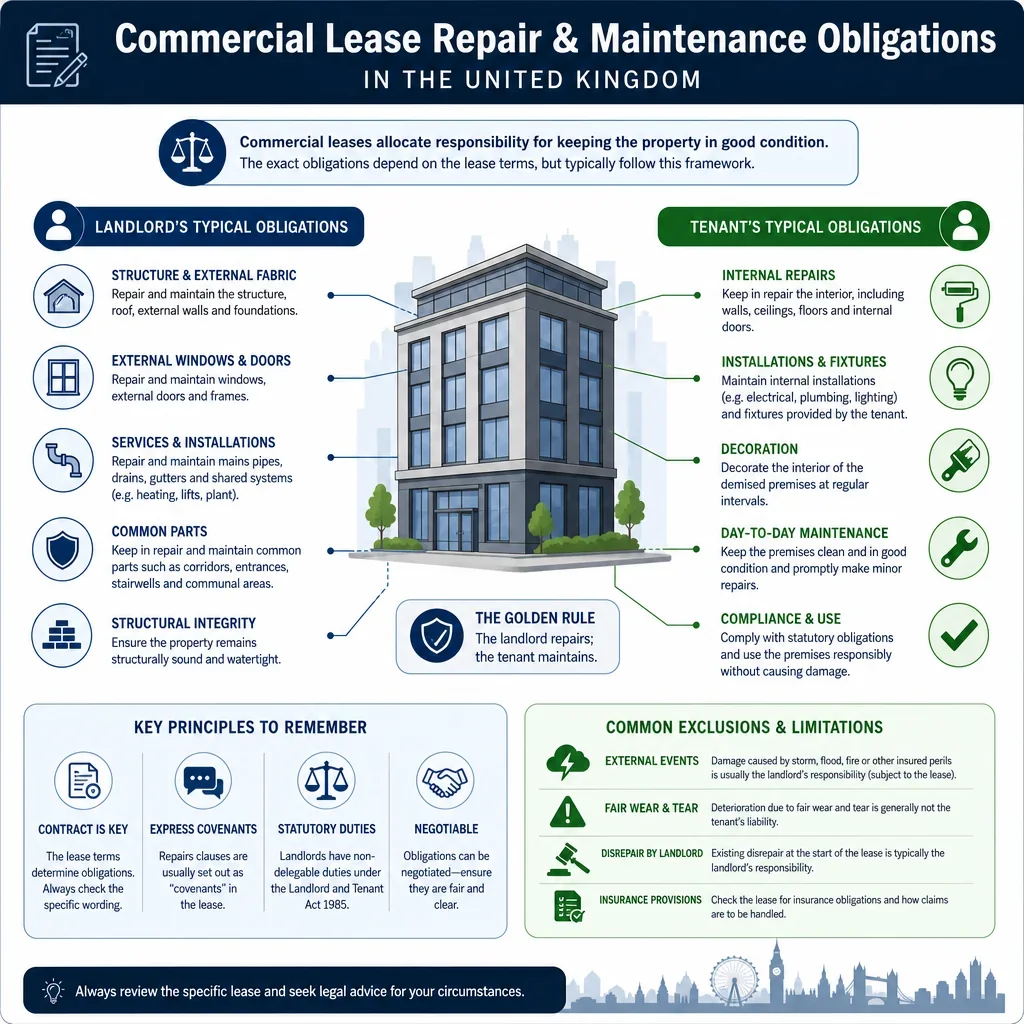
Repairing obligation | Full repairing, internal-only, keep in repair, put in repair and replacement scope. | Both parties | Tenant may inherit expensive historic defects or landlord may retain repair gaps. | Is the tenant responsible for all repairs or only internal non-structural repairs? |
Schedule of condition | Whether repair is limited by photos and survey schedule attached to lease. | Tenant | Tenant may be required to improve premises beyond their initial condition. | Will repair obligations be capped by a schedule of condition? Who prepares it? |
Decoration | Internal and external decoration cycles, colours, materials and end-of-term standard. | Landlord | Dilapidations and reinstatement disputes may arise at lease end. | How often must the tenant decorate and to what specification? |
Completion requirements | ||||
Landlord works | Works specification, timetable, standard, approvals, defects period and consequences of delay. | Landlord | Lease may complete before premises are ready or works dispute may delay occupation. | What works must the landlord complete before lease completion or rent start? |
Repairs and alterations | ||||
Tenant fit-out works | Fit-out scope, approvals, method statements, contractors, timing and reinstatement. | Tenant | Works may breach lease, planning, building regulations or insurance requirements. | What works will the tenant carry out before opening? Is a licence for alterations needed? |
Alterations | Permitted alterations, landlord consent standard, prohibited structural works and reinstatement. | Both parties | Tenant flexibility and landlord control may be misaligned. | Can the tenant alter layout, services, shopfront, signage or structure? |
Rights and restrictions | ||||
Signage and branding | Permitted signs, locations, size, illumination, estate branding and approvals. | Tenant | Tenant may lack visible branding or breach planning advertisement controls. | What signage is required and where will it be displayed? |
Repairs and alterations | ||||
Yielding up and reinstatement | End-of-term condition, removal of alterations, vacant possession and handback procedure. | Landlord | Dilapidations, strip-out and vacant possession disputes may occur. | Must tenant remove fit-out and reinstate at lease end? |
Rights and restrictions | ||||
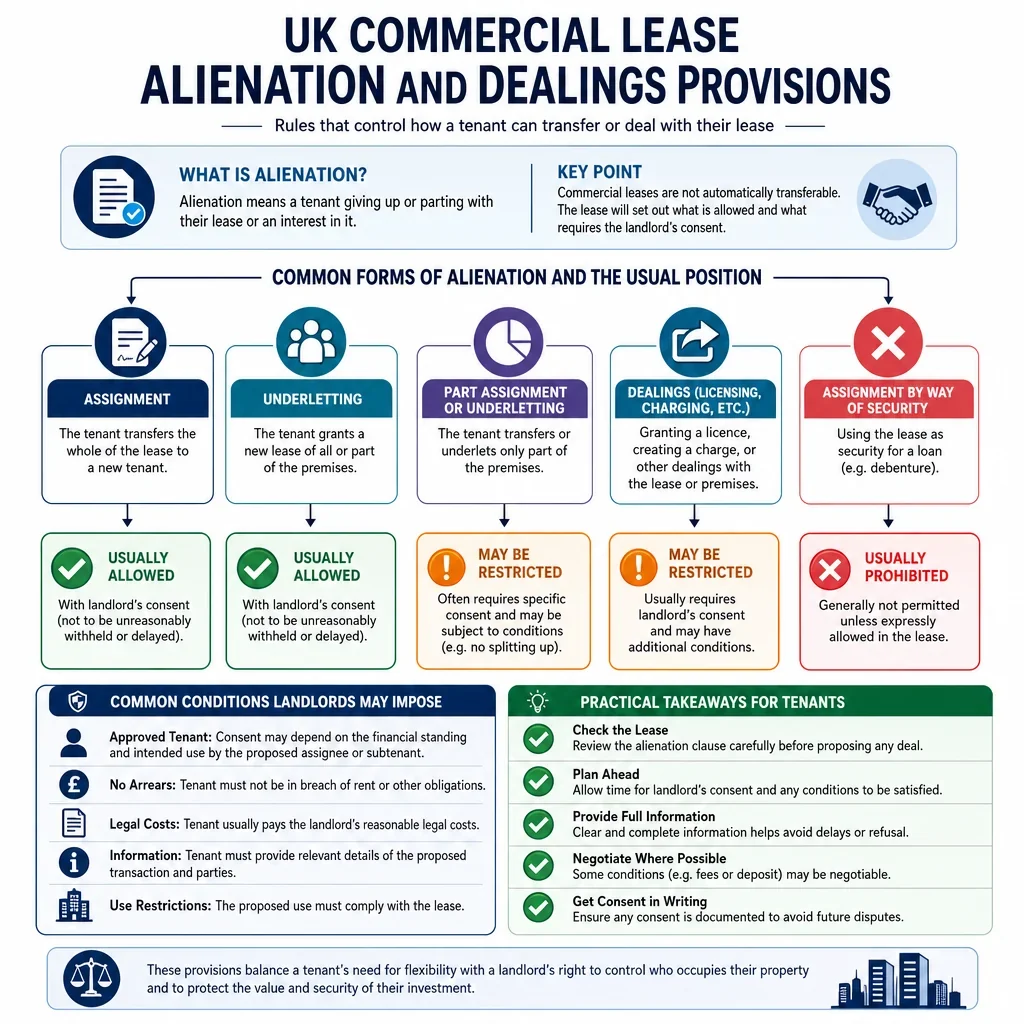
Assignment, underletting and sharing | Whether assignment, underletting, charging, sharing and group occupation are allowed. | Both parties | Tenant exit flexibility and landlord covenant control may be disputed. | Can the tenant assign, underlet, share occupation or charge the lease? |
Assignment conditions | Consent requirements, financial tests, AGA, guarantor and prohibited assignees. | Landlord | Consent conditions may be void, too restrictive or commercially ineffective. | What conditions must be met before assignment consent is granted? |
Underletting conditions | Whole or part, minimum rent, term length, excluded tenancy and undertenant covenants. | Both parties | Subletting structure may undermine rent, control or 1954 Act strategy. | Can the tenant underlet all or part? Must underleases be contracted out? |
Consent procedure | Application requirements, response times, professional costs and reasonableness standard. | Professional adviser | Consent disputes may arise over delay, conditions and costs. | What information must accompany consent applications and who pays landlord costs? |
Financial terms | ||||
Insurance obligations | Building insurance, tenant contents insurance, public liability and policy compliance. | Both parties | Coverage gaps may leave losses uninsured or premium recovery disputed. | Who insures what? What tenant insurance levels are required? |
Damage and rent suspension | Rent suspension trigger, insured risks, uninsured risks, termination rights and suspension period. | Professional adviser | Tenant may pay rent for unusable premises or landlord may lose income unexpectedly. | If the premises are damaged, when is rent suspended and who may terminate? |
Use and occupation | ||||
Utilities and meters | Electricity, gas, water, telecoms, metering, capacity, supplier and payment arrangements. | Landlord | Tenant may lack adequate services or be charged on uncertain apportionment. | Are utilities separately metered? Is service capacity sufficient for tenant operations? |
Telecoms and data connections | Existing connections, wayleave needs, fibre access, riser routes and installation consent. | Tenant | Opening may be delayed by lack of connectivity or wayleave documentation. | What internet and telecoms connections are needed before trading? |
Completion requirements | ||||
EPC and MEES compliance | Current EPC rating, exemptions, improvement works and responsibility for compliance. | Landlord | Letting may be unlawful or improvement costs may be disputed. | What is the EPC rating and are any MEES exemptions or works needed? |
Asbestos information | Asbestos register, management plan, survey reports and responsibility for disturbed materials. | Landlord | Fit-out or repair works may breach asbestos duties or create health risks. | Is there an asbestos register or survey for the premises and common parts? |
Use and occupation | ||||
Fire safety responsibilities | Fire risk assessment responsibility, alarms, escape routes, common parts and compliance works. | Both parties | Regulatory duties may be duplicated, missed or obstructed by premises layout. | Who maintains alarms, escape routes and fire safety equipment? |
Health and safety compliance | Responsibility for workplace safety, plant, access equipment, risk assessments and statutory testing. | Both parties | Unsafe occupation, enforcement action or disputes over statutory compliance costs. | Who is responsible for statutory inspections and workplace safety systems? |
Completion requirements | ||||
Building regulations approval | Whether landlord or tenant works need building control approval and completion certificates. | Professional adviser | Works may be unlawful, unsafe or impossible to certify on assignment or sale. | Do proposed works need building regulations approval or completion certificates? |
Use and occupation | ||||
Environmental matters | Contamination, waste, emissions, hazardous substances, drainage and environmental permits. | Professional adviser | Clean-up liability, permit breaches or operational restrictions may be missed. | Will the tenant store waste, chemicals, fuel or operate regulated processes? |
Financial terms | ||||
Business rates | Rateable value, rating assessment, reliefs, liability start and empty rates position. | Tenant | Tenant may underestimate occupation costs or liability start date. | What is the rateable value and when does tenant rates liability begin? |
Other outgoings | Utilities, refuse, estate charges, BID levy, taxes, assessments and licences. | Landlord | Total occupational cost may differ materially from agreed headline rent. | What other charges must the tenant pay besides rent, insurance and service charge? |
Rights and restrictions | ||||
Restrictive covenants on title | Use, alteration, signage, nuisance, building and estate restrictions affecting the premises. | Professional adviser | Lease may permit activities prohibited by the landlord title. | Do title covenants restrict the proposed use, works or signage? |
Completion requirements | ||||
Superior landlord consent | Whether superior lease requires consent for underletting, alterations, use or signage. | Professional adviser | Grant may breach superior lease and expose landlord to forfeiture risk. | Is the landlord itself a tenant? Does its lease require consent? |
Lender consent | Whether mortgagee consent, deed of priority or notice is required before completion. | Landlord | Lease may breach finance documents or be vulnerable to lender enforcement. | Is the property charged to a lender and is consent needed? |
Legal and professional costs | Who pays lease drafting, surveyor, licence, registration and abortive costs. | Both parties | Completion may be delayed by cost disputes or unpaid undertaking requests. | Does each party pay its own costs or does one party contribute? |
Transaction timetable | Target exchange, completion, access, fit-out, opening and long-stop dates. | Both parties | Works, funding, consents and opening dates may become misaligned. | When must the lease complete and when does the tenant need access? |
Early access for fit-out | Access date, licence terms, insurance, works limits, rent trigger and termination. | Tenant | Tenant may occupy before lease completion without clear liability or control. | Does the tenant need early access before the lease is completed? |
Conditions precedent | Planning, board approval, funding, surveys, licences, landlord works and consent conditions. | Both parties | Party may be forced to complete without essential approvals or safeguards. | What must happen before either party is obliged to complete the lease? |
Confidentiality | Whether terms, incentives, turnover data and negotiations are confidential. | Both parties | Commercially sensitive terms may be disclosed to competitors or other tenants. | Are the heads of terms or incentives confidential? Who may receive them? |
Negotiation exclusivity | Exclusivity period, landlord marketing restrictions, tenant obligations and expiry date. | Tenant | Tenant may spend due diligence costs while landlord negotiates with others. | Will the landlord stop marketing while the tenant undertakes due diligence? |
Binding or non-binding status | Which provisions are binding, subject to contract, confidential or exclusive. | Professional adviser | Unintended contractual obligations or uncertainty over enforceable provisions may arise. | Are the heads subject to contract? Are confidentiality or exclusivity binding? |
Rights and restrictions | ||||
Notice addresses and service methods | Addresses, email position, deemed service rules and notice recipients. | Both parties | Break, default or consent notices may be invalidly served. | Where must formal notices be sent and is email permitted? |
Default and forfeiture | Rent default period, insolvency triggers, breach remedies and re-entry rights. | Landlord | Landlord remedies may be defective or tenant cure rights uncertain. | When can the landlord re-enter for non-payment or other breach? |
Financial terms | ||||
Commercial rent arrears recovery | Awareness that CRAR applies only to qualifying commercial rent arrears and premises. | Professional adviser | Landlord may assume remedies are available when premises or sums do not qualify. | Will the premises be purely commercial and what sums are reserved as rent? |
Use and occupation | ||||
Residential or mixed use element | Whether any residential accommodation, caretaker flat or living accommodation is included. | Both parties | Different statutory regimes, CRAR limits and occupation protections may apply. | Does the letting include or permit any residential occupation? |
Rights and restrictions | ||||
Parking rights | Number of spaces, location, exclusivity, charges, permits and electric charging rights. | Landlord | Tenant may lack operational parking or landlord may lose estate flexibility. | How many parking spaces are included and are they allocated or shared? |
Use and occupation | ||||
Loading and deliveries | Loading bays, delivery hours, vehicle limits, access routes and restrictions. | Tenant | Tenant operations may be impractical or disturb other occupiers. | What delivery access, hours and vehicle sizes are required? |
Waste and refuse | Waste storage, collection, recycling, trade waste contracts and hazardous waste. | Tenant | Estate nuisance, regulatory breaches and unexpected waste costs may arise. | What waste will be produced and where will it be stored and collected? |
Nuisance, noise and odour controls | Restrictions for noise, vibration, smell, extraction, pests, hazardous goods and disturbance. | Landlord | Tenant use may trigger neighbour complaints or breach estate covenants. | Will operations create noise, smells, vibration, extraction or nuisance risks? |
Repairs and alterations | ||||
Plant and equipment | Included plant, ownership, maintenance, replacement, warranties and statutory testing. | Landlord | Repair liability for expensive plant may be disputed. | What plant is included and who maintains or replaces it? |
Air conditioning and extraction | Existing systems, capacity, maintenance, replacement, consent and roof or wall routes. | Tenant | Tenant may be unable to trade or may face unplanned capital costs. | Does the tenant need extraction, cooling, ventilation or external condensers? |
Use and occupation | ||||
Security systems and access control | Keys, alarms, CCTV, shutters, access cards, codes and maintenance duties. | Both parties | Security, data protection and maintenance responsibilities may be overlooked. | What access control, CCTV, alarms or shutters are included or required? |
CCTV and data protection | Who controls CCTV, signage, footage access, retention and data protection compliance. | Both parties | CCTV operation may breach data protection duties or create access disputes. | Who operates CCTV and who may access or retain recorded footage? |
Green lease obligations | Energy data sharing, efficiency works, metering, waste, water and sustainability targets. | Both parties | MEES improvement, data sharing and sustainability costs may be disputed. | Will the lease include energy data sharing or sustainability obligations? |
Rights and restrictions | ||||
Redevelopment rights | Landlord works rights, relocation, scaffolding, interruption, compensation and break rights. | Landlord | Landlord redevelopment may be blocked or tenant quiet enjoyment impaired. | Does the landlord need future redevelopment, relocation or major works flexibility? |
Quiet enjoyment and interruption | Expected landlord access, works disturbance, service interruptions and mitigation obligations. | Both parties | Reserved rights may conflict with tenant occupation and trading expectations. | What interruptions can the tenant tolerate and what notice should landlord give? |
Estate rules and tenant handbook | Rules on deliveries, waste, signage, hours, security, common parts and conduct. | Landlord | Tenant may unknowingly breach operational rules outside the lease text. | Are there estate regulations or a tenant handbook that bind occupiers? |
Completion requirements | ||||
Surveys and due diligence | Building survey, measured survey, environmental searches, title review and replies to enquiries. | Professional adviser | Tenant may accept unknown defects, liabilities or title restrictions. | What surveys, searches and enquiries are needed before signing? |
CPSE replies | Which Commercial Property Standard Enquiries will be answered and by whom. | Professional adviser | Important property information may not be disclosed before lease completion. | Will the landlord provide CPSE replies and supporting documents? |
Existing disputes and notices | Neighbour disputes, statutory notices, enforcement, service charge disputes and insurance claims. | Landlord | Tenant may inherit disruption, costs or compliance obligations unknowingly. | Are there any disputes, notices, enforcement matters or insurance claims? |
Parties and premises | ||||
Fixtures, fittings and chattels | Items included, ownership, condition, price, warranties and removal obligations. | Both parties | Disputes may arise over what passes with the premises or must be removed. | What fixtures, fittings or equipment are included in the letting? |
Inventory and condition of contents | Inventory list, condition evidence, maintenance responsibility and replacement obligations. | Landlord | Liability for missing or defective items may be disputed at handback. | Is there an inventory for included equipment or furniture? |
Existing occupational interests | Current tenants, licensees, concessions, squatters, rights to occupy and vacant possession date. | Landlord | Landlord may be unable to give vacant possession or exclusive occupation. | Will the premises be vacant on completion? Does anyone else occupy or use them? |
Financial terms | ||||
Rent commencement trigger | Whether rent starts on completion, access, opening, works completion or fixed date. | Both parties | Rent-free period and rent liability may start earlier or later than intended. | What event triggers the first rent payment? |
Lease duration | ||||
Force majeure or trading interruption | Whether closure, access restriction, utilities failure or legal prohibition affects rent or term. | Both parties | Parties may assume relief exists when lease provides none. | Should rent or obligations change if trading or access is legally restricted? |
Completion requirements | ||||
Governing law and jurisdiction | Whether English law and courts apply, or another UK jurisdiction is relevant. | Professional adviser | Wrong jurisdiction may be used for premises outside England and Wales. | Are the premises in England, Wales, Scotland or Northern Ireland? Which law applies? |
What Should UK Commercial Lease Heads Of Terms Cover?
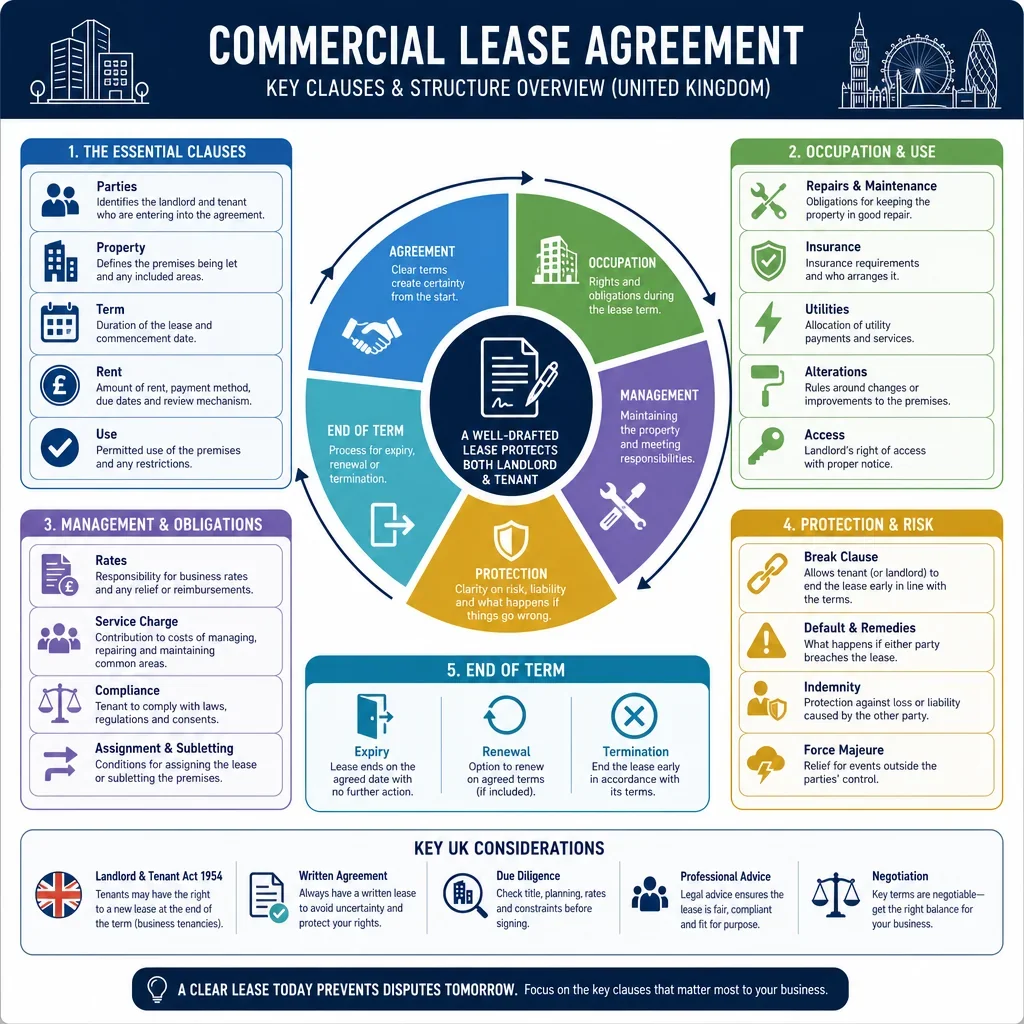
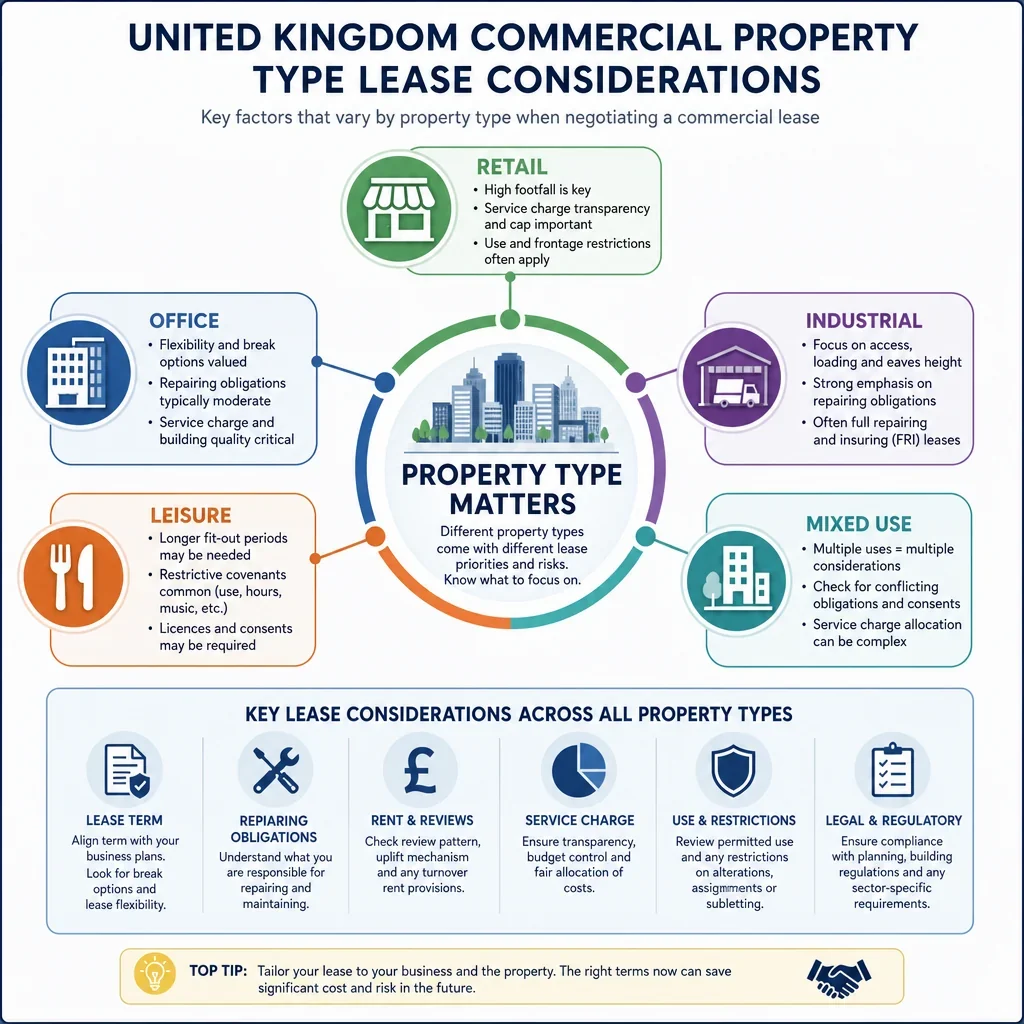
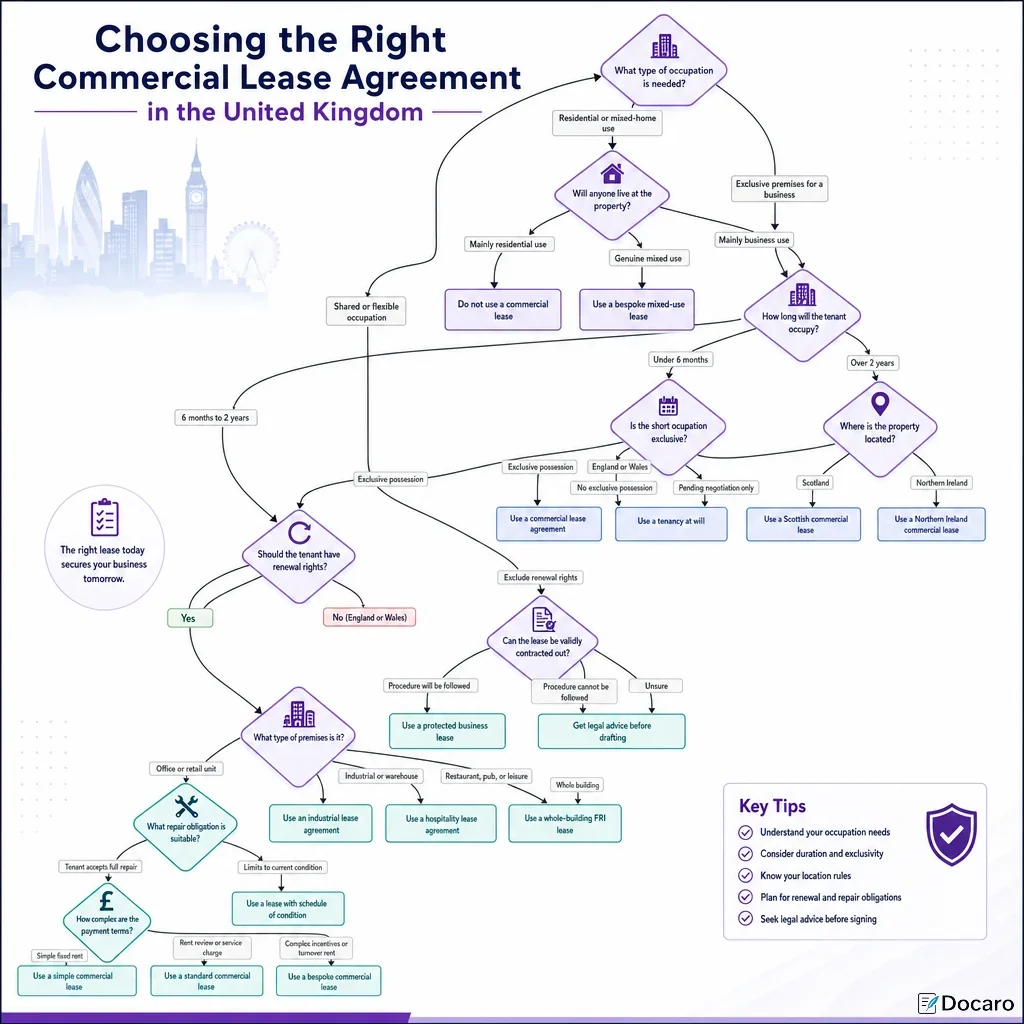
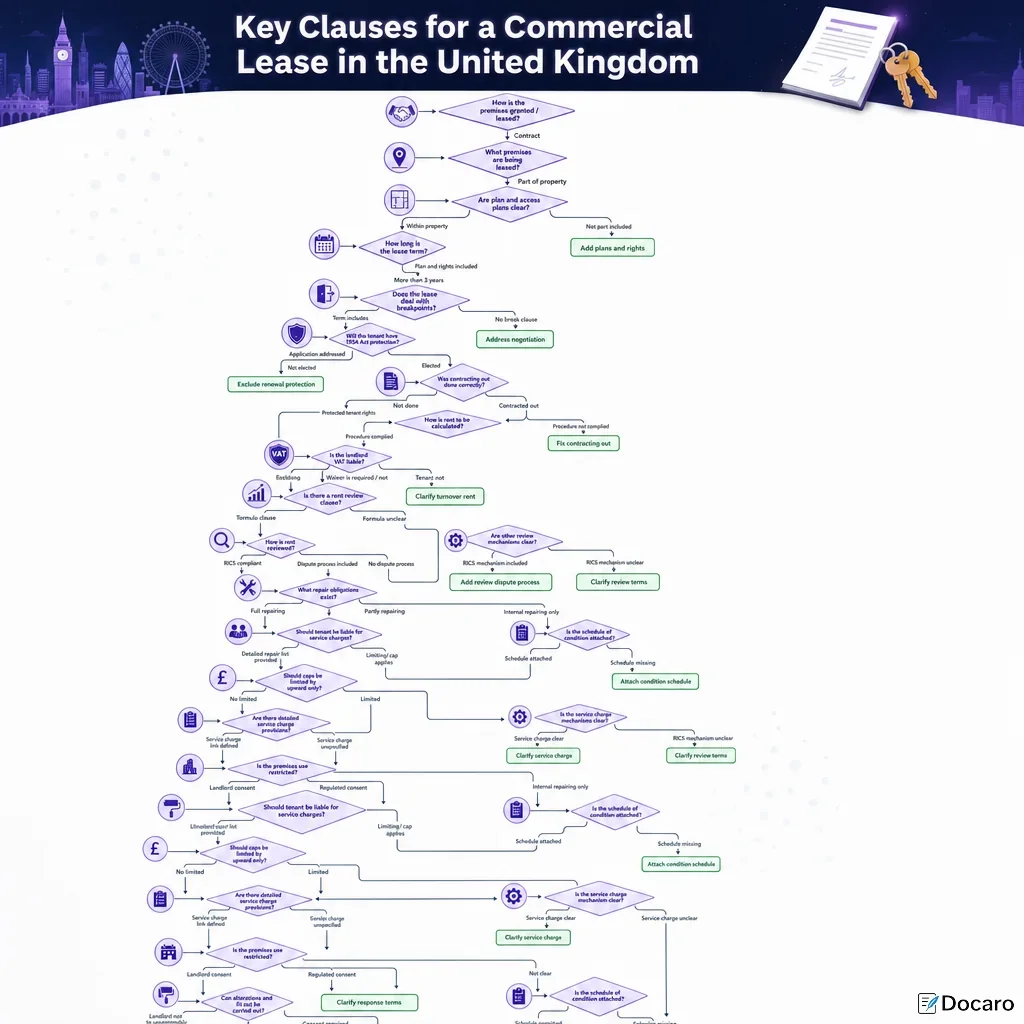
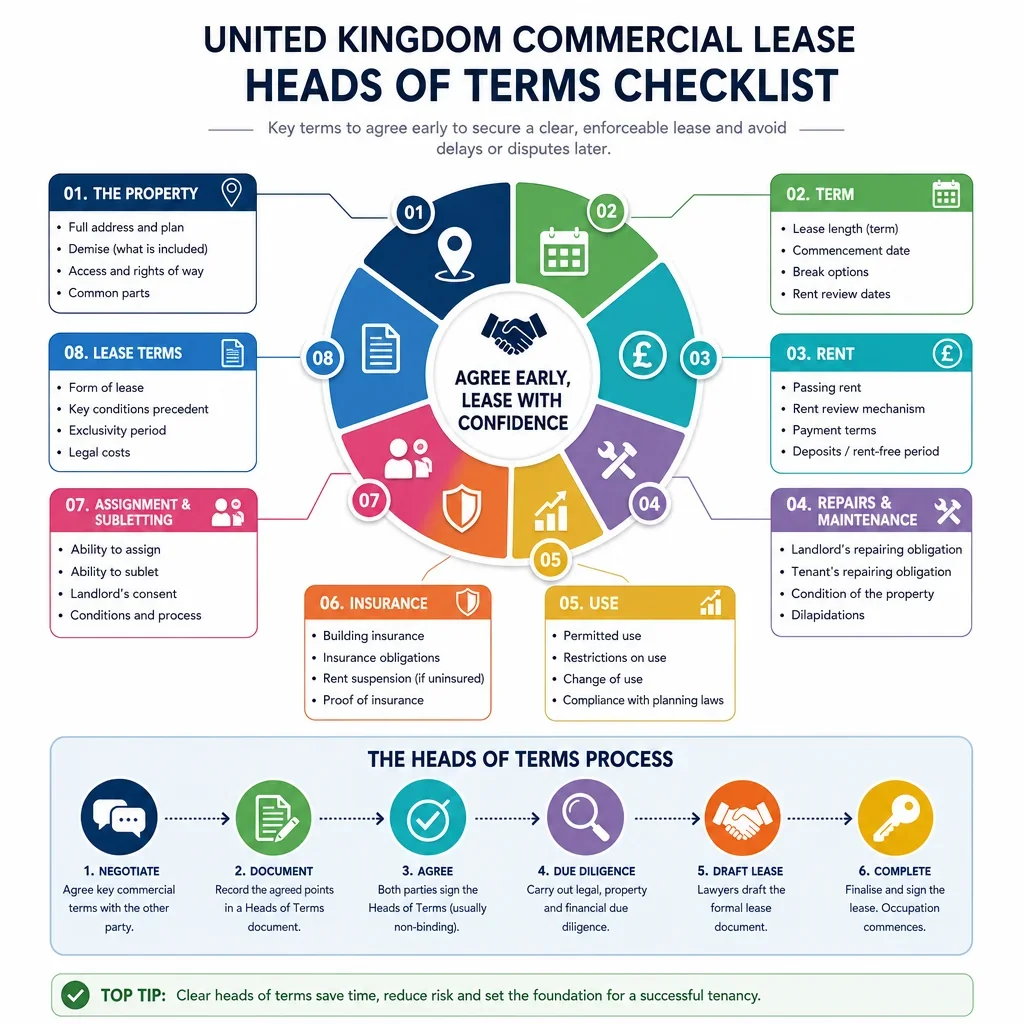
Commercial lease heads of terms should identify the parties, the premises, the rent package, the lease term, renewal position, repair standard, permitted use, key rights, restrictions and completion conditions before drafting starts. The most common drafting problems arise where headline terms are agreed but supporting detail is missing, such as whether rent is VAT-inclusive, whether the lease is inside or outside the Landlord and Tenant Act 1954, whether repair is full repairing and insuring or limited by a schedule of condition, and whether landlord works or consents are conditions to completion.
Which Heads Of Terms Points Carry The Most Legal Risk?
- Security of tenure: If the parties intend the lease to be excluded from the Landlord and Tenant Act 1954, the statutory warning notice, tenant declaration and timing requirements must be handled before completion.
- Premises definition: Plans, exclusions, rights and common parts should be clear, especially for part of a building or estate, to avoid disputes over boundaries, services and repair.
- Repair obligations: A tenant taking a lease of older premises should consider a schedule of condition if repair is to be limited to existing condition.
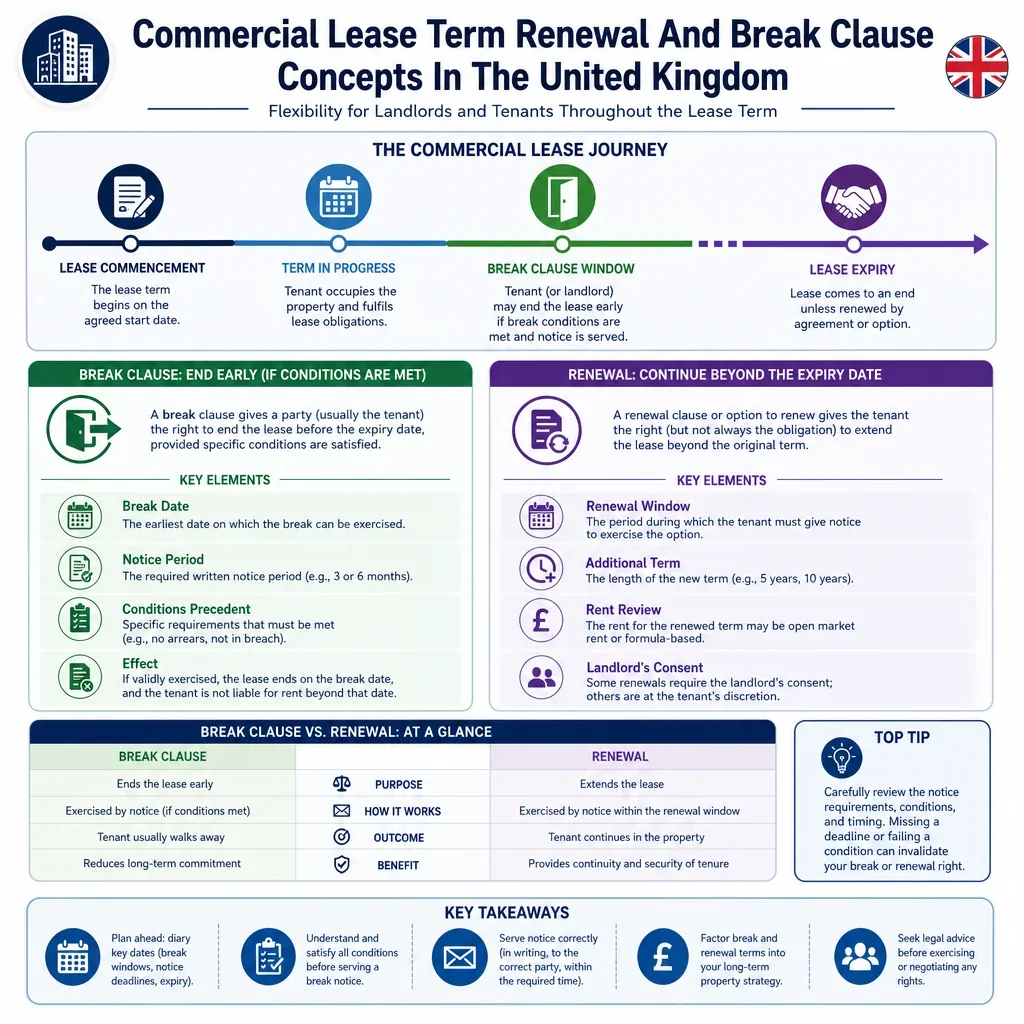
- Break clauses: Break dates, notice periods and conditions should be precise. Overly broad conditions can make a break right difficult to exercise.
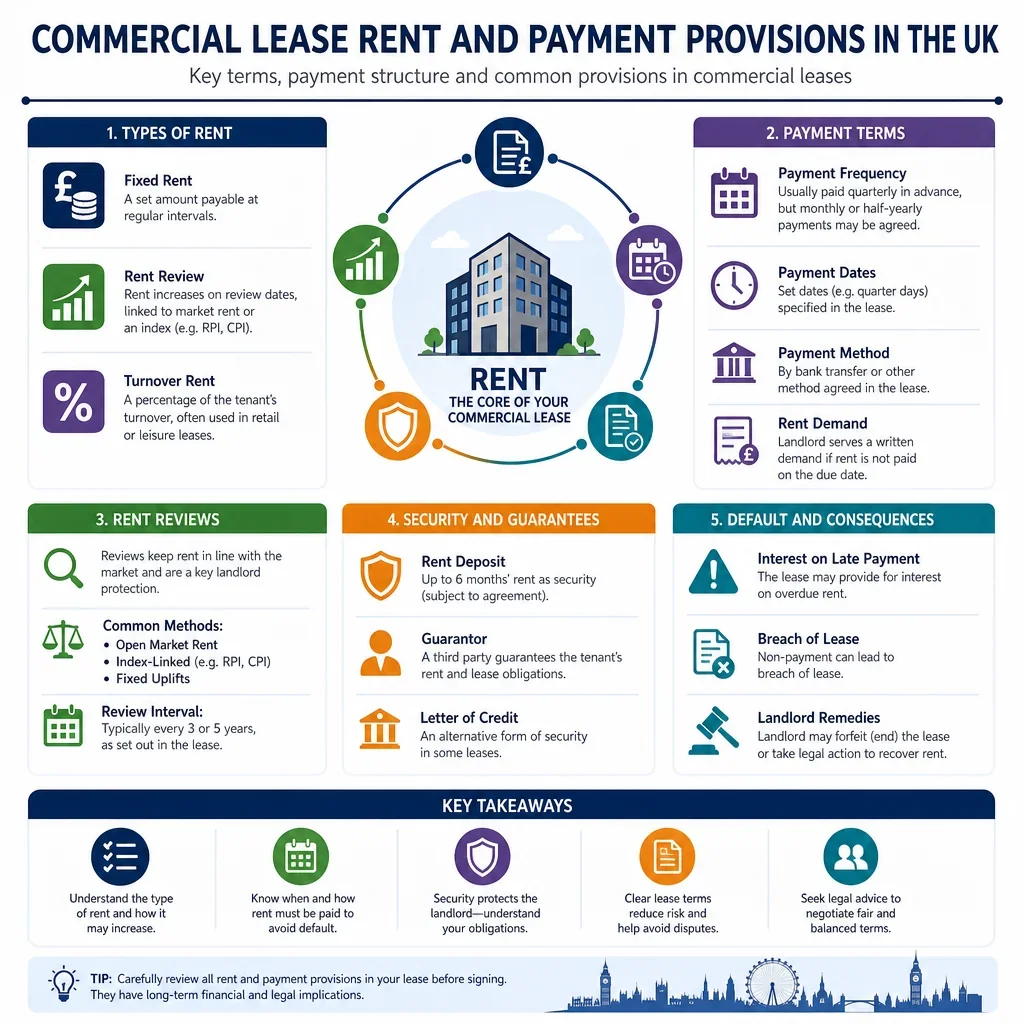
- Financial terms: Rent, VAT, service charge, insurance rent, rent-free periods, incentives, deposits and guarantees should be separated so the lease can allocate each payment correctly.
Who Should Confirm The Information Before A Lease Is Drafted?
The landlord usually confirms title, premises, insurance, service charge, estate rules and works. The tenant usually confirms its identity, use, fit-out needs, funding arrangements, guarantor and operational requirements. Professional advisers should check title, planning use, SDLT, VAT, 1954 Act exclusion, consents, energy performance requirements and any lender or superior landlord approvals.
FAQs
You Might Also Be Interested In