UK Child Maintenance Agreement Duration Options
Description | When It May Be Suitable | Points to Consider | Common Review Approach | End Date Clarity Importance |
|---|---|---|---|---|
Fixed Term | ||||
Payments run from a stated start date to a stated end date. | Useful where parents want certainty for a defined period after separation. | Include what happens after the end date to avoid a payment gap. | Review before end date | High |
A 12-month trial arrangement before agreeing a longer-term position. | Suitable where income, housing or childcare patterns are still settling. | Set a review date at least one month before expiry. | Review before end date | High |
The agreement lasts for a named school year or academic year. | Useful where costs follow school fees, uniforms, clubs or term-time travel. | Define whether it ends on the last teaching day or end of school holidays. | Termly review recommended | High |
Payments apply until a specified date when parents expect to reassess against CMS guidance. | Useful where parents want a private arrangement but will compare it with CMS figures later. | State whether the private amount changes automatically or only by written agreement. | Review before end date | Medium |
A temporary reduced or adjusted amount applies for a set period. | Suitable where a paying parent has short-term unemployment or reduced income. | Require evidence of income change and specify the amount after the temporary term. | Review before end date | High |
A special payment level applies during a parent’s family leave period. | Useful where statutory or employer family leave temporarily changes income. | State the return-to-work payment level and review if leave dates change. | Review before end date | High |
The agreement covers a defined relocation or housing transition period. | Suitable where moving home changes travel, rent, school or childcare costs. | Clarify whether travel costs are included in maintenance or paid separately. | Review before end date | High |
The maintenance agreement is set to align with a wider financial order or review date. | Useful where parents are also resolving divorce or dissolution finances. | Child maintenance in court orders may be affected by CMS jurisdiction after 12 months. | Review before end date | High |
Until a Child Reaches a Specified Age | ||||
Payments continue until the child’s 16th birthday or a defined date linked to it. | Suitable where the child is expected to leave qualifying education at 16. | Clarify whether payments stop on the birthday, month end or school-year end. | Review when circumstances change | High |
Payments continue until the child turns 18. | Useful where parents expect support until adulthood regardless of school timing. | May not match CMS eligibility if approved education continues beyond 18. | Annual review recommended | High |
Payments continue until age 20, usually only while the child remains in approved education or training. | Suitable where parents want the arrangement to broadly reflect CMS eligibility. | Define approved education and require prompt notice if the child leaves it. | Annual review recommended | High |
Payments stop when the child reaches 19 unless extended in writing. | Useful as a compromise where the child may finish sixth form around 18 or 19. | May end too early if the child repeats a year or remains in approved training. | Annual review recommended | High |
Payments end at a specified age or the end of that school year, whichever is later. | Useful where parents want to avoid stopping payments mid-academic year. | Define the school year end date and whether holidays are included. | Review when circumstances change | High |
Maintenance reduces or ends separately as each child reaches a specified age. | Suitable where there is more than one child with different ages or school stages. | State the amount payable for each remaining child after each trigger date. | Annual review recommended | High |
Until a Child Leaves Full-Time Education | ||||
Payments continue until the child finishes compulsory school-age education. | Suitable where the focus is support until GCSEs or equivalent are completed. | Leaving school age differs from later participation duties and benefit rules. | Review when circumstances change | High |
Payments continue while the child remains in approved education or training. | Useful where parents want maintenance to follow post-16 education status. | List qualifying courses and require evidence of enrolment or attendance if requested. | Annual review recommended | High |
Payments end after A-levels, T Levels, Scottish Highers or an equivalent approved course. | Suitable for children in sixth form, college or equivalent non-advanced education. | Specify whether payments continue until exams, results day or the academic year end. | Termly review recommended | High |
Payments continue while the child is in qualifying approved training. | Suitable where the child moves into approved training rather than school or college. | Paid employment or some apprenticeships may not qualify define the trigger carefully. | Termly review recommended | High |
Maintenance ends when Child Benefit is no longer payable due to the child leaving approved education or training. | Useful where parents want a practical evidence-based education trigger. | Child Benefit status may depend on reporting and may not exactly match private intentions. | Review when circumstances change | High |
Payments continue until the child completes a named college or sixth-form course. | Useful where the child is already enrolled on a specific course. | Address course changes, retakes, deferrals and early withdrawal. | Termly review recommended | High |
Payments continue until the child leaves school or college to start higher education. | Suitable where parents treat university support separately from child maintenance. | CMS child maintenance usually concerns qualifying children, not adult university students. | Review when circumstances change | High |
Rolling Arrangement | ||||
Payments continue month to month until changed or ended under the agreement. | Useful where parents need flexibility and do not yet know long-term costs. | Include notice requirements and review triggers to avoid sudden changes. | Annual review recommended | Medium |
The agreement continues indefinitely, with the amount reviewed each year. | Suitable where income changes annually through salary reviews, bonuses or self-employment accounts. | State what income evidence must be exchanged and when changes take effect. | Annual review recommended | Medium |
The arrangement continues, with school or college-related costs reviewed each term. | Useful where extras such as clubs, meals, trips or transport vary by term. | Separate core maintenance from variable education expenses. | Termly review recommended | Medium |
Either parent may request changes or termination by giving a specified notice period. | Useful where parents cooperate but want a clear process for changes. | A notice clause should not leave a child unsupported before a replacement arrangement is made. | Review when circumstances change | Medium |
Payments continue while the agreed overnight care pattern remains materially the same. | Suitable where maintenance depends on shared care or regular overnight stays. | Define what change in overnight stays triggers a review. | Review when circumstances change | Medium |
The arrangement continues while the paying parent’s income stays within an agreed range. | Useful for variable pay, commission, overtime or bonus-based income. | Define gross or net income and the percentage change requiring review. | Annual review recommended | Medium |
Payments continue with reviews after tax returns or business accounts are available. | Suitable where income is self-employed, seasonal or uneven across the year. | Specify accounting evidence, dividend treatment and timing of adjustments. | Annual review recommended | Medium |
Until Further Written Agreement | ||||
The agreement stays in place until both parents record a replacement agreement in writing. | Useful where parents want stability and no unilateral changes. | Can cause difficulty if one parent refuses to agree despite changed circumstances. | Review when circumstances change | Medium |
Payments continue until a dated replacement document is signed or otherwise confirmed in writing. | Suitable where parents want a clear audit trail for changes. | Define whether email, text message or solicitor correspondence counts as written agreement. | Review when circumstances change | High |
The existing arrangement continues until parents reach a written agreement through mediation or negotiation. | Useful where parents expect to revisit maintenance but want interim continuity. | Mediation may not produce agreement include a fallback route such as CMS application. | Review when circumstances change | Medium |
The arrangement remains until parents agree changes after a named future event. | Suitable where a house sale, job change or school move is expected. | Name the event and set a deadline for discussions after it occurs. | Review when circumstances change | Medium |
A private agreement continues unless replaced by a CMS decision, court order, or later written agreement. | Useful where parents want a private arrangement but recognise statutory routes may be used. | Be clear which document prevails if different payment obligations overlap. | Review when circumstances change | High |
Linked to Statutory Child Maintenance Position | ||||
Duration follows whether the child is eligible for statutory child maintenance. | Suitable where parents want the private agreement to mirror CMS eligibility. | Statutory eligibility can depend on age, education and who provides day-to-day care. | Annual review recommended | High |
Payments continue while Child Benefit remains payable for the child. | Useful where parents want a simple indicator of child maintenance eligibility. | Child Benefit can continue during certain education or training periods after age 16. | Review when circumstances change | High |
The private amount applies unless a CMS calculation is made and takes effect. | Suitable where parents accept either private payments or formal CMS assessment. | State whether arrears under the private agreement remain payable after CMS involvement. | Review when circumstances change | High |
A court-ordered maintenance term is reviewed with awareness that CMS may be used after the relevant period. | Relevant where child maintenance is included in a financial order by consent. | Parents should understand when CMS may supersede ongoing child maintenance terms. | Annual review recommended | High |
The agreement continues with yearly reassessment using the CMS calculation approach as a benchmark. | Useful where parents want private payments but statutory-style updates. | Confirm whether the CMS figure is binding between the parents or only a reference point. | Annual review recommended | Medium |
Duration and payer status are reviewed if the child’s main day-to-day carer changes. | Suitable where care may become shared or transfer between parents. | Define how a change of main carer is evidenced and when payments pause or switch. | Review when circumstances change | High |
Payments reduce or end separately as each child ceases to qualify for child maintenance. | Useful for families with several children at different ages or education stages. | Set a formula or schedule for recalculating payments as each child drops out. | Annual review recommended | High |
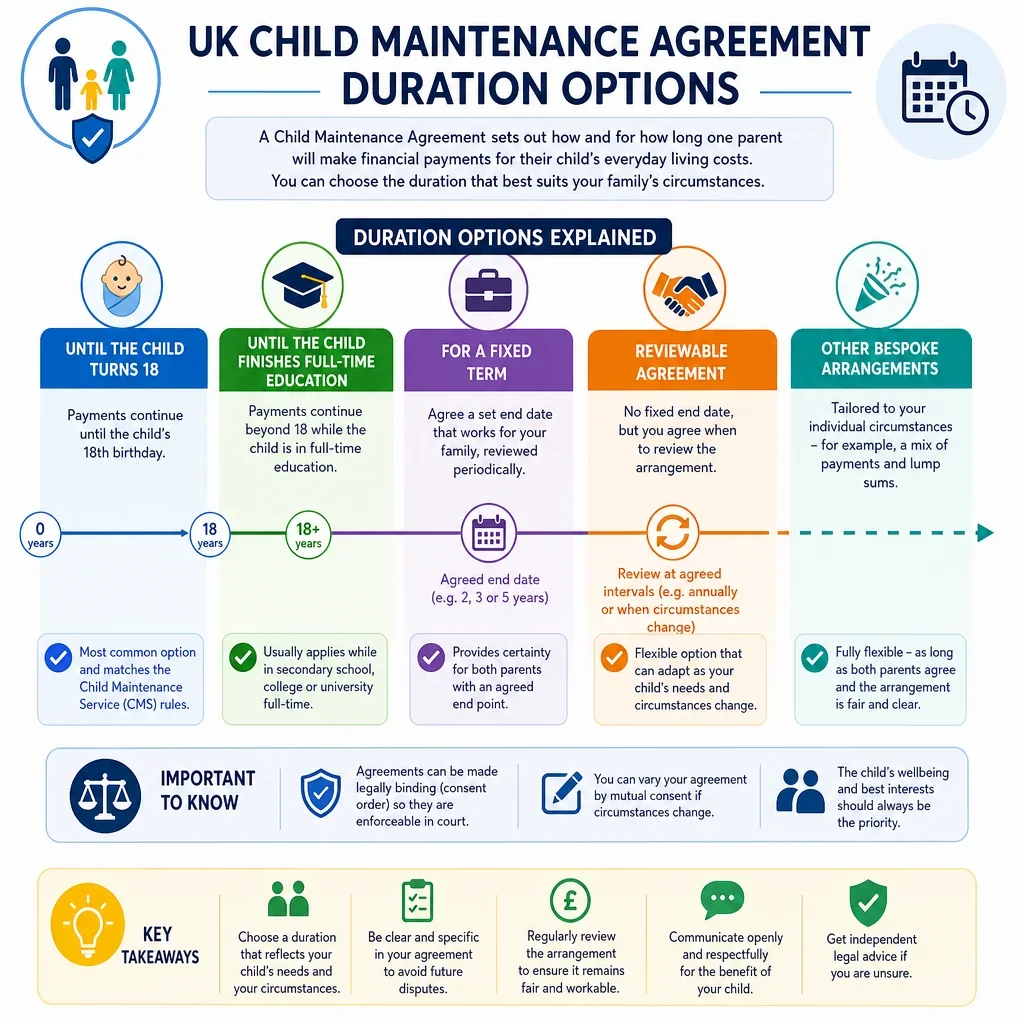
How Long Should A UK Child Maintenance Agreement Last?
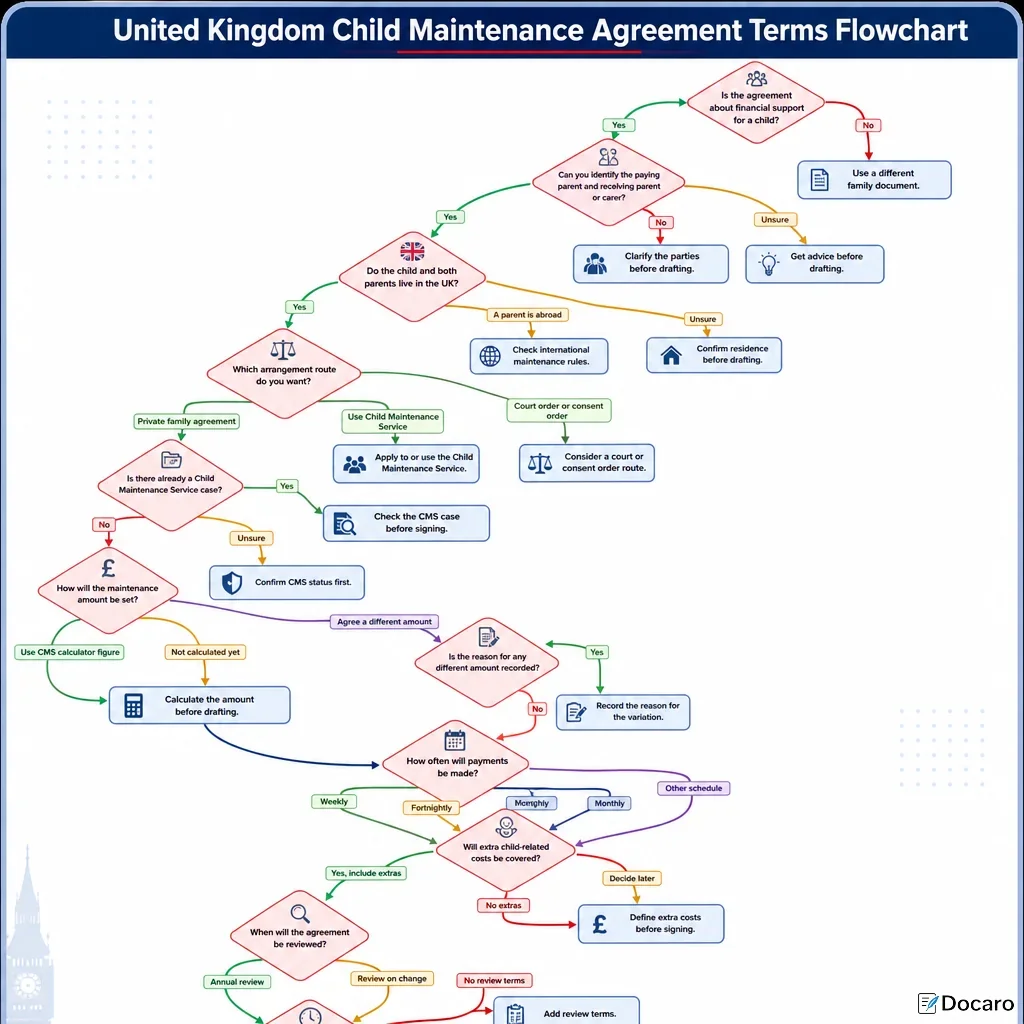
A child maintenance agreement should state both when payments start and exactly when they end or are reviewed. The clearest options are usually a fixed end date, a specified age, or an education-linked trigger. Vague wording such as until further notice can create uncertainty and disputes.
What End Point Is Most Common For Child Maintenance?
Many private arrangements track the statutory child maintenance position: maintenance is commonly linked to a child being under 16, or under 20 if they remain in approved education or training. If using this approach, define the education requirement and include a duty to share school, college or benefit-related updates.
When Should A Child Maintenance Agreement Be Reviewed?
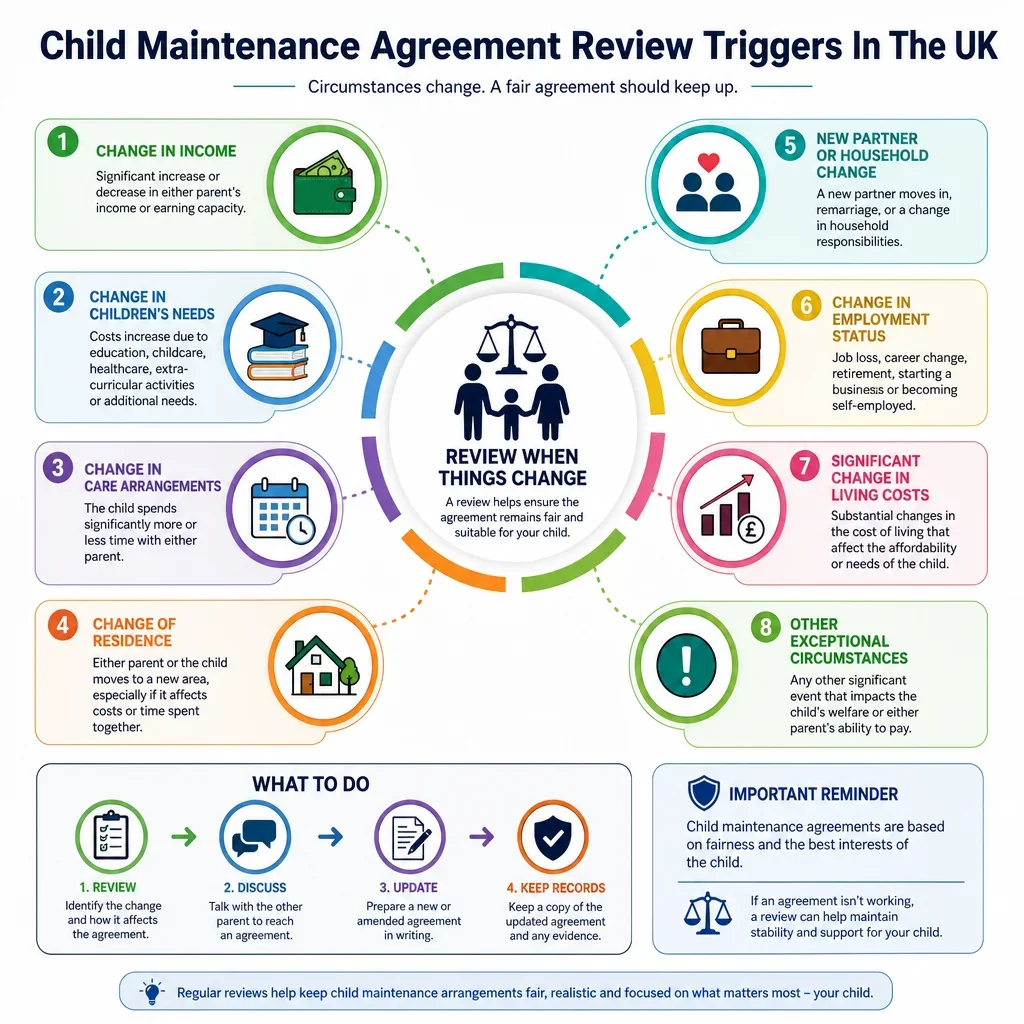
- Annual reviews suit most rolling or statutory-linked arrangements, especially where income changes are likely.
- Termly reviews are useful where payments depend on boarding school, college, university preparation, travel, or other education costs.
- Review before an end date is important for fixed-term agreements, so parents can renegotiate before payments stop.
- Immediate review triggers should cover changes in income, care pattern, benefit entitlement, a child leaving education, or a new CMS calculation.
Why Is Precise Wording Important?
End-date wording is especially important where the agreement ends when a child reaches an age, leaves full-time education, or where the arrangement is intended to follow the Child Maintenance Service position. The agreement should say whether payments stop on a birthday, at the end of a school term, at the end of an academic year, or after written confirmation of the relevant event.
FAQs
You Might Also Be Interested In