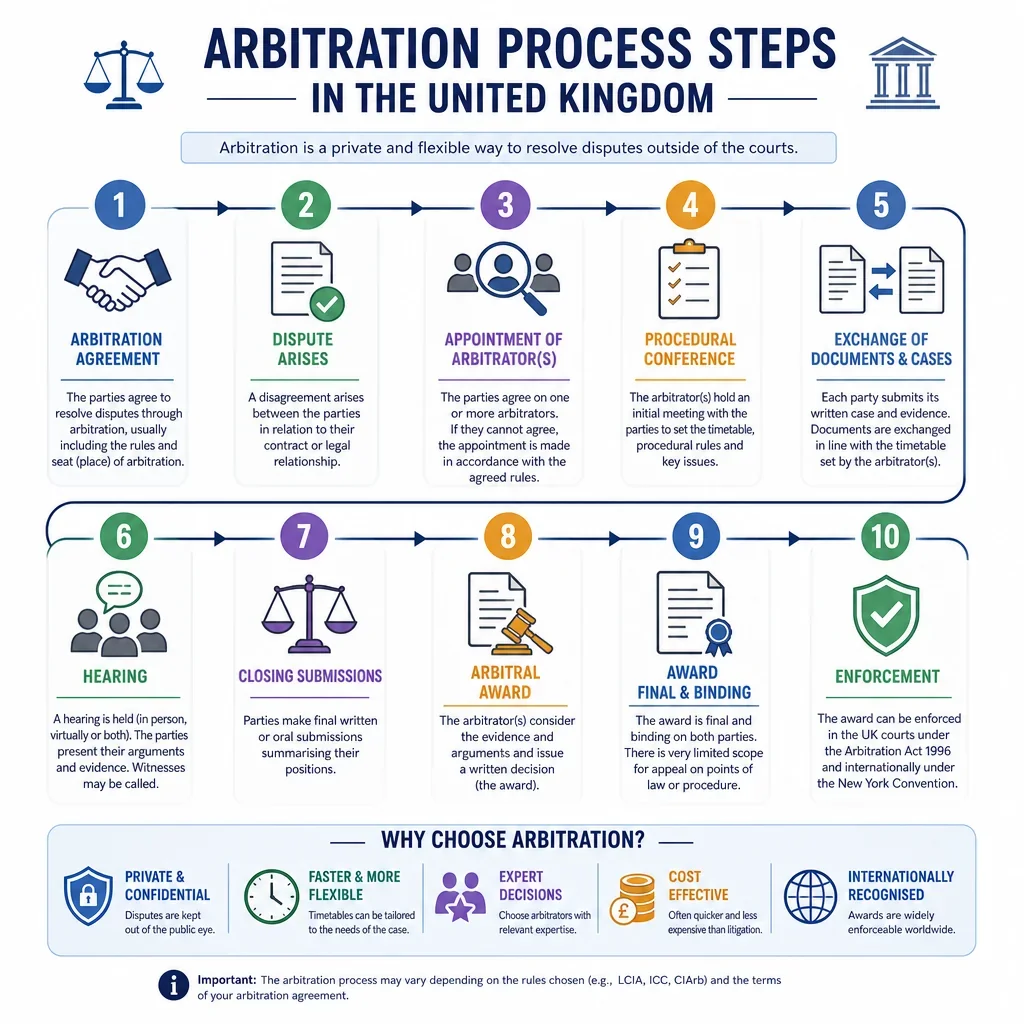
Arbitration Process Steps In The United Kingdom
Process Phase | Step Description | Common Documents | Responsible Actor |
|---|---|---|---|
Review arbitration agreement | |||
Pre-arbitration | Check whether the contract contains a valid arbitration clause and which disputes it covers. | Contract, arbitration clause, amendments, terms and conditions. | Party action required |
Identify the seat of arbitration | |||
Pre-arbitration | Confirm the legal place of arbitration and the procedural law applying to the arbitration. | Arbitration clause, institutional rules, seat provision, governing law clause. | Party action required |
Identify applicable arbitration rules | |||
Pre-arbitration | Determine whether institutional, ad hoc, UNCITRAL, LCIA, ICC, or other rules apply. | Arbitration clause, selected rules, institutional guidance, procedural agreement. | Party action required |
Check limitation periods | |||
Pre-arbitration | Assess whether the claim is within time before starting arbitration. | Key dates chronology, contract, correspondence, limitation analysis. | Party action required |
Comply with escalation clauses | |||
Pre-arbitration | Complete required negotiation, notice, expert determination, or mediation steps before arbitration. | Dispute notice, meeting records, mediation correspondence, settlement offers. | Party action required |
Send pre-arbitration notice | |||
Pre-arbitration | Notify the other party that a dispute has arisen and arbitration may be started. | Notice of dispute, demand letter, contract breach notice, delivery proof. | Party action required |
Consider interim protection | |||
Pre-arbitration | Assess whether urgent court or emergency arbitrator relief is needed before the tribunal is formed. | Injunction application, preservation evidence, asset evidence, emergency application. | Party action required |
Prepare notice of arbitration | |||
Commencement | Draft the document that formally starts the arbitration under the chosen rules. | Notice or request for arbitration, claim summary, arbitration agreement, exhibits. | Party action required |
File request with institution | |||
Commencement | Submit the arbitration request to the named arbitral institution if the clause uses institutional rules. | Request for arbitration, filing fee proof, contract, party details. | Party action required |
Serve notice on respondent | |||
Commencement | Deliver the arbitration notice using the agreed method or legally effective service route. | Service email, courier receipt, certificate of service, notice of arbitration. | Party action required |
Pay registration or filing fee | |||
Commencement | Pay the required institutional fee so the case can be processed. | Invoice, payment confirmation, fee schedule, request for arbitration. | Party action required |
Acknowledge receipt of arbitration | |||
Commencement | The institution or respondent confirms receipt and records the start of the process. | Acknowledgement letter, case reference, service confirmation. | Institution action required |
Submit response to arbitration | |||
Commencement | The respondent answers the claim, raises objections, and may identify counterclaims. | Response, jurisdiction objection, defence summary, counterclaim summary. | Party action required |
Raise jurisdiction objection | |||
Commencement | A party challenges whether the tribunal has power to decide the dispute. | Jurisdiction objection, contract, authority evidence, pleadings. | Party action required |
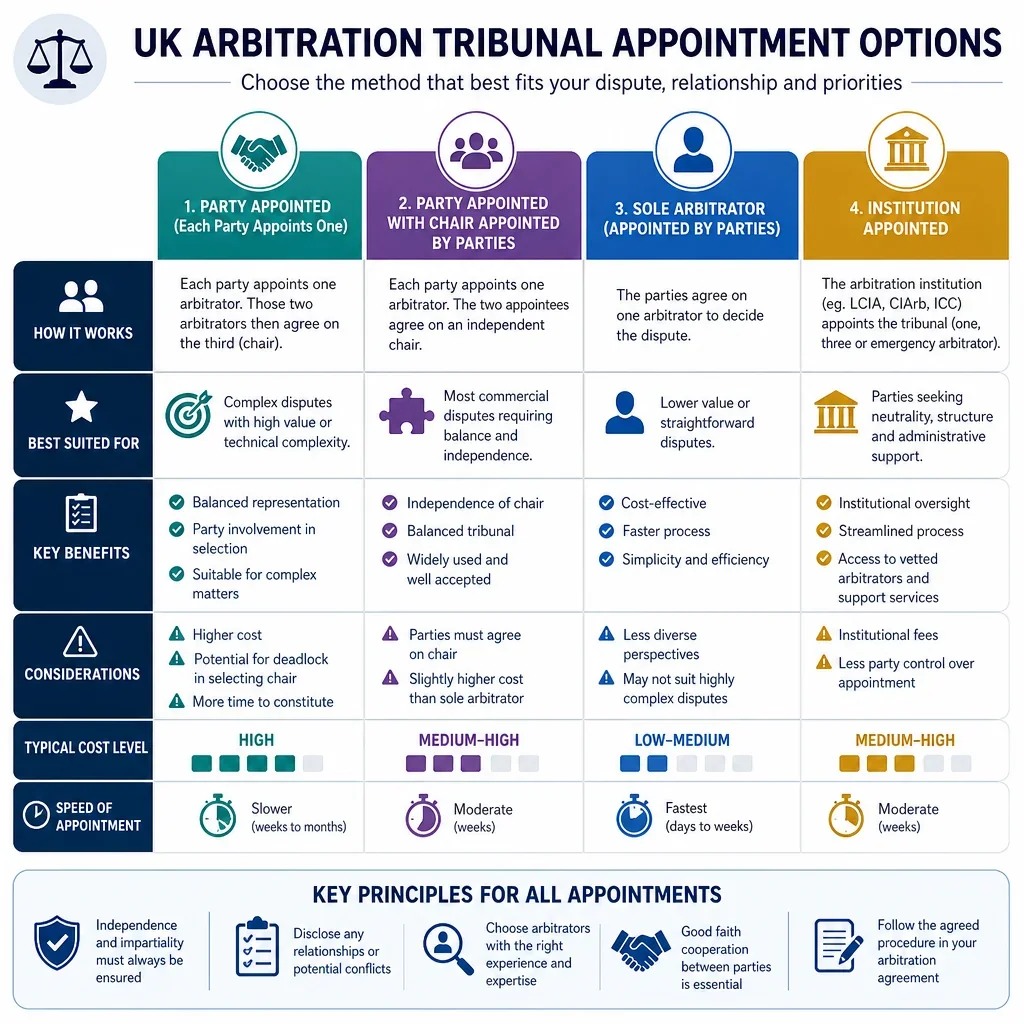
Nominate party-appointed arbitrator | |||
Tribunal formation | A party names its arbitrator if the agreement or rules allow party nomination. | Nomination notice, arbitrator CV, availability statement, independence statement. | Party action required |
Appoint sole arbitrator | |||
Tribunal formation | The parties, institution, or court appoints a sole arbitrator where required. | Appointment agreement, nomination correspondence, institutional appointment notice. | Depends on rules or agreement |
Appoint chair or presiding arbitrator | |||
Tribunal formation | The chair is selected by agreement, co-arbitrators, institution, or appointment authority. | Chair nomination, appointment notice, arbitrator disclosures, terms of appointment. | Depends on rules or agreement |
Disclose conflicts of interest | |||
Tribunal formation | Proposed arbitrators disclose circumstances that may affect impartiality or independence. | Independence declaration, impartiality disclosure, conflicts check, party comments. | Tribunal action required |
Challenge arbitrator appointment | |||
Tribunal formation | A party objects to an arbitrator because of impartiality, qualifications, capacity, or procedural concerns. | Challenge application, evidence, disclosure materials, institutional decision. | Party action required |
Confirm tribunal constitution | |||
Tribunal formation | The tribunal is formally constituted and authorised to conduct the arbitration. | Constitution notice, appointment confirmations, terms of appointment. | Institution action required |
Arrange tribunal secretary if needed | |||
Tribunal formation | The tribunal may appoint administrative support subject to rules and party safeguards. | Secretary proposal, CV, role description, confidentiality undertaking. | Tribunal action required |
Hold preliminary case management conference | |||
Case management | The tribunal and parties discuss procedure, timetable, issues, hearing format, and efficiency. | Agenda, procedural proposals, draft timetable, issues list. | Tribunal action required |
Set procedural timetable | |||
Case management | The tribunal fixes deadlines for pleadings, evidence, applications, hearings, and award steps. | Procedural order, timetable, directions, agreed schedule. | Tribunal action required |
Issue first procedural order | |||
Case management | The tribunal records procedural rules on timetable, documents, evidence, hearings, and communications. | Procedural Order No. 1, procedural calendar, communication protocol. | Tribunal action required |
Decide language of arbitration | |||
Case management | Confirm the language for pleadings, evidence, hearings, translations, and the award. | Language submissions, translation protocol, procedural order. | Depends on rules or agreement |
Address confidentiality arrangements | |||
Case management | Set rules for confidential treatment of pleadings, evidence, hearings, and awards. | Confidentiality order, protective order, redaction protocol, undertakings. | Depends on rules or agreement |
Consider security for costs | |||
Case management | A respondent may seek security if there is concern a claimant cannot pay adverse costs. | Security application, financial evidence, costs estimate, procedural order. | Depends on rules or agreement |
Seek interim measures from tribunal | |||
Case management | A party asks the tribunal for temporary orders preserving assets, evidence, or the status quo. | Interim application, witness evidence, draft order, undertaking. | Party action required |
Apply to court for supportive powers | |||
Case management | A party may seek court help for evidence, asset preservation, injunctions, or other urgent support. | Arbitration claim form, evidence, draft order, arbitration agreement. | Party action required |
Determine preliminary issues | |||
Case management | The tribunal may decide threshold issues before full evidence or final hearing. | Preliminary issue application, agreed issue list, submissions, partial award. | Tribunal action required |
Consider consolidation or joinder | |||
Case management | Decide whether related arbitrations or additional parties should be combined or joined. | Consolidation application, joinder application, related contracts, party consent evidence. | Depends on rules or agreement |
Statement of claim | |||
Evidence and submissions | The claimant sets out facts, legal basis, relief sought, and supporting documents. | Statement of claim, exhibits, chronology, damages schedule, legal submissions. | Party action required |
Statement of defence | |||
Evidence and submissions | The respondent answers the claim and states any factual or legal defences. | Statement of defence, exhibits, limitation defence, legal submissions. | Party action required |
Counterclaim and defence to counterclaim | |||
Evidence and submissions | The respondent brings its own claim and the claimant serves a defence to it. | Counterclaim, defence to counterclaim, reply, exhibits, damages schedule. | Party action required |
Reply submissions | |||
Evidence and submissions | Parties answer points raised in prior pleadings and narrow disputed issues. | Reply, rejoinder, responsive exhibits, updated issues list. | Party action required |
Document production requests | |||
Evidence and submissions | Parties request specific relevant documents from each other if permitted by the timetable. | Redfern schedule, document requests, objections, production order. | Party action required |
Order disclosure or document production | |||
Evidence and submissions | The tribunal decides what documents must be produced and any limits or protections. | Document production order, Redfern schedule, confidentiality protections. | Tribunal action required |
Exchange factual witness statements | |||
Evidence and submissions | Witnesses provide written evidence of the facts they can prove. | Witness statements, exhibits, witness list, translations. | Party action required |
Exchange expert reports | |||
Evidence and submissions | Experts give opinion evidence on technical, financial, valuation, foreign law, or industry issues. | Expert report, expert CV, assumptions, calculations, joint expert statement. | Party action required |
Expert meetings and joint statement | |||
Evidence and submissions | Experts meet to identify agreed and disputed technical points before the hearing. | Joint expert memorandum, agreed issues, disputed issues, updated calculations. | Party action required |
Submit legal authorities | |||
Evidence and submissions | Parties provide case law, legislation, and commentary relied on for legal arguments. | Authorities bundle, statute extracts, case summaries, skeleton argument. | Party action required |
Prepare hearing bundles | |||
Evidence and submissions | Parties compile the documents the tribunal and witnesses will use at the hearing. | Core bundle, hearing bundle, electronic bundle, index, chronology. | Party action required |
Pre-hearing conference | |||
Hearing | The tribunal confirms hearing logistics, technology, witnesses, timetable, and outstanding issues. | Hearing agenda, witness schedule, technology protocol, procedural order. | Tribunal action required |
Opening submissions | |||
Hearing | Parties present an overview of their case and key issues for determination. | Opening statement, slide deck, skeleton argument, chronology. | Party action required |
Examination of factual witnesses | |||
Hearing | Witnesses may be questioned on their written evidence and relevant disputed facts. | Witness statements, cross-examination materials, transcript, exhibits. | Depends on rules or agreement |
Examination of expert witnesses | |||
Hearing | Experts are questioned on opinions, assumptions, methods, and areas of disagreement. | Expert reports, joint statement, calculations, demonstratives, transcript. | Depends on rules or agreement |
Tribunal questions | |||
Hearing | The tribunal asks questions to clarify facts, evidence, legal points, or relief sought. | Transcript, tribunal question list, hearing notes, follow-up submissions. | Tribunal action required |
Closing submissions | |||
Hearing | Parties summarise evidence, legal arguments, damages, interest, and requested orders. | Closing submissions, costs submissions, transcript references, updated damages schedule. | Party action required |
Post-hearing briefs | |||
Hearing | Parties provide written submissions after the hearing if directed by the tribunal. | Post-hearing brief, reply brief, transcript references, authorities bundle. | Depends on rules or agreement |
Costs submissions | |||
Hearing | Parties argue how arbitration costs and legal costs should be allocated. | Costs schedule, fee invoices, submissions on costs, Calderbank offers. | Party action required |
Close proceedings | |||
Award | The tribunal declares the record closed when no further submissions or evidence are needed. | Closure order, final submissions, costs schedules, hearing transcript. | Tribunal action required |
Tribunal deliberations | |||
Award | The tribunal considers the evidence and submissions and reaches its decision. | Deliberation notes, draft award, tribunal correspondence. | Tribunal action required |
Draft arbitral award | |||
Award | The tribunal prepares a written award dealing with liability, remedies, interest, and costs. | Draft award, reasons, dispositive section, costs decision. | Tribunal action required |
Institutional scrutiny of award | |||
Award | Some institutions review draft awards for form, clarity, and rule compliance before issue. | Draft award, scrutiny comments, revised award, institution approval. | Institution action required |
Issue final award | |||
Award | The tribunal delivers the award, which is final and binding subject to limited challenges. | Final award, reasons, interest calculation, costs order, service proof. | Tribunal action required |
Issue partial award | |||
Award | The tribunal may finally decide one issue while other issues continue. | Partial award, jurisdiction award, liability award, procedural directions. | Tribunal action required |
Award interest | |||
Award | The tribunal may decide interest on sums awarded, depending on contract and law. | Interest calculations, contractual interest clause, damages schedule, award. | Tribunal action required |
Allocate arbitration costs | |||
Award | The tribunal decides recoverable costs and how parties should bear them. | Costs schedules, fee invoices, submissions on costs, final award. | Tribunal action required |
Correct clerical errors | |||
Post-award | A party may ask the tribunal to correct accidental slips or clarify the award. | Correction request, corrected award, clarification application, tribunal response. | Party action required |
Challenge award for jurisdiction | |||
Post-award | A party may ask the court to set aside or vary an award for lack of substantive jurisdiction. | Arbitration claim form, award, arbitration agreement, jurisdiction evidence. | Party action required |
Challenge award for serious irregularity | |||
Post-award | A party may challenge an award for serious procedural irregularity causing substantial injustice. | Challenge application, award, procedural orders, evidence of substantial injustice. | Party action required |
Appeal on point of law | |||
Post-award | In limited cases, a party may appeal an English-seated award on a question of law. | Permission application, award, legal question, arbitration agreement. | Party action required |
Recognise and enforce award in UK | |||
Post-award | A successful party may seek court recognition and enforcement of the award. | Award, arbitration agreement, certified copies, translations, enforcement application. | Party action required |
Enforce as court judgment | |||
Post-award | The court may give permission to enforce the award like a judgment or order. | Enforcement application, award, witness statement, draft order. | Party action required |
Resist enforcement | |||
Post-award | The losing party may oppose enforcement on limited statutory grounds. | Opposition evidence, award, arbitration agreement, public policy submissions. | Party action required |
Comply with award voluntarily | |||
Post-award | The losing party pays or performs the award without enforcement proceedings. | Payment confirmation, settlement deed, release, performance evidence. | Party action required |
Recover enforcement costs | |||
Post-award | The enforcing party may seek costs incurred in recognition or enforcement proceedings. | Costs schedule, enforcement order, invoices, payment evidence. | Party action required |
What Are The Key Arbitration Process Steps In The UK?
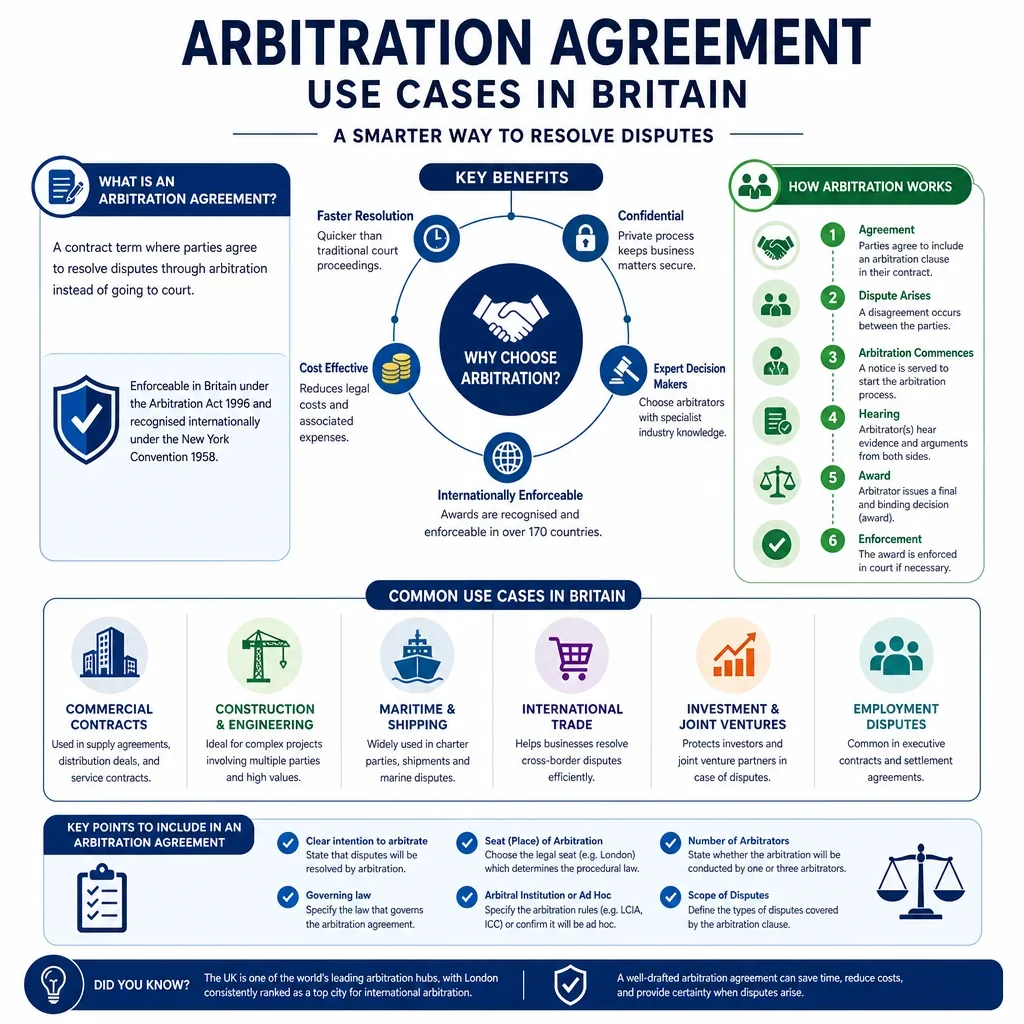
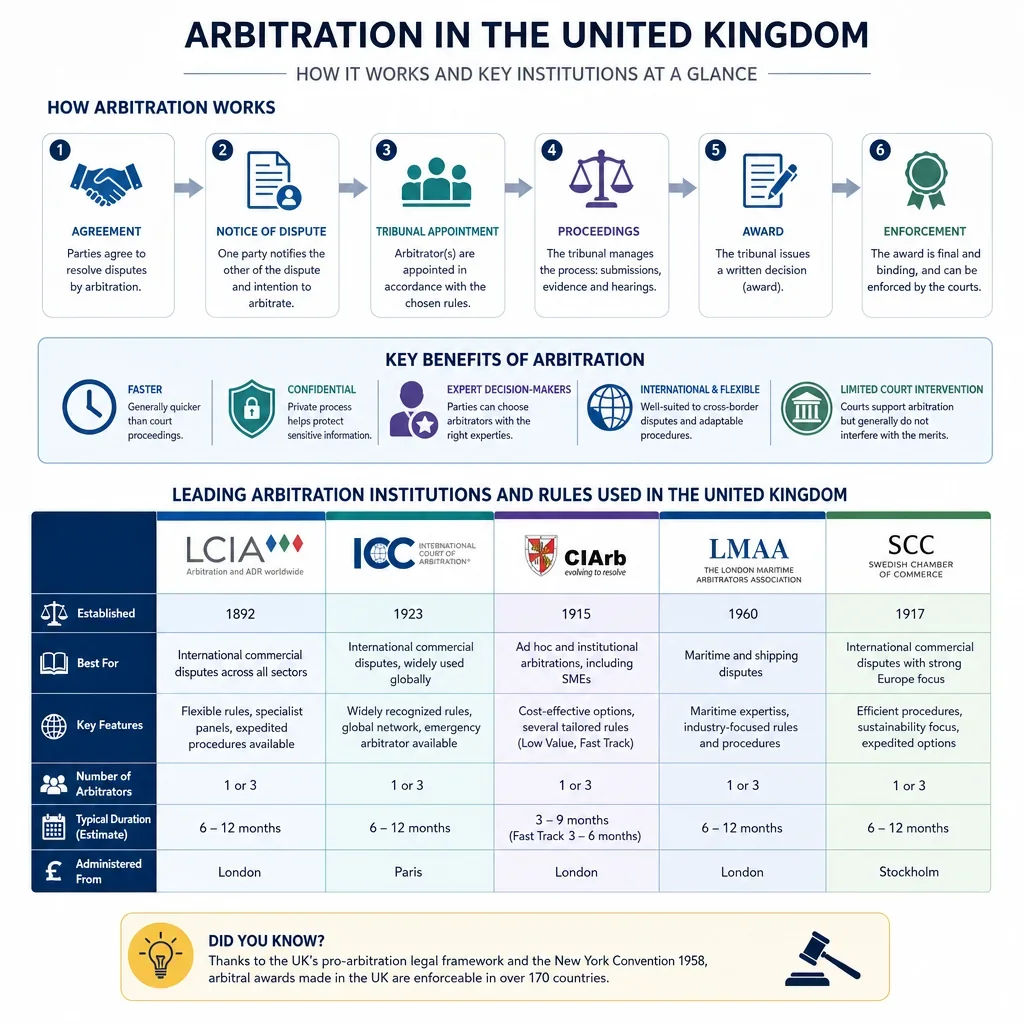
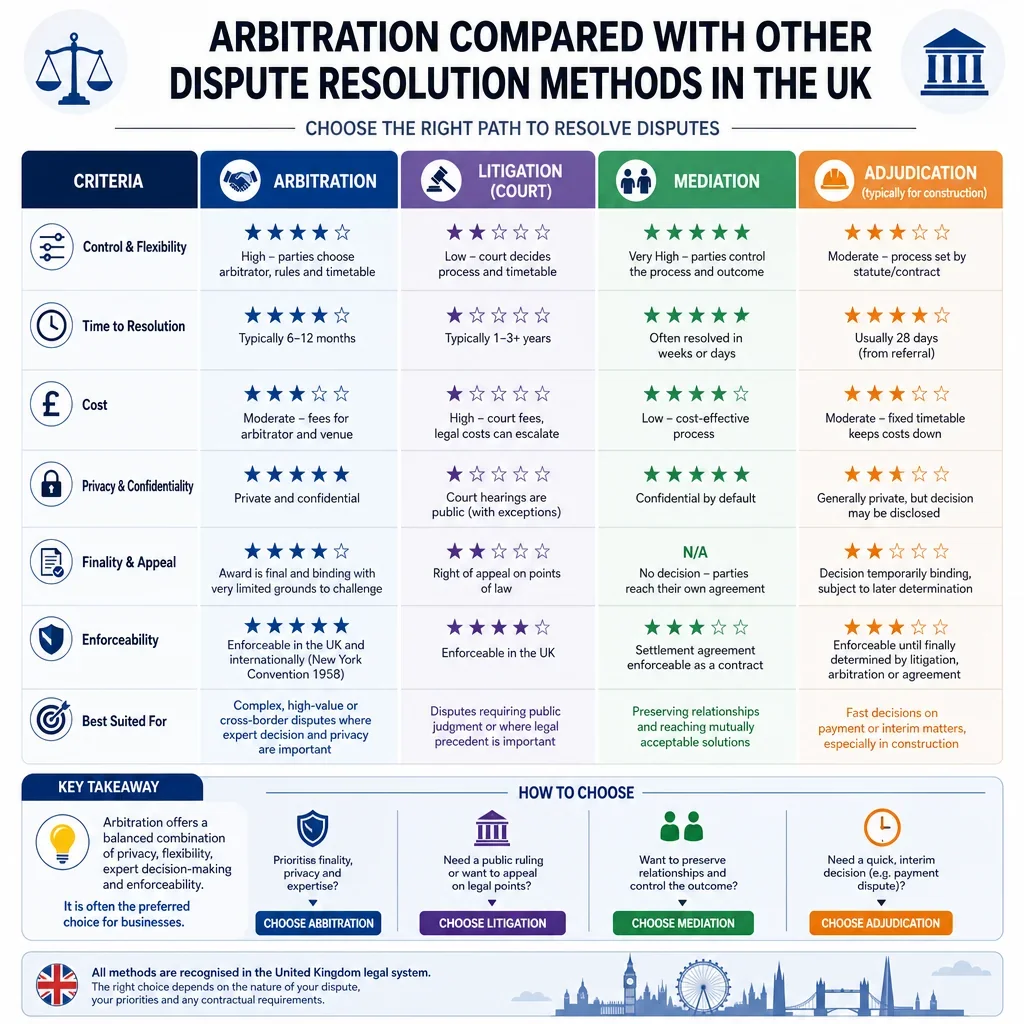
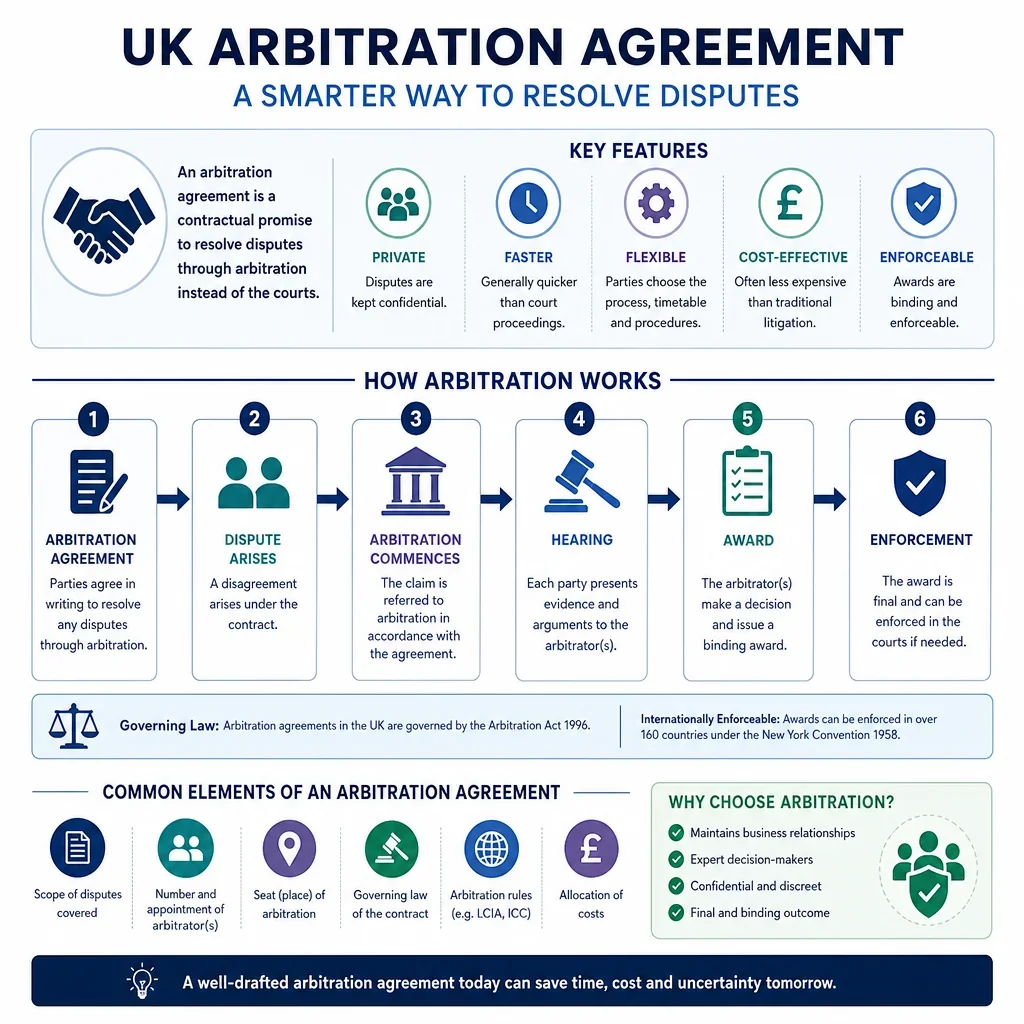
UK arbitration usually follows a structured path: checking the arbitration agreement, starting the claim, appointing the tribunal, setting procedural directions, exchanging submissions and evidence, holding any hearing, issuing the award, and dealing with enforcement or challenges. The arbitration agreement and chosen rules often determine deadlines, appointment mechanics, confidentiality, seat, language, and whether an institution such as the LCIA is involved.
Why Does The Arbitration Agreement Matter So Early?
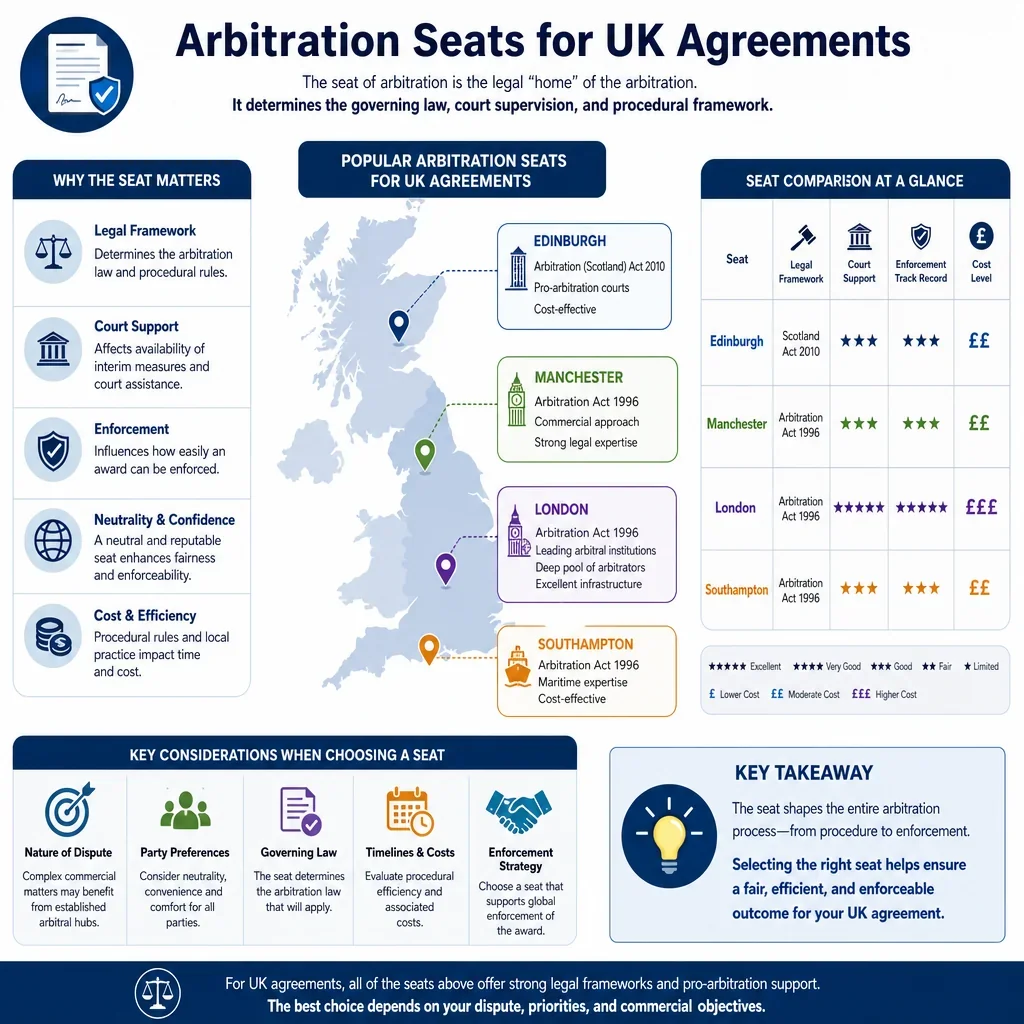
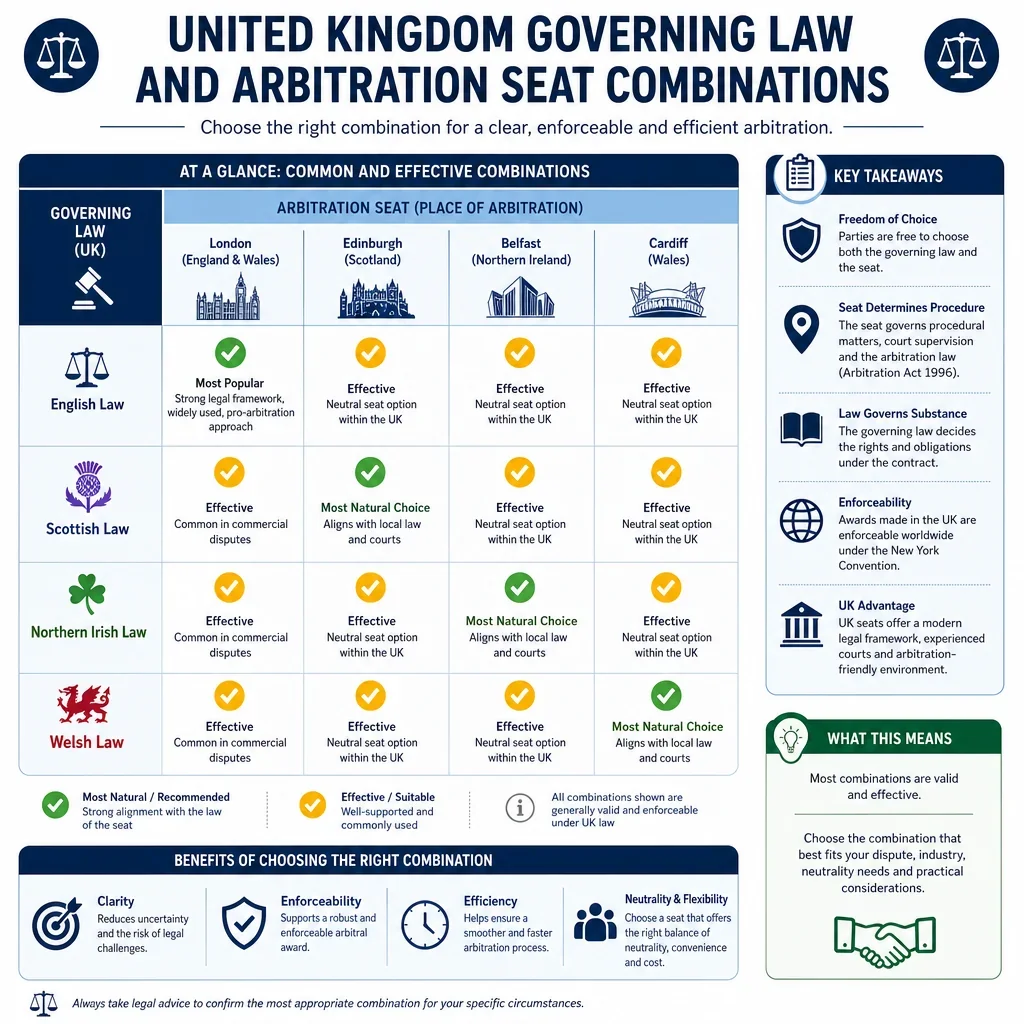
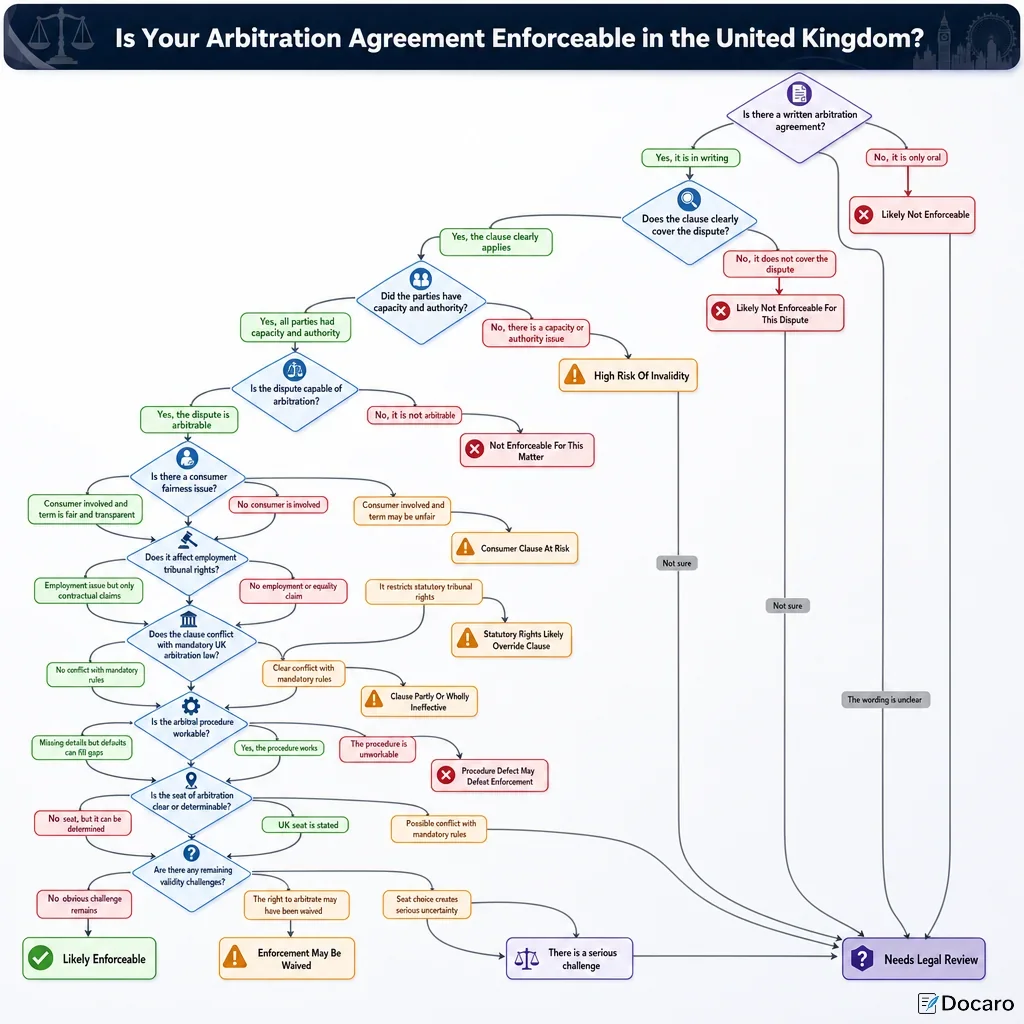
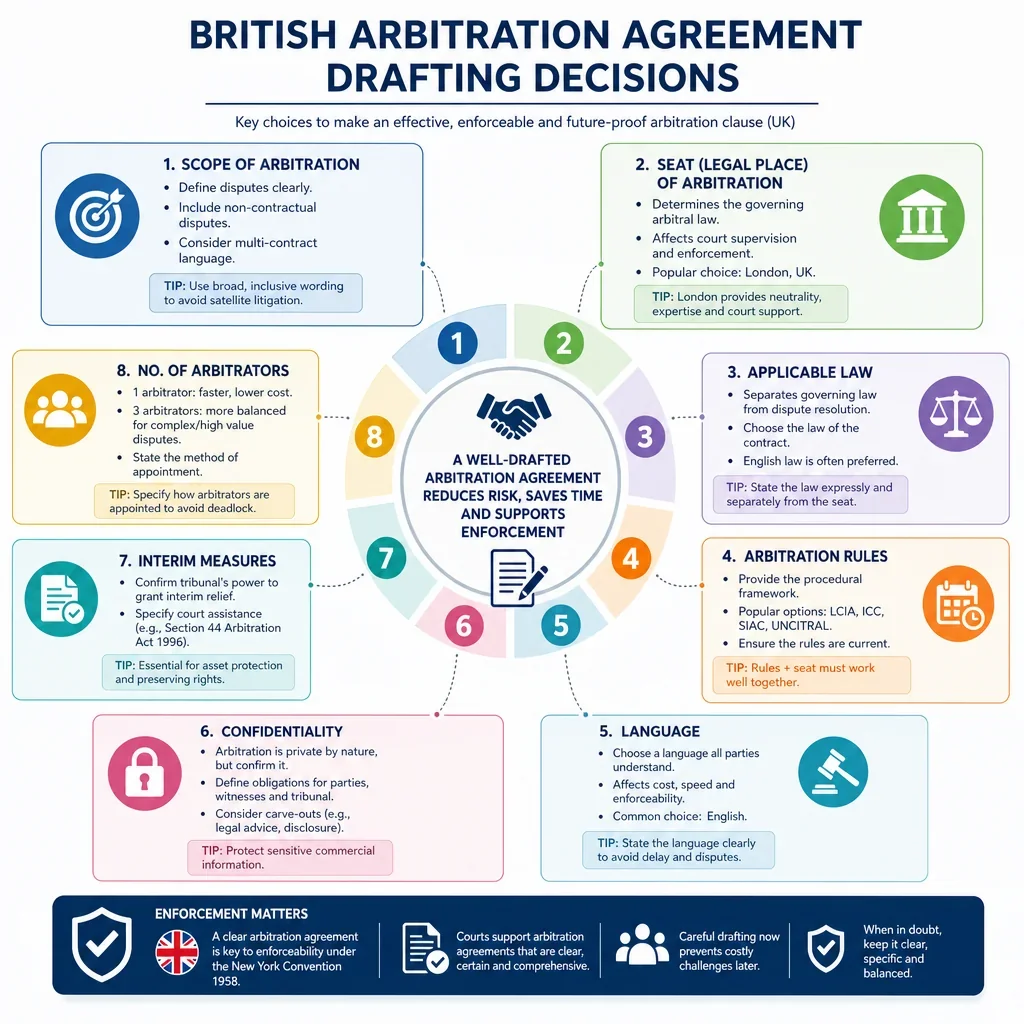
The arbitration agreement is tested at several early stages: whether a dispute is covered, whether pre-arbitration steps have been followed, where the seat is, and how arbitrators are appointed. Under the Arbitration Act 1996, the seat and agreement can affect court support, tribunal powers, challenges to jurisdiction, and enforcement in England, Wales and Northern Ireland.
Which Steps Most Often Need Party Action?
- Before filing: preserve limitation, gather the arbitration clause, comply with negotiation or mediation steps, and prepare the notice of arbitration.
- During the case: serve pleadings, disclose documents, prepare witness and expert evidence, and meet procedural deadlines.
- After the award: consider correction, challenge, recognition, enforcement, settlement, payment, or security for costs consequences.
What UK-Specific Risks Should Users Consider?
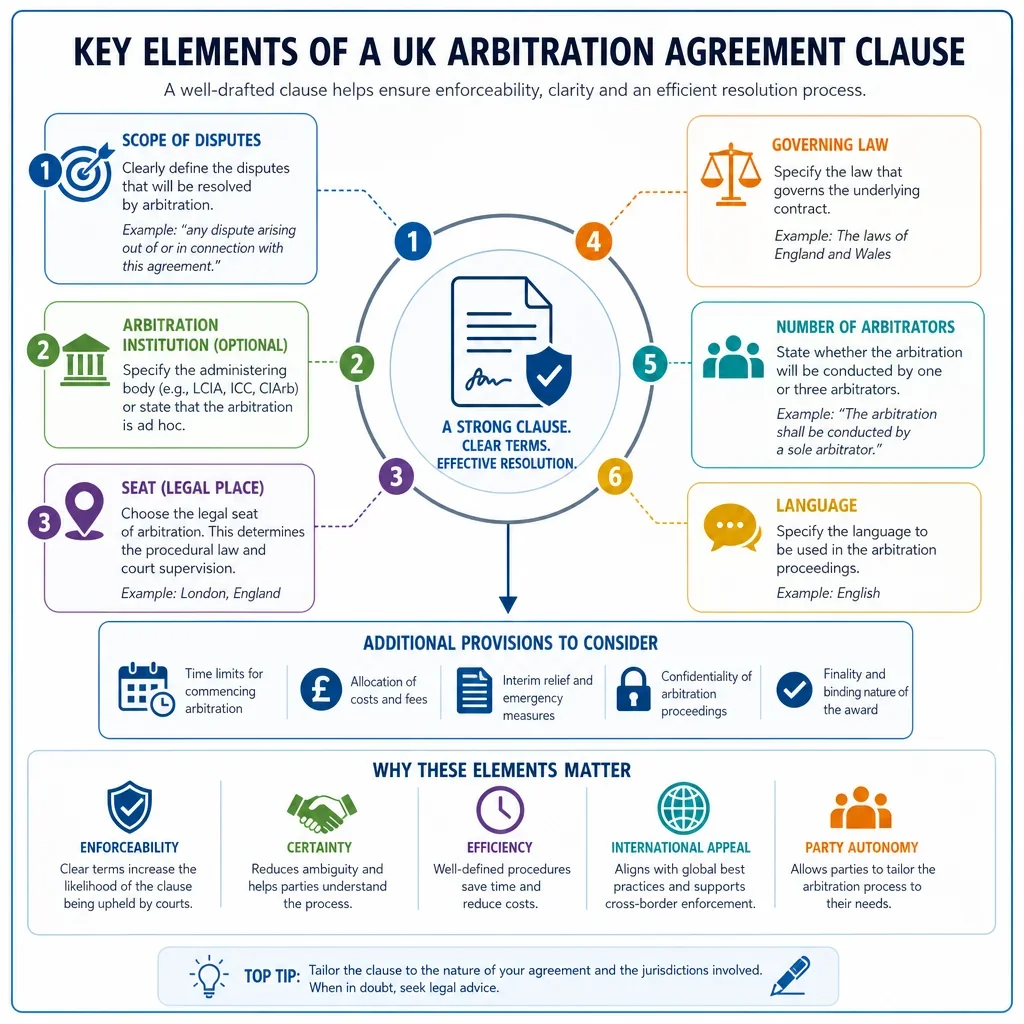
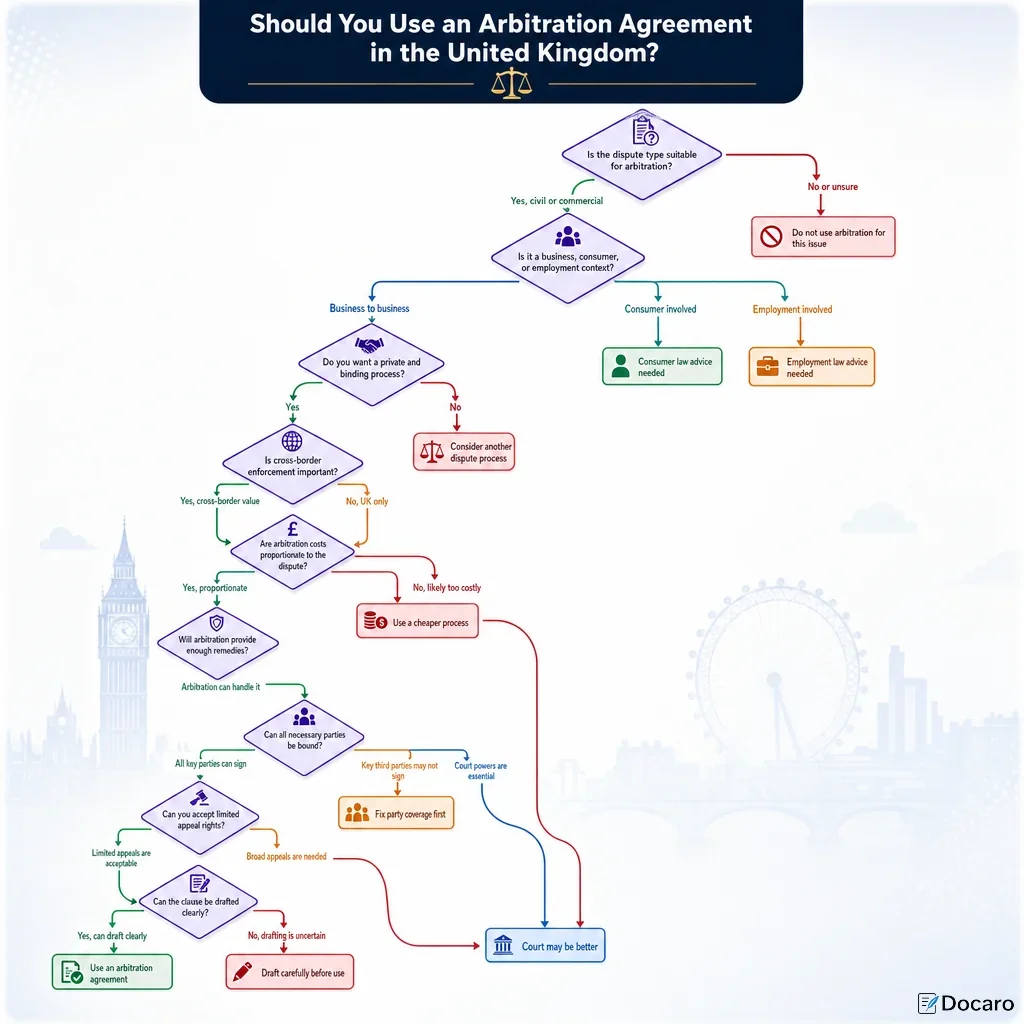
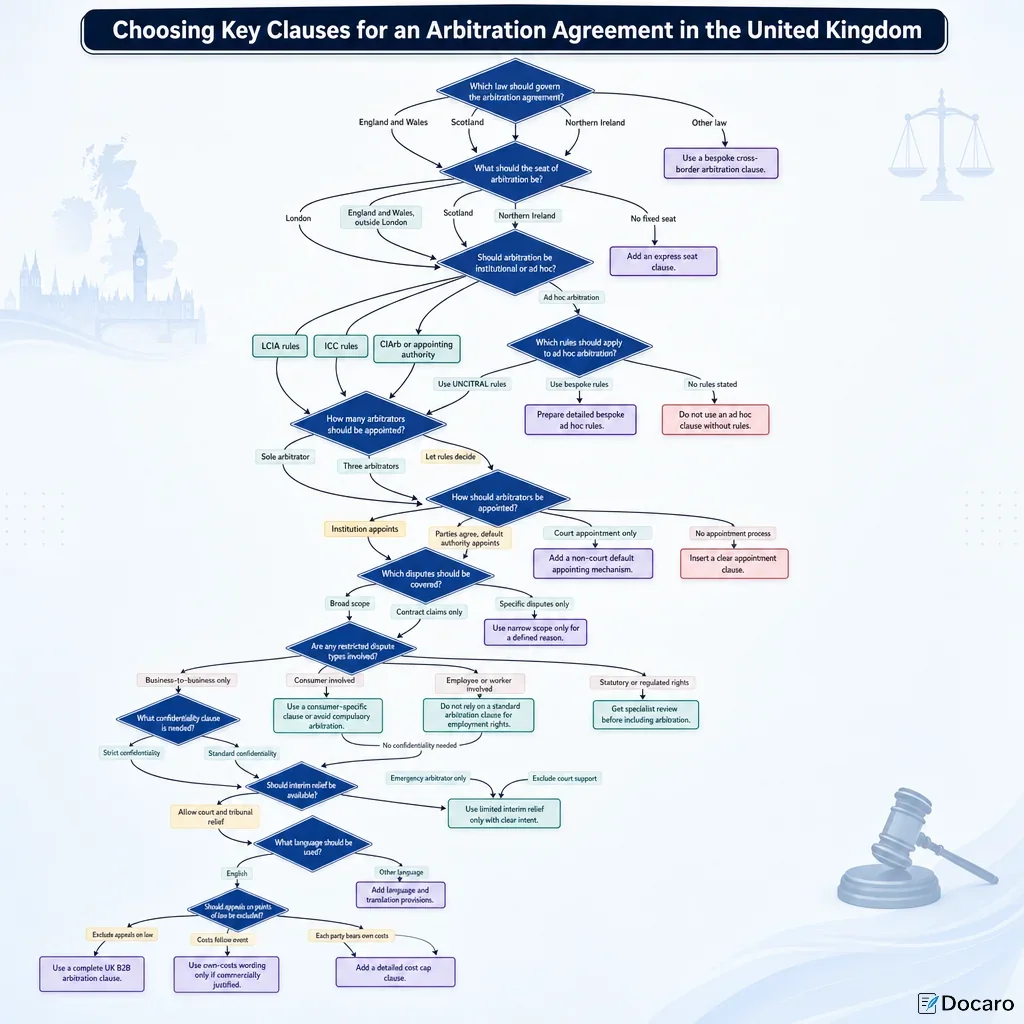
Missing limitation periods, naming the wrong respondent, using the wrong commencement procedure, or ignoring mandatory preconditions can create avoidable jurisdictional disputes. Challenges to an award in England and Wales are generally limited, including challenges for substantive jurisdiction, serious irregularity, or appeals on points of law where available. A well-drafted arbitration agreement can reduce disputes about the seat, rules, number of arbitrators, appointment process, language, confidentiality, and emergency relief.
FAQs
You Might Also Be Interested In