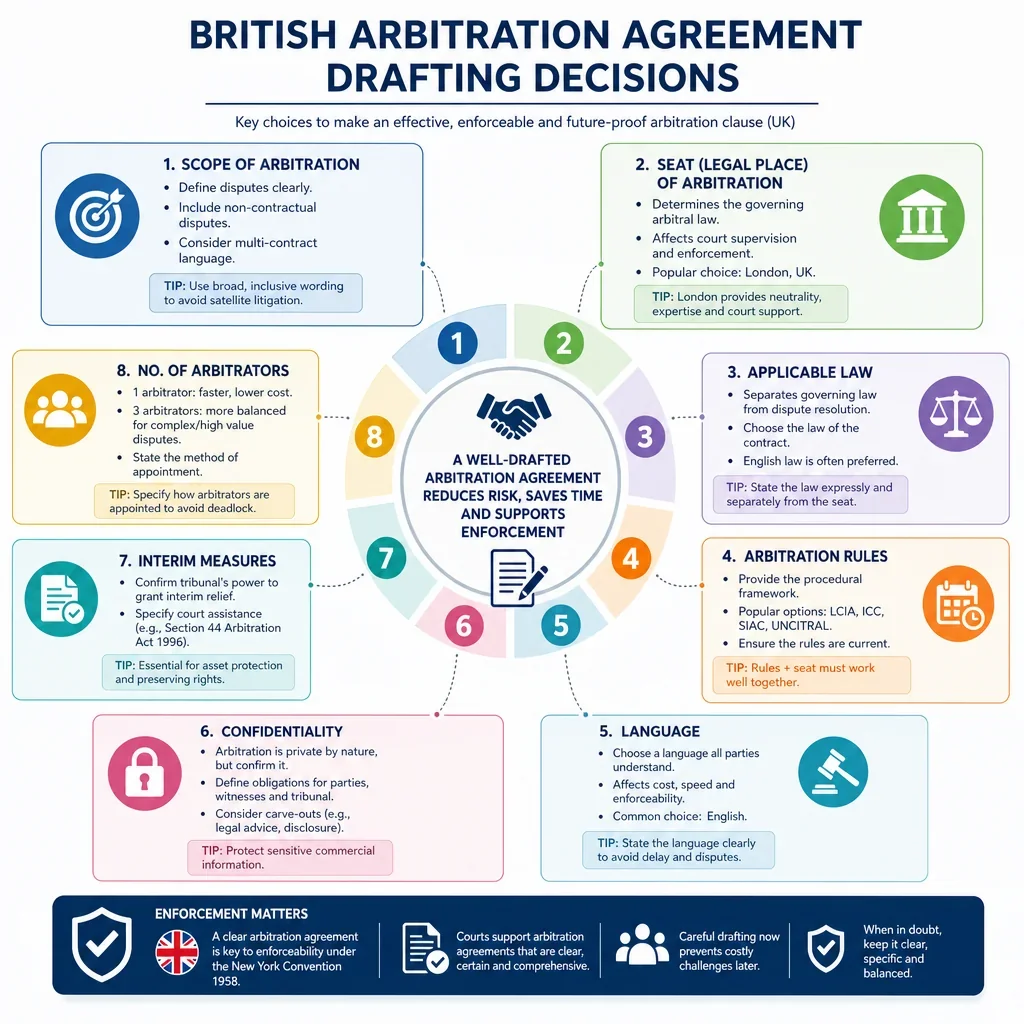
British Arbitration Agreement Drafting Decisions
Decision Category | Common Options | Impact of Decision | User Guidance Note |
|---|---|---|---|
Seat of arbitration | |||
Jurisdiction and law | London Edinburgh Cardiff Belfast another New York Convention seat. | High | The seat usually fixes the procedural law and supervising court, so do not confuse it with the hearing venue. |
Governing law of the contract | |||
Jurisdiction and law | English law Scots law Northern Ireland law foreign law. | High | State the substantive law clearly to avoid arguments about which law decides the merits. |
Law governing the arbitration agreement | |||
Jurisdiction and law | Same as contract law law of the seat express separate choice. | High | Consider an express choice, especially where the contract law and seat are in different countries. |
Arbitration rules | |||
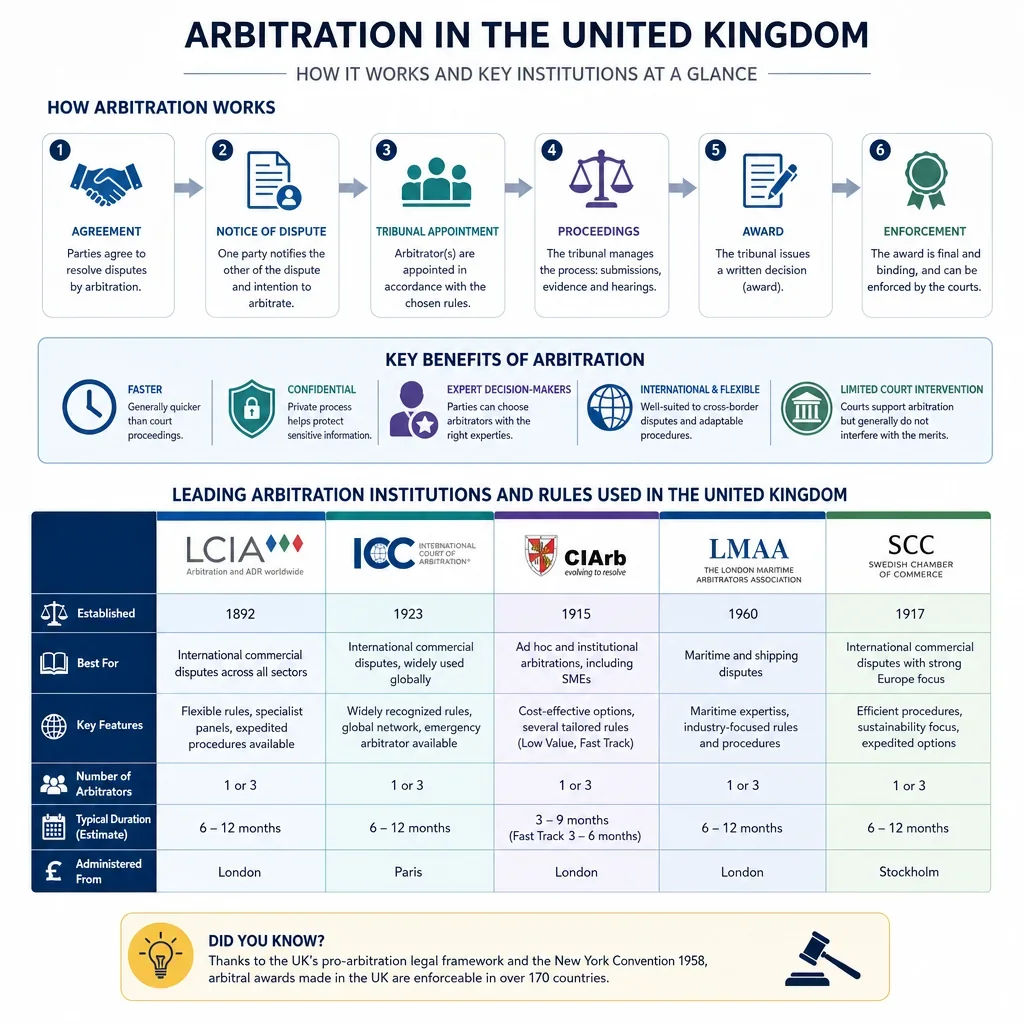
Procedure | LCIA Rules ICC Rules UNCITRAL Rules CIArb rules bespoke ad hoc rules. | High | Rules fill many procedural gaps, including appointments, challenges, emergency relief, and award form. |
Institutional or ad hoc arbitration | |||
Procedure | Administered by LCIA, ICC, SCC, SIAC or CIArb ad hoc under UNCITRAL Rules. | High | Ad hoc arbitration needs stronger drafting on appointments, fees, procedure, and default mechanisms. |
Number of arbitrators | |||
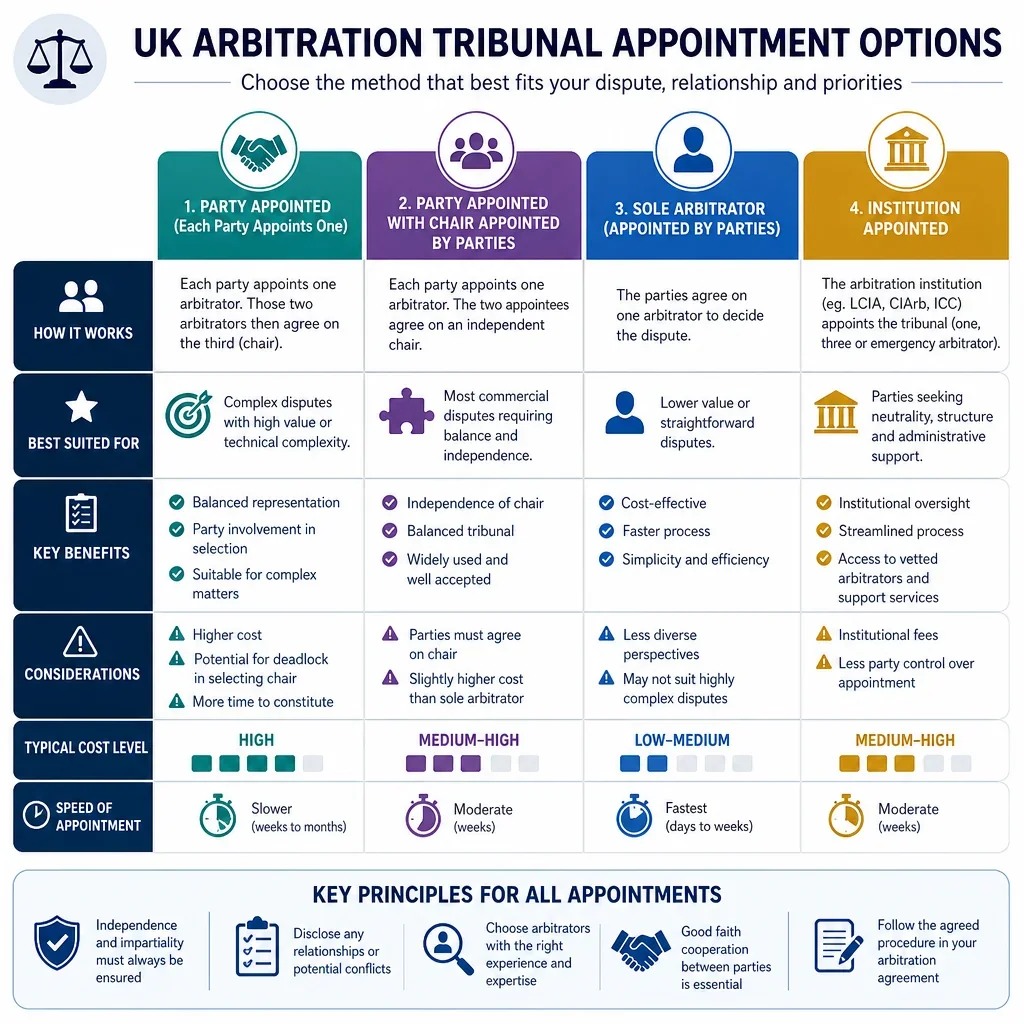
Tribunal | One arbitrator three arbitrators sole arbitrator unless claim value exceeds a threshold. | High | One arbitrator is usually cheaper three may suit complex, high-value, or cross-border disputes. |
Appointment method | |||
Tribunal | Party agreement institution appointment each party appoints one and those appoint the chair. | High | Set a default appointment route so arbitration cannot be stalled by non-cooperation. |
Appointing authority | |||
Tribunal | LCIA Court ICC Court CIArb President court appointment fallback. | High | Name a reliable authority, particularly for ad hoc arbitration or multi-party disputes. |
Arbitrator qualifications | |||
Tribunal | Solicitor or barrister chartered engineer accountant industry specialist no special qualification. | Medium | Use qualifications only where they are essential over-specific criteria can block appointments. |
Independence and impartiality standard | |||
Tribunal | Statutory impartiality only express independence and disclosure duties institutional rules standard. | High | Express disclosure duties help manage conflicts and reduce later challenge risk. |
Tribunal procedural powers | |||
Procedure | Full statutory powers rules-based powers bespoke limits on disclosure, evidence, or hearings. | Medium | Avoid unnecessary restrictions unless speed or cost control is more important than flexibility. |
Scope of disputes covered | |||
Scope of disputes | All disputes arising out of or in connection with the contract specified disputes only carve-outs. | High | Broad wording reduces jurisdiction disputes but check whether any claims should stay in court. |
Non-contractual claims | |||
Scope of disputes | Include tort, misrepresentation, restitution, statutory, and equitable claims exclude some categories. | High | Mention non-contractual claims if you want related disputes heard in one forum. |
Statutory and regulatory claims | |||
Scope of disputes | Include to the extent arbitrable exclude competition, insolvency, consumer, employment, or regulatory matters. | High | Some statutory rights may have arbitrability or public policy limits, so identify sensitive claims. |
Court carve-outs | |||
Scope of disputes | Interim injunctions IP enforcement debt claims confidentiality breaches insolvency proceedings. | Medium | Carve-outs should be narrow and compatible with the overall arbitration obligation. |
Pre-arbitration escalation steps | |||
Procedure | Negotiation executive meeting mediation expert determination cooling-off period none. | Medium | Make steps clear, time-limited, and objective so they do not create enforceability disputes. |
Mandatory mediation before arbitration | |||
Procedure | Required mediation optional mediation mediation in parallel with arbitration no mediation step. | Medium | If mandatory, specify nominating body, timetable, attendance requirements, and when arbitration may start. |
Contractual time limit to start arbitration | |||
Procedure | No special limit shorter contractual deadline deadline linked to notice or final account. | High | Check consistency with limitation law and avoid unclear deadlines that may bar valid claims. |
Notice of arbitration requirements | |||
Procedure | Basic written notice detailed claim summary service by email, post, portal, or courier. | Medium | Align notice rules with the contract notice clause and allow reliable electronic service. |
Language of arbitration | |||
Procedure | English Welsh bilingual language chosen by tribunal language of main contract. | Medium | Choose a language that matches documents, witnesses, lawyers, and likely enforcement needs. |
Venue or hearing location | |||
Procedure | London hearings regional UK hearings virtual hearings tribunal-selected venue. | Medium | State that hearing venue does not change the seat unless that is intended. |
Virtual and hybrid hearings | |||
Procedure | Allowed by default tribunal discretion only by party agreement prohibited for final hearing. | Low | Virtual hearings can reduce cost but consider witness credibility, cybersecurity, and time zones. |
Documents-only procedure | |||
Procedure | Allowed for low-value claims tribunal discretion party consent required no documents-only route. | Medium | Useful for smaller claims, but unsuitable where live witness evidence is important. |
Expedited arbitration procedure | |||
Procedure | Institutional expedited rules bespoke fast-track timetable claim-value threshold opt out. | Medium | Fast-track rules can cut delay but may limit disclosure, submissions, and hearing time. |
Small claims route | |||
Procedure | Fixed-fee sole arbitrator documents-only capped costs online procedure none. | Medium | A proportionate route prevents arbitration costs exceeding the value of lower-value disputes. |
Disclosure and evidence rules | |||
Procedure | Tribunal discretion IBA Rules limited document production no disclosure except ordered. | Medium | Disclosure choices strongly affect cost, speed, and access to evidence. |
Expert evidence | |||
Procedure | Party-appointed experts tribunal-appointed expert single joint expert expert conferencing. | Medium | Technical disputes may need expert rules on duties, reports, meetings, and concurrent evidence. |
Witness evidence format | |||
Procedure | Written witness statements oral examination cross-examination witness conferencing tribunal questions. | Low | Preserve flexibility unless witness credibility will be central to likely disputes. |
Confidentiality obligation | |||
Confidentiality | Express confidentiality clause institutional rule confidentiality privacy only no confidentiality term. | High | State who is bound and what information, documents, hearings, and awards are confidential. |
Confidentiality exceptions | |||
Confidentiality | Court enforcement legal duty regulators auditors insurers funders group companies advisers. | High | Exceptions should be broad enough for compliance, funding, insurance, and enforcement needs. |
Privacy of hearings | |||
Confidentiality | Private hearings only attendance by advisers and experts tribunal-approved attendees public hearings. | Medium | Specify permitted attendees if sensitive commercial, personal, or technical information may be discussed. |
Publication of awards | |||
Confidentiality | No publication anonymised publication publication with consent institution publication rules. | Medium | Balance confidentiality against precedent value, transparency duties, and institutional publication rules. |
Data protection handling | |||
Confidentiality | UK GDPR-compliant processing confidentiality protocol secure transfer room redaction of personal data. | Medium | Plan for personal data in pleadings, evidence, disclosure, awards, and cross-border transfers. |
Cybersecurity protocol | |||
Confidentiality | Secure platform encryption access controls incident notice tribunal cybersecurity directions. | Medium | Important where trade secrets, personal data, sanctions material, or sensitive financial records are involved. |
Tribunal interim measures | |||
Procedure | Express power to order preservation, security, inspection, or interim relief rules-based powers. | High | Interim powers help protect evidence, assets, confidentiality, and the effectiveness of final relief. |
Court interim relief access | |||
Enforcement | Preserve court powers limit court applications require tribunal or institution approval where possible. | High | Do not accidentally remove court support needed for urgent injunctions or evidence preservation. |
Emergency arbitrator procedure | |||
Procedure | Institutional emergency arbitrator opt out bespoke urgent arbitrator court-only urgent relief. | Medium | Useful where urgent relief may be needed before the tribunal is appointed. |
Security for costs | |||
Costs | Tribunal power preserved express power excluded special rules for funded claims. | Medium | Consider this where a claimant may be insolvent, offshore, or third-party funded. |
Deposits and advances on costs | |||
Costs | Equal advances claimant pays first institution schedule tribunal directions non-payment sanctions. | Medium | Non-payment rules prevent a party frustrating the arbitration by refusing advances. |
Allocation of arbitration costs | |||
Costs | Costs follow the event each party bears own costs tribunal discretion capped recovery. | High | Cost rules influence settlement pressure and the financial risk of bringing or defending claims. |
Recoverable legal costs | |||
Costs | Reasonable costs fixed scale capped costs no recovery of in-house costs tribunal assessment. | Medium | Caps and fixed scales improve predictability but may under-compensate a successful party. |
Interest on sums and costs | |||
Costs | Tribunal discretion specified rate base rate plus margin contractual default rate. | Medium | State the rate and period if delay, late payment, or financing cost may be material. |
Currency of award | |||
Enforcement | Contract currency sterling currency of loss tribunal discretion. | Low | Choose a currency matching payments, accounts, and likely enforcement location. |
Form and reasons for award | |||
Enforcement | Reasoned award short reasons agreed award no reasons if parties agree. | Medium | Reasoned awards support confidence and enforcement but may increase time and cost. |
Final and binding wording | |||
Enforcement | Award final and binding subject to statutory challenge rights appeal waiver where permitted. | High | Make finality clear, but remember mandatory challenge routes may still apply. |
Appeal on point of law | |||
Enforcement | Allow statutory appeal exclude section 69 appeal require party consent institutional default exclusion. | High | Excluding appeals improves finality but increases the risk of living with legal error. |
Jurisdiction challenge handling | |||
Enforcement | Rely on statutory challenge require prompt objections tribunal decides own jurisdiction first. | High | Clear scope and appointment wording reduces jurisdiction challenges and enforcement delay. |
Serious irregularity challenge risk | |||
Enforcement | Rely on statutory safeguard procedural fairness wording no attempt to exclude mandatory rights. | High | Draft procedures that preserve equality, fair opportunity to present a case, and tribunal compliance. |
New York Convention enforcement planning | |||
Enforcement | Convention seat and counterparty jurisdiction local enforcement review award formalities checklist. | High | Check enforceability where assets are located, not only where the counterparty is incorporated. |
Written agreement formalities | |||
Enforcement | Signed clause exchange of emails incorporated standard terms separate submission agreement. | High | Keep clear evidence that both parties agreed to arbitrate, especially in online or standard terms contracts. |
Incorporation of arbitration clause by reference | |||
Jurisdiction and law | Clause in main contract express incorporation of terms reference to trade terms separate terms link. | High | Use express wording where standard terms or linked documents contain the arbitration clause. |
Separability wording | |||
Jurisdiction and law | Rely on statute express separability clause expanded wording for invalidity or termination disputes. | Medium | Separability helps the arbitration clause survive allegations that the main contract is invalid. |
Tribunal power to rule on jurisdiction | |||
Jurisdiction and law | Rely on statute express tribunal-first wording court determination by agreement. | Medium | Tribunal-first wording can reduce tactical court applications before the arbitration progresses. |
Stay of court proceedings | |||
Enforcement | Exclusive arbitration wording court carve-outs express right to seek stay. | High | Clear mandatory arbitration wording supports a stay if one party starts court proceedings. |
Consolidation of related arbitrations | |||
Procedure | Allowed by consent institution rules same tribunal may consolidate no consolidation. | Medium | Useful for linked contracts, supply chains, project documents, or group company structures. |
Joinder of additional parties | |||
Procedure | Joinder with all parties' consent institution approval pre-appointment joinder no joinder. | Medium | Address joinder where affiliates, guarantors, subcontractors, or project participants may be involved. |
Multi-contract disputes | |||
Scope of disputes | Same clause across documents umbrella clause separate clauses with compatible seat, rules, and parties. | High | Use consistent clauses across related documents to avoid parallel proceedings. |
Class, representative, or collective claims | |||
Scope of disputes | Individual arbitration only collective arbitration allowed court carve-out for representative claims. | Medium | Check enforceability carefully for consumers, employees, competition claims, and public policy issues. |
Consumer arbitration suitability | |||
Scope of disputes | No mandatory consumer arbitration optional post-dispute arbitration ADR scheme court rights preserved. | High | Mandatory pre-dispute consumer arbitration may be vulnerable to unfair terms controls. |
Employment and worker claims | |||
Scope of disputes | Exclude statutory employment claims arbitrate contractual claims only post-dispute settlement route. | High | UK employment statutes may restrict contracting out of tribunal rights, so draft carve-outs carefully. |
Intellectual property disputes | |||
Scope of disputes | Arbitrate contractual IP disputes court carve-out for validity or registry issues interim injunction carve-out. | Medium | Separate private contractual IP issues from rights needing court or registry action. |
Insolvency-related disputes | |||
Scope of disputes | Court carve-out for winding up or administration arbitration for contractual debt disputes stay mechanism. | High | Insolvency proceedings involve collective statutory processes that may not fit private arbitration. |
Sanctions and illegality issues | |||
Enforcement | Compliance carve-out payment licence wording suspended obligations arbitrator sanctions disclosures. | High | Sanctions can affect appointments, payments, representation, awards, and enforcement. |
State or sovereign party issues | |||
Enforcement | Express arbitration consent immunity waiver service provisions enforcement waiver asset carve-outs. | High | If a state entity is involved, address immunity, authority, service, and enforcement against assets. |
Third-party funding disclosure | |||
Costs | Disclosure of funder identity funding agreement disclosure security for costs trigger no express rule. | Medium | Disclosure helps manage conflicts, costs applications, and security for costs issues. |
Settlement and consent award | |||
Enforcement | Tribunal may record settlement as award private settlement only costs reserved. | Low | A consent award may help enforcement if settlement obligations are not performed. |
Default by non-participating party | |||
Procedure | Proceed in absence dismissal for delay peremptory orders cost sanctions. | Medium | Default rules stop a respondent or claimant derailing the process by silence or delay. |
Service of arbitration documents abroad | |||
Procedure | Email service courier service agent for service deemed receipt rules language requirements. | Medium | Cross-border contracts need practical service rules that will withstand enforcement objections. |
Agent for service of process | |||
Enforcement | UK process agent group company agent solicitor agent no agent. | Medium | Useful where a foreign party has no reliable UK address for notices or court support applications. |
Waiver of procedural objections | |||
Procedure | Rely on statutory waiver require prompt written objections deemed waiver after deadline. | Medium | Prompt objection rules reduce tactical complaints saved until after an unfavourable award. |
Remedies available to tribunal | |||
Enforcement | Damages declarations specific performance injunctions rectification account limited remedies. | High | Ensure the tribunal can grant the remedies needed for the contract and dispute type. |
Punitive or exemplary damages | |||
Enforcement | Exclude punitive damages permit if governing law allows cap damages no express provision. | Medium | Consider enforceability and public policy where foreign law or US parties are involved. |
Equitable and injunctive relief | |||
Enforcement | Tribunal power preserved court carve-out emergency arbitrator exclude specific performance. | High | Important for confidentiality, IP, restrictive covenants, and unique asset obligations. |
Interaction with liability limits | |||
Enforcement | Apply contract caps exclude costs from cap exclude fraud or deliberate breach tribunal discretion. | Medium | Clarify whether damages caps apply to awards, interest, legal costs, and tribunal fees. |
Governing language of contract and clause | |||
Jurisdiction and law | English version prevails bilingual equal authority certified translation controls. | Medium | For bilingual contracts, specify which text prevails to avoid interpretation disputes. |
Authority to agree arbitration | |||
Jurisdiction and law | Board authority delegated signatory authority power of attorney authorised online acceptance. | High | Check signatory authority, especially for companies, partnerships, public bodies, and agents. |
Online acceptance of arbitration clause | |||
Jurisdiction and law | Clickwrap acceptance signed order form incorporated terms hyperlink audit trail evidence. | High | Keep acceptance records showing the user had notice of the arbitration clause before contracting. |
Standard terms reasonableness risk | |||
Enforcement | Negotiated clause prominent standard term opt-out right bespoke dispute clause. | Medium | In standard terms, make arbitration prominent and reasonable to reduce challenge risk. |
Mandatory Arbitration Act provisions | |||
Jurisdiction and law | Draft within mandatory rules do not attempt invalid exclusions adapt non-mandatory provisions. | High | Some Arbitration Act 1996 provisions apply regardless of contrary agreement for an English seat. |
Use or vary statutory default rules | |||
Procedure | Rely on defaults vary by clause replace with institutional rules bespoke procedural code. | Medium | Institutional rules and bespoke wording can override many non-mandatory statutory defaults. |
Equal treatment of parties | |||
Procedure | Balanced appointment rights equal submission rights fair hearing timetable no unilateral control. | High | One-sided procedures can create serious irregularity and enforcement objections. |
Arbitrator immunity | |||
Tribunal | Rely on statutory immunity institutional immunity wording expanded indemnity where lawful. | Low | Usually covered by statute or rules, but check bespoke appointments and ad hoc terms. |
Arbitrator fees and expenses | |||
Costs | Institution fee scale hourly rates capped fees fixed fee for small claims tribunal determination. | Medium | Fee structure affects cost predictability and suitability for low-value disputes. |
VAT and tax on arbitration costs | |||
Costs | Costs exclusive of VAT VAT recoverable if payable tax gross-up tribunal discretion. | Low | Clarify VAT treatment if parties have different VAT recovery positions. |
Survival of confidentiality duties | |||
Confidentiality | Survives termination indefinitely fixed period survives until public domain enforcement exceptions. | Medium | Survival wording matters because disputes often arise after contract termination. |
Legal privilege and without prejudice material | |||
Procedure | English privilege rules governing law privilege rules tribunal discretion express without prejudice protection. | Medium | Cross-border disputes can raise different privilege standards, so consider an express rule. |
Suspension of limitation during ADR steps | |||
Procedure | No suspension contractual standstill arbitration may start to protect limitation mediation without prejudice. | High | Pre-arbitration negotiation should not accidentally cause claims to become time-barred. |
Asset preservation and freezing relief | |||
Enforcement | Court freezing injunction carve-out tribunal interim order emergency arbitrator disclosure of assets. | High | Preserve urgent court powers where there is risk assets will be dissipated before award. |
Anti-suit relief for breach of arbitration clause | |||
Enforcement | Express exclusive arbitration obligation court support preserved damages for breach no express wording. | Medium | Strong exclusive wording supports remedies if a party sues elsewhere despite the clause. |
Consistency with court jurisdiction clause | |||
Jurisdiction and law | Arbitration exclusive courts only for support split jurisdiction court clause deleted. | High | Avoid conflicting arbitration and court clauses unless the split is intentional and precise. |
Expert determination interface | |||
Scope of disputes | Expert for technical valuation only arbitration for legal disputes expert decision final appeal to arbitration. | Medium | Define which disputes go to an expert and which go to arbitration. |
Construction adjudication interaction | |||
Scope of disputes | Adjudication first arbitration final determination court enforcement of adjudicator decision carve-outs. | High | UK construction contracts may have statutory adjudication rights that arbitration wording must accommodate. |
Maritime or trade arbitration rules | |||
Procedure | LMAA Terms GAFTA Rules FOSFA Rules LCIA bespoke trade association rules. | Medium | Sector rules may be expected in shipping, commodities, insurance, and trade contracts. |
Scottish seat considerations | |||
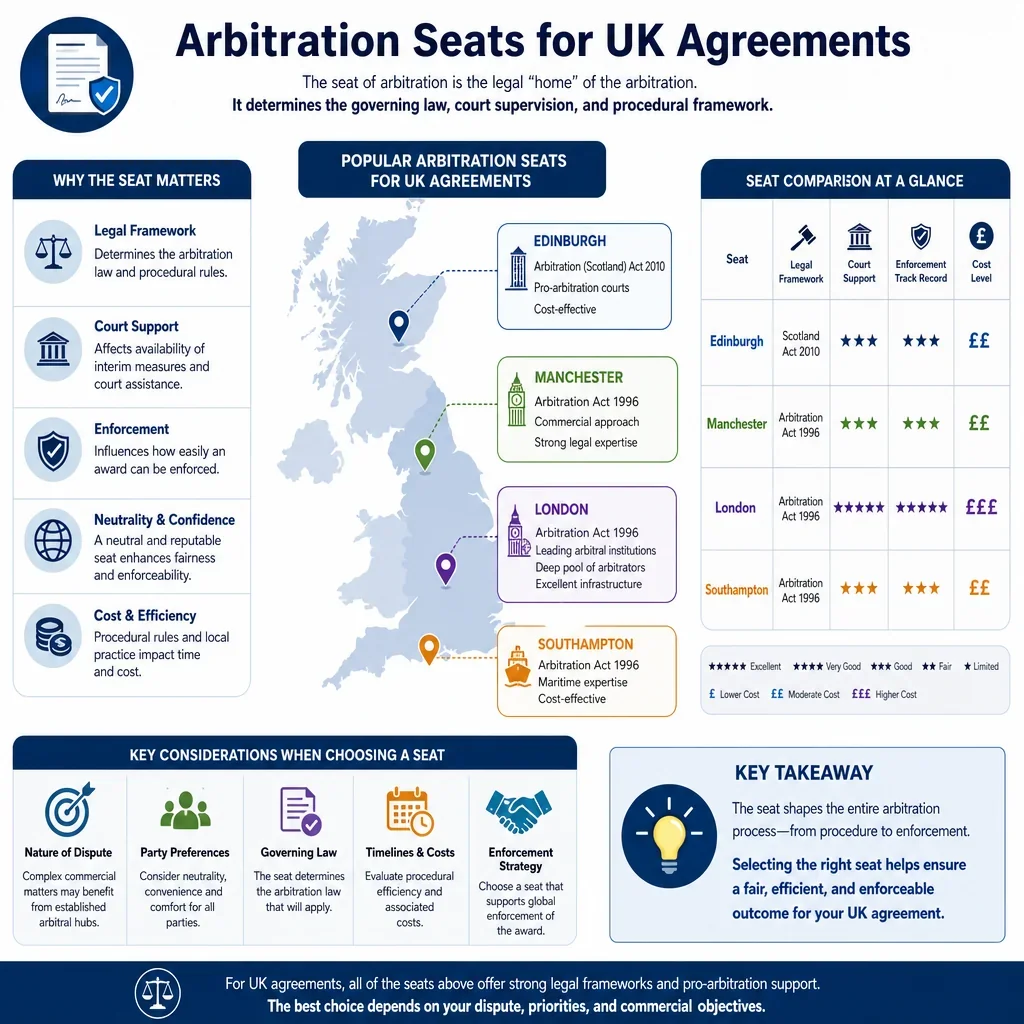
Jurisdiction and law | Edinburgh or Glasgow seat Scottish Arbitration Rules Scots law institutional rules. | High | A Scottish seat engages the Arbitration (Scotland) Act 2010 rather than the Arbitration Act 1996. |
Northern Ireland seat considerations | |||
Jurisdiction and law | Belfast seat Northern Ireland law institutional rules English seat instead. | High | Northern Ireland has its own arbitration legislation, so do not assume English-seat rules apply. |
Welsh language and Wales venue issues | |||
Procedure | English-only arbitration Welsh evidence permitted bilingual documents Cardiff hearings. | Low | If Welsh-language evidence is likely, plan translation, interpretation, and award language. |
Electronic signature and records | |||
Enforcement | Electronic signature accepted platform audit trail wet-ink signature counterpart execution. | Medium | Keep reliable records of signature, identity, timing, and incorporated terms. |
Counterparts and separate signing | |||
Jurisdiction and law | Counterparts permitted scanned copies valid electronic copies valid single original only. | Low | Counterpart wording helps prove agreement where parties sign separate copies. |
Amendment of arbitration clause | |||
Jurisdiction and law | Written amendment only signed variation email variation no oral modification clause. | Medium | Make variations clear because changing the dispute forum can affect accrued and future rights. |
Survival after termination | |||
Jurisdiction and law | Clause survives termination applies to rescission and invalidity disputes no express survival wording. | High | Express survival wording reduces arguments where the main contract has ended or is challenged. |
Assignment and novation effects | |||
Jurisdiction and law | Clause binds assignees novation requires acceptance group transfer provisions no transfer wording. | Medium | Address whether successors, assignees, novated parties, and guarantors are bound. |
Guarantor and surety disputes | |||
Scope of disputes | Same arbitration clause in guarantee guarantor joinder court carve-out for demand enforcement. | High | Guarantees need compatible dispute clauses to avoid separate court and arbitration proceedings. |
Group company participation | |||
Scope of disputes | Only signatories bound affiliates may claim affiliates may be joined third-party rights excluded. | Medium | If affiliates perform or benefit from the contract, state their dispute rights clearly. |
Third-party rights interaction | |||
Scope of disputes | Exclude third-party rights bind beneficiaries to arbitration allow named beneficiaries to enforce. | Medium | If third parties can enforce contract terms, align their rights with the arbitration clause. |
Disclosure to insurers and brokers | |||
Confidentiality | Express permitted disclosure notice to other party confidentiality undertakings no insurer exception. | Low | Insurance notifications often require sharing pleadings, evidence, settlement positions, and awards. |
Disclosure to auditors and accountants | |||
Confidentiality | Permitted disclosure need-to-know basis professional confidentiality duty redacted documents. | Low | Audit and financial reporting may require disclosure of claims, liabilities, and awards. |
Regulatory reporting exception | |||
Confidentiality | Disclosure to FCA, PRA, HMRC, OFSI, ICO, exchange, or other regulator notice where lawful. | Medium | Regulated parties need exceptions for compulsory or prudent reporting. |
Disclosure to legal and professional advisers | |||
Confidentiality | Permitted disclosure adviser confidentiality duty litigation support providers translators and experts. | Low | Arbitration cannot be run effectively unless advisers and support providers may receive materials. |
Correction or clarification of award | |||
Enforcement | Statutory correction route institutional time limit bespoke correction period no extra wording. | Low | Correction mechanisms fix clerical mistakes without reopening the merits. |
Partial and interim awards | |||
Procedure | Tribunal may issue partial awards separate liability and quantum no bifurcation unless agreed. | Medium | Partial awards can narrow issues and support settlement, but may add procedural steps. |
Summary dismissal of weak claims | |||
Procedure | Express summary dismissal power institutional early determination tribunal discretion no summary route. | Medium | Useful for plainly unmeritorious claims or defences, but procedural fairness must be preserved. |
Confidentiality of arbitration existence | |||
Confidentiality | Existence confidential only materials confidential disclosures for reporting and enforcement allowed. | Medium | Public companies and regulated entities may need to disclose that a dispute exists. |
Remedies for confidentiality breach | |||
Confidentiality | Injunction damages indemnity cost sanctions tribunal directions court carve-out. | Medium | Express remedies help where commercial sensitivity is central to choosing arbitration. |
Public sector transparency duties | |||
Confidentiality | FOIA exception publication duties preserved redaction mechanism confidentiality subject to law. | Medium | Public authorities may need disclosure exceptions for freedom of information and transparency rules. |
What Drafting Choices Matter Most In A UK Arbitration Agreement?
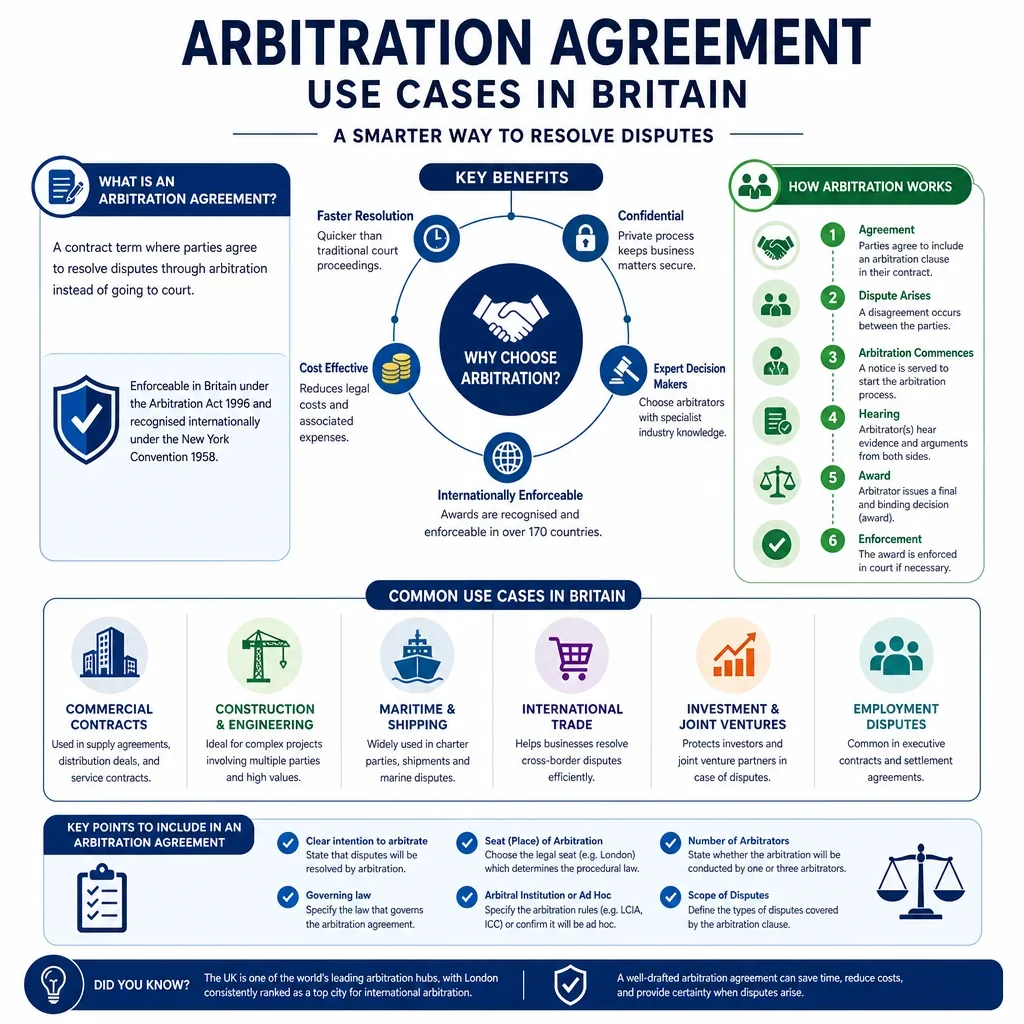
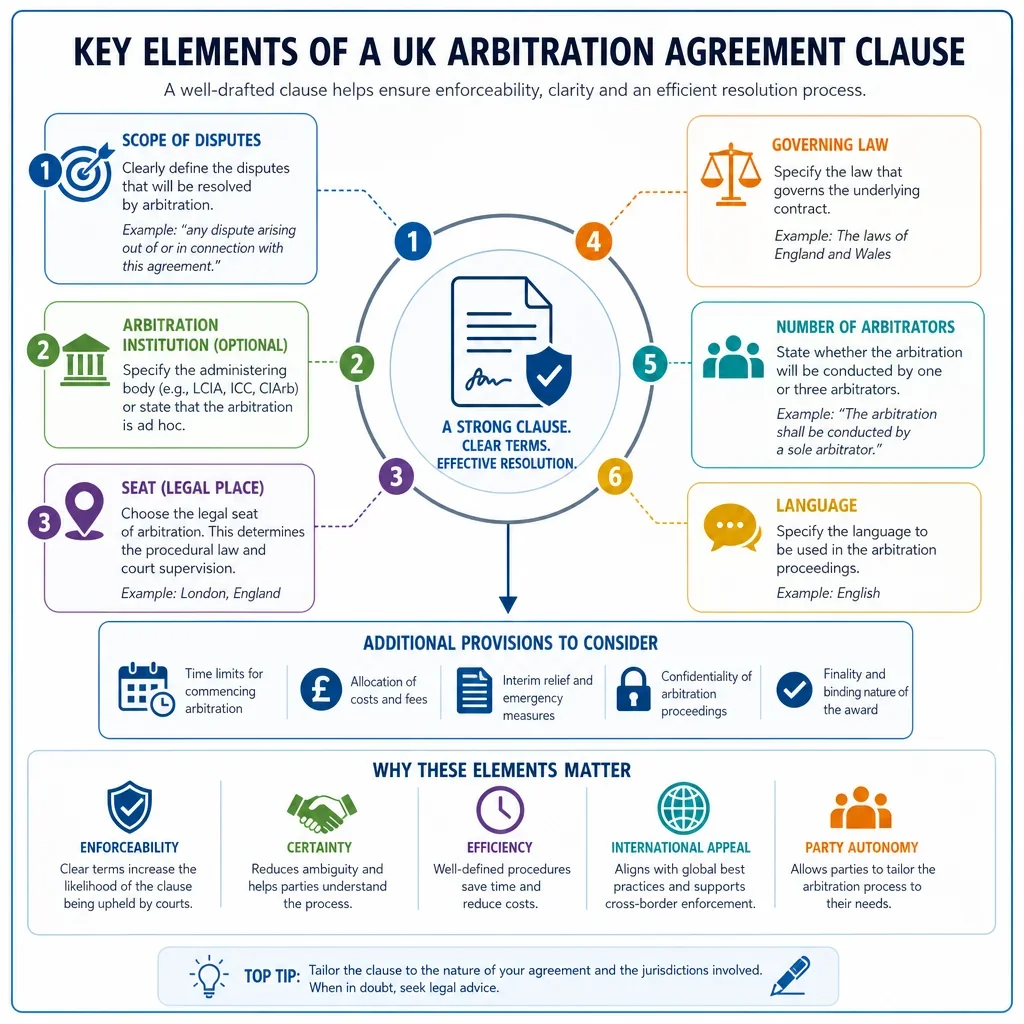
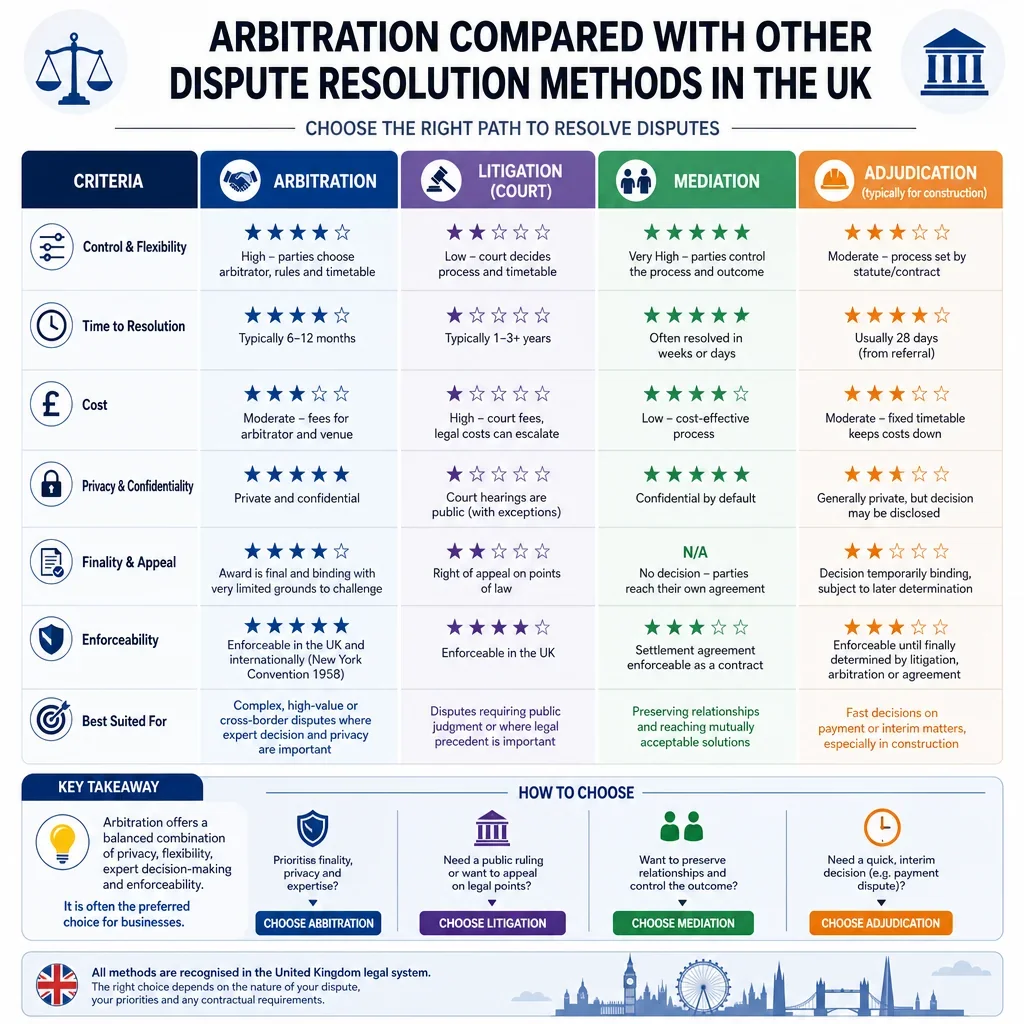
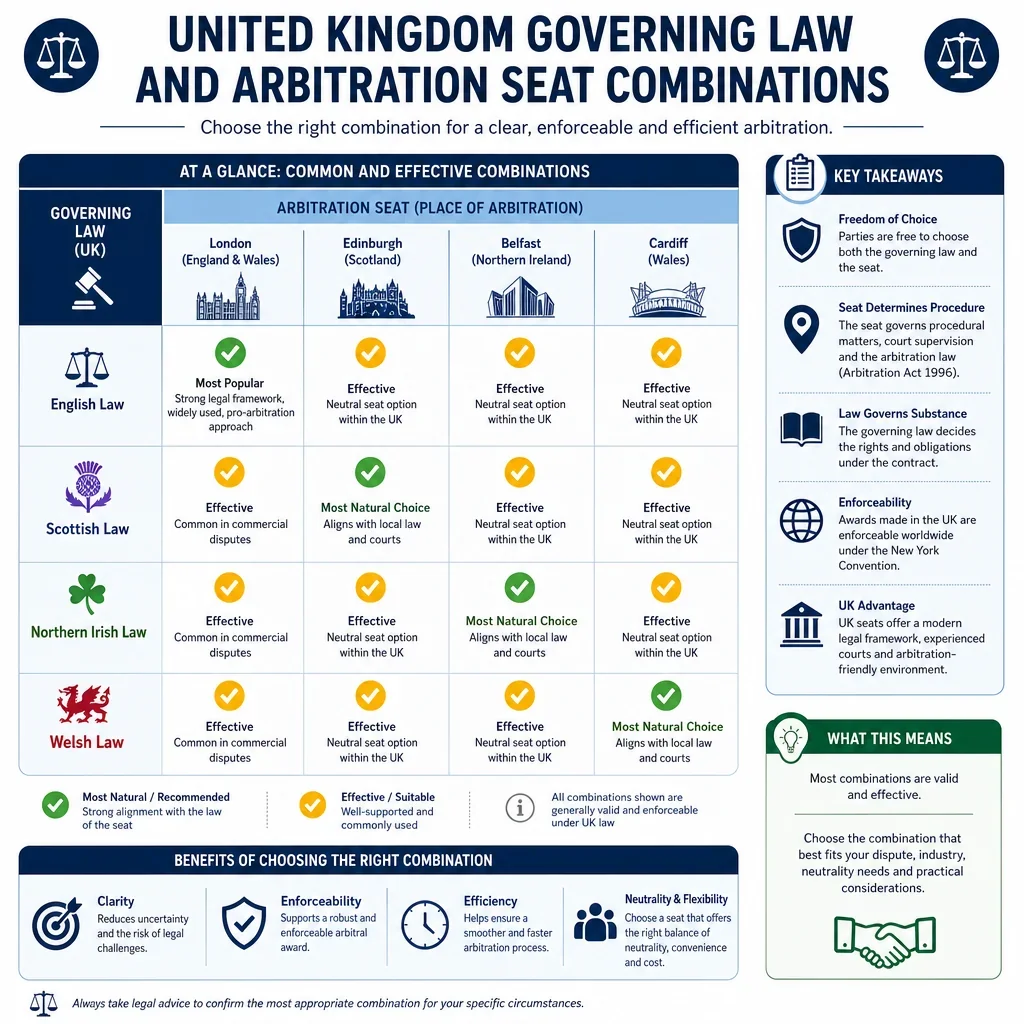
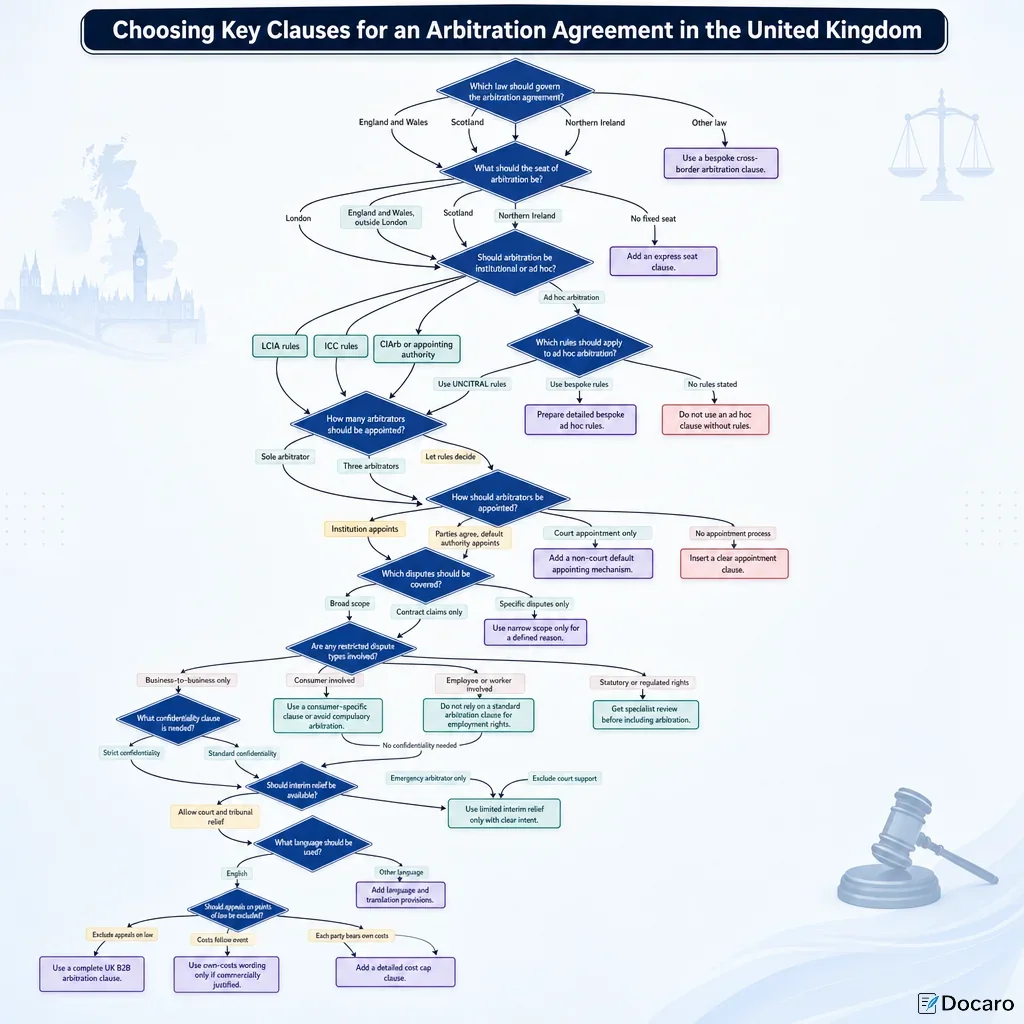
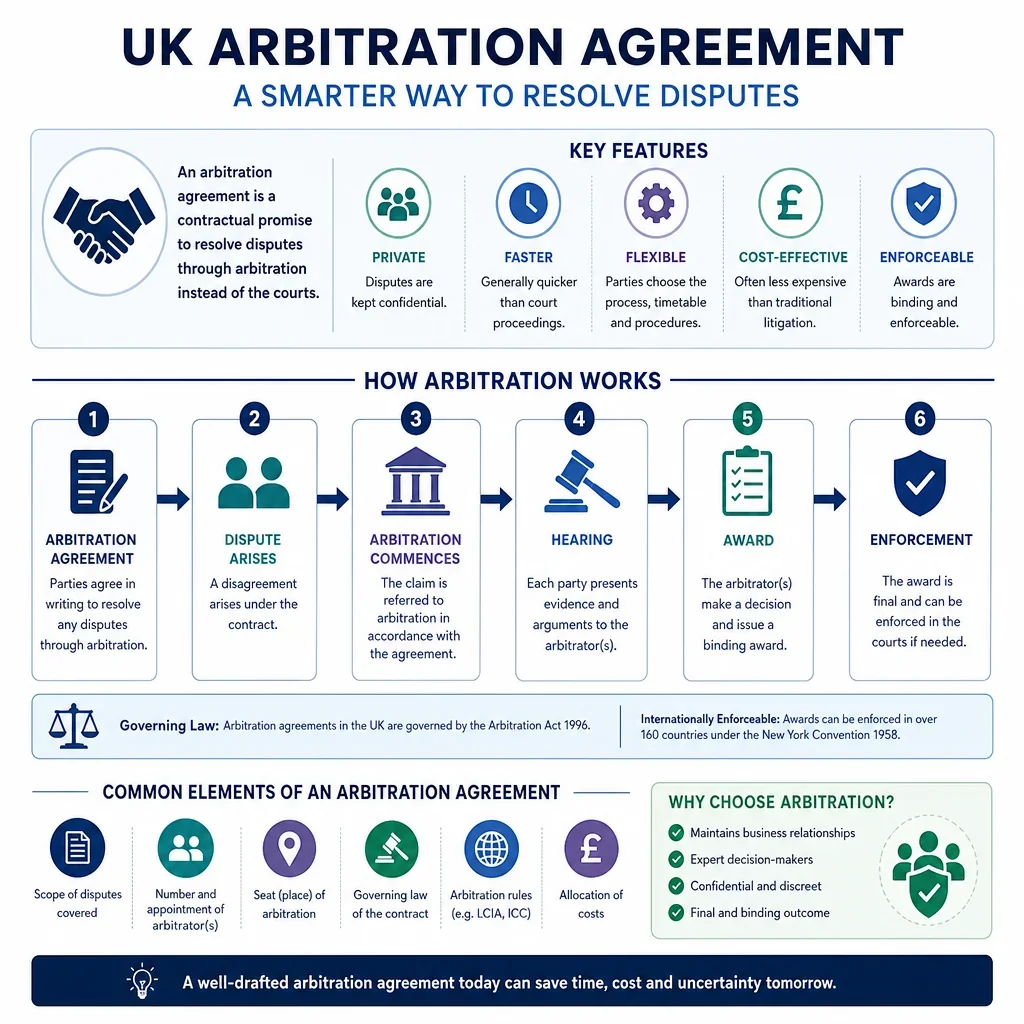
The highest-impact decisions are the seat, governing law, institutional rules, tribunal appointment process, scope of disputes, confidentiality, interim relief, and enforcement wording. In the UK context, the seat is especially important because it usually determines the procedural law and court supervision of the arbitration under the Arbitration Act 1996.
Why Is The Seat Of Arbitration Different From The Venue?
The seat is the legal home of the arbitration; the venue is only where hearings may physically or virtually take place. Choosing London as the seat normally engages the English courts for supervisory issues, while hearings can still occur elsewhere.
Should UK Users Choose Institutional Or Ad Hoc Arbitration?
Institutional arbitration, such as LCIA or ICC arbitration, gives ready-made rules and administrative support. Ad hoc arbitration can be cheaper and more flexible, but it needs more careful drafting on appointments, procedural rules, default mechanisms, fees, and consolidation.
What Should The Clause Say About Disputes Covered?
A broad clause covering disputes arising out of or in connection with the contract usually reduces arguments about jurisdiction. Narrow wording may be useful for specific claims but can create satellite disputes if it excludes tort, misrepresentation, restitution, statutory, or non-contractual claims unintentionally.
How Do Confidentiality And Transparency Affect UK Arbitration?
English arbitration is generally private, but confidentiality should still be drafted expressly because exceptions may apply for enforcement, regulatory reporting, court applications, group companies, insurers, funders, auditors, and professional advisers.
What Enforcement Points Should Be Checked?
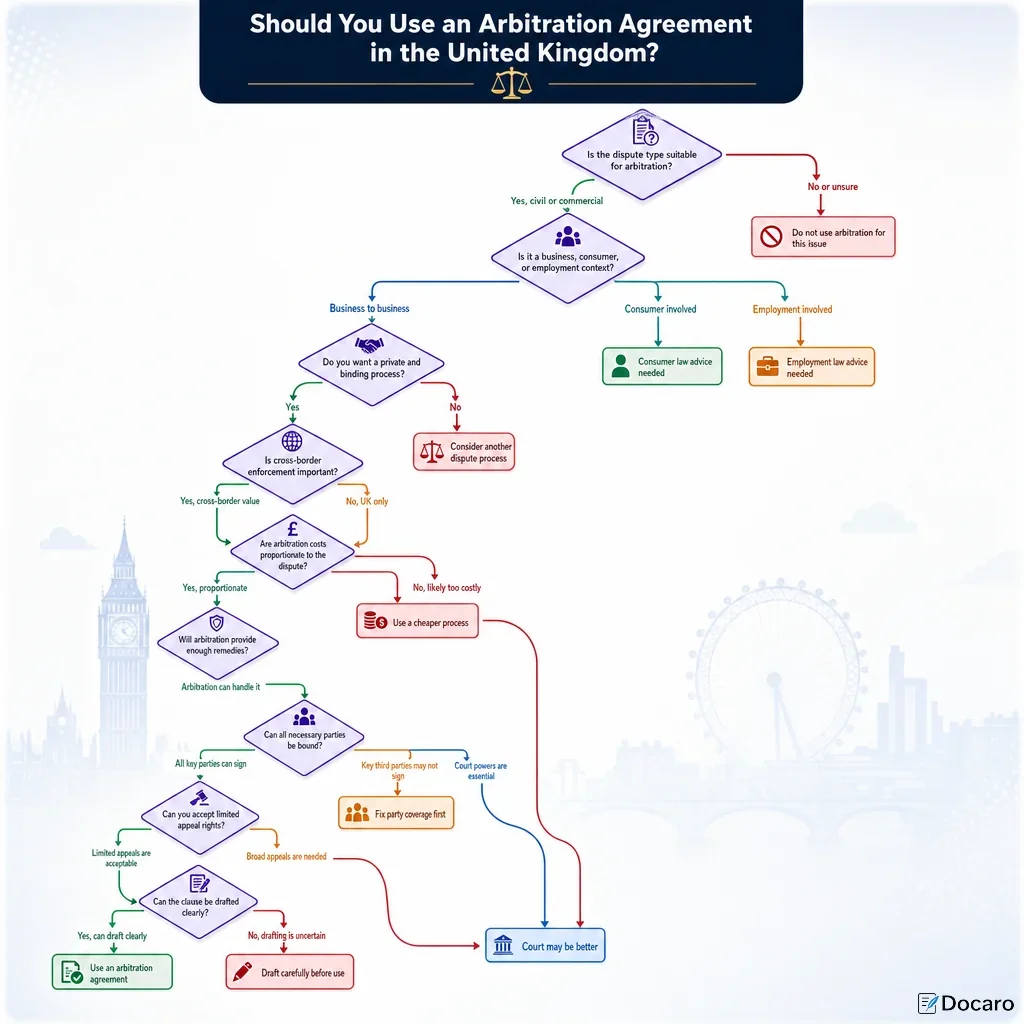
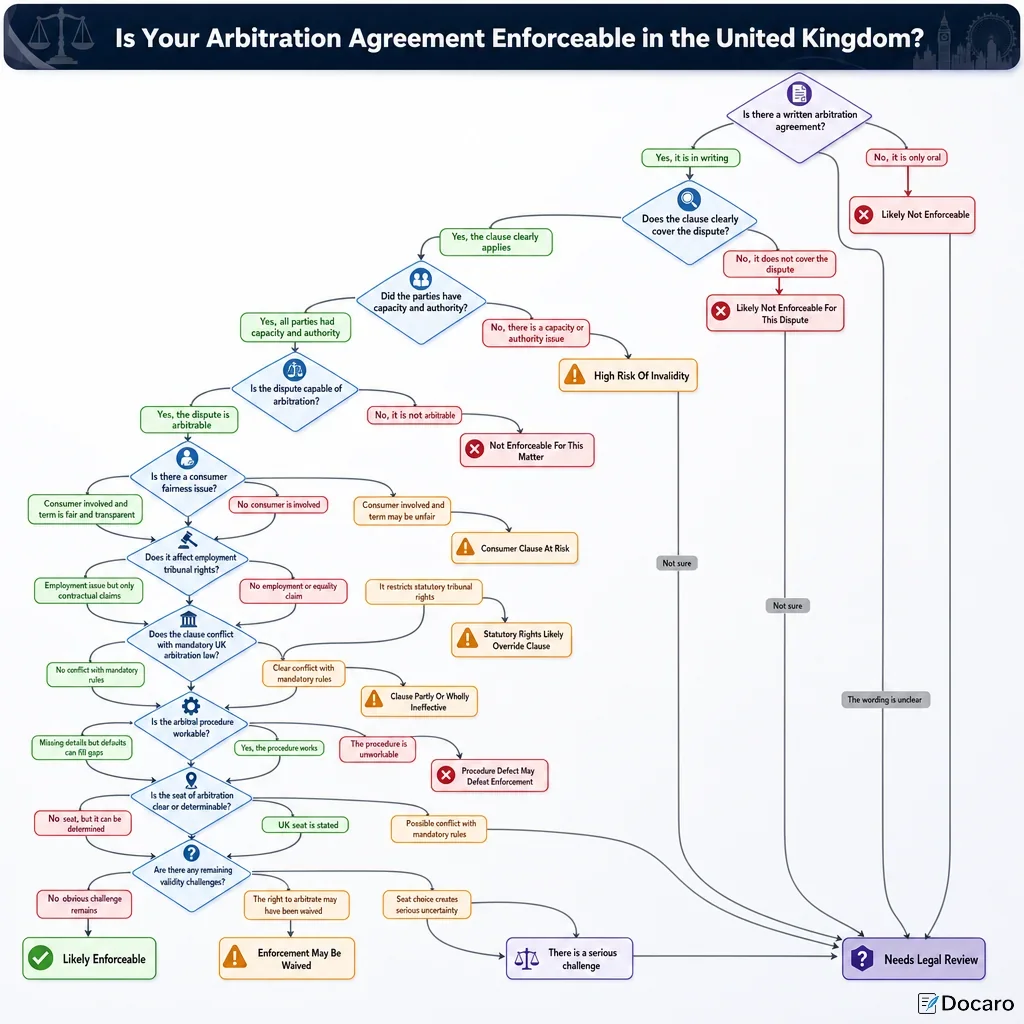
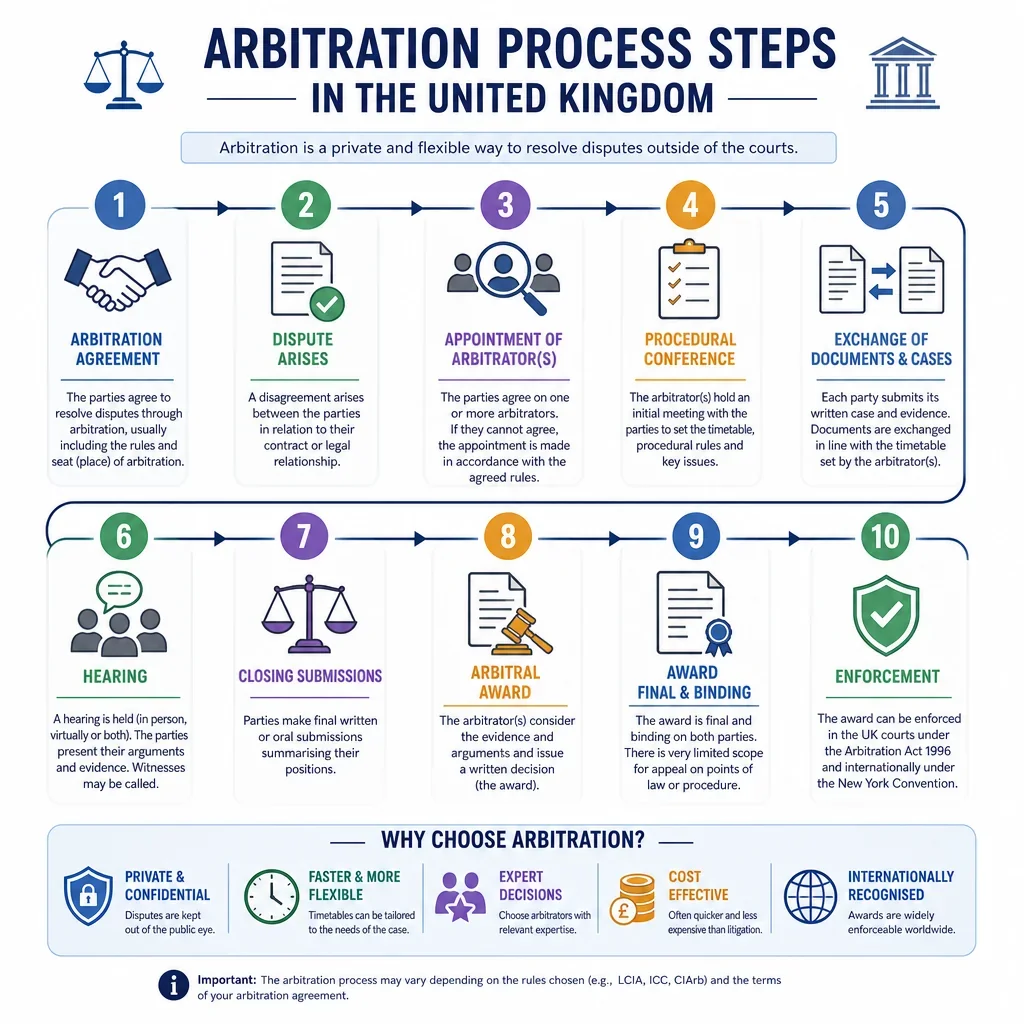
For cross-border contracts, parties should check whether the likely enforcement country is a New York Convention state and whether local law imposes formalities, language, capacity, consumer, employment, insolvency, sanctions, or public policy limits. A clear written arbitration agreement is central to enforceability.
FAQs
You Might Also Be Interested In