United Kingdom Arbitration Agreement Glossary
Term Category | Definition | Example Usage | Complexity Level |
|---|---|---|---|
Arbitration Agreement | |||
Core concept | An agreement to submit present or future disputes to arbitration. | The parties agree to refer all disputes arising out of this agreement to arbitration. | Beginner |
Arbitration Clause | |||
Core concept | A contract term requiring disputes to be resolved by arbitration. | This clause applies to any dispute arising under or in connection with this contract. | Beginner |
Submission Agreement | |||
Core concept | A separate agreement to arbitrate an existing dispute. | The parties enter into this submission agreement after the dispute has arisen. | Intermediate |
Arbitrability | |||
Jurisdiction | Whether a dispute is legally capable of being resolved by arbitration. | Only arbitrable disputes may be referred to the tribunal. | Advanced |
Seat Of Arbitration | |||
Jurisdiction | The legal place of arbitration that determines the procedural law and court supervision. | The seat of arbitration shall be London, England. | Beginner |
Venue | |||
Procedure | The physical or virtual place where hearings or meetings occur. | Hearings may take place in London or by video conference. | Beginner |
Governing Law | |||
Jurisdiction | The law used to interpret the parties' substantive rights and obligations. | This agreement is governed by the law of England and Wales. | Beginner |
Law Of The Arbitration Agreement | |||
Jurisdiction | The law governing the validity and scope of the arbitration agreement itself. | The arbitration agreement is governed by English law. | Advanced |
Procedural Law | |||
Procedure | The law governing how the arbitration is conducted. | The arbitration procedure shall be governed by the law of the seat. | Intermediate |
Arbitration Act 1996 | |||
Core concept | The main UK statute governing arbitration in England, Wales and Northern Ireland. | The arbitration shall be conducted in accordance with the Arbitration Act 1996. | Beginner |
Mandatory Provisions | |||
Procedure | Statutory arbitration rules that apply despite any contrary agreement. | Nothing in this agreement excludes the mandatory provisions of the Arbitration Act 1996. | Advanced |
Non-Mandatory Provisions | |||
Procedure | Default statutory rules that parties may vary by agreement. | The parties vary any non-mandatory provisions to the extent stated in this clause. | Advanced |
Institutional Arbitration | |||
Procedure | Arbitration administered by an arbitral institution under its rules. | The arbitration shall be administered by the LCIA under the LCIA Rules. | Beginner |
Ad Hoc Arbitration | |||
Procedure | Arbitration not administered by an institution. | The arbitration shall be ad hoc and conducted under the UNCITRAL Rules. | Intermediate |
Arbitral Institution | |||
Procedure | An organisation that administers arbitrations and often provides procedural rules. | The LCIA shall act as the arbitral institution. | Beginner |
LCIA Rules | |||
Procedure | Rules of the London Court of International Arbitration. | The arbitration shall be conducted under the LCIA Rules. | Intermediate |
ICC Rules | |||
Procedure | Arbitration rules published by the International Chamber of Commerce. | Disputes shall be finally settled under the ICC Rules of Arbitration. | Intermediate |
UNCITRAL Arbitration Rules | |||
Procedure | International procedural rules often used in ad hoc arbitration. | The arbitration shall be conducted under the UNCITRAL Arbitration Rules. | Intermediate |
Chartered Institute Of Arbitrators | |||
Tribunal | A professional body for dispute resolvers, often used for appointments. | If the parties cannot agree, the President of CIArb shall appoint the arbitrator. | Intermediate |
Arbitral Tribunal | |||
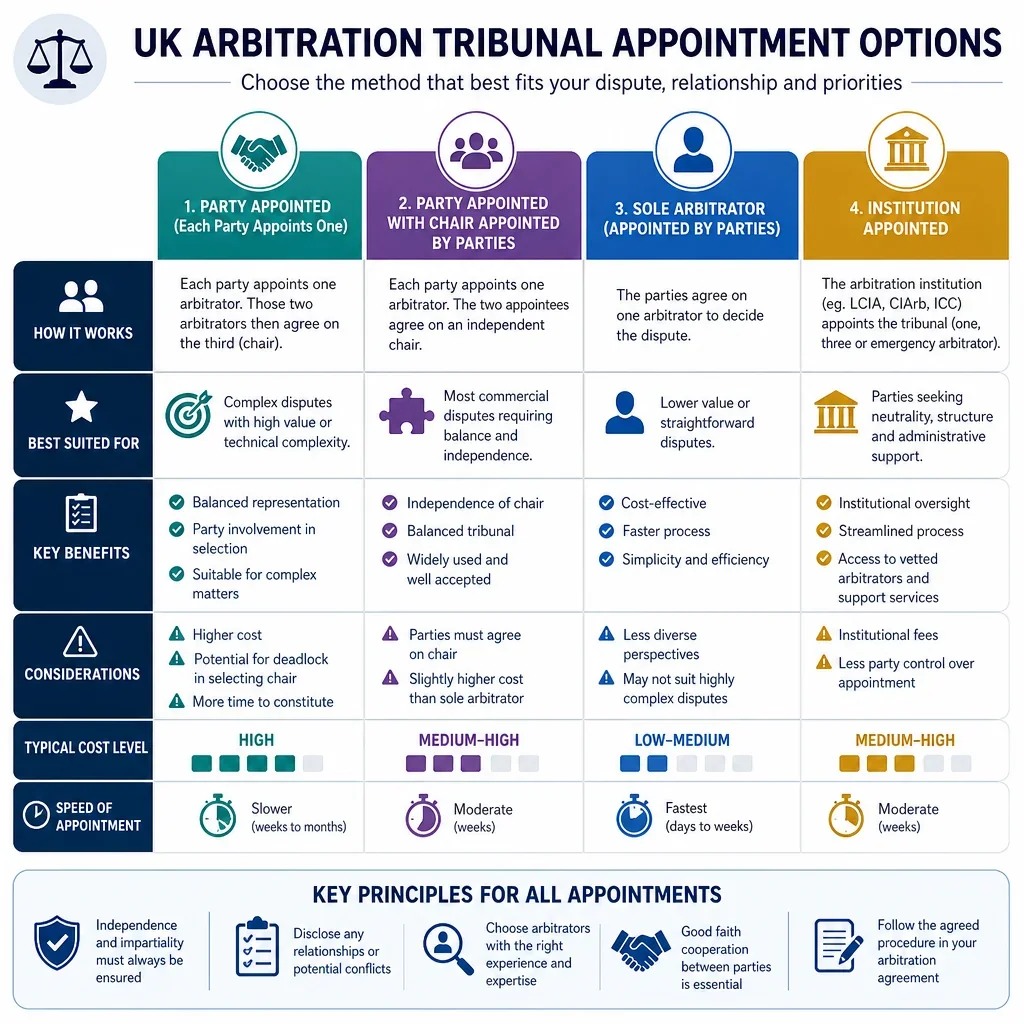
Tribunal | The arbitrator or panel appointed to decide the dispute. | The arbitral tribunal shall consist of three arbitrators. | Beginner |
Sole Arbitrator | |||
Tribunal | One arbitrator appointed to decide the dispute alone. | The tribunal shall consist of a sole arbitrator. | Beginner |
Three-Member Tribunal | |||
Tribunal | A panel of three arbitrators, often with each party nominating one. | Each party shall nominate one arbitrator, and the two nominees shall appoint the chair. | Intermediate |
Presiding Arbitrator | |||
Tribunal | The chair of a multi-member arbitral tribunal. | The presiding arbitrator shall manage the conduct of hearings. | Intermediate |
Appointing Authority | |||
Tribunal | A person or body empowered to appoint an arbitrator if the parties cannot agree. | The LCIA Court shall be the appointing authority. | Intermediate |
Nomination | |||
Tribunal | A party's proposal of a person to serve as arbitrator. | Each party shall nominate one arbitrator within 14 days. | Beginner |
Appointment Of Arbitrator | |||
Tribunal | The process by which an arbitrator is selected and confirmed. | The appointment of the arbitrator shall follow the procedure in this clause. | Beginner |
Impartiality | |||
Tribunal | The arbitrator's duty to be unbiased and fair to all parties. | Each arbitrator shall be impartial and independent. | Beginner |
Independence | |||
Tribunal | Freedom from relationships that may affect an arbitrator's judgment. | The arbitrator must disclose any matter affecting independence. | Intermediate |
Arbitrator Disclosure | |||
Tribunal | Disclosure of circumstances that may give rise to doubts about impartiality. | The arbitrator shall promptly disclose any potential conflict of interest. | Advanced |
Challenge To Arbitrator | |||
Tribunal | An application to remove an arbitrator, usually for bias or incapacity. | A party may challenge an arbitrator only on the grounds permitted by law. | Intermediate |
Vacancy | |||
Tribunal | An empty tribunal position caused by resignation, removal or death. | Any vacancy shall be filled using the original appointment procedure. | Intermediate |
Umpire | |||
Tribunal | A person appointed to decide if two arbitrators cannot agree. | The two arbitrators may appoint an umpire before substantive issues are heard. | Advanced |
Jurisdiction | |||
Jurisdiction | The tribunal's legal power to decide the dispute. | The tribunal may rule on its own jurisdiction. | Beginner |
Kompetenz-Kompetenz | |||
Jurisdiction | The principle that a tribunal may decide its own jurisdiction. | The tribunal shall have Kompetenz-Kompetenz to rule on jurisdictional objections. | Advanced |
Separability | |||
Jurisdiction | The arbitration clause is treated as separate from the main contract. | The arbitration agreement is separable from the other terms of this contract. | Intermediate |
Scope Of Arbitration Clause | |||
Jurisdiction | The range of disputes covered by the arbitration wording. | This clause covers disputes arising out of or in connection with the contract. | Intermediate |
Validity | |||
Jurisdiction | Whether the arbitration agreement is legally effective. | Any question about the validity of this arbitration agreement shall be decided by the tribunal. | Beginner |
Writing Requirement | |||
Core concept | The requirement that an arbitration agreement be made or evidenced in writing. | The parties record their arbitration agreement in writing. | Intermediate |
Notice Of Arbitration | |||
Procedure | A document starting arbitration and identifying the dispute and relief sought. | Arbitration begins when the respondent receives the notice of arbitration. | Beginner |
Request For Arbitration | |||
Procedure | An institutional filing that starts an arbitration. | The claimant shall file a request for arbitration with the institution. | Beginner |
Response | |||
Procedure | The respondent's initial reply to the arbitration claim. | The respondent shall deliver a response within the period set by the rules. | Beginner |
Claimant | |||
Procedure | The party bringing the arbitration claim. | The claimant shall serve its statement of case first. | Beginner |
Respondent | |||
Procedure | The party defending or answering the arbitration claim. | The respondent may bring a counterclaim in its response. | Beginner |
Counterclaim | |||
Procedure | A claim brought by the respondent against the claimant. | The respondent may include any counterclaim in its statement of defence. | Beginner |
Statement Of Case | |||
Procedure | A written pleading setting out a party's claims or defence. | Each party shall serve its statement of case by the tribunal's deadline. | Intermediate |
Pleadings | |||
Procedure | Formal written statements of the parties' cases. | The tribunal may set a timetable for pleadings. | Intermediate |
Defence | |||
Procedure | The respondent's formal answer to the claim. | The respondent shall serve its defence within 28 days. | Beginner |
Terms Of Reference | |||
Procedure | A document defining issues, parties and procedure, especially in ICC arbitration. | The tribunal shall prepare terms of reference after the file is transmitted. | Intermediate |
Procedural Timetable | |||
Procedure | A schedule for pleadings, evidence, hearings and submissions. | The tribunal shall issue a procedural timetable after consultation with the parties. | Beginner |
Procedural Order | |||
Procedure | A tribunal direction on how the arbitration will proceed. | Procedural Order No. 1 shall set the timetable and hearing format. | Intermediate |
Case Management Conference | |||
Procedure | A meeting to organise procedure, timetable and issues. | The tribunal shall hold a case management conference by video link. | Beginner |
Evidence | |||
Procedure | Material used to prove facts, including documents and witness testimony. | The tribunal may decide the admissibility and weight of evidence. | Beginner |
Disclosure | |||
Procedure | The exchange or production of relevant documents. | Disclosure shall be limited to documents requested by the tribunal. | Intermediate |
Document Production | |||
Procedure | A process for requesting and producing specific documents. | Document production shall follow the IBA Rules on the Taking of Evidence. | Intermediate |
Redfern Schedule | |||
Procedure | A table recording document requests, objections and tribunal decisions. | Document requests shall be exchanged in Redfern schedule format. | Advanced |
Witness Statement | |||
Procedure | A written account of a witness's evidence. | Each factual witness shall provide a signed witness statement. | Beginner |
Expert Evidence | |||
Procedure | Opinion evidence from a specialist on technical or professional issues. | The tribunal may appoint an expert to report on quantum. | Intermediate |
Tribunal-Appointed Expert | |||
Procedure | An expert appointed by the tribunal to assist on specific issues. | The tribunal may appoint an independent expert after consulting the parties. | Advanced |
Hearing | |||
Procedure | A session where evidence or arguments are presented to the tribunal. | The final hearing shall take place over three consecutive days. | Beginner |
Documents-Only Arbitration | |||
Procedure | Arbitration decided without an oral hearing, based on written materials. | The dispute may be determined on a documents-only basis. | Intermediate |
Oral Hearing | |||
Procedure | A hearing involving spoken submissions or witness examination. | Either party may request an oral hearing. | Beginner |
Cross-Examination | |||
Procedure | Questioning an opposing party's witness at a hearing. | Witnesses may be available for cross-examination at the hearing. | Intermediate |
Submissions | |||
Procedure | Written or oral arguments made to the tribunal. | Post-hearing submissions shall be filed within 21 days. | Beginner |
Interim Measures | |||
Procedure | Temporary orders made before the final award to protect rights or evidence. | The tribunal may order interim measures pending the final award. | Intermediate |
Preliminary Issue | |||
Procedure | An issue decided early because it may affect the rest of the case. | Jurisdiction shall be determined as a preliminary issue. | Intermediate |
Consolidation | |||
Procedure | Combining two or more arbitrations into one proceeding. | Related arbitrations may be consolidated with all parties' consent. | Advanced |
Joinder | |||
Procedure | Adding an extra party to an arbitration. | No additional party may be joined without consent or as permitted by the rules. | Advanced |
Multi-Party Arbitration | |||
Procedure | Arbitration involving more than two parties. | The clause applies to any multi-party arbitration arising from related contracts. | Advanced |
Expedited Procedure | |||
Procedure | A faster, simplified arbitration process for suitable cases. | Claims below £100,000 shall use an expedited procedure where available. | Intermediate |
Emergency Arbitrator | |||
Tribunal | A temporary arbitrator appointed to decide urgent relief before the tribunal is formed. | A party may apply for emergency arbitrator relief before tribunal appointment. | Advanced |
Confidentiality | |||
Core concept | The duty or agreement to keep arbitration information private. | The parties shall keep the arbitration and award confidential. | Beginner |
Privacy | |||
Core concept | The exclusion of non-parties from arbitration proceedings. | Hearings shall be held in private unless the parties agree otherwise. | Beginner |
Without Prejudice | |||
Procedure | A label for genuine settlement communications usually protected from disclosure. | Settlement discussions shall be treated as without prejudice. | Intermediate |
Limitation Period | |||
Procedure | The time limit for starting a legal claim or arbitration. | Commencement of arbitration shall stop time running for limitation purposes. | Intermediate |
Limitation Act 1980 | |||
Procedure | UK legislation setting limitation periods for many civil claims. | Nothing in this clause extends any limitation period under the Limitation Act 1980. | Intermediate |
Service Of Notices | |||
Procedure | The method for delivering arbitration notices or documents. | Notices may be served by email and recorded delivery. | Beginner |
Language Of Arbitration | |||
Procedure | The language used for pleadings, evidence, hearings and the award. | The language of the arbitration shall be English. | Beginner |
Due Process | |||
Procedure | Fair procedure giving each party a reasonable opportunity to present its case. | The tribunal shall conduct the arbitration in accordance with due process. | Intermediate |
Natural Justice | |||
Procedure | Basic fairness, including unbiased decision-making and the right to be heard. | The procedure shall respect the rules of natural justice. | Intermediate |
Default Of Party | |||
Procedure | A party's failure to participate or comply with tribunal directions. | The tribunal may proceed despite a party's default. | Intermediate |
Peremptory Order | |||
Procedure | A final tribunal order requiring compliance by a stated deadline. | The tribunal may issue a peremptory order for production of documents. | Advanced |
Court Support | |||
Procedure | Assistance from the court for arbitration, such as evidence or interim relief. | A party may seek court support where permitted by the Arbitration Act 1996. | Advanced |
Stay Of Legal Proceedings | |||
Jurisdiction | A court pause of litigation because the dispute must be arbitrated. | Either party may apply for a stay of court proceedings in favour of arbitration. | Intermediate |
Anti-Suit Injunction | |||
Enforcement | A court order restraining proceedings brought in breach of an arbitration agreement. | A party may seek an anti-suit injunction to protect the arbitration agreement. | Advanced |
Award | |||
Award | The tribunal's binding decision on claims, issues or costs. | The tribunal shall issue its award in writing. | Beginner |
Final Award | |||
Award | An award finally resolving the matters it decides. | The final award shall be final and binding on the parties. | Beginner |
Partial Award | |||
Award | An award deciding some issues while others remain unresolved. | The tribunal may issue a partial award on liability. | Intermediate |
Interim Award | |||
Award | An award made before the final award on a discrete issue. | The tribunal may make an interim award on jurisdiction or liability. | Intermediate |
Consent Award | |||
Award | An award recording the parties' agreed settlement. | The parties may ask the tribunal to record their settlement as a consent award. | Intermediate |
Reasoned Award | |||
Award | An award that explains the tribunal's reasons for its decision. | The tribunal shall give reasons for its award unless the parties agree otherwise. | Intermediate |
Form Of Award | |||
Award | The required written content, signature, seat and date of the award. | The award shall comply with the form requirements of the Arbitration Act 1996. | Advanced |
Remedies | |||
Award | Orders the tribunal may grant, such as damages, declarations or specific performance. | The tribunal may award any remedy available under the applicable law. | Intermediate |
Damages | |||
Award | Money awarded to compensate a party for loss. | The claimant seeks damages for breach of contract. | Beginner |
Declaration | |||
Award | A formal statement of the parties' legal rights or obligations. | The tribunal may make a declaration on the meaning of the contract. | Intermediate |
Specific Performance | |||
Award | An order requiring a party to perform a contractual obligation. | The tribunal may order specific performance where permitted by law. | Intermediate |
Interest | |||
Award, Costs | An additional sum for the time value of money before or after an award. | The tribunal may award simple or compound interest. | Intermediate |
Correction Of Award | |||
Award | Fixing clerical mistakes, ambiguities or omissions in an award. | A party may request correction of the award within the permitted time. | Advanced |
Additional Award | |||
Award | A further award dealing with claims the tribunal omitted to decide. | The tribunal may issue an additional award on costs. | Advanced |
Final And Binding | |||
Award | The award conclusively resolves the matters it decides, subject to limited challenges. | Any award shall be final and binding on the parties. | Beginner |
Appeal On Point Of Law | |||
Award | A limited court appeal on a legal question arising from an award. | The parties exclude any appeal on a point of law to the fullest extent permitted. | Advanced |
Serious Irregularity | |||
Award | A serious procedural defect causing substantial injustice. | A challenge for serious irregularity must meet the statutory test. | Advanced |
Substantive Jurisdiction Challenge | |||
Jurisdiction, Award | A court challenge arguing the tribunal lacked jurisdiction. | A party may challenge the award for lack of substantive jurisdiction. | Advanced |
Recognition | |||
Enforcement | Court acceptance that an arbitral award is legally effective. | The award may be recognised in any New York Convention state. | Intermediate |
Enforcement | |||
Enforcement | Using court procedures to compel compliance with an award. | Judgment may be entered in terms of the award for enforcement. | Beginner |
New York Convention | |||
Enforcement | A treaty supporting recognition and enforcement of foreign arbitral awards. | The award may be enforced under the New York Convention. | Beginner |
New York Convention Award | |||
Enforcement | An award made in a state that is party to the New York Convention. | This award is a New York Convention award for enforcement purposes. | Advanced |
Refusal Of Enforcement | |||
Enforcement | A court's rejection of enforcement on limited statutory grounds. | Enforcement may be refused only on recognised grounds. | Advanced |
Public Policy | |||
Enforcement | Fundamental legal principles that may justify refusing enforcement. | Enforcement may be refused if contrary to public policy. | Advanced |
Leave To Enforce | |||
Enforcement | Court permission to enforce an award as if it were a judgment. | A party may apply to the court for leave to enforce the award. | Advanced |
Judgment In Terms Of Award | |||
Enforcement | A court judgment reflecting the arbitral award for enforcement purposes. | The court may enter judgment in terms of the award. | Advanced |
Costs Of Arbitration | |||
Costs | Arbitrators' fees, institutional fees and recoverable legal or other costs. | The tribunal shall allocate the costs of arbitration in the award. | Beginner |
Arbitrator Fees | |||
Costs | Fees charged by arbitrators for their work and expenses. | The parties shall be jointly and severally liable for the arbitrator's reasonable fees. | Beginner |
Institutional Fees | |||
Costs | Administrative charges payable to an arbitral institution. | The parties shall pay any institutional fees required by the LCIA. | Beginner |
Legal Costs | |||
Costs | Lawyers' fees and expenses incurred in the arbitration. | The tribunal may order the unsuccessful party to pay reasonable legal costs. | Beginner |
Costs Follow The Event | |||
Costs | The usual rule that the unsuccessful party pays the successful party's costs. | Costs shall follow the event unless the tribunal decides otherwise. | Intermediate |
Recoverable Costs | |||
Costs | Costs that the tribunal may order one party to pay another. | Recoverable costs shall be assessed by the tribunal if not agreed. | Intermediate |
Security For Costs | |||
Costs | Money or security ordered to protect against unpaid costs. | The respondent may apply for security for costs. | Advanced |
Deposit For Costs | |||
Costs | Advance payment requested to cover tribunal or institutional costs. | Each party shall pay its share of any deposit for costs. | Beginner |
Allocation Of Costs | |||
Costs | The tribunal's decision on who pays arbitration costs. | The tribunal shall determine the allocation of costs in the final award. | Intermediate |
Taxation Of Costs | |||
Costs | Assessment of recoverable costs, now commonly called detailed assessment. | If costs are not agreed, they may be assessed by the tribunal or court. | Advanced |
Third-Party Funding | |||
Costs | Funding of a claim by a non-party in return for a financial return. | A party shall disclose any third-party funder if required by the tribunal. | Advanced |
Mediation Before Arbitration | |||
Procedure | A required attempt to settle through mediation before arbitration starts. | The parties shall attempt mediation before commencing arbitration. | Beginner |
Escalation Clause | |||
Procedure | A clause requiring steps such as negotiation or mediation before arbitration. | Senior executives shall meet before either party may commence arbitration. | Intermediate |
Negotiation Period | |||
Procedure | A set time for settlement talks before arbitration may begin. | Either party may commence arbitration after a 30-day negotiation period. | Beginner |
Dispute Notice | |||
Procedure | A notice identifying a dispute and triggering the dispute resolution process. | A party shall serve a dispute notice before commencing arbitration. | Beginner |
What Should A UK Arbitration Agreement Define Clearly?
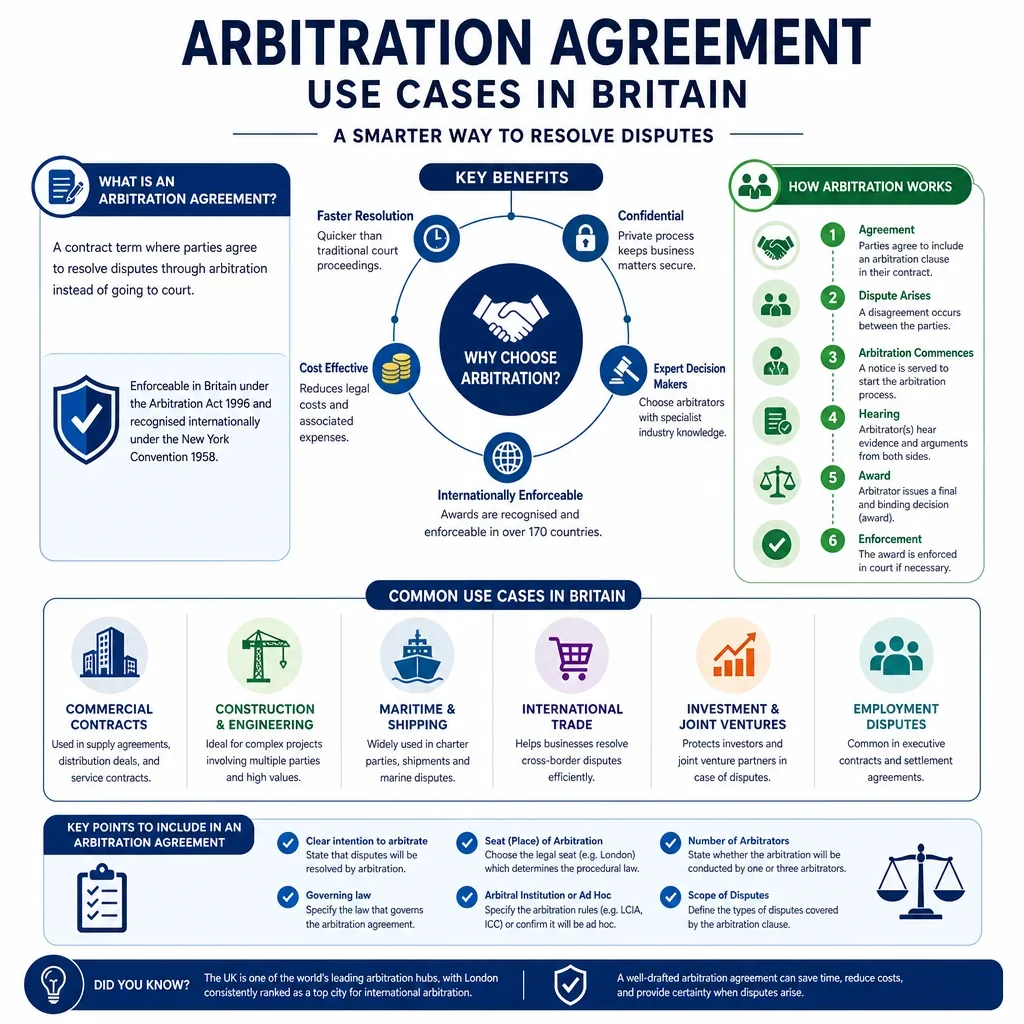
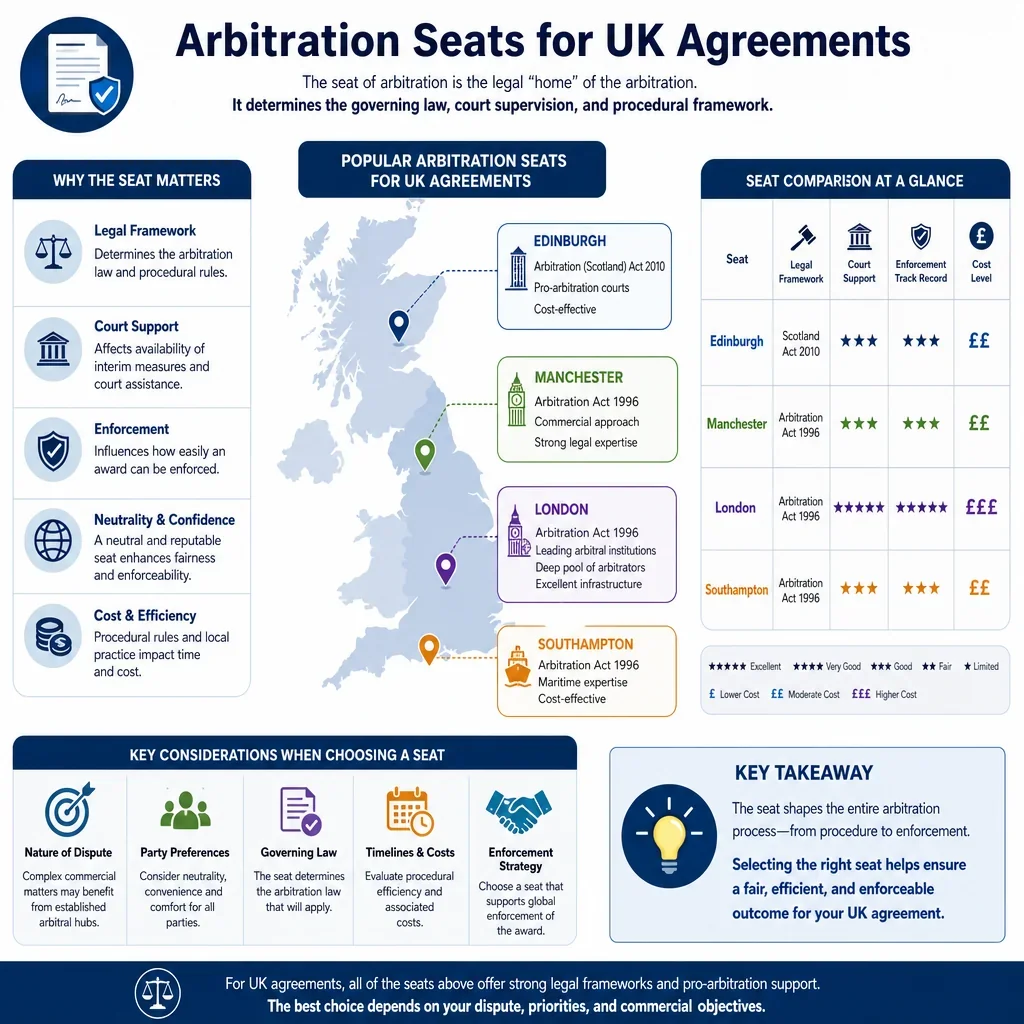
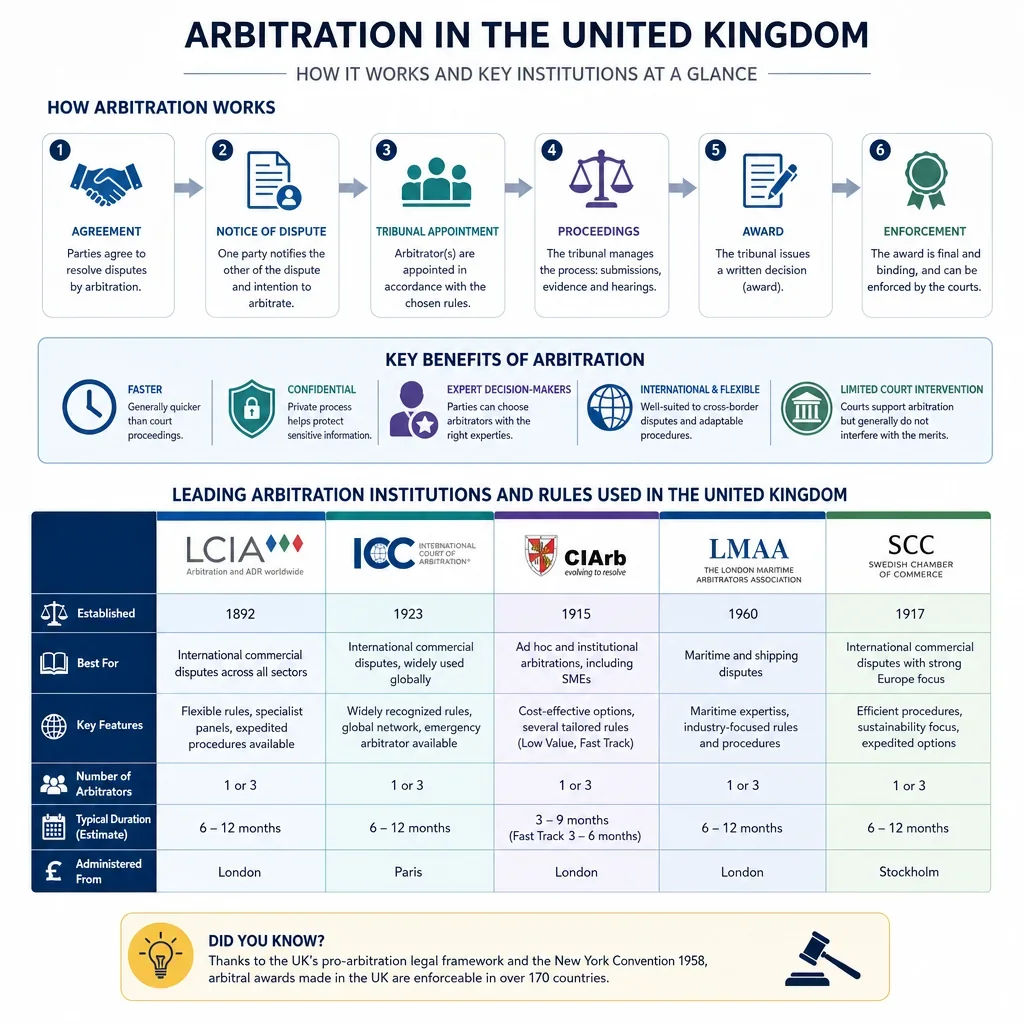
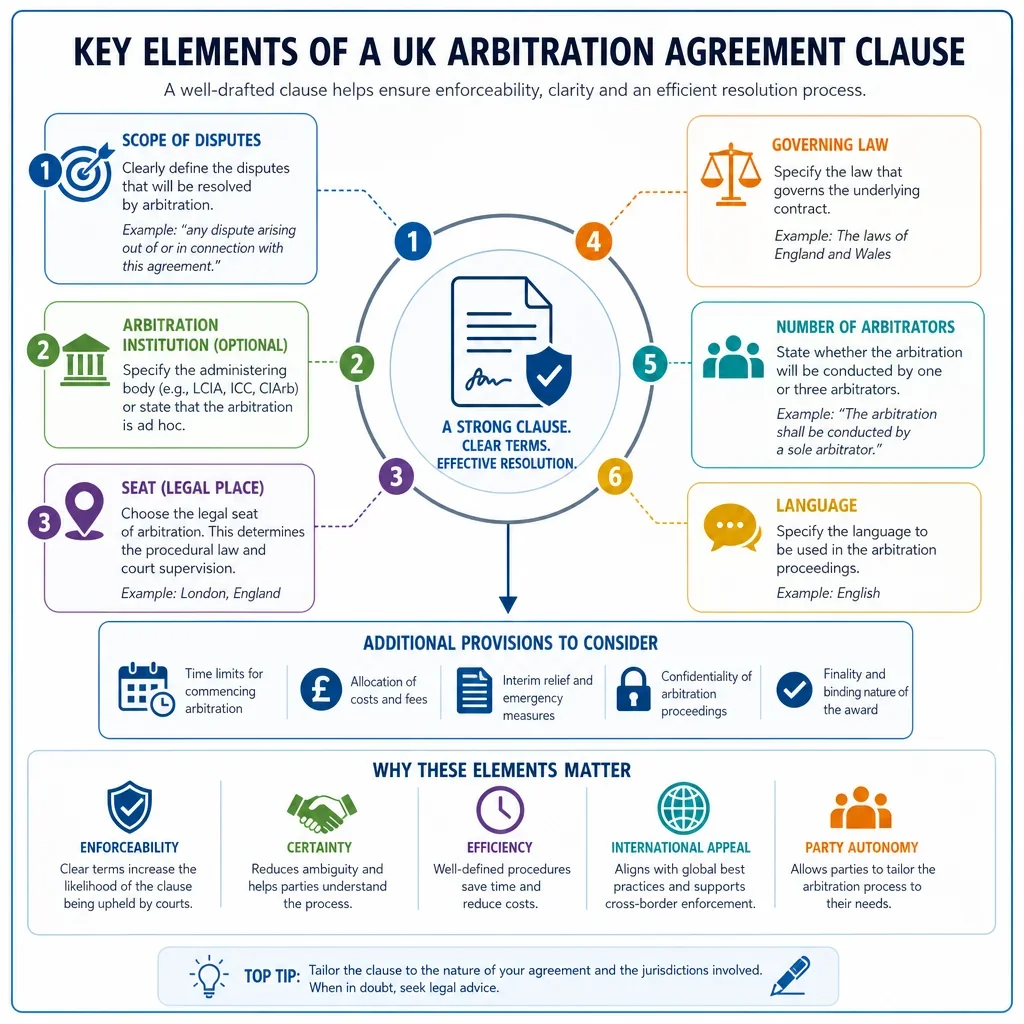
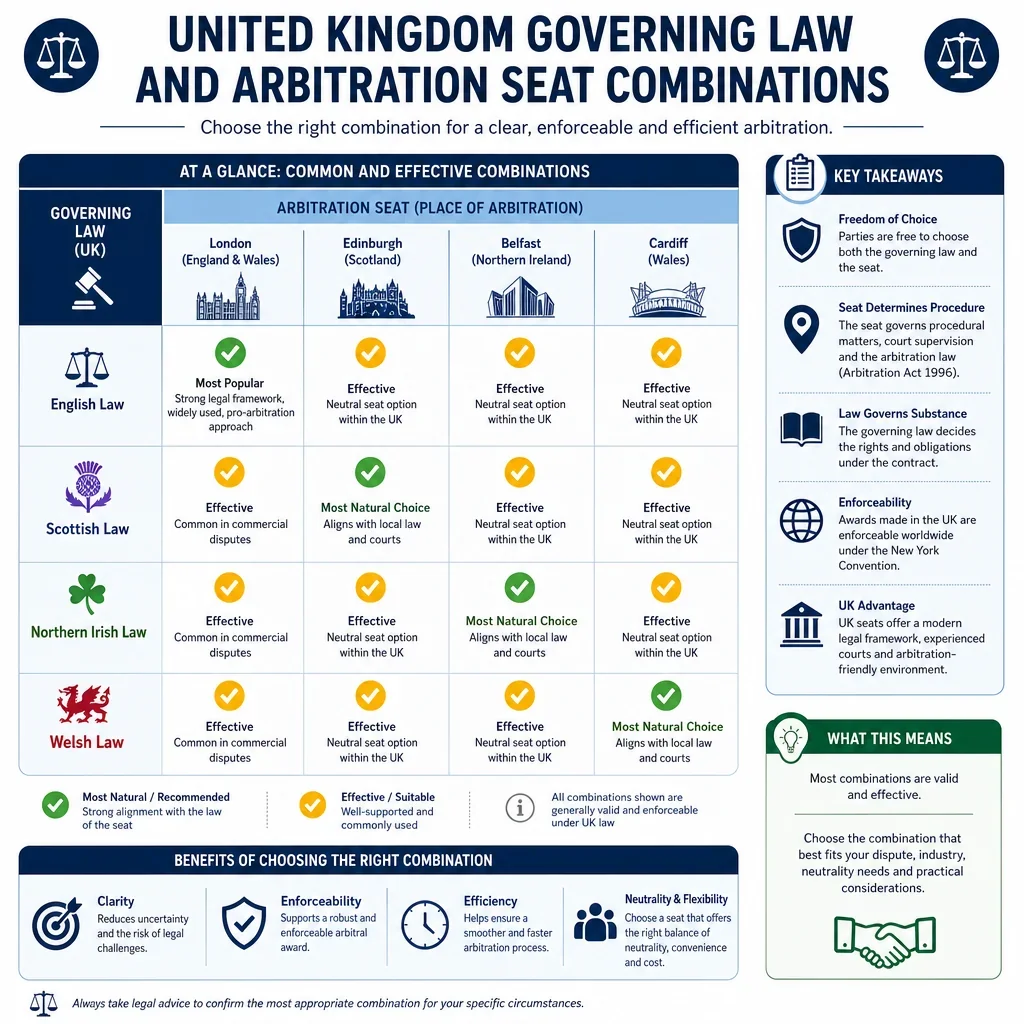
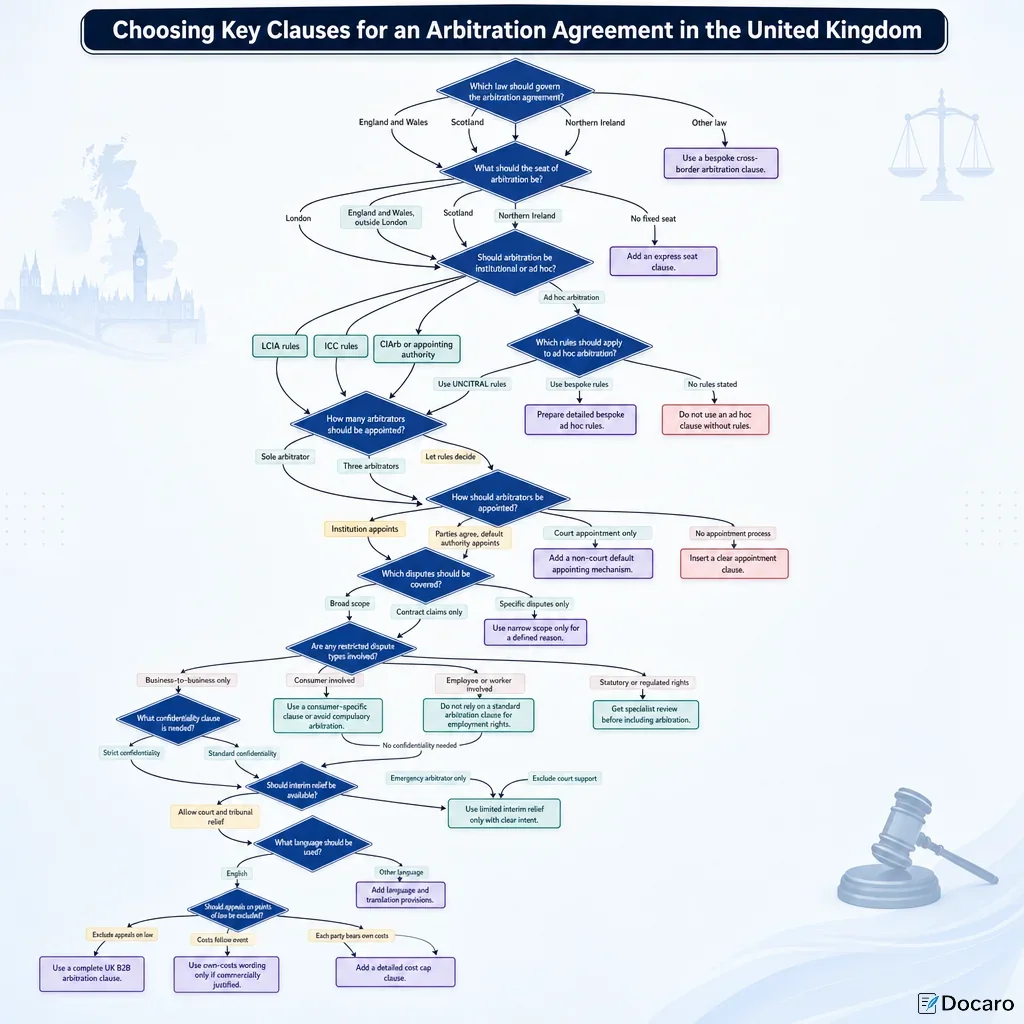
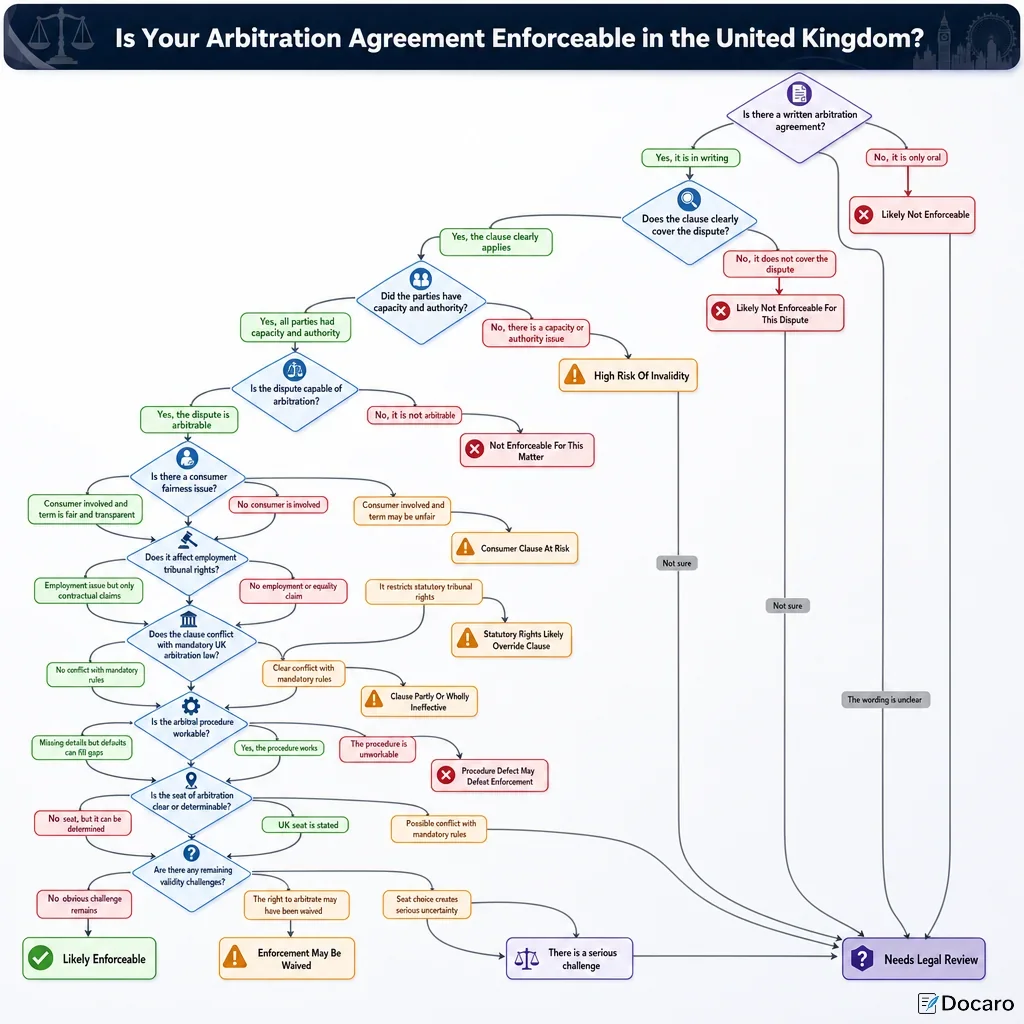
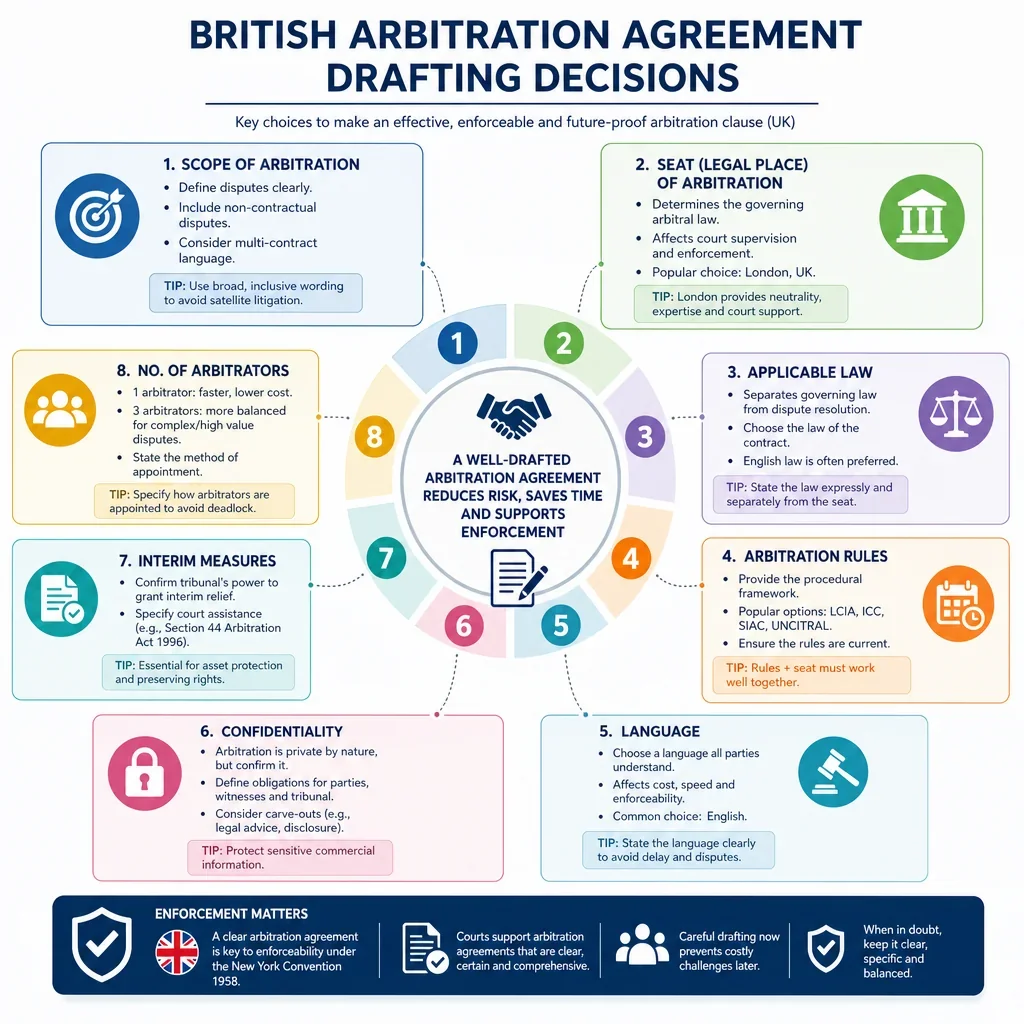
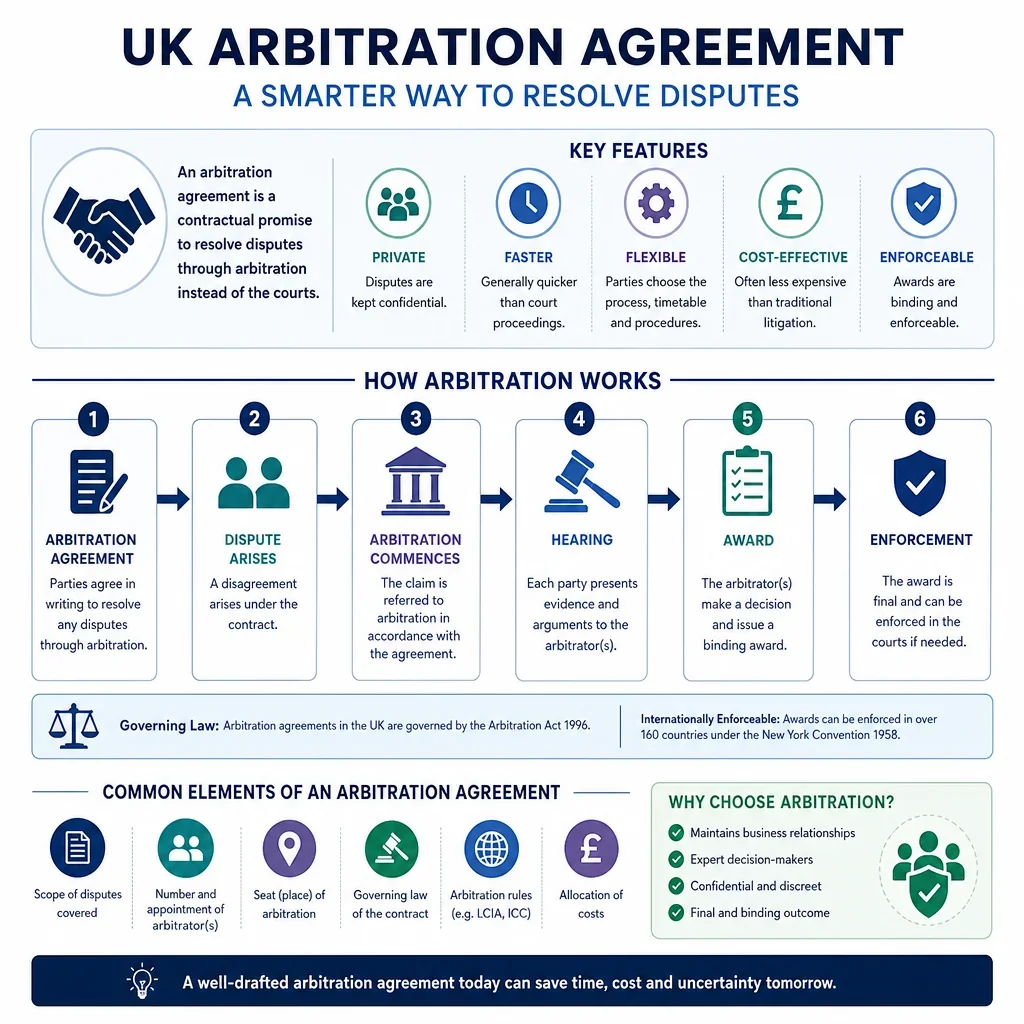
A strong arbitration clause should identify the seat of arbitration, the governing law, the appointing authority, the number of arbitrators, the rules, and the language. In England, Wales and Northern Ireland, the seat usually determines the court with supervisory powers under the Arbitration Act 1996, so it should not be left ambiguous.
Why Does The Seat Of Arbitration Matter In The UK?
The seat links the arbitration to a legal system. If the seat is England and Wales, the Arbitration Act 1996 generally governs matters such as tribunal powers, challenges to awards and court support. The physical hearing can still take place elsewhere, so the seat should be distinguished from the venue.
Which Arbitration Terms Most Affect Enforceability?
- Arbitration agreement, separability and kompetenz-kompetenz help determine whether the tribunal can decide disputes even where the main contract is challenged.
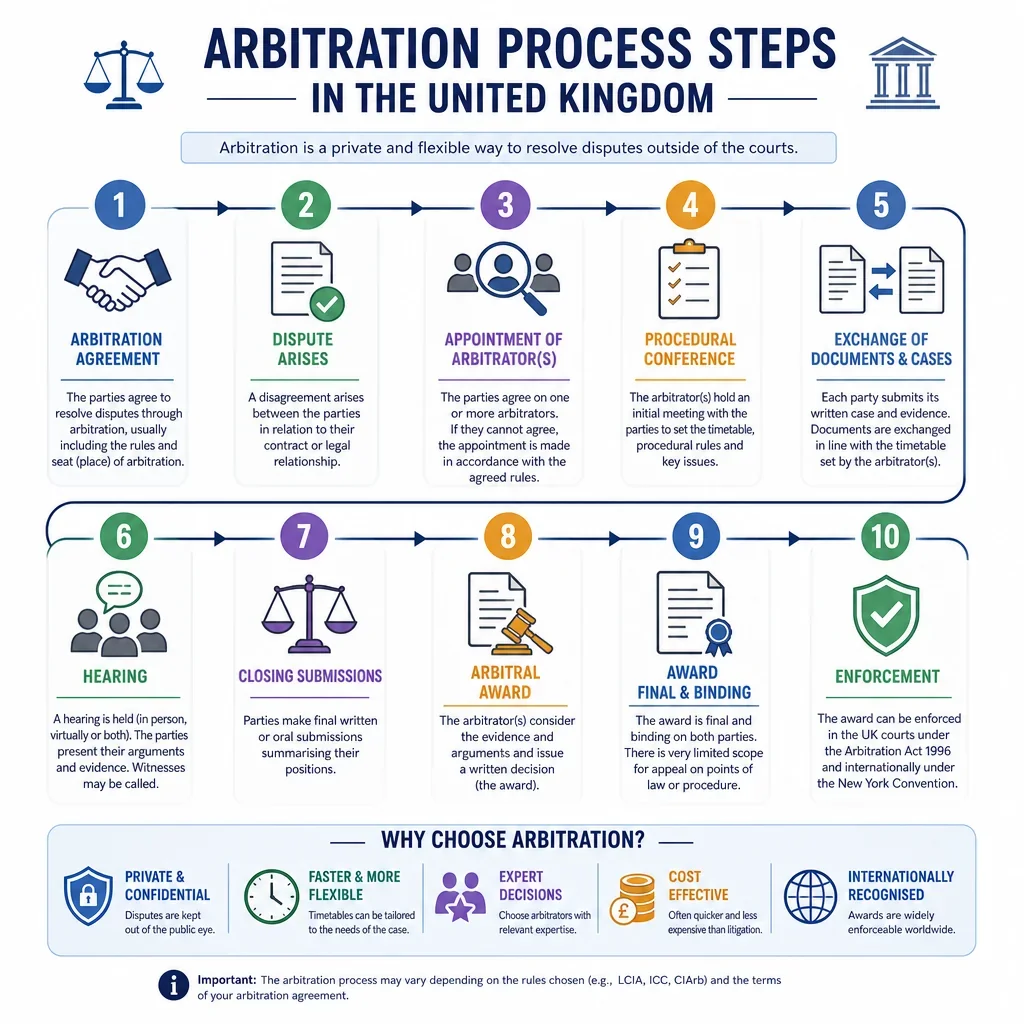
- Final and binding award, New York Convention and recognition and enforcement are central to turning an award into something enforceable in the UK or abroad.
- Due process, impartiality, disclosure and natural justice reduce the risk of challenges to an award.
What Cost Issues Should Users Consider Before Choosing Arbitration?
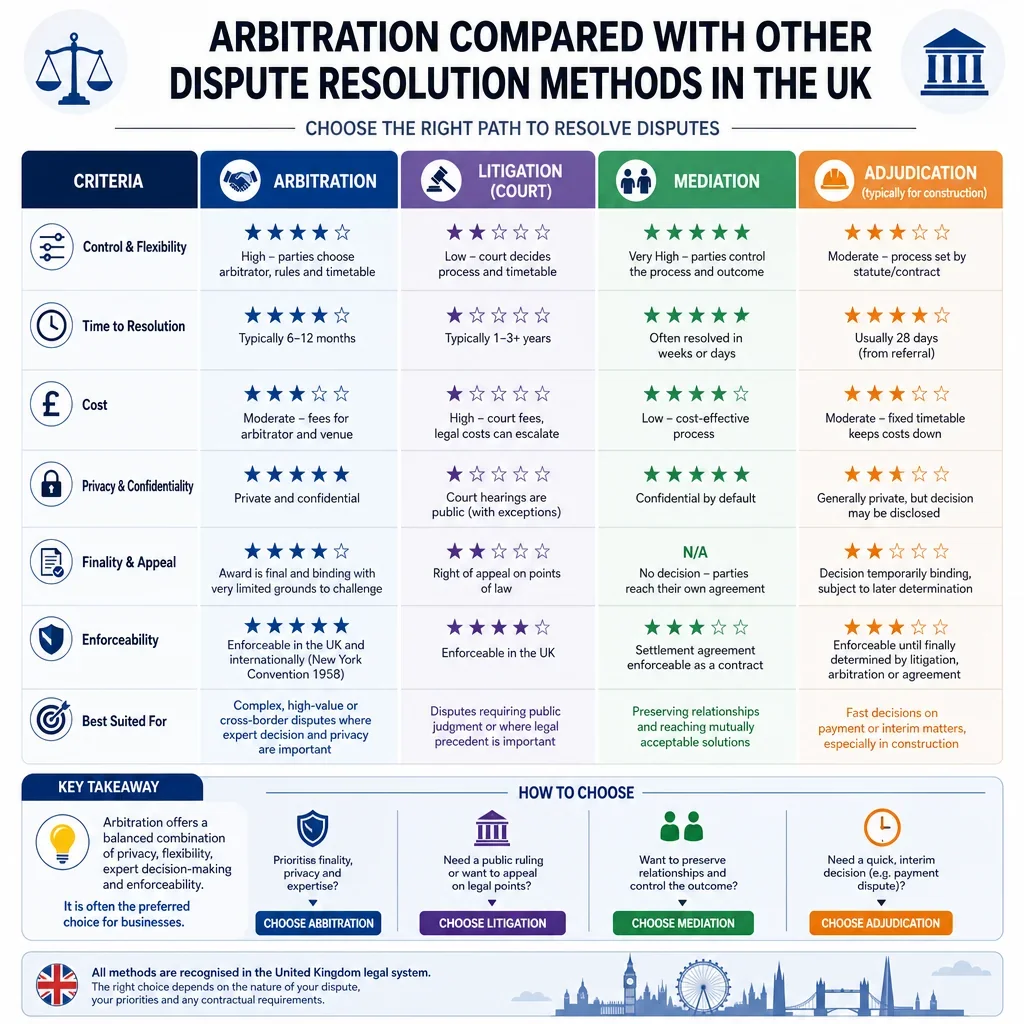
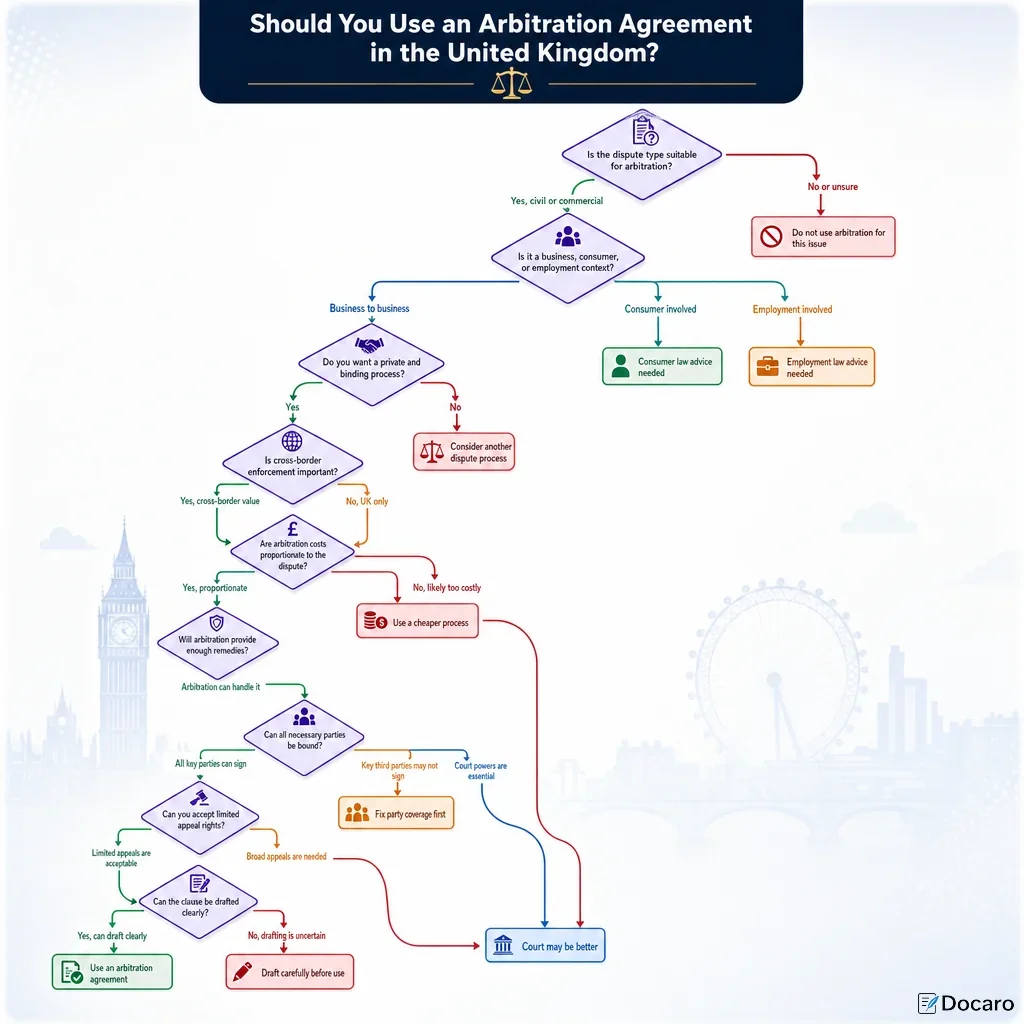
Arbitration can involve arbitrator fees, institutional fees, legal costs, expert costs and security for costs. UK users should consider whether the clause allows recovery of costs, interest and interim measures, and whether expedited or documents-only procedures are appropriate for lower-value disputes.
FAQs
You Might Also Be Interested In