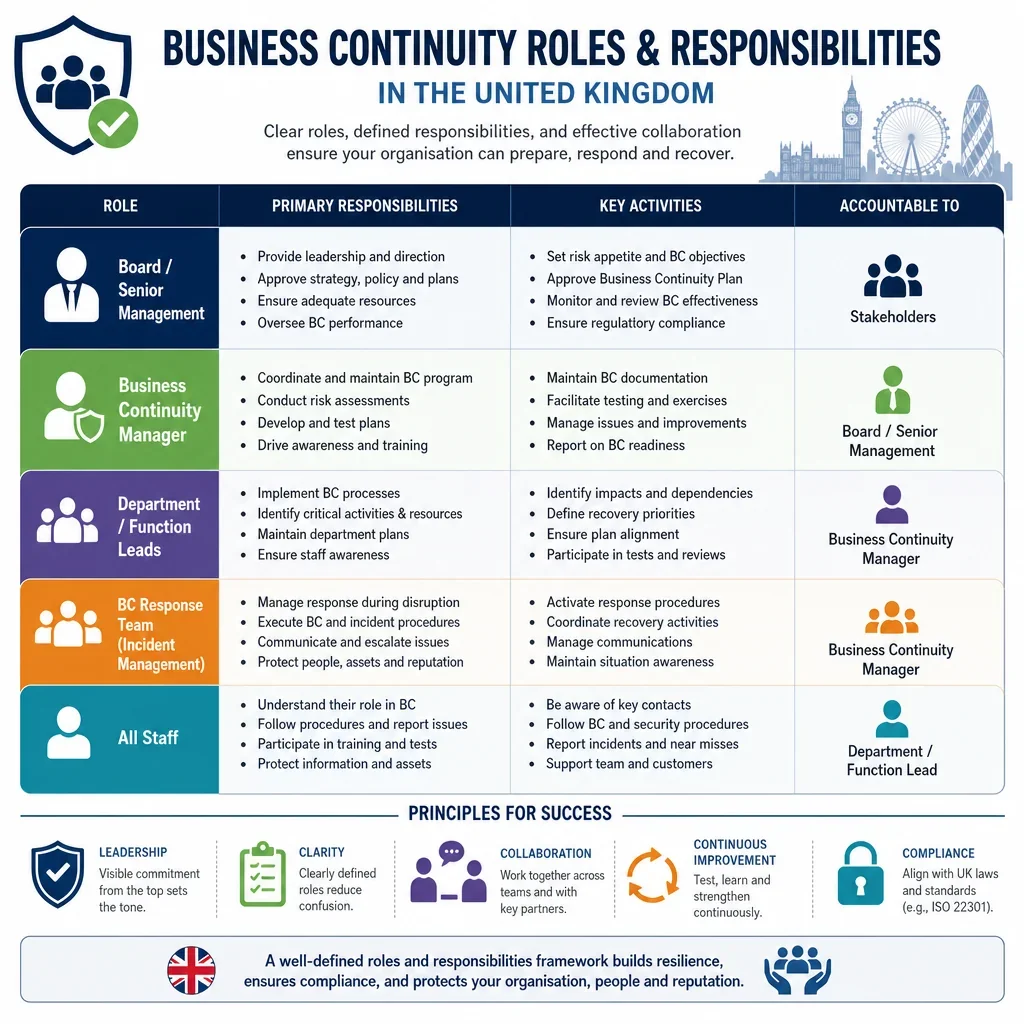
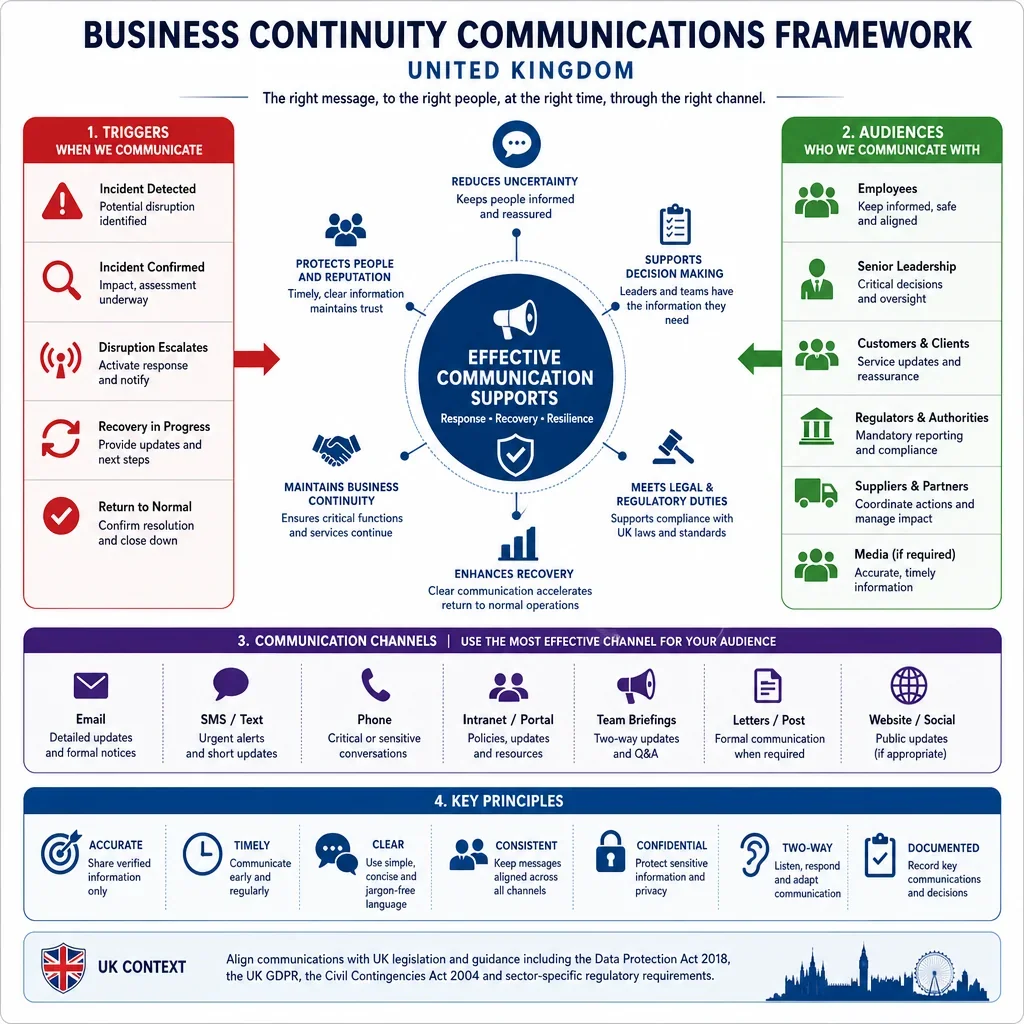
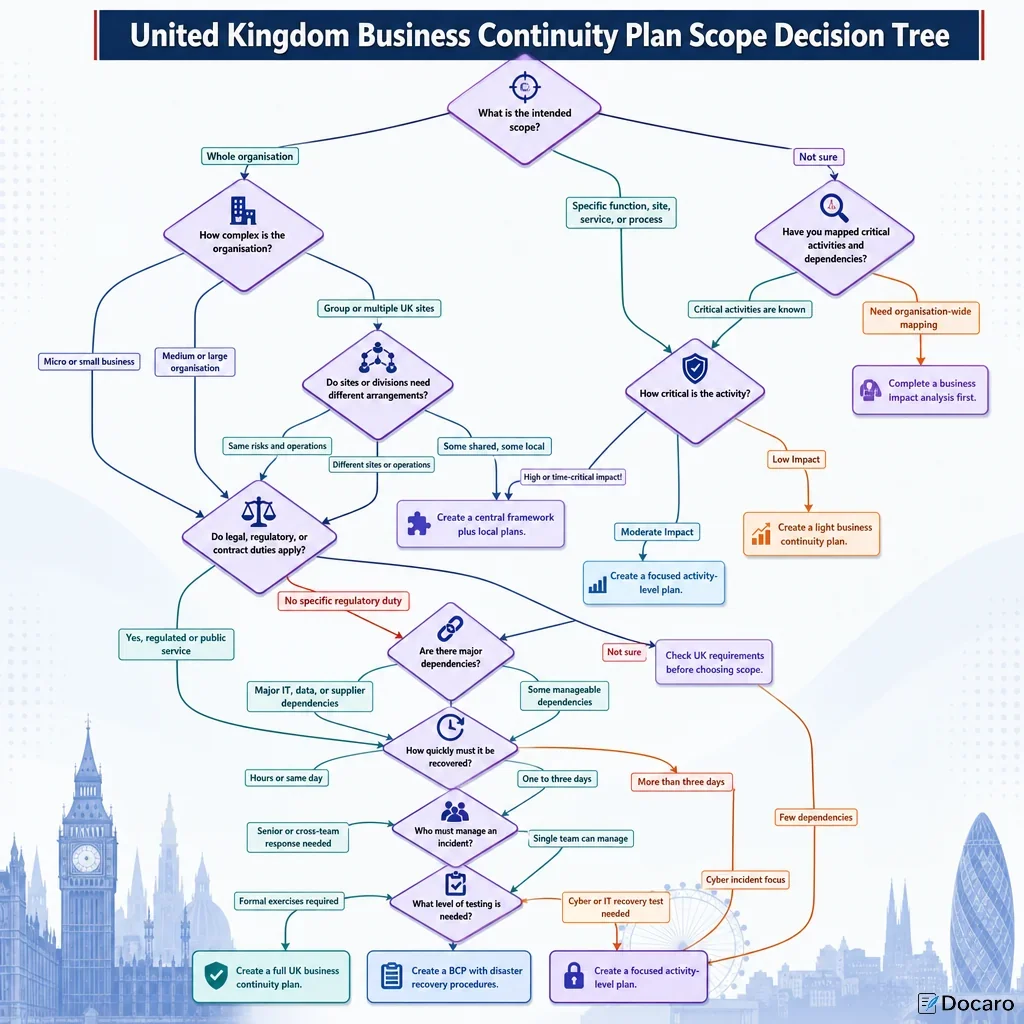
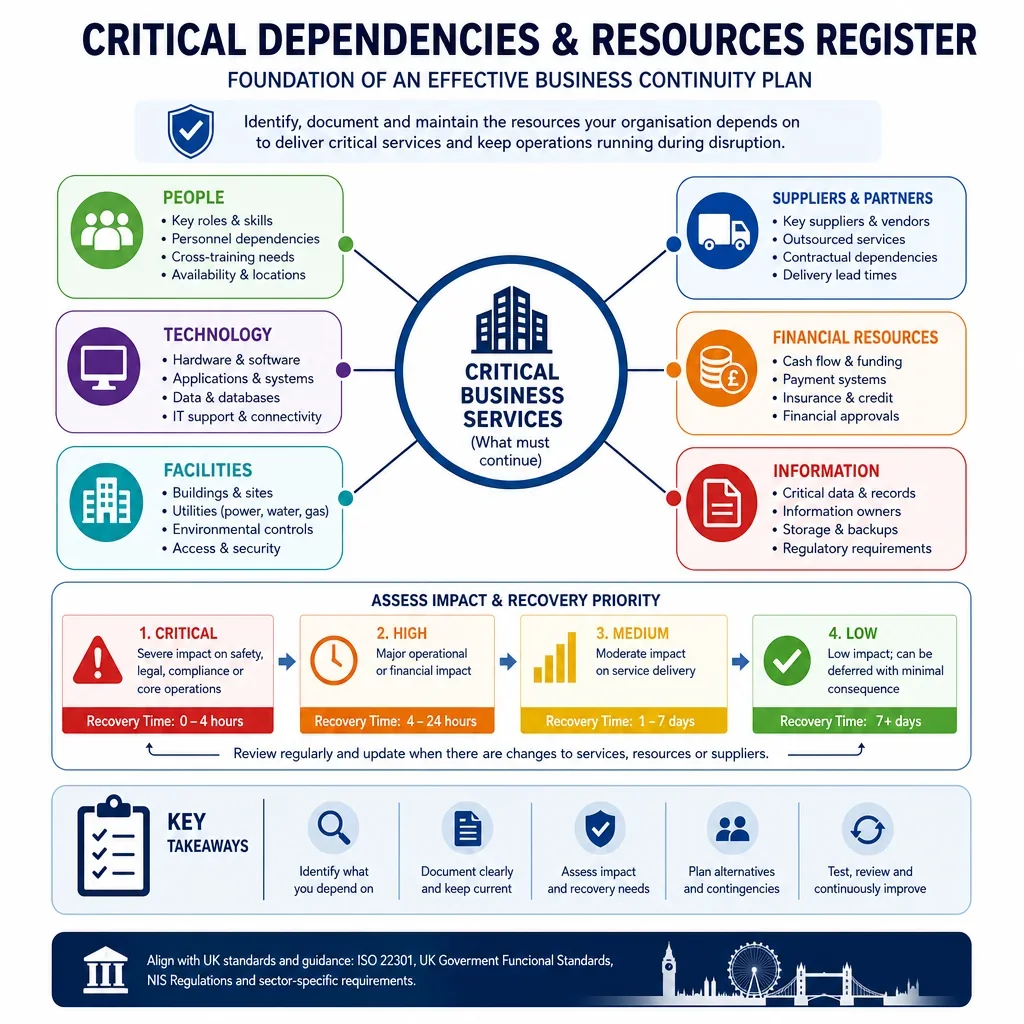
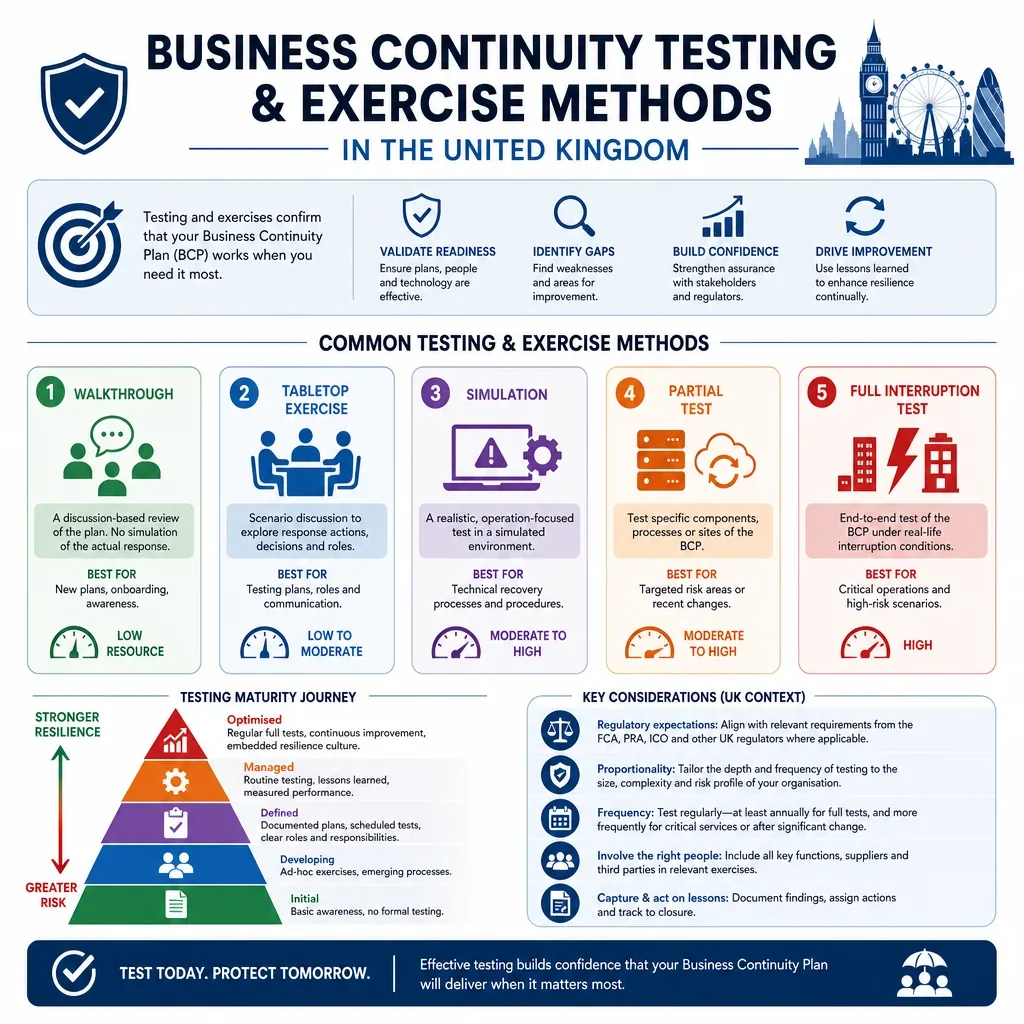
Business Continuity Testing And Exercise Methods In The United Kingdom
Exercise Method | Purpose | Preparation Effort | Typical Participants | Expected Outputs |
|---|---|---|---|---|
Discussion-based | ||||
Tabletop scenario exercise | Discuss roles, decisions and actions in a realistic disruption scenario. | Medium | Incident team, senior managers, business leads, facilities, IT, HR and communications. | Scenario pack, decision log, issues list, improvement actions and exercise report. |
Executive crisis management exercise | Test strategic decision-making, governance and escalation during a major incident. | Medium | Board, executive committee, legal, risk, communications and incident director. | Strategic decisions, escalation lessons, governance gaps and board-level action plan. |
Walkthrough | ||||
Business continuity plan walkthrough | Step through the plan to confirm it is complete, clear and usable. | Low | Plan owner, department managers, continuity coordinator and key role holders. | Marked-up plan, clarification points, owner updates and version control record. |
Technical Test | ||||
Call tree and notification test | Confirm emergency contact details, cascade speed and message delivery. | Low | All staff or nominated responders, HR, communications and incident coordinators. | Contact success rate, failed contacts, timing log and updated contact list. |
Emergency communications channel test | Verify mass notification, collaboration tools and backup communication channels. | Low | IT, communications, incident team, HR and selected staff groups. | Delivery reports, channel failures, response rates and communications action list. |
Discussion-based | ||||
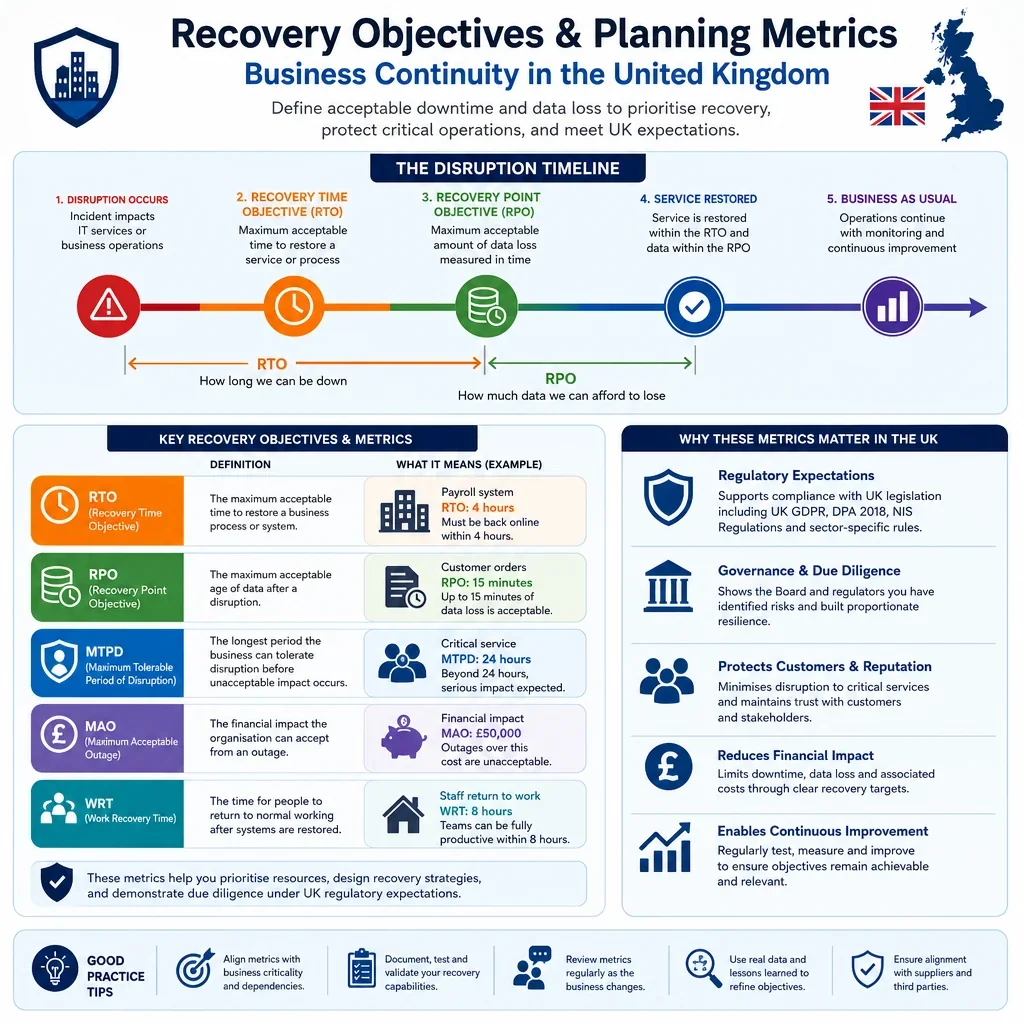
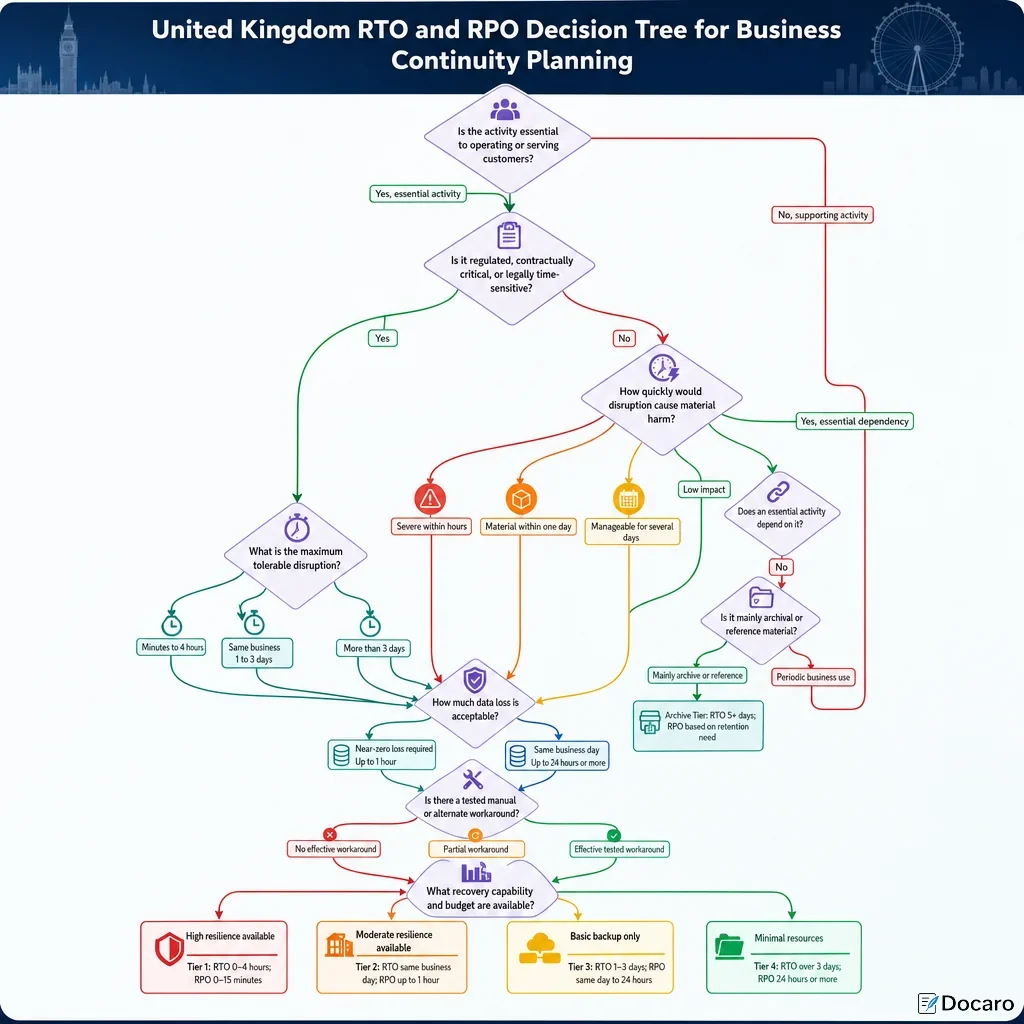
IT disaster recovery tabletop | Review IT recovery priorities, dependencies, RTOs and RPOs without system changes. | Medium | IT operations, cyber security, application owners, business owners and suppliers. | Recovery assumptions, dependency gaps, RTO/RPO issues and remediation actions. |
Technical Test | ||||
Backup restoration test | Prove backups can be restored within required recovery objectives. | Medium | IT operations, application owners, data owners and cyber security team. | Restore logs, data validation results, timing evidence and backup defects. |
Full IT disaster recovery failover test | Validate failover to recovery infrastructure and service restoration procedures. | High | IT operations, infrastructure, network, application teams, service desk and suppliers. | Failover timings, service test results, incident log, rollback record and lessons report. |
Partial system failover test | Test recovery of one service or component without full enterprise disruption. | Medium | Service owner, IT operations, application support, cyber security and users. | Component recovery evidence, defects, user validation and action plan. |
Simulation | ||||
Cyber incident simulation | Practise response to cyber events such as phishing, ransomware or data loss. | Medium | Cyber security, IT, legal, data protection, communications and business leads. | Incident timeline, containment decisions, notification issues and cyber action plan. |
Ransomware recovery exercise | Test isolation, communication, backup recovery and business prioritisation after ransomware. | High | Cyber security, IT, executives, legal, DPO, communications, insurers and suppliers. | Recovery sequence, decision log, notification assessment, restore evidence and lessons report. |
Discussion-based | ||||
Personal data breach response exercise | Test UK GDPR breach assessment, escalation and notification decision-making. | Medium | DPO, legal, cyber security, IT, communications, customer service and executives. | Breach assessment, ICO notification decision, affected-person communication draft and lessons log. |
Simulation | ||||
Crisis communications simulation | Test media handling, stakeholder messages and approval routes under pressure. | Medium | Communications, executives, legal, HR, customer service and incident team. | Holding statements, Q&A, approval timings, message log and communications improvements. |
Social media incident drill | Practise monitoring, response and escalation for fast-moving online criticism or misinformation. | Medium | Communications, marketing, legal, customer service and senior approvers. | Mock posts, response log, escalation timings and revised social media playbook. |
Technical Test | ||||
Incident command centre activation test | Confirm physical or virtual command centre availability, tools and access rights. | Low | Incident team, IT, facilities, security and administrative support. | Activation checklist, access issues, equipment defects and command centre readiness record. |
Live Exercise | ||||
Workplace evacuation drill | Test safe evacuation routes, assembly points and staff response. | Medium | All site occupants, fire wardens, facilities, security and health and safety lead. | Evacuation times, roll-call issues, warden feedback and corrective actions. |
Simulation | ||||
Fire scenario continuity exercise | Test continuity arrangements after loss of premises due to fire. | Medium | Facilities, health and safety, incident team, business leads, HR and insurers. | Premises loss decisions, staff welfare actions, relocation plan gaps and recovery actions. |
Live Exercise | ||||
Alternate workplace relocation test | Prove staff can relocate and work effectively from an alternate site. | High | Critical staff, facilities, IT, HR, security and department managers. | Travel timings, access results, workstation readiness, productivity issues and lessons report. |
Technical Test | ||||
Remote working continuity test | Check staff can access critical systems securely from remote locations. | Medium | Critical staff, IT, cyber security, HR and business managers. | VPN capacity results, access failures, user feedback and security issues. |
Discussion-based | ||||
Supplier disruption exercise | Test response to failure, delay or cyber incident at a critical supplier. | Medium | Procurement, contract owners, supplier managers, legal, operations and supplier representatives. | Supplier dependencies, workaround options, contract issues and continuity action plan. |
Technical Test | ||||
Critical supplier contact test | Confirm supplier emergency contacts, escalation routes and response times. | Low | Procurement, contract owners, supplier service managers and incident team. | Supplier response log, outdated contacts, SLA gaps and updated escalation list. |
Walkthrough | ||||
Manual workaround test | Check whether key activities can continue without normal systems or premises. | Medium | Process owners, operations staff, finance, customer service and IT support. | Workaround steps, resource needs, control gaps and updated process notes. |
Discussion-based | ||||
Loss of key staff exercise | Test succession, delegation and resilience where key people are unavailable. | Low | Department managers, HR, team leaders and continuity coordinator. | Deputy coverage gaps, training needs, delegation rules and contact updates. |
High staff absence exercise | Test prioritisation and staffing during pandemic, industrial action or travel disruption. | Medium | HR, operations, department heads, legal, communications and health and safety lead. | Minimum staffing levels, redeployment options, HR policy issues and action log. |
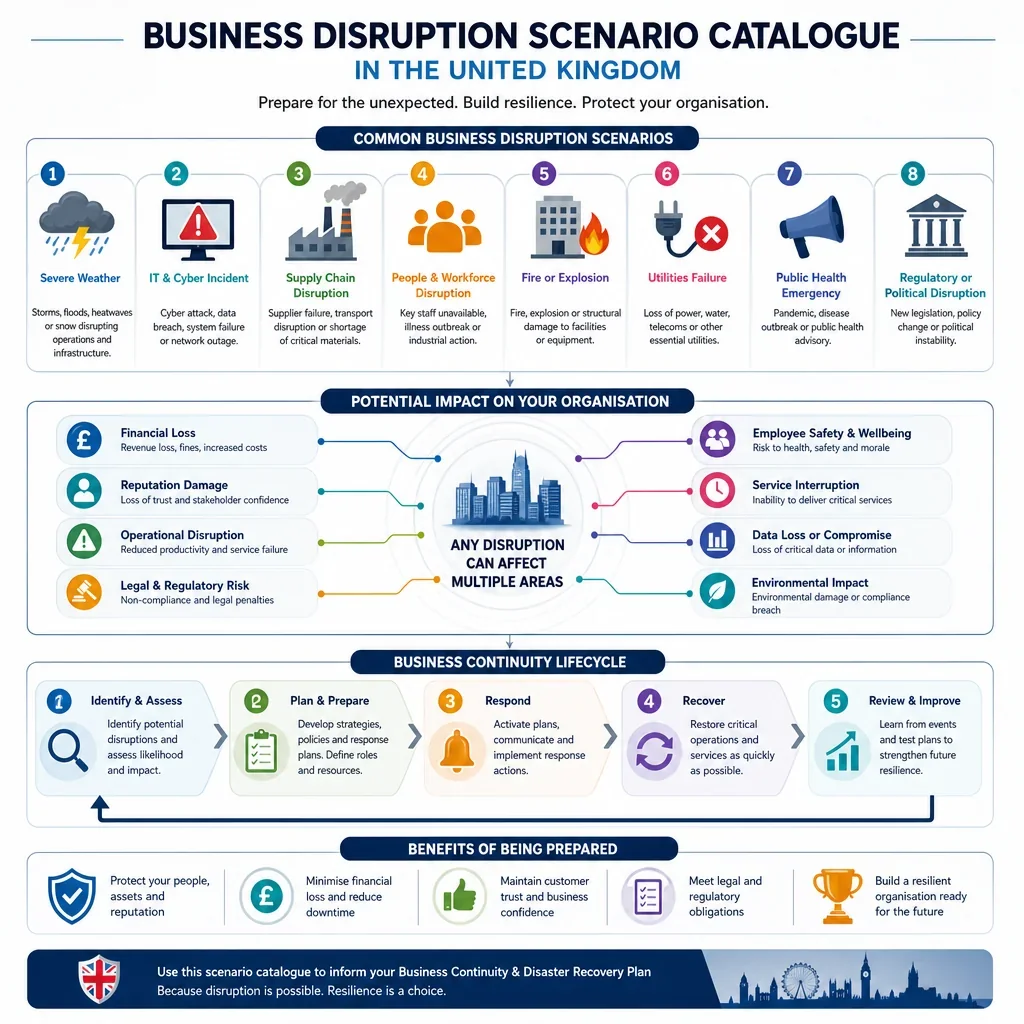
Severe weather disruption exercise | Test response to storms, snow, flooding, heat or transport disruption. | Low | Operations, facilities, HR, logistics, communications and site managers. | Trigger points, site decisions, travel guidance, welfare actions and plan updates. |
Simulation | ||||
Flood response exercise | Test site protection, evacuation, communications and recovery from flooding. | Medium | Facilities, site managers, health and safety, security, communications and operations. | Flood trigger log, site actions, recovery needs, supplier issues and lessons report. |
Power outage exercise | Test response to loss of mains power and generator or UPS arrangements. | Medium | Facilities, IT, operations, security, health and safety and critical suppliers. | Generator readiness, UPS runtime evidence, shutdown decisions and action list. |
Technical Test | ||||
Generator load test | Verify standby generator performance under realistic electrical load. | Medium | Facilities, electrical contractor, health and safety, IT and site management. | Load results, fuel status, maintenance issues, safety checks and defect log. |
Network connectivity failover test | Test resilience of internet, WAN, DNS or telecoms connectivity. | Medium | Network team, IT operations, telecoms supplier, service desk and business testers. | Failover time, routing issues, user impact, supplier tickets and remediation plan. |
Telephony continuity test | Confirm call routing, contact centre overflow and alternative phone arrangements. | Medium | Telecoms team, contact centre, customer service, IT and communications. | Call routing results, failed numbers, customer impact notes and configuration changes. |
Simulation | ||||
Contact centre disruption simulation | Test customer service continuity during system, site or staffing disruption. | Medium | Contact centre managers, agents, IT, workforce planning and communications. | Queue impact, scripts, escalation results, workaround performance and lessons log. |
Discussion-based | ||||
Emergency services liaison exercise | Clarify information sharing and coordination with emergency responders. | Medium | Site management, security, facilities, emergency services liaison and local responders. | Liaison contacts, access arrangements, information needs and coordination actions. |
Live Exercise | ||||
Live multi-agency exercise | Practise coordinated response with external agencies to a major incident. | High | Incident team, emergency services, local authority, site teams and communications. | Exercise control log, safety records, inter-agency lessons and formal debrief report. |
Simulation | ||||
Gold silver bronze command exercise | Test strategic, tactical and operational command interfaces during an incident. | High | Gold, silver and bronze leads, incident controllers, communications and liaison officers. | Command decisions, handover records, coordination issues and command structure improvements. |
Walkthrough | ||||
Incident decision log drill | Practise recording decisions, rationale, actions and timestamps during incidents. | Low | Incident managers, loggists, legal, risk and continuity coordinator. | Sample decision log, recording gaps, role clarity issues and template updates. |
Plan owner validation interviews | Confirm plan assumptions, contacts, dependencies and recovery priorities with owners. | Low | Continuity manager, plan owners, process owners and dependency owners. | Validated assumptions, updated contacts, dependency changes and review record. |
Discussion-based | ||||
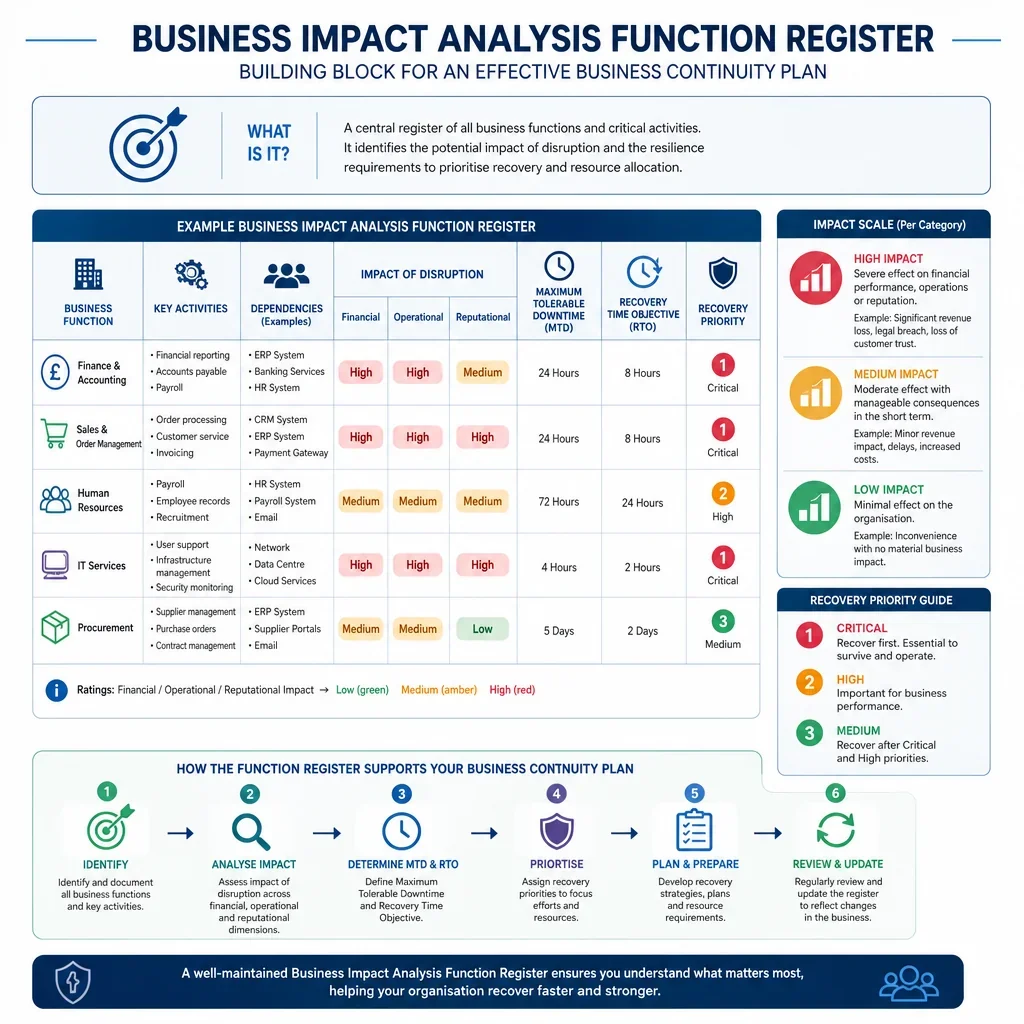
Business impact analysis validation workshop | Check critical activities, impact tolerances, RTOs and resource needs remain current. | Medium | Business owners, risk, finance, operations, continuity manager and IT representatives. | Updated BIA data, priority changes, dependency revisions and approval record. |
Simulation | ||||
Operational resilience scenario test | Assess ability to remain within impact tolerances for important business services. | High | Service owners, risk, compliance, IT, operations, senior managers and suppliers. | Impact tolerance evidence, vulnerabilities, remediation plan and senior management report. |
Severe but plausible scenario exercise | Test regulated service resilience against extreme but credible disruption. | High | Senior managers, risk, compliance, service owners, IT, operations and key third parties. | Scenario results, tolerance breaches, remediation evidence and regulatory governance record. |
Cloud service outage exercise | Test continuity where a cloud platform or SaaS service is unavailable. | Medium | IT, cloud service owner, business users, procurement, legal and supplier manager. | Dependency gaps, workaround options, supplier communications and recovery priorities. |
Technical Test | ||||
SaaS data export and portability test | Confirm data can be exported, accessed and used if a SaaS provider fails. | Medium | Application owner, IT, data owner, procurement, legal and supplier manager. | Export logs, data quality checks, access issues and portability action list. |
Data centre recovery test | Test recovery from loss of a hosting facility or data centre zone. | High | Infrastructure, network, application teams, data centre provider and service owners. | Recovery timings, capacity results, dependency failures, provider issues and lessons report. |
Critical application recovery test | Confirm a critical application can be restored and validated by business users. | Medium | Application support, database administrators, business testers, IT operations and vendor. | Restore timings, user acceptance results, defects and updated runbook. |
Database point-in-time recovery test | Validate database recovery to an agreed point in time. | Medium | Database administrators, application owners, data owners and IT operations. | Recovery point evidence, integrity checks, timing results and defects. |
Immutable backup access test | Confirm protected backups remain accessible and cannot be altered by attackers. | Medium | Backup administrators, cyber security, IT operations and internal audit. | Access evidence, immutability settings, restore sample results and control gaps. |
Walkthrough | ||||
Security incident handover test | Check handover between cyber, IT, legal, data protection and business continuity teams. | Low | Cyber incident lead, continuity manager, DPO, legal, IT and communications. | Handover points, escalation gaps, responsibility matrix and updated playbook. |
Simulation | ||||
Phishing response drill | Test staff reporting, triage and containment of suspected phishing attacks. | Medium | Staff sample, service desk, cyber security, communications and HR. | Report rates, response timings, awareness gaps and containment actions. |
Walkthrough | ||||
Penetration test recovery walkthrough | Use penetration test findings to rehearse containment, recovery and continuity decisions. | Medium | Cyber security, IT, application owners, continuity manager and risk team. | Exploit-to-impact mapping, recovery gaps, control improvements and action owners. |
Live Exercise | ||||
Red team resilience exercise | Test detection, response and business continuity under controlled adversary activity. | High | Red team, blue team, cyber leadership, IT, risk and exercise controllers. | Attack path evidence, detection gaps, response timings and resilience improvement plan. |
Simulation | ||||
Cyber range exercise | Practise technical incident response in a realistic but isolated environment. | High | SOC analysts, incident responders, infrastructure engineers and cyber managers. | Technical actions, detection results, skills gaps, playbook updates and debrief report. |
Live Exercise | ||||
Controlled service degradation test | Test business response to reduced service capacity or performance. | High | Service owner, IT operations, customer operations, risk and exercise control team. | Impact data, customer handling results, capacity thresholds and improvement actions. |
Discussion-based | ||||
Logistics disruption exercise | Test continuity where transport, warehousing or distribution is disrupted. | Medium | Logistics, procurement, operations, customer service, suppliers and finance. | Alternative routes, stock priorities, customer impacts and supplier actions. |
Critical stock shortage exercise | Test prioritisation and substitution where essential stock or materials are unavailable. | Low | Operations, procurement, inventory managers, sales, finance and customer service. | Allocation rules, substitution options, supplier gaps and customer communication actions. |
Technical Test | ||||
Manufacturing line recovery test | Test safe restart and recovery of a critical production line. | High | Production, engineering, maintenance, health and safety, quality and supervisors. | Restart checklist, safety checks, quality results, downtime data and defect actions. |
Walkthrough | ||||
Finance process continuity exercise | Test payroll, payments, billing and financial control workarounds. | Medium | Finance, payroll, treasury, procurement, IT, HR and approval authorities. | Payment priorities, manual controls, approval gaps and finance recovery actions. |
Technical Test | ||||
Payroll continuity test | Confirm payroll can be processed if normal systems or staff are unavailable. | Medium | Payroll, HR, finance, IT, payroll provider and approvers. | Test payroll run, access issues, approval gaps and contingency instructions. |
Discussion-based | ||||
Regulatory notification exercise | Test identification, approval and timing of mandatory incident notifications. | Medium | Legal, compliance, DPO, senior managers, communications and incident lead. | Notification matrix, draft notices, approval route issues and timing assessment. |
Walkthrough | ||||
Records access continuity exercise | Test access to vital records during premises, system or supplier disruption. | Low | Records manager, legal, IT, business owners and archive or storage provider. | Vital records list, access gaps, storage risks and recovery actions. |
Technical Test | ||||
Vital document restoration test | Prove critical documents can be retrieved or restored quickly after loss. | Low | Records manager, IT, legal, business owner and storage provider. | Retrieval timings, document integrity checks, access issues and updated inventory. |
Discussion-based | ||||
Staff welfare and family liaison exercise | Test staff support, absence handling and welfare communications after a serious incident. | Medium | HR, managers, health and safety, communications, legal and employee assistance provider. | Welfare actions, communication templates, escalation gaps and support provider contacts. |
Technical Test | ||||
Lone worker contact test | Confirm lone worker check-in, escalation and emergency contact arrangements. | Low | Lone workers, line managers, HR, health and safety and security team. | Check-in results, missed contact escalations, device issues and updated procedure. |
Emergency site access control test | Test access control, visitor management and lockdown or restricted access arrangements. | Medium | Security, facilities, reception, site managers and health and safety lead. | Access logs, badge issues, lockdown timing, visitor gaps and corrective actions. |
Live Exercise | ||||
Lockdown or invacuation exercise | Practise keeping people safe inside premises during external threats. | High | Site occupants, security, facilities, health and safety, reception and managers. | Lockdown timings, communication gaps, room suitability issues and safety actions. |
Simulation | ||||
Utilities failure exercise | Test response to loss of water, gas, heating, cooling or sanitation. | Medium | Facilities, operations, health and safety, site management and utility suppliers. | Site closure triggers, welfare arrangements, supplier contacts and recovery actions. |
Discussion-based | ||||
Denial of access exercise | Test continuity where staff cannot enter a building or site. | Low | Facilities, HR, IT, operations, security and business unit leads. | Remote work triggers, alternate site needs, access communications and plan updates. |
Walkthrough | ||||
Insurance claims readiness walkthrough | Check evidence capture, notification and loss tracking for business interruption claims. | Low | Finance, legal, insurance manager, operations, facilities and broker. | Claims evidence checklist, notification contacts, cost tracking gaps and actions. |
Stakeholder notification walkthrough | Confirm who must be informed, by whom and with what messages. | Low | Communications, legal, customer service, account managers, HR and executives. | Stakeholder list, message templates, approval gaps and contact updates. |
Discussion-based | ||||
Customer impact prioritisation exercise | Test customer harm assessment and service prioritisation during disruption. | Medium | Customer operations, risk, compliance, legal, communications and service owners. | Customer harm analysis, prioritisation rules, communications actions and control gaps. |
Technical Test | ||||
Accessible crisis communications test | Check urgent communications are accessible to disabled staff or customers. | Low | Communications, HR, customer service, web team, legal and accessibility lead. | Accessible templates, channel checks, format gaps and improvement actions. |
Simulation | ||||
Healthcare major incident exercise | Test health service emergency preparedness, response and continuity arrangements. | High | Clinical leads, estates, IT, operations, EPRR lead, communications and partners. | Capacity decisions, patient safety issues, escalation records and EPRR action plan. |
Civil contingencies partnership exercise | Test cooperation, information sharing and emergency plans with responder agencies. | High | Local authority, emergency services, NHS, utilities, voluntary sector and partner organisations. | Multi-agency debrief, information sharing issues, plan revisions and training actions. |
Walkthrough | ||||
Continuity evidence audit | Check test records, actions and approvals support continuity assurance. | Low | Internal audit, continuity manager, risk, plan owners and action owners. | Evidence gaps, overdue actions, audit findings and management response. |
Discussion-based | ||||
Exercise programme review | Assess whether the testing programme covers priority risks, plans and dependencies. | Low | Continuity manager, risk, internal audit, senior sponsor and plan owners. | Annual test schedule, coverage gaps, resource needs and management approval. |
Post-exercise lessons learned workshop | Turn exercise findings into agreed corrective actions and plan updates. | Low | Exercise participants, facilitators, continuity manager, action owners and senior sponsor. | After-action report, action tracker, plan amendments and closure criteria. |
Simulation | ||||
No-notice activation drill | Test real readiness to activate roles, contacts and response arrangements. | High | Incident team, duty managers, communications, IT, facilities and exercise controllers. | Activation times, unavailable roles, communications issues and readiness improvements. |
Command post exercise | Test incident team coordination from designated command locations. | High | Incident command team, loggists, communications, facilities, IT and exercise control. | Command logs, coordination issues, facility defects and debrief report. |
Communications blackout exercise | Test response when email, chat and normal telephony are unavailable. | Medium | Incident team, IT, communications, HR, security and business leads. | Alternative channel use, contact gaps, message delays and updated communications plan. |
Discussion-based | ||||
Dependency mapping challenge session | Challenge assumptions about people, technology, premises, suppliers and data dependencies. | Low | Service owners, process owners, IT, procurement, facilities, HR and risk. | Dependency map updates, single points of failure and resilience actions. |
Maximum tolerable outage validation | Check outage assumptions against customer, financial, legal and operational impacts. | Medium | Senior managers, risk, finance, legal, service owners and customer operations. | Revised outage limits, impact rationale, approvals and remediation priorities. |
Simulation | ||||
Service desk surge exercise | Test triage, scripting and escalation when incident call volumes spike. | Medium | Service desk, IT operations, communications, customer service and incident managers. | Ticket volumes, scripts, escalation timings, staffing gaps and improvements. |
Walkthrough | ||||
Incident status reporting drill | Practise situation reports, executive updates and operational dashboards. | Low | Incident managers, communications, risk, executives and business leads. | Sample SITREPs, reporting cadence, data gaps and template updates. |
Simulation | ||||
Media interview exercise | Prepare spokespeople for press questions during a business disruption. | Medium | Spokespeople, executives, communications, legal and media trainer. | Interview recordings, message gaps, coaching points and revised media lines. |
Financial market disruption exercise | Test continuity of trading, payments, client money or regulated services. | High | Front office, operations, compliance, risk, IT, legal and senior managers. | Service impact evidence, customer harm assessment, tolerance issues and remediation plan. |
Technical Test | ||||
Payment processing continuity test | Validate fallback arrangements for urgent payments and settlement processes. | High | Payments operations, treasury, IT, compliance, bank contacts and senior approvers. | Fallback payment evidence, approval timings, reconciliation issues and control actions. |
Walkthrough | ||||
Board escalation drill | Check how major incidents are escalated to directors and board committees. | Low | Company secretary, executives, board chair, risk committee and incident director. | Escalation thresholds, briefing template, director contacts and governance improvements. |
Emergency authority delegation walkthrough | Confirm who can approve urgent spending, contracts and public statements. | Low | Executives, finance, legal, company secretary, procurement and incident lead. | Authority gaps, emergency limits, approval routes and policy updates. |
Simulation | ||||
Inject-based functional exercise | Drive realistic decisions using timed updates, messages and complications. | High | Incident team, functional leads, exercise control, observers and subject experts. | Inject log, decision records, response timings, observer notes and debrief report. |
Live Exercise | ||||
End-to-end critical process test | Prove a critical business process can operate through continuity arrangements. | High | Process staff, IT, suppliers, customer service, quality, risk and exercise controllers. | Transaction evidence, control results, timing data, defects and lessons report. |
Technical Test | ||||
Recovery runbook execution test | Validate step-by-step recovery instructions by executing them in test conditions. | Medium | IT operations, application support, service owners and technical SMEs. | Runbook timings, missing steps, error points and revised procedures. |
Walkthrough | ||||
Desktop document review | Check plans are current, consistent and aligned to known risks. | Low | Continuity manager, plan owner, risk, compliance and document controller. | Review comments, version updates, missing sections and approval record. |
Discussion-based | ||||
Scenario library review | Ensure test scenarios reflect relevant national, sector and organisational risks. | Low | Risk, continuity manager, security, operations and senior sponsor. | Updated scenario list, risk links, test priorities and annual exercise plan. |
How Should UK Organisations Test A Business Continuity Plan?
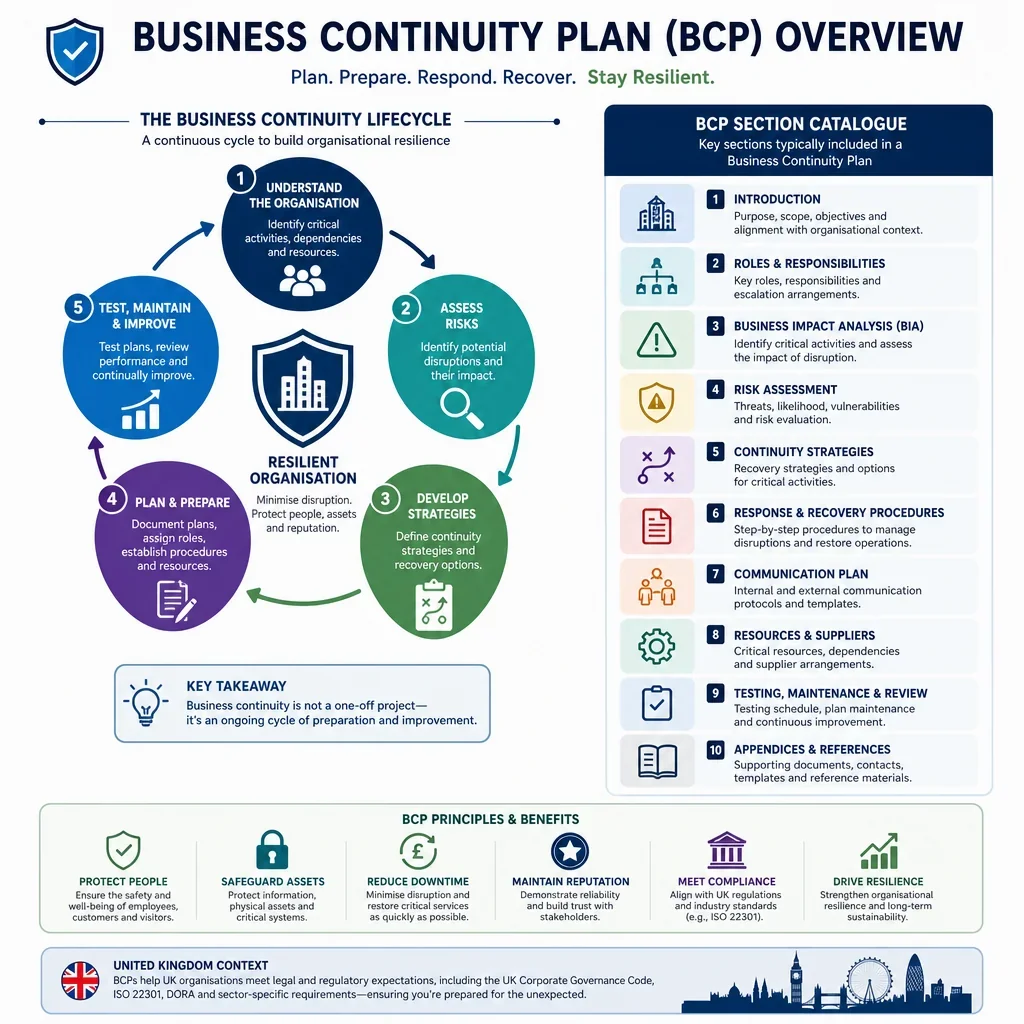
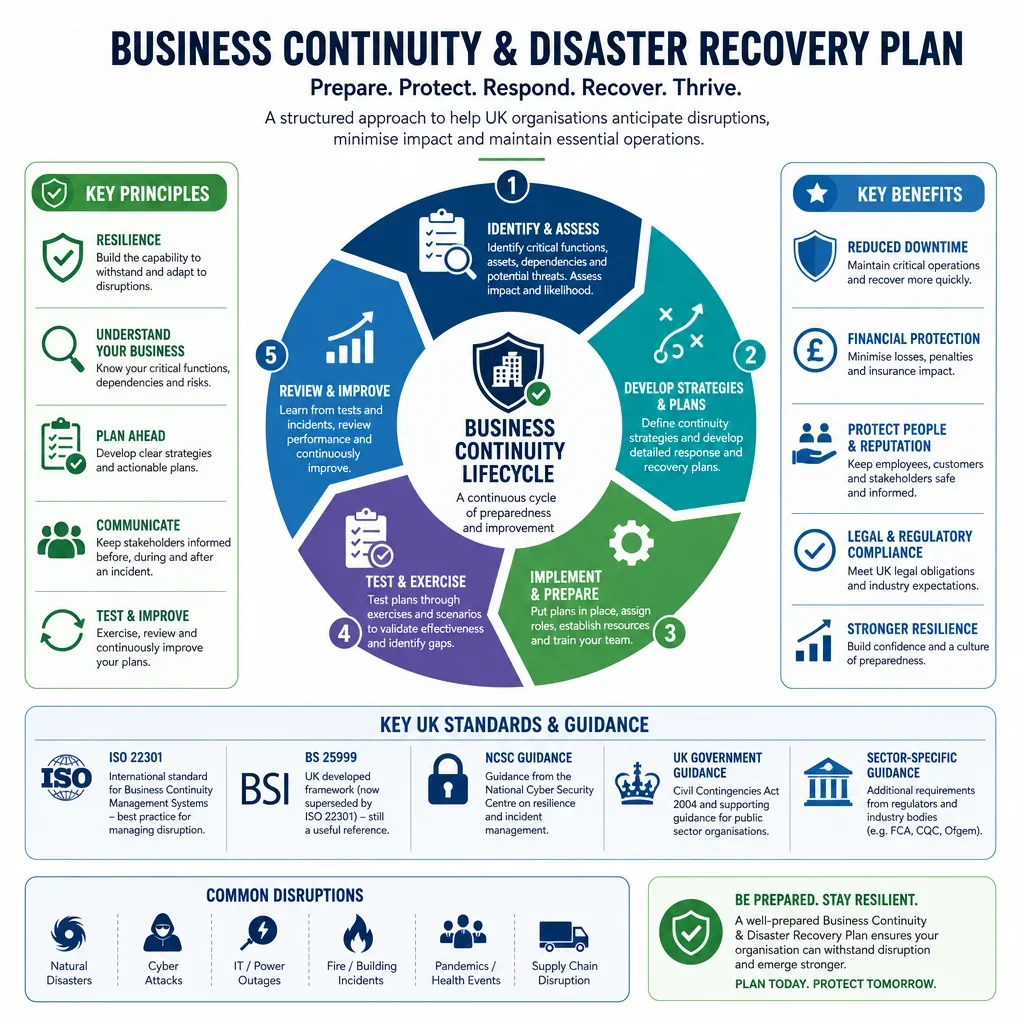
Use a layered programme rather than one annual test. Start with low-effort plan reviews and tabletop exercises, then add technical recovery tests, supplier checks and, where safe, live exercises. This gives evidence that the plan is understood, technically workable and operationally practical.
Which Exercise Methods Produce The Best Evidence?
The strongest audit trail usually comes from methods that create measurable outputs: call tree results, recovery time results, incident logs, decision logs, backup restore evidence, failover records and after-action reports. These outputs help show whether recovery time objectives, communication arrangements and escalation routes are realistic.
What UK Legal And Regulatory Points Should Be Considered?
UK organisations should align testing with relevant duties where applicable. Financial sector firms should consider FCA, PRA and Bank of England operational resilience expectations. Organisations handling personal data should test incident response and recovery in a way that supports UK GDPR and Data Protection Act 2018 accountability. Public bodies, critical suppliers and regulated sectors may also need evidence of cyber resilience and continuity arrangements.
How Often Should Different Tests Be Used?
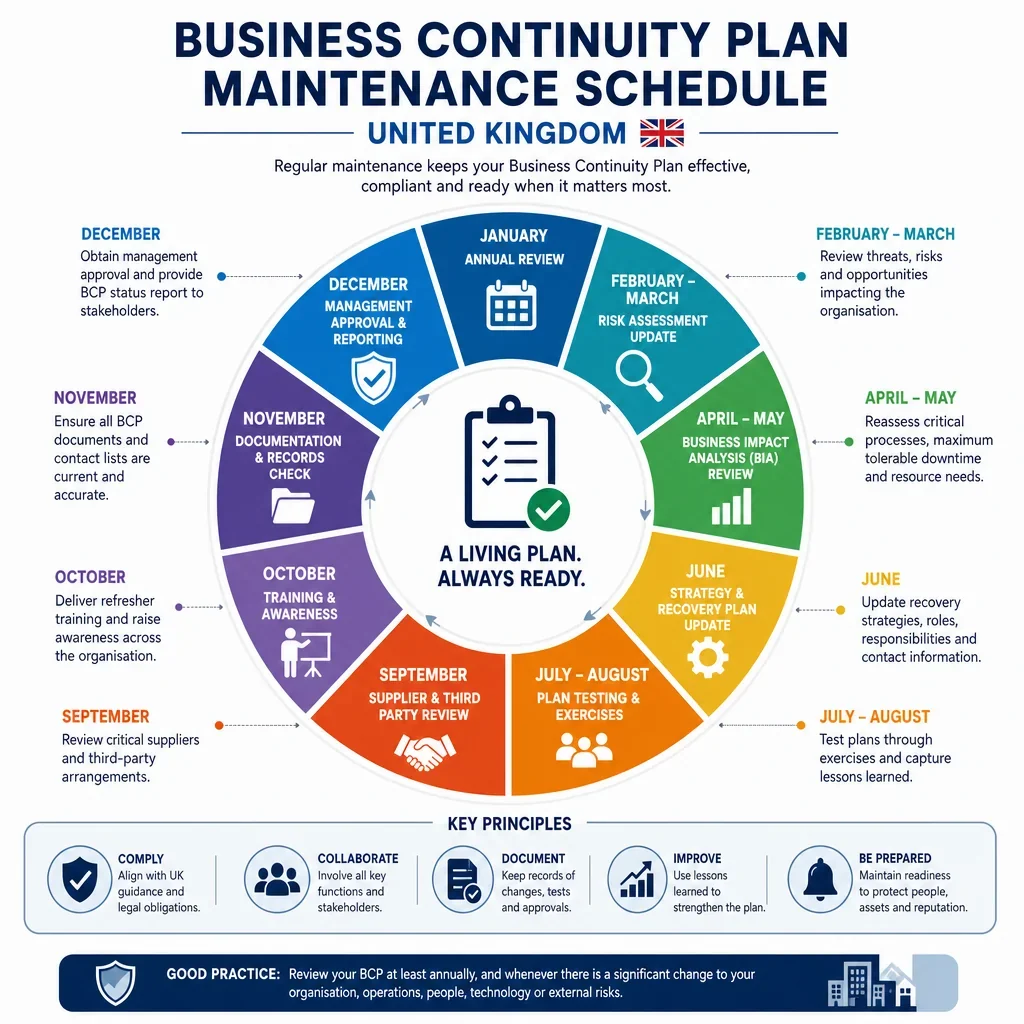
Low-effort methods such as document reviews, contact checks and walkthroughs can be run frequently. Medium-effort scenario exercises, crisis communications drills and supplier exercises are often suited to periodic scheduled testing. High-effort live relocation, full failover, cyber range or multi-agency exercises should be used selectively because they need more planning, risk control and business approval.
FAQs
You Might Also Be Interested In