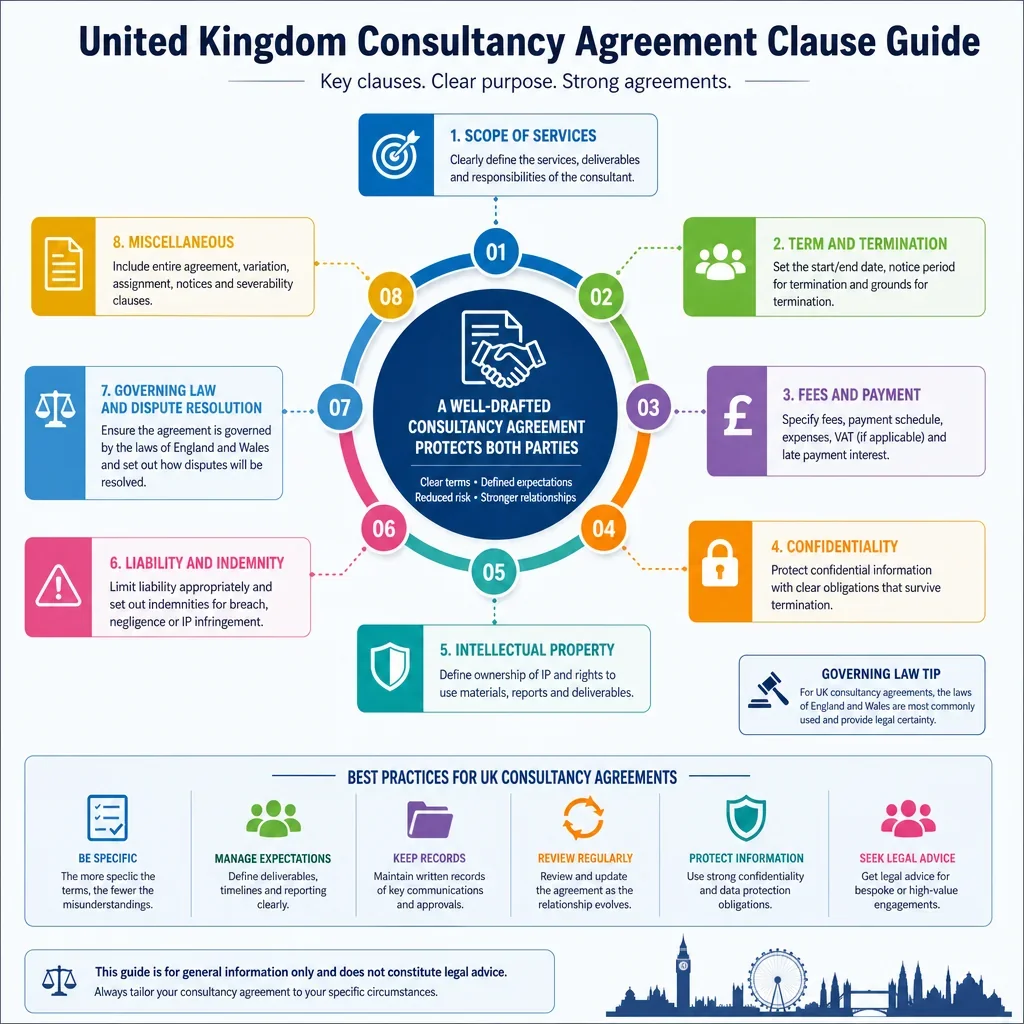
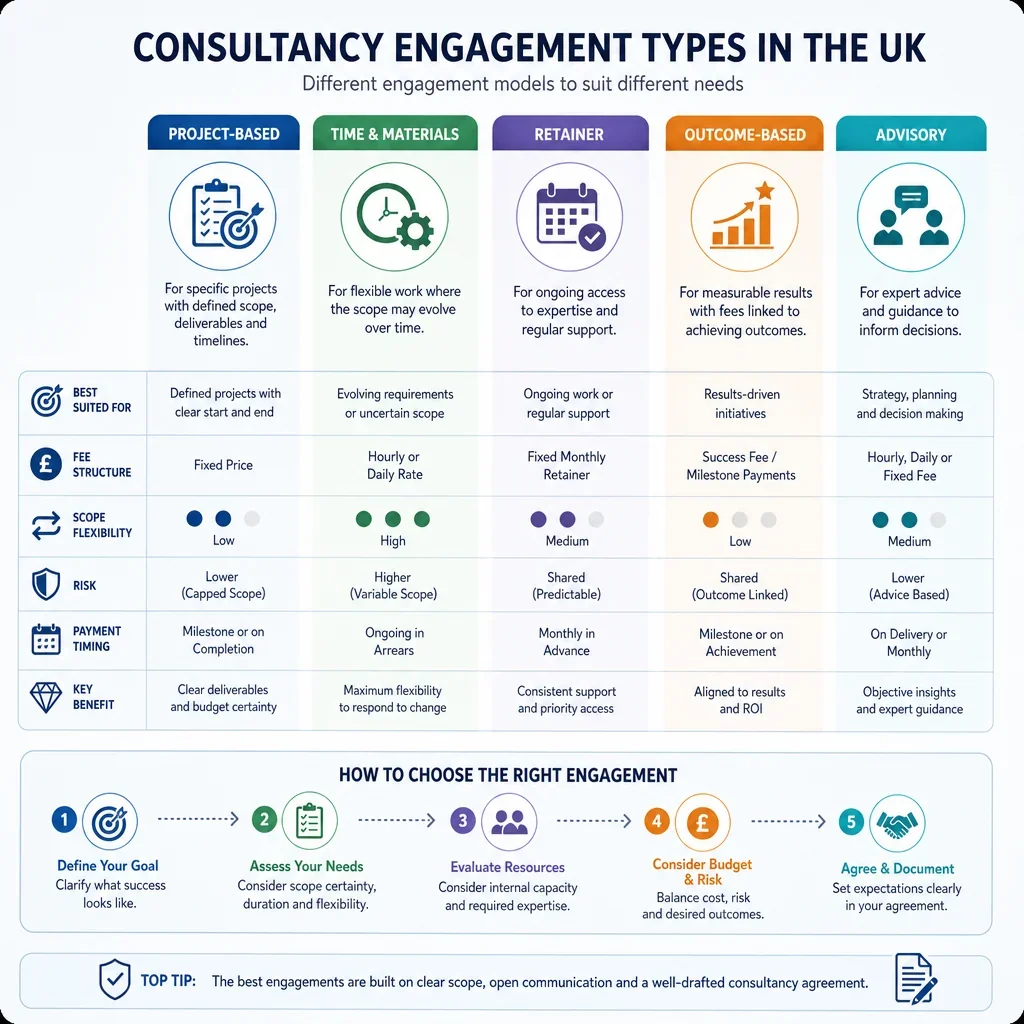
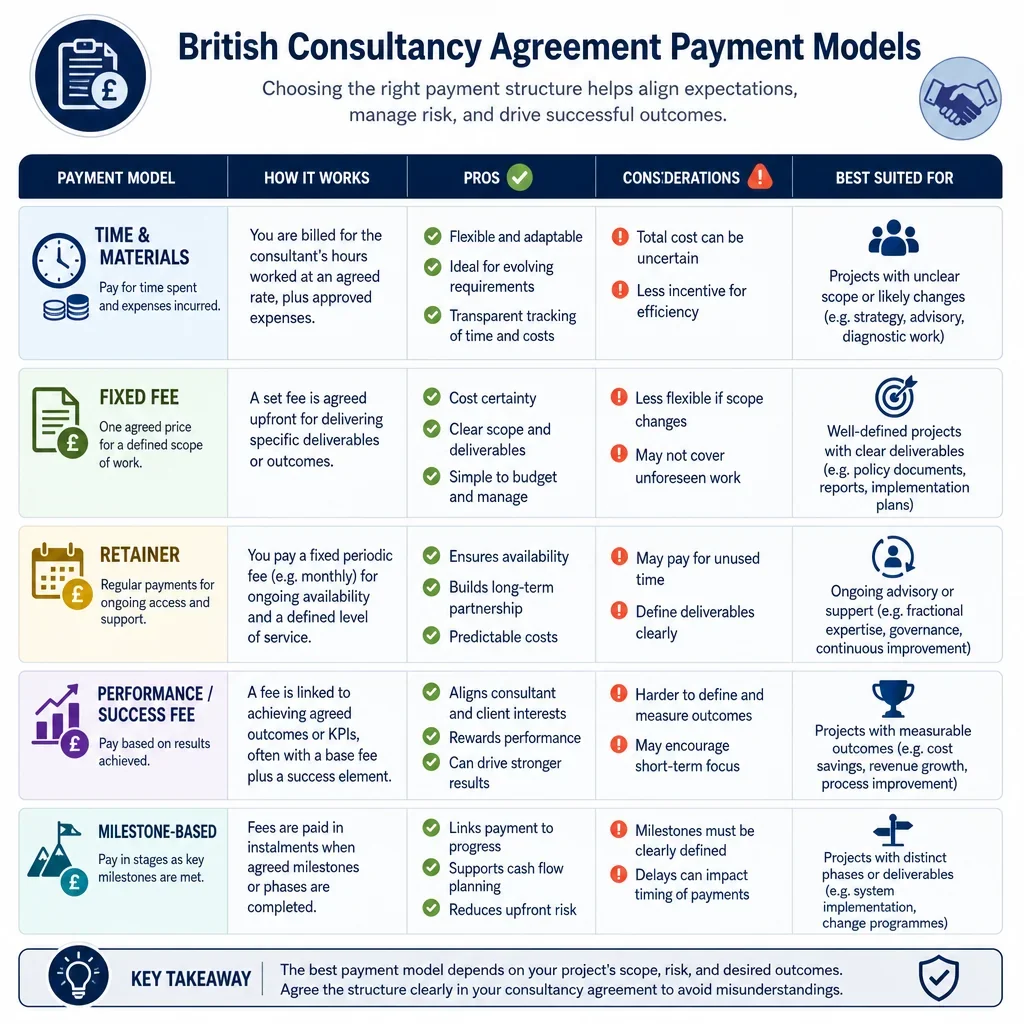
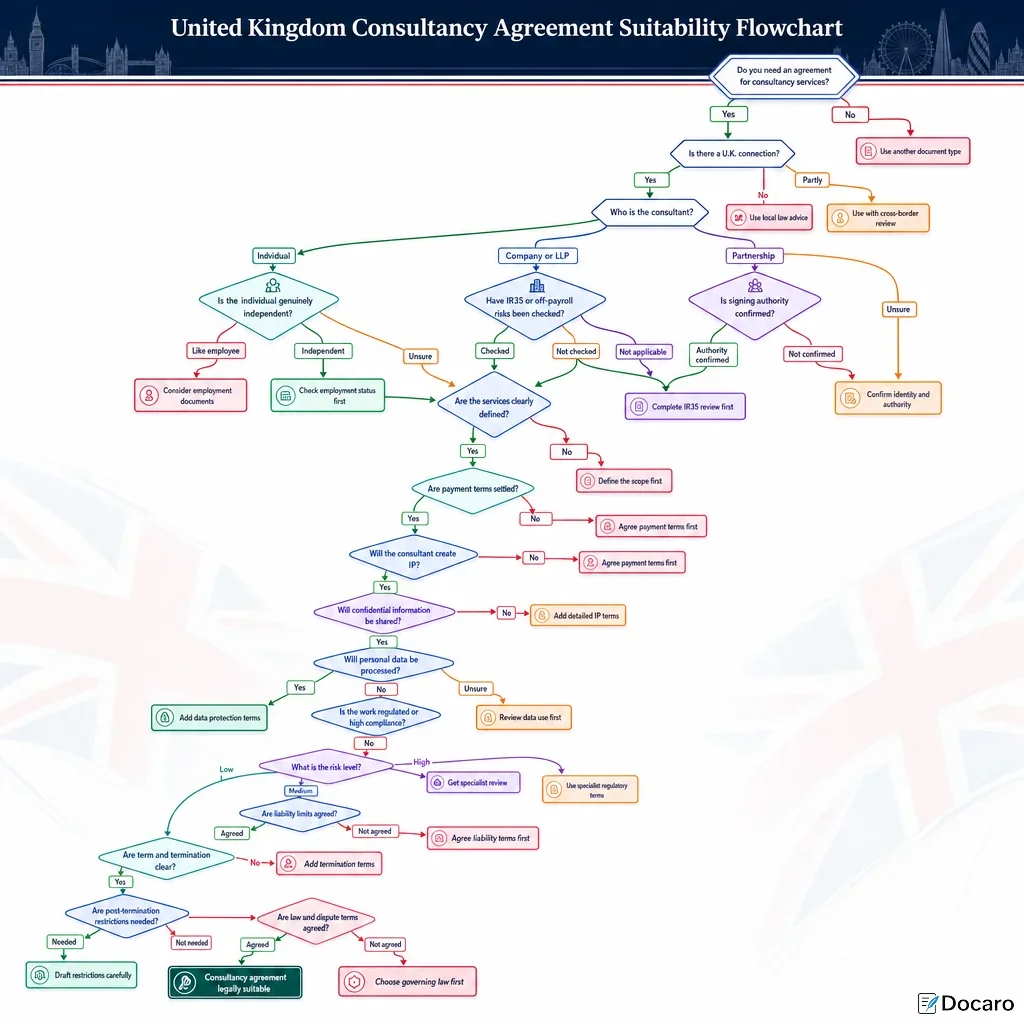
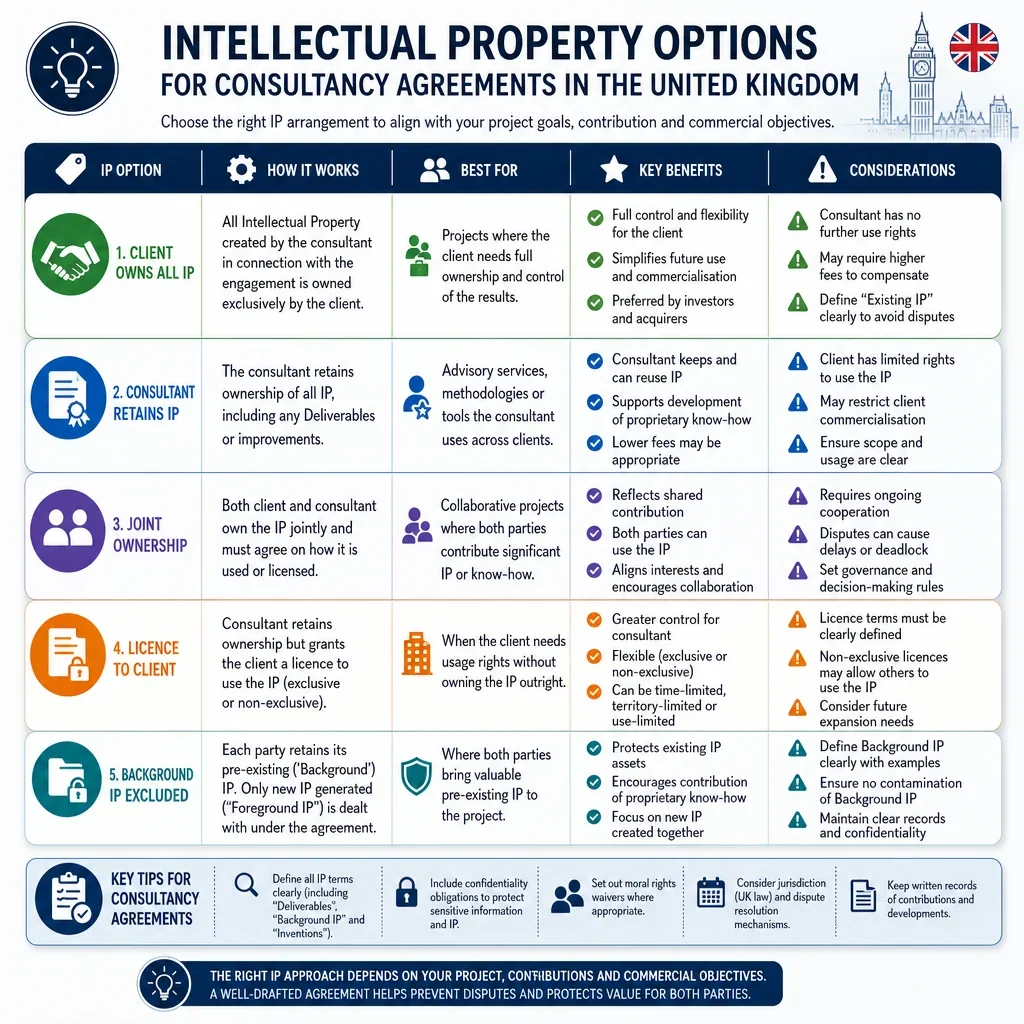
Intellectual Property Options For Consultancy Agreements In The United Kingdom
IP position | Description | Suitable situations | Drafting points | Complexity level |
|---|---|---|---|---|
Client ownership | ||||
Client owns all bespoke deliverables | All IP in work created specifically for the project is assigned to the client. | Bespoke reports, software, branding, designs, policies or manuals commissioned for the client. | Use present assignment language, identify deliverables, include future rights and require further assurance. | Medium |
Client ownership, Pre-existing materials retained | ||||
Client owns project IP, consultant keeps background IP | The client owns new deliverables, while the consultant retains existing tools, templates and methods. | Consultancy using established methodologies, templates, code libraries or diagnostic tools. | Define background IP, list exclusions, and grant the client a licence to embedded background materials. | Medium |
Client ownership | ||||
Client ownership conditional on full payment | IP transfers to the client only when all agreed fees and expenses have been paid. | Fixed-fee projects, staged delivery, small business engagements and higher credit-risk clients. | State when title passes, what interim use is allowed, and what happens on non-payment. | Low |
Automatic assignment on creation | New IP is assigned to the client immediately when created during the services. | Long-term projects, embedded consultants, product development and regulated client environments. | Use wording that assigns present and future rights and require signed confirmatory documents if needed. | Medium |
Assignment after client acceptance | IP transfers only when the client accepts the relevant milestone or final deliverable. | Milestone projects, prototypes, design work and deliverables subject to approval. | Define acceptance tests, deemed acceptance, rejection rights and interim licence terms. | Medium |
Consultant ownership, Licence to client | ||||
Consultant owns deliverables, client gets broad use licence | The consultant keeps ownership but grants the client wide rights to use the deliverables. | Reusable advisory materials, training packs, generic frameworks and repeat consultancy products. | Define licence scope, exclusivity, duration, territory, sublicensing, modification and transfer rights. | Medium |
Consultant owns IP, client has internal-use licence only | The client may use the deliverables internally but cannot resell, publish or exploit them externally. | Strategy reports, training materials, compliance templates and operational guidance. | Define internal use, permitted users, group company access, copying limits and external disclosure. | Low |
Licence to client | ||||
Perpetual non-exclusive client licence | The client can use the deliverables indefinitely, while the consultant can reuse similar work elsewhere. | Templates, business processes, presentations, technical documentation and general advice outputs. | State whether the licence is irrevocable, royalty-free, worldwide and survives termination. | Low |
Exclusive licence to client | The client receives exclusive rights to use the IP, while ownership remains with the consultant. | Market-sensitive projects, client-funded tools, commercial products and competitive sector work. | Define exclusivity, territory, field of use, duration, enforcement rights and consultant residual use. | High |
Field-of-use licence | The client can use the IP only for a defined business sector, purpose or project. | Technology consulting, data models, sector-specific methods and platform customisations. | Define the field precisely and state whether adjacent uses, affiliates and future products are covered. | High |
Project-only client licence | The client may use the deliverables only for the named project or engagement. | Feasibility studies, bid support, temporary campaigns and one-off advisory projects. | Define project boundaries, follow-on use, reuse in later phases and archival copies. | Low |
Territory-limited licence | The client may use the IP only in the UK or another agreed territory. | International rollouts, franchise support, market entry advice and regulated local materials. | Specify territory, online access, cross-border use, affiliates and expansion rights. | Medium |
Time-limited client licence | The client can use the IP for a fixed period, after which rights expire or renew. | Campaigns, pilots, interim management materials and subscription-style consultancy content. | State term, renewal, post-expiry use, deletion duties and fees for extended use. | Low |
Revocable licence until payment, then perpetual licence | The client has temporary use rights during the project, becoming permanent after payment. | Consultants wanting payment protection without assigning ownership. | Link permanent rights to cleared funds and define suspension, revocation and continued confidentiality. | Medium |
Royalty-bearing client licence | The client pays ongoing royalties for commercial use of consultant-owned IP. | Commercialised tools, training products, software, methodologies and revenue-generating deliverables. | Set royalty base, audit rights, reporting, payment dates, VAT and termination for underpayment. | High |
Royalty-free client licence included in fees | The consultancy fee includes the client's agreed use rights, with no separate royalties. | Most standard consultancy deliverables where future revenue tracking is unnecessary. | Say the licence is royalty-free, clarify permitted use and avoid implying ownership transfer. | Low |
Client ownership, Consultant ownership | ||||
Client owns final deliverables only | The client owns the agreed final outputs drafts, working papers and tools remain with the consultant. | Research projects, reports, design work, audit reviews and strategic advisory engagements. | Define final deliverables, exclude drafts and working materials, and cover audit trail retention. | Medium |
Consultant ownership, Pre-existing materials retained | ||||
Consultant retains working papers and know-how | Underlying notes, calculations, processes and professional know-how remain owned by the consultant. | Professional services, financial modelling, technical analysis and management consultancy. | Separate working papers from client data and final deliverables, and preserve confidentiality obligations. | Low |
Client ownership, Pre-existing materials retained | ||||
Client owns supplied data and materials | Client-provided data, documents, trade marks and information remain the client's property. | Any consultancy using client datasets, brand assets, manuals, plans or confidential information. | Grant consultant a limited licence to use client materials only to perform the services. | Low |
Client ownership, Licence to client | ||||
Consultant has limited licence to client materials | The consultant may use client-owned materials only as needed to deliver the services. | Brand, marketing, software, HR, compliance and operational consultancy. | Limit use to the engagement, require return or deletion, and restrict portfolio use. | Low |
Consultant ownership, Pre-existing materials retained, Licence to client | ||||
Consultant retains pre-existing software components | Existing code libraries, scripts and tools remain consultant-owned, with a use licence for the client. | Software consultancy, automation, analytics, dashboards and system integration projects. | Identify components, licence object code or source code, and address maintenance and escrow if needed. | High |
Client ownership | ||||
Client owns bespoke software code | Custom code written specifically for the client is assigned to the client. | Custom applications, plugins, scripts, APIs and internal business systems. | Define source code, repositories, documentation, third-party components and open-source obligations. | High |
Consultant ownership, Licence to client | ||||
Client receives software licence, not source code ownership | The client can use the software but does not own or receive the source code unless agreed. | SaaS tools, proprietary automation, analytics engines and reusable consultant platforms. | Specify permitted users, hosting, source access, backups, support, reverse engineering and termination. | High |
Licence to client, Pre-existing materials retained | ||||
Open-source components subject to separate licences | Open-source elements are not owned by either party and remain governed by their own licences. | Software, data science, automation, website and AI implementation projects. | Require disclosure, licence compliance, copyleft checks, notices and approval for high-risk components. | Specialist advice recommended |
Third-party materials licensed separately | Third-party stock, data, software or content remains subject to the third party's licence terms. | Marketing, design, research, software, training and data projects using external materials. | Identify third-party items, licence fees, permitted use, attribution, indemnities and renewal duties. | Medium |
Client ownership, Licence to client | ||||
Moral rights waived or consented to | The consultant agrees not to assert moral rights that could restrict client use of copyright works. | Creative, design, writing, software documentation, training and marketing deliverables. | Include written waiver or consent covering identified works, adaptations and client successors. | Medium |
Client ownership, Consultant ownership, Licence to client | ||||
Database rights allocated to client or consultant | Rights in databases or structured datasets are allocated separately from copyright in reports or software. | Data cleansing, CRM projects, research databases, analytics models and market intelligence. | Define database maker, input data, derived datasets, extraction rights and permitted reuse. | High |
Consultant ownership, Pre-existing materials retained | ||||
Consultant retains trade secrets and know-how | Confidential methods, processes and know-how remain with the consultant unless expressly transferred. | Specialist consulting, operational improvement, pricing models, algorithms and proprietary frameworks. | Protect confidential information, define residual knowledge and restrict disclosure of proprietary methods. | Medium |
Consultant ownership, Shared rights | ||||
Consultant may use residual general know-how | The consultant may use general skills and ideas retained in memory, but not client confidential information. | Strategic, operational, technical and advisory work where learning carries between projects. | Distinguish residual know-how from confidential information, trade secrets and client-specific outputs. | Medium |
Shared rights | ||||
Joint ownership of jointly created IP | Both parties own IP created jointly, subject to agreed rules on use and exploitation. | Co-development, innovation partnerships, prototypes and mixed client-consultant teams. | Set exploitation rights, consent requirements, revenue sharing, enforcement, assignment and exit rules. | High |
Co-authored copyright with agreed exploitation rights | Where copyright works are jointly authored, both parties should agree how the work can be used. | Joint reports, written methodologies, training content and collaborative creative outputs. | Avoid default uncertainty by granting mutual licences and setting consent rules for commercial use. | High |
Client ownership | ||||
Client owns improvements to client systems | Enhancements made to the client's existing systems, materials or processes belong to the client. | ERP configuration, process redesign, website work, product enhancement and internal tools. | Define improvements, separate consultant tools, and license any embedded consultant background IP. | Medium |
Consultant ownership, Pre-existing materials retained | ||||
Consultant owns improvements to consultant tools | Enhancements to the consultant's pre-existing tools or methods remain owned by the consultant. | Consultant platforms, reusable diagnostics, pricing tools, templates and software libraries. | Exclude client confidential information and grant the client rights needed to use project outputs. | Medium |
Client ownership | ||||
Patentable inventions assigned to client | Inventions created during the consultancy are assigned to the client for patent filing and exploitation. | Engineering, R&D, product development, life sciences and technical innovation projects. | Include disclosure duties, assignment of inventions, patent filing cooperation and confidentiality before filing. | Specialist advice recommended |
Consultant ownership, Licence to client | ||||
Consultant owns inventions, client gets commercial licence | The consultant retains patents or inventions but licenses the client to use them commercially. | Consultant-developed technology, platform inventions and specialist R&D tools. | Cover exclusivity, field, territory, improvements, prosecution costs, infringement and royalties. | Specialist advice recommended |
Client ownership | ||||
Registered design rights assigned to client | Rights in registrable product appearance or graphical designs are assigned to the client. | Product design, packaging, user interfaces, industrial design and consumer goods consultancy. | Cover filing responsibility, design representations, priority, renewals and consultant cooperation. | Specialist advice recommended |
Client ownership, Consultant ownership, Licence to client | ||||
UK unregistered design right allocated expressly | Unregistered rights in shape or configuration are assigned or licensed by express agreement. | Engineering drawings, prototypes, product features and industrial design work. | Define design outputs, ownership, copying rights, evidence of creation and registration strategy. | High |
Client ownership | ||||
Client owns new brand assets and trade mark rights | New names, logos and brand materials created for the client are assigned to the client. | Brand strategy, naming, logo design, marketing consultancy and product launches. | Include clearance responsibility, assignment, filings, domain names, social handles and usage guidelines. | High |
Consultant ownership, Licence to client, Shared rights | ||||
Consultant may use outputs for portfolio only with permission | The consultant may show selected work as a case study only if the client approves. | Design, marketing, software, strategy and transformation projects with publicity value. | Require prior written consent, protect confidential information, and specify logos, screenshots and timing. | Low |
Client ownership | ||||
No consultant portfolio or publicity use | The consultant cannot display, describe or publicise the work without the client's consent. | Confidential launches, regulated businesses, litigation support and commercially sensitive projects. | Ban use of client name, marks, outputs and confidential facts unless written approval is given. | Low |
Client ownership, Licence to client, Pre-existing materials retained | ||||
AI-assisted outputs assigned or licensed with safeguards | Rights in AI-assisted work are allocated, while tool terms and copyright uncertainty are addressed. | Content, design, software, research, legal operations, marketing and data analysis projects. | Disclose AI use, check tool terms, avoid infringing inputs, and define human review duties. | Specialist advice recommended |
Client ownership, Consultant ownership, Licence to client | ||||
Computer-generated works ownership addressed expressly | Where no human author is clear, the agreement states who will own or receive rights in outputs. | AI content generation, automated reporting, algorithmic design and software-generated materials. | Allocate rights contractually and cover prompts, inputs, outputs, training data and platform terms. | Specialist advice recommended |
Client ownership, Pre-existing materials retained | ||||
Client owns prompts and inputs supplied by client | Client-created prompts, data and instructions remain client-owned and confidential. | AI consulting, automation, content generation and data transformation projects. | Restrict training use, disclose tool retention, protect confidential inputs and require deletion where possible. | High |
Consultant ownership, Licence to client, Pre-existing materials retained | ||||
Consultant retains standard training materials | Standard slides, manuals and exercises remain consultant-owned, with limited use rights for attendees. | Workshops, leadership training, compliance training and professional development programmes. | Limit copying, recording, redistribution, train-the-trainer use and adaptation of materials. | Low |
Client ownership | ||||
Client owns bespoke training content | Training materials created specifically around the client's business are assigned to the client. | Internal academies, onboarding programmes, compliance modules and client-specific playbooks. | Medium | |
Licence to client, Consultant ownership | ||||
Recorded consultancy sessions licensed to client | Recordings may be used by the client for agreed internal purposes, while underlying materials remain protected. | Training, coaching, workshops, webinars and knowledge-transfer sessions. | Cover consent, internal distribution, retention, participant privacy, transcript use and confidentiality. | Medium |
Client ownership | ||||
Client owns bespoke copy and campaign assets | Custom marketing copy, campaign concepts and creative assets are transferred to the client. | Marketing consultancy, copywriting, SEO, advertising campaigns and website projects. | Cover drafts, rejected concepts, stock assets, moral rights, attribution and portfolio use. | Medium |
Client ownership, Pre-existing materials retained | ||||
Client owns project-specific SEO outputs | Keyword research, content plans and audit reports for the client transfer to the client. | SEO consultancy, content strategy, website audits and digital marketing retainers. | Exclude generic methods, tools, benchmarks and third-party analytics platform data. | Low |
Client ownership | ||||
Client owns bespoke processes and playbooks | Processes, manuals and playbooks tailored to the client are assigned to the client. | Operations, HR, sales, compliance, procurement and transformation consulting. | Exclude consultant methodologies and clarify whether the client may adapt and distribute internally. | Medium |
Consultant ownership, Licence to client, Pre-existing materials retained | ||||
Client receives licence to use consultant methodology outputs | The client can use outputs produced by a proprietary methodology but does not own the method. | Framework-based consulting, diagnostics, maturity models and benchmarking services. | Define methodology, prohibit reverse engineering and allow practical use of resulting recommendations. | Medium |
Client ownership, Consultant ownership, Licence to client, Pre-existing materials retained | ||||
Model architecture retained, client owns project outputs | The client owns reports and results, while reusable model structures remain consultant-owned. | Analytics, forecasting, machine learning, business intelligence and data science consultancy. | Define models, trained weights, datasets, outputs, retraining rights and confidentiality of client data. | Specialist advice recommended |
Client ownership | ||||
Client owns trained model developed on client data | A model trained specifically for the client on client data is assigned to the client. | Predictive analytics, AI implementation, fraud models, pricing models and optimisation systems. | Cover training data, weights, source code, dependencies, performance limits and ongoing support. | Specialist advice recommended |
Shared rights, Consultant ownership | ||||
Consultant may use anonymised benchmarks | The consultant may use aggregated, anonymised learnings that do not reveal client confidential information. | Benchmarking, market research, analytics, operational consulting and sector reports. | Define anonymisation, aggregation, excluded data, confidentiality limits and data protection compliance. | High |
Client ownership | ||||
Client owns confidential client-specific outputs | Outputs containing the client's confidential strategy, data or trade secrets belong to the client. | M&A support, pricing, restructuring, litigation support, security and competitive strategy. | Combine assignment with strict confidentiality, return, deletion and no portfolio use clauses. | Medium |
Client ownership, Licence to client | ||||
Client receives editable source files | The consultant must provide editable files, repositories or native formats for client use. | Design, software, websites, documents, presentations and technical drawings. | List file formats, repositories, credentials, build files, fonts, plugins and third-party licences. | Medium |
Licence to client, Consultant ownership | ||||
Client receives final files only | The client receives final PDFs, exports or compiled files, but not editable source materials. | Standard reports, design exports, presentation packs and low-cost fixed-scope projects. | State whether native files are excluded or available for an additional fee. | Low |
Client ownership, Licence to client | ||||
Client may white-label deliverables | The client may present the deliverables under its own brand without consultant attribution. | Agency support, reseller work, training content, reports and client-facing tools. | Address attribution, moral rights, sublicensing, end-client use and responsibility for modifications. | Medium |
Licence to client | ||||
Client may sublicense to group companies or end users | The client can allow affiliates, contractors or end users to use the IP within agreed limits. | Group-wide rollouts, outsourcing, SaaS implementation, agencies and franchise networks. | Define permitted sublicensees, flow-down obligations, liability and whether sublicences survive termination. | High |
Licence to client, Consultant ownership | ||||
No sublicensing without consultant consent | The client may use the IP itself but cannot authorise others to use it without consent. | Consultant-owned tools, narrow advisory outputs and sensitive methodology-based projects. | Clarify whether employees, affiliates, contractors and professional advisers count as client use. | Low |
Client ownership, Licence to client | ||||
Client may modify and adapt deliverables | The client can edit, adapt and build on the deliverables for its business purposes. | Templates, policies, manuals, software, designs and training materials. | Permit adaptations, address moral rights, exclude consultant liability for unauthorised modifications. | Medium |
Licence to client, Consultant ownership | ||||
Client may use but not modify deliverables | The client can use the deliverables as supplied but cannot edit or create derivatives. | Accredited training, compliance content, branded frameworks and safety-critical materials. | Define prohibited changes, exceptions for formatting, and liability for unauthorised alterations. | Low |
Client ownership, Licence to client | ||||
Consultant gives non-infringement warranty | The consultant promises that, to its knowledge or absolutely, deliverables do not infringe third-party IP. | Any project producing externally used or commercially important deliverables. | Set warranty standard, exclusions for client materials, third-party items and client modifications. | Medium |
Consultant indemnifies client for IP infringement claims | The consultant covers losses from third-party claims that its deliverables infringe IP rights. | Software, branding, public-facing content, product design and commercial deliverables. | Define claim control, caps, exclusions, mitigation, replacement rights and insurance alignment. | High |
Shared rights, Pre-existing materials retained | ||||
Mutual indemnities for each party's materials | Each party is responsible for infringement claims caused by materials it supplies. | Projects using both client assets and consultant tools or third-party inputs. | Allocate responsibility for client instructions, consultant work, third-party materials and combined use. | Medium |
Client ownership, Pre-existing materials retained | ||||
Consultant not liable for client-supplied infringing materials | The consultant is not responsible if infringement arises from client materials or instructions. | Marketing, software, data, design and document projects using client-supplied content. | Require client warranties for supplied materials and exclude liability for following client specifications. | Low |
Client ownership, Pre-existing materials retained, Licence to client | ||||
Foreground IP assigned, background IP retained | New project IP transfers to the client, while pre-existing IP remains with its original owner. | Complex projects with substantial pre-existing tools, client materials and new deliverables. | Define foreground, background, sideground, improvements and embedded licences clearly. | High |
Consultant ownership, Client ownership, Shared rights | ||||
Sideground IP retained by creator | IP created during the term but outside the project is owned by the party that created it. | Long retainers, overlapping engagements, innovation work and consultants serving multiple clients. | Define project scope, excluded developments, conflicts, evidence records and confidentiality boundaries. | High |
Licence to client, Consultant ownership | ||||
Source code escrow with conditional release | Source code is held by an escrow agent and released if agreed trigger events occur. | Business-critical software where the consultant retains ownership or hosts the system. | Define deposit materials, update frequency, release triggers, verification and post-release licence scope. | Specialist advice recommended |
Client ownership | ||||
Copyright assignment must be in writing and signed | A legal assignment of copyright requires a written document signed by or for the assignor. | Any consultancy where copyright in deliverables is intended to transfer to the client. | Do not rely on payment alone include a signed written assignment clause. | Low |
Future copyright assigned in advance | Rights in works not yet created can be assigned in advance if the contract is drafted properly. | Ongoing consultancy, retainers, agile projects and staged deliverables. | Use future assignment wording and require further documents when rights come into existence. | Medium |
Client ownership, Consultant ownership | ||||
Consultant IP not treated like employee IP by default | Unlike employee-created copyright, contractor-created copyright does not automatically belong to the client. | All independent contractor and consultancy arrangements creating copyright works. | Include an express assignment or licence rather than assuming the client owns commissioned work. | Low |
Client ownership, Licence to client, Consultant ownership | ||||
IP rights survive termination | Assignments and licences continue after the agreement ends, subject to payment and breach terms. | Any consultancy where deliverables must remain usable after project completion. | State which licences survive, when rights end, and whether unpaid work must be returned or deleted. | Medium |
Licence to client, Consultant ownership | ||||
Licence terminates for misuse or non-payment | The consultant can end the client's licence if the client breaches licence limits or fails to pay. | Consultant-owned tools, subscription content, software licences and valuable methodologies. | Specify breach triggers, cure periods, suspension rights, post-termination duties and accrued rights. | Medium |
Client ownership | ||||
Registered IP assignments recorded at UK IPO | Assignments of registered patents, trade marks or designs may need recordal to protect priority and notice. | Projects creating or transferring registered patents, trade marks or designs. | Obtain signed assignments, file recordals, allocate fees and require cooperation after completion. | Specialist advice recommended |
Licence to client | ||||
Registered IP licence may be recorded | Licences of registered IP can sometimes be recorded to protect licensee interests. | Exclusive trade mark, patent or design licences in high-value commercial projects. | Consider recordal, confidentiality of licence terms, enforcement standing and termination updates. | Specialist advice recommended |
Licence to client, Consultant ownership, Pre-existing materials retained | ||||
Client exclusivity in sector, consultant retains general methodology | The client gets exclusivity in its sector, while the consultant can use general methods elsewhere. | Competitive strategy, sector playbooks, commercial models and client-funded framework development. | Define sector, competitors, duration, territory, restricted reuse and permitted generic know-how. | High |
Client ownership, Consultant ownership, Shared rights | ||||
Reversion of IP if client does not use deliverables | IP transfers back or licence rights expand if the client does not commercialise within an agreed period. | Innovation, product development, R&D pilots and consultant-originated concepts. | Define non-use trigger, notice, re-assignment, retained client rights and compensation. | Specialist advice recommended |
Shared rights | ||||
Shared commercialisation with revenue split | Both parties share rights and revenue from commercial exploitation of jointly developed IP. | New products, platforms, spin-outs, innovation partnerships and co-funded R&D. | Set ownership shares, revenue definitions, costs, audits, tax, governance and exit mechanics. | Specialist advice recommended |
Licence to client, Client ownership, Consultant ownership | ||||
Client option to buy IP later | The client starts with a licence and can later purchase ownership for an agreed fee. | Early-stage projects, pilots, uncertain budgets and consultant-owned prototypes. | Set option period, price formula, assignment terms, payment trigger and excluded background IP. | High |
Consultant ownership, Shared rights, Pre-existing materials retained | ||||
Consultant may reuse generic non-confidential elements | The consultant may reuse generic structures, ideas and non-confidential components in later work. | Templates, policies, playbooks, reports and repeated advisory engagements. | Exclude client data, confidential information, trade secrets and substantially identical outputs for competitors. | Medium |
Client ownership, Consultant ownership | ||||
Consultant cannot reuse client-specific IP for competitors | The consultant may keep generic know-how but cannot reuse client-specific outputs for competitors. | Competitive strategy, pricing, bids, product launches and sector-sensitive consultancy. | Define competitors, restricted materials, time period and permitted general experience. | High |
Client ownership | ||||
Client owns project documentation | Project-specific specifications, manuals, reports and handover documents are assigned to the client. | IT projects, operational change, implementation, compliance and technical consultancy. | List documentation, update duties, editable formats, version control and third-party extracts. | Low |
Client ownership, Consultant ownership, Licence to client | ||||
Order of precedence resolves IP clause conflicts | The agreement states which document controls if proposals, statements of work and terms conflict on IP. | Projects with proposals, purchase orders, statements of work and platform terms. | Set hierarchy and ensure IP terms are consistent across the main agreement and schedules. | Medium |
Licence to client, Client ownership | ||||
Group company use permitted | The client's affiliates may use the deliverables within the agreed licence scope. | Corporate groups, multi-site operations, international businesses and shared service functions. | Define group companies, responsibility for affiliate breaches and rights after group restructuring. | Medium |
Client ownership, Licence to client, Shared rights | ||||
End-client receives agreed rights through agency | An agency client can pass agreed IP rights to its own end-client. | Agencies hiring freelance consultants, white-label work and subcontracted delivery. | Permit assignment or sublicensing, align end-client terms, and protect consultant background IP. | High |
Client ownership, Licence to client | ||||
Consultant must obtain IP from subcontractors | The consultant must secure assignments or licences from subcontractors needed for the client's rights. | Projects involving freelance designers, developers, researchers, copywriters or specialist subcontractors. | Require back-to-back IP terms, moral rights waivers, confidentiality and proof of rights on request. | Medium |
Consultant may use client logo only for approved purposes | Client trade marks remain client-owned and may be used by the consultant only with permission. | Case studies, presentations, implementation work, co-branded materials and marketing support. | Set brand guidelines, approval rights, permitted channels, revocation and no goodwill ownership transfer. | Low |
Client ownership | ||||
Client owns project domain names and account assets | Domain names, campaign accounts and online assets registered for the client belong to the client. | Digital marketing, website builds, brand launches, e-commerce and social media consultancy. | Register in client name where possible and require transfer of credentials and admin control. | Medium |
Client ownership, Consultant ownership, Pre-existing materials retained | ||||
Client owns commissioned research report, consultant retains methodology | The client owns the report and findings research methods and generic survey tools remain consultant-owned. | Market research, employee surveys, customer insight and academic-style consultancy. | Address raw data, anonymised data, methodology, publication rights and respondent consents. | High |
Client ownership, Consultant ownership, Shared rights | ||||
Raw research data ownership specified separately | The agreement states who owns and may reuse raw survey, interview or observation data. | Market research, UX research, employee surveys and data-heavy consultancy. | Cover personal data, anonymisation, retention, consent wording, publication and secondary use. | High |
Client ownership, Licence to client | ||||
Publication rights controlled by client | The consultant cannot publish reports, findings or outputs without client approval. | Research, public policy, regulated advice, litigation support and confidential business reviews. | Require written consent, protect confidential information, and address attribution and academic use. | Medium |
Licence to client, Pre-existing materials retained | ||||
Client use subject to third-party platform terms | Deliverables relying on third-party platforms can only be used within those platform terms. | CRM, CMS, analytics, AI, cloud, SaaS and automation implementation projects. | Identify platforms, who contracts with vendor, licence fees, account control and termination effects. | High |
Pre-existing materials retained, Licence to client | ||||
IP dependencies listed in a schedule | A schedule lists background IP, third-party materials and open-source components used in the deliverables. | Software, data, design, technical, AI and complex transformation projects. | Require updates, licence details, restrictions, costs and replacement rights if dependencies change. | High |
Client ownership, Licence to client, Shared rights | ||||
Assignment to client with consultant reuse carve-out | The client owns deliverables, but the consultant gets a limited licence to reuse agreed elements. | Consultant-originated templates, non-confidential frameworks and reusable creative structures. | Define reusable elements, exclude confidential information and restrict competing or identical use. | High |
Client ownership, Consultant ownership, Pre-existing materials retained | ||||
Client owns security findings, consultant owns testing tools | The client owns vulnerability reports scanning tools, scripts and methods remain consultant-owned. | Cybersecurity testing, penetration testing, audits and incident response consultancy. | Protect exploit details, restrict disclosure, define tool access and address legal authorisation for testing. | High |
Licence to client, Consultant ownership | ||||
Client licensed to use drawings for agreed site or project | Design drawings may be used for the agreed project but not reused on other sites unless allowed. | Architecture, engineering, CAD, planning and construction consultancy. | Define site, project, professional reliance, collateral warranties and reuse restrictions. | High |
Client may rely on report, third parties need consent | The client may use and rely on the report third-party reliance is restricted unless agreed. | Due diligence, valuation, environmental, technical, financial and compliance reports. | Separate IP ownership from reliance rights, liability caps and disclosure to funders or buyers. | Medium |
Client ownership | ||||
Client controls privileged or litigation-related outputs | Outputs prepared for legal proceedings or legal advice are controlled by the client and its lawyers. | Litigation support, investigations, expert support and regulatory response consultancy. | Preserve privilege, restrict disclosure, define lawyer instructions and manage expert report publication. | Specialist advice recommended |
Licence to client, Consultant ownership, Pre-existing materials retained | ||||
Expert retains professional analysis tools, client receives report rights | The client may use the expert report for proceedings, while expert methods and tools are retained. | Expert witness, forensic accounting, technical disputes and claims analysis. | Align with court duties, report use, disclosure rules, confidentiality and reliance limits. | Specialist advice recommended |
Consultant ownership, Licence to client, Pre-existing materials retained | ||||
Consultant owns generic compliance templates, client may adapt internally | The client can adapt templates for internal use, but the underlying template set remains consultant-owned. | HR, health and safety, data protection, financial compliance and policy consultancy. | Permit internal adaptation, prohibit resale, and disclaim responsibility for later legal changes. | Medium |
Client ownership | ||||
Client owns regulated client-facing materials after approval | Client-facing regulated materials transfer to the client, subject to required compliance approval. | Financial promotions, insurance, investment, pensions and FCA-regulated consultancy. | Address approval responsibility, record keeping, version control and liability for client amendments. | Specialist advice recommended |
Who Should Own IP In A UK Consultancy Agreement?
Client ownership is usually most appropriate where the client is paying for bespoke deliverables that will be used commercially, such as software, designs, reports, processes or marketing assets. In UK law, copyright is not automatically transferred just because the client has paid for the work, so an express written assignment is normally needed.
When Is A Licence Better Than An Assignment?
A licence to client is often better where the consultant uses repeatable methods, templates, code libraries, know-how or tools across many clients. The agreement should state whether the licence is exclusive or non-exclusive, worldwide or UK-only, perpetual or time-limited, and whether the client can modify, sublicense or transfer the materials.
How Should Pre-Existing Materials Be Handled?
Pre-existing materials retained clauses are essential where the consultant brings background IP, frameworks, training content, software components, data models or proprietary methodologies to the project. The agreement should list those materials and give the client only the rights needed to use the final deliverables.
What UK Drafting Points Are Most Important?
- Use a written assignment for transferred copyright and other assignable rights.
- Separate background IP from project deliverables.
- Address moral rights, confidentiality, third-party materials, open-source software and post-termination use.
- For patents, registered designs and trade marks, consider registration, execution and recordal requirements.
- Where both parties contribute valuable inputs, shared rights can work, but need careful rules on exploitation, revenue, enforcement and exit.
FAQs
You Might Also Be Interested In