Confidentiality And Information Handling In UK Consultancy Agreements
Information issue | Purpose | Typical drafting points | Information affected | Sensitivity level |
|---|---|---|---|---|
Confidential information | ||||
Definition of confidential information | Set the scope of protected information. | Include business, technical, financial, strategic and project information, whether written, oral or electronic. | Client information Mutual information Project materials | High |
Marked and unmarked information | Avoid disputes about whether information is protected. | Protect information marked confidential and information that is obviously confidential from context. | Mutual information | Medium |
Oral confidential disclosures | Protect information shared in meetings or calls. | Cover oral information confirmed in writing or reasonably understood as confidential. | Client information Consultant information Mutual information | Medium |
Trade secrets and know-how | Protect commercially valuable secret information. | Identify trade secrets, restrict use, preserve secrecy and require reasonable protection steps. | Client information Project materials | High |
Use only for consultancy services | Prevent misuse outside the engagement. | Use confidential information only to perform agreed services and not for competitive or personal purposes. | Client information Project materials | High |
Confidential information, Security measures | ||||
Need-to-know access controls | Limit internal exposure of sensitive information. | Disclose only to personnel who need access and are bound by confidentiality obligations. | Client information Personal data Project materials | High |
Permitted disclosure, Security measures | ||||
Subcontractor access to information | Control onward disclosure to delivery partners. | Require prior consent, equivalent duties, due diligence and consultant liability for subcontractor breaches. | Client information Personal data Project materials | High |
Permitted disclosure | ||||
Disclosure to personnel and advisers | Allow practical service delivery and advice. | Permit disclosure to employees, officers, accountants, lawyers and insurers on a confidential need-to-know basis. | Mutual information Project materials | Medium |
Disclosure required by law | Allow compliance with legal obligations. | Permit compulsory disclosure, require notice where lawful, limit disclosure and seek protective treatment. | Mutual information Personal data | High |
Disclosure to regulators or authorities | Allow lawful regulatory cooperation. | Permit disclosure to regulators, tax authorities, courts or public bodies where required or properly requested. | Mutual information Personal data | Medium |
Confidential information | ||||
Public domain exclusion | Avoid protecting information already public. | Exclude information public other than through breach by the receiving party or its representatives. | Mutual information | Low |
Prior knowledge exclusion | Prevent overreach into pre-existing knowledge. | Exclude information already known without confidentiality duty before disclosure. | Consultant information Mutual information | Low |
Independent development exclusion | Protect legitimate independent work. | Exclude information independently developed without use of the disclosing party's confidential information. | Consultant information Mutual information Project materials | Low |
Lawful third-party receipt | Avoid restricting lawful external information. | Exclude information received from a third party without breach of confidentiality. | Mutual information | Low |
Survival after termination | Keep protection after the project ends. | Specify survival period, with indefinite protection for trade secrets or highly sensitive information. | Client information Mutual information Project materials | High |
Return or deletion | ||||
Return of confidential materials | Recover control of information at end of access. | Return documents, devices, records, working papers and project materials on request or termination. | Client information Project materials | High |
Return or deletion, Security measures | ||||
Secure deletion of copies | Reduce post-engagement leakage risk. | Delete electronic copies, extracts and notes using secure methods, subject to lawful retention. | Client information Personal data Project materials | High |
Return or deletion | ||||
Certificate of deletion or return | Create evidence of compliance. | Require written confirmation that materials were returned or securely deleted by a named person. | Client information Personal data Project materials | Medium |
Backups and archival copies | Address information retained in systems. | Permit inaccessible backups until overwritten, with continued confidentiality and no active use. | Client information Personal data Project materials | Medium |
Return or deletion, Permitted disclosure | ||||
Legally required retention | Preserve evidence required by law or regulation. | Allow retained copies for legal, insurance, audit or professional obligations, subject to confidentiality. | Mutual information Personal data Project materials | Medium |
Data protection | ||||
Processor obligations under UK GDPR | Meet mandatory processor contract requirements. | Include documented instructions, confidentiality, security, subprocessor controls, assistance, deletion and audits. | Personal data | High |
Controller, processor or joint controller status | Allocate data protection responsibility correctly. | State roles for each processing activity and avoid assuming processor status incorrectly. | Personal data | High |
Documented processing instructions | Restrict processor use of personal data. | Set subject matter, duration, nature, purpose, data types, data subjects and client instructions. | Personal data | High |
Data protection, Security measures | ||||
Special category personal data | Apply stricter controls to sensitive personal data. | Identify special category data, lawful conditions, access limits, encryption and enhanced handling rules. | Personal data | High |
Criminal offence data | Control particularly restricted personal data. | Restrict access, identify legal basis and require enhanced confidentiality and retention controls. | Personal data | High |
Data protection | ||||
Data subject rights assistance | Support responses to individual rights requests. | Require prompt notice, assistance, no direct response unless authorised and secure retrieval of records. | Personal data | Medium |
Data protection, Security measures | ||||
Personal data breach notification | Enable timely breach assessment and reporting. | Require immediate notice, incident details, mitigation, cooperation and preservation of evidence. | Personal data Client information | High |
Data protection | ||||
International transfers of personal data | Control transfers outside the UK regime. | Require transfer mechanism, prior approval, transfer risk assessment and onward transfer restrictions. | Personal data | High |
IDTA or UK Addendum use | Document approved UK transfer safeguards. | Use the UK IDTA or UK Addendum where applicable and list importer, exporter and transfer details. | Personal data | High |
Security measures, Data protection | ||||
Appropriate technical and organisational measures | Set a baseline security obligation. | Require measures appropriate to risk, including access control, encryption, resilience and regular testing. | Personal data Client information Project materials | High |
Security measures | ||||
Encryption of sensitive information | Reduce risk if data is lost or intercepted. | Require encryption in transit and at rest for laptops, portable media, cloud storage and backups. | Personal data Client information Project materials | High |
Security measures, Confidential information | ||||
Passwords, credentials and keys | Protect systems used for the project. | Prohibit sharing credentials, require MFA, secure storage, prompt revocation and return of access tokens. | Client information Personal data Project materials | High |
Security measures | ||||
Remote working and home offices | Control off-site information handling. | Require private workspaces, secure Wi-Fi, locked screens, no household access and secure disposal. | Client information Personal data Project materials | Medium |
Use of personal devices | Reduce unmanaged device risk. | Allow only approved devices with encryption, patching, antivirus, screen lock and remote wipe capability. | Client information Personal data Project materials | High |
Security measures, Data protection | ||||
Cloud storage and collaboration tools | Control third-party platform risk. | Use approved platforms, restrict sharing links, set permissions, define storage locations and require audit logs. | Client information Personal data Project materials | High |
Security measures | ||||
Removable media restrictions | Prevent loss through portable storage. | Ban or restrict USB drives, require encryption and record any approved use. | Client information Personal data Project materials | Medium |
Email and file transfer security | Reduce misdirection and interception risk. | Require approved channels, encryption for sensitive files, recipient checks and no auto-forwarding. | Client information Personal data Project materials | Medium |
Security measures, Confidential information | ||||
Confidentiality incident reporting | Enable rapid containment of leaks. | Require immediate notice of suspected unauthorised access, loss, disclosure or misuse. | Client information Mutual information Project materials | High |
Security measures, Data protection | ||||
Security and data protection audits | Verify compliance with handling obligations. | Allow audits, questionnaires, evidence requests and remediation plans, with reasonable notice and confidentiality. | Client information Personal data Project materials | Medium |
Security measures, Confidential information | ||||
Information classification rules | Apply controls based on sensitivity. | Define handling rules for public, internal, confidential and highly confidential materials. | Client information Personal data Project materials | Medium |
Security measures | ||||
Compliance with client security policies | Align consultant conduct with client standards. | Incorporate notified policies on IT use, access, classification, clean desk and acceptable use. | Client information Personal data Project materials | Medium |
Publicity restrictions | ||||
Client name and logo use | Prevent unauthorised marketing association. | Prohibit use of client name, logo, trade marks or branding without prior written consent. | Client information | Medium |
Publicity restrictions, Confidential information | ||||
Case studies and testimonials | Control disclosure of project details. | Require approval for case studies, testimonials, portfolio entries and disclosure of outcomes. | Client information Project materials | Medium |
Publicity restrictions | ||||
Press releases and public announcements | Protect timing and message control. | Require prior approval for announcements about the agreement, project, relationship or deliverables. | Client information Mutual information Project materials | Medium |
Social media posts | Prevent informal public disclosure. | Ban unauthorised posts, photos, tags, project references or behind-the-scenes content. | Client information Project materials | Medium |
Confidential information, Publicity restrictions | ||||
Tender and procurement information | Protect competitive and procurement integrity. | Restrict disclosure of bid strategy, evaluation materials, pricing, contract award details and conflicts. | Client information Project materials | High |
Confidential information | ||||
Financial and pricing information | Protect commercially sensitive numbers. | Cover budgets, forecasts, margins, fees, pricing models, discounts and payment data. | Client information Consultant information Mutual information | High |
Business plans and strategy | Protect strategic advantage. | Include market plans, product roadmaps, restructuring plans, targets, customers and expansion plans. | Client information | High |
Confidential information, Security measures | ||||
Technical and system information | Protect systems, code and architecture. | Cover source code, APIs, architecture, vulnerabilities, credentials, specifications and test data. | Client information Project materials | High |
Confidential information, Data protection | ||||
Customer and supplier information | Protect relationships and contact data. | Include lists, contacts, account notes, contracts, preferences, pricing and performance information. | Client information Personal data | High |
Confidential information, Return or deletion | ||||
Draft deliverables and working papers | Control unfinished or internal project outputs. | Treat drafts, notes, analyses, models and recommendations as confidential project materials. | Project materials Client information | Medium |
Confidential information, Data protection | ||||
Aggregated or anonymised learnings | Clarify whether general know-how may be reused. | Permit use only if no client identity, personal data or confidential specifics can be derived. | Mutual information Personal data Project materials | Medium |
Confidential information, Data protection, Security measures | ||||
Use of AI tools with client information | Prevent uncontrolled input into AI systems. | Ban public AI tools unless approved, require no training use, secure settings and client consent. | Client information Personal data Project materials | High |
Confidential information | ||||
Pre-existing consultant materials | Protect consultant tools without exposing client data. | Allow use of generic methods, templates and know-how while preserving client confidentiality. | Consultant information Project materials | Medium |
Confidential information, Security measures | ||||
Information barriers for conflicting clients | Prevent cross-use between clients. | Require separation of teams, restricted repositories, conflict checks and no sharing with competitor projects. | Client information Project materials | High |
Permitted disclosure | ||||
Protected disclosures and whistleblowing | Avoid restricting lawful protected disclosures. | State confidentiality does not prevent disclosures protected by whistleblowing law. | Mutual information Personal data | Medium |
Confidential information, Permitted disclosure | ||||
Legally privileged information | Preserve privilege and legal confidentiality. | Require separate marking, restricted sharing and immediate notice if privileged material is received in error. | Client information Project materials | High |
Permitted disclosure, Confidential information | ||||
Freedom of information requests | Address public authority disclosure duties. | Require consultation where possible, identify confidential sections and recognise statutory disclosure duties. | Mutual information Client information Project materials | Medium |
Environmental information requests | Handle statutory environmental disclosure rights. | Flag environmental information and allow disclosure where required under applicable access rules. | Client information Project materials | Medium |
Security measures | ||||
Cyber Essentials-style baseline controls | Set practical cyber hygiene expectations. | Require firewalls, secure configuration, access control, malware protection and security updates. | Client information Personal data Project materials | Medium |
Data protection | ||||
Records of processing support | Support accountability documentation. | Require details of processing activities, systems, recipients, transfers, retention and safeguards. | Personal data | Medium |
Data protection impact assessment assistance | Support high-risk processing assessments. | Require information, risk input, safeguards and cooperation before high-risk processing starts. | Personal data | High |
Data protection, Permitted disclosure | ||||
Subprocessor appointment and changes | Control delegated personal data processing. | Require prior specific or general authorisation, notice of changes and equivalent written obligations. | Personal data | High |
Data protection, Publicity restrictions | ||||
Use of contact data for marketing | Prevent unauthorised direct marketing. | Prohibit using client contacts for marketing unless lawful basis, consent and PECR rules are satisfied. | Personal data Client information | Medium |
Return or deletion, Data protection | ||||
Retention period for project information | Avoid excessive post-project retention. | Set retention periods by information type and require deletion when no longer needed. | Client information Personal data Project materials | Medium |
Data protection, Security measures | ||||
Data and information minimisation | Limit information collected or copied. | Require only necessary data, avoid bulk exports and remove unnecessary identifiers. | Personal data Client information | Medium |
Data protection | ||||
Accuracy of personal data handled | Prevent harmful reliance on inaccurate data. | Require notification of inaccuracies, correction on instruction and use of current datasets only. | Personal data | Medium |
Confidential information, Publicity restrictions | ||||
Confidentiality of agreement terms | Keep commercial terms private. | Treat fees, scope, negotiations, disputes and contract terms as confidential, subject to permitted disclosures. | Mutual information | Medium |
Confidential information, Permitted disclosure | ||||
Representative breach responsibility | Make parties accountable for onward recipients. | Receiving party remains liable for breaches by employees, advisers, subcontractors and agents. | Mutual information Client information Project materials | High |
What Confidentiality Terms Should A UK Consultancy Agreement Cover?
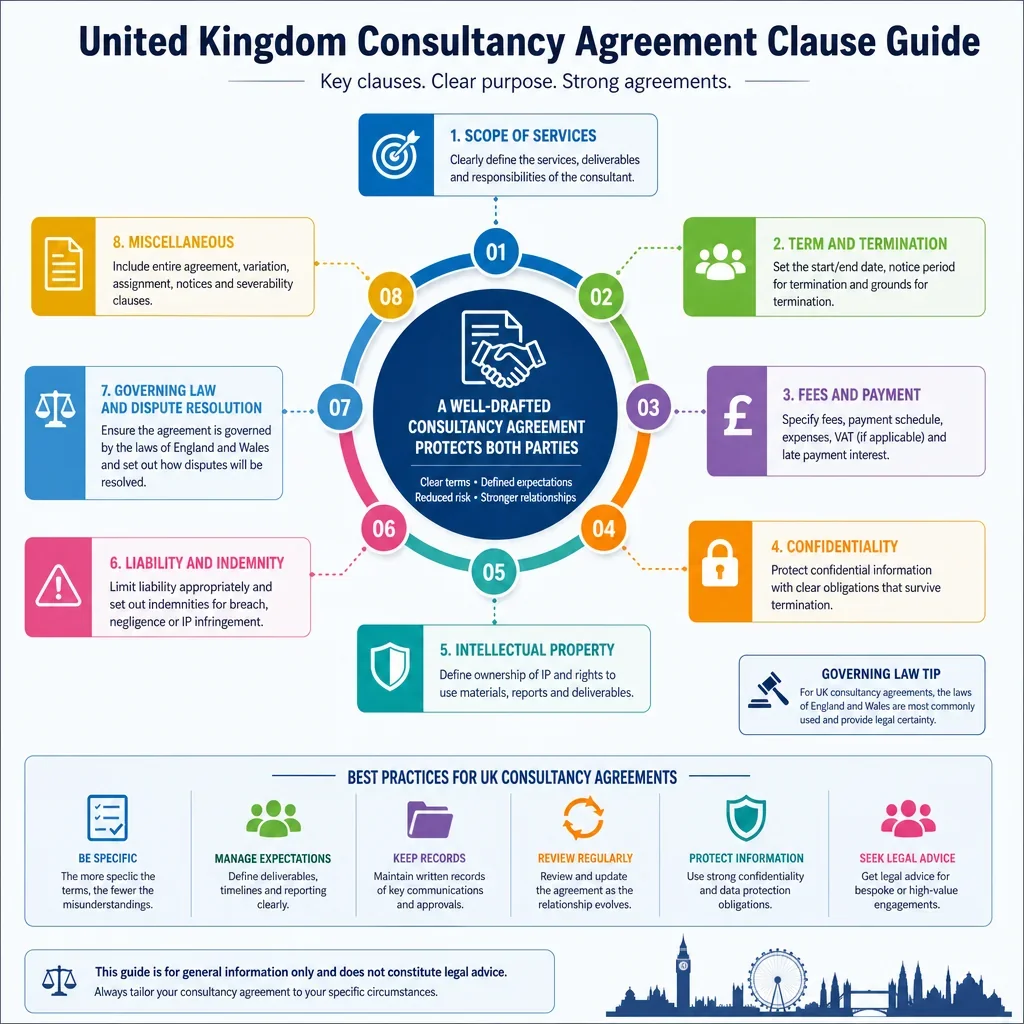
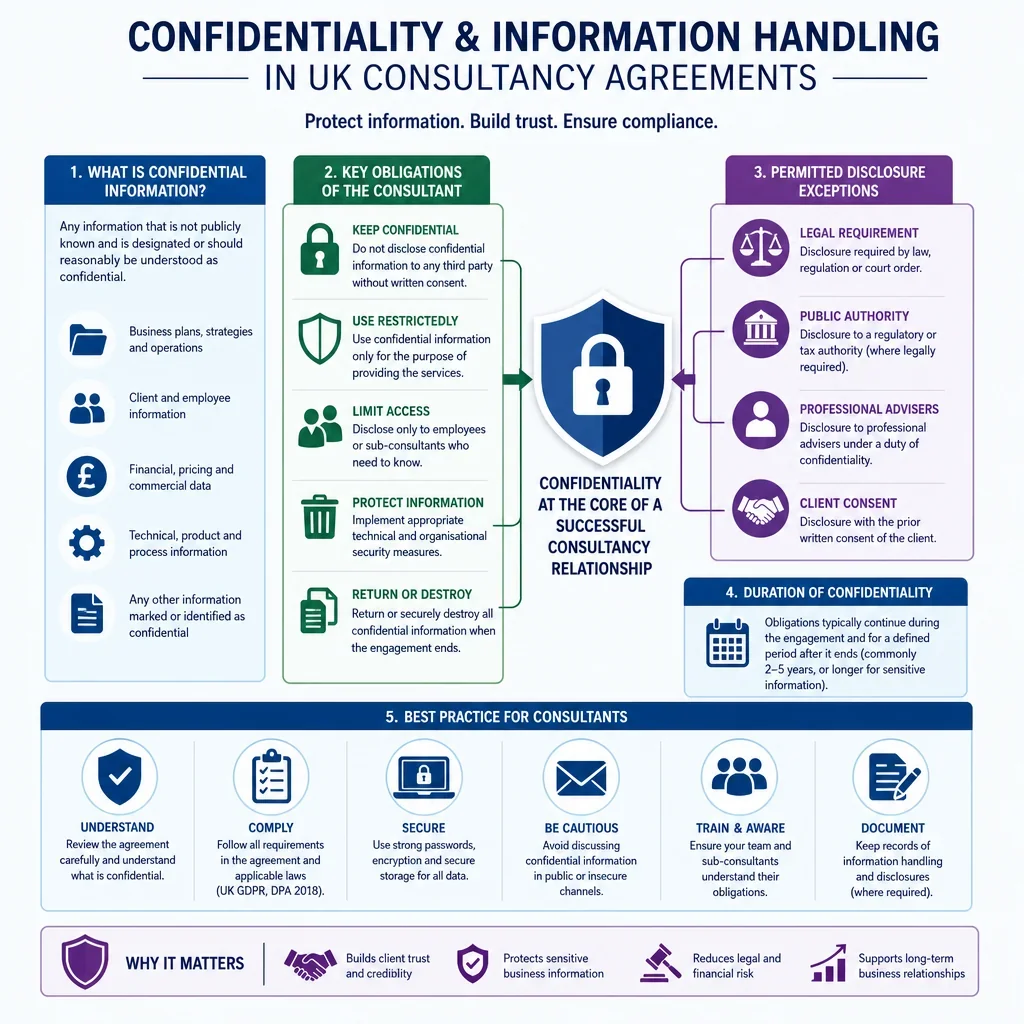
A UK consultancy agreement should define protected information broadly enough to cover client know-how, commercial plans, technical materials, project outputs and personal data, while carving out information that is already public, independently developed, lawfully received from a third party or required to be disclosed by law. The clause should also state who may receive the information, such as employees, subcontractors, professional advisers or regulators, and should make onward disclosure conditional on a need-to-know basis and equivalent confidentiality duties.
How Should Consultants Handle Personal Data And Security?
Where the consultant handles personal data, the agreement should identify whether the consultant is a processor, controller or joint controller and include UK GDPR-compliant data processing terms where required. Key points include documented instructions, security measures, breach notification, assistance with data subject rights, restrictions on international transfers and deletion or return at the end of the engagement. Sensitive or special category data should trigger tighter controls, access limits and audit rights.
What Happens To Information When The Consultancy Ends?
The agreement should require prompt return or secure deletion of confidential information, personal data, project materials, credentials and copies at termination or on request. It should also deal with backups, legal retention duties, archival copies and written certification of deletion. This is important because consultants often work remotely, use cloud tools and create working papers that may contain valuable client information long after the project has finished.
Why Are Publicity And AI Tool Restrictions Important?
Consultants should not publish case studies, name the client, use logos, disclose project details or input client materials into public AI tools without permission. These restrictions help protect trade secrets, personal data, procurement-sensitive information and reputational interests, especially where the client operates in a regulated sector or the work involves confidential strategy, technology or transactions.
FAQs
You Might Also Be Interested In