United Kingdom Consultancy Agreement Clause Guide
Clause name | Clause purpose | Typical importance | Typical use cases | Drafting considerations |
|---|---|---|---|---|
Core commercial term | ||||
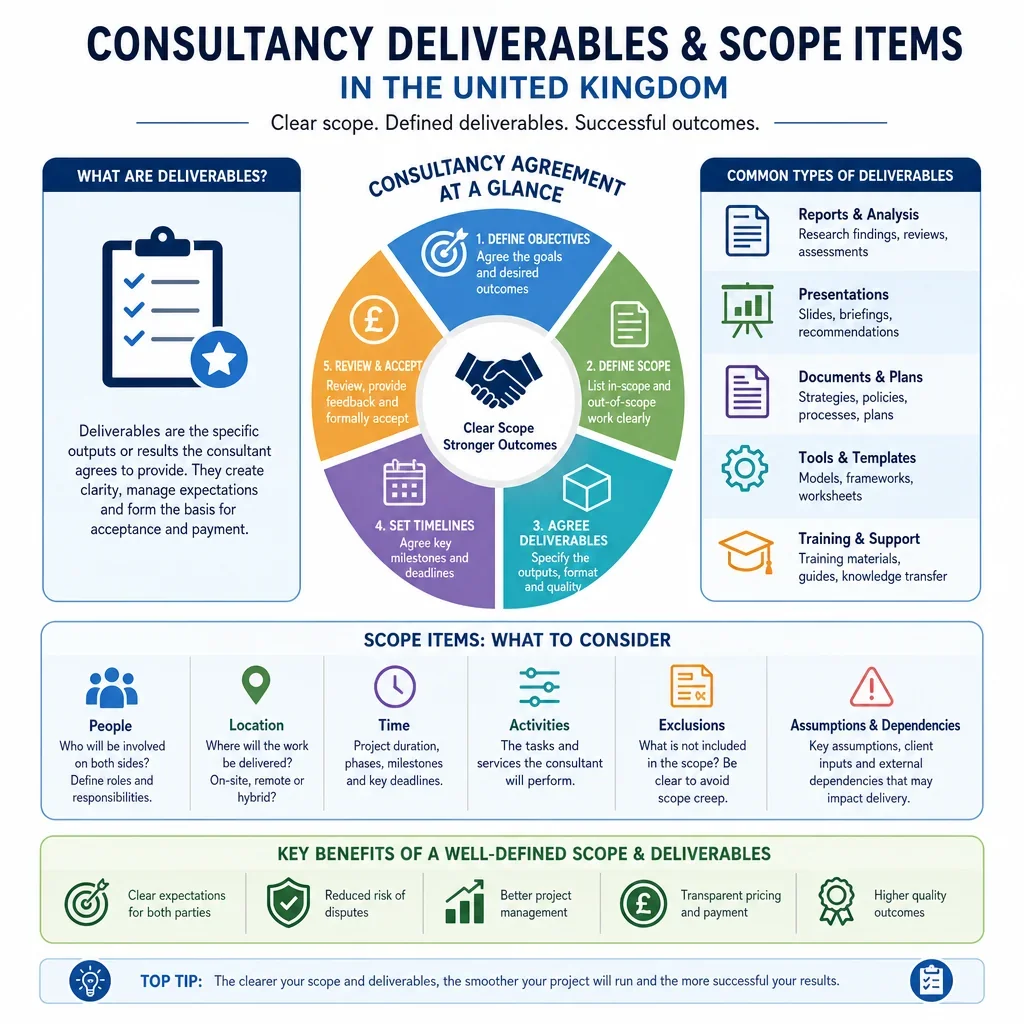
Scope of Services | Defines the consultancy services, deliverables and boundaries of the engagement. | Usually essential | Any consultancy project, especially advisory, IT, marketing, HR, finance or strategy work. | Describe outputs, exclusions, assumptions, standards and any client dependencies clearly. |
Statement of Work | Allows individual projects or work packages to be agreed under a master agreement. | Commonly included | Ongoing consultancy relationships, phased projects or multiple departments using the same consultant. | State precedence between the main agreement and each statement of work. |
Deliverables | Identifies the specific reports, designs, software, advice or other outputs to be supplied. | Usually essential | Projects with tangible outputs, milestone payments or acceptance testing. | Define format, quantity, ownership, acceptance criteria and deadlines for each deliverable. |
Timetable and Milestones | Sets key dates, project phases and milestone obligations. | Commonly included | Implementation projects, launch campaigns, change programmes and time-critical advisory work. | Say whether dates are fixed, estimated or dependent on client input. |
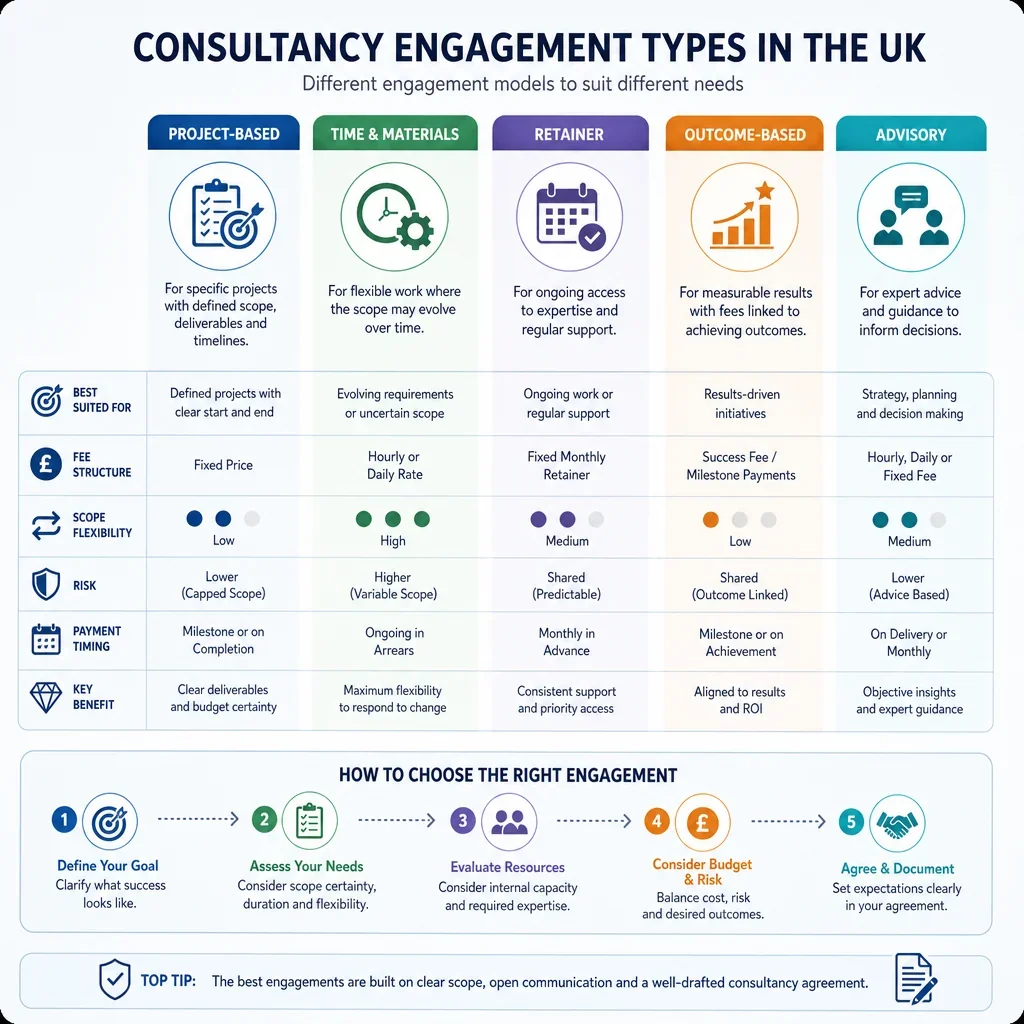
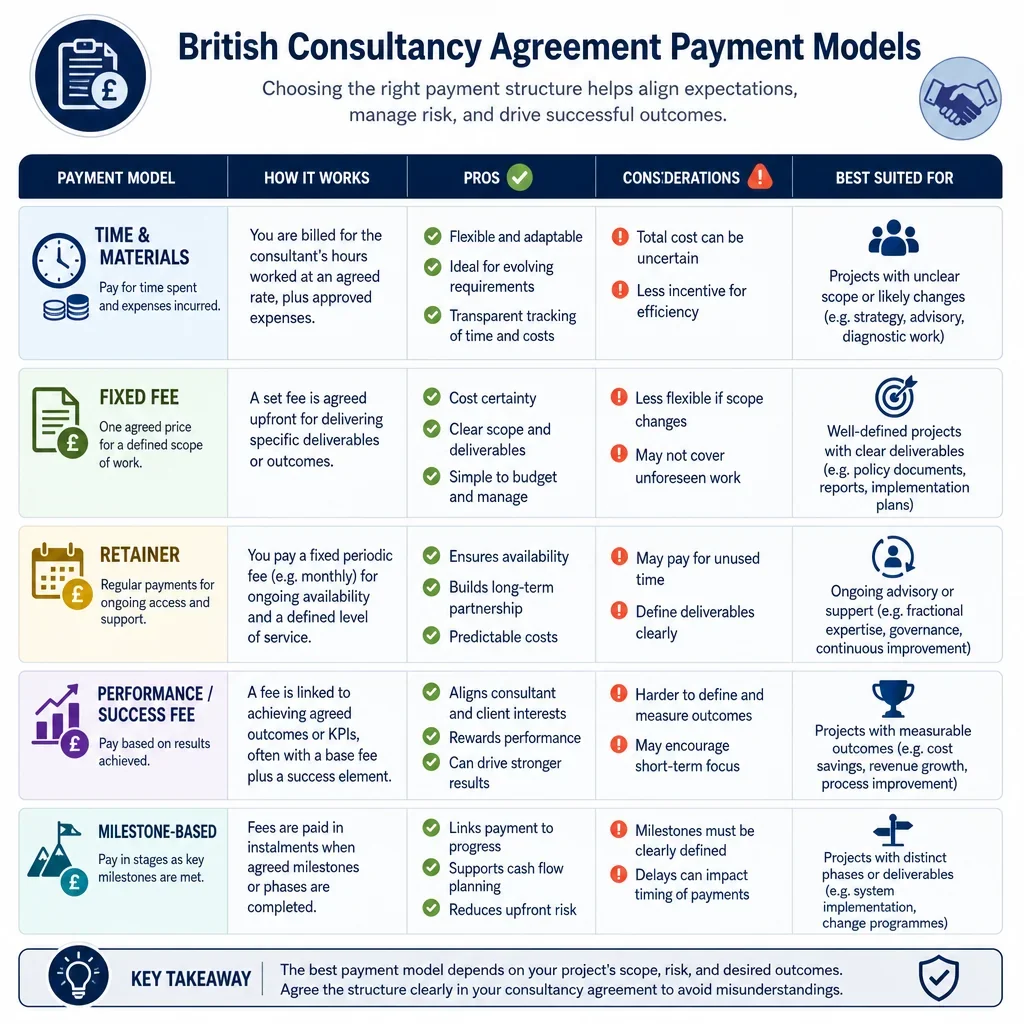
Fees and Charges | States how the consultant will be paid for the services. | Usually essential | All paid consultancy arrangements, including fixed fee, daily rate and retainer models. | Specify rates, fixed fees, retainers, caps, VAT treatment and what is included. |
Expenses | Controls reimbursement of travel, accommodation, materials and other costs. | Commonly included | On-site assignments, travel-heavy engagements or projects requiring third-party costs. | Require prior approval, receipts, policy compliance and limits on categories of spend. |
Invoicing Procedure | Explains when invoices may be issued and what information they must include. | Usually essential | All consultancy agreements where payment depends on valid invoices. | Set invoice timing, purchase order requirements, VAT invoices and dispute procedure. |
Payment Terms | Sets the deadline and method for paying valid invoices. | Usually essential | All commercial consultancy engagements. | State payment period, bank details process, withholding rights and disputed invoice handling. |
Risk allocation | ||||
Late Payment Interest | Allows interest and compensation if commercial invoices are paid late. | Commonly included | Business-to-business consultancy contracts where cash flow is important. | Align with the Late Payment of Commercial Debts (Interest) Act 1998 or specify a contractual rate. |
Core commercial term | ||||
VAT | Clarifies whether stated fees include or exclude VAT. | Commonly included | Consultants registered for VAT or cross-border services requiring tax analysis. | State VAT exclusivity, valid VAT invoice requirements and reverse charge issues if relevant. |
Purchase Orders | Requires a valid purchase order before work starts or invoices are submitted. | Optional depending on circumstances | Large organisations, public bodies or clients with formal procurement systems. | Avoid letting purchase order terms override the signed consultancy agreement unintentionally. |
Change Control | Sets a process for varying scope, timetable, fees or deliverables. | Commonly included | Projects likely to evolve, software builds, transformation work or complex advisory engagements. | Require written approval and explain how cost and timing impacts are agreed. |
Client Responsibilities | Identifies information, access, approvals and cooperation the client must provide. | Commonly included | Projects dependent on client data, stakeholders, systems, premises or decisions. | Link delays caused by the client to timetable relief and additional fees. |
Acceptance of Deliverables | Sets how deliverables are reviewed, accepted or rejected. | Commonly included | Software, reports, designs, policies, training materials and milestone-based projects. | Include objective criteria, review period, deemed acceptance and correction process. |
Risk allocation | ||||
Service Standards | Requires services to be performed with reasonable skill, care and diligence. | Usually essential | Most professional consultancy arrangements. | Avoid unrealistic guarantees match standards to professional role and sector norms. |
Core commercial term | ||||
Key Personnel | Names important individuals and controls their replacement. | Optional depending on circumstances | Engagements sold on a named expert, senior adviser or specialist team. | Balance client approval rights with independent contractor status and substitution wording. |
Compliance | ||||
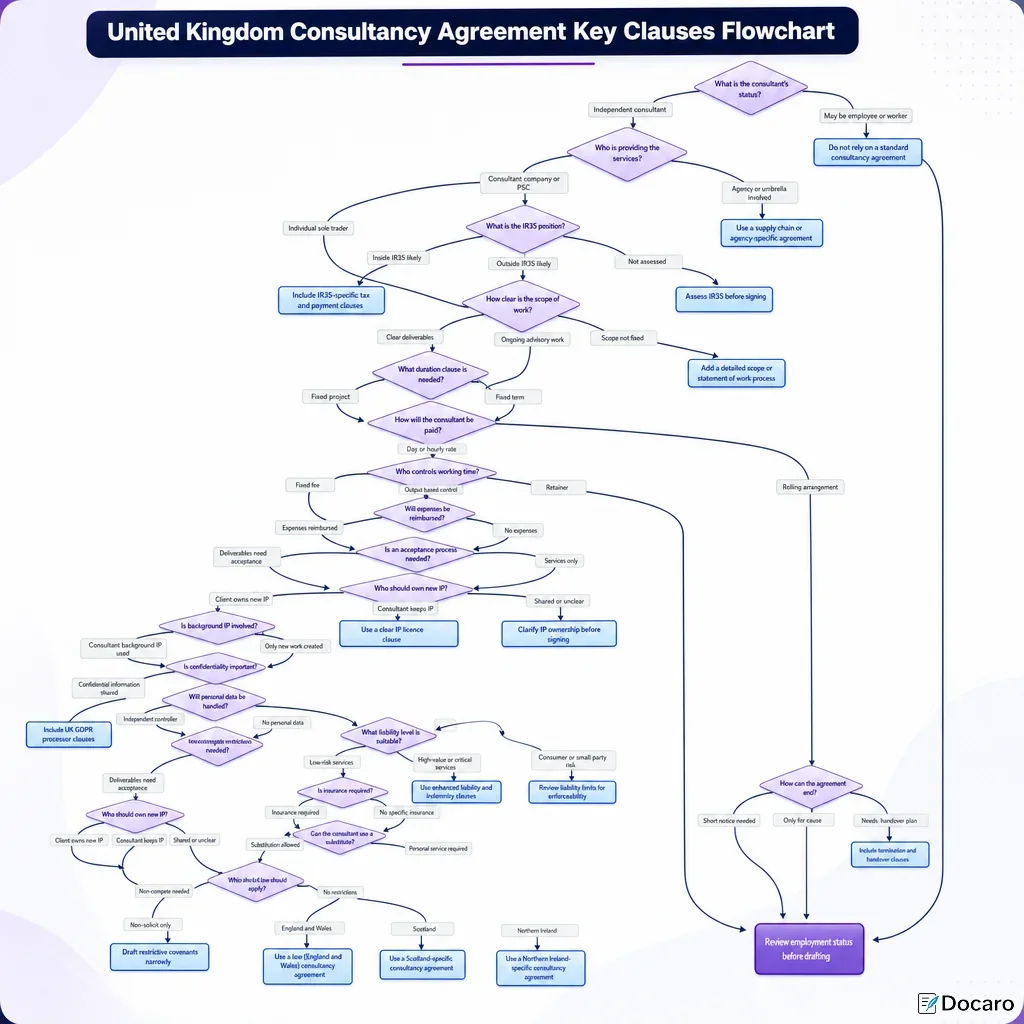
Independent Contractor Status | States that the consultant is independent and not an employee, worker, agent or partner. | Usually essential | Any external consultant engagement, especially individuals and personal service companies. | Ensure the clause matches actual control, integration, mutuality and working practices. |
Right of Substitution | Allows the consultant to provide a suitably qualified substitute. | Commonly included | Freelancers, sole traders and personal service company engagements where status matters. | Make approval criteria objective and ensure substitution is genuine in practice. |
Control and Autonomy | Confirms the consultant controls how services are performed, subject to agreed outcomes. | Commonly included | IR35-sensitive or employment status-sensitive consultancy arrangements. | Avoid employee-style hours, line management and detailed supervision unless truly needed. |
No Mutuality of Obligation | States there is no obligation to offer or accept further work beyond the agreed engagement. | Commonly included | Ad hoc, rolling or project-based consultancy relationships. | Avoid creating an open-ended expectation of continuous work. |
Core commercial term | ||||
Equipment and Resources | States who provides tools, equipment, software and resources needed for the services. | Optional depending on circumstances | IT, design, engineering, training and on-site consultancy. | Clarify security, insurance, licensing and whether client equipment implies employee-style integration. |
Compliance | ||||
Non-Exclusivity | Confirms the consultant may work for others unless restricted by conflicts or confidentiality. | Commonly included | Self-employed consultancy arrangements and portfolio consultants. | Avoid broad exclusivity unless justified consider conflict restrictions instead. |
Tax and National Insurance Responsibility | Allocates responsibility for income tax, corporation tax and National Insurance liabilities. | Usually essential | Individual consultants, sole traders and personal service companies. | Include indemnities only where appropriate and consider off-payroll working rules. |
Off-Payroll Working and IR35 | Addresses tax status assessment and responsibilities for personal service company engagements. | Specialist advice recommended | UK clients engaging consultants through personal service companies or intermediaries. | Check client size, status determination process, fee-payer duties and consistency with actual working practices. |
Confidentiality and intellectual property | ||||
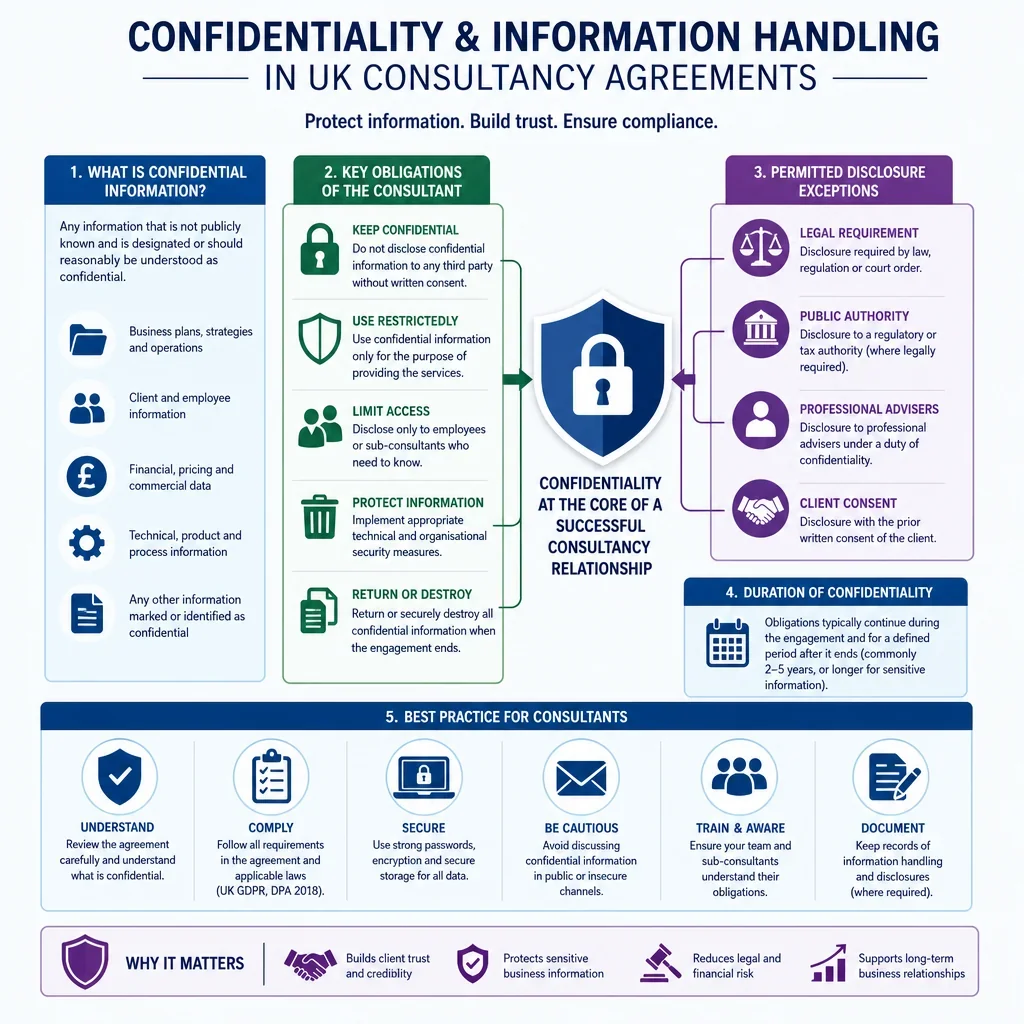
Confidentiality | Protects confidential business, technical, financial and personal information. | Usually essential | Any engagement involving trade secrets, pricing, strategy, customer data or internal documents. | Define protected information, exclusions, permitted disclosures and duration after termination. |
Compliance | ||||
Information Security | Requires safeguards for client systems, data, passwords and devices. | Commonly included | Remote access, cloud systems, personal data, sensitive commercial data or cyber risk. | Specify access controls, incident reporting, encryption, device use and return of credentials. |
Data Protection | Allocates UK GDPR and Data Protection Act 2018 responsibilities for personal data. | Usually essential | Consultants handling employee, customer, user, patient, candidate or supplier personal data. | Identify controller, processor or joint controller roles and include mandatory processor terms if needed. |
Processor Obligations | Sets mandatory terms where the consultant processes personal data for the client. | Usually essential | Outsourced HR, payroll, marketing, IT support, analytics or customer service consultancy. | Include instructions, confidentiality, security, sub-processors, assistance, deletion and audit rights. |
International Data Transfers | Controls transfers of personal data outside the UK. | Specialist advice recommended | Offshore consultants, global cloud tools, overseas support teams or international group companies. | Check adequacy, UK IDTA, UK addendum and transfer risk assessment requirements. |
Confidentiality and intellectual property | ||||
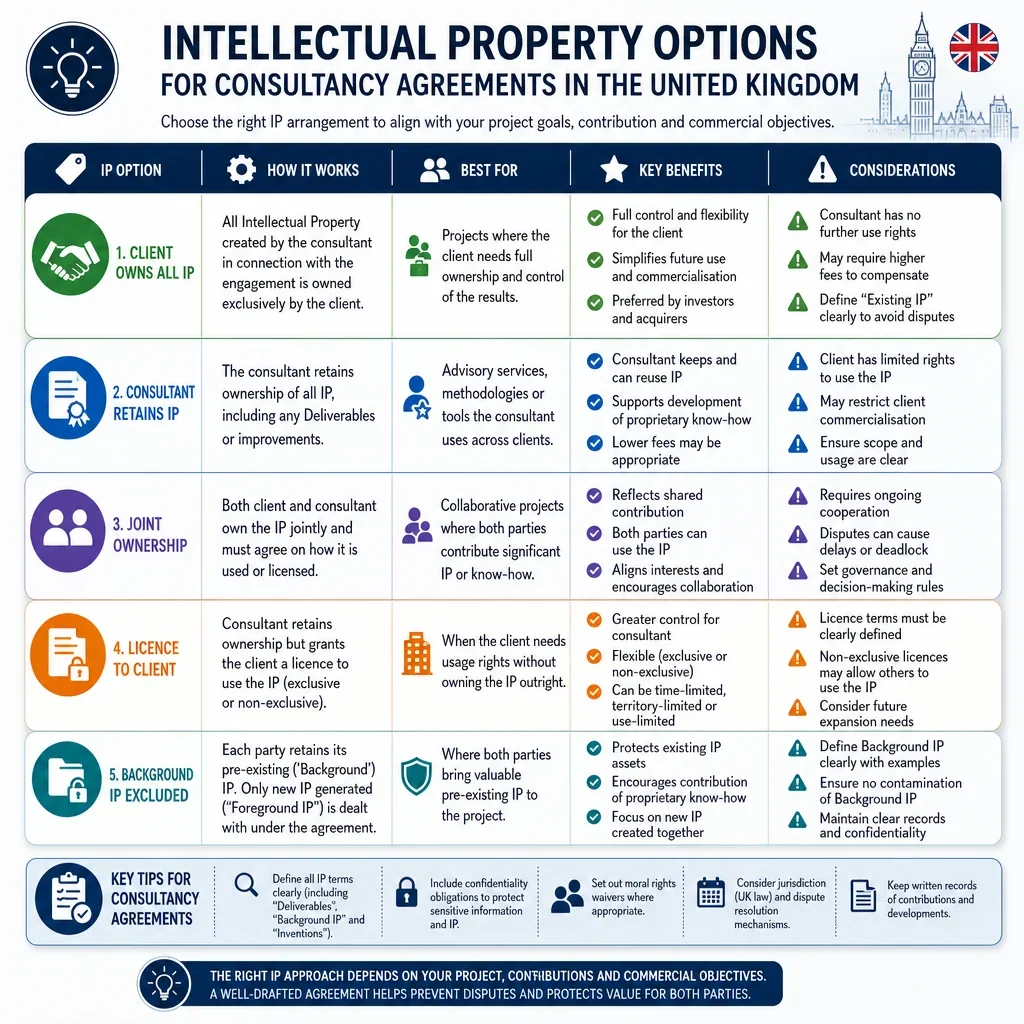
Intellectual Property Ownership | States who owns pre-existing materials and newly created work. | Usually essential | Software, designs, reports, branding, training content, processes, inventions and strategy documents. | Distinguish background IP from project IP and state assignment or licence terms expressly. |
Assignment of Project IP | Transfers ownership of specified intellectual property in deliverables to the client. | Usually essential | Client needs to own code, creative assets, specifications, documents or inventions. | Use written assignment wording and confirm timing, consideration and future rights. |
Licence to Use Consultant Materials | Allows the client to use materials the consultant owns but does not transfer. | Commonly included | Templates, frameworks, tools, pre-existing software, methodologies or know-how. | Define scope, duration, territory, exclusivity, sublicensing and transfer rights. |
Moral Rights Waiver | Reduces author objections to editing, non-attribution or use of copyright works. | Commonly included | Creative, written, design, marketing, software or training deliverables. | Obtain clear written waiver where deliverables may be adapted or published without attribution. |
Third-Party Materials | Controls use of third-party content, software, datasets or tools in deliverables. | Commonly included | Software development, design, research, AI, marketing and content production. | Require disclosure of licence terms and confirm the client can lawfully use the materials. |
Open Source Software | Regulates use of open source code in software deliverables. | Optional depending on circumstances | Software, SaaS, website, app and AI development projects. | Restrict copyleft licences if they may affect proprietary client code. |
Inventions and Patentable Rights | Allocates rights in inventions, patent applications and technical developments. | Specialist advice recommended | Engineering, biotech, product development, R&D and technical consultancy. | Include disclosure duties, assignment assistance and inventor cooperation after termination. |
Publicity and Use of Names | Controls announcements, case studies, logos and references to the engagement. | Optional depending on circumstances | High-profile clients, agencies, public sector, regulated sectors and marketing case studies. | Require prior written approval for press releases, logo use and portfolio references. |
Risk allocation | ||||
Consultant Warranties | Gives promises about authority, skill, compliance and non-infringement. | Commonly included | Professional services, IP-heavy work and regulated or compliance-sensitive projects. | Avoid absolute guarantees unless intended align with liability caps and insurance. |
Client Warranties | Confirms the client may provide materials, instructions and access needed for the services. | Optional depending on circumstances | Consultant relies on client data, content, systems, licences or business instructions. | Include accuracy, legality and rights to use client-provided materials. |
Limitation of Liability | Caps or limits financial exposure for breach, negligence and other claims. | Usually essential | Nearly all commercial consultancy agreements, especially higher value or higher risk work. | Check reasonableness under UCTA and carve out liabilities that cannot be excluded. |
Exclusion of Indirect Losses | Excludes or limits categories such as loss of profit, revenue, goodwill or data. | Commonly included | Commercial projects where consequential business losses may exceed fees. | Use precise wording and consider whether listed losses are direct or indirect in context. |
Non-Excludable Liability | Preserves liability that cannot lawfully be excluded or restricted. | Usually essential | Agreements containing liability limits or exclusions. | Carve out death or personal injury caused by negligence, fraud and other mandatory liabilities. |
Indemnities | Requires one party to compensate the other for specified losses or claims. | Commonly included | IP infringement, tax, data protection, confidentiality, third-party claims or regulatory breaches. | Define triggers, recoverable losses, conduct of claims and whether the cap applies. |
Insurance | Requires the consultant to maintain appropriate insurance cover. | Commonly included | Professional advice, site visits, regulated work, data risk or high-value projects. | Specify professional indemnity, public liability, cyber and employer liability cover as relevant. |
Professional Indemnity Insurance | Covers claims arising from professional negligence, errors or omissions. | Commonly included | Management, engineering, IT, design, financial, HR, legal-adjacent or technical consultancy. | Set minimum cover, run-off period and proof of insurance requirements. |
Force Majeure | Excuses or suspends performance affected by events outside reasonable control. | Commonly included | Longer projects, travel-dependent work, supply chain reliance or international engagements. | Define events, notice duties, mitigation and termination after prolonged disruption. |
Business Continuity | Requires planning for continuity of services during disruption. | Optional depending on circumstances | Critical operational consultancy, managed services, IT support or public sector work. | Set recovery expectations, contact routes and fallback arrangements proportionate to the fee. |
Compliance | ||||
Anti-Bribery and Corruption | Requires compliance with anti-bribery laws and prohibits improper payments. | Commonly included | Sales, procurement, public sector, international, agent or intermediary engagements. | Include policies, training, reporting, audit rights and termination for breach. |
Modern Slavery Compliance | Requires compliance with modern slavery and human trafficking obligations. | Optional depending on circumstances | Large businesses, public procurement, supply chain consultancy or higher-risk jurisdictions. | Consider policies, supply chain due diligence, reporting duties and audit rights. |
Equality and Non-Discrimination | Requires services to be performed without unlawful discrimination or harassment. | Commonly included | HR, recruitment, training, workplace investigations, customer-facing and public sector work. | Align with client policies and avoid discriminatory deliverables, processes or recommendations. |
Health and Safety | Requires compliance with health and safety duties when providing services. | Commonly included | On-site consultancy, construction, engineering, manufacturing, events or hazardous environments. | Address site rules, risk assessments, PPE, incident reporting and responsibility split. |
Sanctions Compliance | Requires compliance with UK sanctions and restricts dealings with sanctioned parties. | Optional depending on circumstances | International consultancy, finance, technology, logistics, defence or high-risk countries. | Include screening, notification, suspension and termination rights for sanctions risk. |
Export Control Compliance | Controls transfer of restricted goods, software, technology or technical information. | Specialist advice recommended | Defence, dual-use technology, encryption, aerospace, engineering and overseas projects. | Check licence needs before sharing controlled technology or technical assistance abroad. |
Regulatory Compliance | Requires compliance with sector-specific legal and regulatory requirements. | Specialist advice recommended | Financial services, legal, healthcare, education, energy, telecoms or insurance consultancy. | Identify applicable regulator, permissions, approved-person requirements and reporting duties. |
Risk allocation | ||||
Conflicts of Interest | Requires disclosure and management of competing duties or interests. | Commonly included | Strategic advice, procurement, public sector, M&A, recruitment or competitor clients. | Define restricted conflicts, disclosure timing, consent process and conflict remedies. |
Non-Solicitation of Staff and Clients | Restricts poaching of staff, customers or key contacts for a limited period. | Optional depending on circumstances | Consultants with access to client employees, customers, prospects or sensitive relationships. | Keep restrictions reasonable in scope, duration and protected interests for enforceability. |
Non-Compete Restriction | Restricts working for competitors or competing with the client for a period. | Specialist advice recommended | Highly strategic, sensitive or market-critical consultancy assignments. | Use only where necessary and narrowly tailor geography, activity, duration and interests. |
Non-Dealing Restriction | Prevents the consultant dealing with specified client contacts regardless of solicitation. | Optional depending on circumstances | Consultants introduced to valuable customers, suppliers, investors or prospects. | Define restricted contacts carefully and keep the period proportionate. |
Compliance | ||||
Audit Rights | Allows checks of records, systems, compliance or fees. | Optional depending on circumstances | Data processing, regulated sectors, expenses, public procurement or compliance-sensitive work. | Set notice, frequency, scope, confidentiality and who pays audit costs. |
Core commercial term | ||||
Records and Reporting | Requires records of work, time, costs, decisions and compliance matters. | Optional depending on circumstances | Time-based billing, regulated work, public sector projects or long-running programmes. | Specify report format, frequency, retention period and evidence needed for invoices. |
Access to Premises and Systems | Controls consultant access to client sites, networks and facilities. | Commonly included | On-site work, system implementation, audits, security reviews and operational consultancy. | Include security checks, access rules, badge return and suspension rights. |
Remote Working and Location | States where services may be performed and any location restrictions. | Optional depending on circumstances | Hybrid projects, overseas consultants, data security restrictions or client site requirements. | Consider tax, data transfers, security, insurance and time zone implications. |
Risk allocation | ||||
Subcontracting | Controls whether the consultant may delegate work to subcontractors. | Commonly included | Agencies, consultancy firms, specialist teams or projects needing additional expertise. | Require approval, flow-down obligations and consultant responsibility for subcontractor acts. |
Core commercial term | ||||
Assignment and Transfer | Controls transfer of rights or obligations to another party. | Commonly included | Corporate groups, business sales, outsourcing chains or long-term relationships. | Decide if client group transfers or business sale transfers are pre-approved. |
Termination | ||||
Term of Agreement | States when the agreement starts and ends. | Usually essential | All consultancy arrangements, fixed-term, rolling, retainer or project-based. | Clarify whether completion, expiry or termination ends outstanding statements of work. |
Termination for Convenience | Allows a party to end the agreement on notice without proving breach. | Commonly included | Retainers, advisory roles, uncertain budgets or flexible project needs. | Set notice period and payment for completed work, committed costs and wind-down support. |
Termination for Cause | Allows termination for material breach or specified serious events. | Usually essential | All consultancy agreements where breach, non-payment or misconduct risk exists. | Include cure periods where appropriate and immediate termination for serious breaches. |
Termination for Insolvency | Allows termination or other consequences when a party becomes insolvent. | Commonly included | Commercial engagements where credit risk or business continuity matters. | Check restrictions on termination of supply contracts under insolvency law where relevant. |
Consequences of Termination | Sets what happens to work, payments, materials and access when the agreement ends. | Usually essential | All consultancy agreements, especially projects with unfinished deliverables or client materials. | Cover final invoices, handover, return of property, deletion of data and survival clauses. |
Handover and Exit Assistance | Requires support to transition work back to the client or a replacement supplier. | Optional depending on circumstances | IT, operations, interim management, outsourcing support or critical business projects. | Specify duration, fees, deliverables, knowledge transfer and cooperation duties. |
Confidentiality and intellectual property | ||||
Return or Destruction of Materials | Requires return, deletion or destruction of client information, equipment and documents. | Commonly included | Confidential projects, data processing, system access or use of client equipment. | Allow retention of legal archive copies only where justified and protected. |
Termination | ||||
Survival of Clauses | Identifies provisions that continue after termination or expiry. | Usually essential | Agreements with confidentiality, IP, payment, liability, indemnity or restrictive covenant clauses. | List surviving clauses expressly and set any time limits. |
Dispute management | ||||
Notices | Sets how formal notices must be given and when they are treated as received. | Commonly included | Termination, breach notices, disputes, change control and formal approvals. | Specify permitted delivery methods, addresses, email use and deemed receipt rules. |
Dispute Escalation | Requires issues to be escalated to senior representatives before formal proceedings. | Commonly included | Ongoing relationships, complex projects or high-value consulting arrangements. | Set short escalation periods and preserve urgent injunctive relief rights. |
Mediation | Encourages or requires parties to try settlement with a mediator. | Optional depending on circumstances | Disputes where preserving commercial relationships or controlling costs matters. | State appointment process, timing and whether mediation is mandatory before litigation. |
Governing Law | States which countryu0027s law governs the agreement. | Usually essential | All consultancy agreements, especially cross-border or UK-wide engagements. | Choose England and Wales, Scotland or Northern Ireland deliberately, not just u0027UK lawu0027. |
Jurisdiction | Identifies which courts may hear disputes under the agreement. | Usually essential | All consultancy agreements, especially where parties are in different countries. | Decide exclusive or non-exclusive jurisdiction and align with governing law. |
Arbitration | Requires disputes to be resolved by private arbitration rather than court litigation. | Optional depending on circumstances | International, confidential, high-value or technically complex disputes. | Specify seat, rules, language, number of arbitrators and emergency relief rights. |
Risk allocation | ||||
Entire Agreement | Confirms the written contract replaces prior discussions and understandings. | Commonly included | Negotiated engagements with proposals, emails, pitch decks or earlier drafts. | Do not exclude fraud check whether pre-contract representations should survive. |
Core commercial term | ||||
Variation | Requires contract changes to follow an agreed formal process. | Commonly included | Projects where scope, fees or deadlines may change during delivery. | Require written agreement by authorised representatives and coordinate with change control. |
Dispute management | ||||
Waiver | Prevents delay or inaction from automatically giving up contractual rights. | Commonly included | Agreements where late performance, late payment or repeated breaches may be tolerated temporarily. | State waivers must be express and limited to the specific breach. |
Severance | Allows the rest of the agreement to continue if one provision is invalid. | Commonly included | Contracts with liability limits, restrictive covenants or complex compliance terms. | Do not rely on severance to save overbroad restraints or unfair exclusions. |
Risk allocation | ||||
Third Party Rights | Controls whether non-parties may enforce terms of the agreement. | Commonly included | Group companies, affiliates, subcontractors, insurers or named beneficiaries. | Exclude the Act or identify exactly which third parties may enforce which terms. |
Core commercial term | ||||
Counterparts and Electronic Signature | Allows signing in separate copies and, where valid, by electronic signature. | Optional depending on circumstances | Remote signing, multi-party contracts or fast-moving commercial engagements. | Check execution formalities, authority and any witness requirements for deeds. |
Risk allocation | ||||
Authority to Enter Agreement | Confirms each signatory has authority to bind their organisation. | Commonly included | Companies, LLPs, public bodies, agencies and group company contracting. | Check contracting entity name, Companies House details and signatory authority. |
No Agency or Partnership | Prevents the consultant from binding the client or creating a partnership. | Commonly included | External consultants interacting with customers, suppliers or public authorities. | State any authority to negotiate, spend or represent the client separately and narrowly. |
Core commercial term | ||||
Approvals and Decision-Making | Identifies who may approve work, changes, expenses and deliverables. | Optional depending on circumstances | Projects with multiple stakeholders, governance boards or strict budgets. | Name authorised representatives and set response times to avoid delay. |
Service Levels | Sets measurable performance targets and remedies for failure. | Optional depending on circumstances | Managed consultancy, support, IT operations, interim services or recurring reporting. | Define metrics, measurement periods, exclusions and service credit mechanics. |
Knowledge Transfer | Requires the consultant to share know-how, documentation and training with the client. | Optional depending on circumstances | Transformation, IT implementation, interim management and process improvement projects. | Specify sessions, materials, recordings, attendees and whether extra fees apply. |
Compliance | ||||
Use of AI Tools | Controls whether the consultant may use AI systems to perform services or create outputs. | Optional depending on circumstances | Content, coding, analytics, research, recruitment, legal-adjacent or data-heavy consultancy. | Address confidentiality, personal data, IP, verification, bias and disclosure of AI use. |
Background Checks and Screening | Requires checks before consultants access sensitive sites, systems or people. | Optional depending on circumstances | Financial services, schools, healthcare, government, critical infrastructure or security roles. | Ensure checks are lawful, proportionate, role-specific and data-protection compliant. |
Safeguarding | Requires protection of children or vulnerable adults during the engagement. | Specialist advice recommended | Education, charities, care, healthcare, youth services or community projects. | Include DBS checks, policies, reporting routes, training and supervision arrangements. |
TUPE | Addresses possible employee transfer risks on outsourcing or service provision changes. | Specialist advice recommended | Outsourcing, insourcing, retendering or replacing service providers with dedicated teams. | Consider employee information, indemnities, consultation duties and exit allocation. |
Consumer Law Safeguards | Addresses mandatory consumer protections if the client is an individual consumer. | Specialist advice recommended | Consultancy sold to individuals outside their trade, business or profession. | Check fairness, cancellation rights, service standards and limits on exclusions. |
Public Sector Procurement Terms | Addresses special terms required for public authority consultancy contracts. | Specialist advice recommended | Central government, NHS, local authority, education or other contracting authority projects. | Check transparency, audit, conflicts, termination, social value and mandatory procurement terms. |
Freedom of Information | Allows public sector clients to comply with information access requests. | Optional depending on circumstances | Consultancy contracts with public authorities subject to FOIA or EIR duties. | Do not promise absolute confidentiality against statutory disclosure obligations. |
Environmental and Sustainability Requirements | Requires environmental standards, sustainability reporting or low-carbon working practices. | Optional depending on circumstances | Public sector, ESG projects, supply chain consultancy or site-based work. | Make requirements measurable and avoid vague commitments that cannot be evidenced. |
Core commercial term | ||||
Travel Time and Working Hours | Clarifies whether travel time or specified hours are chargeable or required. | Optional depending on circumstances | Day-rate consultants, on-site assignments, workshops or multi-location projects. | Avoid employee-style fixed hours unless necessary define billable travel clearly. |
Risk allocation | ||||
Suspension of Services | Allows services to be paused for non-payment, security concerns or client delay. | Optional depending on circumstances | Long-running engagements, payment risk, unsafe sites or unresolved compliance issues. | Set notice, consequences, restart costs and continued obligations during suspension. |
Remedies for Defective Services | Sets correction, re-performance, refund or other remedies for service defects. | Commonly included | Deliverable-based projects, milestone acceptance or defined professional outputs. | Define defect, notice period, cure opportunity and whether remedies are exclusive. |
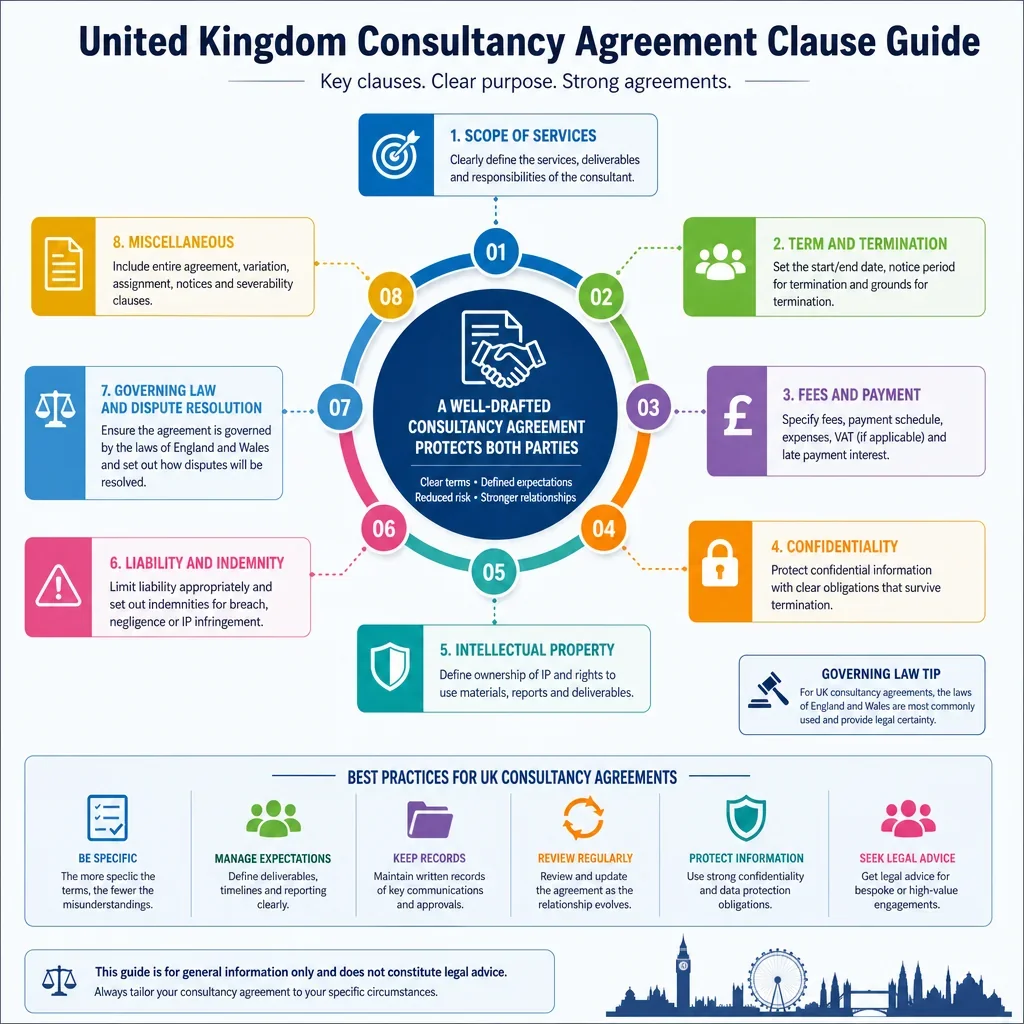
What Clauses Matter Most In A UK Consultancy Agreement?
Scope, fees, intellectual property, confidentiality, data protection, tax status and termination are the clauses most likely to affect day-to-day enforceability and commercial risk. A consultancy agreement should make clear what the consultant will deliver, how and when they will be paid, who owns outputs, what information must be protected, and how either party can end the relationship.
How Can A Consultancy Agreement Reduce UK Employment Status Risk?
Clauses on independent contractor status, substitution, control, working practices, exclusivity, equipment and tax responsibility should match the real relationship. UK tribunals and HMRC look at the practical reality, not just labels. Businesses using personal service companies should also consider off-payroll working rules.
What UK Compliance Clauses Should Not Be Missed?
Where relevant, include clauses covering UK GDPR and Data Protection Act 2018 obligations, anti-bribery, modern slavery, equality, health and safety, sanctions, export controls and public sector procurement requirements. These clauses are especially important where consultants handle personal data, represent the client, access premises, deal with public bodies or work in regulated sectors.
How Should Intellectual Property Be Handled?
Do not assume the client automatically owns work created by an external consultant. A clear IP assignment clause, supported by moral rights waivers, licence-back wording where needed, and open-source or third-party materials controls, is often essential for software, creative, technical, research and strategic deliverables.
When Is Specialist Advice Recommended?
Specialist input is usually sensible for clauses involving IR35, employment status, regulated professional services, TUPE, high-value liability caps, international data transfers, restrictive covenants, public sector contracts, financial services, medical or safety-critical work. These clauses can materially affect tax, enforceability, regulatory exposure and operational risk.
FAQs
You Might Also Be Interested In