

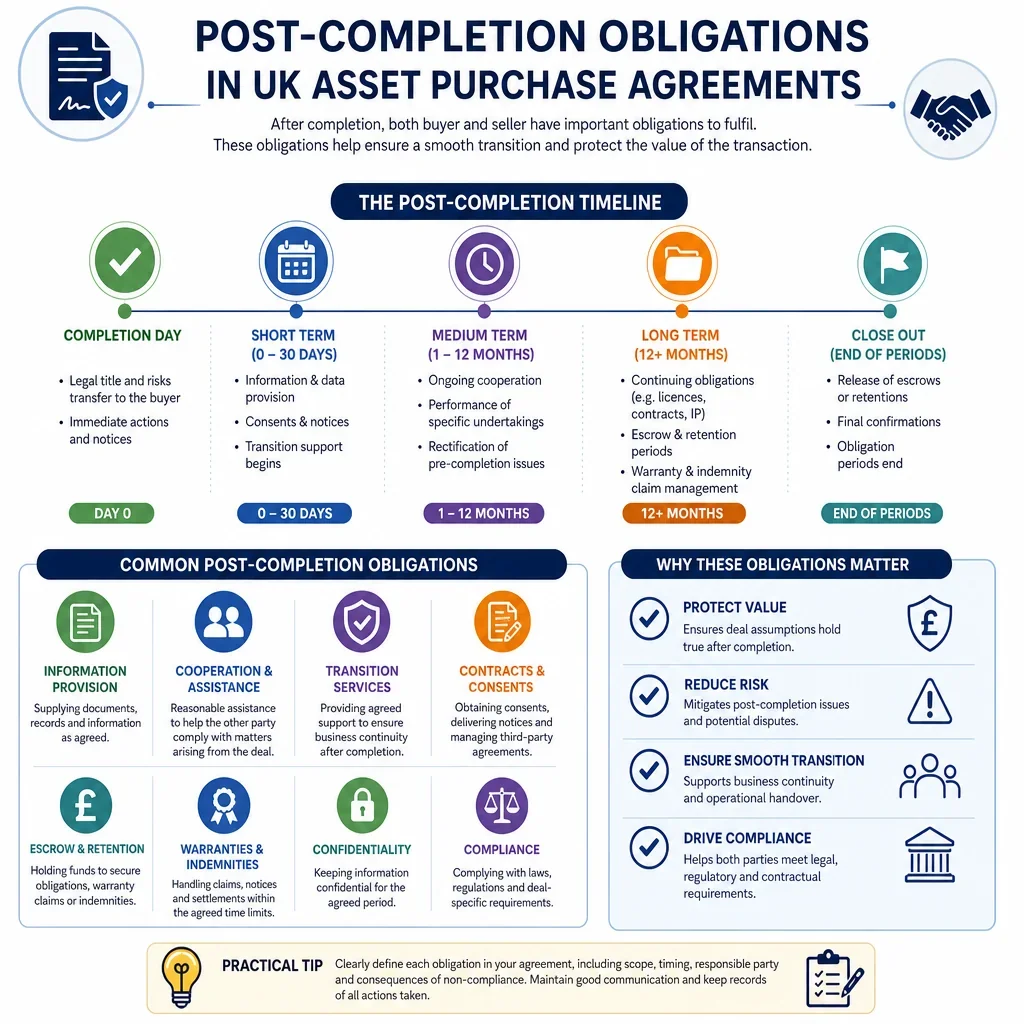
Post-Completion Obligations In UK Asset Purchase Agreements
Created:
This article explains key post-completion obligations in UK asset purchase agreements, helping buyers and sellers understand practical duties after closing. It supports users reviewing an AI Generated British Asset Sale Agreement with structured, relevant guidance.
Obligation | Responsible party | Description | Typical timeframe | Purpose | Consequence of breach |
|---|---|---|---|---|---|
Records and information | |||||
Deliver Business Records | Seller | Provide books, ledgers, operating files, manuals and historic records relating to the assets. | On completion or within 5-10 business days. | Allows the buyer to operate, audit and evidence ownership of the acquired business. | Specific performance, damages, indemnity claim or retention release delay. |
Transfer Electronic Data | Seller | Export and securely deliver digital files, databases, CRM data and operational data sets. | At completion or as soon as practicable after completion. | Ensures continuity of business systems and preserves usable commercial information. | Damages, injunctive relief, access order or data remediation costs. |
Provide Access To Retained Records | Both parties | Allow reasonable inspection and copying of retained pre-completion records needed for tax, claims or audits. | Usually 6-7 years after completion. | Supports statutory record keeping, warranty claims, tax enquiries and litigation. | Court order for access, damages or adverse evidential consequences. |
Preserve Tax Records | Both parties | Keep relevant accounting and tax records for statutory periods and make copies available where required. | Commonly at least 6 years for business tax and accounting records. | Supports HMRC compliance, audits, tax returns and post-completion tax allocation. | Tax penalties, indemnity claim, damages or inability to defend HMRC enquiry. |
Retain Accounting Records | Both parties | Retain accounting records relating to the business and provide reasonable cooperation for company reporting. | Private companies generally keep records for 3 years public companies for 6 years. | Helps satisfy Companies Act accounting duties and post-sale reporting needs. | Criminal offence risk for officers, damages or contractual indemnity claim. |
Customer and supplier transition | |||||
Notify Customers Of Transfer | Both parties | Send agreed notices informing customers of the sale, new contact details and payment instructions. | Immediately after completion or within 5 business days. | Preserves goodwill, reduces misdirected payments and supports revenue continuity. | Damages for lost revenue, indemnity for misdirected payments or cooperation order. |
Notify Suppliers Of Transfer | Both parties | Inform suppliers of the asset sale, new buyer details and ordering or invoicing arrangements. | Immediately after completion or within 5-10 business days. | Maintains supply continuity and avoids interruption to trading. | Damages, indemnity for supply interruption or obligation to assist with reactivation. |
Contract transfer | |||||
Novate Customer Contracts | Both parties | Obtain customer consent and execute novation documents transferring rights and obligations to the buyer. | Within 30-90 days after completion, depending on consent process. | Transfers ongoing contractual obligations where assignment alone is insufficient. | Indemnity, damages, service-back obligation or deferred consideration adjustment. |
Perfect Assignment Of Receivables | Both parties | Give written notice of assigned debts or receivables to debtors where legal assignment is intended. | As soon as practicable after completion. | Helps the buyer enforce assigned receivables directly against debtors. | Assignment may remain equitable only, increasing enforcement and priority risk. |
Transfer Supplier Contracts | Both parties | Seek assignments, novations or new contracts for key supplier arrangements used by the business. | Within 30-60 days after completion. | Ensures the buyer can obtain goods and services on continuity terms. | Damages, indemnity for increased costs or transitional supply obligation. |
Administrative handover | |||||
Provide Transitional Services | Seller | Provide temporary support such as IT, finance, payroll, premises, logistics or management assistance. | 30-180 days after completion. | Bridges operational gaps until the buyer can run the assets independently. | Service credits, damages, step-in rights or specific performance. |
Migrate IT Systems | Both parties | Separate accounts, migrate software access, transfer domain controls and assist with system cutover. | Completion day to 90 days after completion. | Prevents operational disruption and unauthorised access to business systems. | Damages, cyber remediation costs, injunction or service continuity claim. |
Transfer Domain Names | Seller | Transfer domain registrations, registrar accounts and DNS control for acquired websites. | On completion or within 5 business days. | Gives the buyer control of online trading channels and brand assets. | Specific performance, damages, injunction or account recovery costs. |
Transfer Social Media Accounts | Seller | Hand over login credentials, admin rights and recovery details for acquired business accounts. | On completion or within 2 business days. | Preserves marketing channels, customer communications and brand reputation. | Injunction, damages, account recovery costs or holdback retention. |
Regulatory or filing matter | |||||
Record IP Assignments | Buyer | File assignment or change of ownership details for registered trade marks, patents or designs. | Promptly after completion often within 6 months for priority against later interests. | Updates public registers and protects enforceability against third parties. | Priority issues, enforcement complications, filing costs or indemnity claim. |
Administrative handover | |||||
Handover Physical Assets | Seller | Deliver possession of plant, machinery, vehicles, stock, keys, passes and equipment. | At completion or by agreed delivery dates. | Gives the buyer practical control and possession of purchased assets. | Specific delivery, damages, price adjustment or risk allocation claim. |
Payment and reconciliation | |||||
Reconcile Stock Count | Both parties | Verify completion stock levels and calculate any price adjustment for shortages or excess stock. | Completion day or within 5 business days. | Ensures the purchase price reflects actual transferred inventory. | Price adjustment dispute, expert determination, damages or retention claim. |
Prepare Completion Accounts | Buyer | Prepare accounts showing agreed asset values, working capital, debtors, creditors and adjustments. | Usually 20-60 business days after completion. | Finalises the economic deal where price depends on completion figures. | Deemed acceptance, expert determination, interest or damages. |
Pay Completion Adjustment | Buyer | Pay any additional amount due after stock, working capital or completion account adjustments. | 5-10 business days after final determination. | Ensures the final price matches the agreed valuation mechanism. | Interest, debt claim, set-off or escrow deduction. |
Refund Price Overpayment | Seller | Repay any amount owed to the buyer after final completion accounts or agreed adjustments. | 5-10 business days after final determination. | Prevents seller windfall where estimated completion figures were inaccurate. | Debt claim, interest, set-off, escrow claim or indemnity recovery. |
Apportion Rates And Utilities | Both parties | Allocate business rates, utilities, rent, service charges and similar outgoings across completion. | At completion or within 30 days after invoices are received. | Ensures each party pays costs attributable to its period of ownership or occupation. | Reimbursement claim, interest, set-off or indemnity. |
Collect And Remit Book Debts | Both parties | Collect assigned receivables or forward wrongly received customer payments to the entitled party. | Promptly often within 2-5 business days of receipt. | Avoids unjust retention of payments and supports clean revenue allocation. | Debt claim, account of profits, interest, trust claim or indemnity. |
Pay Retained Liabilities | Seller | Discharge liabilities excluded from the sale, including pre-completion creditors and claims. | As they fall due or within agreed post-completion period. | Protects the buyer from liabilities it did not agree to assume. | Indemnity claim, damages, set-off or escrow deduction. |
Pay Assumed Liabilities | Buyer | Pay liabilities expressly assumed by the buyer under the asset purchase agreement. | As they fall due after completion. | Prevents creditor claims against the seller for liabilities transferred economically to the buyer. | Seller indemnity claim, damages or third-party enforcement risk. |
Regulatory or filing matter | |||||
Support VAT TOGC Treatment | Both parties | Cooperate on evidence and notifications needed for transfer of a going concern VAT treatment. | Before completion and during any HMRC enquiry after completion. | Helps avoid unnecessary VAT charge where statutory TOGC conditions are met. | VAT assessment, interest, penalties, gross-up or tax indemnity claim. |
Maintain VAT Registration Or Option To Tax | Buyer | Maintain or apply for VAT registration and make any required option to tax for relevant property assets. | Usually before or immediately after completion, depending on transaction structure. | Supports VAT compliance and intended VAT treatment of transferred business or property. | VAT liability, penalties, loss of TOGC treatment or indemnity claim. |
Employee transition | |||||
Complete PAYE Payroll Handover | Both parties | Provide payroll data, starter information and employment tax details needed for transferred employees. | At completion and before the buyer's first payroll run. | Enables accurate PAYE operation and employee payment continuity. | Payroll errors, HMRC penalties, employee claims or indemnity recovery. |
Provide TUPE Employee Liability Information | Seller | Provide prescribed employee liability information to the buyer where TUPE applies. | At least 28 days before transfer, or as soon as reasonably practicable if later changes occur. | Allows the buyer to assess employment liabilities transferring with the business. | Employment tribunal compensation, commonly at least £500 per employee unless just and equitable otherwise. |
Cooperate On TUPE Information And Consultation | Both parties | Assist with information and consultation duties relating to affected employees and employee representatives. | Long enough before transfer to allow meaningful consultation. | Reduces risk of protective awards and employee relations disruption. | Protective award up to 13 weeks' gross pay per affected employee. |
Transfer Employee Records | Seller | Provide employment contracts, payroll history, absence records, disciplinary records and benefits data lawfully. | At completion or shortly after, subject to data protection controls. | Enables lawful employment administration after transfer. | Employee claims, ICO enforcement, damages or indemnity claim. |
Arrange Pension Auto-Enrolment Continuity | Buyer | Set up pension arrangements and assess transferred workers for automatic enrolment duties. | From first day of employment or transfer, subject to statutory postponement rules. | Ensures pension compliance and continuity of employee benefits. | Regulatory notices, fixed or escalating penalties and employee claims. |
Transition Employee Benefits | Buyer | Set up replacement benefits such as healthcare, insurance, cars, bonuses and vouchers where agreed. | From completion or within first payroll period. | Supports employee continuity and compliance with agreed employment terms. | Employee claims, breach of contract damages or indemnity claims. |
Notify Seller Of Proposed Employee Measures | Buyer | Provide details of measures the buyer envisages taking in relation to affected employees. | Before transfer in time for seller consultation updates after completion if agreed. | Enables seller to comply with TUPE consultation obligations. | Indemnity for protective awards, damages or employment tribunal exposure. |
Regulatory or filing matter | |||||
Issue Data Protection Notices | Buyer | Notify individuals how transferred personal data will be processed by the buyer. | At or soon after completion, subject to UK GDPR transparency rules. | Supports lawful and transparent processing of customer, supplier and employee data. | ICO enforcement, fines, claims by data subjects or indemnity claims. |
Register With ICO Or Pay Data Protection Fee | Buyer | Pay any required data protection fee if the buyer becomes a controller processing personal data. | Before or soon after processing begins. | Ensures compliance with UK data protection fee requirements. | Monetary penalty from the ICO and contractual indemnity exposure. |
Records and information | |||||
Delete Or Return Buyer Data | Seller | Delete, return or segregate personal data and confidential business data no longer needed by the seller. | Immediately after completion or within 30 days. | Prevents unlawful processing, misuse of confidential information and duplicate data risk. | Injunction, damages, ICO enforcement or confidentiality indemnity claim. |
Regulatory or filing matter | |||||
Update Companies House Filings | Buyer | File required changes to officers, registered office, PSCs or company details if affected by the transaction. | Usually within statutory filing deadlines, often 14 days for many company changes. | Keeps corporate records accurate after the transaction. | Late filing penalties, criminal offence risk, rejection of filings or indemnity claim. |
Transfer Or Reapply For Business Licences | Buyer | Obtain replacement licences, permits or approvals needed to operate the acquired business. | Before trading starts or within licence-specific deadlines. | Ensures lawful operation of regulated activities after completion. | Trading prohibition, regulatory penalties, closure risk or indemnity claim. |
Transfer Premises Licence | Buyer | Apply to transfer alcohol or entertainment premises licences where the business includes licensed premises. | Usually before completion or immediately on completion to avoid trading interruption. | Allows continued lawful sale of alcohol or licensed activities. | Illegal trading, licence objections, fines, closure or indemnity claim. |
Register Property Transfer Or Lease Assignment | Buyer | Register freehold transfer, lease assignment or other registrable property interest at HM Land Registry. | Priority period commonly 30 business days after official search registration as soon as practicable. | Protects legal title and priority of the buyer's property interest. | Loss of priority, registration gap risk, damages or professional negligence claim. |
Contract transfer | |||||
Obtain Outstanding Landlord Consents | Both parties | Continue seeking landlord licences to assign, underlet or occupy leasehold premises where not completed pre-completion. | As soon as practicable often within 30-90 days. | Secures lawful occupation and avoids breach of lease covenants. | Lease forfeiture risk, damages, rent indemnity or occupation termination. |
Arrange Authorised Guarantee Or Release | Both parties | Complete any authorised guarantee agreement or landlord release required on lease assignment. | At lease assignment or immediately after completion. | Allocates continuing lease liability between seller, buyer and landlord. | Continuing rent liability, landlord claim, indemnity or completion default. |
Regulatory or filing matter | |||||
Update Vehicle Keeper Records | Both parties | Notify DVLA of changes to registered keeper for transferred vehicles. | Immediately after sale or transfer. | Updates liability for vehicle tax, penalties and keeper notices. | Penalty notices, tax issues, indemnity claim or administrative costs. |
Administrative handover | |||||
Maintain Run-Off Insurance | Seller | Maintain agreed insurance cover for pre-completion liabilities, claims-made risks or historic operations. | Usually 2-6 years after completion, depending on risk. | Provides financial backing for historic claims and indemnities. | Indemnity claim, damages equal to uninsured loss or escrow retention. |
Put Buyer Insurance In Place | Buyer | Arrange property, liability, motor, cyber and business interruption insurance for acquired assets. | From completion. | Ensures risk is insured once assets pass to the buyer. | Uninsured loss, lender default, indemnity dispute or operational exposure. |
Records and information | |||||
Cooperate With Warranty Claims | Both parties | Provide information, access and assistance needed to investigate warranty or indemnity claims. | During agreed warranty limitation period. | Allows claims to be assessed with evidence from both pre- and post-completion periods. | Adverse inference, costs order, damages or loss of claim control rights. |
Notify And Manage Third-Party Claims | Both parties | Promptly notify claims affecting indemnities and follow agreed conduct, defence and settlement procedures. | Immediately or within 5-10 business days of awareness. | Protects indemnifying party's ability to control exposure and preserve defences. | Reduced indemnity recovery, damages or loss of conduct rights. |
Restrictive covenant | |||||
Maintain Confidentiality | Both parties | Keep confidential business information, trade secrets, pricing and customer data secret after completion. | Often 3-5 years trade secrets may be protected indefinitely while secret. | Protects goodwill, know-how and commercially sensitive information. | Injunction, damages, account of profits or equitable remedies. |
Comply With Non-Compete Covenant | Seller | Avoid competing with the transferred business within agreed activities, geography and period. | Often 1-3 years, depending on goodwill and reasonableness. | Protects the goodwill the buyer paid for. | Injunction, damages, account of profits or clawback of consideration. |
Do Not Solicit Customers | Seller | Do not solicit or canvass customers or clients transferred to the buyer. | Often 1-3 years after completion. | Prevents erosion of transferred goodwill and customer relationships. | Injunction, damages for lost margin or account of profits. |
Do Not Deal With Transferred Customers | Seller | Do not accept business from specified customers, even if they approach the seller. | Often 6 months to 2 years after completion. | Provides stronger goodwill protection than a solicitation-only restriction. | Injunction, damages, account of profits or covenant enforcement claim. |
Do Not Poach Employees | Seller | Do not solicit or employ key employees transferred to or retained by the buyer. | Often 1-2 years after completion. | Protects workforce stability and transferred know-how. | Injunction, recruitment cost damages or account of profits. |
Avoid Disparaging Statements | Both parties | Do not make statements likely to damage the other party or the transferred business. | Often 2-5 years after completion. | Protects reputation, goodwill and customer confidence during transition. | Damages, injunction, corrective statement or confidentiality claim. |
Administrative handover | |||||
Stop Using Seller Name Or Branding | Buyer | Remove seller-retained names, logos and branding from premises, websites and materials. | Immediately or within 30-90 days under a transitional licence. | Prevents brand confusion and protects retained intellectual property. | IP infringement claim, injunction, damages or licence termination. |
Assign And Support Use Of Acquired Brand | Seller | Assist buyer with practical use of transferred trading names, logos and marketing materials. | At completion and during agreed brand transition period. | Enables continuity of customer recognition and goodwill. | Specific performance, damages or loss of goodwill claim. |
Notify Insurers And Brokers | Both parties | Notify insurers, brokers and warranty insurers of asset transfer and changed insured interests. | At completion or immediately after completion. | Avoids coverage gaps and preserves claim notification rights. | Policy avoidance risk, uninsured loss or indemnity claim. |
Regulatory or filing matter | |||||
Transfer Environmental Permits | Buyer | Apply to transfer, vary or replace environmental permits for regulated sites or activities. | Before operating regulated activity or within regulator-specific process times. | Ensures the buyer can lawfully continue regulated environmental operations. | Enforcement notices, fines, suspension, criminal liability or indemnity claim. |
Update Waste Carrier Registration | Buyer | Register or update waste carrier, broker or dealer status where transferred operations handle waste. | Before carrying, brokering or dealing in waste. | Ensures compliance with waste regulation for transferred activities. | Fines, enforcement action, prosecution or indemnity claim. |
Records and information | |||||
Handover Health And Safety Information | Seller | Provide risk assessments, accident records, maintenance logs and safety procedures for transferred operations. | At completion or before buyer assumes operational control. | Helps buyer meet health and safety duties from day one. | Regulatory enforcement, prosecution, employee claims or indemnity claim. |
Customer and supplier transition | |||||
Cooperate On Product Recalls | Both parties | Share information and assist with recalls or corrective action for products sold before completion. | Immediately on becoming aware of safety issue. | Protects consumers and allocates responsibility for pre- and post-completion products. | Regulatory sanctions, damages, indemnity claim or reputational loss. |
Payment and reconciliation | |||||
Administer Escrow Or Retention | Both parties | Give instructions for release, deduction or continuation of escrow or retained consideration. | On agreed release dates or after claim resolution. | Secures post-completion claims, adjustments or obligations. | Escrow dispute, court direction, interest or damages. |
Pay Deferred Consideration | Buyer | Pay fixed deferred amounts when milestones, dates or conditions in the agreement are satisfied. | On agreed dates, often 6-24 months after completion. | Spreads purchase price risk and preserves buyer cash flow. | Debt claim, interest, acceleration, security enforcement or set-off dispute. |
Prepare Earn-Out Statements | Buyer | Prepare revenue, profit or KPI statements used to calculate earn-out consideration. | After each earn-out period, commonly within 30-60 days. | Provides transparent calculation of contingent sale proceeds. | Expert determination, damages, information order or adverse calculation presumption. |
Operate Business Consistently During Earn-Out | Buyer | Avoid actions primarily designed to reduce earn-out payments or distort agreed metrics. | For the earn-out period, often 1-3 years. | Protects seller's contingent consideration expectations. | Damages, equitable adjustment, expert determination or accelerated earn-out claim. |
Administrative handover | |||||
Change Bank Mandates And Payment Details | Buyer | Set up buyer bank accounts, payment instructions, direct debits and merchant services for the business. | At completion or within 10 business days. | Prevents misdirected revenue and payment interruption. | Lost receipts, chargebacks, indemnity claim or operational disruption. |
Transfer Merchant And Payment Systems | Both parties | Transfer or replace card terminals, payment gateways, direct debit mandates and platform accounts. | Completion day to 30 days after completion. | Maintains customer payment capability after the asset sale. | Lost sales, chargebacks, damages or transitional processing obligation. |
Customer and supplier transition | |||||
Migrate Direct Debit Mandates | Buyer | Transfer direct debit instructions or obtain new mandates where required by scheme rules. | Before first post-completion collection. | Enables lawful collection of recurring customer payments. | Failed collections, refund claims, scheme breaches or damages. |
Contract transfer | |||||
Release Seller Guarantees And Security | Buyer | Procure replacement guarantees, bonds, letters of credit or security given by seller for transferred obligations. | At completion or within 30-90 days. | Removes seller exposure for obligations economically assumed by buyer. | Indemnity claim, continuing guarantee liability or security enforcement risk. |
Regulatory or filing matter | |||||
Release Charges Over Transferred Assets | Seller | Procure discharge of security interests and filings affecting assets sold free from encumbrances. | At completion or promptly after lender repayment. | Ensures buyer receives clean title to the purchased assets. | Specific performance, title claim, indemnity or escrow retention. |
Administrative handover | |||||
Deliver Vacant Possession Or Shared Occupation | Seller | Give buyer agreed access, keys and occupation rights for premises included in the sale. | At completion or under agreed access schedule. | Allows the buyer to operate from the business premises. | Specific performance, rent reimbursement, damages or termination of access licence. |
Forward Business Mail And Communications | Seller | Forward post, emails, calls and notices relating to the transferred business to the buyer. | Usually 3-12 months after completion. | Prevents missed customer orders, legal notices and supplier communications. | Damages, indemnity for missed notices or cooperation order. |
Redirect Legal Notices | Both parties | Promptly forward statutory, contractual or litigation notices received for the other party. | Immediately, often within 1-2 business days. | Avoids missed deadlines and default judgments or lost contractual rights. | Indemnity for losses, damages or loss of claim control protections. |
Customer and supplier transition | |||||
Update Website And Public Listings | Buyer | Update website, online listings, terms, contact details and trading disclosures after transfer. | Immediately or within 10 business days after completion. | Reduces customer confusion and supports legal trading transparency. | Customer claims, regulatory complaints, lost sales or indemnity dispute. |
Adopt New Customer Terms | Buyer | Publish or notify post-completion terms and consumer information for ongoing customer sales. | Before taking post-completion orders. | Ensures customer contracts are formed with the buyer on compliant terms. | Consumer cancellation rights, enforcement, damages or indemnity claim. |
Payment and reconciliation | |||||
Reconcile Customer Deposits And Prepayments | Both parties | Allocate responsibility for customer deposits, gift cards, credits and pre-paid orders. | At completion or within 30 days. | Prevents double payment and ensures customers receive goods, services or refunds. | Customer claims, price adjustment, indemnity or set-off. |
Allocate Supplier Rebates And Credits | Both parties | Reconcile rebates, credits, refunds and volume incentives earned before and after completion. | When credits are received or within agreed accounting period. | Ensures economic benefits are allocated to the correct ownership period. | Accounting adjustment, debt claim, set-off or indemnity. |
Contract transfer | |||||
Transfer Software And IP Licences | Both parties | Obtain consents, new seats or replacement licences for software and IP used by the business. | Before cutover or within 30 days after completion. | Avoids unlicensed software use and operational disruption. | Licence termination, infringement claim, audit fees or indemnity. |
Records and information | |||||
Transfer Code Repositories | Seller | Provide source code repositories, deployment keys, documentation and build environment access. | At completion or within 5 business days. | Allows the buyer to maintain acquired software and digital products. | Specific performance, damages, service credits or retention claim. |
Contract transfer | |||||
Maintain Consent Tracker | Both parties | Track outstanding consents, responsible contacts, status, conditions and follow-up actions. | Until all material consents are obtained or alternatives agreed. | Creates accountability for incomplete contract and licence transfers. | Delay claims, indemnity, loss of deferred consideration or operational breach. |
Hold Non-Transferred Contract Benefits For Buyer | Seller | Account to the buyer for benefits of contracts not yet assigned or novated. | Until consent, novation, termination or replacement contract is achieved. | Preserves the commercial deal where third-party consent is pending. | Account of profits, specific performance, damages or equitable claim. |
Perform Non-Transferred Contracts As Agent | Seller | Continue performing or administering non-transferred contracts for buyer's account where lawful. | Until assignment, novation or agreed cut-off date. | Maintains customer and supplier continuity pending formal transfer. | Indemnity, damages for lost contracts or termination rights. |
Administrative handover | |||||
Comply With Temporary Occupation Licence | Buyer | Observe terms for temporary use of seller premises during transition. | Usually 1-6 months after completion. | Allows operational continuity while property arrangements are finalised. | Licence termination, damages, indemnity or eviction proceedings. |
Remove Excluded Assets | Seller | Remove assets not sold to the buyer from premises or systems without disrupting operations. | At completion or within 10-30 days. | Clarifies ownership and frees space or systems for buyer use. | Storage charges, disposal rights, damages or indemnity. |
Records and information | |||||
Cleanse Excluded Data From Transferred Devices | Seller | Remove seller-retained confidential data and third-party personal data from transferred devices where appropriate. | Before completion or within agreed secure handover period. | Reduces data breach and confidentiality risk on transferred hardware. | ICO reporting, damages, injunction or indemnity claim. |
Assist With Post-Completion Audit | Both parties | Provide information and confirmations needed for buyer or seller financial audits. | During first audit cycle after completion. | Supports accurate financial reporting for the transaction period. | Damages, audit delay costs or information access order. |
Cooperate With HMRC Enquiries | Both parties | Provide documents and assistance for HMRC enquiries relating to pre- or post-completion periods. | During statutory enquiry and assessment periods. | Helps allocate and defend tax liabilities under the agreement. | Tax indemnity claim, penalties, interest or loss of defence rights. |
Regulatory or filing matter | |||||
File SDLT Return And Pay SDLT | Buyer | Submit SDLT return and pay SDLT where land or property interests are acquired in England or Northern Ireland. | Generally within 14 days of effective transaction date. | Required for property tax compliance and Land Registry registration. | Penalties, interest and registration delays. |
File LBTT Return And Pay LBTT | Buyer | Submit LBTT return and pay LBTT for Scottish land or property interests. | Generally within 30 days of effective transaction date. | Required for Scottish property tax compliance. | Penalties, interest and registration issues. |
File LTT Return And Pay LTT | Buyer | Submit LTT return and pay LTT for Welsh land or property interests. | Generally within 30 days of effective transaction date. | Required for Welsh property tax compliance. | Penalties, interest and registration issues. |
Contract transfer | |||||
Notify Lenders And Finance Providers | Both parties | Notify asset finance, hire purchase, leasing or lender counterparties and obtain required consents. | Before completion or within agreed post-completion period. | Avoids default under finance documents and preserves use of financed assets. | Acceleration, repossession, default interest, indemnity or damages. |
Novate Asset Finance Agreements | Both parties | Transfer hire purchase, leasing or equipment finance arrangements to the buyer with funder consent. | At completion or within 30-60 days. | Allows buyer to use financed equipment and releases seller where agreed. | Repossession risk, continuing seller liability or indemnity claim. |
Regulatory or filing matter | |||||
Update Statutory Registers For Transferred Subsidiary Interests | Buyer | Update statutory registers where the asset sale includes shares or membership interests. | Promptly after transfer and within applicable Companies Act deadlines. | Records legal ownership and corporate control accurately. | Ownership disputes, filing offences, damages or rectification proceedings. |
Administrative handover | |||||
Transfer Telephone Numbers | Both parties | Port or redirect business telephone numbers and call routing to the buyer. | At completion or within telecom provider process times. | Preserves customer contact channels and avoids lost enquiries. | Lost sales, customer confusion, damages or transitional support claim. |
Customer and supplier transition | |||||
Transfer Marketing Consents Lawfully | Both parties | Transfer evidence of marketing consents and suppression lists subject to UK GDPR and PECR rules. | At completion and before buyer sends marketing communications. | Helps buyer lawfully market to transferred customer lists. | ICO enforcement, fines, complaints, damages or indemnity claim. |
Administrative handover | |||||
Assist With Title Defects | Seller | Execute further documents and provide evidence needed to perfect buyer title to assets. | On request after completion. | Cures gaps in transfer mechanics and supports clean ownership. | Specific performance, damages, indemnity or title warranty claim. |
Give Further Assurance | Both parties | Sign further documents and do acts reasonably needed to implement the asset sale. | On reasonable request after completion. | Provides a catch-all mechanism for imperfect or incomplete transfer steps. | Specific performance, damages, court order or costs recovery. |
Payment and reconciliation | |||||
Cooperate With Expert Determination | Both parties | Appoint and assist an independent accountant or expert for completion account or earn-out disputes. | After dispute notice expert usually appointed within 10-20 business days. | Resolves technical valuation disputes efficiently without full litigation. | Court appointment, adverse costs, binding expert decision or damages. |
What Post-Completion Obligations Matter Most In A UK Asset Purchase Agreement?
Operational handover, contract transfer, employee transfer and reconciliation obligations usually need the most detailed drafting because they determine whether the buyer can actually run the purchased business after completion.
- Contracts often do not transfer automatically. Where novation, assignment or landlord consent is needed, the seller usually remains involved after completion and may need to hold benefits on trust or assist until third-party consent is obtained.
- Employees require UK-specific treatment. If TUPE applies, employee information, consultation, records and liability allocation should be handled carefully because statutory duties and protective awards can arise.
- Completion accounts and apportionments need clear deadlines. Stock, debtors, prepayments, utilities, rates, deposits and retained liabilities should be reconciled quickly to avoid open-ended disputes.
- Regulated assets and filings can delay full control. Companies House, HMRC VAT, data protection, licensing, pension and sector consents may require post-completion action even after the purchase price has been paid.
- Restrictive covenants should be proportionate. Non-compete, non-solicitation and confidentiality obligations are commonly used to protect goodwill, but they must be carefully scoped to improve enforceability under UK law.
How Should These Obligations Be Used In An Asset Purchase Agreement?
The agreement should convert each post-completion task into a named obligation with a responsible party, deadline, cooperation duty, evidence requirement and remedy. For high-risk items, consider holdbacks, indemnities, specific performance, access rights and dispute procedures rather than relying only on a general breach of contract claim.
Want to Generate Your own Asset Purchase Agreement?
Docaro AI can help you write your own Asset Purchase Agreement for use in the United Kingdom in minutes.
FAQs
Post-completion obligations are duties that apply after completion of an asset purchase agreement, such as paying deferred consideration, transferring records, notifying customers, assisting with registrations, and enforcing restrictive covenants.
Show All FAQs
You Might Also Be Interested In
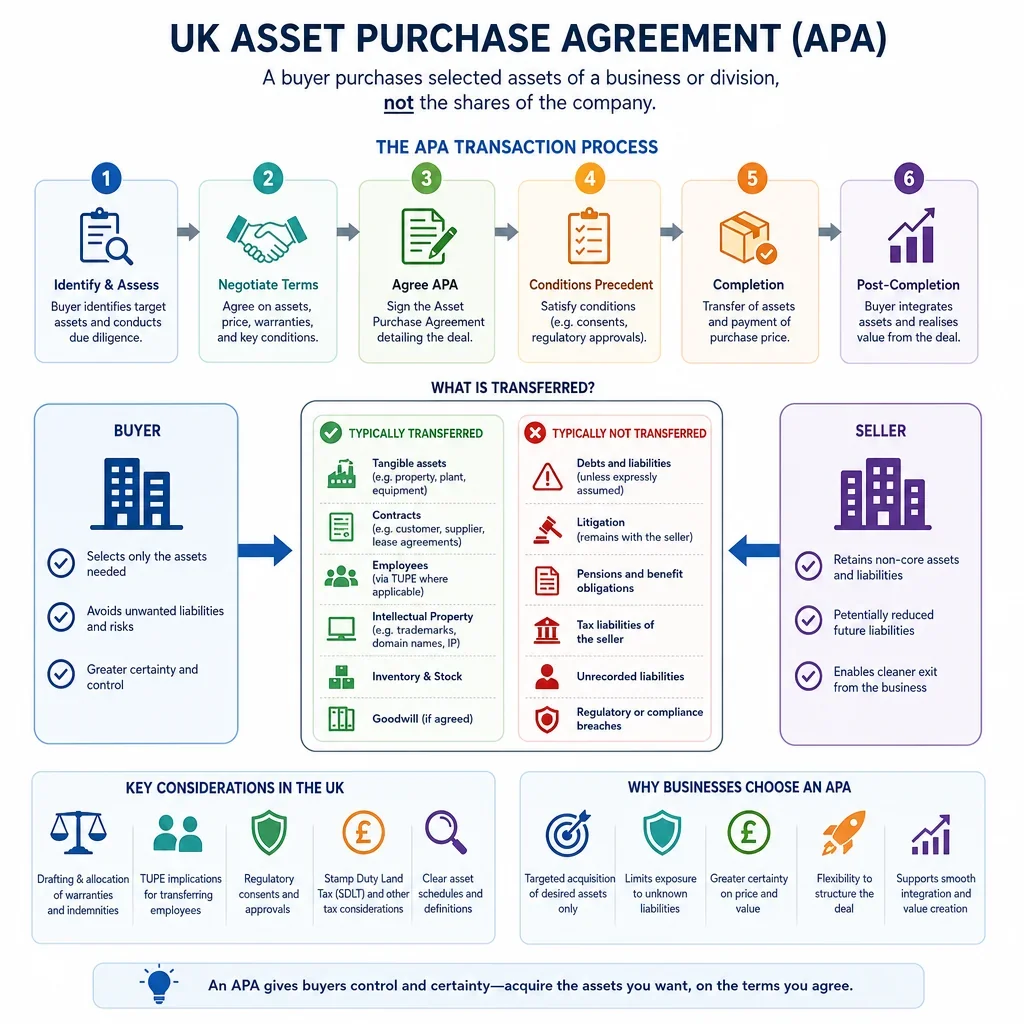
Explore UK asset purchase agreement scenarios to understand deal structures, risks, and practical drafting considerations.
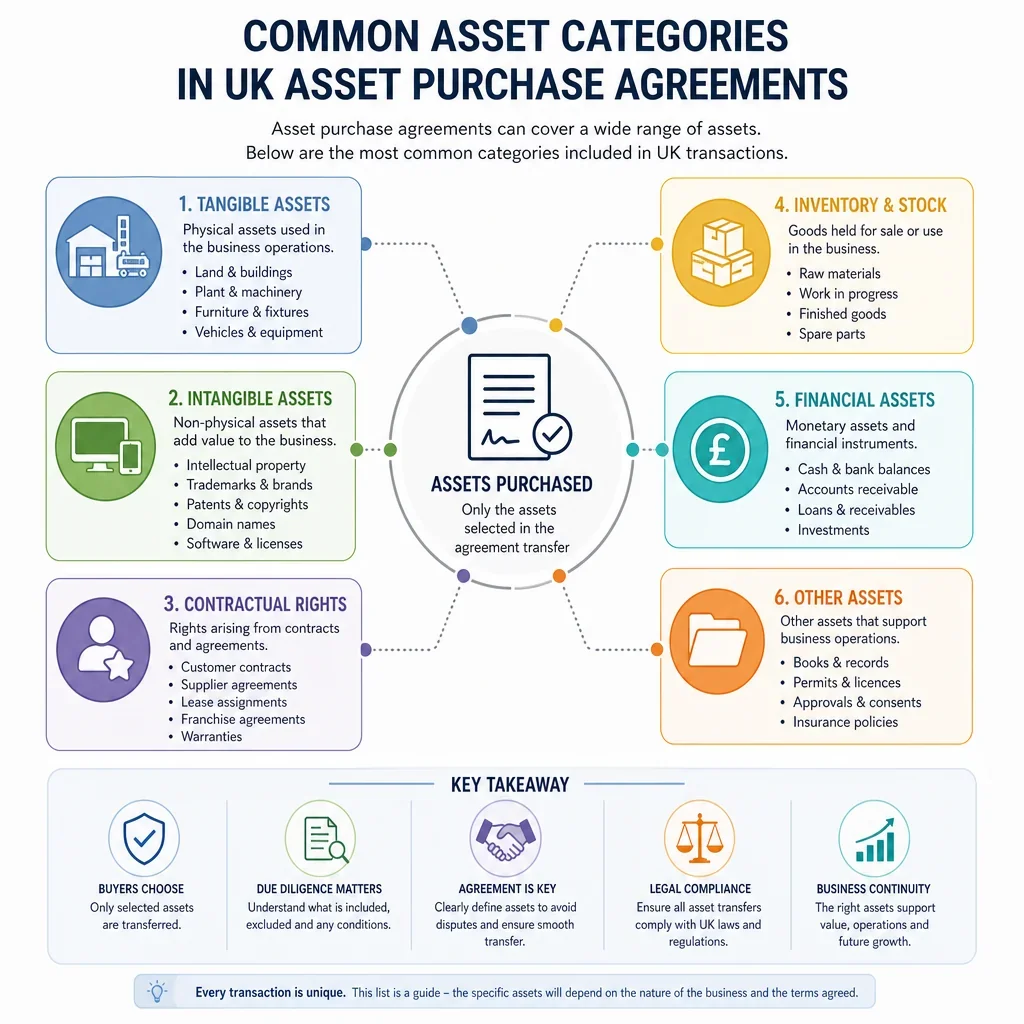
Explore common asset categories in UK asset purchase agreements, including tangible assets, IP, contracts, stock, and goodwill.
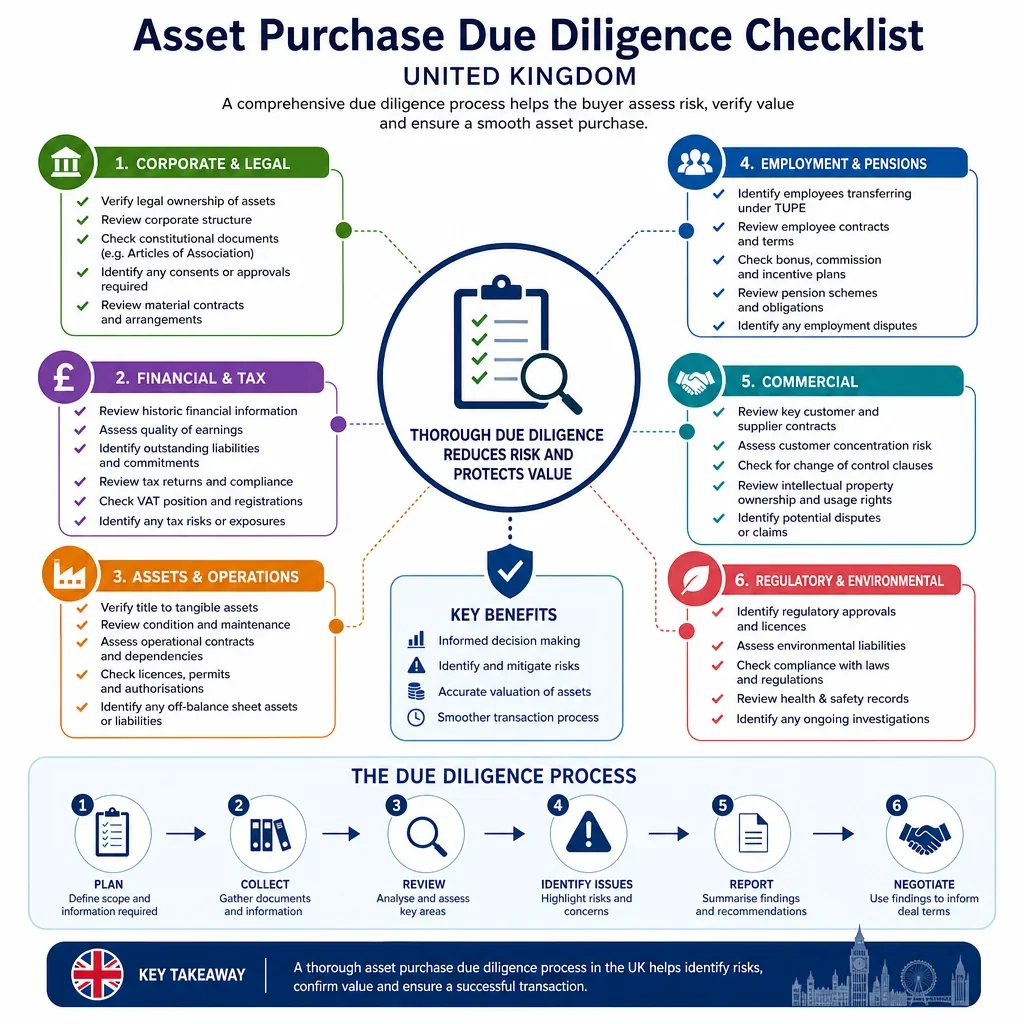
United Kingdom asset purchase due diligence checklist covering key legal, financial, and operational review points before completion.
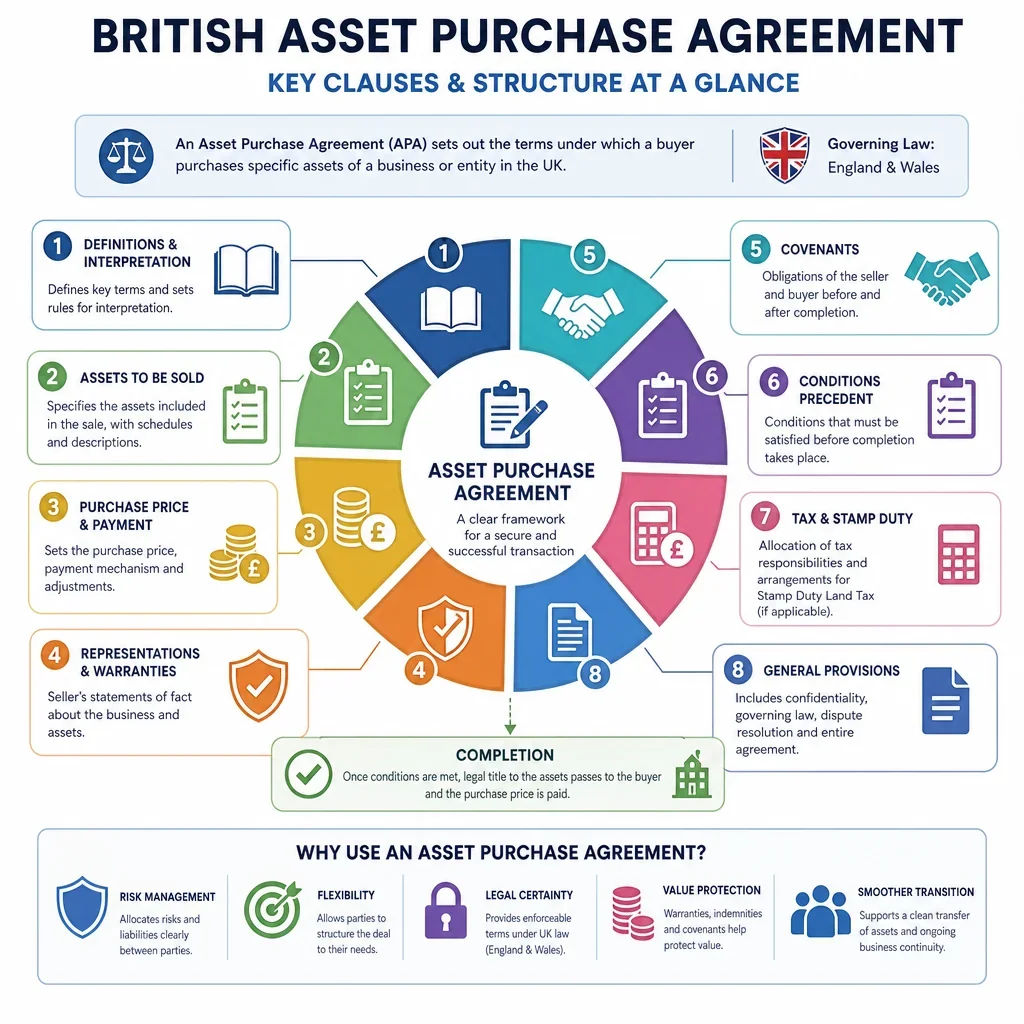
Explore British asset purchase agreement clauses with structured insights to compare drafting, risks, and deal terms.
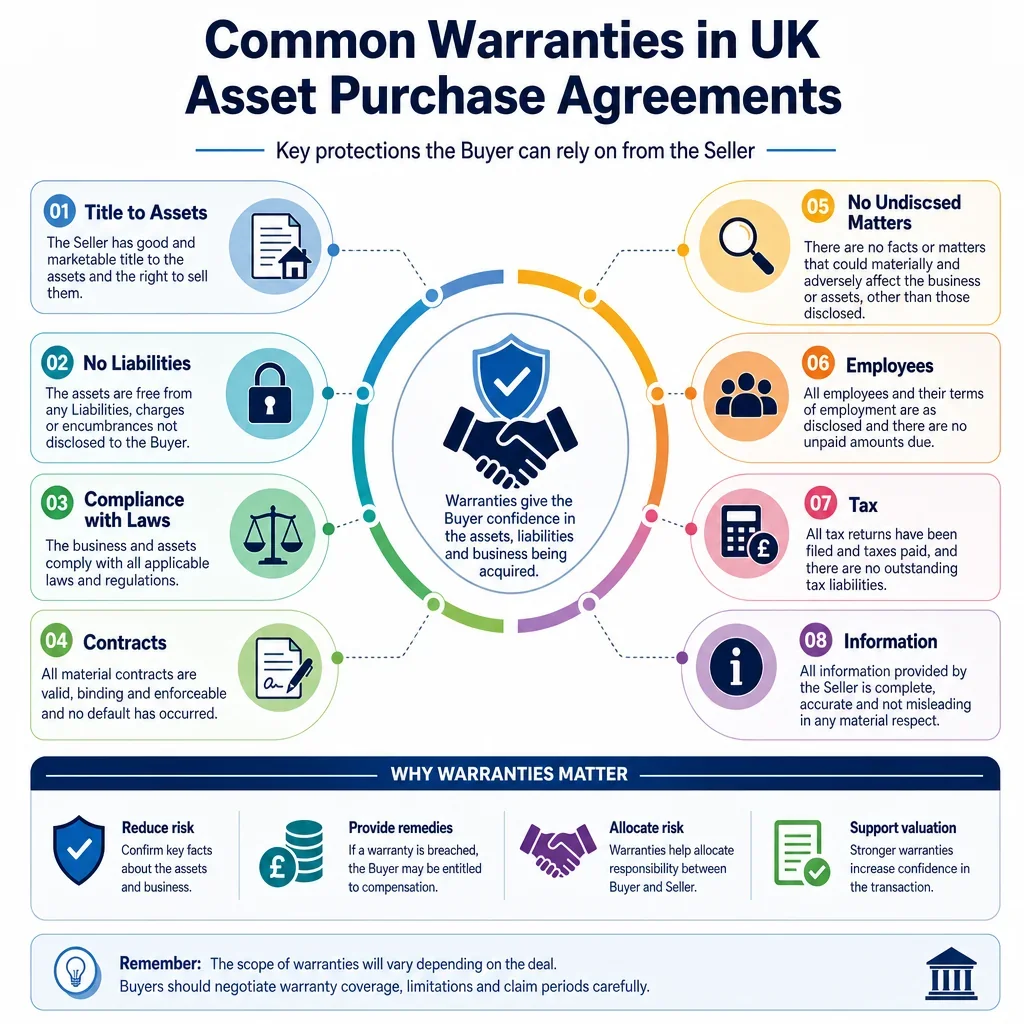
Understand common warranties in UK asset purchase agreements, their purpose, and how they help buyers and sellers manage risk.
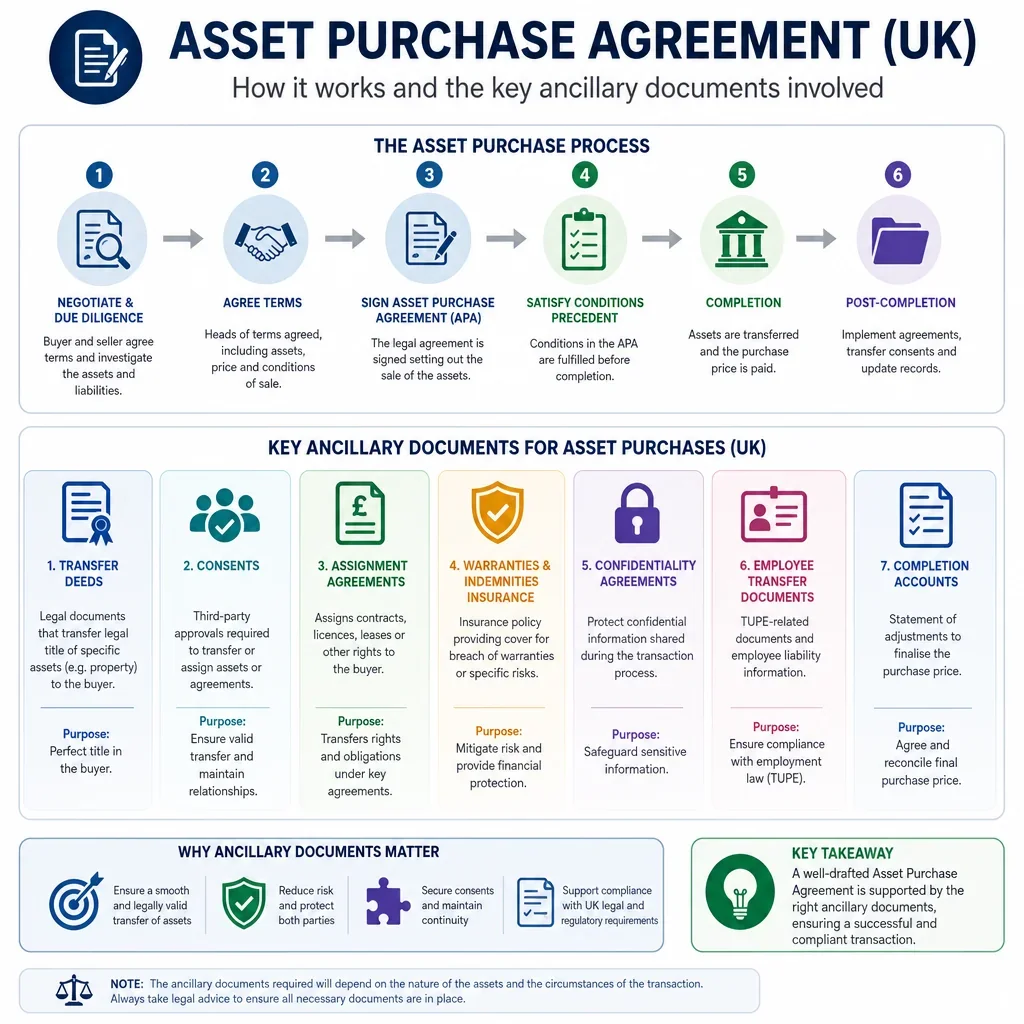
Explore UK ancillary documents for asset purchases, including key supporting records used in British asset sale transactions.
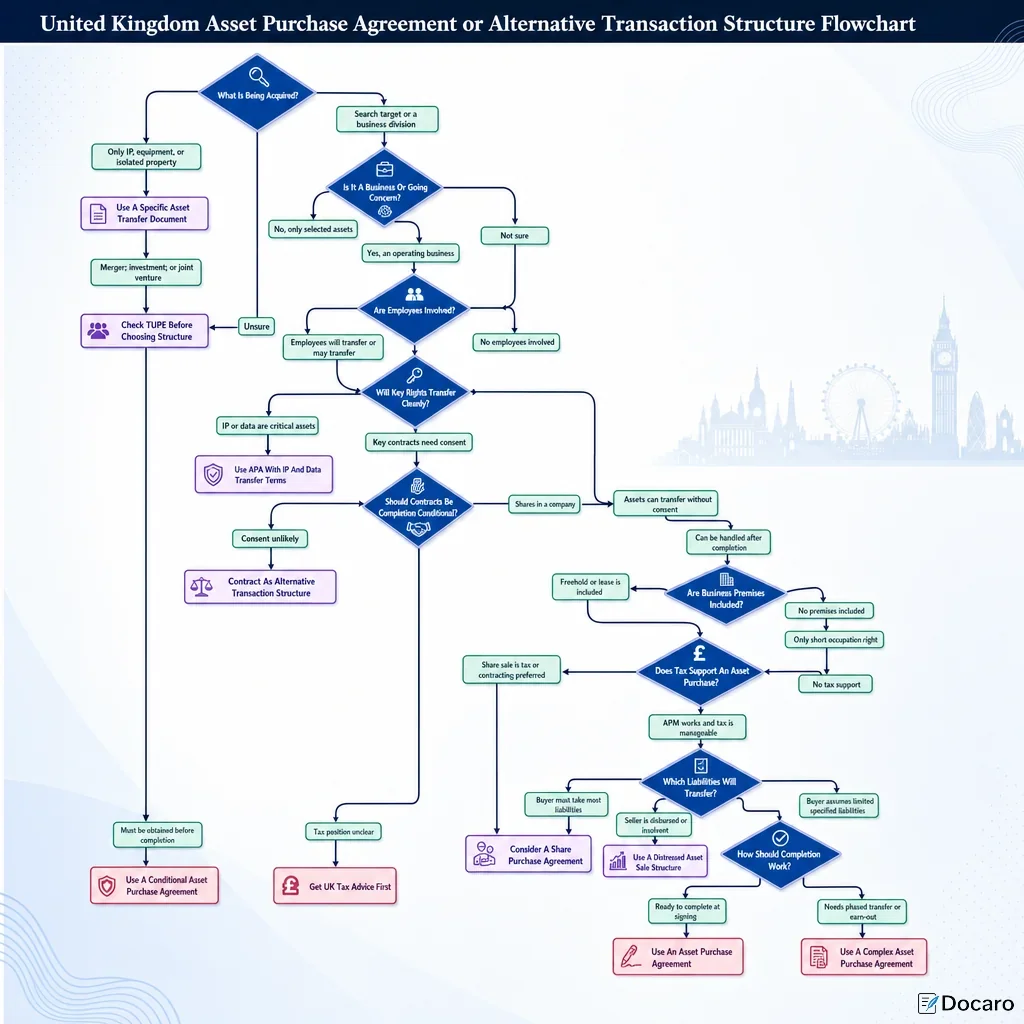
United Kingdom flowchart comparing asset purchase agreements and alternative transaction structures for informed deal planning.
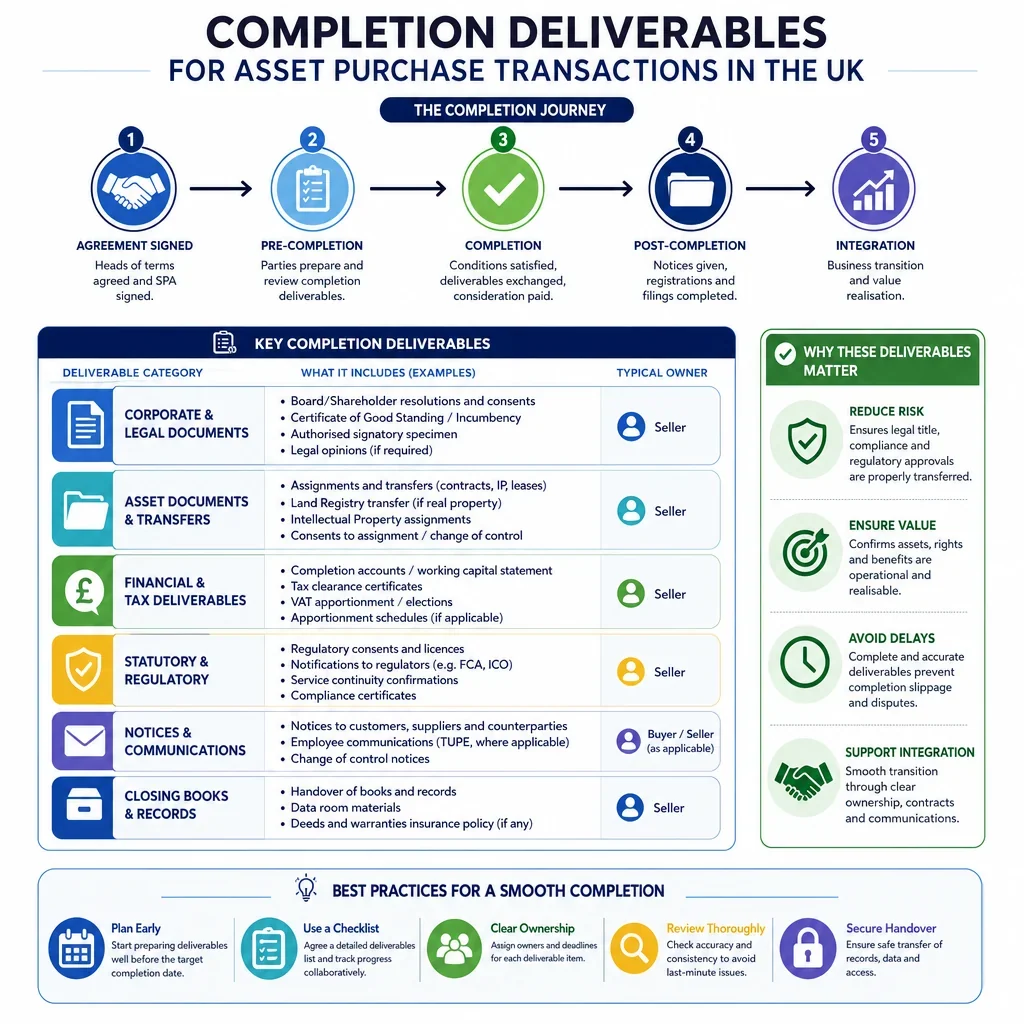
UK guide to completion deliverables for asset purchase transactions, helping parties prepare key documents for closing.
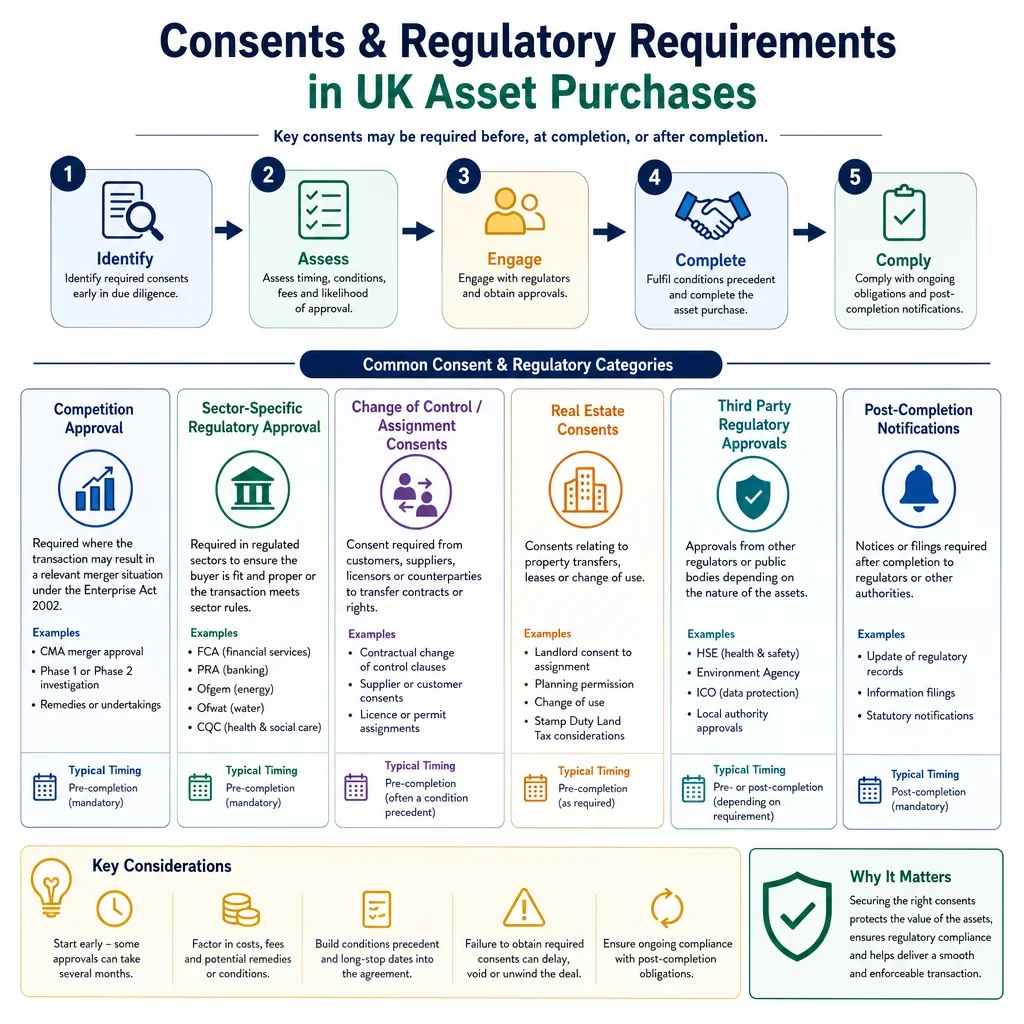
UK guide to consents and regulatory requirements in asset purchases, helping buyers and sellers plan compliant transactions.
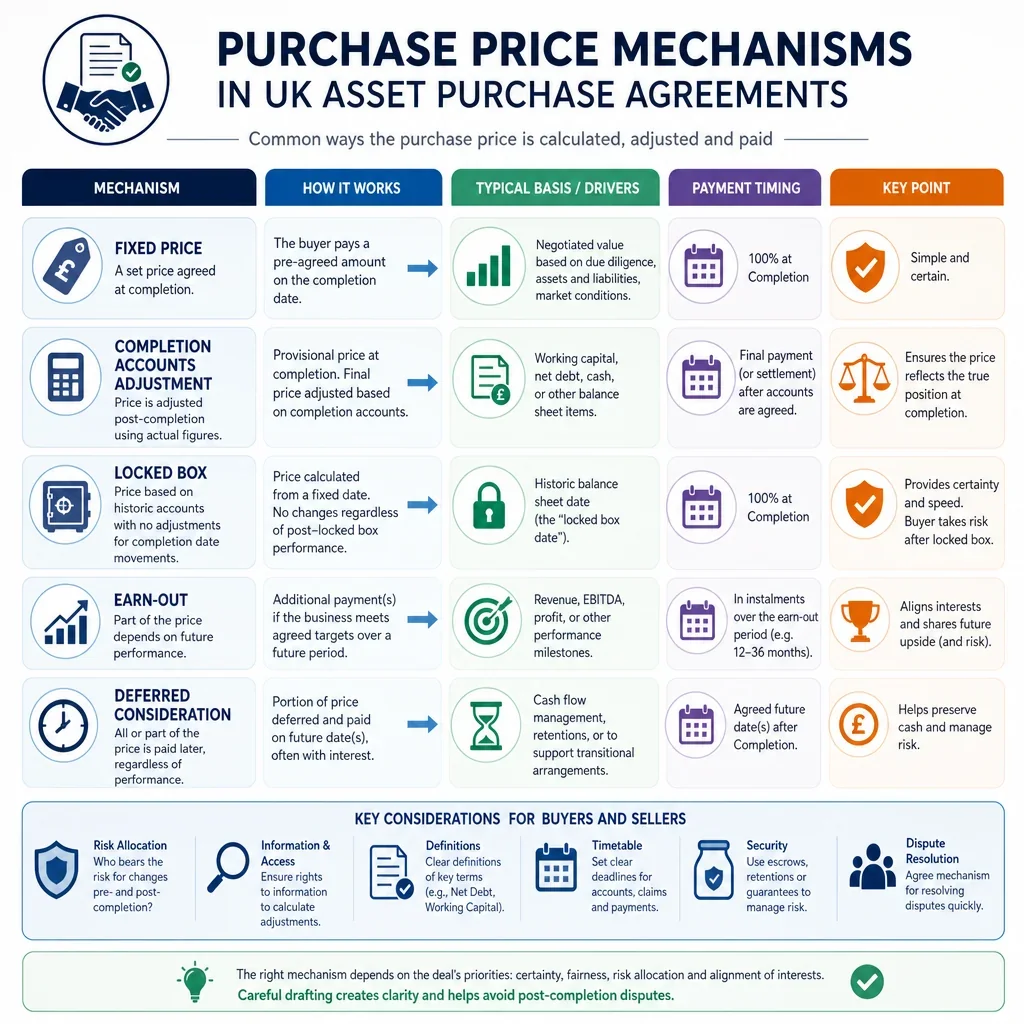
Explore UK purchase price mechanisms in asset purchase agreements, including valuation, adjustments, and deal risk.
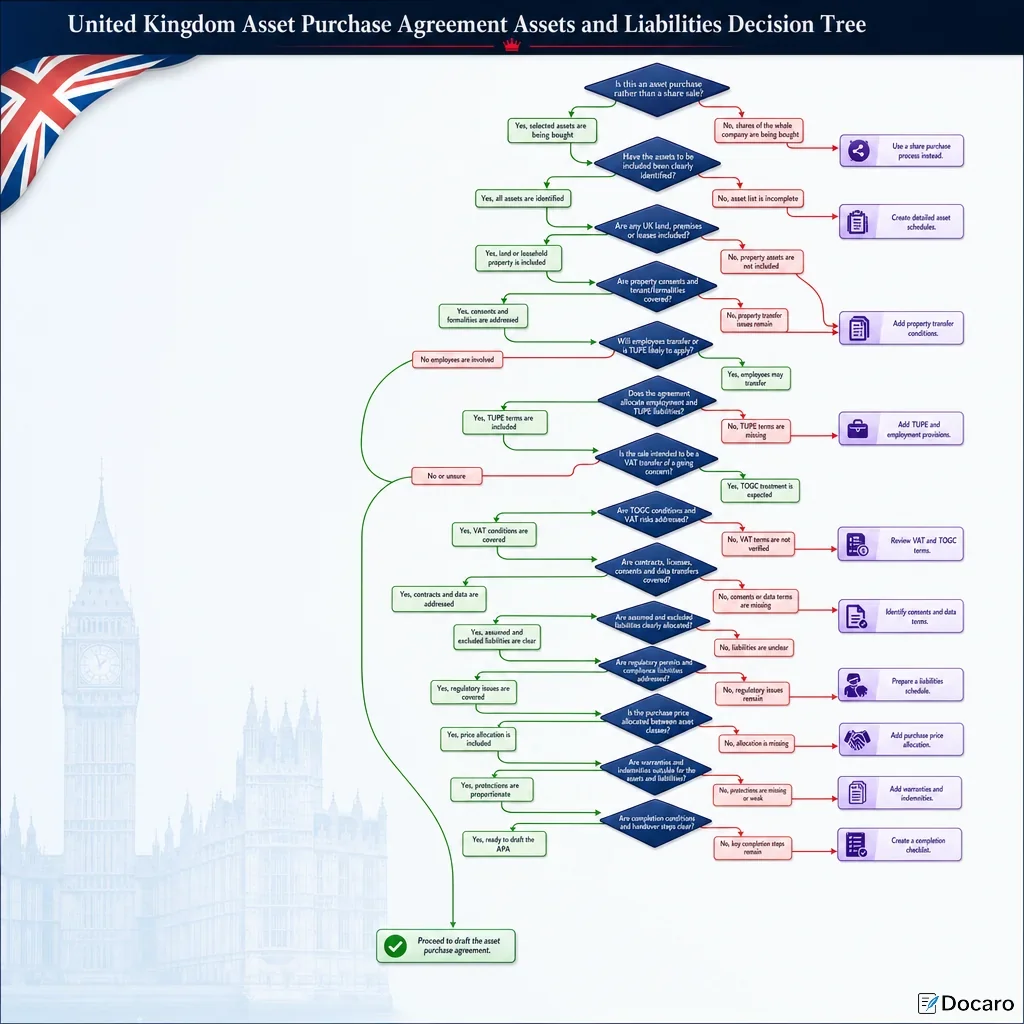
Use this United Kingdom decision tree to assess assets and liabilities in an asset purchase agreement before drafting or review.
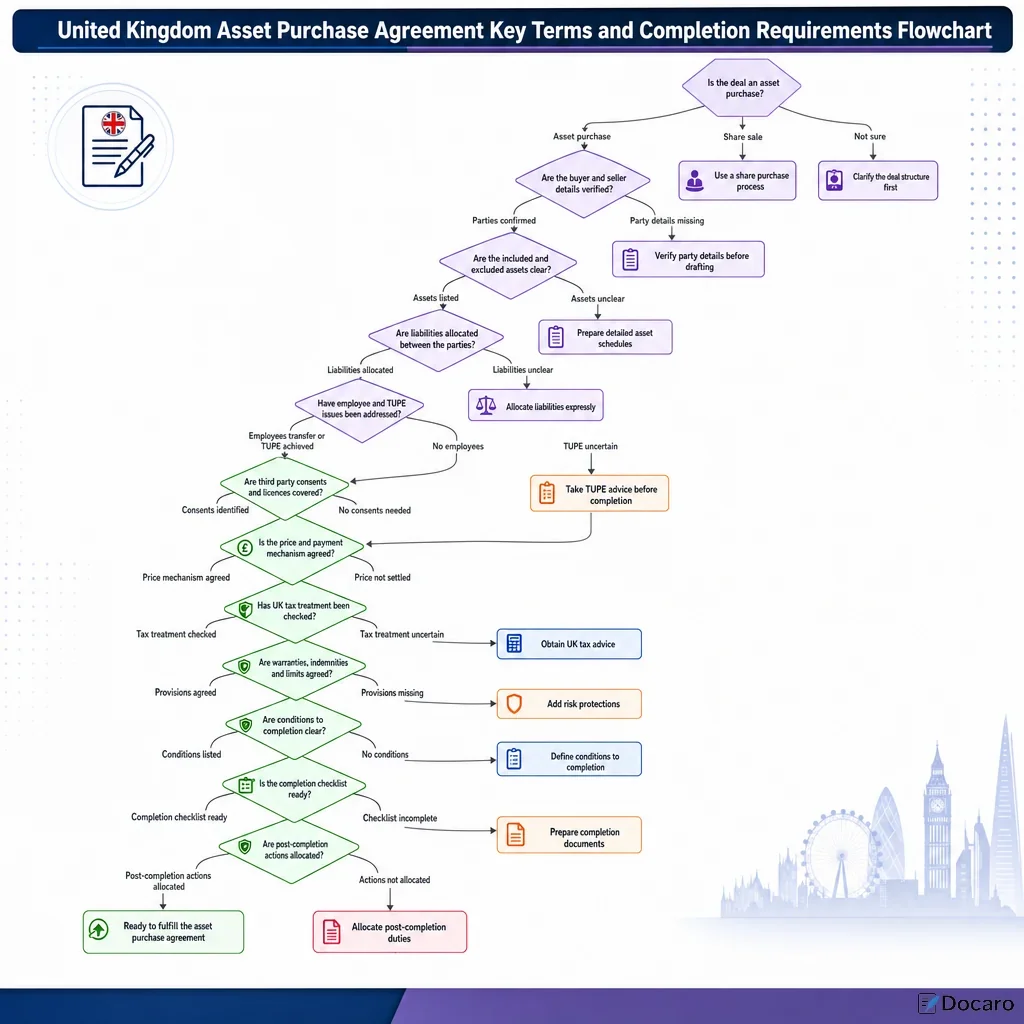
United Kingdom asset purchase agreement flowchart covering key terms and completion requirements for business asset sales.