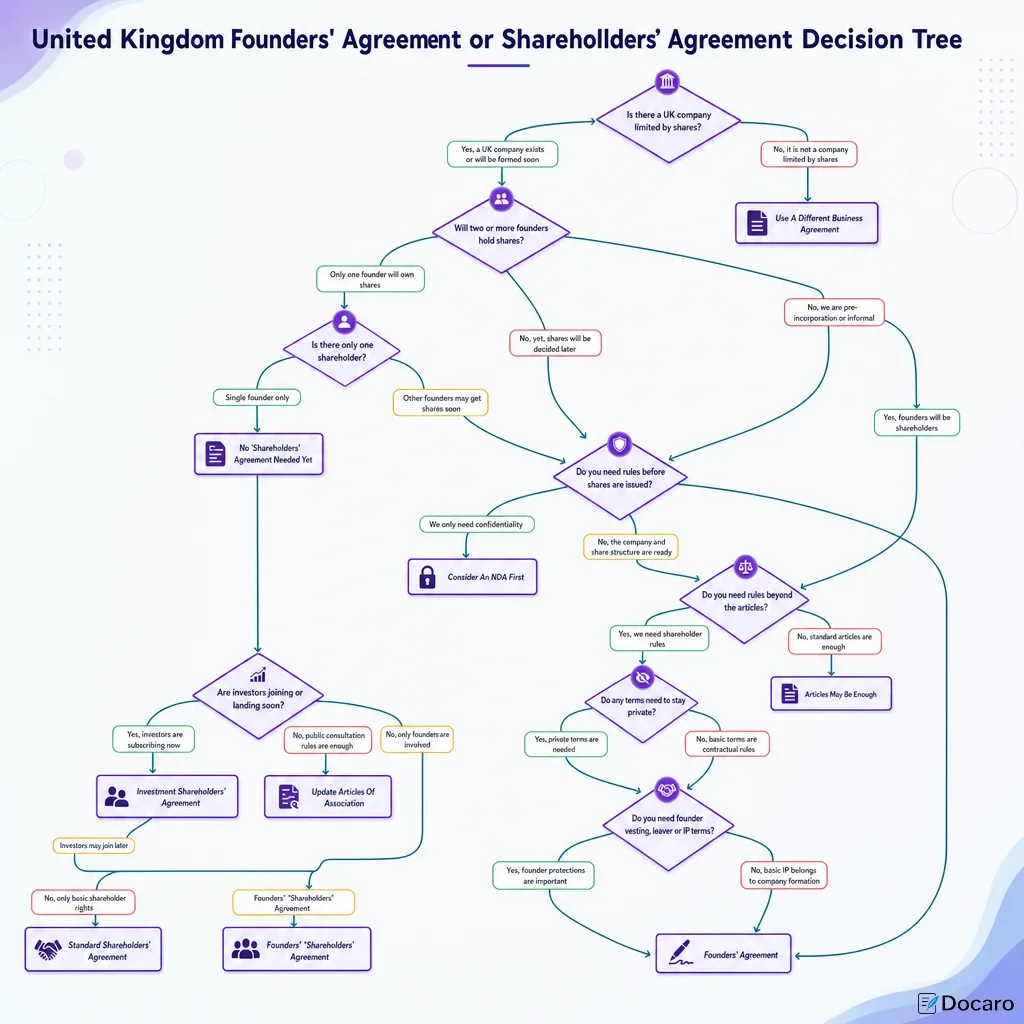
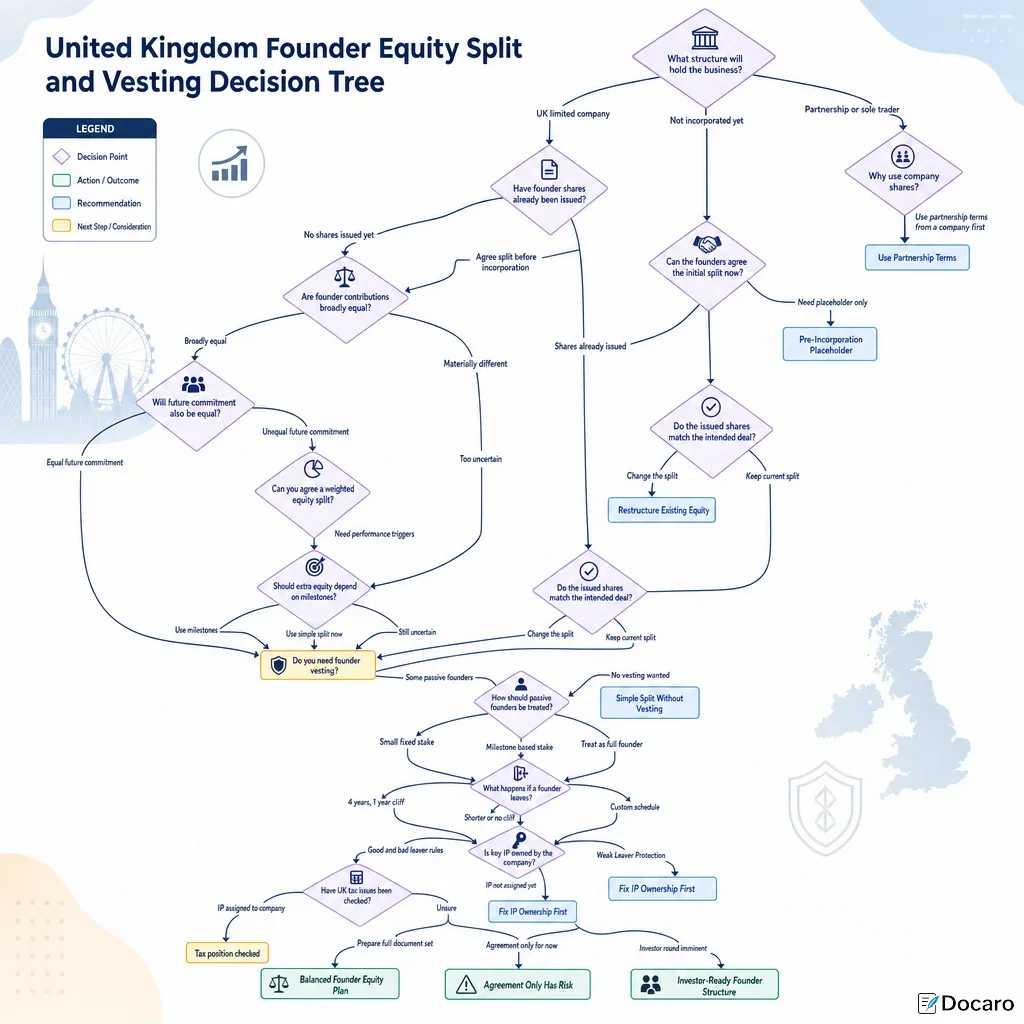
United Kingdom Founders' Agreement Clause Library
Clause Name | Purpose | Typical Importance | Key Considerations | Example Use Case |
|---|---|---|---|---|
Equity and ownership | ||||
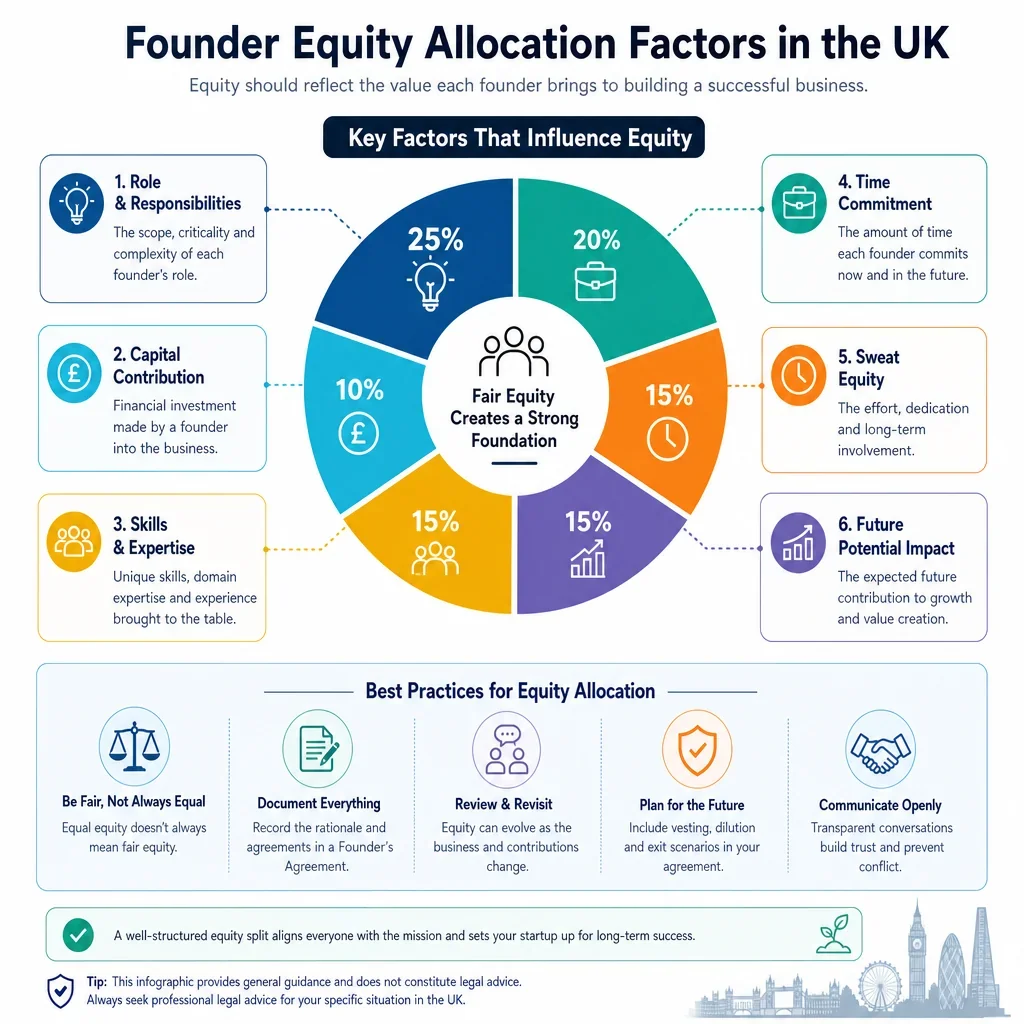
Foundersu0027 Equity Split | Records each founderu0027s initial shareholding and ownership percentage. | High | Contributions, cash invested, IP brought in, future workload and tax treatment. | Two founders agree a 60:40 split because one contributes existing software. |
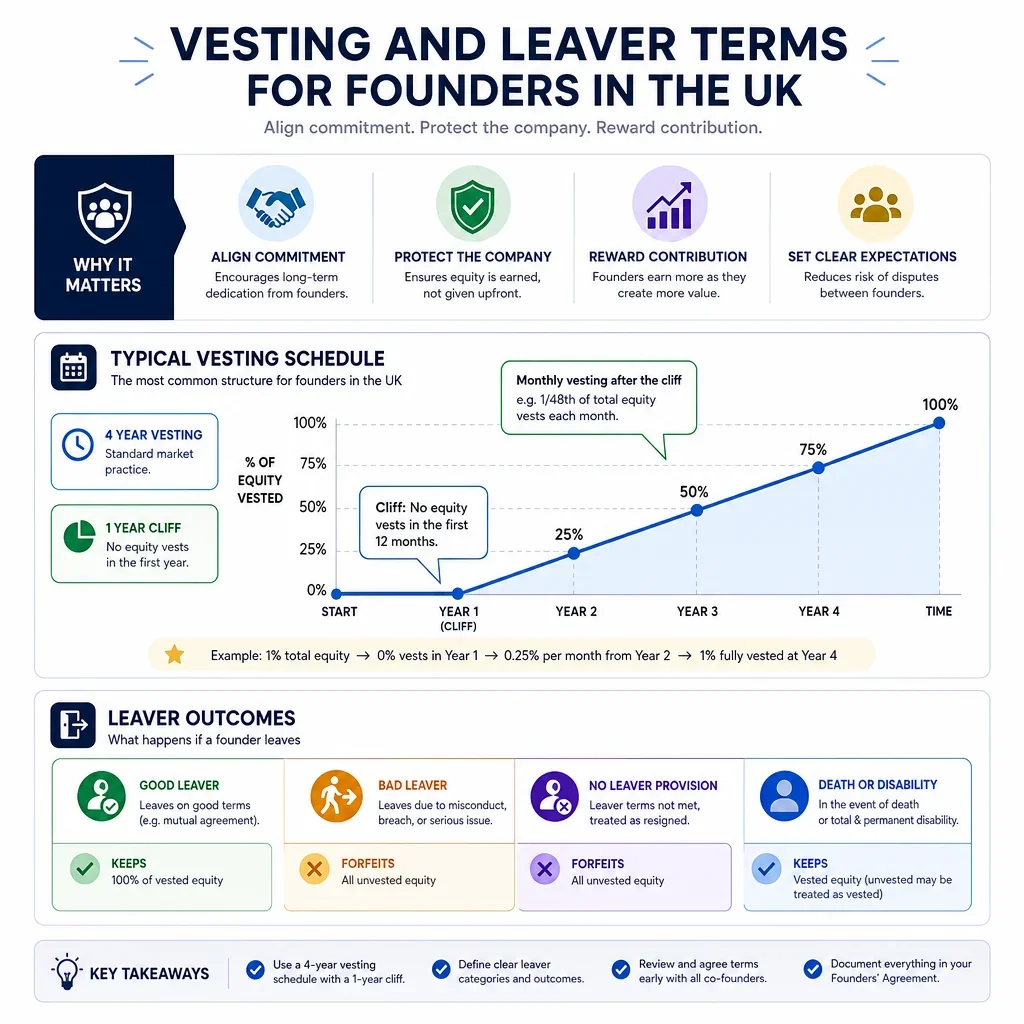
Share Vesting | Makes founders earn shares over time or against milestones. | High | Vesting period, cliff, acceleration, leaver rules and tax consequences. | A startup uses four-year vesting so an early leaver cannot keep all equity. |
Vesting Cliff | Delays vesting until a minimum service period has passed. | High | Common cliff length, fairness, retention effect and treatment of early dismissal. | No founder shares vest unless the founder stays for at least 12 months. |
Reverse Vesting | Allows the company or founders to buy back unvested shares. | High | Buyback mechanism, articles alignment, consideration and share capital rules. | A founder receives shares upfront but unvested shares are repurchased on departure. |
Share Classes | Defines different rights attached to ordinary, growth or preference shares. | Medium | Voting, dividends, capital rights, investor expectations and articles consistency. | A company creates non-voting growth shares for an incoming technical founder. |
Capital Contributions | Records money, assets or services each founder must contribute. | High | Payment dates, consequences of non-payment, valuation and whether funds are loans. | Each founder agrees to contribute £10,000 working capital by completion. |
Founder Loans | Sets repayment terms for money lent by founders to the company. | Medium | Interest, repayment priority, conversion rights, tax and insolvency risk. | A founder funds early product development through a repayable director loan. |
Future Share Issues | Controls when the company may issue new shares. | High | Dilution, investor rounds, pre-emption rights and required founder approval. | Founders require unanimous consent before issuing shares to a new investor. |
Pre-Emption On New Shares | Gives existing shareholders first refusal on new share issues. | High | Statutory rights, disapplication, investor exclusions and timing. | A founder can maintain their percentage during a small friends-and-family round. |
Anti-Dilution Protection | Protects founders or investors from excessive dilution in later rounds. | Medium | Weighted average formula, founder fairness and investor negotiation impact. | A founder seeks protection if a down round occurs within 12 months. |
Option Pool | Reserves shares for employees, consultants or advisers. | Medium | Pool size, founder dilution, EMI eligibility and board approval. | A startup creates a 10% EMI option pool before hiring senior staff. |
Dividend Policy | Sets expectations for distributing profits to shareholders. | Medium | Available profits, reinvestment strategy, tax and board discretion. | Founders agree profits will be reinvested until annual revenue exceeds a threshold. |
Profit Sharing | Explains how profits are shared if not strictly by shareholding. | Low | Company law limits, dividend rules, employment income and tax treatment. | A sales founder receives a bonus-based profit share separate from dividends. |
Roles and responsibilities | ||||
Founder Remuneration | Sets salary, fees or deferred compensation for founders. | High | PAYE, NIC, affordability, employment status and board approval. | Founders agree no salaries until the company raises seed funding. |
Founder Roles | Allocates operational responsibilities between founders. | High | Job titles, authority limits, reporting, accountability and skills gaps. | One founder leads product while another manages finance and fundraising. |
Time Commitment | Requires founders to devote agreed time to the business. | High | Full-time status, side jobs, caregiving, illness and objective measurement. | A part-time founder must move full-time after a funding round closes. |
Performance Milestones | Links obligations or equity to agreed business milestones. | Medium | Clear metrics, deadline control, evidence and consequences of failure. | A CTO receives additional equity after delivering the MVP. |
Company administration | ||||
Director Appointment | States which founders may be appointed as directors. | High | Articles, Companies House filings, board size and investor director rights. | Each co-founder has the right to be appointed as a director while employed. |
Roles and responsibilities | ||||
Director Duties Acknowledgement | Reminds founder-directors of their statutory duties. | High | Conflicts, independent judgment, company benefit and duty to promote success. | Founder-directors confirm they understand duties under sections 171 to 177. |
Founder Employment Status | Clarifies whether a founder is employee, worker, consultant or director only. | High | Employment rights, tax, IP ownership, dismissal and documentation. | A technical founder starts as a consultant before joining as an employee. |
Outside Activities | Restricts side projects, jobs or interests that may distract or conflict. | Medium | Scope, consent process, existing commitments and enforceability. | A founder must disclose a consultancy role for a related business. |
Conflict Of Interest | Requires disclosure and management of personal interests. | High | Disclosure timing, voting restrictions, authorisation and records. | A founder owns shares in a supplier and must disclose the interest. |
Business Opportunities | Prevents founders from taking company opportunities personally. | High | Opportunity definition, approval exceptions and director duties. | A founder cannot divert a customer lead to their separate company. |
Decision making | ||||
Board Composition | Sets the number and identity of directors on the board. | High | Founder representation, investor seats, chair role and quorum. | Three founders agree each will hold one board seat. |
Board Meetings | Sets frequency, notice and format of board meetings. | Medium | Notice, remote attendance, agenda, minutes and urgent decisions. | The board meets monthly by video call with written minutes kept. |
Board Quorum | States who must be present for board decisions to be valid. | High | Founder presence, adjourned meetings and deadlock risk. | At least one technical and one commercial founder must attend key meetings. |
Shareholder Voting Thresholds | Sets voting percentages needed for shareholder approvals. | High | Ordinary resolutions, special resolutions, veto rights and minority protection. | Issuing shares requires 75% approval instead of a simple majority. |
Reserved Matters | Lists major decisions requiring special founder or investor consent. | High | Funding, hiring, debt, budgets, acquisitions, share issues and veto abuse. | No founder can sell core IP without unanimous approval. |
Founder Veto Rights | Gives a founder consent rights over specified decisions. | Medium | Minority protection, deadlock risk, expiry and misuse. | A minority founder can block any sale of the company before year three. |
Chair And Casting Vote | Appoints a chair and decides whether they have a tie-break vote. | Medium | Fairness, deadlock prevention, founder equality and articles consistency. | A three-director board gives the independent chair a casting vote. |
Budget Approval | Requires approval of annual budgets and material spending. | Medium | Approval threshold, overspend limits, emergency costs and reporting. | Any spend above £25,000 requires board approval. |
Company administration | ||||
Banking Authority | Controls who may operate bank accounts and approve payments. | Medium | Dual authorisation, spending limits, fraud controls and online banking access. | Payments over £5,000 require approval from two founders. |
Dispute management | ||||
Deadlock Resolution | Provides a process when founders cannot agree on key decisions. | High | Escalation, mediation, buy-sell rights and avoiding forced unfair exits. | Equal 50:50 founders disagree on accepting an acquisition offer. |
Russian Roulette Buy-Sell | Allows one founder to set a price to buy or sell shares. | Low | Financial imbalance, valuation fairness, funding ability and coercion risk. | Two equal founders need a final exit mechanism after mediation fails. |
Texas Shoot-Out | Uses sealed bids to determine who buys the other founderu0027s shares. | Low | Funding disparity, valuation uncertainty and suitability for 50:50 companies. | Two founders each want sole control after a strategic breakdown. |
Mediation | Requires disputes to be mediated before court proceedings. | Medium | Mediator selection, timing, confidentiality and urgent injunction exceptions. | Founders must attend mediation before starting an unfair prejudice claim. |
Expert Determination | Refers technical or valuation disputes to an independent expert. | Medium | Expert appointment, finality, costs, evidence and scope of questions. | An accountant determines fair value for a departing founderu0027s shares. |
Arbitration | Sends disputes to private arbitration instead of court. | Low | Seat, rules, cost, confidentiality and enforceability of awards. | International founders want confidential binding dispute resolution in London. |
Leaving the company | ||||
Good Leaver | Defines favourable treatment for founders leaving in accepted circumstances. | High | Death, disability, redundancy, illness, dismissal without cause and share price. | A founder leaving due to serious illness may keep vested shares. |
Bad Leaver | Penalises founders leaving after misconduct or serious breach. | High | Trigger events, fairness, employment law, valuation discount and enforceability. | A founder dismissed for fraud must sell shares at nominal value. |
Compulsory Transfer On Exit | Requires a departing founder to sell some or all shares. | High | Trigger events, buyer, price, payment timing and articles alignment. | A resigning founder must offer shares to the remaining founders first. |
Share Transfer Restrictions | Limits when founders can sell or transfer shares. | High | Permitted transfers, family trusts, investor consent and articles wording. | No founder may sell shares to a competitor without board consent. |
Right Of First Refusal | Gives existing shareholders first chance to buy shares being sold. | High | Offer process, valuation, matching rights, deadlines and permitted transfers. | A founder must offer shares to co-founders before selling to a third party. |
Tag-Along Rights | Lets minority founders join a majority share sale on the same terms. | Medium | Trigger percentage, sale terms, minority protection and investor expectations. | A minority founder joins a sale led by the majority founder. |
Drag-Along Rights | Allows majority holders to force minority shareholders into a sale. | Medium | Approval threshold, minimum price, buyer identity and minority safeguards. | An acquirer requires 100% ownership before completing a trade sale. |
Founder Death Or Incapacity | Sets what happens if a founder dies or cannot work. | Medium | Insurance, estate rights, buyout pricing and business continuity. | The company buys back shares from a deceased founderu0027s estate. |
Founder Divorce Or Bankruptcy | Protects the company from involuntary share transfers. | Medium | Family court orders, trustees in bankruptcy, pre-emption and valuation. | A founderu0027s bankruptcy triggers a right for others to buy their shares. |
Confidentiality and IP | ||||
Confidentiality | Protects business secrets, plans, customer data and financial information. | High | Definition, exclusions, duration, disclosure permissions and remedies. | Founders keep pitch decks, code and customer lists confidential. |
Trade Secrets Protection | Protects information that has commercial value because it is secret. | High | Reasonable protection steps, permitted disclosures and evidence of secrecy. | A founder handles proprietary algorithms and supplier pricing models. |
IP Assignment | Transfers foundersu0027 intellectual property rights to the company. | High | Written assignment, pre-existing works, moral rights and future rights. | A founder assigns source code created before incorporation to the company. |
Pre-Existing IP | Identifies IP a founder owned before joining the company. | High | Ownership evidence, licence scope, exclusions and investor due diligence. | A founder licenses an existing analytics library to the startup. |
Moral Rights Waiver | Waives certain personal rights in copyright works where permitted. | Medium | Written waiver, creative works, attribution, integrity rights and limits. | A designer-founder waives attribution rights in branding assets. |
Inventions And Patents | Allocates ownership and filing duties for patentable inventions. | Medium | Inventorship, employee inventions, assignment, prosecution costs and confidentiality. | A hardware startup decides who owns patentable prototypes. |
Open Source Software | Controls use of open source code in company products. | Medium | Licence terms, copyleft risk, attribution, audit trail and customer warranties. | A SaaS startup restricts GPL code in proprietary backend software. |
Domain Names And Accounts | Ensures business domains, social accounts and cloud accounts belong to the company. | Medium | Registrant details, password control, MFA, transfer on exit and evidence. | A founder registers the company domain in their personal name. |
Data Protection Responsibilities | Allocates responsibility for handling personal data lawfully. | High | Controller roles, security, lawful basis, ICO registration and breach process. | A health-tech founder manages customer onboarding and sensitive user data. |
Non-Compete | Restricts founders from competing with the company. | Medium | Duration, geography, business scope, legitimate interest and enforceability. | A founder leaving a fintech startup cannot launch a direct rival for six months. |
Non-Solicitation Of Customers | Stops founders poaching customers after leaving. | Medium | Restricted customers, duration, contact history and legitimate interest. | A sales founder cannot approach customers they handled in the last year. |
Non-Solicitation Of Staff | Stops founders poaching employees, contractors or advisers. | Medium | Who is protected, duration, seniority and recruitment exceptions. | A departing founder cannot hire the startupu0027s lead developer for 12 months. |
Dispute management | ||||
Non-Disparagement | Prevents founders making damaging statements about the company or each other. | Low | Whistleblowing, truthful statements, legal disclosures and scope. | A founder exit settlement includes mutual non-disparagement wording. |
Company administration | ||||
Announcements And Publicity | Controls public statements, press releases and social media announcements. | Low | Approval process, investor announcements, confidentiality and brand risk. | No founder may announce a funding round before completion. |
Confidentiality and IP | ||||
Company Name And Branding | Allocates responsibility for company name, brand and trade mark matters. | Medium | Trade mark clearance, ownership, domain names and brand approvals. | A founder designed the logo before incorporation and assigns it to the company. |
Company administration | ||||
Company Formation Obligations | Sets duties for incorporation and initial filings. | Medium | Company name, registered office, articles, share allotments and PSC records. | Founders agree who will incorporate the company and file initial forms. |
Articles Of Association Consistency | Ensures the agreement aligns with the companyu0027s articles. | High | Share transfers, voting, class rights, precedence and public filing. | Leaver provisions are mirrored in the articles to bind future shareholders. |
Shareholder Register And Filings | Allocates responsibility for statutory registers and Companies House filings. | Medium | Members register, PSC register, confirmation statements and filing deadlines. | A founder-company secretary maintains registers after each share transfer. |
PSC Register Compliance | Requires disclosure of persons with significant control. | Medium | Control thresholds, updating duties, nominee holdings and Companies House filings. | A founder holding over 25% is recorded as a PSC. |
Accounting Records | Allocates responsibility for keeping proper accounting records. | Medium | Bookkeeping, access rights, accounts deadlines, audit and tax records. | The finance founder must maintain Xero records and monthly management accounts. |
Information Rights | Gives founders access to financial and operational information. | Medium | Reporting frequency, confidentiality, shareholder rights and sensitive data. | A non-executive founder receives monthly revenue and cash runway reports. |
Tax Cooperation | Requires founders to cooperate on tax filings and elections. | Medium | Share valuations, section 431 elections, EMI filings and PAYE reporting. | Founders sign tax elections after receiving restricted shares. |
Expenses Policy | Sets rules for reimbursement of business expenses. | Low | Receipts, approval limits, travel, personal costs and tax compliance. | A founder must get approval before claiming overseas conference costs. |
Insurance | Requires suitable business, D&O or key person insurance. | Low | Cover type, premiums, exclusions, investor requirements and key person risk. | The company obtains key person insurance for a sole technical founder. |
Founder Warranties | Records promises about capacity, ownership, IP and no conflicts. | Medium | Accuracy, disclosure, remedies, reliance and investor due diligence. | Each founder warrants they own the IP they are contributing. |
Dispute management | ||||
Indemnities | Requires a founder to cover specified losses caused by breach. | Medium | Scope, caps, exclusions, proof of loss and director indemnity limits. | A founder indemnifies the company for losses from undisclosed third-party IP claims. |
Limitation Of Liability | Caps or excludes certain claims between founders. | Medium | Fraud carve-outs, deliberate breach, reasonableness and statutory limits. | Liability for ordinary breach is capped at the value of a founderu0027s shares. |
Restrictive Covenant Severance | Allows unenforceable restrictions to be severed where possible. | Low | Drafting precision, separate restrictions and enforcement risk. | A court can remove excessive words from a non-compete clause if validly severable. |
Company administration | ||||
Term And Termination | States when the agreement starts, ends and which clauses survive. | Medium | Survival of confidentiality, IP, leaver, dispute and restrictive clauses. | Confidentiality and IP obligations survive after a founder sells all shares. |
Deed Execution | Provides for execution as a deed where appropriate. | Medium | Consideration, witness requirements, company execution and limitation periods. | IP assignment and share transfer obligations are executed as a deed. |
Dispute management | ||||
Governing Law And Jurisdiction | Chooses the law and courts for the agreement. | High | England and Wales, Scotland or Northern Ireland court choice and overseas founders. | UK founders choose English law and English courts for certainty. |
Company administration | ||||
Notices | Sets how formal notices must be served. | Low | Email validity, postal addresses, deemed receipt and overseas founders. | A leaver notice must be sent by email and recorded delivery. |
Entire Agreement | Limits reliance on previous discussions not included in the agreement. | Medium | Fraud carve-out, side letters, pitch promises and prior term sheets. | A founder cannot rely on an old email promising extra equity. |
Variation | Sets how the agreement may be amended. | Medium | Written consent, unanimous approval, investor consent and articles changes. | All founders must sign any amendment to vesting terms. |
Assignment Of Agreement | Controls whether rights under the agreement can be transferred. | Low | Group companies, successors, investor transfers and personal obligations. | The company may assign IP enforcement rights to a group company after restructuring. |
Third Party Rights | States whether non-parties can enforce the agreement. | Low | Group companies, investors, employees and exclusion of statutory rights. | An investor is allowed to enforce confidentiality obligations directly. |
Counterparts And Electronic Signature | Allows signing in separate copies and electronically. | Low | Witnessing deeds, identity checks, platform evidence and overseas signers. | Remote founders sign the agreement using an e-signature platform. |
What Clauses Should A UK Founders\u0027 Agreement Usually Prioritise?
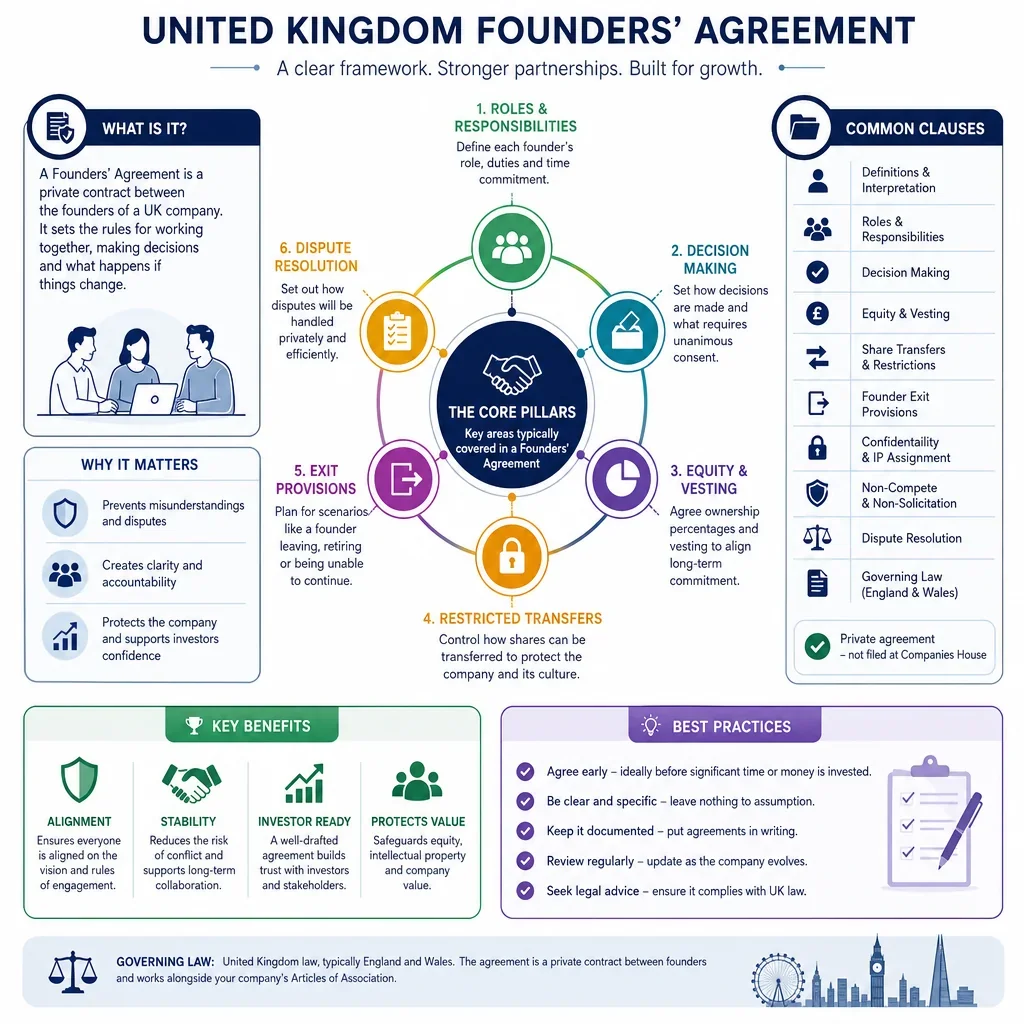
Equity, vesting, IP assignment, decision making and founder exits are usually the highest-risk areas. These clauses determine who owns the company, who controls key decisions, whether the company owns its technology and brand, and what happens if a founder leaves early.
Why Does IP Ownership Need Special Attention In The UK?
In the UK, founders should not assume the company automatically owns everything created before incorporation or outside employment. Copyright and other rights may need a written assignment, and patent rights can depend on inventorship and entitlement. A founders\u0027 agreement should work alongside employment, consultancy and IP assignment documents.
How Do Founder Exit Clauses Reduce Disputes?
Good leaver, bad leaver, vesting, compulsory transfer and drag/tag provisions help avoid deadlock when a founder resigns, is dismissed, becomes incapacitated or stops contributing. Without clear terms, a departed founder may retain shares and voting power despite no longer working in the business.
Which UK Legal Points Often Affect Founders\u0027 Agreements?
- Companies Act 2006: share transfers, directors\u0027 duties, conflicts, dividends and company administration must be consistent with company law and the articles of association.
- Employment and tax: salary, consultancy status, share options and vesting can create PAYE, NIC, employment rights and EMI option issues.
- Data protection and confidentiality: clauses handling personal data, trade secrets and customer information should align with UK GDPR, the Data Protection Act 2018 and the Trade Secrets Regulations.
- Competition restrictions: non-compete and non-solicitation clauses must be carefully limited to be enforceable under English law.
FAQs
You Might Also Be Interested In