

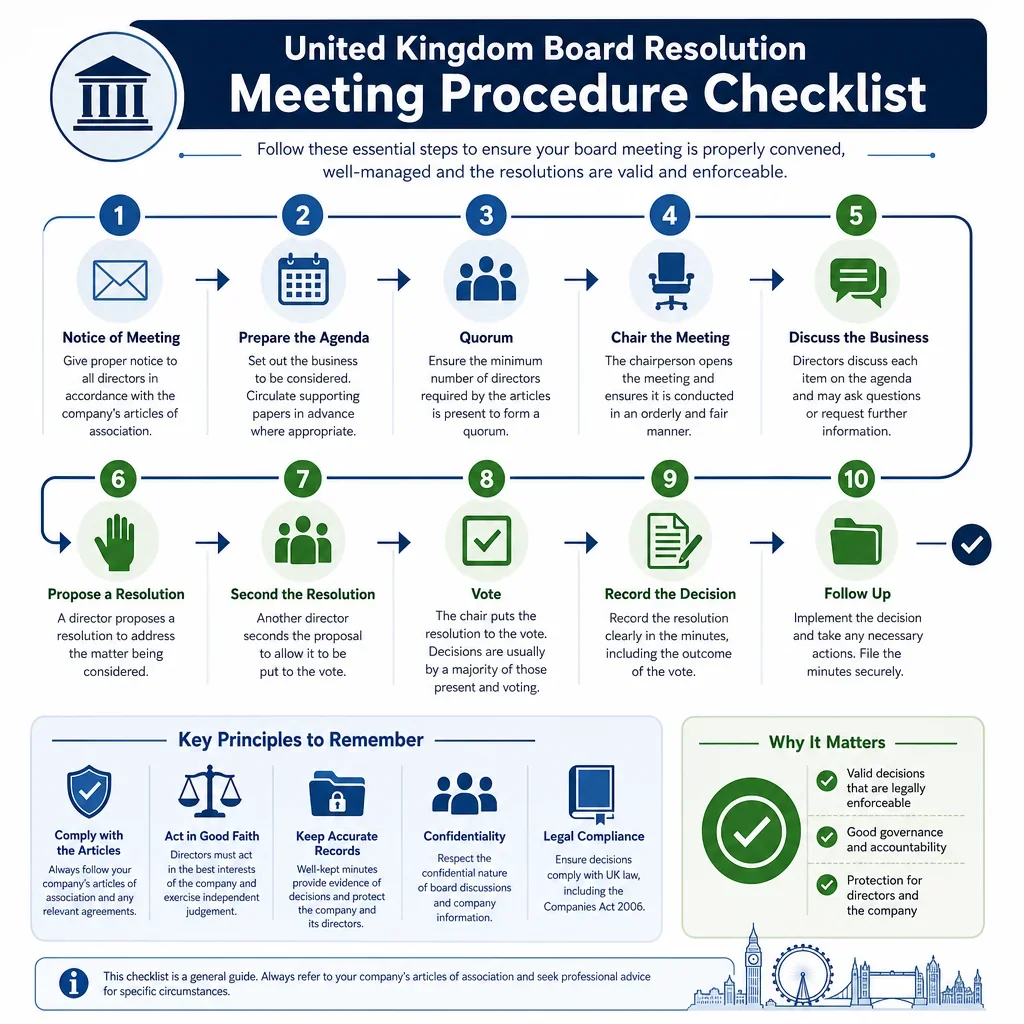
United Kingdom Board Resolution Meeting Procedure Checklist
Created:
This structured checklist helps directors and company secretaries follow the key steps for holding and recording board resolution meetings in the United Kingdom. It is part of our AI Generated British Corporate Resolutions resources, designed to support clearer governance and compliant decision-making.
Procedure Item | Importance | Articles Should Be Checked | Usually Recorded in Minutes | Risk if Overlooked |
|---|---|---|---|---|
Calling the meeting | ||||
Confirm who may call the board meeting | Only an authorised person should initiate formal board business. | true | false | Medium |
Act on a director’s request to call a meeting | Prevents obstruction of board decision-making rights. | true | false | Medium |
Ask the secretary to convene the meeting if applicable | Ensures notice and papers are administered consistently. | true | false | Low |
Prepare a clear agenda for each resolution | Helps directors understand and approve specific decisions. | false | true | Medium |
Circulate board papers with sufficient background information | Supports informed decision-making and directors’ statutory duties. | false | true | Medium |
Check whether shareholder consent is needed | Some decisions exceed board authority or are reserved matters. | true | true | High |
Confirm the current directors entitled to attend | Attendance and voting rights depend on valid appointment status. | true | true | High |
Notice | ||||
Give notice to every director entitled to receive it | Failure to notify an entitled director may invalidate decisions. | true | true | High |
Provide reasonable notice before the meeting | Directors need fair opportunity to attend and prepare. | true | true | High |
State date, time, place and meeting method in the notice | Directors must know how and when to participate. | true | true | Medium |
Describe the general purpose of the meeting | Avoids surprise decisions outside directors’ expectations. | true | true | Medium |
Send notice to directors outside the UK if entitled | Modern articles often require notice regardless of location. | true | false | High |
Obtain agreement if holding the meeting on short notice | Reduces challenge risk where notice period is compressed. | true | true | High |
Record waiver of notice by absent or late-notified directors | Creates evidence that notice defects were accepted. | true | true | High |
Use a notice method permitted by the articles | Improper service may mean notice was not validly given. | true | false | Medium |
Quorum | ||||
Confirm the minimum quorum before business starts | Board decisions usually require a quorum to be valid. | true | true | High |
Ensure quorum remains present for each resolution | A later departure may invalidate subsequent business. | true | true | High |
Check whether a sole director can form a quorum | Some articles require more than one director for board decisions. | true | true | High |
Confirm whether alternate directors count in the quorum | Attendance rules may differ for alternates and appointors. | true | true | Medium |
Exclude conflicted directors from quorum where required | Conflicted directors may be barred from counting or voting. | true | true | High |
Check quorum rules for any adjourned meeting | Adjournment may not cure a quorum defect automatically. | true | true | Medium |
Conflicts of interest | ||||
Require directors to declare interests in proposed transactions | Undeclared interests may breach statutory duty and taint approval. | true | true | High |
Record declarations of interests in existing transactions | Late disclosure may still be required for existing arrangements. | true | true | High |
Check whether the board can authorise the conflict | Authorisation power depends on company type and articles. | true | true | High |
Confirm whether conflicted directors may vote | Improper votes can change the outcome of a resolution. | true | true | High |
Ask conflicted directors to leave if required | Protects impartial discussion and valid quorum calculation. | true | true | High |
Record the nature and extent of each declared interest | A vague declaration may not satisfy disclosure requirements. | false | true | High |
Check shareholder approval for substantial property transactions | Director-related asset transactions may need member approval. | false | true | High |
Check member approval for loans to directors | Certain director loans require shareholder approval. | false | true | High |
Voting | ||||
Appoint or confirm the chair of the meeting | The chair manages procedure and may affect voting rules. | true | true | Medium |
Pass resolutions by required majority of eligible directors | The required approval threshold determines whether the resolution passes. | true | true | High |
Use unanimous approval where the articles require it | Some reserved decisions need more than a simple majority. | true | true | High |
Check whether the chair has a casting vote | A tied vote may only pass if a casting vote exists. | true | true | Medium |
Record abstentions and reasons where relevant | Clarifies approval count and conflict handling. | false | true | Medium |
Record dissenting votes if a director requests it | Protects individual directors and evidences the vote outcome. | false | true | Low |
Confirm authority to delegate implementation actions | Implementation may fail if signatories lack authority. | true | true | Medium |
Authorise named people to sign related documents | Documents must be signed by authorised persons or valid company signatories. | true | true | Medium |
Minutes | ||||
Make minutes of the directors’ meeting | Companies must keep minutes of directors’ meetings. | false | true | High |
Keep board minutes for at least 10 years | Statutory records must be retained for inspection and evidence. | false | false | Medium |
Record date, time, location and meeting method | Identifies the meeting and supports procedural evidence. | false | true | Low |
List directors present, absent and in attendance | Shows quorum, eligibility and who participated. | false | true | Medium |
Minute that proper notice was given or waived | Creates evidence that the meeting was properly convened. | true | true | Medium |
Minute that a quorum was present | Provides evidence that the board could validly transact business. | true | true | Medium |
Set out the exact wording of each resolution passed | Avoids uncertainty about what the board approved. | false | true | High |
Record key factors considered for significant decisions | Supports compliance with the duty to promote company success. | false | true | Medium |
Approve or note previous board minutes if relevant | Maintains continuity and confirms earlier records. | false | true | Low |
Have minutes approved and signed by the chair | Signed minutes are evidence of the proceedings. | false | false | Medium |
Record authorised actions and responsible persons | Helps implement the resolution and prove delegated authority. | false | true | Medium |
Note any Companies House filings required after approval | Some board decisions require public filings or registers updates. | false | true | Medium |
Written resolutions | ||||
Check the articles permit written board resolutions | Board written resolutions depend on articles or agreed procedure. | true | false | High |
Circulate the written resolution to all eligible directors | All eligible directors should have the chance to approve or object. | true | false | High |
Exclude conflicted or ineligible directors from approval count | The approval threshold should use the correct voting group. | true | false | High |
Obtain all required director approvals for written decisions | Written board decisions often require unanimous eligible approval. | true | false | High |
Record the date the written resolution takes effect | Determines when authority and implementation begin. | true | false | Medium |
Allow counterpart signatures only if acceptable under procedure | Counterparts help collect approvals but should be procedurally valid. | true | false | Medium |
Confirm electronic signatures are acceptable for approvals | Electronic approval evidence should be reliable and admissible. | true | false | Medium |
Store written resolutions with the company minute book | Creates a durable company record of board approval. | false | false | Medium |
Electronic meetings | ||||
Check the articles allow telephone or video meetings | Remote meetings should be validly convened under the articles. | true | true | High |
Ensure all participants can hear and contribute | Participation defects can undermine attendance and quorum. | true | true | High |
Record which directors attended electronically | Shows who was present and how quorum was maintained. | false | true | Medium |
Pause proceedings if a director loses connection materially | A lost connection may affect participation, quorum and voting. | true | true | Medium |
Use secure access details for electronic meetings | Protects confidential board discussions and papers. | false | false | Medium |
Verify the identity of remote attendees | Ensures only authorised participants attend and vote. | false | false | Medium |
Do not record the meeting unless authorised and appropriate | Recording can create confidentiality and data protection issues. | false | false | Low |
What Makes A UK Board Resolution Procedurally Sound?
A board resolution is usually safest when the directors can show that the meeting was properly called, that every director entitled to receive notice was notified, that a quorum was present throughout the relevant business, and that any conflicts were handled under the Companies Act 2006 and the company articles.
Which Documents Should Be Checked Before The Meeting?
- Check the articles first: many board procedure rules are modified by the company articles, including quorum, chairing, alternate directors, conflicts, casting votes, written resolutions and electronic meetings.
- Use the statutory duties as a baseline: directors must promote the success of the company and avoid or declare conflicts, so the minutes should show the decision-making process where the matter is material.
- Keep clear minutes: minutes must be kept for at least 10 years under the Companies Act 2006, and they are often the main evidence that the resolution was validly passed.
When Is The Risk Highest?
- High-risk issues include missing notice, lack of quorum, conflicted directors counting in the quorum or voting improperly, failure to declare an interest, and using a written resolution without unanimous eligible director approval where required.
- Electronic meetings should only be used where permitted by the articles or otherwise accepted by the company’s governance arrangements, and the minutes should record that participants could hear and participate effectively.
- Written board resolutions are convenient, but they should be circulated to all eligible directors and stored with the company’s minute book or statutory records.
Want to Generate Your own Board Resolution?
Docaro AI can help you write your own Board Resolution for use in the United Kingdom in minutes.
FAQs
A United Kingdom board resolution meeting procedure checklist is a practical guide for directors to follow when calling, holding, recording, and approving decisions at a board meeting. It helps ensure that board resolutions are properly authorised, documented, and retained in the company’s records.
Show All FAQs
You Might Also Be Interested In
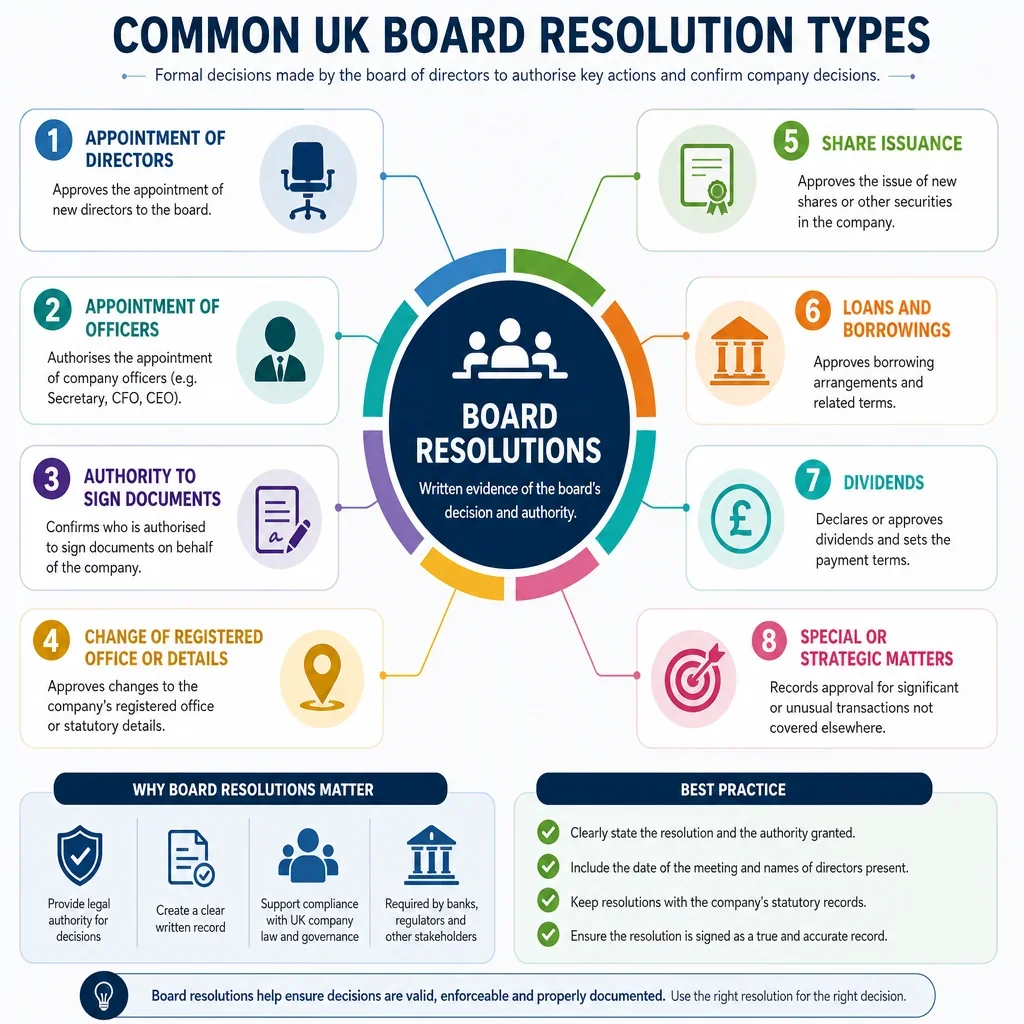
Explore common UK board resolution types, their uses, and why they matter for company decisions and corporate governance.
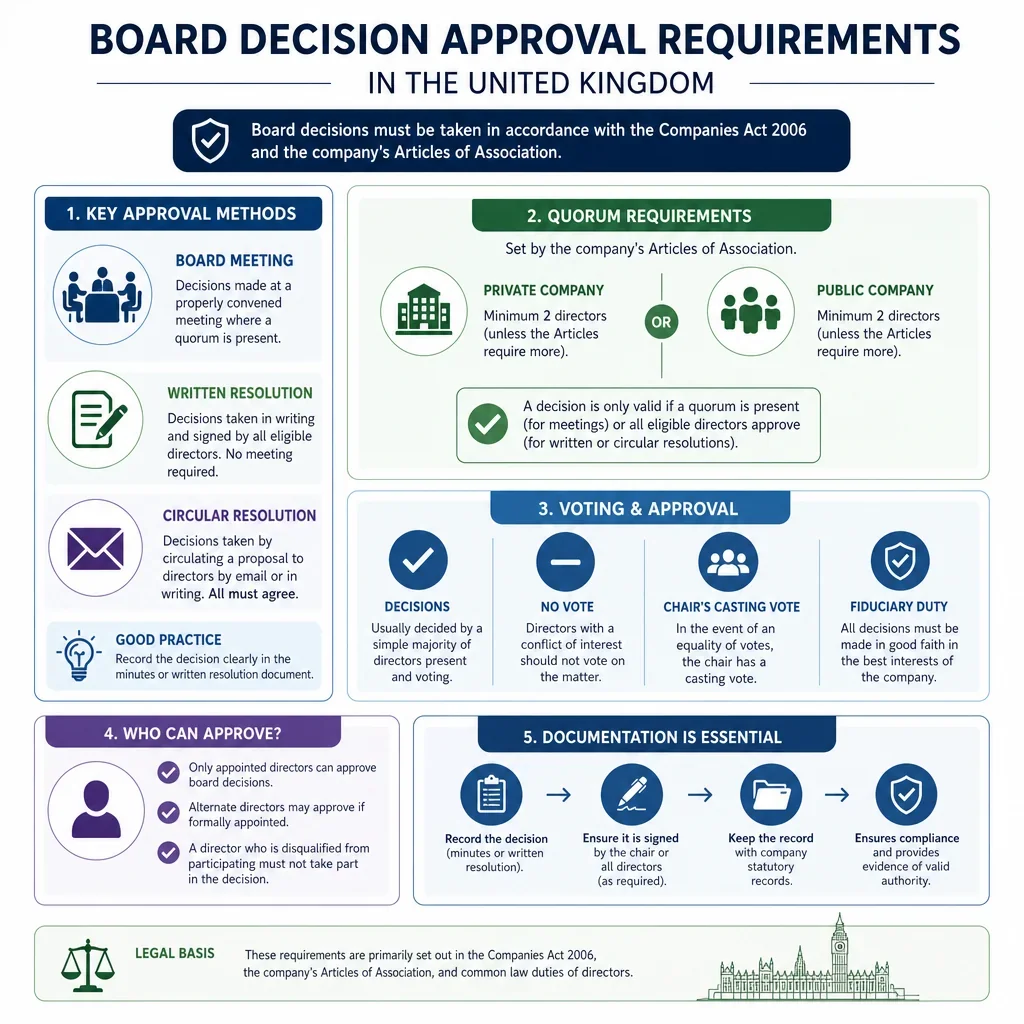
United Kingdom board decision approval requirements for compliant corporate governance, resolutions and director approvals.
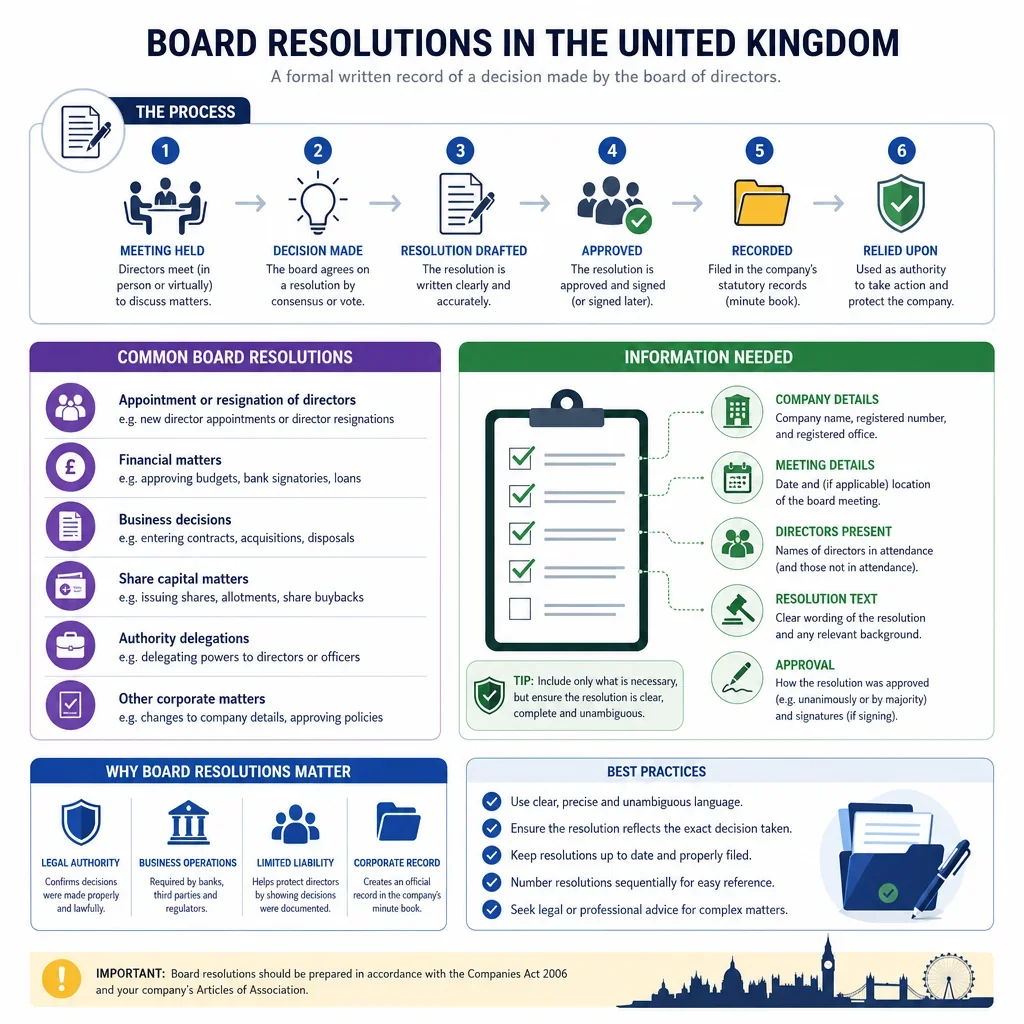
Key information needed for United Kingdom board resolutions to help directors prepare accurate, compliant corporate records.
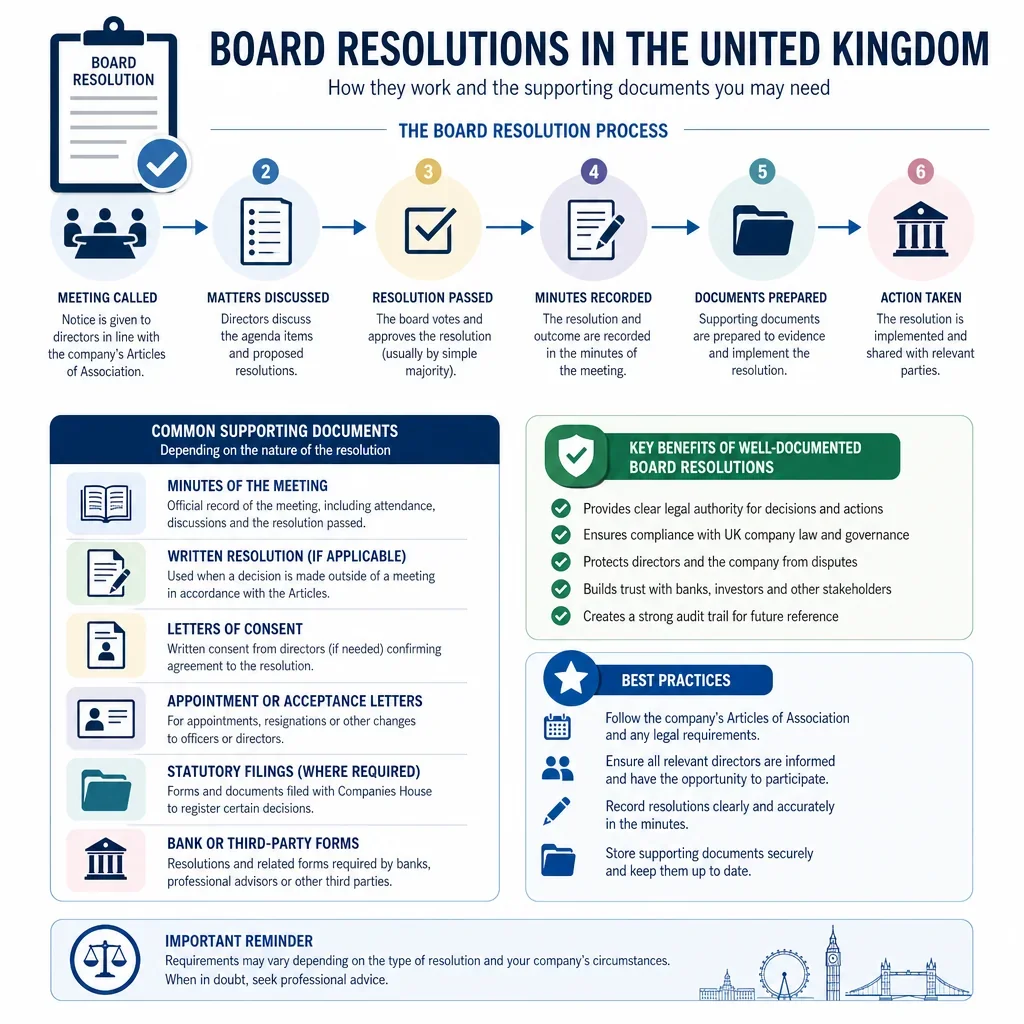
United Kingdom guide to supporting documents for board resolutions, helping directors record evidence and approvals clearly.
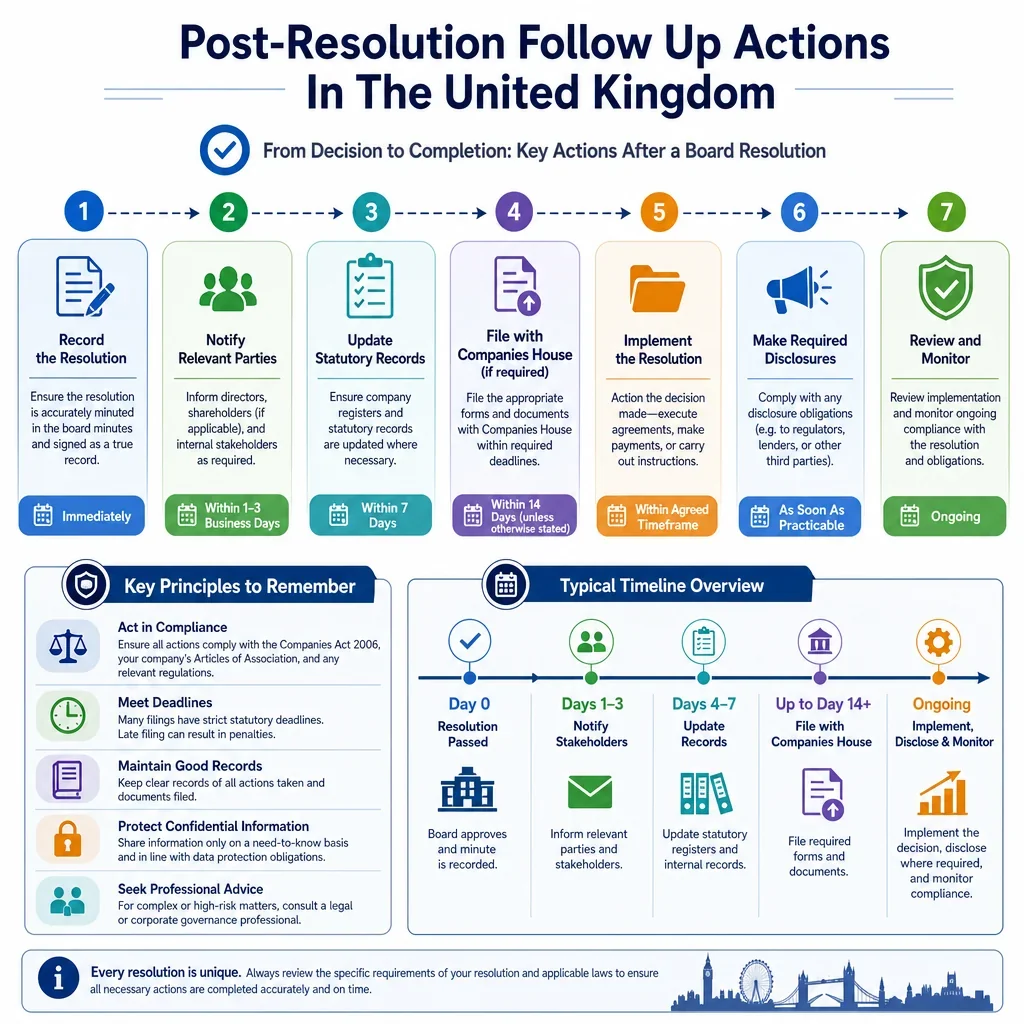
Post-resolution follow up actions in the United Kingdom, covering records, filings, notices, and practical compliance steps.
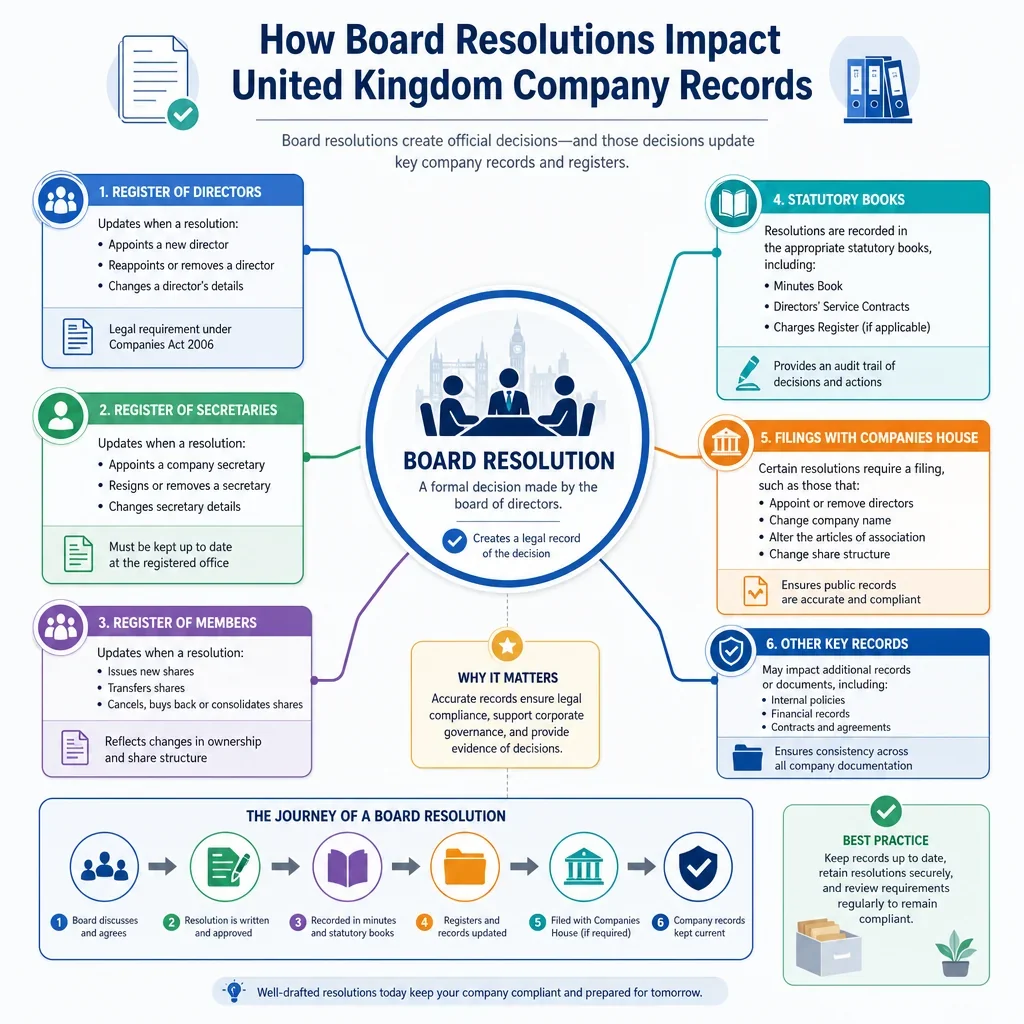
United Kingdom guide to company records affected by board resolutions, helping directors maintain accurate corporate governance documents.
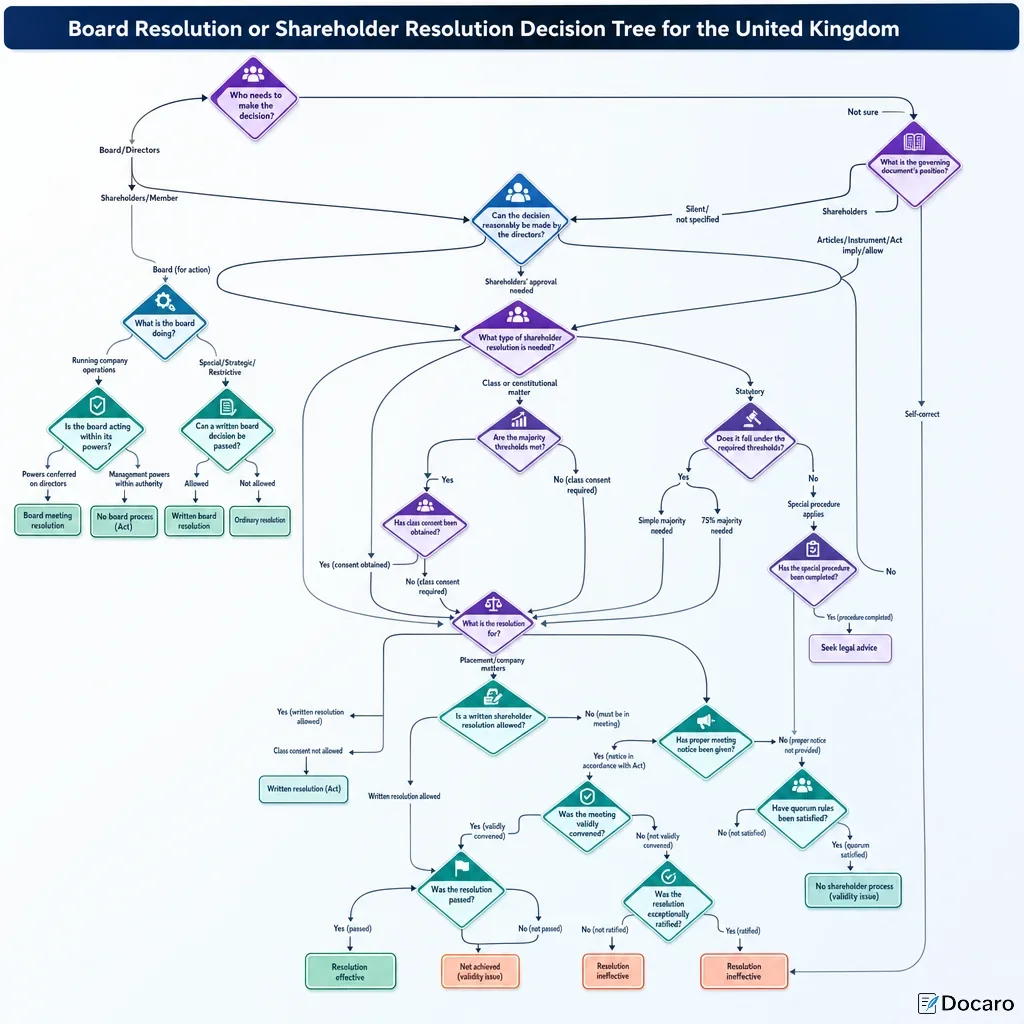
Use this United Kingdom decision tree to decide whether a board or shareholder resolution is needed for common company actions.
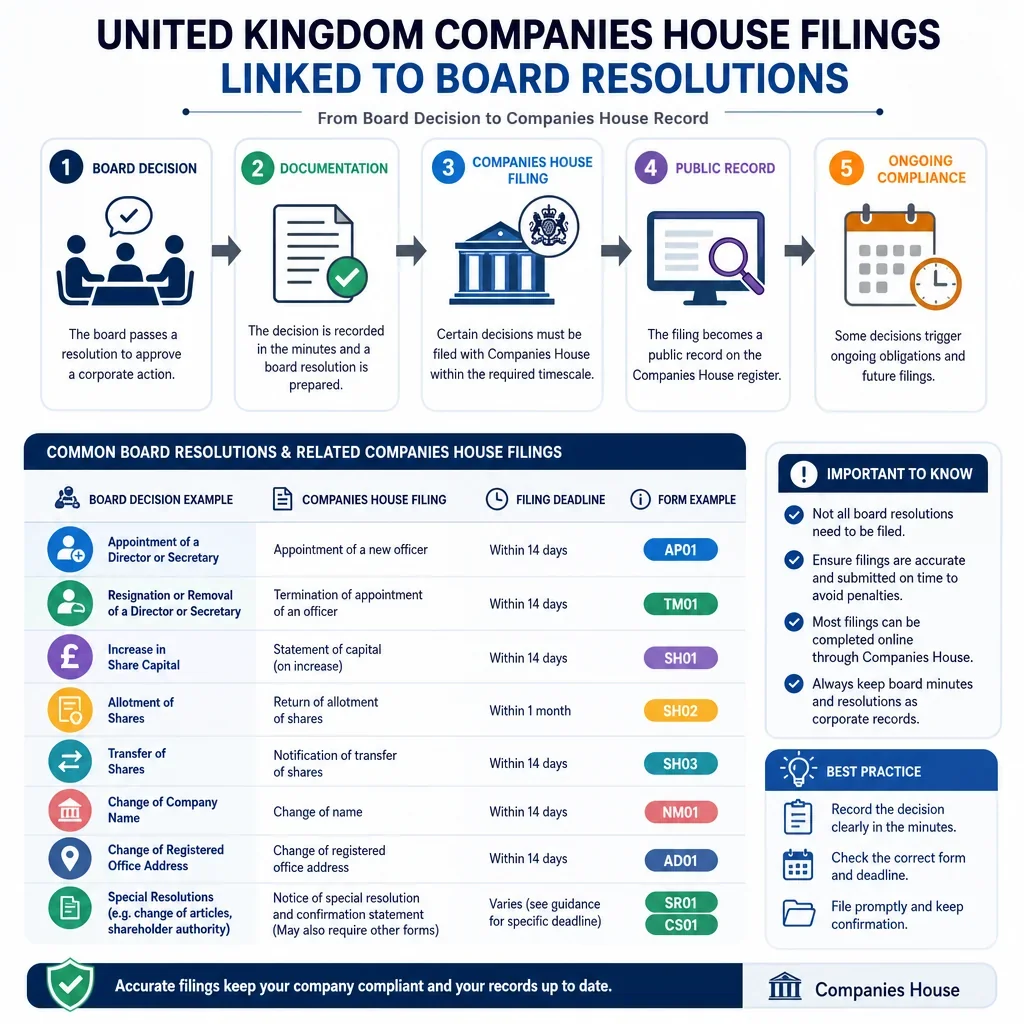
United Kingdom guide linking Companies House filings to board resolutions for clearer corporate compliance and governance records.
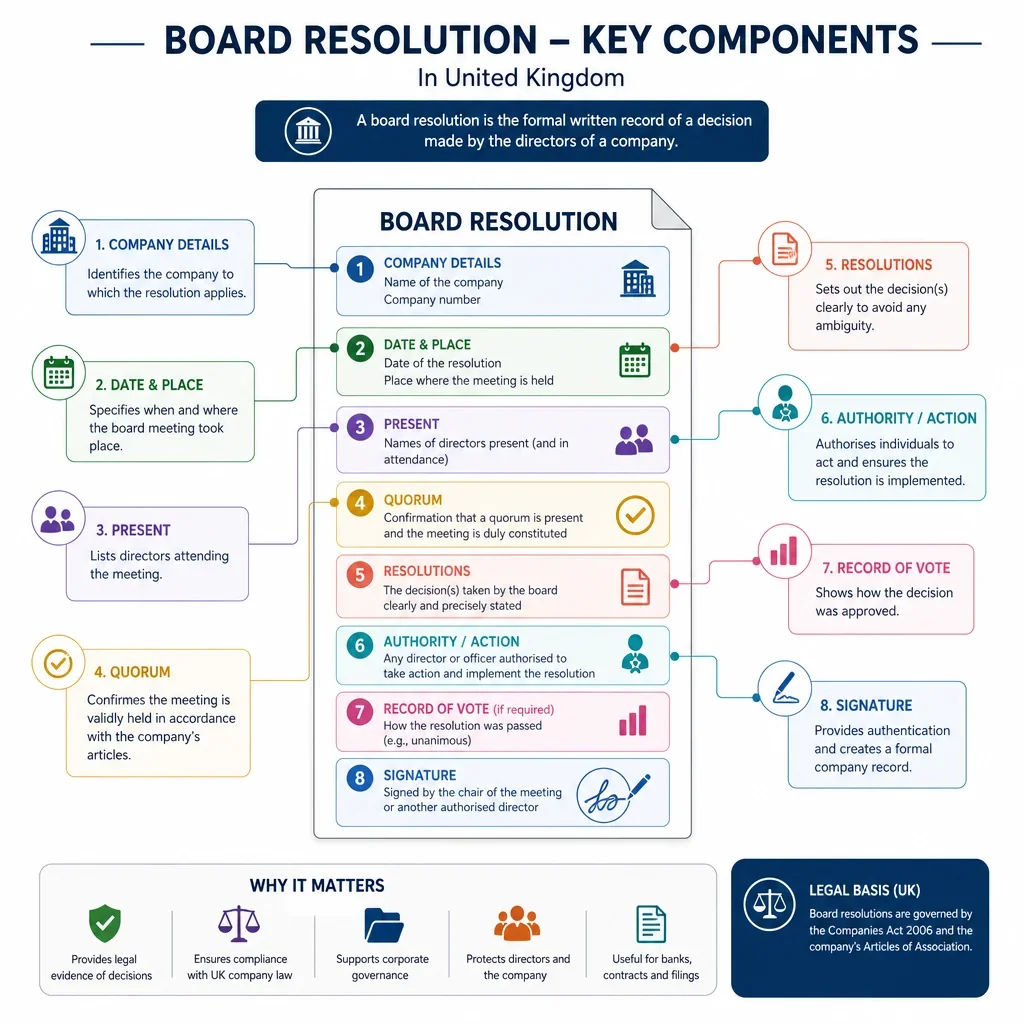
Learn key board resolution drafting components in the United Kingdom for clearer governance, compliance, and efficient corporate decisions.
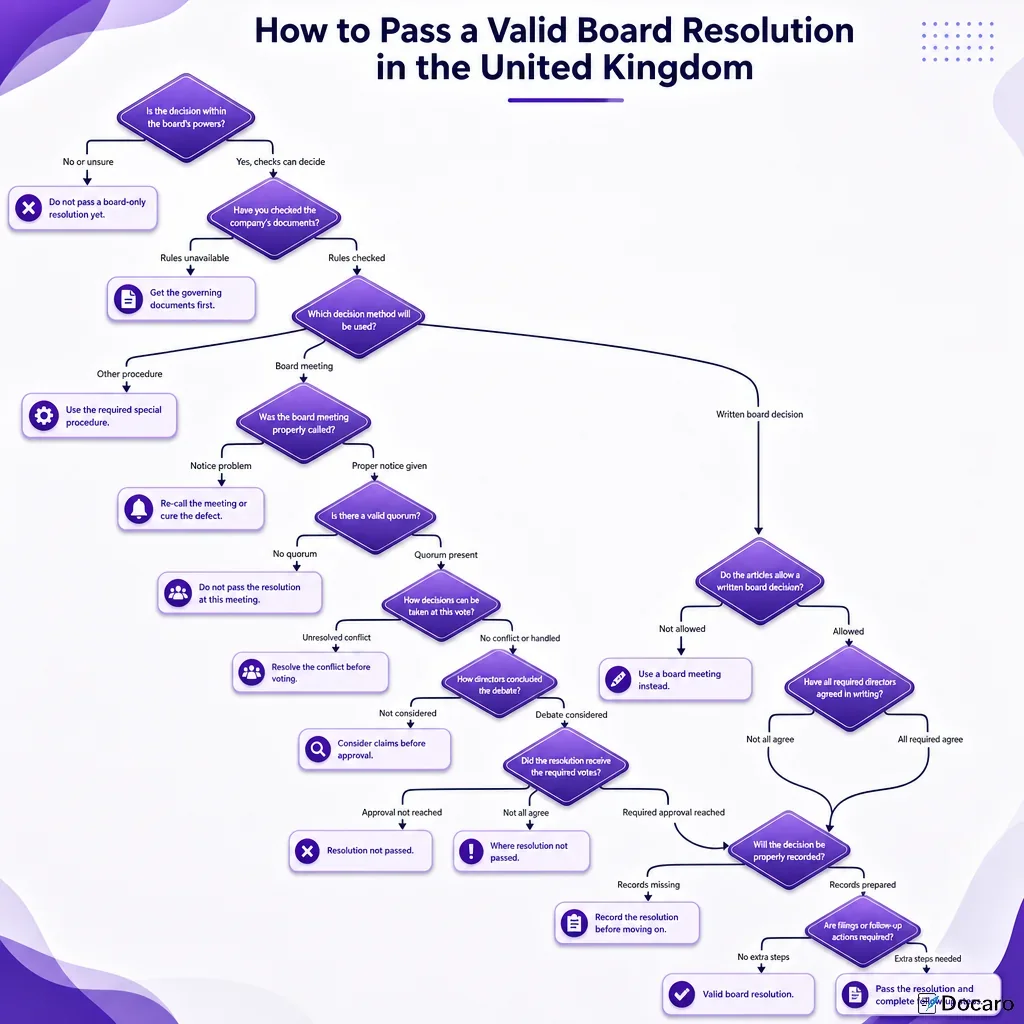
Learn how to pass a valid board resolution in the United Kingdom with clear steps for directors and company compliance.
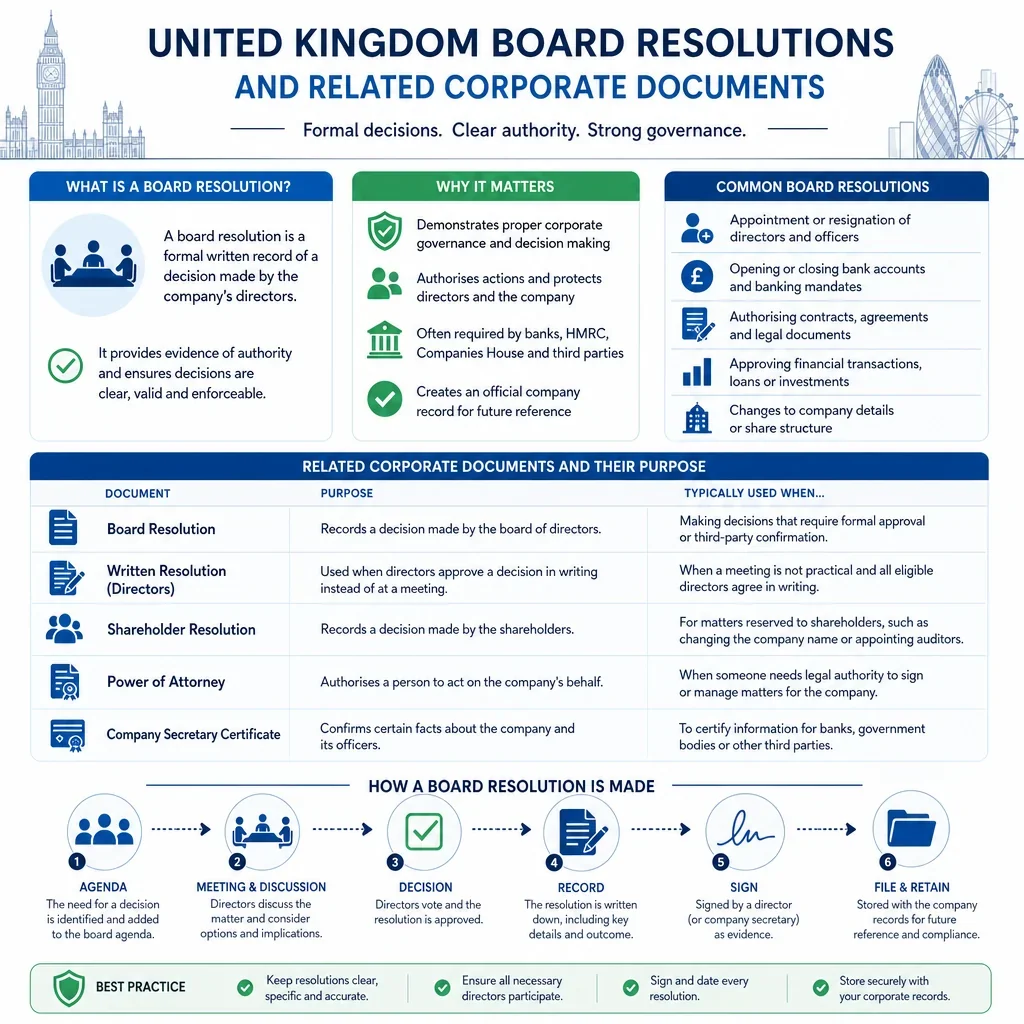
United Kingdom board resolutions and corporate documents for company decisions, records, approvals, and governance workflows.
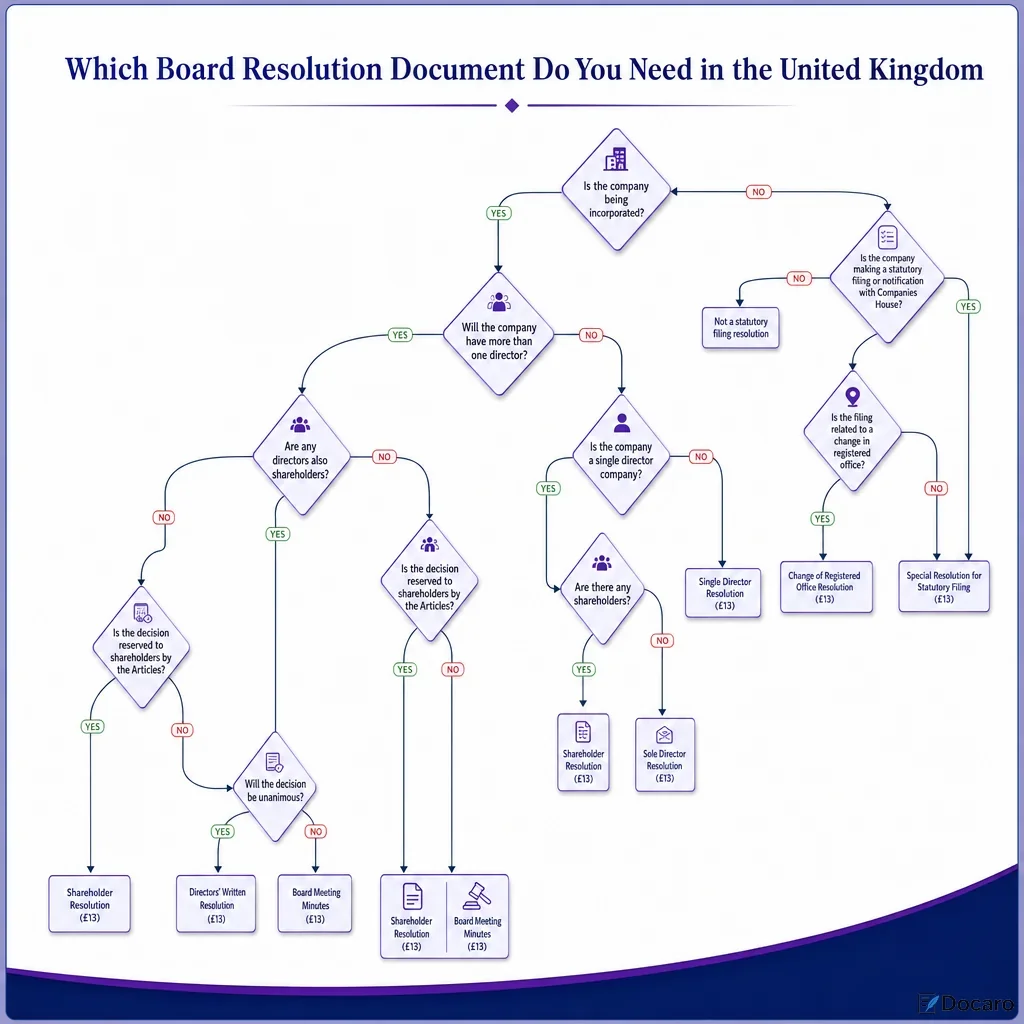
Find the right board resolution document for your United Kingdom company with this quick decision flowchart and guidance.