
AI Generated Whistleblower Policy for use in the United States
PDF & Word - 2026 Updated
Docaro Pricing
When Do You Need a Whistleblower Policy in the United States?
American Legal Rules for a Whistleblower Policy
Using the wrong structure for a whistleblowing procedure can fail to comply with federal protections under laws like the Sarbanes-Oxley Act, exposing the organization to legal risks.
What a Proper Whistleblower Policy Should Include
- Clear Reporting ChannelsProvide easy ways for employees to report concerns, like a hotline or direct contact to management.
- No Retaliation GuaranteeAssure that anyone who reports in good faith will not face punishment or unfair treatment.
- Confidentiality and AnonymityProtect the reporter's identity and keep details private unless disclosure is necessary.
- Fair Investigation ProcessOutline steps to promptly and thoroughly investigate reported issues without bias.
- Scope of Reportable IssuesDefine what can be reported, such as illegal acts, fraud, or violations of company rules.
- Training and AwarenessRequire educating employees on how to use the policy and their rights under it.
- Record-KeepingMaintain secure records of reports and outcomes for accountability and review.
Generate Your Document in 4 Easy Steps
Why Use Docaro?
 United States
Free Example Whistleblower Policy Template
Below is a free template example of a Whistleblower Policy for use in the United States generated by our AI model.
The clauses in your actual Whistleblower Policy will vary from this example as they will be entirely bespoke to your requirements as set out in the questionnaire you complete.
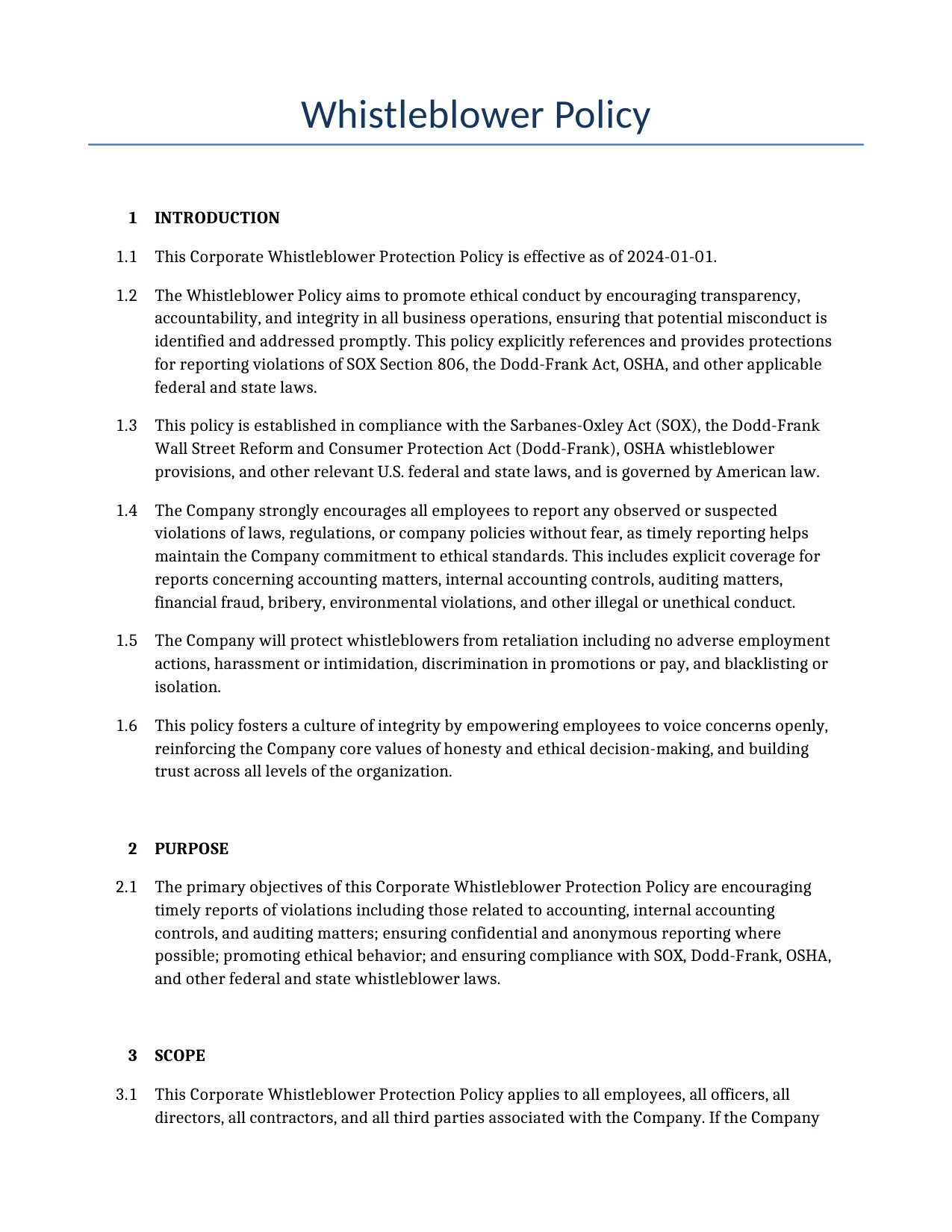
Corporate Whistleblower Protection Policy
1INTRODUCTION
This Corporate Whistleblower Protection Policy is effective as of 2024-01-01.
The Whistleblower Policy aims to promote ethical conduct by encouraging transparency, accountability, and integrity in all business operations, ensuring that potential misconduct is identified and addressed promptly. This policy explicitly references and provides protections for reporting violations of SOX Section 806, the Dodd-Frank Act, OSHA, and other applicable federal and state laws.
This policy is established in compliance with the Sarbanes-Oxley Act (SOX), the Dodd-Frank Wall Street Reform and Consumer Protection Act (Dodd-Frank), OSHA whistleblower provisions, and other relevant U.S. federal and state laws, and is governed by American law.
The Company strongly encourages all employees to report any observed or suspected violations of laws, regulations, or company policies without fear, as timely reporting helps maintain the Company commitment to ethical standards. This includes explicit coverage for reports concerning accounting matters, internal accounting controls, auditing matters, financial fraud, bribery, environmental violations, and other illegal or unethical conduct.
The Company will protect whistleblowers from retaliation including no adverse employment actions, harassment or intimidation, discrimination in promotions or pay, and blacklisting or isolation.
This policy fosters a culture of integrity by empowering employees to voice concerns openly, reinforcing the Company core values of honesty and ethical decision-making, and building trust across all levels of the organization.
2PURPOSE
The primary objectives of this Corporate Whistleblower Protection Policy are encouraging timely reports of violations including those related to accounting, internal accounting controls, and auditing matters; ensuring confidential and anonymous reporting where possible; promoting ethical behavior; and ensuring compliance with SOX, Dodd-Frank, OSHA, and other federal and state whistleblower laws.
3SCOPE
This Corporate Whistleblower Protection Policy applies to all employees, all officers, all directors, all contractors, and all third parties associated with the Company. If the Company operates in multiple states, this policy incorporates applicable state-specific whistleblower protections, such as those under California, New York, or other state laws that may provide additional safeguards.
This policy becomes effective for the defined scope on 2024-01-01.
4DEFINITIONS
For the purposes of this Corporate Whistleblower Protection Policy, good faith means acting honestly and without malice or intent to deceive, based on a reasonable belief that the information provided is accurate. A \“reasonable belief\” exists when the reporter has a subjective belief that the information is true and an objectively reasonable basis for that belief, even if the reported conduct is ultimately unsubstantiated.
For the purposes of this Corporate Whistleblower Protection Policy, retaliation includes any adverse action, such as termination, demotion, or harassment, taken against an individual for engaging in protected whistleblower activities. This includes subtle forms such as isolation, exclusion from meetings, or negative performance reviews motivated by the protected activity.
For the purposes of this Corporate Whistleblower Protection Policy, protected activity refers to reporting suspected violations of law, regulations, or company policies in good faith, without fear of reprisal. This explicitly includes reports of financial fraud, bribery, environmental violations, accounting irregularities, breaches of internal controls, auditing matters, securities violations, and other matters protected under SOX, Dodd-Frank, OSHA, and related laws.
For the purposes of this Corporate Whistleblower Protection Policy, confidentiality means the protection of the identity of the reporter and the details of the report from unauthorized disclosure.
For the purposes of this Corporate Whistleblower Protection Policy, anonymous reporting means the submission of a report without revealing the identity of the reporter. Anonymous reports must still be investigated to the extent possible based on the information provided.
For the purposes of this Corporate Whistleblower Protection Policy, audit committee means the committee of the Board of Directors responsible for overseeing financial reporting, internal controls, and compliance matters including whistleblower reports.
5PROTECTED ACTIVITIES
Reports of illegal conduct qualify as protected activity under this Corporate Whistleblower Protection Policy when made in good faith.
Reports of fraud qualify as protected activity under this Corporate Whistleblower Protection Policy when made in good faith. This includes financial fraud, accounting fraud, and related misconduct.
Reports of securities violations qualify as protected activity under this Corporate Whistleblower Protection Policy when made in good faith.
Reports of discrimination qualify as protected activity under this Corporate Whistleblower Protection Policy when made in good faith.
Reports of harassment qualify as protected activity under this Corporate Whistleblower Protection Policy when made in good faith.
Reports of other unethical behavior qualify as protected activity under this Corporate Whistleblower Protection Policy when made in good faith. Examples include bribery, environmental violations, breaches of internal accounting controls, auditing irregularities, and any matters that the reporter reasonably believes constitute a violation of federal securities laws, shareholder fraud, or other laws protected under SOX Section 806, Dodd-Frank, and OSHA.
6REPORTING PROCEDURES
The Company enables an internal hotline for reporting concerns under this Corporate Whistleblower Protection Policy. The hotline should be independent and, where feasible, managed by a third-party provider to ensure impartiality and compliance with SOX and other regulations.
The Company enables a dedicated email address for reporting concerns under this Corporate Whistleblower Protection Policy.
Employees may report concerns directly to their immediate supervisor or department head under this Corporate Whistleblower Protection Policy. However, if the supervisor is involved, reports should escalate to the Compliance Officer, Audit Committee, or external authorities.
The Company allows anonymous reporting through internal channels under this Corporate Whistleblower Protection Policy.
The Company allows confidential reporting where the reporter identity is kept private unless the reporter chooses otherwise under this Corporate Whistleblower Protection Policy.
Employees should report concerns promptly using the hotline at 1-800-WHISTLE, email whistleblower@company.com, or by speaking to their immediate supervisor. Procedures for external reporting to the SEC, DOL, OSHA, or other agencies are also available and protected.
All reports will be investigated confidentially.
This Corporate Whistleblower Protection Policy includes options for reporting to external regulatory agencies. Whistleblowers have the right to report directly to the SEC, OSHA, DOL, or other authorities without first reporting internally, and such reports are fully protected.
7CONFIDENTIALITY AND ANONYMITY
The Company allows confidential reporting under this Corporate Whistleblower Protection Policy.
The Company allows anonymous submissions under this Corporate Whistleblower Protection Policy.
Anonymous submissions can be made through the hotline or online portal under this Corporate Whistleblower Protection Policy. Such reports will be investigated where possible based on the sufficiency of the information provided.
All confidential reports will be handled with the utmost discretion, sharing information only with individuals directly involved in the investigation and on a need-to-know basis.
Anonymous submissions can be made through designated channels without requiring any personal identifying information, ensuring the reporter identity remains unknown throughout the process.
Limitations on anonymity and confidentiality under this Corporate Whistleblower Protection Policy include legal disclosure and investigation necessity.
Reporters will be protected from retaliation, with all reports kept strictly confidential and anonymous where requested, in compliance with applicable U.S. laws such as the Sarbanes-Oxley Act.
8NON-RETALIATION
The Company provides a general assurance that no adverse action will be taken against individuals who report in good faith under this Corporate Whistleblower Protection Policy. This policy strictly prohibits all forms of retaliation, including overt actions (termination, demotion) and subtle forms (exclusion, altered duties, or negative evaluations).
Prohibited retaliation under this Corporate Whistleblower Protection Policy includes termination of employment, demotion or reduction in responsibilities, and harassment or hostile work environment. Legal remedies for retaliation may include reinstatement, back pay, compensatory damages, attorney fees, and other relief available under SOX, Dodd-Frank, and OSHA. Violations may result in disciplinary action up to termination and potential legal liability for the Company and individuals involved.
For the purposes of this section, good faith reporting means acting with the honest belief that the reported information is true and accurate.
The non-retaliation assurance under this Corporate Whistleblower Protection Policy explicitly covers current employees, former employees, and contractors and vendors. It extends to all protected persons including those who assist or participate in investigations.
9NO RETALIATORY NDAS OR AGREEMENTS
The Company will not enforce, require, or implement any confidentiality agreement, non-disclosure agreement (NDA), arbitration clause, or other contract provision that prevents, impedes, or discourages good-faith whistleblowing reports to government authorities, including the SEC, OSHA, DOL, or Congress. This is in full compliance with SOX Section 806, Dodd-Frank, and related regulations.
Any existing agreements containing such restrictive clauses will not be enforced to the extent they conflict with whistleblower rights. Employees are explicitly permitted to communicate with regulatory agencies regarding possible violations without prior Company approval or notification.
Violations of this section, such as attempting to enforce prohibited NDAs against whistleblowers, may result in disciplinary action for responsible individuals and expose the Company to legal liability, including fines and other penalties under federal law.
This policy does not prohibit legitimate NDAs for protecting trade secrets or other confidential information unrelated to whistleblower reports of legal violations.
10INVESTIGATION PROCESS
The Company will receive and acknowledge the report within three days of receipt.
The Company will assess the report for credibility and potential risks. Investigations will be conducted impartially, with safeguards to avoid conflicts of interest, such as assigning independent investigators or escalating to third parties when necessary.
The Company will assign an investigator and gather relevant evidence and interviews. Timelines will comply with legal standards, with initial assessments completed promptly and full investigations targeted for completion within 60-90 days, depending on complexity.
The Company will conduct a thorough analysis of findings. Complex matters involving accounting, internal controls, or auditing will be escalated to the Audit Committee for oversight.
The Company will prepare a report with recommendations and close the investigation within sixty days of receipt, or as extended with notification to the reporter.
The Compliance Officer is designated as responsible for conducting the investigation under this Corporate Whistleblower Protection Policy.
The Board of Directors will be involved in overseeing the investigation process under this Corporate Whistleblower Protection Policy, particularly for high-level or financial reports.
The reporter will be updated at key milestones, including initial acknowledgment, midway through the investigation, and upon completion, or every thirty days, whichever occurs first.
Updates to the reporter on the investigation progress will be provided by email or phone call.
All updates to the reporter will maintain assurances of confidentiality under this Corporate Whistleblower Protection Policy.
Whistleblowers have the right to access legal counsel at their own expense. The Company will not interfere with or retaliate against whistleblowers for consulting with attorneys regarding their rights or reports.
11FALSE REPORTS
Good faith reports are protected even if they are unsubstantiated under this Corporate Whistleblower Protection Policy.
The Company will impose a written warning or termination of employment on employees who knowingly make false or malicious reports. Disciplinary actions for bad-faith reports will not chill or deter good-faith whistleblowing; only knowingly false reports are subject to discipline.
The Company explicitly protects reports of fraud, reports of harassment, and reports of safety violations made in good faith under this Corporate Whistleblower Protection Policy.
12PROTECTIONS UNDER LAW
This Corporate Whistleblower Protection Policy includes a summary of protections under the SEC Whistleblower Program, including anti-retaliation provisions and the right to financial rewards.
This Corporate Whistleblower Protection Policy includes a summary of protections under OSHA, which enforces whistleblower provisions for various federal laws including environmental, safety, and securities-related matters.
This Corporate Whistleblower Protection Policy emphasizes the rights to remedies for violations of whistleblower protections under American law, such as reinstatement with the same seniority, back pay with interest, compensatory damages, and attorney fees. Enforcement may be pursued through the DOL, SEC, or federal courts as provided by SOX, Dodd-Frank, and OSHA.
13REWARDS AND INCENTIVES
Eligible whistleblowers may receive monetary awards under the SEC Whistleblower Program for providing original information that leads to successful SEC enforcement actions resulting in monetary sanctions exceeding $1 million.
Under provisions of the Dodd-Frank Act, awards typically range from 10% to 30% of the monetary sanctions collected. The exact percentage is determined by the SEC based on factors such as the significance of the information, the degree of assistance provided, and the law enforcement interest in the matter.
The Company does not interfere with, discourage, or impede any individual\’s right to seek or receive such financial rewards or bounties. This policy supports full compliance with Dodd-Frank by affirming that whistleblowers retain all rights to apply directly to the SEC for awards.
Awards are determined solely by the SEC and are not guaranteed. The Company makes no representations regarding the likelihood or amount of any award. For more information, refer to the SEC Office of the Whistleblower.
14TRAINING AND AWARENESS
The Company requires annual training for all employees on this Corporate Whistleblower Protection Policy. Training will include specifics on anti-retaliation measures, legal rights under SOX, Dodd-Frank, and OSHA, and the importance of non-retaliatory practices.
The Company requires mandatory training on this Corporate Whistleblower Protection Policy as part of the onboarding process for new hires.
The Company will deliver the Whistleblower Policy training through online modules and webinars.
The Whistleblower Policy training content will include an overview of the policy, how to report concerns confidentially, protection against retaliation, real-world examples of whistleblowing scenarios (including financial fraud, bribery, and environmental issues), whistleblower legal rights, and the prohibition on retaliatory NDAs.
The Company will establish a regular communication plan to promote ongoing awareness of this Corporate Whistleblower Protection Policy.
The Company will promote awareness of this Corporate Whistleblower Protection Policy through the company intranet, email newsletters, and town hall meetings.
The Company will make available to employees a dedicated policy handbook, FAQ section on the company intranet, contact information for the compliance officer, and links to external whistleblower protection resources from the SEC.
15RECORDKEEPING
The Compliance Department is responsible for maintaining the records of reports and investigations under this Corporate Whistleblower Protection Policy.
The Company requires documentation for anonymous reports, identified reports, verbal reports, and written reports under this Corporate Whistleblower Protection Policy.
The Company will document reports and investigations in digital records stored in a secure electronic database with timestamps and audit trails.
All records must be stored in a secure, access-controlled system under this Corporate Whistleblower Protection Policy. Recordkeeping will comply with data privacy laws such as the CCPA (if applicable in California operations), GDPR (for international aspects), and other relevant regulations, including appropriate data minimization and deletion schedules.
The minimum retention period for whistleblower records is seven years from the date of receipt of the report, or longer as required by law.
Access to records shall be limited to authorized personnel on a need-to-know basis, with prior approval from the Chief Compliance Officer.
16BOARD OVERSIGHT AND AUDIT COMMITTEE ROLE
As required by SOX Section 301 and related rules, the Audit Committee of the Board of Directors shall oversee the Company\’s whistleblower program. This includes receiving and reviewing reports of accounting, internal accounting controls, auditing, or other financial matters directly from whistleblowers.
Whistleblowers may report directly to the Audit Committee, bypassing management if necessary. The Audit Committee will ensure independent investigation of such matters and report findings to the full Board as appropriate.
The Board of Directors is responsible for ensuring overall compliance with this policy, including periodic reviews and addressing any systemic issues identified through whistleblower reports.
The Audit Committee may engage independent counsel or advisors as needed to fulfill its oversight responsibilities without interference from management.
17POLICY REVIEW AND UPDATES
This Corporate Whistleblower Protection Policy will be reviewed every two years.
The next scheduled review of this Corporate Whistleblower Protection Policy is 2025-12-31.
The Compliance Officer is responsible for conducting the periodic review of this Corporate Whistleblower Protection Policy.
Employees will be notified of any updates made to this Corporate Whistleblower Protection Policy.
Updates will be drafted by the Compliance Officer, reviewed by the Legal Department, and approved by the Board of Directors via a majority vote.
Amendments to this Corporate Whistleblower Protection Policy may be triggered by periodic scheduled review, changes in applicable laws, or feedback from whistleblower reports.
18CONTACT INFORMATION
For questions regarding this Corporate Whistleblower Protection Policy, contact the ethics officer Dr. Jane Smith at jane.smith@company.com or (555) 123-4567, or the Chief Compliance Officer at compliance@company.com or (555) 987-6543. Multiple points of contact are provided to facilitate reporting.
Anonymous reporting is allowed through the contact channels under this Corporate Whistleblower Protection Policy.
Available contact methods under this Corporate Whistleblower Protection Policy include email, phone hotline, and online portal. External agency contacts include: SEC Office of the Whistleblower (whistleblower@sec.gov or 202-551-4790), OSHA Whistleblower Protection (www.whistleblowers.gov), and DOL (for SOX complaints).
19ACKNOWLEDGMENT
All employees must acknowledge receipt and confirm their understanding of this Corporate Whistleblower Protection Policy through electronic signature. This policy does not create any contractual rights or alter the at-will employment relationship where applicable.
20SIGNATURE
By signing below, the employee acknowledges that the employee has received, read, and understood this Corporate Whistleblower Protection Policy and agrees to abide by its terms.
Employee Name: _______________________________
Employee Signature: _______________________________ Date: ________________
On behalf of the Company: _______________________________ Date: ________________
21DISCLAIMERS
This policy is intended to provide guidance and promote compliance with applicable laws but does not create any contractual rights, guarantees, or entitlements for employees or other persons. It does not alter the at-will nature of employment where applicable.
The Company reserves the right to modify, amend, or discontinue this policy at any time, with or without notice, to the extent permitted by law.
This example shows approximately 70% of a typical document and is provided for illustrative purposes only. The remaining content has been omitted.
Every document generated by Docaro is tailored to your specific circumstances, jurisdiction and the information you provide. The completed document includes all applicable clauses and provisions required for your situation.
To generate the full, personalised document, answer a short series of questions and your document will be created instantly.