
AI Generated Remote Work and Hybrid Work Policy for use in the United States
PDF & Word - 2026 Updated
Docaro Pricing
When Do You Need a Remote Work and Hybrid Work Policy in the United States?
American Legal Rules for a Remote Work and Hybrid Work Policy
Using the wrong structure for a remote or hybrid work policy can inadvertently create unenforceable terms or compliance risks under U.S. labor laws.
What a Proper Remote Work and Hybrid Work Policy Should Include
- Eligibility CriteriaDefine who qualifies for remote or hybrid work based on role, performance, and location.
- Work Schedule and HoursSpecify expected work hours, including core hours for collaboration and flexibility options.
- Communication GuidelinesOutline tools and methods for staying connected, such as email, video calls, and regular check-ins.
- Equipment and ResourcesDetail company-provided tools, reimbursement for home setups, and maintenance responsibilities.
- Data Security and PrivacyExplain rules for protecting company information and personal data while working remotely.
- Performance ExpectationsSet clear goals and metrics to measure productivity regardless of work location.
- Health and Safety MeasuresRequire a safe home workspace and compliance with any applicable health guidelines.
- Expense ReimbursementsCover costs like internet, phone, or travel for hybrid arrangements.
- Training and SupportProvide resources and onboarding to help employees succeed in remote or hybrid roles.
- Policy Review and ChangesState how the policy can be updated and the process for employee feedback.
Generate Your Document in 4 Easy Steps
Why Use Docaro?
 United States
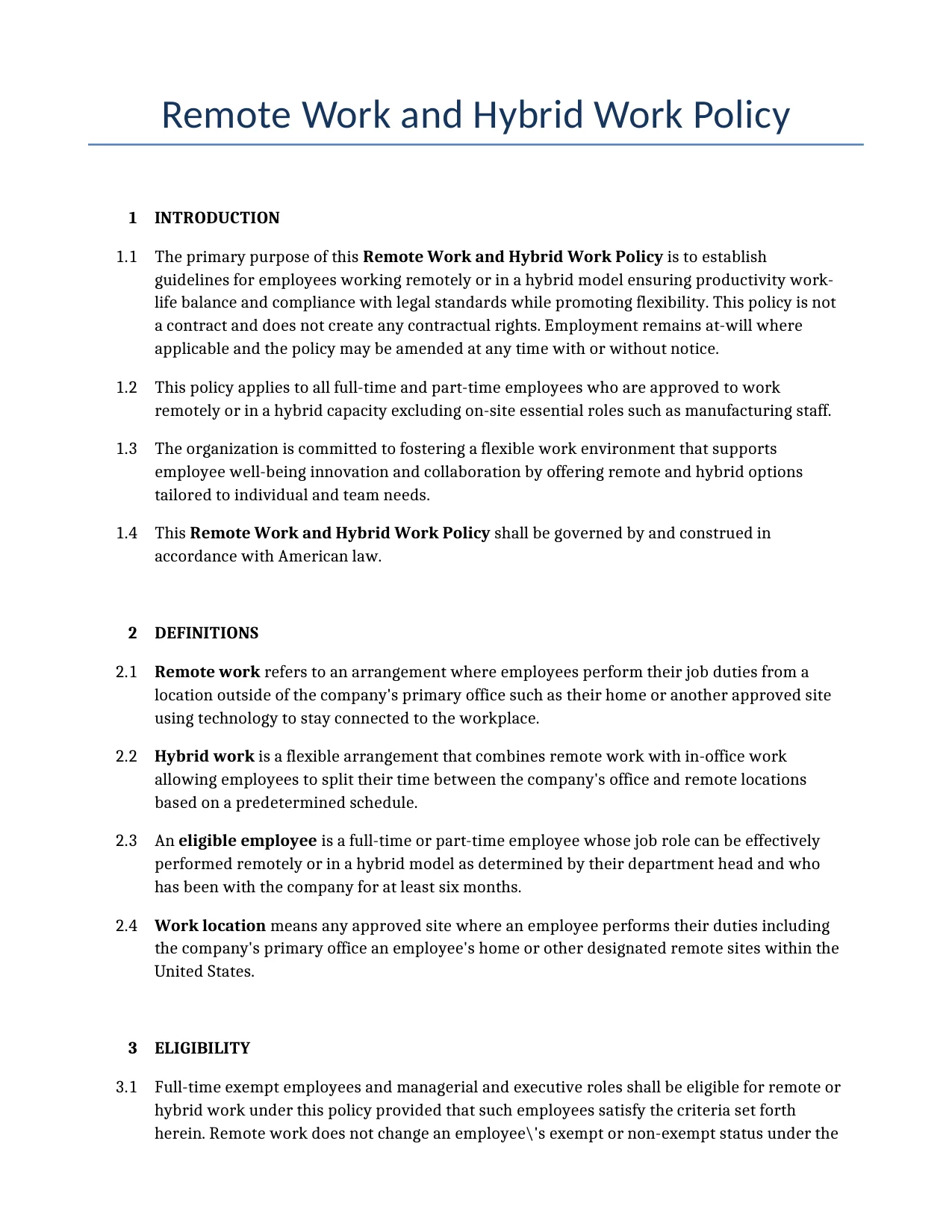
Free Example Remote Work and Hybrid Work Policy Template
Below is a free template example of a Remote Work and Hybrid Work Policy for use in the United States generated by our AI model.
The clauses in your actual Remote Work and Hybrid Work Policy will vary from this example as they will be entirely bespoke to your requirements as set out in the questionnaire you complete.
Remote Work and Hybrid Work Policy
1INTRODUCTION
The primary purpose of this Remote Work and Hybrid Work Policy is to establish guidelines for employees working remotely or in a hybrid model ensuring productivity work-life balance and compliance with legal standards while promoting flexibility. This policy is not a contract and does not create any contractual rights. Employment remains at-will where applicable and the policy may be amended at any time with or without notice.
This policy applies to all full-time and part-time employees who are approved to work remotely or in a hybrid capacity excluding on-site essential roles such as manufacturing staff.
The organization is committed to fostering a flexible work environment that supports employee well-being innovation and collaboration by offering remote and hybrid options tailored to individual and team needs.
This Remote Work and Hybrid Work Policy shall be governed by and construed in accordance with American law.
2DEFINITIONS
Remote work refers to an arrangement where employees perform their job duties from a location outside of the company's primary office such as their home or another approved site using technology to stay connected to the workplace.
Hybrid work is a flexible arrangement that combines remote work with in-office work allowing employees to split their time between the company's office and remote locations based on a predetermined schedule.
An eligible employee is a full-time or part-time employee whose job role can be effectively performed remotely or in a hybrid model as determined by their department head and who has been with the company for at least six months.
Work location means any approved site where an employee performs their duties including the company's primary office an employee's home or other designated remote sites within the United States.
3ELIGIBILITY
Full-time exempt employees and managerial and executive roles shall be eligible for remote or hybrid work under this policy provided that such employees satisfy the criteria set forth herein. Remote work does not change an employee\'s exempt or non-exempt status under the FLSA. Non-exempt employees must accurately track all hours worked to ensure proper overtime pay.
Knowledge workers management and executive positions shall be eligible for remote or hybrid work arrangements if the employee\'s job role can be effectively performed in such a manner.
To qualify as an eligible employee the employee must maintain a satisfactory performance rating have no disciplinary actions pending or in effect and achieve key metrics as established by the company.
An eligible employee must reside within a geographic area that permits reliable performance of job duties and must have access to reliable technology sufficient to meet the requirements of the employee\'s role. State-specific variations may apply for employees in New York or California.
Managerial approval shall be required for all remote or hybrid work arrangements before such arrangements may commence.
A trial period of ninety days shall be implemented for all new remote or hybrid arrangements to assess the suitability of the arrangement for both the employee and the company.
The eligibility criteria set forth in this section shall become effective on January 1 2024.
4TYPES OF WORK ARRANGEMENTS
Fully remote work arrangements shall be allowed for eligible employees who satisfy all requirements of this policy.
Hybrid work schedules shall be allowed whereby eligible employees split their time between remote and in-office work according to a predetermined schedule approved by the company.
Temporary remote work shall be allowed for short-term situations such as travel or personal circumstances provided that such arrangements are approved in advance by the employee\'s manager.
The provisions of this section shall become effective on January 1 2024.
5APPLICATION AND APPROVAL PROCESS
Employees seeking remote or hybrid work arrangements shall complete the Remote Work Application Form and submit it via email to the employee\'s direct supervisor at least thirty days in advance of the proposed start date.
Managers shall conduct an initial review of all remote or hybrid work applications before such applications proceed to the Human Resources Department.
The manager and the Human Resources Department shall be involved in the final approval of remote or hybrid work applications and the Human Resources Department shall have authority to approve such requests.
Approvals or denials of remote or hybrid work applications shall be communicated to employees by email from the Human Resources Department with a formal letter attached within seven days after the decision is made.
An appeal process shall be available for employees whose remote or hybrid work applications are denied and such appeals shall be submitted in writing to the Human Resources Department within ten days of receipt of the denial.
The application and approval process set forth in this section shall become effective on January 1 2024.
6WORK SCHEDULES AND EXPECTATIONS
Core hours shall be defined as 10:00 AM to 3:00 PM Pacific Time Monday through Friday during which all employees are expected to be available for meetings and collaboration. Non-exempt employees must accurately track all hours worked including any overtime for compliance with the FLSA. Remote work does not change an employee\'s exempt status.
Flexibility in employees\' work schedules shall be allowed outside of core hours provided that all work is completed in accordance with the employee\'s obligations under this policy and applicable law including the Fair Labor Standards Act. State-specific rules such as meal and rest breaks in California and New York apply.
Employees shall provide mandatory virtual attendance for all team meetings on-site attendance for specific roles or events and advance notice of three days for any absences or schedule changes.
Employees are expected to be available and responsive via email chat and video calls during core hours with limited interruptions for personal matters unless pre-approved and employees shall respond to communications within one hour during such hours.
No expectations shall be set for employee availability outside of standard work hours except as required by law or in cases of emergency.
7WORK EQUIPMENT AND RESOURCES
The company shall provide equipment to employees for remote or hybrid work and shall reimburse employees for the reasonable use of personal equipment in accordance with company procedures. This includes compliance with state laws such as California\'s requirements for necessary business expenses.
The company shall provide software licenses to employees for remote or hybrid work and shall reimburse employees for home internet access used in connection with such work provided that employees maintain a minimum internet speed of twenty-five megabits per second.
The company shall be responsible for the maintenance and repairs of all company-provided equipment.
The provisions of this section shall become effective on January 1 2024.
8HOME OFFICE SETUP AND SAFETY
Employees shall use an ergonomic chair an adjustable desk and proper lighting in their home office setup and shall conduct home office hazard assessments annually.
Employees shall have basic emergency equipment such as a fire extinguisher in their home office.
The company shall provide ergonomic training to employees through online modules and video tutorials.
The home office setup guidelines set forth in this section shall take effect on January 1 2024.
All home office setups shall comply with the Occupational Safety and Health Act and the company shall assist employees in meeting these standards where required.
While OSHA does not generally inspect home offices the company encourages safe ergonomic setups. The company provides resources on ergonomics to minimize injury risks. Employees must report any work-related injuries immediately. The company will investigate and record such injuries as required by law. The company\'s liability is limited to work-related incidents properly reported and documented.
9DATA SECURITY AND CONFIDENTIALITY
Employees shall use secure connections such as virtual private networks when accessing company data remotely and shall employ multi-factor authentication for all company accounts accessed remotely.
Employees shall not use public Wi-Fi for handling confidential company information and shall handle confidential information only through encryption secure file sharing and device screen lock protocols.
Employees shall complete regular cybersecurity training and shall use only company-issued devices for remote access to company data with passwords of at least twelve characters in length.
Company data shall be classified into three levels: public non-sensitive information internal general business data and confidential sensitive information such as financials customer data or proprietary information and employees must identify and label data accordingly before remote access.
Employees shall immediately report any suspected data security incidents to the Information Technology Department.
10COMMUNICATION AND COLLABORATION
The company shall approve the use of Slack Microsoft Teams and email such as Outlook for employee communication in remote and hybrid work arrangements.
Mandatory response times for communications during business hours shall be established consistent with the responsiveness standards set forth in Section 6 of this policy.
Zoom and Microsoft Teams shall be designated as the virtual meeting platforms for official use and employees shall be required to attend all scheduled virtual team meetings.
Microsoft 365 and Asana or Trello shall be approved for team projects and file sharing.
The provisions of this section shall become effective on January 1 2024.
11PERFORMANCE MANAGEMENT
Performance shall be evaluated based on productivity adherence to deadlines quality of deliverables and effective communication with equal emphasis on outcomes rather than physical presence.
Specific metrics including project completion rate quality of work output and communication effectiveness shall be used for performance evaluation in remote and hybrid roles.
Regular check-ins shall be conducted bi-weekly in the format of virtual one-on-one video calls via Zoom supplemented by asynchronous updates through shared project management tools.
Formal feedback mechanisms including one-on-one meetings anonymous surveys and performance review software shall be implemented for remote and hybrid employees.
Goals shall be set collaboratively at the start of each quarter using the SMART framework with progress reviewed during bi-weekly check-ins and adjusted as needed.
Performance standards may be adjusted to account for remote work challenges provided that such adjustments are approved by the employee\'s manager and the Human Resources Department.
12COMPENSATION AND BENEFITS
Compensation for employees shall remain the same regardless of whether the employee is working remotely in a hybrid arrangement or on-site except that adjustments shall be made based on cost of living differences in the employee\'s work location. This does not alter FLSA obligations for non-exempt employees to track hours for overtime.
The benefits package shall be the same for remote and hybrid employees as for on-site employees.
The company shall establish a policy for reimbursing work-related expenses for remote and hybrid employees including technology and software as well as office supplies and equipment.
The company shall pay overtime to eligible employees working remotely or in a hybrid setup in accordance with the Fair Labor Standards Act.
The provisions of this section shall become effective on January 1 2024.
13EXPENSE REIMBURSEMENT
The company will reimburse employees for all necessary and reasonable business expenses incurred in the course of remote or hybrid work in compliance with federal law and state-specific requirements including California Labor Code Section 2802 which requires reimbursement of all reasonable and necessary expenses.
Reimbursable items may include but are not limited to a portion of home internet utilities office supplies cell phone usage and ergonomic equipment subject to approval and documentation.
Employees must submit expense claims with supporting receipts via the company\'s expense portal within 30 days of incurring the expense. Reimbursements will be processed within 30 days of approval in accordance with IRS accountable plan rules to ensure tax-free treatment.
Failure to comply with reimbursement procedures may result in denial of claims and disciplinary action. Employees in states like California and New York should be aware of additional protections under state law.
14COMPLIANCE WITH LAWS AND REGULATIONS
The company primarily conducts its operations in California and this Remote Work and Hybrid Work Policy shall comply with the California Labor Code Section 925 the New York Wage Theft Prevention Act where applicable and all other applicable federal state and local laws including the Fair Labor Standards Act the Occupational Safety and Health Act the Americans with Disabilities Act the Family and Medical Leave Act Equal Employment Opportunity Laws under Title VII of the Civil Rights Act and the Worker Adjustment and Retraining Notification Act.
The company shall maintain workers\' compensation coverage for employees injured while working remotely or in hybrid setups.
This policy discloses that employees working remotely across state lines may face tax implications and employees are encouraged to consult with a tax professional regarding such matters.
Managers overseeing remote or hybrid employees shall complete annual mandatory anti-discrimination training.
The company shall ensure compliance with state-specific meal and rest break requirements for remote workers in accordance with applicable law.
The remote and hybrid work policy shall become effective on January 1 2024 with all compliance measures in place.
For ADA accommodations in remote or hybrid settings employees may request modifications such as adjusted schedules or equipment. The company will engage in an interactive process to determine reasonable accommodations without undue hardship.
Non-exempt employees in California must receive a 30-minute unpaid meal break for shifts over 5 hours and 10-minute paid rest breaks for every 4 hours worked. Similar rules apply in other states as required by law.
The company may electronically monitor remote work activities and provides this notice in compliance with state laws such as those in Delaware and Connecticut requiring disclosure of monitoring practices.
Under the CCPA and similar state privacy laws this policy serves as notice that the company collects data on remote work activities including login times productivity metrics and location data where applicable. Employees have rights to access delete or opt-out of sales of personal information as outlined in the company privacy policy.
This policy does not alter the at-will nature of employment in applicable states. Nothing in this policy creates a contract of employment for any specific duration or limits the company\'s or employee\'s right to terminate the relationship at any time with or without cause.
15TAX AND MULTI-STATE COMPLIANCE
Income tax withholding will be based on the employee\'s primary work location. If an employee works across state lines they may create tax obligations in multiple states.
Employees must notify the company in writing of any changes to their work location or residence at least 30 days in advance. Failure to notify may result in inaccurate tax withholding and potential penalties.
The company will handle unemployment insurance and other payroll taxes based on applicable state laws where the employee performs work. For multi-state workers this may involve apportionment of taxes among states.
Employees are strongly recommended to seek independent tax advice from a qualified professional regarding their personal tax situation including potential credits deductions or liabilities arising from remote work.
16EMPLOYEE RESPONSIBILITIES
Employees shall maintain productivity levels equivalent to in-office work and shall promptly report any technical or work-related issues encountered during remote or hybrid work via email to their supervisor or the dedicated IT helpdesk.
Employees shall adhere to all company policies while working remotely or in a hybrid setup and shall use company resources properly and only for business purposes with no personal use allowed and no sharing of resources permitted.
Employees shall work eight hours per day in accordance with their approved schedule and applicable law.
17MANAGER RESPONSIBILITIES
Managers shall complete training on remote work management covering remote communication skills performance monitoring techniques and inclusive environment strategies and such training shall be completed annually and whenever significant policy updates occur.
Managers shall monitor the performance of remote and hybrid team members through regular check-in meetings and output-based metrics.
Managers shall actively foster an inclusive environment for remote and hybrid teams by implementing regular virtual team-building activities ensuring equitable access to communication tools and conducting bias awareness sessions to promote diversity and inclusion.
18TRAINING AND SUPPORT
A mandatory onboarding program shall be provided for employees transitioning to remote or hybrid work and such program shall include virtual orientation sessions on company culture setup of remote work tools and a checklist for home office ergonomics.
Ongoing training programs on tools and best practices shall be provided quarterly and shall cover cybersecurity best practices time management in remote settings effective virtual communication and work-life balance strategies.
An online portal a dedicated support email and a mentorship program shall be provided as resources to employees and managers for remote or hybrid work transitions.
The training and support programs set forth in this section shall be implemented on January 1 2024.
19MONITORING AND TRACKING
Work hours shall be tracked through self-reporting via timesheets and calendar integration without invasive surveillance. Non-exempt employees must track hours accurately to comply with FLSA overtime requirements. Remote work does not change exempt or non-exempt classifications.
Productivity shall be tracked through output-based metrics and compliance with remote work policies shall be tracked through periodic reviews of adherence to this policy. State variations for New York and California employees include additional wage and hour considerations.
Employees\' personal data and non-work activities shall not be monitored and all tracking tools shall be limited to work-related metrics only with data access restricted to authorized Human Resources personnel and regular audits shall ensure compliance with privacy laws.
20RETURN TO OFFICE PROCEDURES
Employees must provide at least fourteen days\' advance notice before transitioning from remote or hybrid work to full on-site work.
The company may revoke remote or hybrid work arrangements for performance issues business needs or misuse of policy and shall provide written notice of revocation at least thirty days in advance including the specific reason and effective date with an opportunity for the employee to discuss the decision with their manager.
An appeal process shall be available for employees regarding return to office decisions and such appeals shall be submitted in writing to the Human Resources Department.
Employee-initiated changes to remote or hybrid arrangements must be submitted in writing to the Human Resources Department and approved by the employee\'s supervisor with reviews conducted quarterly or as business needs allow.
Employees may voluntarily withdraw from their remote work arrangement by providing two weeks\' notice.
Notifications regarding return to office transitions shall be provided by email and through the company portal.
The provisions of this section shall become effective on January 1 2024.
21TERMINATION OF REMOTE WORK AGREEMENT
The remote work agreement may be terminated due to performance issues including failure to meet productivity targets repeated missed deadlines or consistent failure to communicate effectively with the team.
Performance reviews shall be conducted quarterly to assess compliance with performance criteria.
The employer may terminate the remote work agreement due to business needs and shall provide thirty days\' notice of such termination.
The provisions of this section shall become effective on January 1 2024.
22GRIEVANCE AND DISPUTE RESOLUTION
A formal grievance procedure shall be available for addressing concerns related to remote or hybrid work policies and employees shall initially contact an Human Resources Representative by submitting a grievance via email to the Human Resources Department or through the company\'s internal online portal.
The company shall acknowledge receipt of a grievance within five days and the Human Resources Department shall investigate the grievance and complete the investigation within thirty days.
All grievances shall be handled with confidentiality and employees shall be notified of grievance resolutions in writing via email with a follow-up meeting if requested.
An internal appeal option shall be available for unresolved grievances.
Retaliation against employees who file grievances related to remote or hybrid work policies is strictly prohibited.
The provisions of this section shall become effective on January 1 2024.
23REVIEW AND UPDATES
This Remote Work and Hybrid Work Policy shall be reviewed annually by the Human Resources Director and Legal Counsel with the next review scheduled for January 15 2025.
Policy updates may be initiated outside of the regular review schedule by changes in federal or state laws technological advancements or employee feedback or incidents and any such updates shall require approval from senior management.
24ACKNOWLEDGMENT AND AGREEMENT
By signing below the employee acknowledges receipt of the Remote Work and Hybrid Work Policy understands its terms and agrees to comply with all terms of the policy. This policy is not a contract does not create any contractual rights and does not alter the at-will nature of employment where applicable. The company may amend this policy at any time with or without notice.
The employee shall provide acknowledgment and agreement through electronic signature or checkbox confirmation.
This Remote Work and Hybrid Work Policy shall be effective as of January 1 2024.
25SIGNATURE SECTION
Employee Name: _______________________________
Employee Signature: _______________________________ Date: _______________
On behalf of the Company: _______________________________
Company Representative Signature: _______________________________ Date: _______________
This example shows approximately 70% of a typical document and is provided for illustrative purposes only. The remaining content has been omitted.
Every document generated by Docaro is tailored to your specific circumstances, jurisdiction and the information you provide. The completed document includes all applicable clauses and provisions required for your situation.
To generate the full, personalised document, answer a short series of questions and your document will be created instantly.