
AI Generated American Shareholders' Agreement
PDF & Word - 2026 Updated
Docaro Pricing
When Do You Need a Shareholders' Agreement in the United States?
American Legal Rules for a Shareholders' Agreement
Using the wrong type of shareholders' agreement can expose the company to unintended governance risks or disputes among owners.
What a Proper Shareholders' Agreement Should Include
- Company OwnershipClearly states the number of shares each shareholder owns and how ownership can change.
- Decision-Making RulesOutlines how major business decisions are voted on and what majority is needed.
- Adding New ShareholdersDescribes the process for bringing in new owners and how existing shares are handled.
- Selling SharesSets rules for when and how shareholders can sell their shares, including who can buy them.
- Handling DisputesProvides steps to resolve disagreements between shareholders fairly.
- Protecting Minority OwnersIncludes safeguards so shareholders with fewer shares aren't overpowered.
- What Happens if a Shareholder LeavesExplains how shares are managed if someone dies, quits, or is removed.
- Running the CompanyDefines roles and responsibilities for managing daily operations and board meetings.
- Sharing ProfitsDetails how dividends and company earnings are distributed among shareholders.
- Non-Compete AgreementsPrevents shareholders from starting competing businesses while involved.
Generate Your Document in 4 Easy Steps
Why Use Docaro?
 United States
Free Example Shareholders' Agreement Template
Below is a free template example of a Shareholders' Agreement for use in the United States generated by our AI model.
The clauses in your actual Shareholders' Agreement will vary from this example as they will be entirely bespoke to your requirements as set out in the questionnaire you complete.
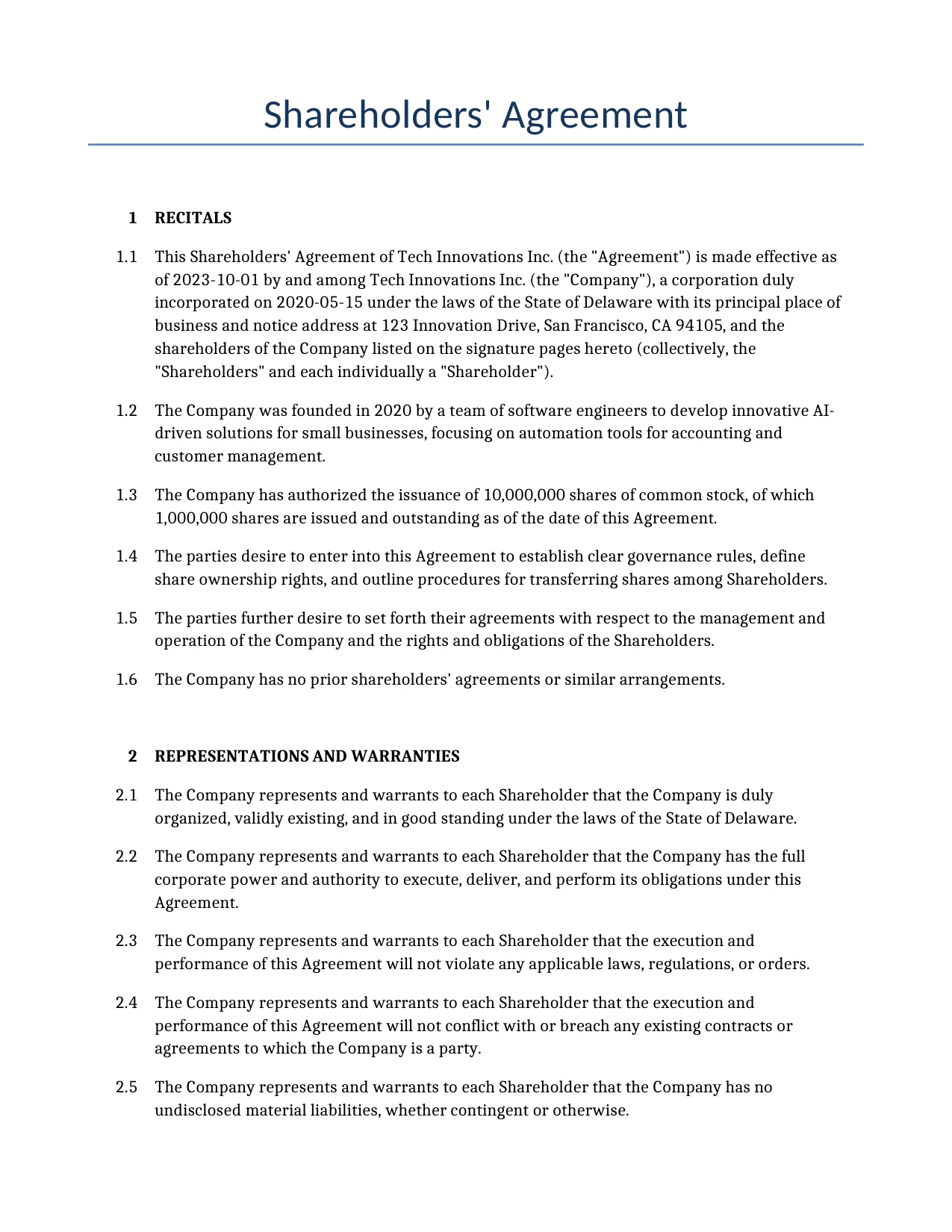
Shareholders' Agreement of Tech Innovations Inc.
1RECITALS
This Shareholders' Agreement of Tech Innovations Inc. (the "Agreement") is made effective as of 2023-10-01 by and among Tech Innovations Inc. (the "Company"), a corporation duly incorporated on 2020-05-15 under the laws of the State of Delaware with its principal place of business and notice address at 123 Innovation Drive, San Francisco, CA 94105, and the shareholders of the Company listed on the signature pages hereto (collectively, the "Shareholders" and each individually a "Shareholder").
The Company was founded in 2020 by a team of software engineers to develop innovative AI-driven solutions for small businesses, focusing on automation tools for accounting and customer management.
The Company has authorized the issuance of 10,000,000 shares of common stock, of which 1,000,000 shares are issued and outstanding as of the date of this Agreement.
The parties desire to enter into this Agreement to establish clear governance rules, define share ownership rights, and outline procedures for transferring shares among Shareholders.
The parties further desire to set forth their agreements with respect to the management and operation of the Company and the rights and obligations of the Shareholders.
The Company has no prior shareholders' agreements or similar arrangements.
2REPRESENTATIONS AND WARRANTIES
The Company represents and warrants to each Shareholder that the Company is duly organized, validly existing, and in good standing under the laws of the State of Delaware.
The Company represents and warrants to each Shareholder that the Company has the full corporate power and authority to execute, deliver, and perform its obligations under this Agreement.
The Company represents and warrants to each Shareholder that the execution and performance of this Agreement will not violate any applicable laws, regulations, or orders.
The Company represents and warrants to each Shareholder that the execution and performance of this Agreement will not conflict with or breach any existing contracts or agreements to which the Company is a party.
The Company represents and warrants to each Shareholder that the Company has no undisclosed material liabilities, whether contingent or otherwise.
The Company represents and warrants to each Shareholder that there are 1,000,000 shares of common stock issued and outstanding.
The Company represents and warrants to each Shareholder that there are no preemptive rights or options to acquire shares held by any person other than those disclosed in this Agreement.
The Company represents and warrants to each Shareholder that the Company fully owns its intellectual property and such ownership is free of claims.
The Company represents and warrants to each Shareholder that the Company is in compliance with all applicable tax laws and has timely filed all required tax returns.
3DEFINITIONS
"Affiliate" means, with respect to any Person, any other Person that directly or indirectly controls, is controlled by, or is under common control with such Person. For purposes of this definition, "control" (including the terms "controlled by" and "under common control with") means the possession, directly or indirectly, of the power to direct or cause the direction of the management and policies of a Person, whether through the ownership of voting securities, by contract, or otherwise.
"Transfer" means any sale, assignment, pledge, hypothecation, gift, or other disposition or transfer of shares or any legal or beneficial interest therein, whether voluntary or involuntary.
"Permitted Transferee" means (i) any Affiliate of a Shareholder, (ii) any immediate family member of a Shareholder (spouse, parents, siblings, or children), (iii) any trust established for the sole benefit of a Shareholder or such Shareholder's immediate family members, or (iv) any transferee in a transfer upon the death or incapacity of a Shareholder pursuant to will, intestacy, or operation of law.
"Fair Market Value" means the fair market value of the Shares as determined by mutual agreement of the parties or, if they cannot agree within thirty (30) days, by an independent appraiser selected by the board of directors (or, if the board cannot agree, by a court of competent jurisdiction in Delaware) using one or more of the following methodologies as appropriate: discounted cash flow, comparable company analysis, or precedent transaction analysis. The appraiser's determination shall be final and binding absent manifest error.
4SHARE TRANSFER RESTRICTIONS
No Shareholder shall Transfer any shares of the Company without first offering such shares to the other Shareholders and the Company pursuant to a right of first refusal as set forth in this Section 4. Any transferee must execute a joinder agreement in the form attached as Exhibit A to become a party to this Agreement as a condition to the Transfer.
A Shareholder desiring to Transfer shares (the "Selling Shareholder") shall deliver a written notice to the Company and the other Shareholders stating the number of shares proposed to be transferred, the price, the identity of the proposed transferee, and the terms of the proposed Transfer (a "Transfer Notice").
The Company and the other Shareholders shall have thirty (30) days from receipt of such Transfer Notice to elect to purchase all or any portion of the shares offered by the Selling Shareholder on the same terms as the proposed Transfer. If more than one party elects to purchase, the shares shall be allocated pro rata based on the number of shares held by each electing party.
If the Company and the other Shareholders do not elect to purchase all of the shares, the Selling Shareholder may Transfer the remaining shares to the proposed transferee on the terms set forth in the Transfer Notice, provided that the Transfer complies with all other provisions of this Agreement, including the execution of a joinder by the transferee.
If a Shareholder proposes to sell fifty percent (50%) or more of such Shareholder's shares to a third party in a single transaction or series of related transactions, each other Shareholder shall have the right to participate in such sale on a pro rata basis on the same terms and conditions as the selling Shareholder (the "Tag-Along Rights"). To exercise Tag-Along Rights, a Shareholder must deliver written notice within twenty (20) days after receipt of the Transfer Notice. The mechanics shall follow those for the right of first refusal, with the selling Shareholder coordinating the sale.
The transfer restrictions set forth in this Section 4 shall not apply to Transfers to Permitted Transferees, provided that the Permitted Transferee executes a joinder agreement agreeing to be bound by this Agreement.
Any purported Transfer in violation of this Section 4 shall be null and void and the Company shall not recognize any such Transfer or record any such Transfer on its books. The Company may enforce this by refusing to register the Transfer or by seeking injunctive relief.
Joinder Agreement. Any transferee of shares pursuant to this Agreement must execute a joinder agreement in substantially the form attached hereto as Exhibit A, agreeing to be bound by all terms of this Agreement as if an original signatory.
5BUY-SELL PROVISIONS
Upon the occurrence of any of the following events (each a "Trigger Event"), the Company or the remaining Shareholders may elect (but shall not be required) to purchase all or any portion of the shares of the affected Shareholder: (i) the death of a Shareholder, (ii) the disability of a Shareholder (defined as inability to perform duties for 180 consecutive days), (iii) the termination of employment of a Shareholder for cause or without cause, or (iv) voluntary resignation of a Shareholder. Mandatory buyouts are not required to avoid potential unenforceability under Delaware law.
The party electing to purchase shall deliver written notice within sixty (60) days after the Trigger Event. If multiple parties elect, shares shall be allocated first to the Company, then pro rata to Shareholders.
Prior to any sale of shares to an outsider following a Trigger Event, the shares shall first be offered to the remaining Shareholders pursuant to a right of first refusal on the terms set forth in Section 4 of this Agreement.
The value of the shares in any buy-sell transaction shall be the Fair Market Value as defined in Section 3.4. If the Trigger Event is death, the value may alternatively be determined by reference to any applicable key man life insurance proceeds if the parties so agree.
Payment for the shares shall be made in cash or on such other terms as the parties may agree within sixty (60) days following the determination of the purchase price, subject to compliance with Delaware General Corporation Law solvency requirements.
6DRAG-ALONG RIGHTS
If Shareholders holding at least sixty-six percent (66%) of the outstanding shares (the "Dragging Shareholders") approve a Sale of the Company (as defined below), each other Shareholder (the "Dragged Shareholders") shall be required to participate in such sale on the same terms and conditions as the Dragging Shareholders, subject to the exceptions set forth herein. A "Sale of the Company" means (i) a sale of all or substantially all of the assets, (ii) a sale of a majority of the outstanding shares, or (iii) a merger or consolidation resulting in a change of control.
All Shareholders shall receive the same form and proportion of consideration per share in any dragged-along sale, and the consideration must be allocated in accordance with the Company's certificate of incorporation. Drag-along rights shall not apply to sales involving employees or service providers where the primary purpose is compensatory.
The Dragging Shareholders shall provide at least thirty (30) days' prior written notice to the Dragged Shareholders before enforcing the drag-along rights, which notice shall include the material terms of the proposed sale.
Each Dragged Shareholder shall bear a pro-rata share of any sale-related expenses (not to exceed customary amounts) based on the number of shares sold by such Shareholder, but shall not be required to make representations beyond those regarding authority, ownership, and title to shares.
Tag-along rights under Section 4 shall not apply to a drag-along sale approved in accordance with this Section 6.
Power of Attorney. Each Shareholder hereby grants an irrevocable power of attorney to the Dragging Shareholders (or their designee) to execute all documents and take all actions necessary to effectuate a drag-along sale on behalf of such Shareholder if such Shareholder fails to comply after notice. This power is coupled with an interest and shall survive bankruptcy or incapacity.
7PREEMPTIVE RIGHTS
Each Shareholder shall have a preemptive right to purchase such Shareholder's Pro Rata Share of any New Securities that the Company may from time to time issue after the date hereof, other than Excluded Securities. "New Securities" means any capital stock or securities convertible into capital stock issued by the Company, excluding (i) shares issued in connection with a qualified public offering, (ii) shares issued upon exercise of outstanding options or warrants, (iii) shares issued in connection with acquisitions, and (iv) shares issued pursuant to employee benefit plans approved by the board.
The Company shall give each Shareholder at least twenty (20) days' prior written notice of any proposed issuance of New Securities, specifying the price, terms, and identity of the proposed purchaser. Each Shareholder shall have fifteen (15) days from receipt of such notice to elect to purchase all or any part of its Pro Rata Share by written notice to the Company. "Pro Rata Share" means the ratio of shares held by the Shareholder to the total outstanding shares immediately prior to the issuance.
If any Shareholder declines to purchase its full Pro Rata Share, the remaining shares shall be reoffered pro rata to the participating Shareholders. Any unpurchased New Securities may then be issued to third parties on terms no more favorable than those offered to the Shareholders, within sixty (60) days.
The preemptive rights shall terminate upon the closing of a qualified initial public offering of the Company's shares registered under the Securities Act of 1933, as amended.
8RIGHT OF FIRST OFFER FOR NEW SECURITIES
In addition to the preemptive rights set forth in Section 7, the Company shall not issue any New Securities unless it first offers such securities to the Shareholders pursuant to this Right of First Offer. The notice and exercise mechanics shall be the same as those set forth in Section 7.2.
9RESTRICTIONS ON ISSUANCE OF NEW SHARES OR SECURITIES
The Company shall not issue any additional shares of capital stock or any securities convertible into or exercisable for shares of capital stock without the prior written consent of Shareholders holding at least seventy-five percent (75%) of the outstanding shares, except for (i) shares issued pursuant to the preemptive rights or right of first offer in this Agreement, (ii) shares issued upon conversion of outstanding convertible securities, (iii) shares issued pursuant to employee stock plans approved by the board and Shareholders, or (iv) shares issued in connection with a bona fide acquisition of assets or equity approved by the board.
10ANTI-DILUTION PROTECTIONS
In the event the Company issues New Securities at a price per share less than the price per share paid by any Shareholder (a "Dilutive Issuance"), such Shareholder shall be entitled to anti-dilution protection in the form of a weighted average adjustment to the number of shares held or the issuance of additional shares to maintain the Shareholder's percentage ownership. This protection shall not apply to Excluded Securities as defined in Section 7.1. The mechanics of adjustment shall be set forth in the Company's certificate of incorporation or a separate schedule to this Agreement.
11INFORMATION AND INSPECTION RIGHTS
The Company shall deliver to each Shareholder (i) audited annual financial statements within ninety (90) days after fiscal year end, (ii) unaudited quarterly financial statements within forty-five (45) days after each quarter end, and (iii) an annual budget and business plan approved by the board. These rights shall terminate for any Shareholder that is a competitor of the Company as determined in good faith by the board.
Each Shareholder and its representatives shall have the right, upon reasonable notice and during normal business hours, to inspect the books and records of the Company and to discuss the Company's affairs with its officers. Such inspection rights shall be subject to execution of a confidentiality agreement if requested by the Company and shall not apply to information subject to attorney-client privilege.
12INTELLECTUAL PROPERTY
Each Shareholder who is or was an employee, consultant, or contractor hereby assigns to the Company all right, title, and interest in and to any inventions, works of authorship, mask works, designs, know-how, or other intellectual property created by such Shareholder in the course of services to the Company ("Company IP"). Such assignment includes all moral rights and the right to sue for past infringement. To the extent any Company IP is not assignable, the Shareholder grants the Company an exclusive, royalty-free, irrevocable, perpetual license.
Each Shareholder agrees to execute all documents and take all actions reasonably requested by the Company to perfect the Company's ownership of Company IP, including assignments and applications for patents, copyrights, or other registrations. This obligation survives termination of the Agreement or cessation of the Shareholder's relationship with the Company.
The Company shall own all intellectual property developed using Company resources or during the time a Shareholder provides services to the Company, consistent with Delaware law and applicable employment or consulting agreements.
13GOVERNANCE AND MANAGEMENT
A quorum at any meeting of the Shareholders shall require the presence, in person or by proxy, of Shareholders holding at least fifty-one percent (51%) of the outstanding shares entitled to vote.
Ordinary resolutions of the Shareholders shall require the affirmative vote of at least fifty percent (50%) of the shares present and entitled to vote at a meeting at which a quorum is present.
Supermajority decisions, including amendments to this Agreement or the Company's governing documents, mergers, acquisitions, incurrence of debt over $100,000, or issuance of new securities (except as permitted herein), shall require the affirmative vote of at least seventy-five percent (75%) of all outstanding shares entitled to vote. Minority Shareholders holding at least ten percent (10%) of the shares shall have veto rights over the following protective provisions: (i) amendments to certificate of incorporation or bylaws adversely affecting their rights, (ii) authorization of senior or pari passu securities, (iii) any transaction that would dilute their ownership below ten percent (10%), and (iv) change in the Company's principal business.
The board of directors of the Company shall consist of five (5) seats. Directors shall be elected annually by the Shareholders at the annual meeting pursuant to the voting agreements in Section 14. Directors need not be Shareholders. The board shall include at least one director designated by minority Shareholders holding at least ten percent (10%) of the shares for so long as such ownership is maintained.
The board of directors shall hold meetings at least quarterly. Special meetings may be called by the CEO or any two directors upon five (5) days' notice.
A quorum for meetings of the board of directors shall require the presence of at least three (3) directors. Actions may be taken by unanimous written consent in lieu of a meeting.
Decisions of the board of directors shall be made by a simple majority vote of the directors present at a meeting at which a quorum is present, except for actions requiring supermajority approval under the protective provisions.
The board of directors shall have the authority to appoint and remove the chief executive officer, chief financial officer, and other officers of the Company. The officers shall have the duties and authority customarily held by such positions under Delaware law.
14VOTING AGREEMENTS
Each Shareholder agrees to vote (or cause to be voted) all of such Shareholder's shares in favor of the election of directors nominated in accordance with the procedures in Section 13.4 and the approval of major transactions as specified herein.
The voting agreements shall cover the election of directors, the approval of mergers, acquisitions, sales of substantially all assets, amendments to governing documents, and other actions requiring supermajority approval under Section 13.3.
All key matters covered by the voting agreements shall require a supermajority vote as set forth in Section 13.3 of this Agreement.
Shareholders may grant irrevocable proxies to other Shareholders or designated individuals to vote on key matters in accordance with this Agreement. Such proxies are coupled with an interest and shall survive transfers to Permitted Transferees.
No voting trust shall be established for any shares under this Agreement unless unanimously agreed by all Shareholders.
In the event of a breach of the voting agreements, the non-breaching parties shall be entitled to seek an injunction or specific performance to enforce the terms of this Section 14, in addition to any other remedies available at law or in equity.
15DIVIDEND POLICY
The Company may declare dividends in accordance with Delaware General Corporation Law, which requires that dividends be paid only out of surplus or net profits and that the Company remains solvent after payment (i.e., assets exceed liabilities plus preferential dissolution rights). The board of directors shall determine whether to declare dividends, prioritizing reinvestment in growth opportunities.
Dividends, if declared, shall be paid pro rata based on each Shareholder's ownership percentage and shall not be cumulative unless specified by the board for preferred stock (if any).
The declaration of dividends shall require the approval of a majority of the board of directors and, if required under protective provisions, approval of Shareholders holding at least fifty percent (50%) of the shares.
Dividends shall be paid to Shareholders by direct bank deposit to the account designated by each Shareholder or by check.
16CAPITAL CONTRIBUTIONS
The board of directors may from time to time determine that additional capital is required for the Company's operations and issue a capital call notice to all Shareholders. Such notice shall specify the total amount needed, each Shareholder's pro rata portion (based on ownership), the purpose, and a deadline of not less than thirty (30) days. Additional capital contributions shall be proportionate to ownership unless all Shareholders agree otherwise. Failure to contribute shall not result in unlawful coercion; instead, non-contributing Shareholders shall suffer dilution as calculated by a formula set forth on Schedule A, or the contributing Shareholders may elect to treat the non-contribution as a loan bearing interest at the maximum rate permitted by law.
If a Shareholder fails to make a required additional capital contribution, the other Shareholders shall have the option (but not the obligation) to contribute the shortfall pro rata and receive additional shares or other equity adjustments to reflect the additional contribution. Any buyout option shall be at Fair Market Value as defined herein and subject to Delaware law restrictions on oppressive conduct.
The provisions of this Section 16 shall be interpreted to comply with Delaware General Corporation Law and shall not impose personal liability on Shareholders beyond their investment.
17FIDUCIARY DUTIES AND WAIVERS
Shareholders who serve as directors owe fiduciary duties of care and loyalty to the Company and all its shareholders under Delaware law. This Agreement is not intended to expand, reduce, or waive such duties except to the extent expressly permitted. To the extent permitted by Delaware General Corporation Law Section 102(b)(7), the Company's certificate of incorporation may limit personal liability of directors for breaches of the duty of care. Shareholders acknowledge that certain actions approved in accordance with this Agreement shall not constitute a breach of fiduciary duty.
18DEADLOCK RESOLUTION
In the event of a deadlock (defined as failure to obtain required votes on a matter for two consecutive board or shareholder meetings), the parties shall first attempt resolution through good faith negotiations for thirty (30) days. If unresolved, the matter shall be referred to mediation in Delaware administered by a mutually agreed mediator. If mediation fails, any party may petition the Delaware Court of Chancery for relief, which may include, but is not limited to, appointment of a custodian or receiver under Section 226 of the Delaware General Corporation Law, compulsory buyout at Fair Market Value, or other equitable relief. This provision does not apply to matters requiring supermajority approval where deadlock is anticipated.
19NON-COMPETE AND CONFIDENTIALITY
Each Shareholder agrees that during the term of this Agreement and for a period of one (1) year following the termination of such Shareholder's relationship with the Company (or six (6) months in the case of a Shareholder owning less than five percent (5%) of the shares), such Shareholder shall not directly or indirectly engage in any business that competes with the Company's principal business within a twenty-five (25) mile radius of any location where the Company conducts substantial business as of the date of termination. This restriction shall not apply to passive ownership of less than two percent (2%) of publicly traded securities. The parties agree this restriction is reasonable in time, geography, and scope under Delaware law.
Each Shareholder and the Company agree to maintain the confidentiality of all Confidential Information (defined as non-public information concerning the business, technology, finances, or affairs of the Company or other Shareholders) and not to disclose such information to any third party without the prior written consent of the Company or the affected Shareholder, as applicable. Confidential Information does not include information that is or becomes publicly known through no fault of the receiving party or is independently developed.
The obligations under this Section 19 shall survive the termination of this Agreement for a period of five (5) years (or indefinitely with respect to trade secrets).
20INDEMNIFICATION
The Company shall indemnify its directors, officers, employees, and agents to the fullest extent permitted by Section 145 of the Delaware General Corporation Law against any claims, liabilities, losses, or expenses (including attorneys' fees) arising from their service to the Company, provided that such person acted in good faith and in a manner reasonably believed to be in or not opposed to the best interests of the Company, and, with respect to any criminal action, had no reasonable cause to believe the conduct was unlawful.
Such indemnification shall cover third party claims, derivative suits, and actions by or in the right of the Company, subject to the limitations in Section 145.
The Company shall advance reasonable attorneys' fees and other expenses incurred by a director or officer in defending any proceeding in advance of its final disposition, upon receipt of an undertaking by or on behalf of such person to repay all amounts so advanced if it shall ultimately be determined that such person is not entitled to be indemnified under this Section or Section 145.
The Company shall maintain directors' and officers' liability insurance and may maintain other insurance (including general liability, property, and key person life insurance) in amounts and with such coverage as the board of directors determines is reasonable and prudent.
No indemnification shall be provided for acts or omissions finally determined to constitute willful misconduct, bad faith, or knowing violation of law.
21INSURANCE REQUIREMENTS
In addition to directors' and officers' liability insurance, the Company shall obtain and maintain, at its expense, (i) commercial general liability insurance, (ii) property insurance covering all material assets, (iii) business interruption insurance, and (iv) such other insurance as the board determines is appropriate for the business. Certificates of insurance shall be provided to Shareholders upon request.
22TAX MATTERS
The Company shall be treated as a C corporation for U.S. federal and state income tax purposes unless the board and Shareholders holding at least eighty percent (80%) of the shares unanimously elect to make an S corporation election under Section 1362 of the Internal Revenue Code (if eligible) or to treat the Company as a partnership for tax purposes (if restructured). The Company shall timely file all tax returns and comply with all tax laws. Shareholders shall cooperate in providing information for tax filings, including K-1s if applicable. The Company shall not take any action that would terminate an S election without supermajority approval.
The parties acknowledge that this Agreement does not create a partnership for tax purposes and agree to report consistently with the Company's tax classification on their individual returns.
23NO PARTNERSHIP
Nothing in this Agreement shall be deemed to create a partnership, joint venture, or other fiduciary relationship between the Shareholders or between any Shareholder and the Company beyond the corporate relationship established under the Delaware General Corporation Law and the Company's governing documents. Each Shareholder acts solely as an investor and not as a partner.
24DISPUTE RESOLUTION
Any dispute arising out of or relating to this Agreement shall be governed exclusively by the laws of the State of Delaware without regard to its conflict of laws principles. The parties consent to the exclusive jurisdiction of the Delaware Court of Chancery (or, if such court lacks subject matter jurisdiction, the federal or state courts located in Delaware) for any action or proceeding relating to this Agreement. The parties waive any objection based on forum non conveniens.
Prior to filing any action in court, the parties shall attempt to resolve the dispute through mediation administered by a mutually agreed mediator in Delaware. If mediation does not resolve the dispute within sixty (60) days, either party may commence litigation in accordance with Section 24.1. This Section shall not preclude a party from seeking injunctive relief or specific performance in court where appropriate.
The prevailing party in any action or proceeding shall be entitled to recover its reasonable attorneys' fees and costs from the other party.
25TERMINATION
This Agreement shall terminate upon the earliest of (i) the dissolution or liquidation of the Company, (ii) the closing of a qualified initial public offering registered under the Securities Act of 1933, or (iii) mutual written agreement of all parties. Termination shall not relieve any party of obligations accrued prior to termination.
This Agreement may be terminated by a Shareholder only upon transfer of all of such Shareholder's shares in accordance with this Agreement, provided that the Agreement shall continue in effect as to the remaining Shareholders.
The provisions relating to confidentiality, non-compete (to the extent applicable), intellectual property, indemnification, governing law, and any causes of action for breach prior to termination shall survive the termination of this Agreement.
26AMENDMENT AND WAIVER
Any amendment to this Agreement shall require the written consent of the Company and Shareholders holding at least seventy-five percent (75%) of the outstanding shares (or such higher threshold as may be required for the underlying change), and shall be preceded by at least ten (10) days' written notice to all Shareholders. Unanimous consent shall be required for amendments that adversely affect any Shareholder's material rights in a disproportionate manner.
All amendments to this Agreement must be in writing and executed by the required parties. The party entitled to the benefit of any provision of this Agreement may waive such provision, provided that any such waiver shall be in writing and shall not constitute a waiver of any future breach.
27COMPLIANCE WITH SECURITIES LAWS
All transfers of shares shall be made in compliance with the Securities Act of 1933, as amended (the "Securities Act"), the Securities Exchange Act of 1934, Rule 144 thereunder (if applicable), and all applicable state securities or "blue sky" laws. The shares have not been registered under the Securities Act and may not be transferred except pursuant to registration or an available exemption.
Each Shareholder represents that such Shareholder is acquiring or holding shares for investment purposes only and not with a view to resale or distribution in violation of applicable securities laws. Each Shareholder agrees to provide the Company with such information as may be required to comply with Rule 144 or other exemptions.
The Company shall place a legend on all certificates (or book entries) for shares substantially as follows: "THE SHARES REPRESENTED HEREBY ARE SUBJECT TO A SHAREHOLDERS' AGREEMENT AND MAY BE TRANSFERRED ONLY IN ACCORDANCE THEREWITH. SUCH SHARES HAVE NOT BEEN REGISTERED UNDER THE SECURITIES ACT OF 1933 AND MAY NOT BE TRANSFERRED EXCEPT PURSUANT TO AN EFFECTIVE REGISTRATION STATEMENT OR AN EXEMPTION FROM REGISTRATION." The Company shall not be required to recognize any transfer that would violate securities laws.
Registration Rights. The Company grants the Shareholders demand and piggyback registration rights as set forth in the Registration Rights section of this Agreement.
28REGISTRATION RIGHTS
Demand Rights. Shareholders holding at least fifty percent (50%) of the registrable securities may request in writing that the Company effect a registration under the Securities Act of all or a portion of their registrable securities (a "Demand Registration"). The Company shall use commercially reasonable efforts to effect such registration, provided that it shall not be obligated to effect more than two Demand Registrations in any twelve-month period or if the anticipated aggregate offering price is less than $5,000,000. The Company may defer a Demand Registration for up to ninety (90) days if the board determines in good faith that it would be materially detrimental.
Piggyback Rights. If the Company proposes to register any of its securities under the Securities Act (other than on Forms S-4 or S-8), each Shareholder shall have the right to include its registrable securities in such registration, subject to pro rata underwriter cutbacks if required. The Company shall provide at least twenty (20) days' notice of such proposed registration.
The Company shall bear all registration expenses (other than underwriting discounts and commissions) for Demand and Piggyback Registrations. The parties shall enter into customary indemnification and contribution agreements in connection with any registration.
These registration rights shall terminate on the earlier of (i) five (5) years after the effective date of the Company's initial public offering or (ii) when all registrable securities may be sold without restriction under Rule 144.
29SPOUSAL CONSENT
If any Shareholder is married and resides in a community property jurisdiction, such Shareholder's spouse shall execute a spousal consent in the form attached as Exhibit B, acknowledging the terms of this Agreement and agreeing that any community property interest in the shares shall be subject to this Agreement. Failure to obtain such consent shall not invalidate the Agreement but may result in the Company refusing to recognize community property claims.
30FURTHER ASSURANCES
Each party agrees to execute and deliver such additional documents and take such further actions as may be reasonably necessary to carry out the purposes of this Agreement, including any actions required to comply with Delaware General Corporation Law or federal securities laws.
31CUMULATIVE REMEDIES
All rights and remedies provided in this Agreement are cumulative and in addition to, and not in lieu of, any other rights or remedies available at law or in equity. No exercise of one remedy shall preclude the exercise of any other.
32NO THIRD-PARTY BENEFICIARIES
This Agreement is for the sole benefit of the parties hereto and their permitted successors and assigns and nothing herein shall create or be construed to create any third-party beneficiary rights in any person or entity not a party to this Agreement, except as expressly provided with respect to Permitted Transferees who execute a joinder.
33HEADINGS
The headings in this Agreement are for reference only and shall not affect the interpretation of this Agreement.
34NOTICES
All notices required or permitted under this Agreement shall be in writing and shall be delivered by personal delivery, certified mail, or email to the address set forth for each party, which address for the Company and each Shareholder is as set forth on the signature pages or Schedule B hereto (which for the Company is 123 Innovation Drive, San Francisco, CA 94105).
Notices sent by certified mail shall be deemed received five (5) days after mailing. Notices sent by email shall be deemed received upon confirmation of receipt. Notices shall become effective upon receipt.
Any party may change its notice address by providing written notice of such change to the other parties in accordance with this Section 34.
35SEVERABILITY
If any provision of this Agreement is held to be invalid or unenforceable under the laws of the State of Delaware, such provision shall be severed from this Agreement and the remaining provisions shall continue in full force and effect.
The parties shall negotiate in good faith to replace any invalid provision with a valid provision that achieves the original intent of the parties to the greatest extent possible.
36ENTIRE AGREEMENT
This Agreement constitutes the entire understanding between the Shareholders and the Company with respect to the subject matter hereof and supersedes all prior agreements, understandings, and negotiations, whether written or oral.
37ASSIGNMENT
No party may assign any of its rights or delegate any of its obligations under this Agreement without the prior written consent of the other parties, except as otherwise expressly provided herein (including Transfers to Permitted Transferees in accordance with the transfer restrictions).
Any attempted assignment in violation of this Section 37 shall be null and void.
38COUNTERPARTS
This Agreement may be executed in one or more counterparts, each of which shall be deemed an original, but all of which together shall constitute one and the same instrument. Delivery of an executed counterpart by facsimile or electronic transmission shall be effective as delivery of a manually executed counterpart.
39SIGNATURES
IN WITNESS WHEREOF, the parties have executed this Agreement as of the date first above written.
Tech Innovations Inc.: _______________________________ By: _______________________________ Name: Title: Date:
Shareholder 1: _______________________________ Name: Date:
Shareholder 2: _______________________________ Name: Date:
Additional Shareholders as applicable shall execute signature pages in the foregoing form.
This example shows approximately 70% of a typical document and is provided for illustrative purposes only. The remaining content has been omitted.
Every document generated by Docaro is tailored to your specific circumstances, jurisdiction and the information you provide. The completed document includes all applicable clauses and provisions required for your situation.
To generate the full, personalised document, answer a short series of questions and your document will be created instantly.