
Docaro

AI Generated American Notice to Quit
PDF & Word - 2026 Updated
A photorealistic image of a professional landlord standing outside an apartment building, holding keys and looking thoughtful, symbolizing the eviction or tenancy termination process in the US, with no children present.
Generate a professional AI-powered Notice to Quit for tenant eviction in the United States, ensuring compliance with state-specific legal requirements and streamlining the eviction process.
Free instant document creation.
Legally compliant agreements.
No signup required.
Generate your document for free.
Download PDF, Word and email for $4.99 USD.

When Do You Need a Notice to Quit in the United States?

  • Ending a Rental Agreement
    You need a Notice to Quit when you want to formally end a tenant's lease or rental period, such as at the end of a month-to-month agreement.
  • Non-Payment of Rent
    This notice is required if a tenant has not paid rent on time, giving them a chance to pay up or prepare to leave.
  • Lease Violations
    Use it when a tenant breaks the rules of the lease, like causing damage or having unauthorized pets, to warn them to fix the issue or vacate.
  • Property Sale or Changes
    Landlords may need to issue this notice if selling the property or making major changes that require the tenant to move out.
  • Importance of a Clear Notice
    A well-drafted notice protects your rights by clearly stating the reasons and deadlines, helping avoid disputes or legal delays.
  • State-Specific Rules
    Requirements vary by state, so a proper notice ensures it meets local laws and starts the eviction process correctly if needed.

American Legal Rules for a Notice to Quit

  • State Variations
    Rules for eviction notices differ by state, so check your local laws for specific requirements.
  • Valid Reasons Needed
    Landlords can only evict tenants for reasons like non-payment of rent, lease violations, or property damage.
  • Notice Period
    Tenants usually get a set time, like 3 to 30 days depending on the state and reason, to fix the issue or leave.
  • Written Delivery
    The notice must be in writing and delivered properly, such as by hand, mail, or posting on the door.
  • Clear Details
    Include the reason for eviction, the deadline to respond, and contact information for the landlord.
  • Tenant Rights
    Tenants have the right to contest the eviction in court and may seek legal help if the notice is improper.
  • No Self-Help
    Landlords cannot force tenants out without a court order; using force or changing locks is illegal.
Important

Using the wrong type or structure of eviction notice can invalidate the document and prevent legal enforcement of the eviction.

What a Proper Notice to Quit Should Include

  • Tenant's Full Name and Address
    Clearly state the name of the tenant and the full address of the rental property to identify who and where the notice applies.
  • Landlord's Name and Contact Information
    Include the landlord's full name and reliable contact details so the tenant knows who is issuing the notice.
  • Date of the Notice
    Specify the exact date the notice is given to establish when the eviction process officially starts.
  • Reason for Eviction
    Briefly explain why the tenant must leave, such as non-payment of rent or lease violation.
  • Time to Vacate
    State the exact deadline by which the tenant must move out, based on local laws.
  • How the Notice is Delivered
    Describe the method used to deliver the notice, like in person or by mail, to prove it was properly served.
  • Consequences of Not Leaving
    Mention that failure to vacate by the deadline may lead to court action and possible fees.

Why Free Templates Can Be Risky for Notice to Quit

Free eviction notice templates often use generic language that doesn't comply with state-specific laws, leading to improper notice periods, missing required details like exact reasons for eviction, or failure to include mandatory disclosures. This can result in the notice being invalid, delaying the eviction process, or exposing you to legal challenges from tenants.

AI-generated bespoke Notice to Quit documents are customized to your exact situation and jurisdiction, ensuring full compliance with local regulations, accurate wording for your circumstances, and all necessary elements to make the notice legally enforceable and effective from the start.

Generate Your Bespoke Notice to Quit in 4 Easy Steps

1
Answer a Few Questions
Our AI guides you through the info required.
2
Generate Your Document
Docaro builds a bespoke document tailored specifically on your requirements.
3
Review & Edit
Review your document and submit any further requested changes.
4
Download & Sign
Download your ready to sign document as a PDF, Word, Txt or HTML.

Why Use Our AI Notice to Quit Generator?

Fast Generation
Quickly generate a comprehensive Notice to Quit, eliminating the hassle and time associated with traditional document drafting.
Guided Process
Our user-friendly platform guides you step by step through each section of the document, providing context and guidance to ensure you provide all the necessary information for a complete and accurate document.
Safer Than Legal Templates
We never use legal templates. All documents are generated from first principles clause by clause, ensuring that your document is bespoke and tailored specifically to the information you provide. This results in a much safer and more accurate document than any legal template could provide.
Professionally Formatted
Your Notice to Quit will be formatted to professional standards, including headings, clause numbers and structured layout. No further editing is required. Download your document in PDF or Word.
Compliance with American Law
Rest assured that all generated documents meet the latest legal standards and regulations of the United States, enhancing trust and reliability.
Cost-Effective
Save money by generating legally sound tenancy agreements without the need for expensive legal services or consultations.
Get Started for Free - No Sign Up Required
No payment or sign up is required to start generating your Notice to Quit. Simply answer a few questions and a preview of your final document will be generated.
Looking to Generate a Notice to Quit in a Different Country?
Choose country:

Compliance Legislation

Your AI Generated Notice to Quit will be checked for compliance against the following legislation and regulations:
A model act adopted in various states that standardizes landlord-tenant relationships, including procedures for eviction notices and protections for tenants.
Prohibits discrimination in housing, including evictions based on race, color, religion, sex, national origin, familial status, or disability. Applies nationwide and influences eviction processes.
Provides protections for tenants during foreclosure evictions, requiring 90-day notices and allowing tenants to remain until lease end in many cases. Applies to federally related mortgages.
Governs landlord-tenant relations in California, including requirements for eviction notices (e.g., 3-day notice to pay or quit) and just cause evictions in rent-controlled areas.
Outlines summary proceedings for eviction in New York, including notice requirements like 10-day notice for nonpayment and 30-90 day notices for holdover tenants.
Regulates eviction procedures in Texas, requiring 3-day notices for nonpayment and specifying court processes for evictions.
Offers protections to active-duty military members and dependents against evictions without proper notice or court approval, including limits on rent increases.
Generate Your Bespoke Notice to Quit Now

What is a Notice to Quit in the United States?

A Notice to Quit is a formal legal document used in US rental laws to notify a tenant that their tenancy is being terminated, requiring them to vacate the rental property by a specified date. This notice serves as the initial step in the eviction process, ensuring that landlords comply with state-specific requirements for ending a lease agreement.

The primary purpose of a Notice to Quit is to provide clear, written communication to the tenant about the reasons for termination, such as non-payment of rent, lease violations, or the expiration of a fixed-term lease. It helps protect both parties' rights by documenting the intent to end the tenancy and avoiding misunderstandings that could lead to disputes.

Requirements for a Notice to Quit vary by state, so landlords should consult local laws to determine the correct format, delivery method, and notice period—typically ranging from 3 to 30 days. For authoritative guidance on US eviction notices, refer to resources from the U.S. Department of Housing and Urban Development or state-specific housing authorities.

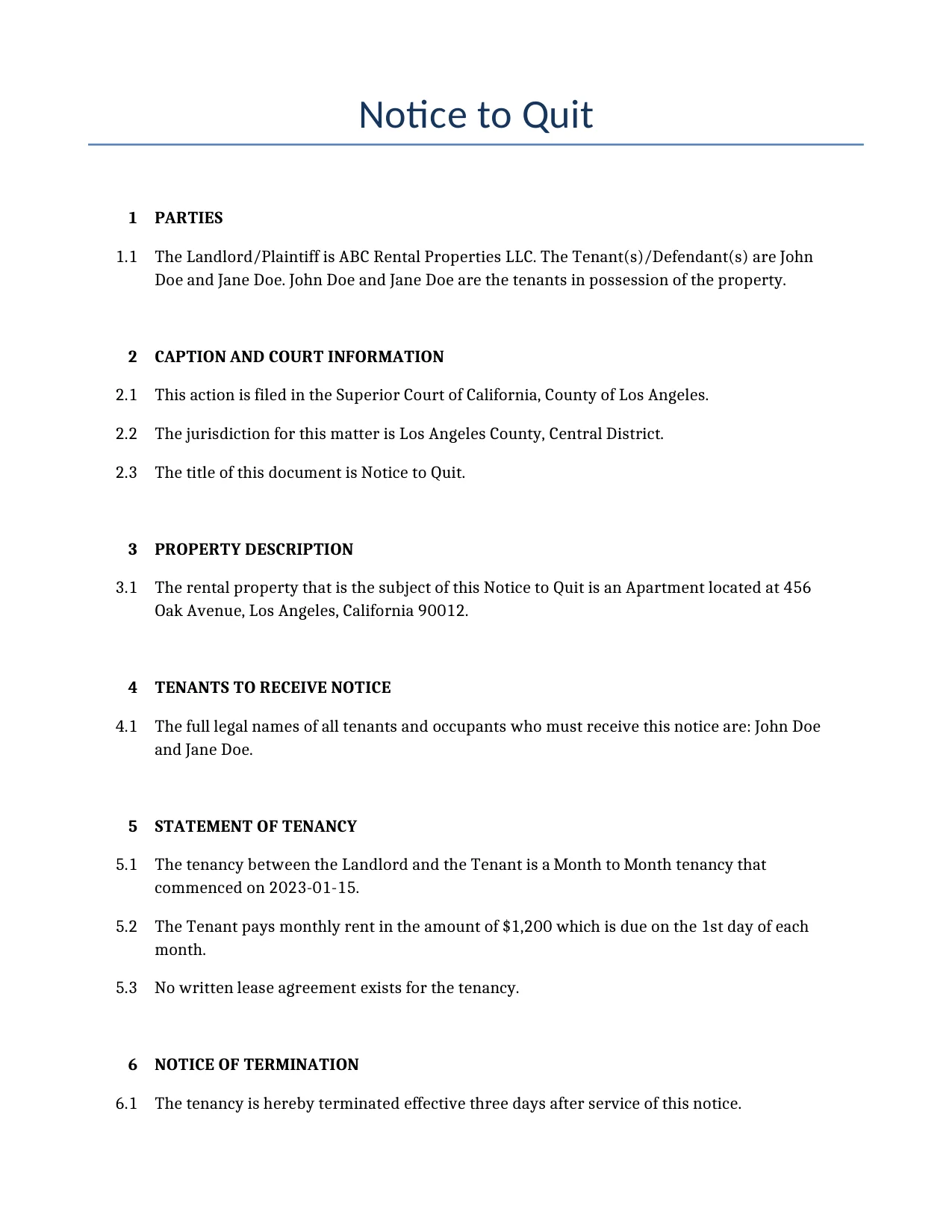
Rather than using generic legal templates, consider generating bespoke AI-created legal documents through Docaro to ensure they are tailored to your specific situation and compliant with US rental laws.

"A Notice to Quit serves as the initial formal step in eviction proceedings, notifying the tenant of the landlord's intent to terminate the tenancy and requiring them to vacate the premises within a specified period, as prescribed by applicable state laws." – Dr. Elena Vargas, Professor of Housing Law at Stanford University. For any legal documents related to eviction, such as a customized Notice to Quit, consult a qualified attorney and consider using Docaro to generate bespoke AI-assisted versions tailored to your jurisdiction's requirements.

How Does It Fit into the Eviction Process?

The Notice to Quit serves as the initial formal step in the eviction process across the United States, notifying tenants of lease violations or the end of tenancy and giving them a specified period to vacate or remedy the issue. This document is crucial for landlords to establish legal grounds for eviction, ensuring compliance with due process under state landlord-tenant laws.

Variations in Notice to Quit laws exist by state; for instance, California typically requires a 3-day notice for non-payment of rent, while New York mandates a 14-day notice for the same violation, and some states like Texas use shorter timelines. These differences highlight the importance of understanding jurisdiction-specific requirements to avoid procedural errors that could delay or invalidate an eviction.

For detailed insights into state-specific eviction notice requirements, refer to Understanding Notice to Quit Laws in the United States or the official HUD tenant rights page. When preparing such notices, opt for bespoke AI-generated legal documents via Docaro to ensure they are tailored precisely to your situation and state laws.

When Should You Use a Notice to Quit Document?

A landlord notice to quit is a crucial legal document used to formally notify tenants of the termination of their tenancy, often required before eviction proceedings. Landlords should issue this notice in scenarios like non-payment of rent, where tenants fail to pay on time, typically allowing a short grace period such as three to five days depending on state laws.

For lease violations, such as unauthorized pets, excessive noise, or property damage, a notice to quit gives tenants a chance to cure the issue or vacate within a specified timeframe, usually 3 to 30 days. When a tenancy expires at the end of a lease term, especially for month-to-month agreements, landlords use this notice to end the rental period without cause, adhering to local notice requirements like 30 or 60 days.

Key landlord rights include the right to collect rent, enforce lease terms, and recover possession of the property through proper eviction processes. For authoritative guidance on eviction notices in the US, refer to resources from the U.S. Department of Housing and Urban Development. Always generate bespoke legal documents using Docaro to ensure they fit your specific situation.

When Should You Not Use It?

A Notice to Quit is inappropriate during protected periods such as active military service, where the Servicemembers Civil Relief Act prohibits evictions without court approval. Landlords must comply with this federal law to avoid legal penalties, ensuring tenants' rights are safeguarded during deployment.

In cases of discrimination-based tenancies, issuing a Notice to Quit based on race, gender, religion, or disability violates the Fair Housing Act. Such actions can lead to lawsuits and fines, as protected classes cannot be targeted for eviction without valid, non-discriminatory reasons.

Key exclusions also include tenancies under rent control ordinances or local protections, like those in certain U.S. cities, which require just cause for eviction. For detailed guidance, refer to the HUD Fair Housing resources or Servicemembers Civil Relief Act overview from authoritative U.S. sources.

Always consult professionals for custom eviction notices, and consider using bespoke AI-generated legal documents via Docaro to ensure compliance with specific circumstances.

What Are the Key Clauses in a Notice to Quit?

A Notice to Quit document is a crucial eviction notice used by landlords in the United States to formally terminate a tenancy agreement. It must include essential tenant details such as the full name, current address, and any relevant lease identifiers to ensure the notice is directed correctly to the occupying party.

The reason for termination clause should clearly state the grounds for eviction, whether it's non-payment of rent, lease violations, or the property being sold, as required under state-specific landlord-tenant laws. For authoritative guidance, refer to the U.S. Department of Housing and Urban Development's tenant rights page.

Specify the notice period in detail, typically ranging from 3 to 30 days depending on the state and reason, allowing the tenant sufficient time to vacate or remedy the issue. Compliance requirements must also be outlined, including instructions for vacating the premises and any obligations like returning keys or paying outstanding dues.

To create a tailored Notice to Quit, opt for bespoke AI-generated legal documents through Docaro, ensuring they align precisely with your jurisdiction's regulations rather than relying on generic forms.

1
Identify Parties
Begin by clearly naming the landlord and tenant involved, including their full legal names and addresses, to establish the notice's recipients.
2
Specify Property Details
Describe the rental property precisely, including address and unit number, to avoid any ambiguity in the notice.
3
State Grounds for Eviction
Outline the specific reasons for issuing the notice to quit, such as non-payment or lease violation, with relevant dates.
4
Draft Termination Terms
Include the quit date, possession requirements, and any next steps; generate a bespoke document using Docaro for accuracy.

What Are the Rights and Obligations of Landlords and Tenants?

A Notice to Quit is a formal document used by landlords to notify tenants of the termination of a tenancy, outlining specific rights and obligations under U.S. rental laws. Landlords must ensure the notice complies with state-specific timelines, such as 30 or 60 days for month-to-month tenancies, and cannot issue it for discriminatory reasons prohibited by the Fair Housing Act, which protects against bias based on race, color, religion, sex, national origin, disability, or familial status.

Tenants receiving a Notice to Quit have the right to contest it in court if it's invalid, such as for retaliatory eviction or failure to provide proper notice, and must vacate by the specified date to avoid eviction proceedings. Both parties are obligated to adhere to fair housing laws, ensuring no harassment or unequal treatment; for detailed guidance, refer to the U.S. Department of Housing and Urban Development resources.

To create compliant notices, use bespoke AI-generated legal documents via Docaro for customized, jurisdiction-specific drafting that integrates fair housing compliance. This approach helps avoid generic templates and ensures tailored protection for all involved in the eviction process.

If you receive a notice from your landlord that seems improper or unclear, know your rights as a tenant to contest it promptly. Consult local housing laws and seek professional advice to challenge it effectively. For personalized legal documents tailored to your situation, use Docaro's AI generation tools to create bespoke notices and responses that fit your needs.

How to Serve the Notice Properly?

Serving a notice to quit to tenants is a critical step in the eviction process under United States landlord-tenant laws. Proper service ensures the notice is legally valid and helps avoid delays in court proceedings.

To serve the notice correctly, follow state-specific guidelines, which may include personal delivery, certified mail, or posting on the property door. For detailed instructions on how to serve a proper notice to quit to tenants, refer to our comprehensive guide.

Consult authoritative resources like the U.S. Department of Housing and Urban Development for federal tenant rights information. Always generate bespoke legal documents using Docaro to tailor notices to your specific situation and jurisdiction.

What Recent Legal Changes Affect Notice to Quit Documents?

The COVID-19 eviction moratorium implemented by the federal government through the Centers for Disease Control and Prevention (CDC) expired in August 2021, marking a significant shift in tenant protections nationwide. Landlords can now issue standard Notice to Quit forms in most states, but some areas retain lingering restrictions to support renters recovering from pandemic hardships.

Recent federal legislation, such as the Preventing Eviction from Renter Protections Act proposed in 2023, aims to enhance eviction safeguards by requiring more detailed notices and mediation processes before court proceedings. For the latest updates, refer to the HUD eviction protections page, which outlines ongoing national policies affecting Notice to Quit requirements.

At the state level, California enacted Assembly Bill 12 in 2023, mandating at least 60 days' notice for tenants with children or those facing economic hardship, extending beyond traditional timelines. Similarly, New York State's Housing Stability and Tenant Protection Act of 2019 continues to influence eviction notices by prohibiting fees for late rent payments during grace periods.

For bespoke legal documents tailored to these evolving tenant rights, consider using Docaro's AI-generated options to ensure compliance with both federal and state-specific Notice to Quit rules, rather than generic templates.

How to Avoid Common Mistakes?

Creating a Notice to Quit document requires precision to ensure it's legally enforceable under U.S. landlord-tenant laws. Common errors include incorrect notice periods, which vary by state and lease type, potentially leading to invalid evictions.

Another frequent mistake is failing to specify the exact reason for termination, such as non-payment of rent or lease violations, which can weaken your case in court. For more details, read our guide on Common Mistakes in Notice to Quit Documents and How to Avoid Them.

To prevent these issues, always verify state-specific requirements through authoritative sources like the U.S. Department of Housing and Urban Development. Opt for bespoke AI-generated legal documents using Docaro to customize notices accurately and avoid generic templates.

  • Double-check tenant details and property addresses to prevent clerical errors.
  • Include clear deadlines for compliance or vacating the premises.
  • Consult local eviction laws to ensure proper delivery methods, such as certified mail.

Notice to Quit FAQs

A Notice to Quit is a formal legal document served to a tenant by a landlord to notify them that their tenancy is being terminated and they must vacate the property. It is the first step in the eviction process in the United States, outlining the reasons for eviction, such as non-payment of rent or lease violations, and providing a deadline to leave.

Document Generation FAQs

Docaro is an AI-powered legal document generator that helps you create fully formatted, legally sound contracts and agreements in minutes. Just answer a few guided questions and download your document instantly.
You Might Also Be Interested In
A Legal Contract Between A Landlord And Tenant Outlining The Terms For Renting A Residential Property.
A Legal Contract Outlining The Terms For Renting A Specific Room In A Shared Property, Including Rent, Duration, And Responsibilities.
A Form Submitted By Prospective Tenants To Apply For Renting A Residential Property, Including Personal And Financial Information For Landlord Review.
A Letter From A Previous Landlord Recommending A Tenant's Reliability And Conduct.
A Legal Document Outlining The Rights And Responsibilities Of Property Owners Sharing A Common Boundary Wall.
A Document Used By Landlords And Tenants To Record The Condition Of A Rental Property At The Start And End Of A Tenancy To Assess Damages And Security Deposit Deductions.
A Legal Document Outlining The Rights, Responsibilities, And Financial Obligations Of Individuals Sharing A Residence.
A Formal Written Notice From A Landlord To A Tenant Informing Them That Their Tenancy Is Ending And They Must Vacate The Property By A Specified Date.
A Document Recording The Condition Of A Rental Property At The Start And End Of A Tenancy To Assess Damages And Security Deposit Deductions.
A Document Provided By A Landlord To A Tenant Confirming Receipt Of A Security Deposit, Including The Amount, Date, And Terms For Its Return.
A Formal Written Notification From A Landlord To A Tenant Announcing An Upcoming Increase In The Monthly Rent Amount, Typically Required By Law To Provide Advance Notice.
A Legal Document That Extends The Term Of An Existing Residential Lease Between Landlord And Tenant.
A Legal Contract Outlining The Terms Under Which A Lodger Rents A Room In The Landlord's Home, Often With Shared Facilities.

Related Articles

A photorealistic image of a concerned adult tenant standing outside a modest apartment building in an urban setting, holding a set of keys and looking at the door, symbolizing the moment of receiving a notice to quit and facing potential eviction, with no legal documents visible, no children present, and a realistic everyday atmosphere.
Learn everything about notice to quit laws in the United States. This comprehensive guide covers eviction notices, tenant rights, state-specific rules, and tips for landlords and renters to navigate the process legally.
A photorealistic image of a professional landlord standing confidently in a well-maintained apartment hallway, holding a set of keys, symbolizing the process of tenant turnover and property management without focusing on any legal documents.
Learn the step-by-step process to serve a proper notice to quit to tenants. Understand legal requirements, timelines, and best practices to ensure compliance and protect your rights as a landlord.
A photorealistic image of a frustrated adult tenant packing boxes in a modest apartment, symbolizing the stress and mistakes in eviction notices, with subtle elements like a calendar or moving checklist in the background, no children present.
Discover the most common mistakes in notice to quit documents that can lead to legal issues, and learn practical tips to avoid them for a smooth eviction process.