
AI Generated Performance Improvement Plan for use in the United States
PDF & Word - 2026 Updated
Docaro Pricing
When Do You Need a Performance Improvement Plan in the United States?
American Legal Rules for a Performance Improvement Plan
Using an incorrect structure for a performance improvement plan may inadvertently create contractual obligations or limit the employer's ability to terminate employment.
What a Proper Performance Improvement Plan Should Include
- Clear Performance IssuesIdentify specific areas where the employee's work needs improvement, using concrete examples to avoid confusion.
- Measurable GoalsSet specific, achievable targets with deadlines to track progress effectively.
- Support and ResourcesOutline any training, mentoring, or tools provided to help the employee succeed.
- Timeline for ImprovementDefine a reasonable period, typically 30 to 90 days, for the employee to meet the goals.
- Regular Check-insSchedule meetings to review progress and provide feedback during the plan.
- Expected OutcomesExplain the positive results if goals are met, such as continued employment.
- Consequences of FailureState potential next steps, like further discipline or termination, if improvement does not occur.
- Signatures and AgreementInclude spaces for the employee and manager to sign, showing understanding and commitment.
Generate Your Document in 4 Easy Steps
Why Use Docaro?
 United States
Free Example Performance Improvement Plan Template
Below is a free template example of a Performance Improvement Plan for use in the United States generated by our AI model.
The clauses in your actual Performance Improvement Plan will vary from this example as they will be entirely bespoke to your requirements as set out in the questionnaire you complete.
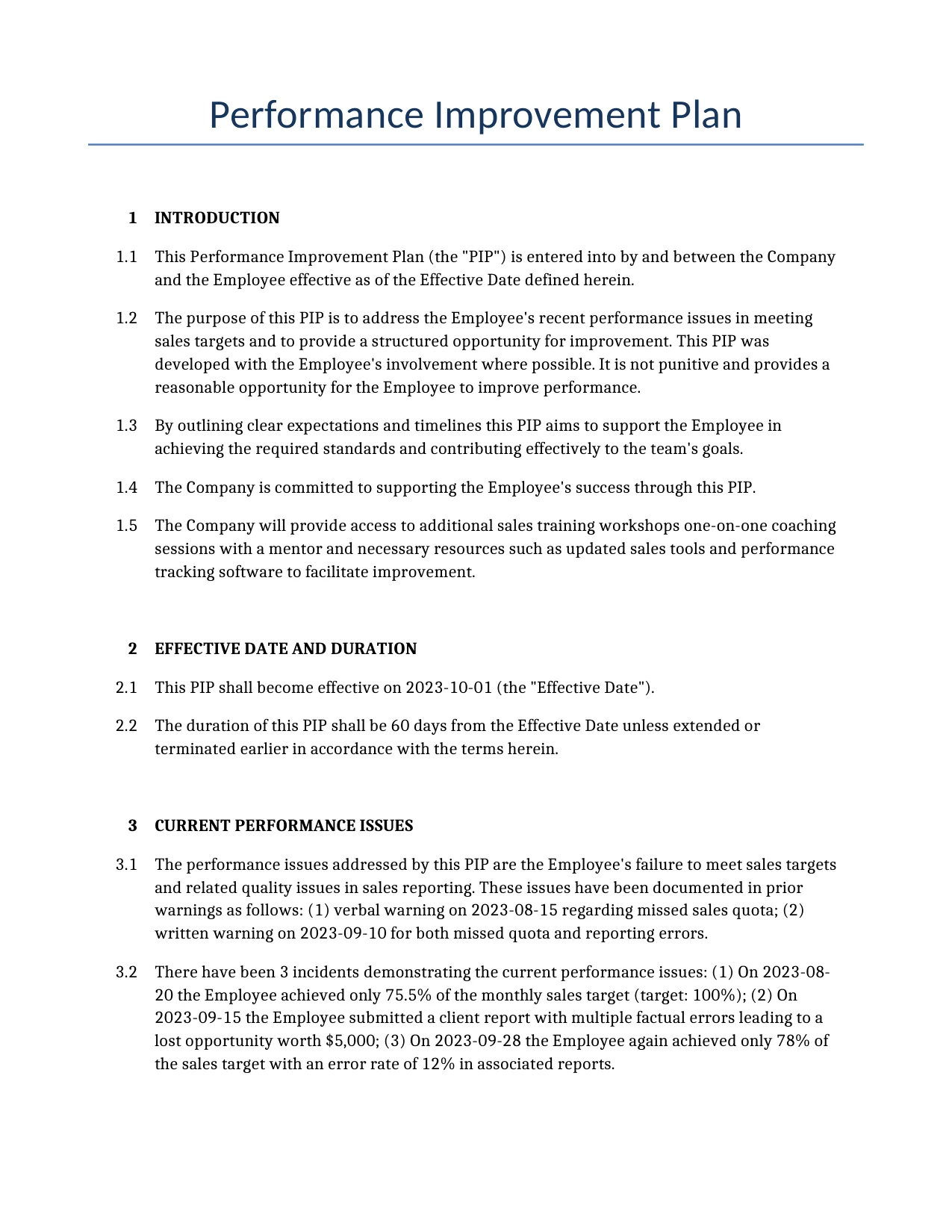
Performance Improvement Plan
1INTRODUCTION
This Performance Improvement Plan (the "PIP") is entered into by and between the Company and the Employee effective as of the Effective Date defined herein.
The purpose of this PIP is to address the Employee's recent performance issues in meeting sales targets and to provide a structured opportunity for improvement. This PIP was developed with the Employee's involvement where possible. It is not punitive and provides a reasonable opportunity for the Employee to improve performance.
By outlining clear expectations and timelines this PIP aims to support the Employee in achieving the required standards and contributing effectively to the team's goals.
The Company is committed to supporting the Employee's success through this PIP.
The Company will provide access to additional sales training workshops one-on-one coaching sessions with a mentor and necessary resources such as updated sales tools and performance tracking software to facilitate improvement.
2EFFECTIVE DATE AND DURATION
This PIP shall become effective on 2023-10-01 (the "Effective Date").
The duration of this PIP shall be 60 days from the Effective Date unless extended or terminated earlier in accordance with the terms herein.
3CURRENT PERFORMANCE ISSUES
The performance issues addressed by this PIP are the Employee's failure to meet sales targets and related quality issues in sales reporting. These issues have been documented in prior warnings as follows: (1) verbal warning on 2023-08-15 regarding missed sales quota; (2) written warning on 2023-09-10 for both missed quota and reporting errors.
There have been 3 incidents demonstrating the current performance issues: (1) On 2023-08-20 the Employee achieved only 75.5% of the monthly sales target (target: 100%); (2) On 2023-09-15 the Employee submitted a client report with multiple factual errors leading to a lost opportunity worth $5,000; (3) On 2023-09-28 the Employee again achieved only 78% of the sales target with an error rate of 12% in associated reports.
4PERFORMANCE EXPECTATIONS AND GOALS
The primary objectives that the Company sets for the Employee's improvement in this PIP are to meet or exceed sales targets and to improve accuracy in customer data entry and reporting.
The specific performance area outlined for the Employee is Sales Performance.
The Employee is expected to achieve a minimum of 100 percent of their monthly sales quota with at least 95 percent accuracy in customer data entry and reporting while maintaining timely follow-ups on leads.
The method to be used for measuring the Employee's performance against the expected standard is Quantitative Metrics including sales reports and CRM data.
The Employee must fully meet this performance goal by 2023-11-30 (within 60 days of the Effective Date).
Successful completion requires meeting or exceeding the sales quota for two consecutive months with no more than 5 percent error rate in reports as verified by monthly performance reviews.
The expected standard and measurement method are achievable for the Employee during the PIP period.
5ACTION PLAN
The Employee must address the specific performance deficiencies of consistently missing sales targets and showing a lack of attention to detail in reports leading to errors that require rework.
The Action Plan includes sales training workshops that the Employee must complete by 2023-11-30.
The Action Plan assigns a mentor to the Employee for guidance. The mentor will provide one-on-one coaching twice per week to review sales techniques, role-play client interactions, and assist with lead follow-up strategies.
The Employee must meet with their supervisor for progress reviews bi-weekly.
The Employee shall sign an acknowledgment of the Action Plan and their responsibilities under this PIP.
If the Employee fails to meet the responsibilities set forth in the Action Plan including failure to improve in sales performance the consequence shall be possible termination.
6TIMELINE AND MILESTONES
The start date for the Employee's Action Plan is 2023-10-01.
The end date for the Employee's Action Plan is 2023-11-30.
This PIP includes 3 key milestones: (1) By 2023-10-15 complete initial sales training and achieve 85% of monthly sales target; (2) By 2023-11-01 demonstrate improved reporting accuracy (error rate below 8%) and achieve at least 95% of sales target; (3) By 2023-11-30 meet or exceed 100% of sales quota for the month with error rate no more than 5%.
The first progress review check-in shall occur on 2023-10-15.
Bi-weekly progress review check-ins shall be scheduled during the PIP.
The review date scheduled for evaluating the Employee's progress under this PIP is 2023-11-30.
The milestones shall occur at 15-day 30-day and 60-day points during the PIP period.
Successful completion of the Action Plan by the Employee will be indicated by achieving the sales and accuracy targets outlined in Section 4.
7SUPPORT AND RESOURCES PROVIDED
The Company shall provide sales training workshops, one-on-one coaching, updated sales tools, and performance tracking software to assist the Employee in improving performance.
The Company will provide a 2-week sales training workshop focusing on advanced selling techniques and client engagement along with one-on-one coaching sessions scheduled twice weekly. These will fit within the 60-day PIP duration and be completed by 2023-10-31.
The Company shall provide one-on-one coaching sessions to the Employee.
The Company shall arrange an Internal Mentor for the Employee.
8MONITORING AND EVALUATION PROCESS
The Employee's progress will be monitored through regular check-in meetings review of performance metrics and ongoing feedback to ensure alignment with the outlined goals.
Meetings between the manager and the Employee for monitoring progress shall occur bi-weekly.
The manager shall use Performance Metrics Review (sales data and CRM reports) Manager Observations and Written Progress Logs as methods of assessment for evaluating the Employee's progress.
Success will be defined by achieving at least 100 percent of monthly sales quota with no more than 5 percent error rate in reports for two consecutive months and receiving positive feedback in evaluations.
The documentation requirements for the monitoring and evaluation process are Meeting Notes Progress Reports and Signed Acknowledgment Forms.
The Monitoring and Evaluation Process shall start on 2023-10-01.
The Monitoring and Evaluation Process shall end on 2023-11-30.
9CONSEQUENCES OF FAILURE TO MEET EXPECTATIONS
The primary consequence if the Employee fails to meet expectations is termination of employment. Depending on company policy and applicable state law progressive discipline may include additional steps such as further warnings before termination.
The Employee is hereby warned that failure to meet the expectations and goals set forth in this PIP may result in termination of employment.
The final evaluation of the Employee's performance under the PIP shall occur on 2023-11-30.
The Employee must achieve at least 100 percent of monthly sales quota with at least 95 percent accuracy in reports as outlined in Section 4 of this PIP in order to avoid the consequences set forth herein.
10EMPLOYEE ACKNOWLEDGMENT
The Employee acknowledges receipt of this PIP.
The Employee acknowledges their understanding of the contents of this PIP and has had the opportunity to ask questions.
The Employee agrees to participate in this PIP.
The Employee's signature is required in the acknowledgment section of this PIP.
The date of the Employee's acknowledgment of this PIP shall be on or after 2023-10-01. This PIP does not alter the at-will employment status (where applicable).
11COMPLIANCE WITH APPLICABLE LAW
This PIP is intended to comply with all applicable state and federal laws including Title VII of the Civil Rights Act of 1964 the Age Discrimination in Employment Act of 1967 (ADEA) the Americans with Disabilities Act of 1990 (ADA) the Family and Medical Leave Act of 1993 (FMLA) the Fair Labor Standards Act of 1938 (FLSA) the National Labor Relations Act of 1935 (NLRA) and the Equal Employment Opportunity Commission's Enforcement Guidance on Reasonable Accommodation and Undue Hardship under the ADA.
Nothing in this PIP shall be construed to violate any rights the Employee may have under the foregoing statutes or any other applicable law. This PIP complies with at-will employment principles applicable in this state.
The Company shall provide reasonable accommodations as required under the ADA if the Employee discloses a disability that may affect performance under this PIP. This PIP is not a contract and does not create any guarantee of continued employment.
12GOVERNING LAW
This PIP shall be governed by and construed in accordance with American law without regard to its conflict of laws principles.
13AT-WILL EMPLOYMENT
This PIP does not change the at-will nature of employment. Nothing in this PIP is intended to create an express or implied contract of employment for any duration. Either the Company or the Employee may terminate the employment relationship at any time with or without cause and with or without notice.
14CONFIDENTIALITY
All discussions and documents related to this PIP are confidential. The Employee must not disclose any details of this PIP to third parties except as required by law or with the prior written consent of the Company.
15ENTIRE AGREEMENT
This PIP constitutes the entire agreement between the Company and the Employee with respect to the subject matter hereof and supersedes all prior and contemporaneous agreements and understandings whether oral or written.
16SEVERABILITY
If any provision of this PIP is held to be invalid or unenforceable by a court of competent jurisdiction such provision shall be severed from this PIP and the remaining provisions shall remain in full force and effect.
17NOTICES
All notices required or permitted under this PIP shall be in writing and shall be deemed duly given if delivered personally or sent by registered or certified mail postage prepaid to the addresses set forth below or to such other address as either party may designate by written notice.
Notices to the Company shall be addressed to the Human Resources Department at the Company's principal place of business.
Notices to the Employee shall be addressed to the Employee at the most recent address on file with the Company.
18VARIATION
No variation of this PIP shall be effective unless it is in writing and signed by both the Company and the Employee.
19SIGNATURES
IN WITNESS WHEREOF the parties have executed this PIP as of the date first above written.
Company: _______________________________ Date: _______________
By: ___________________________________ Title: _________________
Employee: ______________________________ Date: _______________
Signature: _____________________________
This example shows approximately 70% of a typical document and is provided for illustrative purposes only. The remaining content has been omitted.
Every document generated by Docaro is tailored to your specific circumstances, jurisdiction and the information you provide. The completed document includes all applicable clauses and provisions required for your situation.
To generate the full, personalised document, answer a short series of questions and your document will be created instantly.