
AI Generated Employee Handbook for use in the United States
PDF & Word - 2026 Updated
Docaro Pricing
When Do You Need an Employee Handbook in the United States?
American Legal Rules for an Employee Handbook
Using the wrong structure for house rules can inadvertently create enforceable legal obligations or expose you to liability.
What a Proper Employee Handbook Should Include
- Company Mission and ValuesExplain the company's goals and core principles to help employees understand the workplace culture.
- Employment BasicsCover how hiring works, job roles, and what employees can expect on day one.
- Work Rules and ExpectationsOutline daily operations like hours, attendance, and performance standards.
- Pay and BenefitsDetail salary, overtime, health insurance, and other perks available to staff.
- Time Off PoliciesDescribe vacation, sick days, holidays, and leave options for personal needs.
- Safety GuidelinesProvide steps to keep the workplace safe and what to do in emergencies.
- Anti-Harassment RulesSet clear expectations for respectful behavior and how to report issues.
- Discipline and TerminationExplain steps for addressing problems and the process if employment ends.
- Technology and PrivacyCover rules for using company devices, email, and protecting personal information.
- Acknowledgment FormInclude a section for employees to confirm they read and agree to the handbook.
Generate Your Document in 4 Easy Steps
Why Use Docaro?
 United States
Free Example Employee Handbook Template
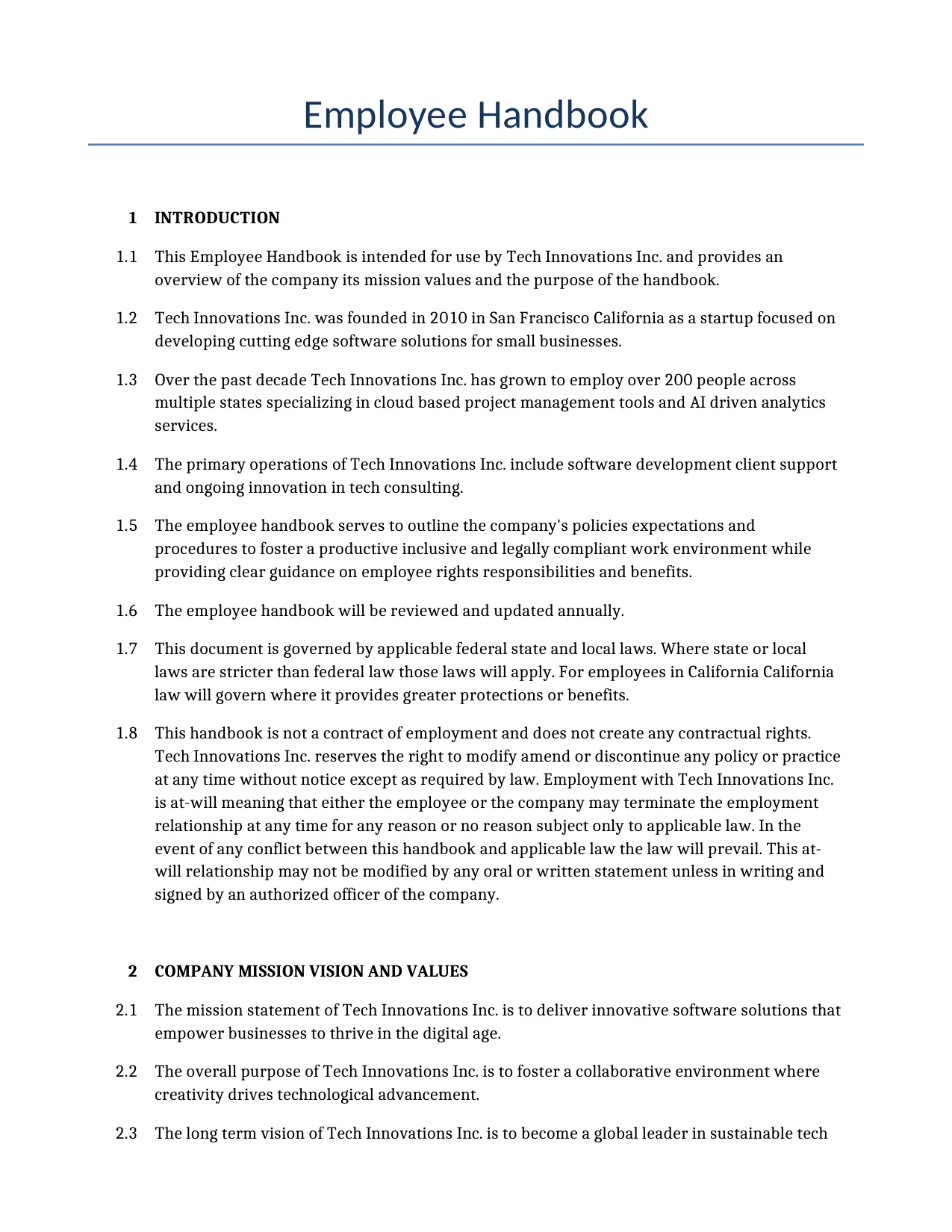
Below is a free template example of a Employee Handbook for use in the United States generated by our AI model.
The clauses in your actual Employee Handbook will vary from this example as they will be entirely bespoke to your requirements as set out in the questionnaire you complete.
Employee Handbook
1INTRODUCTION
This Employee Handbook is intended for use by Tech Innovations Inc. and provides an overview of the company its mission values and the purpose of the handbook.
Tech Innovations Inc. was founded in 2010 in San Francisco California as a startup focused on developing cutting edge software solutions for small businesses.
Over the past decade Tech Innovations Inc. has grown to employ over 200 people across multiple states specializing in cloud based project management tools and AI driven analytics services.
The primary operations of Tech Innovations Inc. include software development client support and ongoing innovation in tech consulting.
The employee handbook serves to outline the company's policies expectations and procedures to foster a productive inclusive and legally compliant work environment while providing clear guidance on employee rights responsibilities and benefits.
The employee handbook will be reviewed and updated annually.
This document is governed by applicable federal state and local laws. Where state or local laws are stricter than federal law those laws will apply. For employees in California California law will govern where it provides greater protections or benefits.
This handbook is not a contract of employment and does not create any contractual rights. Tech Innovations Inc. reserves the right to modify amend or discontinue any policy or practice at any time without notice except as required by law. Employment with Tech Innovations Inc. is at-will meaning that either the employee or the company may terminate the employment relationship at any time for any reason or no reason subject only to applicable law. In the event of any conflict between this handbook and applicable law the law will prevail. This at-will relationship may not be modified by any oral or written statement unless in writing and signed by an authorized officer of the company.
2COMPANY MISSION VISION AND VALUES
The mission statement of Tech Innovations Inc. is to deliver innovative software solutions that empower businesses to thrive in the digital age.
The overall purpose of Tech Innovations Inc. is to foster a collaborative environment where creativity drives technological advancement.
The long term vision of Tech Innovations Inc. is to become a global leader in sustainable tech innovations by 2030.
The vision statement for the future of Tech Innovations Inc. is to create a world where technology enhances human potential and promotes environmental sustainability.
Tech Innovations Inc. defines five core values that guide its operations and employee behavior.
The first core value of Tech Innovations Inc. is Integrity.
Integrity guides the operations of Tech Innovations Inc. by ensuring transparency in all dealings and encourages employees to act ethically building trust with clients and colleagues alike.
The core values of Tech Innovations Inc. are Integrity Innovation Teamwork Excellence and Customer Focus.
3EMPLOYMENT POLICIES
Employment with Tech Innovations Inc. is at will which means that either the employee or Tech Innovations Inc. may terminate the employment relationship at any time for any reason or no reason at all subject to applicable law. This at-will status cannot be modified except in a writing signed by an authorized officer of the company. This handbook does not create any contractual rights.
4EQUAL EMPLOYMENT OPPORTUNITY AND AFFIRMATIVE ACTION
Tech Innovations Inc. is an equal opportunity employer and is committed to providing equal employment opportunities to all employees and applicants without regard to race color religion sex including pregnancy childbirth lactation and related medical conditions sexual orientation gender gender identity gender expression national origin age disability genetic information including family medical history marital status military and veteran status political affiliation or any other characteristic protected by federal state or local law including but not limited to Title VII the ADA the ADEA the FMLA the PWFA the PUMP Act GINA the NLRA and California\’s FEHA. This policy applies to all terms and conditions of employment including recruiting hiring placement promotion termination layoff recall transfer leaves of absence compensation and training.
Tech Innovations Inc. maintains an anti-discrimination policy that prohibits discrimination against employees or applicants based on any protected characteristic under federal state or local law. The company with over 200 employees is fully committed to compliance with all applicable laws.
Jane Smith HR Director is designated as the Equal Employment Opportunity Officer for handling discrimination complaints at Tech Innovations Inc.
Employees should report incidents of discrimination or harassment immediately to their supervisor the HR department or the designated EEO Officer via email phone or in person.
Reports of discrimination or harassment will be kept confidential to the extent possible under the policies of Tech Innovations Inc.
Tech Innovations Inc. includes a non-retaliation clause in its anti-discrimination policy such that no employee will face retaliation for making a good faith report of discrimination or participating in an investigation as required by the EEOC Enforcement Guidance on Retaliation and Related Issues and applicable state laws.
Investigations of discrimination complaints at Tech Innovations Inc. will be conducted promptly and completed within a reasonable timeframe depending on the complexity of the matter.
Tech Innovations Inc. as a federal contractor maintains an affirmative action plan in compliance with applicable laws including Executive Order 11246 VEVRAA and Section 503 of the Rehabilitation Act.
Tech Innovations Inc. prohibits harassment based on any protected characteristic under federal state or local law. Harassment includes but is not limited to slurs epithets threats intimidation derogatory comments or jokes unwelcome sexual advances or requests for sexual favors and other verbal or physical conduct.
Tech Innovations Inc. provides reasonable accommodations for disabilities religious beliefs pregnancy childbirth lactation related medical conditions and other protected statuses in accordance with the ADA Title VII the PWFA the PUMP Act FEHA and all other applicable laws. The company will engage in an interactive process with employees requesting accommodations.
Tech Innovations Inc. with over 200 employees outlines a specific internal procedure for reporting discrimination harassment or affirmative action concerns. Employees may also file complaints with the EEOC the California Civil Rights Department or other applicable agencies.
5RECRUITMENT AND HIRING
Tech Innovations Inc. uses LinkedIn Indeed and Glassdoor as job posting platforms for recruitment.
The typical timeline for the recruitment process at Tech Innovations Inc. from posting to offer is 4 to 6 weeks.
Tech Innovations Inc. prioritizes internal candidates for open positions during recruitment.
Tech Innovations Inc. uses online job boards employee referrals and social media as sources for sourcing candidates during recruitment.
Tech Innovations Inc. requires background checks for all new hires.
The types of background checks performed by Tech Innovations Inc. on candidates include criminal history employment verification and education verification.
Tech Innovations Inc. implements pre employment drug screening as part of the hiring process in compliance with applicable laws.
Tech Innovations Inc. includes an Equal Employment Opportunity statement in all job postings.
6ORIENTATION AND ONBOARDING
Tech Innovations Inc. includes a formal new hire orientation program in this Employee Handbook.
The planned duration of the new hire orientation process at Tech Innovations Inc. is one full week.
The format used by Tech Innovations Inc. for new hire orientation includes in person sessions and virtual sessions.
Tech Innovations Inc. includes descriptions of mandatory training programs in the orientation section including training on anti-harassment EEO policies data privacy cybersecurity and safety.
The types of training programs covered by Tech Innovations Inc. in the onboarding section include safety and compliance training diversity and inclusion training and role specific skills training.
The specific activities included by Tech Innovations Inc. for integrating new hires into the company culture are team building workshops mentorship pairing with current employees and participation in company social events.
The feedback mechanisms implemented by Tech Innovations Inc. during the onboarding process are one on one check in meetings.
7COMPENSATION AND PAYROLL
Tech Innovations Inc. uses bi weekly pay frequency for employee payroll. All wages will be paid in accordance with federal and California law including timely payment requirements.
All non exempt employees of Tech Innovations Inc. are eligible for overtime pay under the Fair Labor Standards Act and California law. Exemptions are determined in compliance with FLSA and California Wage Orders. Employees classified as exempt are paid on a salary basis and meet the duties tests for exemption.
Tech Innovations Inc. calculates overtime for employees using the standard FLSA method of payment for hours worked over 40 hours per week or as required by California law for daily overtime.
Employees must submit a written request to their direct supervisor at least 24 hours in advance to obtain approval for overtime work at Tech Innovations Inc. unless it is an emergency in which case verbal approval must be obtained immediately and documented afterward.
The types of deductions included in the payroll deductions policy of Tech Innovations Inc. are federal and state income taxes Social Security and Medicare contributions health dental and vision insurance premiums and retirement plan contributions such as 401k. Deductions comply with federal and California law.
Tech Innovations Inc. requires written employee consent for all voluntary deductions in compliance with applicable laws.
The primary wage payment method offered by Tech Innovations Inc. to employees is direct deposit. Employees will receive itemized wage statements compliant with California Labor Code Section 226.
In compliance with California Labor Code Sections 201 and 202 final paychecks will be issued immediately upon termination if the employee is terminated by the company or on the last day of employment if the employee quits with at least 72 hours notice. If the employee quits without 72 hours notice final pay will be provided within 72 hours. Final pay will include all earned wages accrued but unused PTO vacation and any other compensation due. Failure to provide timely final pay may result in waiting time penalties under California law.
Tech Innovations Inc. maintains a policy for correcting payroll errors such as overpayments or underpayments in accordance with the Fair Labor Standards Act and California law.
Tech Innovations Inc. complies with federal and California minimum wage laws. The current applicable minimum wage will be paid to all non-exempt employees. California\’s minimum wage is higher than the federal rate and will be followed.
Non-exempt employees will receive reporting time pay split shift premiums meal and rest break premiums and other pay as required by California Wage Orders if applicable. Employees are entitled to a 30-minute unpaid meal break before the end of the fifth hour of work and a 10-minute paid rest break per four hours worked. If breaks are missed employees will receive premium pay of one hour of pay at the regular rate for each missed break as required by law. Employees must report any missed breaks to their supervisor immediately. On-duty meal periods may be permitted only by mutual written agreement when the nature of the work prevents relief from all duties.
8BENEFITS OVERVIEW
Tech Innovations Inc. offers life insurance benefits to its employees.
Tech Innovations Inc. offers short term and long term disability insurance to its employees.
Tech Innovations Inc. offers Health Savings Accounts in conjunction with high deductible health plans.
The annual benefits open enrollment period at Tech Innovations Inc. starts on 2024 11 01 and ends on 2024 11 15.
The open enrollment period at Tech Innovations Inc. lasts 15 days with an effective date for new health insurance coverage enrollments of 2024 12 01.
Employees must log into the benefits portal during the open enrollment period to select or modify their benefits at Tech Innovations Inc. with assistance available through HR during business hours.
All benefits are governed by the applicable plan documents Summary Plan Descriptions (SPDs) and legal requirements including the ACA ERISA HIPAA and COBRA. In the event of any conflict between this handbook and the official plan documents or SPDs the plan documents and SPDs will control. Employees may request copies of SPDs from HR.
Tech Innovations Inc. complies with all applicable requirements of the Affordable Care Act including employer shared responsibility provisions and reporting.
9HEALTH INSURANCE
Tech Innovations Inc. offers health insurance benefits to its employees through Blue Cross Blue Shield.
Tech Innovations Inc. contributes to employee health insurance premiums with the company contributing 80 percent and employees contributing 20 percent.
The annual deductible amount for the health insurance plan at Tech Innovations Inc. is 1500 USD with a coinsurance rate of 20 percent after the deductible and an annual out of pocket maximum of 6000 USD.
The health insurance plan at Tech Innovations Inc. includes prescription drug coverage.
Full time employees and part time employees are eligible for health insurance at Tech Innovations Inc. after a waiting period of 1 month.
The health insurance at Tech Innovations Inc. includes dependent coverage and offers PPO and HDHP plan options.
Tech Innovations Inc. offers dental insurance benefits to its employees through Delta Dental with the company contributing to premiums and an annual maximum benefit of 1500 USD including orthodontic coverage.
Tech Innovations Inc. offers vision insurance benefits to its employees through VSP Vision Care with the company contributing to premiums covered vision exams every 12 months and an allowance of 200 USD for glasses or contacts.
Tech Innovations Inc. complies with the Health Insurance Portability and Accountability Act (HIPAA) and the Health Information Technology for Economic and Clinical Health (HITECH) Act to protect the privacy and security of employees\’ protected health information. Employees\’ medical information will be kept confidential as required by law.
Upon termination of employment employees may be eligible for continuation of health coverage under COBRA. See the new COBRA subsection below for details.
New subsection on COBRA continuation coverage: In compliance with the Consolidated Omnibus Budget Reconciliation Act (COBRA) Tech Innovations Inc. provides qualified employees and their dependents the opportunity to continue health insurance coverage at group rates for a limited time after certain qualifying events such as termination of employment reduction in hours or other events. The company will provide a COBRA notice explaining rights and responsibilities. Continuation coverage may last up to 18 months or longer in certain cases. Employees must pay the full premium plus a 2 percent administrative fee. Failure to pay premiums timely may result in loss of coverage. More information is available in the SPD or from HR. COBRA does not apply to small employers but the company provides this for compliance where applicable.
10RETIREMENT PLANS
Tech Innovations Inc. offers a retirement savings plan including a 401k plan with matching contributions of 50 percent up to 6 percent of salary.
The vesting schedule for company matching contributions in the 401k plan at Tech Innovations Inc. is graded vesting of 20 percent per year over 5 years.
The effective date for the retirement plans described in this handbook at Tech Innovations Inc. is 2024 01 01.
Retirement plans are governed by the Employee Retirement Income Security Act (ERISA). As a plan fiduciary Tech Innovations Inc. is responsible for administering the plan prudently and in the best interests of participants. Employees have rights under ERISA including the right to examine plan documents and receive a Summary Plan Description (SPD). Questions regarding the plan should be directed to HR or the plan administrator. Contribution limits are set by the IRS and may change annually. The company\’s fiduciary responsibilities include acting solely in the interest of participants exercising prudence in investments and following the plan document.
11PAID TIME OFF (PTO)
Tech Innovations Inc. offers paid time off benefits to its employees including 15 paid vacation days per year and 7 paid sick days per year for full time employees. In compliance with California\’s Healthy Workplaces Healthy Families Act of 2014 the company provides at least 24 hours or 3 days of paid sick leave per year which may be included in the PTO policy. Additional sick leave accrues at the rate of 1 hour per 30 hours worked.
Tech Innovations Inc. includes a vacation policy and a sick leave policy in its Paid Time Off section. Sick leave may be used for the employee\’s own illness injury preventive care or to care for a family member as defined by law. Sick leave may not be used for vacation purposes.
Employees at Tech Innovations Inc. accrue vacation days and sick leave over time rather than receiving them all at once and may carry over unused sick leave to the next year as required by California law. Accrued but unused vacation is paid out upon termination.
Tech Innovations Inc. includes personal days in its Paid Time Off section and uses monthly accrual for PTO with carryover of unused PTO to the next year allowed until the end of the PTO benefit year on 12 31 2024.
The approval process for PTO usage requests at Tech Innovations Inc. requires supervisor approval and employees may not take advance PTO before it is accrued.
Tech Innovations Inc. pays out unused PTO to employees upon termination in accordance with applicable law including California requirements for vacation payout.
California Paid Family Leave (PFL) provides partial wage replacement for employees taking time off to bond with a new child care for a seriously ill family member or participate in qualifying exigencies related to a family member\’s military service. PFL is administered through the State of California and employees should contact the Employment Development Department (EDD) for benefits. This does not create additional job-protected leave beyond what is provided under FMLA or CFRA.
12HOLIDAYS AND LEAVE OF ABSENCE
Tech Innovations Inc. includes a list of standard company holidays in this Employee Handbook which are New Year\’s Day Martin Luther King Jr. Day Presidents\’ Day Memorial Day Juneteenth Independence Day Labor Day Thanksgiving Day Day after Thanksgiving and Christmas Day.
All listed company holidays are paid holidays for eligible employees at Tech Innovations Inc.
Tech Innovations Inc. provides Family and Medical Leave Act (FMLA) leave to eligible employees in compliance with the FMLA. Eligible employees may take up to 12 weeks of unpaid job-protected leave in a 12-month period for qualifying reasons including serious health conditions birth or adoption of a child or caring for a family member. The company also complies with the California Family Rights Act (CFRA) which provides up to 12 weeks of leave (or 26 weeks in certain military caregiver situations) and runs concurrently with FMLA where applicable but may provide additional protections under California law.
Tech Innovations Inc. provides gender-neutral paid parental leave for bonding with a new child. Eligible employees may receive up to 12 weeks of paid parental leave in accordance with company policy the PWFA and applicable state laws. Leave for pregnancy childbirth or related conditions will be provided as required by the Pregnant Workers Fairness Act (PWFA) the PUMP for Mothers Act and California law including reasonable accommodations for pregnant employees and lactation accommodations. Employees should contact HR to request leave or accommodations.
Tech Innovations Inc. includes policies for bereavement leave jury duty leave military leave and sick leave in this handbook. Employees will be granted leave for jury duty as required by law and will receive regular pay for up to 5 days of jury service per year less any jury fees received. The company complies with the Uniformed Services Employment and Reemployment Rights Act (USERRA) for military leave and will reemploy eligible employees following qualified military service. Bereavement leave of up to 3 days is provided for the death of an immediate family member.
Tech Innovations Inc. requires a formal approval process for all leaves of absence. All leaves will be reviewed on a case-by-case basis to ensure compliance with federal state and local laws. Employees returning from leave will be restored to the same or equivalent position as required by law.
The effective date for the Holidays and Leave of Absence section in this handbook is 2024 01 01.
Voting leave will be provided as required by applicable state law. Employees should provide reasonable notice to vote outside of working hours if possible.
13WORK HOURS AND ATTENDANCE
Standard work hours at Tech Innovations Inc. are Monday through Friday from 9 00 AM to 5 00 PM with a total of 40 hours per week. Non-exempt employees will not work more than the maximum hours permitted without overtime compensation as required by the FLSA and California law.
Tech Innovations Inc. includes a policy on overtime work for its employees in compliance with the Fair Labor Standards Act and California law.
The duration for meal breaks at Tech Innovations Inc. is 30 minutes and must be provided before the end of the fifth hour of work. The rest break policy is a 10-minute paid rest break per every 4 hours worked or major fraction thereof. These comply with California Labor Code and Wage Order requirements. If an employee is required to work during a meal or rest break the employee must report it immediately and will receive one additional hour of pay at the regular rate for each workday that a compliant meal or rest break is not provided. Employees may not waive breaks. On-duty meal periods are permitted only when the nature of the work prevents an employee from being relieved of all duty and only by mutual written agreement that can be revoked by the employee at any time. Make-up breaks will be provided as soon as practicable if a break is missed due to business necessity.
Tech Innovations Inc. uses electronic time tracking software for tracking employee attendance. All non-exempt employees must accurately record all hours worked including start and stop times meal periods and any overtime. Falsification of time records is grounds for disciplinary action up to and including termination.
Employees at Tech Innovations Inc. must notify their supervisor 24 hours in advance for planned absences.
Tech Innovations Inc. includes an accrual system for paid time off in its attendance policy.
Employees must notify their direct supervisor by phone or email at least 2 hours before the start of their shift for unplanned absences at Tech Innovations Inc. including the reason and expected duration.
This policy is intended to comply with all applicable California Wage Orders and the California Labor Code. In the event of any conflict applicable law prevails.
14DRESS CODE AND PERSONAL APPEARANCE
Tech Innovations Inc. implements a business casual dress code policy for its employees.
Tech Innovations Inc. prohibits jeans T shirts and athletic wear unless otherwise approved for specific roles or as a reasonable accommodation.
Employees at Tech Innovations Inc. must maintain a neat and professional appearance including clean and well groomed hair minimal visible tattoos or piercings and no strong fragrances that could affect others. The company prohibits discrimination based on gender expression or gender identity and will provide reasonable accommodations for religious dress and grooming practices as required by Title VII and California law.
Tech Innovations Inc. handles requests for religious accommodations regarding dress and appearance on a case by case evaluation in compliance with Title VII of the Civil Rights Act of 1964 the ADA FEHA and all other applicable laws.
In areas involving machinery or hazards employees at Tech Innovations Inc. must wear closed toe shoes protective eyewear and high visibility vests as required by OSHA standards.
Workplace Violence Prevention: Tech Innovations Inc. is committed to providing a safe workplace and complies with California requirements for workplace violence prevention including risk assessments training and maintaining a Workplace Violence Prevention Plan. Threats of violence harassment intimidation or violent behavior will not be tolerated. Employees must report any incidents or threats immediately to their supervisor or HR. All reports will be investigated promptly and appropriate action taken including possible disciplinary action up to termination and involvement of law enforcement as necessary. The company provides training on de-escalation and emergency response. See the Health and Safety section for related policies.
15PERFORMANCE MANAGEMENT
Tech Innovations Inc. conducts semi annual performance reviews for its employees with the performance review cycle starting on 2024 01 01. Performance management does not alter the at-will nature of employment.
The performance review process at Tech Innovations Inc. involves a structured meeting between the employee and their manager to discuss achievements challenges and future goals with reviews including self assessment forms completed by employees prior to the meeting.
Employees and managers at Tech Innovations Inc. are required to set individual goals during performance management.
Tech Innovations Inc. includes a process for ongoing feedback outside of formal reviews.
Tech Innovations Inc. implements Performance Improvement Plans for underperforming employees. PIPs do not create any guarantee of continued employment and do not alter at-will status.
The Performance Improvement Plan process at Tech Innovations Inc. begins with a formal discussion identifying performance issues followed by setting specific measurable goals and a timeline typically 90 days with regular check ins to monitor progress and support provided as needed.
Consequences for employees at Tech Innovations Inc. who do not meet PIP goals include termination or demotion. Termination may occur at any time consistent with at-will employment.
16TRAINING AND DEVELOPMENT
Tech Innovations Inc. includes a section on professional development opportunities for employees in this Employee Handbook.
The types of professional development opportunities offered by Tech Innovations Inc. to employees include workshops and seminars online courses and certifications and mentorship programs.
Tech Innovations Inc. includes a tuition reimbursement program for employees pursuing higher education for job related courses only that meet a minimum grade requirement.
Tech Innovations Inc. describes career advancement programs such as promotions or internal mobility in this Employee Handbook. Advancement decisions do not alter at-will employment status.
17WORKPLACE CONDUCT AND BEHAVIOR
Tech Innovations Inc. includes an anti harassment policy in the Workplace Conduct and Behavior section. This policy is not a contract and does not alter at-will employment.
Tech Innovations Inc. emphasizes expectations for respect including non discrimination based on protected characteristics and inclusive language and communication.
Tech Innovations Inc. requires annual ethical behavior training for employees covering conflict of interest disclosure confidentiality and data protection and honesty in reporting and communications.
Tech Innovations Inc. includes a confidential reporting mechanism for conduct violations.
The next review of the Workplace Conduct and Behavior policies at Tech Innovations Inc. is set for 2025 12 31 and 30 days are allowed for resolving employee grievances related to conduct.
18ANTI-HARASSMENT AND ANTI-BULLYING POLICY
Tech Innovations Inc. maintains this Anti Harassment and Anti Bullying Policy that explicitly prohibits harassment based on race color religion sex including pregnancy childbirth lactation and related conditions sexual orientation gender gender identity gender expression national origin age disability genetic information marital status military or veteran status political affiliation or any other characteristic protected by law.
This policy at Tech Innovations Inc. includes a general prohibition on all forms of harassment and bullying beyond protected characteristics with a zero tolerance approach.
Examples of prohibited conduct at Tech Innovations Inc. include verbal abuse physical intimidation cyberbullying and retaliation.
Employees should promptly report any incidents of harassment or bullying to their supervisor HR or through the designated channels at Tech Innovations Inc. providing as much detail as possible including dates times and witnesses.
Reporting channels at Tech Innovations Inc. include immediate supervisor Human Resources Department and anonymous hotline with anonymous reporting allowed.
All reports at Tech Innovations Inc. will be investigated promptly and impartially by HR or a designated investigator including interviews with involved parties and collection of relevant evidence while maintaining confidentiality to the extent possible with investigations completed within a reasonable time not to exceed 60 days unless extended for good cause.
This policy at Tech Innovations Inc. includes a strong non retaliation clause protecting reporters and participants in accordance with the EEOC Enforcement Guidance on Retaliation and Related Issues and California law.
Violations at Tech Innovations Inc. may result in disciplinary actions up to and including verbal or written warnings suspension termination of employment or other appropriate measures depending on the severity of the conduct.
This policy at Tech Innovations Inc. requires mandatory training on anti harassment and anti bullying for employees and becomes effective on 2024 01 01. This policy does not create contractual rights and does not alter the at-will nature of employment.
19HEALTH AND SAFETY
Employees at Tech Innovations Inc. must report all workplace hazards immediately to their supervisor.
Employees must report any observed workplace hazard immediately to their direct supervisor either in person by phone at extension 123 or via the internal reporting app at Tech Innovations Inc.
If the supervisor is unavailable at Tech Innovations Inc. the employee must report to the Safety Officer at safety@company.com within 15 minutes and all reports will be documented and investigated within 24 hours.
Tech Innovations Inc. mandates regular emergency evacuation drills for all employees conducted quarterly. The company maintains an Emergency Action Plan compliant with OSHA standards detailing procedures for fires natural disasters medical emergencies and other events. All employees will receive training on the plan.
The designated emergency assembly points for the workplace at Tech Innovations Inc. are the parking lot north of the main building for the primary point and the grassy area by the loading dock for the east wing with all points marked with green signage and verified clear during roll call.
Tech Innovations Inc. affirms its commitment to full OSHA compliance in all operations including hazard communication standards provision of personal protective equipment (PPE) as needed ergonomics training to prevent repetitive strain injuries and maintenance of a safe workplace free from recognized hazards.
The types of workplace hazards present in the operations of Tech Innovations Inc. are chemical physical and ergonomic.
First aid kits at Tech Innovations Inc. are located in the main lobby near the reception desk in the break room on the second floor in the warehouse storage area and in each department\’s main office with all kits clearly marked and inspected monthly.
Lactation Accommodation: In compliance with the PUMP for Mothers Act and California law Tech Innovations Inc. will provide reasonable break time and a private non-bathroom space shielded from view for employees to express breast milk for up to one year after the child\’s birth. Employees should notify HR of their needs. The company will engage in an interactive process to provide appropriate accommodations.
20CONFIDENTIALITY AND DATA PROTECTION
Employees at Tech Innovations Inc. are required to protect company and employee confidential information.
Employees at Tech Innovations Inc. are required to sign Non Disclosure Agreements as part of the Confidentiality and Data Protection section.
Confidential information at Tech Innovations Inc. is defined to include trade secrets customer lists financial records proprietary software employee personal data and internal business strategies.
Data security measures required by Tech Innovations Inc. from employees include password protection encryption of data secure device usage and regular training.
Employees at Tech Innovations Inc. must report any suspected confidentiality or data protection breaches immediately. The company maintains breach notification procedures in compliance with applicable laws including the California Consumer Privacy Act (CCPA/CPRA).
Disciplinary consequences apply for violations of confidentiality and data protection policies at Tech Innovations Inc. up to and including termination.
Employee data categories explicitly protected under the data protection policy at Tech Innovations Inc. include personal identifiable information health and medical data financial information and performance reviews. The company complies with the CCPA/CPRA providing California residents the right to know access delete and opt-out of sale of their personal information. Employees may submit privacy requests to HR.
Employees at Tech Innovations Inc. are prohibited from disclosing confidential information to third parties without authorization.
Electronic Monitoring Notice (California): Tech Innovations Inc. may monitor employees\’ use of company systems including email internet activity and computer usage for security compliance and business purposes. Employees have no expectation of privacy in their use of company-provided equipment or networks. This notice is provided pursuant to California law.
21INTELLECTUAL PROPERTY
Employees at Tech Innovations Inc. must assign all rights in inventions created during employment to the company including a standard invention assignment clause that requires employees to promptly assign all rights title and interest in any inventions conceived or reduced to practice during employment to the company including a waiver of moral rights where applicable.
Tech Innovations Inc. owns all copyrights in works created by employees during employment.
Employees at Tech Innovations Inc. must disclose any prior inventions they own before or during employment through mandatory disclosure.
All trademarks created or used by employees belong to Tech Innovations Inc.
Employees at Tech Innovations Inc. are obligated to maintain confidentiality of IP related information indefinitely after employment ends.
Employees at Tech Innovations Inc. must assist the company in securing and enforcing IP rights such as by signing documents.
22USE OF COMPANY PROPERTY
Employees at Tech Innovations Inc. are required to sign an acknowledgment form confirming they have read and understood the company property use policy.
The policy at Tech Innovations Inc. covers use restrictions for computing devices vehicles software and licenses and office equipment.
Limited personal use of company property by employees outside of work hours is not permitted at Tech Innovations Inc.
Activities explicitly prohibited when using company property at Tech Innovations Inc. include illegal or unlawful actions harassment or discrimination accessing inappropriate content and unauthorized software installation.
Tech Innovations Inc. monitors employee usage of company property such as internet activity or vehicle logs consistent with the electronic monitoring notice in Section 20.
Tech Innovations Inc. includes a specific policy section on the use of company vehicles and requires tracking and auditing of software licenses used on company property.
Inventory checks of company property assets are required every 6 months at Tech Innovations Inc.
All company property including devices keys and access cards must be returned on the last day of employment or within 24 hours of termination notice at Tech Innovations Inc. in good condition with any necessary passwords provided.
Disciplinary actions apply for misuse of company property at Tech Innovations Inc.
23INFORMATION TECHNOLOGY POLICIES
Tech Innovations Inc. allows the company to monitor employee emails for compliance and security purposes as detailed in the electronic monitoring notice.
Employees at Tech Innovations Inc. are not permitted to use personal email accounts for company business.
The policy for employee internet usage during work hours at Tech Innovations Inc. is limited personal use.
Employees at Tech Innovations Inc. are allowed to access personal social media accounts during work hours with guidelines that prohibit confidential information sharing and encourage positive engagement. See the new Social Media section for additional details.
Annual cybersecurity training is mandatory for all employees at Tech Innovations Inc.
Acceptable technology practices at Tech Innovations Inc. require that employees must use company technology resources responsibly avoiding any activities that could compromise security such as downloading unauthorized software or visiting high risk websites with all usage aligned with business needs and ethical standards.
Employees at Tech Innovations Inc. must change their passwords every 90 days.
The policy regarding personal device usage for company work at Tech Innovations Inc. is BYOD with restrictions. See the new BYOD section for details.
Employees at Tech Innovations Inc. must report suspected cybersecurity incidents immediately. The company maintains a Cybersecurity Incident Response Plan that includes identification containment eradication recovery and post-incident review. Employees must cooperate fully with any investigation.
Tech Innovations Inc. complies with all applicable data privacy laws including the CCPA/CPRA. For California residents the company provides notice of data collection and rights to access delete or opt out of the sale of personal information.
24DRUG AND ALCOHOL POLICY
The policy at Tech Innovations Inc. prohibits the use of alcohol on company premises and during work hours the possession or use of illegal drugs by employees at any time and the misuse of prescription medications without a valid prescription.
The types of drug and alcohol testing included in the policy at Tech Innovations Inc. are pre employment testing random testing reasonable suspicion testing and post accident testing in compliance with applicable laws.
Employees at Tech Innovations Inc. are required to sign a consent form before any drug or alcohol testing.
A positive test result at Tech Innovations Inc. does not result in immediate termination but disciplinary actions for policy violations include warning suspension termination and rehabilitation referral.
Tech Innovations Inc. provides an Employee Assistance Program for substance abuse support.
Employees at Tech Innovations Inc. must acknowledge receipt and understanding of the drug and alcohol policy which becomes effective on 2024 01 01.
25SMOKING AND TOBACCO USE
Tech Innovations Inc. allows smoking in designated outdoor areas on the company premises but prohibits all forms of tobacco use including smokeless products like chewing tobacco and e cigarettes in the entire workplace.
The policy at Tech Innovations Inc. covers all indoor workspaces outdoor company premises and company vehicles and becomes effective on 2024 01 01.
Enforcement measures for violations of the smoking and tobacco use policy at Tech Innovations Inc. include verbal warning and written reprimand.
26DISCIPLINARY ACTION
The progressive discipline policy at Tech Innovations Inc. aims to address employee performance or conduct issues through a structured fair process including verbal counseling written warnings performance improvement plans and potential suspension before termination with the goal to encourage improvement while ensuring compliance with company standards. However progressive discipline is discretionary and does not alter the at-will employment relationship. The company may terminate employment at any time with or without cause or notice.
The progressive discipline process at Tech Innovations Inc. includes a verbal warning as the first step a written warning as a subsequent step and suspension without pay as a disciplinary option.
Termination at Tech Innovations Inc. will occur after documented progressive discipline steps unless severe misconduct applies with employees receiving at least two weeks notice or pay in lieu thereof except in cases of immediate termination and HR will handle exit interviews and final payroll. This does not create any contractual right to notice or progressive discipline.
A fixed notice period applies for terminations under progressive discipline at Tech Innovations Inc. with written documentation required for every step of the disciplinary process. Nothing in this policy changes the at-will nature of employment.
Immediate termination is allowed at Tech Innovations Inc. in cases of severe misconduct without progressive steps and the disciplinary action procedures apply to all employees with the policy effective on 2024 01 01. The company complies with the federal Worker Adjustment and Retraining Notification (WARN) Act and California WARN for mass layoffs or plant closings providing required notices where applicable.
27TERMINATION OF EMPLOYMENT
Voluntary termination at Tech Innovations Inc. occurs when an employee chooses to end their employment with the company such as through resignation or retirement and employees are required to provide a notice period for voluntary termination. Employment remains at-will.
The types of involuntary termination covered in this Employee Handbook at Tech Innovations Inc. are layoff due to economic reasons disciplinary termination and termination for cause. The company complies with WARN Act requirements for mass layoffs providing 60 days\’ notice where required by federal or California law.
Tech Innovations Inc. includes a policy for conducting exit interviews in this Employee Handbook.
Final pay at Tech Innovations Inc. will be issued in compliance with California law as detailed in Section 7.8.
Post employment obligations addressed in this Employee Handbook at Tech Innovations Inc. for former employees include confidentiality of company information return of company property and non compete agreements where permitted by law.
All terminations at Tech Innovations Inc. will follow a structured process including documentation HR involvement and final settlement of employee accounts to ensure compliance with company policies and legal requirements.
Employment at Tech Innovations Inc. is at will as explicitly stated in the Termination of Employment section and throughout this handbook. This at-will status cannot be modified by any policy or statement in this handbook.
28GRIEVANCE PROCEDURE
This Grievance Procedure outlines a fair and impartial process for employees to address workplace concerns and resolve disputes effectively at Tech Innovations Inc. This procedure does not create any contractual rights alter at-will employment or establish binding arbitration or due process requirements beyond what is required by law.
Eligible grievances at Tech Innovations Inc. under this procedure include discrimination or harassment unfair treatment or favoritism and working conditions or safety.
Employees at Tech Innovations Inc. are encouraged to first discuss their grievance directly with their immediate supervisor or the involved party to seek an amicable resolution as the informal resolution step and have 10 days to attempt informal resolution before escalating.
A formal written submission is required for grievances that cannot be resolved informally at Tech Innovations Inc. using email to HR or online portal with the form including the employee\’s name contact information a detailed description of the grievance dates and times of incidents names of witnesses and any supporting evidence.
Employees at Tech Innovations Inc. have 30 days after the incident to submit a formal grievance.
An investigation process is outlined for submitted grievances at Tech Innovations Inc. with the Human Resources Director or a designated HR representative as the investigator and the company has 14 days to complete the investigation followed by a resolution provided within 7 days. Timelines may be extended for good cause.
An appeal process is included at Tech Innovations Inc. for employees dissatisfied with the resolution with the company CEO or a senior executive panel as the authority for handling appeals and employees have 10 days to file an appeal after receiving the initial resolution.
Confidentiality is emphasized throughout the grievance procedure at Tech Innovations Inc. with a non retaliation policy explicitly stated and records of grievances retained for 3 years. This procedure does not limit employees\’ rights to file complaints with government agencies.
29ACCOMMODATIONS FOR DISABILITIES
Tech Innovations Inc. is committed to providing reasonable accommodations to qualified individuals with disabilities in accordance with the Americans with Disabilities Act FEHA the PWFA and all other applicable laws.
Tech Innovations Inc. will engage in an interactive process with employees requesting accommodations under this policy.
Full time employees part time employees and temporary or contract employees qualify as employees eligible for accommodations under this policy at Tech Innovations Inc.
A disability is defined as a physical or mental impairment that substantially limits one or more major life activities a record of such an impairment or being regarded as having such an impairment as per the ADA in this policy at Tech Innovations Inc.
Employees at Tech Innovations Inc. are required to provide medical documentation when requesting accommodations using written form to HR email to designated contact or online portal submission.
The Human Resources Director is designated as the primary coordinator for handling accommodation requests at Tech Innovations Inc. which must acknowledge and begin the interactive process within 5 days after receiving a request.
Examples of reasonable accommodations at Tech Innovations Inc. include modified work schedules assistive technology or equipment job restructuring and accessible workspace modifications.
This policy at Tech Innovations Inc. explains that an undue hardship is a significant difficulty or expense to the company considering factors such as the nature and cost of the accommodation the overall financial resources of the company and the impact on operations.
Employees at Tech Innovations Inc. may appeal a denied request by submitting a written appeal to the HR Director within 10 days of the denial with a final decision provided within 15 days.
This policy at Tech Innovations Inc. assures employees that all accommodation information will be kept confidential and prohibits retaliation against employees who request or use accommodations with an effective date of 2024 01 01. This policy does not alter at-will employment.
30REMOTE WORK AND TELECOMMUTING
Tech Innovations Inc. allows remote work and telecommuting for its employees based on job role and performance.
Employees at Tech Innovations Inc. must submit a formal request to their direct supervisor via email including reasons for the request and proposed schedule with the supervisor reviewing and forwarding to HR for final approval within 7 business days.
Tech Innovations Inc. provides equipment for remote workers and measures productivity using output based metrics and regular check ins with an expected 8 hours per day for remote workers.
Employees at Tech Innovations Inc. must maintain a safe and dedicated remote workspace and follow data security measures including VPN usage and device encryption with the remote work policy effective on 2024 01 01.
Expense Reimbursement for Remote Work: In compliance with California Labor Code Section 2802 Tech Innovations Inc. will reimburse employees for all necessary and reasonable business-related expenses incurred in the course of remote work such as internet service home office equipment (if not provided by the company) and utilities attributable to work use. Employees must submit expense reports with receipts within 30 days. The company will not reimburse personal expenses or those not pre-approved.
31TRAVEL AND EXPENSE REIMBURSEMENT
Employees at Tech Innovations Inc. must obtain prior authorization before engaging in business travel with approved modes of transportation including air travel and personal vehicle at a mileage reimbursement rate of 0.67 dollars per mile or the current IRS or California rate whichever is higher.
Reimbursement is allowed for lodging expenses during business travel at Tech Innovations Inc. using a per diem allowance for meals with expense reports submitted within 30 days after travel.
Receipts are required for all expense reimbursements including small amounts at Tech Innovations Inc. with the direct supervisor as the approving authority and explicit exclusions for alcoholic beverages and family travel.
Advance payments or cash advances are allowed for anticipated travel expenses at Tech Innovations Inc. with the policy effective on 2024 01 01.
32EMPLOYEE RECOGNITION AND REWARDS
Tech Innovations Inc. implements formal employee recognition programs including verbal praise certificates or awards and monetary bonuses occurring monthly. Recognition programs do not alter at-will employment.
The rewards program at Tech Innovations Inc. includes quarterly bonuses for top performers gift cards for consistent attendance and team outings for department milestones to foster a positive and motivated work environment with a start date of 2024 01 01.
Eligibility criteria for participation in recognition and rewards at Tech Innovations Inc. are all employees after probation based on tenure.
33DIVERSITY EQUITY AND INCLUSION
Tech Innovations Inc. includes a formal statement on commitment to diversity in the Diversity Equity and Inclusion section of this Employee Handbook and mandates annual inclusion training programs for all employees.
The DEI policies at Tech Innovations Inc. include regular audits of hiring practices to ensure equitable opportunities mentorship programs for underrepresented groups and celebrations of cultural diversity through company events targeting women racial and ethnic minorities LGBTQ+ individuals and people with disabilities for diversity recruitment initiatives.
A mechanism is included for employees to report DEI related concerns anonymously at Tech Innovations Inc.
34ENVIRONMENTAL POLICIES
Tech Innovations Inc. includes a general sustainability policy in this Employee Handbook describing goals to reduce carbon footprint by 20 percent over the next five years through efficient resource use and renewable energy adoption and to promote biodiversity by sourcing sustainable materials.
A recycling program policy is included at Tech Innovations Inc. for employees to separate and recycle paper and cardboard plastics glass and metals with energy conservation measures and a waste reduction policy also included.
Environmental responsibility training is required annually for employees at Tech Innovations Inc.
35CONFLICT OF INTEREST
Employees at Tech Innovations Inc. are required to disclose any financial interests that could create a conflict of interest and any family or personal relationships with suppliers customers or other employees that might pose a conflict of interest covering immediate family members and extended family.
Guidelines at Tech Innovations Inc. prohibit or restrict employees\’ outside employment that conflicts with their duties to the company with specific steps for ethical decision making when a potential conflict arises including identify the potential conflict assess the impact on company interests consult with supervisor or HR disclose fully and document the decision and recuse if necessary to avoid bias.
Reporting mechanisms at Tech Innovations Inc. for potential conflicts of interest include direct supervisor Human Resources Department and anonymous hotline with employees required to annually certify that they have no undisclosed conflicts of interest.
36WHISTLEBLOWER POLICY
Employees at Tech Innovations Inc. are allowed to make anonymous reports under the Whistleblower Policy with the company explicitly stating that it will not retaliate against employees who report in good faith. This policy does not alter at-will employment.
Reporting channels at Tech Innovations Inc. under the Whistleblower Policy include Human Resources Department hotline or anonymous line and external regulatory bodies.
Employees at Tech Innovations Inc. should submit reports in writing via email to the HR department or through the anonymous hotline including details such as the nature of the issue individuals involved dates and any supporting evidence with reports acknowledged within 48 hours and investigated promptly and reports must be made in good faith to qualify for protection.
Types of activities protected under the Whistleblower Policy at Tech Innovations Inc. include violations of law fraud or financial misconduct health and safety violations and discrimination or harassment with confidentiality assured to the extent permitted by law.
37ACKNOWLEDGMENT AND SIGNATURE
I acknowledge that I have received and read the Employee Handbook of Tech Innovations Inc. and understand its contents including all policies procedures and expectations outlined herein. I understand that this handbook is not a contract of employment and does not create any contractual rights. I further understand that my employment is at-will and that policies may change at any time.
I agree to abide by the policies set forth in this Employee Handbook and understand that this handbook does not create a contract of employment and that my employment is at will.
Employee Signature: _______________________________ Date: _______________
Printed Name: _____________________________________
On behalf of Tech Innovations Inc. I acknowledge the above.
Company Representative Signature: _______________________________ Date: _______________
Printed Name and Title: _____________________________________
38WORKERS' COMPENSATION
Tech Innovations Inc. provides workers\’ compensation insurance as required by California law for all employees. This insurance covers medical expenses and a portion of lost wages for work-related injuries or illnesses. Employees must report any work-related injury or illness to their supervisor immediately no later than 24 hours after the incident. Failure to report promptly may delay or jeopardize benefits. The company will not retaliate against employees who file valid workers\’ compensation claims. More information including claim forms and the designated medical provider is available from HR. This policy complies with California Labor Code requirements for workers\’ compensation.
39UNEMPLOYMENT INSURANCE
Tech Innovations Inc. participates in the state unemployment insurance program as required by federal and California law. Eligible employees who become unemployed through no fault of their own may qualify for unemployment benefits administered by the California Employment Development Department (EDD). The company will provide necessary separation information to the EDD. Filing for unemployment benefits will not result in retaliation. For more information employees should contact the EDD directly.
40SOCIAL MEDIA AND ELECTRONIC COMMUNICATIONS
Tech Innovations Inc. recognizes that employees may engage in social media and electronic communications. This policy applies to all forms of social media including but not limited to Facebook LinkedIn X (formerly Twitter) Instagram TikTok blogs and personal websites. Employees must comply with all company policies including confidentiality intellectual property anti-harassment and cybersecurity when using social media whether on company time or personal time if it relates to the company. Employees may not post confidential information trade secrets or proprietary data. Employees may not speak on behalf of the company unless authorized. Violations may result in disciplinary action up to termination. The company may monitor social media activity consistent with applicable law including the electronic monitoring notice. This policy complies with the NLRA regarding protected concerted activities.
Employees are encouraged to use social media responsibly and positively. When identifying themselves as Tech Innovations Inc. employees online employees should include a disclaimer that views expressed are their own and not the company\’s. Employees should respect copyrights and trademarks and obtain permission before posting company-related content.
41BRING YOUR OWN DEVICE (BYOD)
Tech Innovations Inc. permits employees to use personal devices for business purposes under a Bring Your Own Device (BYOD) program. Participation is voluntary. By participating employees agree to install company-managed mobile device management (MDM) software that allows the company to remotely wipe company data in the event of loss theft or termination. Employees must follow all IT security policies including password requirements encryption and reporting of lost devices. The company is not responsible for personal data on the device. Upon termination or removal from the BYOD program the company may wipe company data. Employees must reimburse the company for any unauthorized charges. Detailed BYOD agreements must be signed. This policy complies with California privacy laws and Labor Code Section 2802 for necessary reimbursements.
42MEDIA RELATIONS
Only authorized representatives of Tech Innovations Inc. may speak to the media on behalf of the company. Employees who are contacted by media representatives regarding company matters must immediately refer the inquiry to the Marketing or PR department without providing any comments. Unauthorized disclosure of information to the media may result in disciplinary action up to and including termination. This policy does not restrict employees from discussing wages hours or working conditions as protected under the NLRA.
43SOLICITATION AND DISTRIBUTION
To maintain a productive work environment Tech Innovations Inc. restricts solicitation and distribution of non-work-related materials. Employees may not solicit other employees for any purpose during working time (time when the employee is expected to be performing job duties). Distribution of literature or materials is prohibited during working time or in working areas. Non-employees are not permitted to solicit or distribute on company premises. This policy does not prohibit employees from engaging in protected concerted activities under the NLRA during non-working time in non-working areas. Violations of this policy may result in disciplinary action.
44DISCLAIMER
This Employee Handbook is intended as a guide only and does not create a contract of employment express or implied. Employment at Tech Innovations Inc. is at-will and may be terminated by the company or the employee at any time for any reason not prohibited by law. The policies procedures and benefits described herein are subject to change at any time at the sole discretion of the company with or without notice except as otherwise required by law. In the event of any conflict between this handbook and applicable federal state or local law the law will control. Employees are responsible for familiarizing themselves with and complying with all policies. This handbook supersedes all prior handbooks and communications on these subjects.
This example shows approximately 70% of a typical document and is provided for illustrative purposes only. The remaining content has been omitted.
Every document generated by Docaro is tailored to your specific circumstances, jurisdiction and the information you provide. The completed document includes all applicable clauses and provisions required for your situation.
To generate the full, personalised document, answer a short series of questions and your document will be created instantly.