
AI Generated Health and Safety Manual for use in the United States
PDF & Word - 2026 Updated
Docaro Pricing
When Do You Need a Health and Safety Manual in the United States?
American Legal Rules for a Health and Safety Manual
Failing to align the health and safety manual's structure with applicable OSHA standards can result in non-compliance and increased workplace risks.
What a Proper Health and Safety Manual Should Include
- Company Safety PolicyA clear statement of the company's commitment to protecting employee health and safety in all operations.
- Employee ResponsibilitiesGuidelines on what each worker must do to maintain a safe workplace and report hazards promptly.
- Hazard IdentificationSteps for spotting and assessing potential risks in the work environment before they cause harm.
- Emergency ProceduresDetailed plans for handling accidents, fires, or medical emergencies, including evacuation routes and first aid.
- Training RequirementsInformation on mandatory safety training sessions to equip employees with necessary knowledge and skills.
- Personal Protective EquipmentRules for using and maintaining gear like helmets, gloves, or masks to prevent injuries.
- Incident ReportingProcess for documenting and investigating accidents or near-misses to prevent future occurrences.
- Health and Wellness ProgramsSupport for employee well-being, including access to health checks and stress management resources.
Generate Your Document in 4 Easy Steps
Why Use Docaro?
 United States
Free Example Health and Safety Manual Template
Below is a free template example of a Health and Safety Manual for use in the United States generated by our AI model.
The clauses in your actual Health and Safety Manual will vary from this example as they will be entirely bespoke to your requirements as set out in the questionnaire you complete.
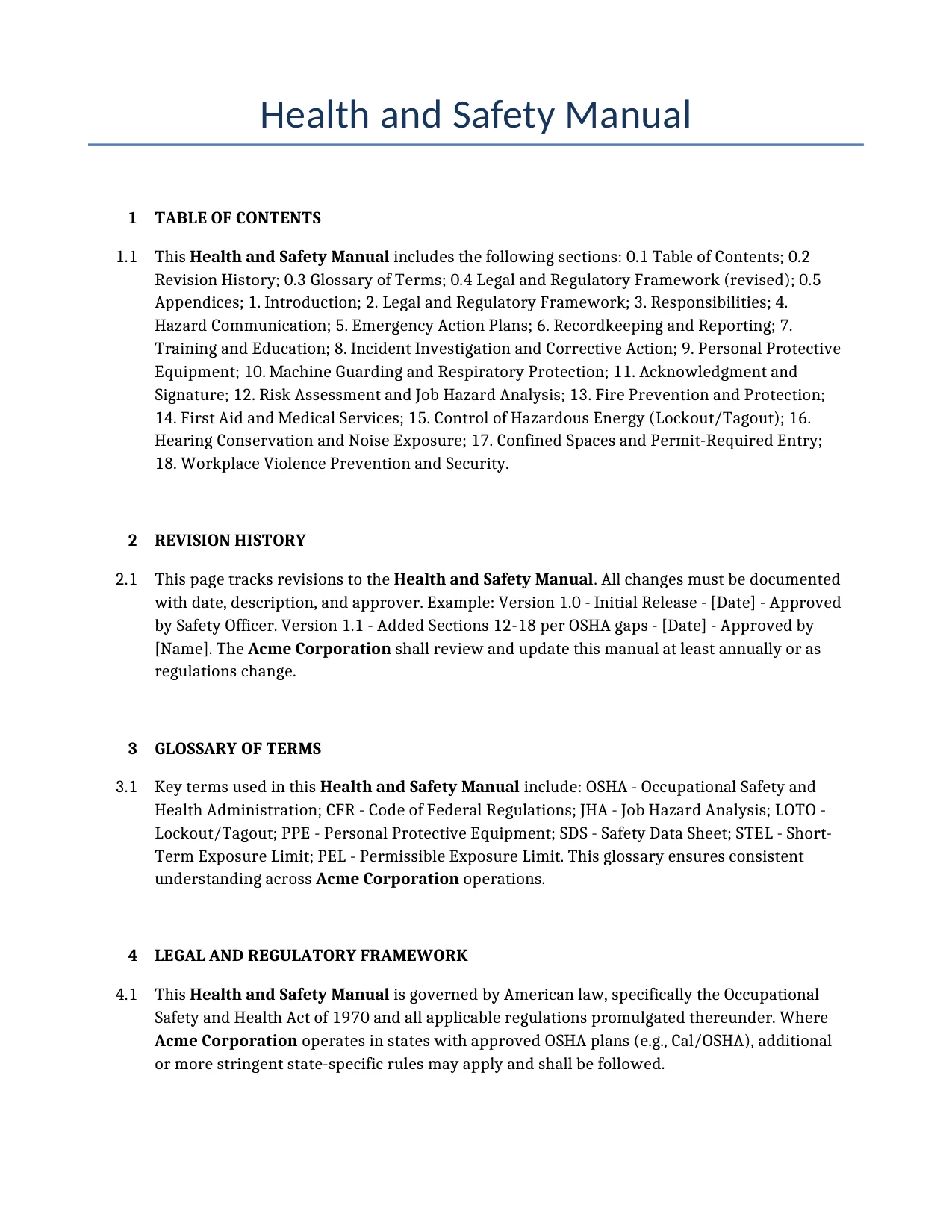
Health and Safety Manual
1TABLE OF CONTENTS
This Health and Safety Manual includes the following sections: 0.1 Table of Contents; 0.2 Revision History; 0.3 Glossary of Terms; 0.4 Legal and Regulatory Framework (revised); 0.5 Appendices; 1. Introduction; 2. Legal and Regulatory Framework; 3. Responsibilities; 4. Hazard Communication; 5. Emergency Action Plans; 6. Recordkeeping and Reporting; 7. Training and Education; 8. Incident Investigation and Corrective Action; 9. Personal Protective Equipment; 10. Machine Guarding and Respiratory Protection; 11. Acknowledgment and Signature; 12. Risk Assessment and Job Hazard Analysis; 13. Fire Prevention and Protection; 14. First Aid and Medical Services; 15. Control of Hazardous Energy (Lockout/Tagout); 16. Hearing Conservation and Noise Exposure; 17. Confined Spaces and Permit-Required Entry; 18. Workplace Violence Prevention and Security.
2REVISION HISTORY
This page tracks revisions to the Health and Safety Manual. All changes must be documented with date, description, and approver. Example: Version 1.0 - Initial Release - [Date] - Approved by Safety Officer. Version 1.1 - Added Sections 12-18 per OSHA gaps - [Date] - Approved by [Name]. The Acme Corporation shall review and update this manual at least annually or as regulations change.
3GLOSSARY OF TERMS
Key terms used in this Health and Safety Manual include: OSHA - Occupational Safety and Health Administration; CFR - Code of Federal Regulations; JHA - Job Hazard Analysis; LOTO - Lockout/Tagout; PPE - Personal Protective Equipment; SDS - Safety Data Sheet; STEL - Short-Term Exposure Limit; PEL - Permissible Exposure Limit. This glossary ensures consistent understanding across Acme Corporation operations.
4LEGAL AND REGULATORY FRAMEWORK
This Health and Safety Manual is governed by American law, specifically the Occupational Safety and Health Act of 1970 and all applicable regulations promulgated thereunder. Where Acme Corporation operates in states with approved OSHA plans (e.g., Cal/OSHA), additional or more stringent state-specific rules may apply and shall be followed.
5APPENDICES
Appendices include: Incident Report Template (OSHA 301 equivalent); Sample SDS; Training Log Form; Full Written Hazard Communication Program; JHA Forms; LOTO Procedures; First Aid Inventory Checklist. These support the policies in this Health and Safety Manual and are maintained by the Safety Officer at Acme Corporation. References to specific company procedures are contained herein or in attached programs. Acme Corporation maintains a non-retaliation policy: No employee shall face retaliation for reporting hazards, incidents, or concerns in good faith.
6INTRODUCTION
This Health and Safety Manual is established by Acme Corporation to provide a comprehensive framework for maintaining a safe and healthy work environment for all employees. It incorporates risk assessments, employee involvement, and annual reviews to ensure continuous improvement and full OSHA compliance.
Acme Corporation recognizes that the health and safety of its employees is of paramount importance and is committed to preventing workplace injuries and illnesses through proactive measures, including hazard identification and a safety committee.
The purpose of this Health and Safety Manual is to outline the policies, procedures, and responsibilities that ensure compliance with applicable laws and promote a culture of safety within the organization, including specific duties for management, supervisors, and employees.
This Health and Safety Manual applies to all employees, contractors, and visitors at all facilities operated by Acme Corporation, covering general industry (29 CFR 1910), construction (29 CFR 1926) where applicable, and other operations such as powered industrial trucks.
All parties involved in the operations of Acme Corporation must adhere to the provisions set forth in this Health and Safety Manual to maintain a safe workplace. This includes compliance with bloodborne pathogens (29 CFR 1910.1030) where applicable, ergonomics to prevent musculoskeletal disorders, electrical safety (29 CFR 1910 Subpart S), and forklift operations (29 CFR 1910.178).
7LEGAL AND REGULATORY FRAMEWORK
This Health and Safety Manual is governed by American law, specifically the Occupational Safety and Health Act of 1970 and all applicable regulations promulgated thereunder. Where state plans apply, additional rules may exist and Acme Corporation will comply.
Acme Corporation shall comply with the OSHA General Duty Clause under Section 10(a)(1) of the Occupational Safety and Health Act of 1970, which requires the employer to furnish to each of its employees employment and a place of employment which are free from recognized hazards that are causing or are likely to cause death or serious physical harm to the employees.
The operations of Acme Corporation in manufacturing and warehousing are primarily subject to the standards set forth in 29 CFR 1910 for general industry, including but not limited to those covering hazard communication (29 CFR 1910.1200), respiratory protection (29 CFR 1910.134), machine guarding (29 CFR 1910.212), bloodborne pathogens (29 CFR 1910.1030) if applicable, electrical safety (29 CFR 1910 Subpart S), powered industrial trucks (29 CFR 1910.178), and ergonomics best practices to address musculoskeletal disorders.
Where Acme Corporation engages in construction-related activities during facility modifications, the company shall comply with the safety and health regulations for construction as outlined in 29 CFR 1926, including fall protection where applicable.
Acme Corporation shall fully comply with the Hazard Communication Standard as detailed in 29 CFR 1910.1200, ensuring that all hazardous chemicals are properly evaluated and that information concerning their hazards is communicated to employees. A complete written Hazard Communication Program is referenced in the Appendices.
In accordance with 29 CFR 1910.38, Acme Corporation shall develop and implement emergency action plans to protect employees in the event of an emergency, including fire prevention elements per 29 CFR 1910.39.
Acme Corporation shall adhere to the OSHA recordkeeping requirements under 29 CFR 1904, maintaining accurate records of work-related injuries and illnesses as mandated.
The management of Acme Corporation shall regularly review and update this Health and Safety Manual at least annually to ensure ongoing compliance with all applicable American laws and regulations, incorporating employee input via the safety committee.
Additional coverage is included for hazardous waste operations (29 CFR 1910.120) if relevant to Acme Corporation activities. All programs shall be reviewed annually with employee involvement.
8RESPONSIBILITIES
The management of Acme Corporation is responsible for providing a safe working environment, ensuring that all necessary resources are allocated to support health and safety initiatives, conducting PPE hazard assessments per 29 CFR 1910.132, establishing a safety committee with employee representatives, and ensuring annual program reviews.
Supervisors at Acme Corporation shall enforce the policies outlined in this Health and Safety Manual, provide training to employees under their supervision on all relevant hazards (including ergonomics, electrical safety, and forklifts), perform daily inspections, and report issues promptly.
All employees of Acme Corporation are required to comply with the safety procedures established in this Health and Safety Manual, to report any unsafe conditions to their supervisors immediately, participate in training and safety committees, and follow non-retaliation protections for reporting.
The safety officer designated by Acme Corporation shall oversee the implementation of this Health and Safety Manual, conduct regular audits to verify compliance, maintain records, coordinate incident investigations, and ensure all OSHA-required programs (e.g., LOTO, hearing conservation) are fully implemented.
Disciplinary procedures for safety violations at Acme Corporation shall be progressive, starting with verbal warnings and escalating to termination for willful violations, while maintaining a culture of safety rather than punishment.
9HAZARD COMMUNICATION
In compliance with 29 CFR 1910.1200, Acme Corporation shall maintain a written hazard communication program that addresses the evaluation of chemical hazards and the communication of those hazards to employees. The full program is located in the Appendices.
Acme Corporation shall ensure that safety data sheets are readily accessible to all employees who may be exposed to hazardous chemicals in the course of their work, including in electronic or paper form at all times.
All containers of hazardous chemicals at Acme Corporation facilities shall be properly labeled in accordance with the requirements of the Hazard Communication Standard, using GHS-compliant labels.
Acme Corporation shall provide training to employees regarding the hazards of chemicals present in the workplace and the protective measures to be taken, including during initial assignment and whenever new hazards are introduced. Training shall cover all required topics per 29 CFR 1910.1200.
10EMERGENCY ACTION PLANS
Pursuant to 29 CFR 1910.38, Acme Corporation shall establish and maintain an emergency action plan that includes procedures for reporting emergencies and evacuating the premises, as well as fire prevention and protection measures per 29 CFR 1910.39.
The emergency action plan of Acme Corporation shall designate employees responsible for implementing the plan during an emergency event and shall account for all employees, including those with disabilities.
Acme Corporation shall conduct regular drills to ensure that all employees are familiar with the emergency action plan and their roles in an emergency, at least annually, with documentation retained.
This section integrates with fire prevention (Section 18) and first aid (Section 19) for comprehensive emergency response at Acme Corporation.
11RECORDKEEPING AND REPORTING
In accordance with 29 CFR 1904, Acme Corporation shall maintain records of all work-related injuries and illnesses that occur at its facilities, including OSHA 300 logs, with privacy protections for certain cases.
Acme Corporation shall report any severe injuries or fatalities to the appropriate authorities as required by OSHA regulations (within 8 hours for fatalities, 24 hours for in-patient hospitalizations).
The records maintained by Acme Corporation shall be made available to employees and authorized representatives upon request in compliance with applicable laws. Annual summaries shall be posted as required.
Records for training, audits, and medical services shall also be maintained per specific standards (e.g., 29 CFR 1910.1020 for access to employee exposure and medical records).
12TRAINING AND EDUCATION
Acme Corporation shall provide comprehensive training to all employees on the health and safety policies contained in this Health and Safety Manual, covering all OSHA-required topics including hazard communication, LOTO (29 CFR 1910.147), PPE (29 CFR 1910.132), respiratory protection, bloodborne pathogens if applicable, forklift operation (29 CFR 1910.178), electrical safety, ergonomics, confined spaces, and workplace violence prevention.
Training provided by Acme Corporation shall be documented and shall include verification that employees have understood the material presented, through tests, demonstrations, or certifications where required.
Acme Corporation shall conduct refresher training at regular intervals or whenever there are changes to policies or procedures that affect employee safety, with additional training for new hires and upon assignment to new tasks.
Employee involvement in training development and safety committee participation is encouraged to enhance the effectiveness of the program at Acme Corporation.
13INCIDENT INVESTIGATION AND CORRECTIVE ACTION
Following any workplace incident, Acme Corporation shall conduct a thorough investigation to determine the root causes and prevent recurrence, involving the safety committee and employees where appropriate, per best practices and OSHA guidelines.
Corrective actions identified through investigations shall be implemented promptly by Acme Corporation to address any deficiencies in safety practices, with timelines and responsible parties assigned and tracked.
All incident reports prepared by Acme Corporation shall be reviewed by management to ensure that appropriate measures have been taken, and trends analyzed for proactive prevention.
Near-miss incidents shall also be investigated to identify hazards before injuries occur.
14PERSONAL PROTECTIVE EQUIPMENT
Acme Corporation shall assess the workplace to determine if hazards are present that necessitate the use of personal protective equipment by employees, per 29 CFR 1910.132. This hazard assessment shall be documented and updated as needed.
Where personal protective equipment is required, Acme Corporation shall provide such equipment at no cost to the employee and shall ensure that it is properly maintained, cleaned, and replaced when damaged.
Employees of Acme Corporation shall be trained in the proper use, care, and limitations of the personal protective equipment provided to them, including when it is necessary, what type to use, and how to don/doff it.
PPE training shall be certified in writing, and retraining provided when there are changes in workplace hazards or PPE.
15MACHINE GUARDING AND RESPIRATORY PROTECTION
In compliance with 29 CFR 1910.212 and related standards, Acme Corporation shall ensure that all machinery is equipped with appropriate guards to protect employees from hazards such as point of operation, rotating parts, and flying chips. Guards shall be affixed and maintained.
Acme Corporation shall implement a respiratory protection program as required by 29 CFR 1910.134 where employees may be exposed to airborne contaminants, including selection, use, and maintenance of respirators.
The respiratory protection program of Acme Corporation shall include medical evaluations, fit testing, and training for affected employees, with a written program available to all.
This section also addresses electrical safety per 29 CFR 1910 Subpart S, requiring qualified persons, lockout/tagout integration (cross-reference Section 20), and safe work practices for electrical hazards. For powered industrial trucks (forklifts, 29 CFR 1910.178), Acme Corporation shall ensure operator training, certification, and daily inspections.
Ergonomics program elements are incorporated to minimize musculoskeletal disorders through workstation design, job rotation, and employee reporting of symptoms.
16ACKNOWLEDGMENT AND SIGNATURE
By signing below, the employee acknowledges that he or she has received, read, and understood the contents of this Health and Safety Manual and agrees to comply with all policies and procedures set forth herein. This includes understanding non-retaliation for reporting safety issues.
Employee Name: _____________________________________________
Employee Signature: _________________________________________ Date: ________________
On behalf of Acme Corporation, the undersigned certifies that this Health and Safety Manual has been approved and adopted as the official policy of the company.
Authorized Representative Name: _______________________________
Authorized Representative Signature: ____________________________ Date: ________________
17RISK ASSESSMENT AND JOB HAZARD ANALYSIS
Acme Corporation shall conduct comprehensive risk assessments and Job Hazard Analyses (JHAs) for all tasks and processes to identify potential hazards in manufacturing and warehousing operations. This aligns with OSHA guidelines under the General Duty Clause and best practices for proactive hazard control per 29 CFR 1910.
JHAs shall be performed by competent persons, involve employee participation, and be documented, reviewed annually, and updated when processes change. Controls shall follow the hierarchy of controls: elimination, substitution, engineering, administrative, and PPE.
Training on identified hazards and controls from risk assessments shall be provided to all affected employees at Acme Corporation. Records of assessments shall be maintained per 29 CFR 1910.1020.
18FIRE PREVENTION AND PROTECTION
In accordance with 29 CFR 1910.39 and 29 CFR 1910 Subpart L, Acme Corporation shall develop and implement a fire prevention plan that includes identification of fire hazards, housekeeping procedures, maintenance of fire equipment, and employee training.
Acme Corporation shall ensure portable fire extinguishers are provided, inspected monthly, and maintained annually per 29 CFR 1910.157. Employees shall be trained in their use if expected to use them.
Hot work permits, flammable storage controls, and emergency evacuation integration with the Emergency Action Plan (Section 10) are required. Regular fire drills and inspections shall be conducted and documented.
19FIRST AID AND MEDICAL SERVICES
Pursuant to 29 CFR 1910.151, Acme Corporation shall ensure that adequate first aid supplies are available at all facilities, and that personnel trained in first aid and CPR are present or that emergency medical services are available within a reasonable time.
The first aid program at Acme Corporation shall include an inventory of supplies compliant with ANSI Z308.1, eyewash stations per 29 CFR 1910.151(c) where needed, and procedures for responding to medical emergencies integrated with the Emergency Action Plan.
Medical services, including exposure evaluations for bloodborne pathogens (29 CFR 1910.1030) if applicable, shall be provided at no cost to employees. Training and records shall be maintained.
20CONTROL OF HAZARDOUS ENERGY (LOCKOUT/TAGOUT)
In compliance with 29 CFR 1910.147, Acme Corporation shall establish and implement a Control of Hazardous Energy program (Lockout/Tagout or LOTO) to protect employees from unexpected energization or release of stored energy during servicing and maintenance of machines and equipment.
The LOTO program shall include energy control procedures, employee training (initial and refresher), periodic inspections at least annually, and provision of lockout devices. Only authorized employees may perform LOTO.
Acme Corporation shall provide training on the recognition of hazardous energy sources and the methods for isolating them. This integrates with electrical safety (29 CFR 1910 Subpart S) and machine guarding (Section 15). Records of training and inspections shall be retained.
21HEARING CONSERVATION AND NOISE EXPOSURE
Per 29 CFR 1910.95, Acme Corporation shall implement a Hearing Conservation Program where employees are exposed to noise at or above 85 dBA 8-hour TWA. This includes noise monitoring, audiometric testing, hearing protectors, training, and recordkeeping.
Acme Corporation shall conduct baseline and annual audiograms, provide and require use of hearing protection where needed, and train employees annually on the effects of noise and protective measures. Engineering controls shall be prioritized.
Records of noise measurements and audiometric tests shall be maintained for the required duration. The program shall be evaluated regularly for effectiveness.
22CONFINED SPACES AND PERMIT-REQUIRED ENTRY
In accordance with 29 CFR 1910.146, Acme Corporation shall identify all permit-required confined spaces and implement a written permit space program to protect employees from associated hazards such as atmospheric, engulfment, or entrapment risks.
The program shall include permits, atmospheric testing, ventilation, attendant and entrant training, rescue procedures (non-entry preferred), and coordination with contractors. Entry shall be prohibited without a valid permit.
Acme Corporation shall provide training to all affected employees (entrants, attendants, entry supervisors) and conduct annual program reviews. Alternative procedures for certain spaces may be used if criteria are met.
23WORKPLACE VIOLENCE PREVENTION AND SECURITY
Acme Corporation is committed to providing a workplace free from violence and threats. Although OSHA does not have a specific standard for workplace violence, this program follows OSHA guidelines (e.g., OSHA Publication 3148) and the General Duty Clause to assess risks and implement controls.
The Workplace Violence Prevention Plan shall include risk assessments (especially for warehousing and public-facing roles), training on de-escalation and reporting, security measures (e.g., access controls, cameras), and an incident response protocol. A safety committee shall review incidents.
All threats or incidents of violence shall be reported immediately without fear of retaliation. Acme Corporation shall investigate, provide support to affected employees, and update policies based on lessons learned. Coordination with local law enforcement is included where appropriate.
This example shows approximately 70% of a typical document and is provided for illustrative purposes only. The remaining content has been omitted.
Every document generated by Docaro is tailored to your specific circumstances, jurisdiction and the information you provide. The completed document includes all applicable clauses and provisions required for your situation.
To generate the full, personalised document, answer a short series of questions and your document will be created instantly.