
AI Generated American Line of Credit Agreement
PDF & Word - 2026 Updated
Docaro Pricing
When Do You Need a Line of Credit Agreement in the United States?
American Legal Rules for a Line of Credit Agreement
Using the wrong structure for a line of credit agreement can lead to unenforceable terms or unintended regulatory violations.
What a Proper Line of Credit Agreement Should Include
- Parties InvolvedClearly identify the lender and borrower with their full names and contact details.
- Credit LimitSpecify the maximum amount the borrower can draw from the line of credit.
- Interest RateDetail how interest is calculated, including the rate and when it applies to borrowed amounts.
- Draw ProceduresExplain how and when the borrower can access funds from the credit line.
- Repayment TermsOutline the schedule for paying back borrowed amounts, including minimum payments.
- Fees and ChargesList any fees for using the credit, like origination or late payment charges.
- Default ConditionsDescribe what happens if the borrower fails to make payments or breaks the agreement.
- Termination RulesState how and when either party can end the agreement.
Generate Your Document in 4 Easy Steps
Why Use Docaro?
 United States
Free Example Line of Credit Agreement Template
Below is a free template example of a Line of Credit Agreement for use in the United States generated by our AI model.
The clauses in your actual Line of Credit Agreement will vary from this example as they will be entirely bespoke to your requirements as set out in the questionnaire you complete.
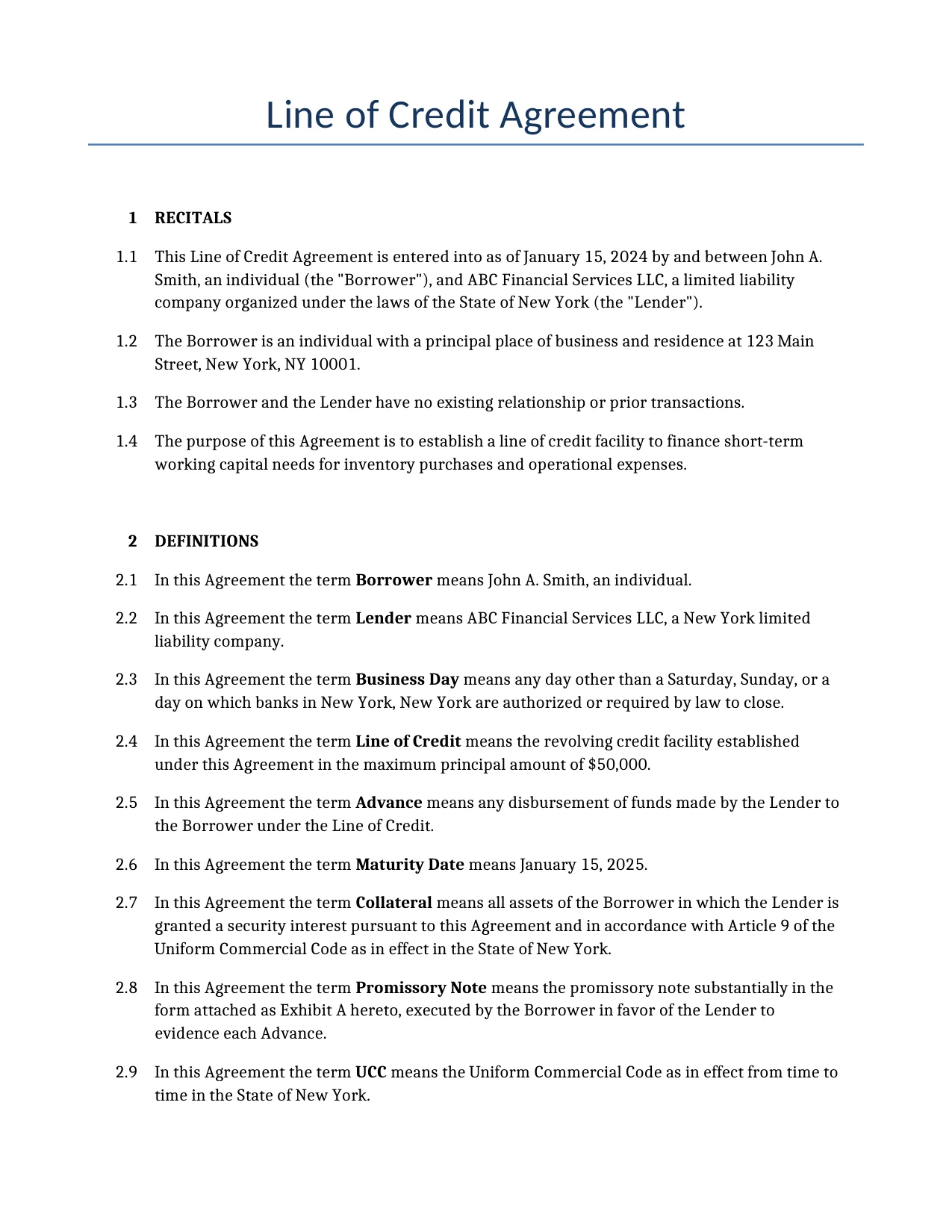
Line of Credit Agreement
1RECITALS
This Line of Credit Agreement is entered into as of January 15, 2024 by and between John A. Smith, an individual (the "Borrower"), and ABC Financial Services LLC, a limited liability company organized under the laws of the State of New York (the "Lender").
The Borrower is an individual with a principal place of business and residence at 123 Main Street, New York, NY 10001.
The Borrower and the Lender have no existing relationship or prior transactions.
The purpose of this Agreement is to establish a line of credit facility to finance short-term working capital needs for inventory purchases and operational expenses.
2DEFINITIONS
In this Agreement the term Borrower means John A. Smith, an individual.
In this Agreement the term Lender means ABC Financial Services LLC, a New York limited liability company.
In this Agreement the term Business Day means any day other than a Saturday, Sunday, or a day on which banks in New York, New York are authorized or required by law to close.
In this Agreement the term Line of Credit means the revolving credit facility established under this Agreement in the maximum principal amount of $50,000.
In this Agreement the term Advance means any disbursement of funds made by the Lender to the Borrower under the Line of Credit.
In this Agreement the term Maturity Date means January 15, 2025.
In this Agreement the term Collateral means all assets of the Borrower in which the Lender is granted a security interest pursuant to this Agreement and in accordance with Article 9 of the Uniform Commercial Code as in effect in the State of New York.
In this Agreement the term Promissory Note means the promissory note substantially in the form attached as Exhibit A hereto, executed by the Borrower in favor of the Lender to evidence each Advance.
In this Agreement the term UCC means the Uniform Commercial Code as in effect from time to time in the State of New York.
3LINE OF CREDIT FACILITY
The Lender hereby establishes a Line of Credit in favor of the Borrower in the maximum principal amount of $50,000.00 USD.
The primary purpose of the Line of Credit is to finance short-term working capital needs for inventory purchases and operational expenses.
The maximum amount available under the Line of Credit shall not exceed $50,000.00 USD at any time.
The Line of Credit shall be a revolving facility allowing the Borrower to borrow, repay, and re-borrow Advances subject to the terms and conditions of this Agreement.
4AVAILABILITY PERIOD
The effective date of this Line of Credit Agreement is January 15, 2024.
The availability period for Advances under the Line of Credit shall commence on January 15, 2024 and shall end on January 15, 2025.
The Line of Credit facility shall expire on the Maturity Date unless renewed in accordance with Section 4.4.
The parties may renew the Line of Credit facility upon mutual written agreement executed no later than thirty days prior to the expiration date.
Advances may first be requested under the Line of Credit on or after January 15, 2024.
All obligations under this Agreement shall be repaid in full on the Maturity Date of January 15, 2025.
5ADVANCES
The Borrower shall request Advances by submitting a written request to the Lender specifying the amount and purpose of the Advance.
The Borrower, John A. Smith, shall be the only person authorized to request Advances on behalf of the Borrower.
Each Advance shall be in a minimum amount of $1,000 USD.
The Borrower shall provide the Lender with one Business Day prior written notice before any Advance can be made.
The Borrower may request multiple Advances under the Line of Credit before any repayment is required subject to the availability of the Line of Credit and satisfaction of all conditions precedent.
The Lender shall make each Advance by wire transfer to the Borrower's designated bank account.
The Borrower shall submit all Advance requests by electronic mail to the Lender at the address specified in the Notices section of this Agreement.
The Lender shall not be obligated to fund any Advance unless all conditions precedent set forth in Section 11 of this Agreement have been satisfied, including execution and delivery of the Promissory Note as provided in Section 11.13.
6INTEREST RATES
Interest shall accrue on each Advance at a fixed annual rate of 5.5 percent, calculated daily on the basis of a 365-day year and actual days elapsed.
Interest shall be calculated on the basis of a 365-day year and the actual number of days elapsed.
Interest shall begin to accrue on Advances as of the date each Advance is made on or after the effective date of January 15, 2024.
Upon the occurrence of an Event of Default the interest rate applicable to the entire outstanding balance shall increase to the lesser of (i) 8.5 percent per annum or (ii) the maximum rate permitted under applicable New York usury laws.
Default interest shall apply to the entire outstanding balance until the Event of Default is cured or the obligations are paid in full. Interest shall not be compounded.
All interest rates and fees under this Agreement comply with New York usury laws, including NY Penal Law \§ 190.40 and General Obligations Law, and shall be automatically reduced to the maximum permitted rate if any overcharge occurs.
7PAYMENTS AND PREPAYMENTS
Interest payments shall be due on the 15th day of each month commencing on February 15, 2024.
Principal payments shall be due on the last day of each month commencing on January 31, 2024, with the entire outstanding principal balance due on the Maturity Date.
The Borrower may prepay the principal amount in whole or in part at any time without penalty.
All payments and prepayments shall be made by wire transfer or ACH electronic transfer to the Lender's designated account which is Account Number 123456789 at First National Bank with Routing Number 021000021 located at 123 Main Street, New York, NY 10001.
Payment schedules under this Agreement shall begin on or after January 15, 2024.
All payments shall be applied first to accrued interest and then to principal unless otherwise directed by the Lender.
Late fees, if any, shall not exceed the maximum permitted under New York law.
8FEES
The Borrower shall pay the Lender a commitment fee equal to 0.5 percent per annum on the unused portion of the Line of Credit which fee shall be payable quarterly in arrears.
The Borrower shall pay the Lender an origination fee of 1.0 percent of the maximum Line of Credit amount which fee shall be due and payable on the effective date of this Agreement.
The Borrower shall pay an annual fee of $500.00 USD on each anniversary of the effective date of this Agreement.
The Borrower shall pay any processing fees incurred in connection with each Advance which fees shall be deducted from the Advance proceeds.
9REPRESENTATIONS AND WARRANTIES OF THE BORROWER
The Borrower represents and warrants that the Borrower has full power and authority to execute, deliver, and perform his obligations under this Line of Credit Agreement.
The Borrower represents and warrants that the Borrower's execution of this Line of Credit Agreement does not conflict with any other agreements, or applicable laws.
The Borrower represents and warrants that no governmental approvals, consents, or filings are required for the Borrower to enter into and perform this Line of Credit Agreement, except for UCC filings referenced herein.
The Borrower represents and warrants that the Borrower is not in default under any material contract, lease, or other agreement.
The Borrower represents and warrants that there is no pending or threatened litigation, investigation, or proceeding against the Borrower that could reasonably be expected to have a material adverse effect.
The Borrower represents and warrants that the current total value of the Borrower's assets is $1,500,000.00 USD.
The Borrower represents and warrants that the current total value of the Borrower's liabilities is $500,000.00 USD.
The Borrower represents and warrants that the current net worth of the Borrower is $1,000,000.00 USD.
The Borrower represents and warrants that the Borrower's most current financial statements are dated within the last 90 days prior to the effective date and accurately reflect his financial condition as of a date no earlier than October 1, 2023.
The Borrower represents and warrants that the Borrower's financial statements are true, complete, and prepared in accordance with generally accepted accounting principles.
The Borrower represents and warrants that there have been no material adverse changes in the Borrower's financial condition since the date of the latest financial statements.
The Borrower represents and warrants that the Borrower has timely filed all tax returns and paid all taxes due.
The Borrower represents and warrants that the Borrower is in compliance with all applicable requirements of the Employee Retirement Income Security Act of 1974 regarding employee benefit plans, if any.
The Borrower represents and warrants that the Borrower is in compliance with all environmental laws and regulations.
The Borrower represents and warrants that the Borrower owns or has valid rights to all material intellectual property used in his business.
The Borrower represents and warrants that the proceeds of the Line of Credit will not be used in violation of Regulations T, U, or X of the Federal Reserve Board.
The Borrower represents and warrants that neither the Borrower nor any person or entity controlling or controlled by the Borrower is (i) currently identified on the Specially Designated Nationals and Blocked Persons list maintained by the Office of Foreign Assets Control ("OFAC"), (ii) a person with whom dealings are prohibited under any OFAC sanctions program, or (iii) otherwise in violation of any economic sanctions administered by OFAC or any other governmental authority. The funds used to repay the obligations are not derived from any illegal activity.
The Borrower represents and warrants that this Agreement is for commercial purposes and not for personal, family, or household purposes.
10COVENANTS
The Borrower shall provide the Lender with quarterly financial statements within forty-five days after the end of each fiscal quarter, commencing with the quarter ending March 31, 2024.
The Borrower shall provide the Lender with annual financial statements within ninety days after the end of each fiscal year, commencing with the year ending December 31, 2024.
The Borrower shall provide the Lender with a compliance certificate with each set of financial statements confirming compliance with all covenants.
The Borrower shall maintain a maximum debt to equity ratio of 2.5 to 1.0 at all times, tested quarterly commencing March 31, 2024. A breach of this covenant shall have a 30-day cure period after notice.
The Borrower shall maintain a minimum current ratio of 1.2 to 1.0 at all times, tested quarterly commencing March 31, 2024. A breach of this covenant shall have a 30-day cure period after notice.
The Borrower shall not incur capital expenditures exceeding $50,000 USD in any fiscal year without the prior written consent of the Lender.
The Borrower shall not incur additional indebtedness without the prior written consent of the Lender.
The Borrower shall not create or permit any liens on its assets without the prior written consent of the Lender except for liens in favor of the Lender.
The Borrower shall limit the payment of dividends or distributions to available cash flow after satisfying all obligations under this Agreement.
The Borrower shall not sell or dispose of assets exceeding $25,000 USD in any fiscal year without the prior written consent of the Lender.
The Borrower shall not merge, consolidate, or acquire other entities without the prior written consent of the Lender.
The Borrower shall provide the Lender with written notice within five Business Days of any material adverse change, default, litigation, or change in management.
The Borrower shall provide the Lender with thirty days advance written notice for any permitted actions such as asset sales that require notice under this Agreement.
The Borrower shall maintain insurance coverage on its assets and business operations in amounts and with insurers acceptable to the Lender.
The Borrower shall permit the Lender access to its books and records upon reasonable request during normal business hours.
The Borrower shall test compliance with financial covenants quarterly commencing March 31, 2024.
The Borrower shall comply with all environmental laws and regulations at all times.
The Borrower shall comply with all applicable anti-money laundering (AML), know-your-customer (KYC), and sanctions laws, including those administered by OFAC. The Borrower shall not use the proceeds of any Advance in violation of such laws.
11CONDITIONS PRECEDENT
The Borrower shall deliver copies of any organizational or formation documents (if applicable) and evidence of authority to the Lender prior to the first Advance.
The Borrower shall deliver a certificate of good standing (if applicable) to the Lender prior to the first Advance.
The Borrower shall deliver evidence of identity and authority satisfactory to the Lender prior to the first Advance.
The Borrower shall deliver UCC-1 financing statement searches confirming no prior liens on the Collateral prior to the first Advance.
The Borrower shall deliver releases or terminations of any existing liens on the Collateral prior to the first Advance.
The Borrower shall deliver certificates of insurance covering the Collateral prior to the first Advance.
The Borrower shall deliver his most recent financial statements to the Lender prior to the first Advance.
There shall have been no material adverse change in the Borrower's financial condition since the date of the latest financial statements prior to any Advance.
The Borrower shall deliver a representation that no default under other agreements exists prior to any Advance.
The Lender shall have a perfected first-priority security interest in the Collateral in accordance with Article 9 of the Uniform Commercial Code prior to any Advance.
The Borrower shall deliver an officer's certificate (or personal certificate) confirming satisfaction of all conditions precedent prior to any Advance.
The Borrower shall have executed and delivered the Promissory Note in the form attached as Exhibit A as a condition precedent to the first Advance and each subsequent Advance.
The Borrower shall have provided evidence of compliance with all applicable consumer protection laws, including any required ECOA notices if this transaction is deemed to have a consumer purpose component.
12EVENTS OF DEFAULT
Failure to make any payment when due shall constitute an Event of Default if not cured within ten days after written notice from the Lender.
Breach of any covenant contained in this Agreement (other than payment) shall constitute an Event of Default if not cured within thirty days after written notice from the Lender.
Cross default with any other indebtedness of the Borrower in excess of $10,000 shall constitute an Event of Default under this Agreement.
The bankruptcy or insolvency of the Borrower shall constitute an Event of Default under this Agreement.
Any unsatisfied judgment against the Borrower in excess of $100,000 USD shall constitute an Event of Default if not vacated or bonded within thirty days.
Breach of any representation or warranty shall constitute an Event of Default if not cured within thirty days after written notice from the Lender.
13REMEDIES
Upon the occurrence of an Event of Default the Lender may accelerate the entire outstanding balance under the Line of Credit and declare it immediately due and payable.
Upon the occurrence of an Event of Default the Lender may set off any amounts owed by the Borrower against any deposits or accounts of the Borrower maintained with the Lender.
Upon the occurrence of an Event of Default the Lender may take possession of any Collateral in accordance with Article 9 of the Uniform Commercial Code.
Upon the occurrence of an Event of Default the Lender may sell the Collateral and apply the proceeds to the outstanding obligations in accordance with Article 9 of the Uniform Commercial Code.
The Lender shall provide the Borrower with ten Business Days notice before exercising any remedies upon an Event of Default to the extent such notice is required by applicable law.
Upon the occurrence of an Event of Default the interest rate on the outstanding balance shall increase as provided in Section 6.4 of this Agreement.
The Borrower shall be allowed ten Business Days to cure monetary defaults before the Lender may fully exercise remedies under this Agreement.
14TERMINATION AND ACCELERATION
This Agreement shall terminate upon the occurrence of an Event of Default and the Lender's election to terminate the Line of Credit.
Upon termination all outstanding obligations shall be accelerated and become immediately due and payable upon ten Business Days written notice from the Lender.
Failure to pay principal, failure to pay interest, or breach of covenants shall constitute events permitting termination and acceleration under this Section.
The Borrower shall be provided a cure period as set forth in Section 12 prior to termination and acceleration.
Upon termination the Lender shall cease making any further Advances and may demand delivery of Collateral.
Acceleration shall not occur automatically but shall require affirmative action by the Lender.
15INDEMNIFICATION
The Borrower shall indemnify the Lender against all losses, claims, damages, liabilities, and expenses arising from this Agreement including those related to default and enforcement actions.
The Borrower shall indemnify the Lender against any taxes, duties, or similar charges imposed in connection with the Line of Credit.
The indemnification shall cover the Lender's reasonable attorneys' fees and other legal expenses incurred in enforcing this Agreement or defending claims.
The Lender shall provide the Borrower with thirty calendar days notice of any claim before seeking indemnification under this Section.
The indemnification obligations under this Section shall survive termination or repayment of this Agreement.
16EXPENSES AND COSTS
The Borrower shall reimburse the Lender for all reasonable legal fees incurred in connection with the enforcement of this Line of Credit Agreement.
The Borrower shall reimburse the Lender for all court costs associated with any legal proceedings related to this Line of Credit Agreement.
The Borrower's obligation to reimburse expenses and costs shall arise upon default on payments, breach of covenants, or acceleration of the obligations under this Agreement.
17GOVERNING LAW
This Agreement shall be governed by and construed in accordance with the laws of the State of New York without regard to conflict of laws principles.
This Agreement is made in compliance with the Truth in Lending Act (TILA) (to the extent applicable), Regulation Z (12 CFR Part 1026), the Equal Credit Opportunity Act (ECOA), Regulation B (12 CFR Part 1002), Regulation V (12 CFR Part 1022), and the Uniform Commercial Code (UCC) Article 9.
18JURISDICTION AND VENUE
The Borrower consents to the exclusive jurisdiction of the courts of the State of New York located in New York County for any dispute arising under this Agreement.
Venue for any legal proceedings related to this Agreement shall be in the state or federal courts located in New York County, New York.
The Borrower consents to the personal jurisdiction of the designated courts in the State of New York.
Service of process upon the Borrower may be made by certified mail to the Borrower's address set forth in the Notices section of this Agreement.
19WAIVER OF JURY TRIAL
EACH PARTY TO THIS AGREEMENT HEREBY KNOWINGLY, VOLUNTARILY, AND INTENTIONALLY WAIVES ITS RIGHT TO A JURY TRIAL IN ANY LITIGATION ARISING FROM OR RELATED TO THIS AGREEMENT. THIS WAIVER IS A MATERIAL INDUCEMENT TO THE LENDER TO ENTER INTO THIS AGREEMENT.
The waiver of jury trial shall apply to all disputes governed by the law of the State of New York under this Agreement.
20NOTICES
All notices under this Agreement shall be in writing and delivered by hand delivery, certified mail, or email.
Notices to the Borrower shall be sent to 123 Main Street, New York, NY 10001 and shall be deemed effective upon receipt (or upon sending if by email with confirmation).
Notices to the Lender shall be sent to 456 Oak Avenue, Los Angeles, CA 90210 and shall be deemed effective upon receipt (or upon sending if by certified mail, overnight courier, or email with confirmation).
Each party shall provide the other with thirty days prior written notice of any change in its notice address.
21ENTIRE AGREEMENT
This Agreement, together with the Promissory Note and any exhibits, constitutes the entire understanding between the parties and supersedes all prior understandings or agreements between the Lender and the Borrower.
22AMENDMENTS AND WAIVERS
This Agreement may only be modified by a written amendment signed by both the Lender and the Borrower.
Oral amendments to this Agreement are expressly prohibited.
Any waiver of any provision of this Agreement must be in writing and signed by the Lender.
Any waiver by the Lender applies only to the specific breach and does not waive any future breaches by the Borrower.
23SEVERABILITY
If any provision of this Agreement is held to be invalid or unenforceable the remaining provisions of this Agreement shall remain in full force and effect.
The severability provision shall apply to the entire Agreement.
24COUNTERPARTS
This Agreement may be executed in one or more counterparts each of which shall be deemed an original but all of which together shall constitute one and the same instrument.
Electronic signatures, faxed copies, and scanned signatures shall be permitted for execution of counterparts and shall have the same legal effect as original signatures.
25ASSIGNMENT
The Lender may assign its rights and obligations under this Agreement to any qualified assignee with the prior written consent of the Borrower which consent shall not be unreasonably withheld.
The non-assigning party shall receive thirty calendar days notice of any assignment.
All successors and assigns of the parties shall be bound by the terms of this Agreement.
26CONFIDENTIALITY
Each party shall maintain the confidentiality of all non-public information received from the other party during the term of this Agreement and for three years thereafter.
Confidentiality obligations shall not apply to information that is publicly available or required to be disclosed by law or regulation.
The confidentiality obligations shall survive termination of this Agreement.
Upon termination of this Agreement each party shall return or destroy all confidential information of the other party.
27NO WAIVER
The failure of the Lender to exercise any right or remedy under this Agreement shall not constitute a waiver of such right or remedy.
The No Waiver clause shall cover single or partial exercise of rights, delay in enforcing remedies, and acceptance of partial payments.
No waiver of any breach shall be effective unless it is in writing and signed by the Lender.
28SURVIVAL
The provisions concerning representations and warranties, indemnification obligations, confidentiality provisions, and governing law shall survive termination of this Agreement.
The selected survival provisions shall apply indefinitely after termination of this Agreement.
29MISCELLANEOUS
The masculine gender shall include the feminine and neuter genders and vice versa throughout this Agreement.
The headings in this Agreement are for convenience only and shall not affect the interpretation of the terms of this Agreement.
Any controversy arising under this Agreement shall be resolved by binding arbitration in accordance with the rules of the American Arbitration Association under the Federal Arbitration Act. This provision is consistent with the jury trial waiver in Section 19 and does not limit the Lender's right to exercise self-help remedies or foreclose on collateral.
The Borrower acknowledges receipt of all required disclosures under TILA (if applicable), ECOA, and New York state lending laws, including any consumer protection notices. A copy of such notices is attached as Exhibit B.
30SECURITY AGREEMENT AND COLLATERAL
As security for the prompt payment and performance of all obligations under this Agreement, the Promissory Note, and all related documents, the Borrower hereby grants to the Lender a first-priority security interest in all of the Borrower's right, title, and interest in and to all personal property and assets, whether now owned or hereafter acquired, including but not limited to accounts, inventory, equipment, general intangibles, investment property, deposit accounts, and proceeds thereof (collectively, the "Collateral"). This security interest is granted under and in accordance with Article 9 of the UCC.
The Borrower covenants to maintain the Collateral in good condition, to insure the Collateral against all risks with insurance naming the Lender as loss payee, and to provide evidence of such insurance upon request. The Borrower shall not sell, transfer, or encumber the Collateral without the Lender's prior written consent, except in the ordinary course of business for inventory.
The Lender's security interest shall attach to all proceeds of the Collateral and to all after-acquired property of the same type. The Lender may file UCC-1 financing statements and any amendments or continuations to perfect its security interest. The Borrower authorizes the Lender to file such financing statements without further signature of the Borrower to the extent permitted by law.
The Lender's security interest shall be a first-priority lien on the Collateral, superior to all other liens except those expressly permitted in writing by the Lender. The Borrower shall take all actions requested by the Lender to perfect, protect, and enforce the security interest, including executing additional documents.
Upon the occurrence of an Event of Default, in addition to the remedies set forth in Section 13, the Lender shall have all rights and remedies of a secured party under Article 9 of the UCC, including the right to take possession of the Collateral, sell it at public or private sale, and apply the proceeds to the obligations. The Borrower waives any right to notification of disposition of Collateral except as required by the UCC.
This Section 30 integrates with and supplements the Definitions in Section 2, the Covenants in Section 10, the Conditions Precedent in Section 11, the Events of Default in Section 12, and the Remedies in Section 13. All references to Collateral and security interests throughout this Agreement are deemed to incorporate the provisions of this Section.
31LENDER REPRESENTATIONS AND WARRANTIES
The Lender represents and warrants that it is duly organized, validly existing, and in good standing under the laws of the State of New York and has full power and authority to enter into this Agreement and to make the Advances contemplated hereby.
The Lender represents and warrants that the execution, delivery, and performance of this Agreement do not conflict with its organizational documents or any applicable law.
The Lender represents and warrants that the funds to be advanced under this Agreement are not derived from any illegal activity and that the Lender is in compliance with all anti-money laundering, KYC, and OFAC requirements. Neither the Lender nor any of its principals is on any prohibited list maintained by OFAC or any governmental authority.
The Lender represents and warrants that it is in compliance with all applicable lending laws, including usury laws, the Truth in Lending Act (to the extent applicable), ECOA, and all other federal, state, and local laws governing commercial and consumer lending. The Lender has no conflicts of interest that would prevent it from entering into this Agreement.
The Lender represents and warrants that it is an accredited investor or otherwise qualified to engage in this commercial lending transaction under applicable securities and banking laws.
32USURY COMPLIANCE
Notwithstanding any provision to the contrary, in no event shall the Borrower be obligated to pay interest or fees exceeding the maximum rate or amount permitted under New York usury laws, including without limitation NY Penal Law \§ 190.40 and the New York General Obligations Law. If any interest or fee charged or received exceeds the maximum permitted, such excess shall be applied to reduce the principal or refunded to the Borrower, and the rate shall automatically be reduced to the maximum allowed by law.
The Borrower and Lender agree that this Agreement is entered into for commercial purposes. To the extent the Borrower qualifies for any exemption from usury laws under New York law, the parties intend for such exemption to apply fully.
This Section shall govern over any conflicting provision in this Agreement, including Sections 6, 7, and 8.
33FORCE MAJEURE
Neither party shall be liable for any failure or delay in performance of its obligations under this Agreement (other than payment obligations) if such failure or delay is due to a Force Majeure Event, which includes acts of God, war, terrorism, pandemics, government orders, strikes, or other events beyond the party's reasonable control.
The affected party shall provide prompt written notice to the other party of the Force Majeure Event and its expected duration. Performance shall be excused for the duration of the event, but the Agreement shall otherwise remain in full force.
If a Force Majeure Event continues for more than 60 days, either party may terminate this Agreement upon written notice, provided all outstanding obligations are repaid.
34SIGNATURE PAGE
IN WITNESS WHEREOF the parties have executed this Line of Credit Agreement as of the date first above written.
Borrower: _______________________________ John A. Smith Date: _______________
State of New York
County of New York
On the ___ day of ___________, 2024, before me, the undersigned, personally appeared John A. Smith, personally known to me or proved to me on the basis of satisfactory evidence to be the individual whose name is subscribed to the within instrument and acknowledged to me that he executed the same in his capacity, and that by his signature on the instrument, the individual executed the instrument.
_______________________________
Notary Public
Lender: _______________________________ ABC Financial Services LLC By: _______________________________ Authorized Signatory Date: _______________
State of New York
County of _______________
On the ___ day of ___________, 2024, before me, the undersigned, personally appeared ________________, personally known to me or proved to me on the basis of satisfactory evidence to be the individual whose name is subscribed to the within instrument and acknowledged to me that he/she executed the same in his/her capacity, and that by his/her signature on the instrument, the individual, or the person upon behalf of which the individual acted, executed the instrument.
_______________________________
Notary Public
This Signature Page is the final section of the Agreement. Exhibits: Exhibit A - Form of Promissory Note; Exhibit B - Required Disclosures and Notices (including ECOA and TILA if applicable).
This example shows approximately 70% of a typical document and is provided for illustrative purposes only. The remaining content has been omitted.
Every document generated by Docaro is tailored to your specific circumstances, jurisdiction and the information you provide. The completed document includes all applicable clauses and provisions required for your situation.
To generate the full, personalised document, answer a short series of questions and your document will be created instantly.