
AI Generated American Employment Agreement
PDF & Word - 2026 Updated
Docaro Pricing
When Do You Need an Employment Contract in the United States?
American Legal Rules for Employment Contracts
Using the wrong type of employment agreement can inadvertently create unintended employee rights or obligations.
What a Proper Employment Contract Should Include
- Job DetailsClearly state the job title, duties, and reporting structure to set expectations for the role.
- CompensationSpecify the salary, payment schedule, bonuses, and any benefits like health insurance or vacation time.
- Work ScheduleOutline the expected hours, location of work, and any flexibility for remote or overtime arrangements.
- Start and End DatesInclude the employment start date and whether the position is at-will or for a fixed term.
- Termination RulesDescribe conditions for ending employment, notice periods, and severance if applicable.
- ConfidentialityProtect company secrets by agreeing not to share sensitive information during or after employment.
- Non-Compete ClauseLimit working for competitors after leaving to safeguard the company's interests, within legal bounds.
- Dispute ResolutionDefine how disagreements will be handled, such as through mediation or arbitration.
Generate Your Document in 4 Easy Steps
Why Use Docaro?
 United States
Free Example Employment Contract Template
Below is a free template example of a Employment Contract for use in the United States generated by our AI model.
The clauses in your actual Employment Contract will vary from this example as they will be entirely bespoke to your requirements as set out in the questionnaire you complete.
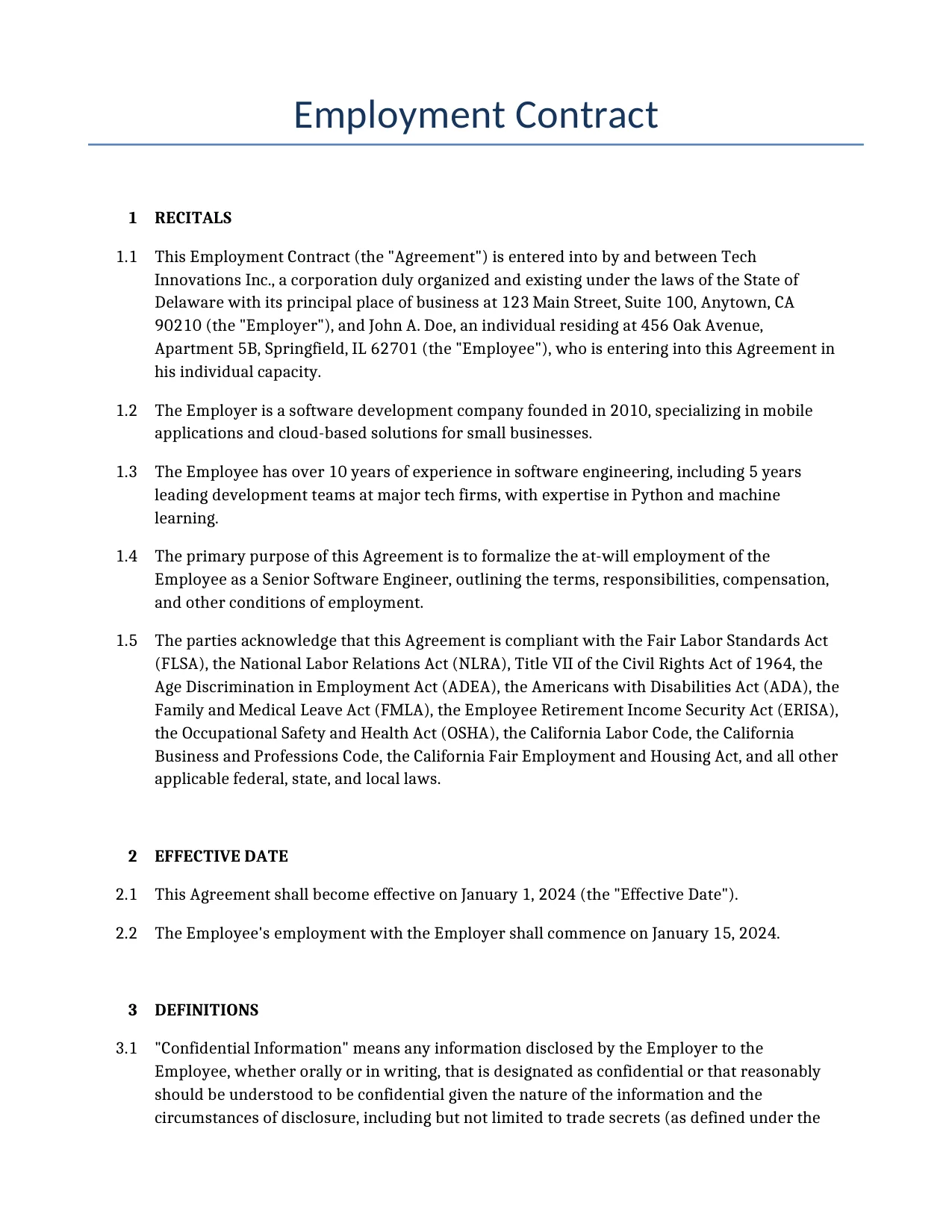
Employment Contract
1RECITALS
This Employment Contract (the "Agreement") is entered into by and between Tech Innovations Inc., a corporation duly organized and existing under the laws of the State of Delaware with its principal place of business at 123 Main Street, Suite 100, Anytown, CA 90210 (the "Employer"), and John A. Doe, an individual residing at 456 Oak Avenue, Apartment 5B, Springfield, IL 62701 (the "Employee"), who is entering into this Agreement in his individual capacity.
The Employer is a software development company founded in 2010, specializing in mobile applications and cloud-based solutions for small businesses.
The Employee has over 10 years of experience in software engineering, including 5 years leading development teams at major tech firms, with expertise in Python and machine learning.
The primary purpose of this Agreement is to formalize the at-will employment of the Employee as a Senior Software Engineer, outlining the terms, responsibilities, compensation, and other conditions of employment.
The parties acknowledge that this Agreement is compliant with the Fair Labor Standards Act (FLSA), the National Labor Relations Act (NLRA), Title VII of the Civil Rights Act of 1964, the Age Discrimination in Employment Act (ADEA), the Americans with Disabilities Act (ADA), the Family and Medical Leave Act (FMLA), the Employee Retirement Income Security Act (ERISA), the Occupational Safety and Health Act (OSHA), the California Labor Code, the California Business and Professions Code, the California Fair Employment and Housing Act, and all other applicable federal, state, and local laws.
2EFFECTIVE DATE
This Agreement shall become effective on January 1, 2024 (the "Effective Date").
The Employee's employment with the Employer shall commence on January 15, 2024.
3DEFINITIONS
"Confidential Information" means any information disclosed by the Employer to the Employee, whether orally or in writing, that is designated as confidential or that reasonably should be understood to be confidential given the nature of the information and the circumstances of disclosure, including but not limited to trade secrets (as defined under the Defend Trade Secrets Act and California Uniform Trade Secrets Act), business plans, customer lists, financial data, proprietary technology, algorithms, source code, product designs, marketing strategies, and any other non-public information relating to the Employer's business. Confidential Information does not include information that (i) is or becomes generally available to the public without breach of this Agreement, (ii) was rightfully in the Employee's possession prior to disclosure, or (iii) is independently developed by the Employee without use of the Employer's Confidential Information.
"Cause" means (i) the Employee's conviction of, or plea of nolo contendere to, a felony or any crime involving moral turpitude; (ii) the Employee's gross misconduct or willful and material breach of this Agreement or any material company policy; (iii) the Employee's willful and continued failure to substantially perform his duties after written notice and a reasonable opportunity to cure; or (iv) any act of fraud, embezzlement, or dishonesty in connection with the Employee's duties.
"Good Reason" means the occurrence of any of the following without the Employee's written consent: (i) a material reduction in the Employee's base salary; (ii) a material diminution in the Employee's authority, duties, or responsibilities; or (iii) a material change in the geographic location where the Employee must perform services (more than 50 miles from the prior location). Good Reason shall not exist unless the Employee provides written notice to the Employer within 30 days of the initial existence of the condition, the Employer fails to cure within 30 days, and the Employee terminates employment within 60 days after the cure period.
"Inventions" means all inventions, discoveries, improvements, designs, techniques, processes, software, works of authorship, mask works, trade secrets, and other intellectual property, whether or not patentable or registrable, that are made, conceived, developed, or reduced to practice by the Employee, either alone or jointly with others.
Other terms used throughout this Agreement shall have the meanings ascribed to them in their respective sections or as otherwise defined under applicable California and federal law, including the California Labor Code and the Fair Labor Standards Act (FLSA).
4POSITION AND DUTIES
The Employer hereby employs the Employee in the position of Senior Software Engineer. A detailed job description is set forth in Exhibit A attached hereto and incorporated by reference.
The Employee shall perform all duties and responsibilities set forth in Exhibit A, as well as any other duties reasonably assigned by the Employer consistent with the position. The Employee shall meet all performance expectations, including specific metrics and key performance indicators (KPIs) such as timely completion of development sprints, code quality standards (measured by peer review acceptance rates exceeding 95\%), contribution to team objectives, and achievement of project milestones as determined by the Engineering Manager.
The Employee shall report directly to the Engineering Manager, Jane Doe, or such other person as designated by the Employer.
The Employee shall devote the Employee's full working time, attention, and best efforts to the business of the Employer and shall not engage in any other employment or business activity that conflicts with the Employee's duties hereunder. The Employee shall comply with all of the Employer's policies and procedures, including but not limited to those contained in the Employee Handbook (as may be amended from time to time), a copy of which the Employee acknowledges receiving and will sign an acknowledgment for as set forth in Exhibit C.
The Employee's primary work location shall be hybrid, consisting of a combination of office and remote work as determined by the Employer.
5TERM OF EMPLOYMENT
The employment of the Employee by the Employer is at-will. This means that either the Employee or the Employer may terminate the employment relationship at any time, with or without cause or notice, subject only to the provisions of Section 12 (Termination) of this Agreement. This at-will status may not be modified except by a written agreement signed by both parties.
Certain obligations under this Agreement, including but not limited to those related to confidentiality, intellectual property assignment, non-solicitation, return of company property, post-termination obligations, and dispute resolution, shall survive any termination of employment or expiration of this Agreement.
6COMPENSATION
The Employer shall pay the Employee an annual base salary of $150,000.00 USD, which shall be paid in semi-monthly installments on the 15th and last day of each month in accordance with the Employer's standard payroll practices. The salary is for an exempt position under the FLSA and California wage and hour laws and is not eligible for overtime pay. The Employer shall provide the Employee with accurate itemized wage statements as required by California Labor Code Section 226.
The Employee shall be eligible for a discretionary performance-based bonus of up to 15\% of base salary, as determined by the Employer in its sole discretion based on the Employee's performance, achievement of KPIs, and company objectives. The Employee shall also receive a one-time signing bonus of $10,000.00, payable within 30 days of the commencement of employment, subject to applicable withholdings.
The Employer shall reimburse the Employee for all necessary and reasonable business expenses incurred in the performance of duties in accordance with California Labor Code Section 2802 and the Employer's expense reimbursement policy. All compensation payable under this Section shall be subject to applicable withholdings and deductions as required by law. Payments shall comply with all timely payment requirements under California law.
7BENEFITS
The Employee shall be eligible to participate in the Employer's group health, dental, and vision insurance plans, retirement savings plan (intended to comply with ERISA), and other benefits in accordance with the terms, eligibility criteria, and waiting periods (typically 30-90 days) of the applicable plans. The Employee's contribution amounts shall be as set forth in the plan documents and may be adjusted from time to time.
The Employee shall be eligible for paid sick leave, paid family leave, and state disability insurance as required by California law. The Employee shall also receive paid time off in accordance with the Employer's policies, which shall comply with all applicable laws including the Family and Medical Leave Act (FMLA) and California Family Rights Act.
Upon termination, the Employee shall be provided with information regarding rights to continue health coverage under COBRA and any applicable state laws. All benefits are governed by the terms of the separate plan documents, which may be amended by the Employer from time to time. The Employee acknowledges that the Employer does not guarantee the continuation of any particular benefit.
8EXPENSES
The Employer shall reimburse the Employee for all necessary and reasonable business-related expenses incurred in the performance of duties in accordance with California Labor Code Section 2802 and the Employer's expense reimbursement policy, including but not limited to travel, meals, entertainment, and office supplies.
The Employee must submit appropriate documentation and receipts for all expenses within 30 days of incurrence. The Employer shall reimburse approved expenses within 30 days of receipt of proper documentation.
9CONFIDENTIALITY
The Employee acknowledges that during the course of employment, the Employee will have access to the Employer's Confidential Information (as defined in Section 3).
The Employee agrees to maintain the confidentiality of all Confidential Information and not to disclose, use, or exploit it for any purpose other than the performance of duties for the Employer, except as required by law (with prior notice to the Employer where legally permitted) or with the Employer's prior written consent.
Upon termination of employment (for any reason) or at any time upon request, the Employee shall immediately return to the Employer all documents, files, data, devices, and other materials containing Confidential Information, in any form, and shall not retain any copies.
The obligations under this Section shall survive the termination of this Agreement indefinitely.
10NON-COMPETE AND NON-SOLICITATION
In accordance with California Business and Professions Code Section 16600, which generally voids post-employment non-compete agreements, the Employee agrees that during the term of employment only, the Employee shall not, directly or indirectly, engage in any competitive business activity that conflicts with the Employee's duties to the Employer.
For a period of 12 months following the termination of employment for any reason, the Employee shall not, directly or indirectly, solicit, induce, or attempt to solicit or induce any customers, clients, or employees of the Employer with whom the Employee had material contact during the last 12 months of employment to cease or reduce their relationship with the Employer or to engage in business with a competitor. This restriction is reasonable, narrowly tailored to protect the Employer's legitimate business interests, and compliant with California law.
The Employee acknowledges that breach of this Section would cause irreparable harm to the Employer for which monetary damages would be inadequate, and that the Employer shall be entitled to seek injunctive relief in addition to any other remedies available at law or equity.
11INTELLECTUAL PROPERTY
The Employee agrees to disclose promptly to the Employer all Inventions (as defined in Section 3) that the Employee makes, conceives, or reduces to practice during the term of employment, whether during working hours or using the Employer's resources.
The Employee hereby assigns to the Employer all right, title, and interest in and to all such Inventions, including all intellectual property rights therein. This assignment does not apply to any invention that qualifies fully under the provisions of California Labor Code Section 2870, which states that an employee shall not be required to assign rights to an invention for which no equipment, supplies, facilities, or trade secret information of the Employer was used, that was developed entirely on the Employee's own time, and that does not relate to the Employer's business or anticipated research and does not result from work performed for the Employer.
The Employee shall execute any and all documents necessary to perfect the Employer's ownership of such Inventions, including patent applications, at the Employer's expense. The Employee waives any moral rights or similar rights in such Inventions.
The Employee represents that all prior inventions and intellectual property developed before the Effective Date are listed on Exhibit B attached hereto. The Employee acknowledges the Employer's policies on inventions and use of company resources.
12TERMINATION
Employment is at-will as set forth in Section 5. Either party may terminate the employment relationship at any time, with or without cause or notice. To the extent any notice is provided, the Employer may, in its discretion, place the Employee on paid administrative leave during any notice period.
The Employer may terminate the Employee's employment immediately for Cause (as defined in Section 3). Upon termination for Cause, the Employee shall only be entitled to accrued but unpaid wages and benefits through the date of termination.
In the event of termination, the Employer shall provide the Employee with a final paycheck including all accrued but unused vacation (if applicable under policy) no later than the termination date, in compliance with California Labor Code requirements. The Employer shall also provide notice of unemployment insurance rights as required by law. If applicable, the Employer shall comply with the Worker Adjustment and Retraining Notification (WARN) Act and any California equivalent.
This Agreement is compliant with all applicable laws regarding termination, including the FLSA, NLRA, Title VII, ADEA, ADA, FMLA, OSHA, California Labor Code, and all anti-discrimination and wage payment laws.
13SEVERANCE
In the event of involuntary termination without Cause, the Employee may be eligible for severance pay and benefits continuation as determined by the Employer in its sole discretion, in accordance with its policies, this Agreement, and applicable law (including requirements for a valid release of claims). Severance is not guaranteed.
14RETURN OF COMPANY PROPERTY
Upon termination of employment for any reason, or at any earlier time upon the Employer's request, the Employee shall immediately return to the Employer all Company property, including but not limited to computers, mobile devices, access cards, keys, documents, data, files, and any other materials in the Employee's possession or control relating to the Employer's business. The Employee shall not retain any copies, extracts, or summaries of such materials in any form (electronic or otherwise).
The Employee consents to the Employer's access and review of any Company systems, accounts, or devices used by the Employee at any time, including upon termination, to ensure compliance with this obligation. Failure to return property may result in deduction from final pay to the extent permitted by law and may lead to legal action.
15DATA PRIVACY AND PROTECTION
The Employer will collect, use, and process the Employee's personal data (including but not limited to contact information, employment history, performance data, and compensation information) as necessary for employment administration, payroll, benefits, compliance with law, and legitimate business purposes. The Employer complies with the California Consumer Privacy Act (CCPA/CPRA) and all other applicable data privacy laws.
The Employee consents to the collection, use, disclosure, and transfer of such personal data to affiliates, service providers, and as required by law. Any international data transfers shall comply with applicable safeguards. The Employee has rights to access, correction, and deletion of personal data as set forth in the Employer's privacy policy. The Employee agrees to maintain the privacy of other employees' and customers' data in accordance with applicable laws.
16DISPUTE RESOLUTION
To the fullest extent permitted by law, any disputes arising out of or related to this Agreement or the employment relationship (except for claims that cannot legally be arbitrated, such as certain claims under the NLRA) shall be resolved through final and binding arbitration. This arbitration agreement is governed by the Federal Arbitration Act. The Employee is not waiving any rights to file charges with government agencies such as the EEOC, NLRB, DLSE, or workers' compensation boards.
Arbitration shall be conducted in Anytown, California, before a single arbitrator under the rules of the American Arbitration Association (AAA) for employment disputes. The arbitrator shall apply California substantive law. The Employer shall pay all arbitration filing fees and arbitrator costs, except that the Employee shall pay any portion of such fees that would be required in court. Each party shall bear their own attorneys' fees unless otherwise provided by law. The arbitrator may award any remedies available in court.
The parties agree to waive any right to bring or participate in a class, collective, or representative action. All arbitration proceedings shall remain confidential to the extent permitted by law. This Section does not limit rights under the NLRA or any other non-waivable statutory rights.
17GOVERNING LAW
This Agreement shall be governed by and construed in accordance with the laws of the State of California, without regard to its conflict of laws principles. Any litigation or proceeding not subject to arbitration shall be brought exclusively in the state or federal courts located in the county where the Employer is headquartered (Los Angeles County, California). The parties consent to personal jurisdiction and venue in such courts.
18ENTIRE AGREEMENT
This Agreement, together with the Exhibits attached hereto and any documents expressly incorporated by reference (including the Employee Handbook), constitutes the entire agreement between the parties with respect to the subject matter hereof and supersedes all prior agreements, understandings, and representations, whether oral or written.
This Agreement may only be amended by a written instrument signed by both the Employer and the Employee. No other modifications shall be effective.
19SEVERABILITY
If any provision of this Agreement is held to be invalid, illegal, or unenforceable by a court or arbitrator, such provision shall be severed or reformed to the minimum extent necessary, and the remaining provisions shall remain in full force and effect. In particular, if any restrictive covenant is found unenforceable, it shall be enforced to the maximum extent permissible under California law.
20ASSIGNMENT
The Employee may not assign this Agreement or any rights or obligations hereunder without the prior written consent of the Employer. The Employer may assign this Agreement to any affiliate, successor, or purchaser of all or substantially all of its assets or business without the consent of the Employee.
21NOTICES
All notices under this Agreement shall be in writing and delivered by personal delivery, certified mail (return receipt requested), or email (with confirmation of receipt) to the Employer at 123 Main Street, Suite 100, Anytown, CA 90210, Attention: Human Resources, or to the Employee at the address on file with the Employer (initially 456 Oak Avenue, Apartment 5B, Springfield, IL 62701).
Notices shall be deemed effective upon receipt or, if mailed, three (3) business days after deposit in the U.S. mail.
22WAIVER
The failure of either party to enforce any provision of this Agreement shall not constitute a waiver of future enforcement of that or any other provision. All waivers must be in writing and signed by the waiving party.
23COUNTERPARTS
This Agreement may be executed in counterparts, each of which shall be deemed an original, and all of which together shall constitute one and the same instrument. Electronic signatures (including DocuSign or similar) shall be deemed original signatures.
24NO PARTNERSHIP OR AGENCY
Nothing in this Agreement shall be construed to create a partnership, joint venture, or any relationship other than that of employer and employee between the parties. The Employee is not authorized to act as an agent or representative of the Employer except to the extent expressly authorized in writing.
25COMPLIANCE WITH LAWS
The Employer and the Employee shall comply with all applicable federal, state, and local laws, including but not limited to those listed in the Recitals, the California Labor Code (including wage statement, expense reimbursement, and paid sick leave requirements), the California Business and Professions Code (including prohibition on unlawful non-competes), CCPA/CPRA, and all anti-discrimination laws. The Employer shall not discriminate against the Employee on any basis prohibited by law. The Employee shall be entitled to all protections, leaves, and rights provided under applicable law.
26SIGNATURE SECTION
| EMPLOYER | |
| Signature: | |
| Print Name: | |
| Date: |
| EMPLOYEE | |
| Signature: | |
| Print Name: | |
| Date: |
The Employee acknowledges that the Employee has had the opportunity to review this Agreement thoroughly, ask questions, and consult with independent legal counsel of the Employee's choice prior to signing. The Employee is entering into this Agreement voluntarily.
27EXHIBITS
Exhibit A: Job Description and Performance Expectations
Exhibit B: List of Prior Inventions (to be completed by Employee)
Exhibit C: Acknowledgment of Receipt of Employee Handbook and Key Policies
This example shows approximately 70% of a typical document and is provided for illustrative purposes only. The remaining content has been omitted.
Every document generated by Docaro is tailored to your specific circumstances, jurisdiction and the information you provide. The completed document includes all applicable clauses and provisions required for your situation.
To generate the full, personalised document, answer a short series of questions and your document will be created instantly.