
AI Generated American Letter of Intent to Lease
PDF & Word - 2026 Updated
Docaro Pricing
When Do You Need a Letter of Intent to Lease in the United States?
American Legal Rules for a Letter of Intent to Lease
Using the wrong type or structure of lease agreement can inadvertently create unintended legal rights or obligations for the tenant or landlord.
What a Proper Letter of Intent to Lease Should Include
- Parties InvolvedClearly identify the landlord and tenant, including their full names and contact details.
- Property DescriptionProvide a detailed description of the property's location, size, and any specific features.
- Lease TermSpecify the start and end dates of the lease, including any renewal options.
- Rent Amount and PaymentOutline the monthly rent, due dates, and method of payment.
- Security DepositState the amount of the security deposit and the conditions for its return.
- Key DatesInclude timelines for signing the formal lease and moving in.
- Exclusivity PeriodDefine a time frame where the landlord won't negotiate with other tenants.
- Conditions and Next StepsList any conditions that must be met before the formal lease is signed.
Generate Your Document in 4 Easy Steps
Why Use Docaro?
 United States
Free Example Letter of Intent to Lease Template
Below is a free template example of a Letter of Intent to Lease for use in the United States generated by our AI model.
The clauses in your actual Letter of Intent to Lease will vary from this example as they will be entirely bespoke to your requirements as set out in the questionnaire you complete.
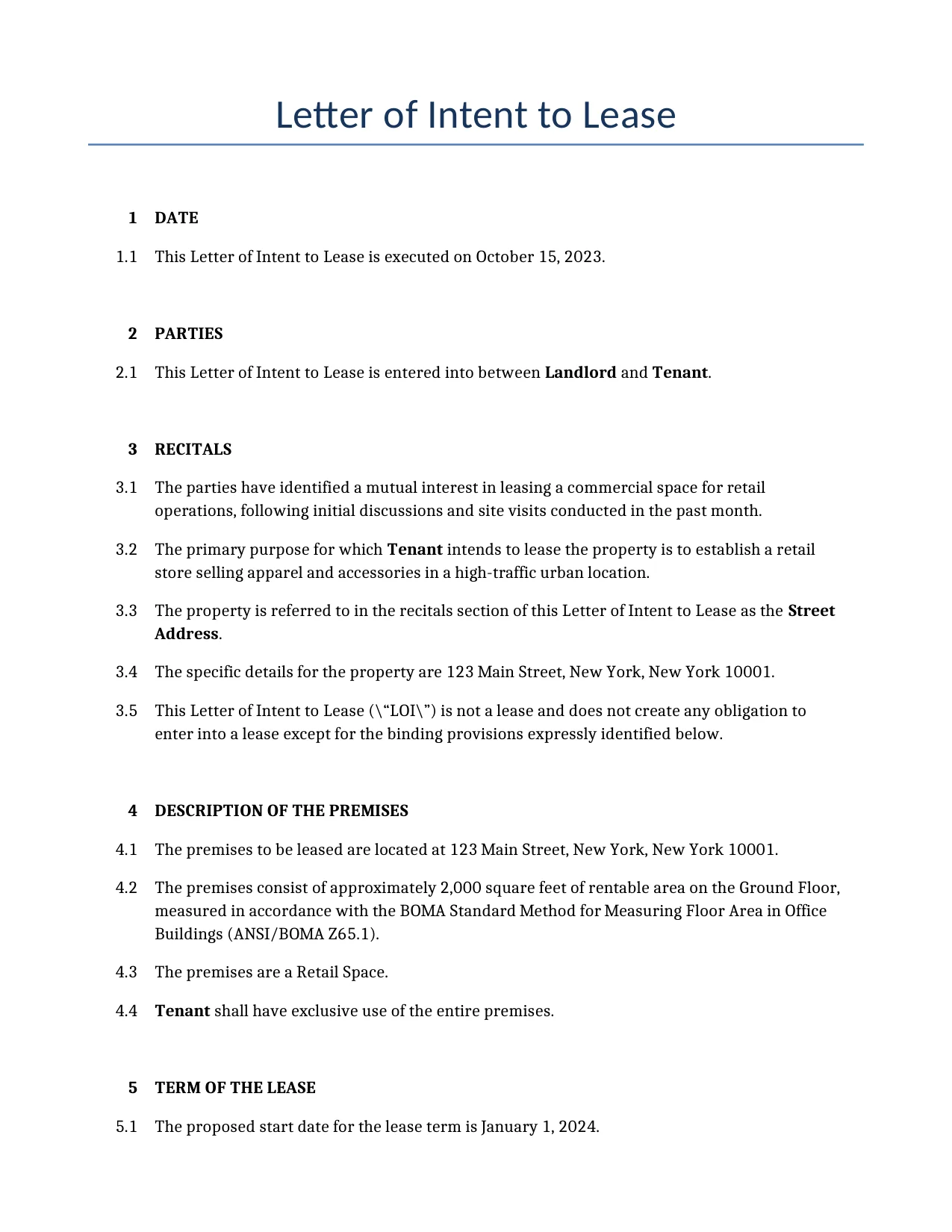
Letter of Intent to Lease
1DATE
This Letter of Intent to Lease is executed on October 15, 2023.
2PARTIES
This Letter of Intent to Lease is entered into between Landlord and Tenant.
3RECITALS
The parties have identified a mutual interest in leasing a commercial space for retail operations, following initial discussions and site visits conducted in the past month.
The primary purpose for which Tenant intends to lease the property is to establish a retail store selling apparel and accessories in a high-traffic urban location.
The property is referred to in the recitals section of this Letter of Intent to Lease as the Street Address.
The specific details for the property are 123 Main Street, New York, New York 10001.
This Letter of Intent to Lease (\“LOI\”) is not a lease and does not create any obligation to enter into a lease except for the binding provisions expressly identified below.
4DESCRIPTION OF THE PREMISES
The premises to be leased are located at 123 Main Street, New York, New York 10001.
The premises consist of approximately 2,000 square feet of rentable area on the Ground Floor, measured in accordance with the BOMA Standard Method for Measuring Floor Area in Office Buildings (ANSI/BOMA Z65.1).
The premises are a Retail Space.
Tenant shall have exclusive use of the entire premises.
5TERM OF THE LEASE
The proposed start date for the lease term is January 1, 2024.
The proposed end date for the initial lease term is December 31, 2026 (an initial term of three (3) years).
The lease shall include two (2) renewal options of three (3) years each as shall be negotiated in the formal lease agreement.
6RENTAL RATE AND PAYMENTS
The base rent shall be $25.50 per square foot per year for the 2,000 square feet of rentable area, resulting in annual base rent of $51,000.00.
The total annual base rent shall be $51,000.00 and shall be payable in equal monthly installments of $4,250.00.
Rent for any partial month shall be prorated based on the actual number of days in such month.
The lease term shall commence on January 1, 2024.
The rent shall be due on the 1st day of each month. Late payments shall incur a late fee of 5% and interest at the rate of 1.5% per month (or the maximum rate permitted by New York law).
The base rent shall include an annual escalation of 3% as shall be negotiated in the formal lease agreement.
Common Area Maintenance charges, taxes, and insurance shall be included as additional rent as shall be negotiated in the formal lease agreement.
7SECURITY DEPOSIT
The security deposit shall be $8,500.00 (equal to two months\’ base rent).
Tenant shall pay the security deposit by check or wire transfer.
Tenant shall pay the security deposit upon execution of this LOI.
Landlord shall pay interest on the security deposit as required by New York law (General Obligations Law \§ 7-103).
Landlord shall return the security deposit, minus any lawful deductions, within 30 days after the end of the lease and delivery of possession.
Landlord shall provide Tenant with an itemized list of any deductions from the security deposit.
8USE OF PREMISES
The permitted use of the leased premises shall be a retail store for the sale of clothing, apparel and accessories, and related uses. Tenant shall have the exclusive right to such use within the property.
The permitted use shall not involve the use, storage, or disposal of any hazardous materials except in compliance with all applicable laws.
The permitted signage for the use of the premises shall include building facade signage and interior signage, subject to applicable zoning, landmark and building codes.
Subleasing or assignment of the premises shall be allowed only upon Landlord\’s prior written consent, which shall not be unreasonably withheld, conditioned or delayed, and only for uses consistent with the permitted use.
9IMPROVEMENTS AND ALTERATIONS
Landlord shall provide a tenant improvement allowance of $75,000.00, to be paid within 30 days after Tenant submits invoices and lien waivers for work completed in accordance with plans approved by Landlord.
Tenant shall require the Landlord\’s prior written approval for all alterations, which approval shall not be unreasonably withheld.
All improvements and alterations shall be completed in a good and workmanlike manner and in compliance with all applicable laws, including the Americans with Disabilities Act (ADA).
Landlord shall approve alterations to the premises when such approval is not unreasonably withheld and the alterations are subject to building standards compliance.
At the end of the term, Tenant shall not be required to remove any alterations unless Landlord notifies Tenant at the time of approval that removal will be required.
Tenant shall be responsible for the cost of improvements in excess of the tenant improvement allowance.
10UTILITIES AND SERVICES
Tenant shall be responsible for and shall pay all utilities and services serving the premises, including electricity, gas, water, sewer, trash removal, and telecommunications, directly to the providers.
Landlord shall be responsible for utilities serving the common areas, which costs may be included in CAM charges as negotiated in the lease.
11INSURANCE
Tenant shall maintain commercial general liability insurance of at least $1,000,000 per occurrence and $2,000,000 aggregate, property insurance covering its improvements and personal property, and workers\’ compensation as required by law. Landlord shall be named as additional insured.
Landlord shall maintain property insurance on the building and commercial general liability insurance. Tenant shall be named as additional insured on Landlord\’s liability policy.
All policies shall be with insurers rated A-VIII or better by A.M. Best and shall provide that they may not be canceled without 30 days\’ prior written notice to the other party.
12MAINTENANCE AND REPAIRS
Tenant shall maintain the interior of the premises, including all non-structural elements, plumbing, electrical, and HVAC systems exclusively serving the premises, in good condition and repair, at Tenant\’s expense.
Landlord shall maintain the structure, roof, exterior walls, foundation, and common areas in good condition and repair, with costs potentially passed through as CAM.
13COMPLIANCE WITH LAWS
Tenant and Landlord shall comply with all applicable federal, New York State and local laws, including the Americans with Disabilities Act (ADA), zoning and land-use regulations, and environmental laws (including but not limited to CERCLA and New York State ECL Article 27).
Tenant shall not cause or permit any hazardous substances to be brought upon, kept or used in or about the premises in violation of applicable environmental laws. Tenant shall promptly notify Landlord of any release or violation.
14CONDITIONS PRECEDENT
Tenant must complete due diligence before the formal lease is executed. Due diligence shall include, without limitation, review of title, survey, environmental reports (Phase I ESA), zoning compliance, structural and mechanical inspections, and confirmation of Tenant\’s financing.
Tenant shall have 45 days from the date of this LOI to complete due diligence.
All conditions precedent must be satisfied or waived by Tenant by December 1, 2023.
15EXCLUSIVITY PERIOD
The exclusivity period shall start on October 16, 2023 and shall end on December 1, 2023.
During the exclusivity period Landlord agrees not to negotiate with other potential tenants regarding the premises or to market the premises for lease. In the event of a breach, Tenant shall be entitled to seek specific performance or damages, and the exclusivity period shall be extended by the duration of the breach.
16CONFIDENTIALITY
Both parties shall keep the terms of this Letter of Intent to Lease and the negotiations strictly confidential.
The confidentiality obligation shall be mutual and shall apply equally to both the Landlord and Tenant.
Confidential information does not include information that is or becomes publicly known through no fault of the receiving party, is independently developed, or is required to be disclosed by law.
The confidentiality obligation shall last for two (2) years after the date of this LOI or, if a lease is executed, for the term of the lease.
The confidentiality obligation shall survive termination of this Letter of Intent to Lease.
Disclosures of confidential information shall be permitted to legal and financial advisors, affiliates, employees, and as required by law, without breaching this clause, provided recipients are advised of the confidentiality obligations.
17NON-BINDING PROVISIONS
This LOI is non-binding and does not create any obligation to enter into a lease except for the binding provisions expressly identified in Section 18 below. This LOI is not a lease and creates no leasehold interest or other estate in the premises. No party shall have any liability to the other if a formal lease is not executed for any reason except as set forth in the binding provisions.
18BINDING PROVISIONS
The following provisions are binding on the parties and shall survive termination of this LOI: Sections 15 (Exclusivity Period), 16 (Confidentiality), 19 (Expenses and Due Diligence), 21 (Governing Law), 22 (Brokerage), 26 (Miscellaneous), and this Section 18. These binding obligations shall survive any termination of this LOI.
The exclusivity provision shall commence on October 16, 2023 and shall last until December 1, 2023 (or longer if extended by breach).
The confidentiality provision shall cover the LOI terms, negotiation details, and all non-public business information disclosed by either party.
19EXPENSES AND DUE DILIGENCE
Tenant shall be responsible for the costs of its own due diligence, including but not limited to inspections, environmental reports, title examination, survey, and its own legal and consulting fees.
Landlord shall be responsible for the costs of any appraisals it orders and its own legal fees.
There shall be a due diligence period of 45 days during which Tenant can conduct inspections without penalty. Tenant shall restore the premises to their prior condition if tests involve invasive work, at Tenant\’s expense.
20DEFAULT AND REMEDIES
In the event of a material default under any binding provision of this LOI, the non-defaulting party shall have all remedies available at law or in equity, including the right to seek specific performance or damages. No party shall be liable for consequential or punitive damages.
21DISPUTE RESOLUTION
Any dispute arising out of or relating to this LOI shall first be submitted to mediation in New York County, New York before a mutually acceptable mediator. If mediation is unsuccessful, the dispute shall be resolved by binding arbitration administered by the American Arbitration Association in accordance with its Commercial Arbitration Rules.
22BROKERAGE
No broker has been engaged by either party in connection with this transaction. Each party represents to the other that no broker is entitled to a commission and shall indemnify the other against any claims for brokerage commissions.
23TERMINATION
This LOI shall automatically terminate (a) upon execution of a mutually acceptable formal lease, (b) upon written notice by either party if the other party is in material breach of a binding provision, or (c) if the conditions precedent are not satisfied or waived by December 1, 2023.
Upon termination, the parties shall have no further obligations except for the binding provisions that expressly survive termination. Any security deposit paid shall be returned to Tenant promptly upon termination if no lease is executed.
24FORCE MAJEURE
Neither party shall be liable for delay or failure to perform its obligations (other than payment obligations) to the extent caused by events beyond its reasonable control, including acts of God, fire, flood, war, terrorism, labor disputes, governmental orders, or pandemics (\“Force Majeure\”), provided written notice is given promptly. Performance shall be extended for the duration of the Force Majeure event.
25GOVERNING LAW
This Letter of Intent to Lease and any future lease agreement shall be governed by the laws of the State of New York, without regard to conflict of laws principles. The parties consent to the exclusive jurisdiction of the state and federal courts located in New York County, New York.
This LOI shall be interpreted and enforced in accordance with New York law, including the Statute of Frauds and all applicable real property, landlord-tenant, and commercial leasing statutes and regulations. UCC Article 2A shall not apply as this is a lease of real property.
26ENTIRE AGREEMENT
This Letter of Intent to Lease constitutes the entire understanding between the parties on the subject matter.
This Letter of Intent to Lease supersedes all prior agreements or understandings between the parties.
27AMENDMENTS
Any modifications to this entire agreement shall be handled by written amendment signed by both parties.
Any changes to this Letter of Intent to Lease must be made in writing and signed by both parties.
28SEVERABILITY
If any provision of this Letter of Intent to Lease is held to be invalid or unenforceable, the remaining provisions shall remain in full force and effect.
29NOTICES
All notices under this Letter of Intent to Lease shall be in writing and delivered personally, by certified mail, or by overnight courier to the addresses of the parties as shall be provided in the formal lease agreement.
30COUNTERPARTS
This Letter of Intent to Lease may be executed in counterparts, each of which shall be deemed an original, and all of which together shall constitute one and the same instrument.
31ELECTRONIC TRANSACTIONS
This Letter of Intent to Lease may be executed by electronic means pursuant to the New York Electronic Signatures and Records Act and the federal ESIGN Act.
32MISCELLANEOUS
No waiver of any provision shall be effective unless in writing and signed by the waiving party. A waiver of one breach shall not constitute a waiver of any other or subsequent breach.
Time is of the essence with respect to all dates and time periods in this LOI.
Section headings are for convenience only and shall not be used to interpret the meaning of any provision.
33SIGNATURES
| LANDLORD | |
| Signature: | |
| Print Name: | |
| Date: |
| TENANT | |
| Signature: | |
| Print Name: | |
| Date: |
This example shows approximately 70% of a typical document and is provided for illustrative purposes only. The remaining content has been omitted.
Every document generated by Docaro is tailored to your specific circumstances, jurisdiction and the information you provide. The completed document includes all applicable clauses and provisions required for your situation.
To generate the full, personalised document, answer a short series of questions and your document will be created instantly.