
AI Generated Cybersecurity Policy for use in the United States
PDF & Word - 2026 Updated
Docaro Pricing
When Do You Need a Cybersecurity Policy in the United States?
American Legal Rules for a Cybersecurity Policy
Using the wrong structure for a cybersecurity policy can expose the organization to unnecessary regulatory non-compliance and security vulnerabilities.
What a Proper Cybersecurity Policy Should Include
- Purpose and ScopeDefines the policy's goals and applies to all employees, contractors, and systems within the organization.
- Roles and ResponsibilitiesOutlines who is accountable for protecting data, such as IT teams, managers, and staff.
- Acceptable Use of ResourcesSets rules for how company devices, networks, and software can be used safely.
- Data Protection MeasuresDescribes steps to secure sensitive information, like encryption and access controls.
- Incident Response PlanDetails how to detect, respond to, and recover from security breaches quickly.
- Training and AwarenessRequires regular education for everyone on recognizing and avoiding cyber threats.
- Compliance and EnforcementEnsures adherence to laws and company rules, with consequences for violations.
- Review and UpdatesMandates periodic checks and revisions to keep the policy current with new risks.
Generate Your Document in 4 Easy Steps
Why Use Docaro?
 United States
Free Example Cybersecurity Policy Template
Below is a free template example of a Cybersecurity Policy for use in the United States generated by our AI model.
The clauses in your actual Cybersecurity Policy will vary from this example as they will be entirely bespoke to your requirements as set out in the questionnaire you complete.
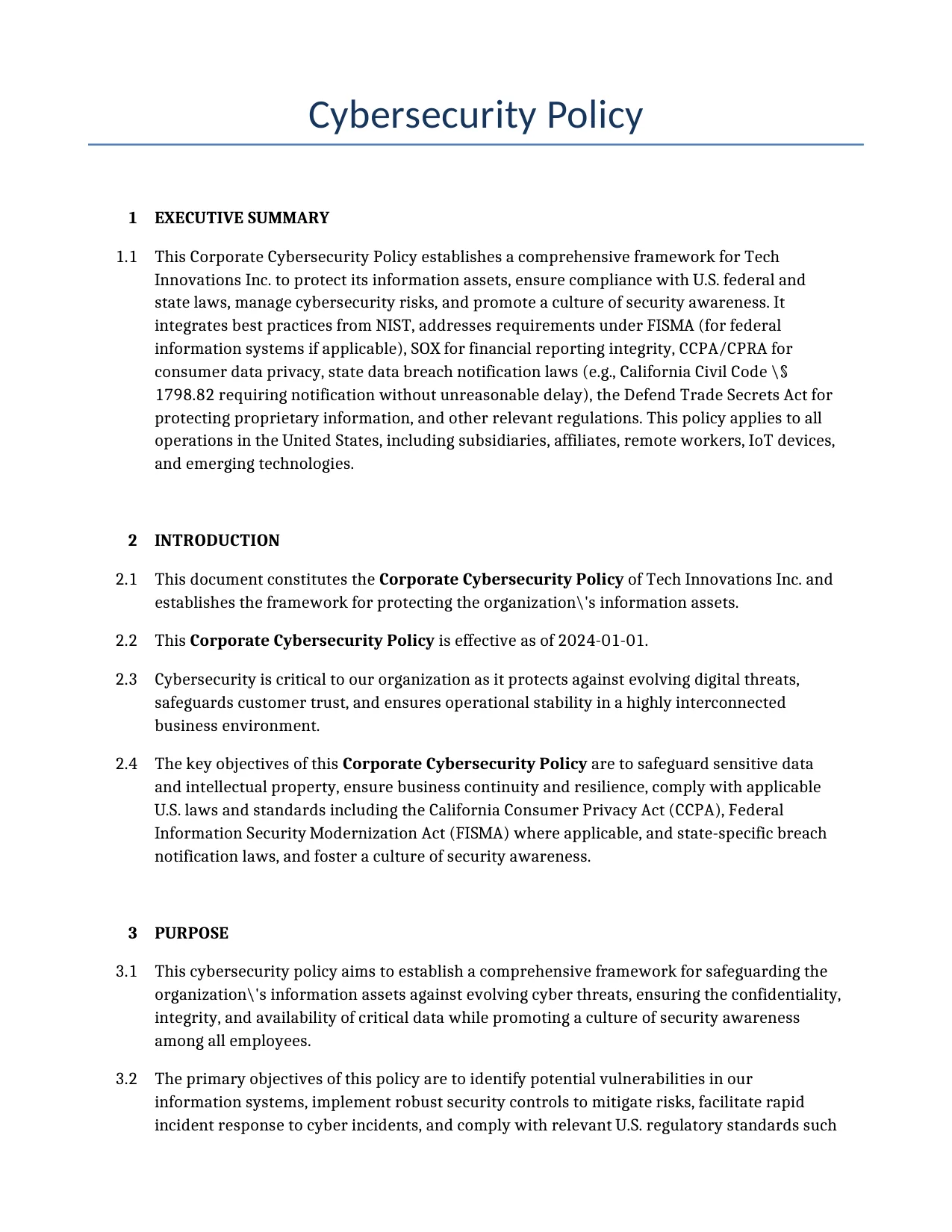
Corporate Cybersecurity Policy
1EXECUTIVE SUMMARY
This Corporate Cybersecurity Policy establishes a comprehensive framework for Tech Innovations Inc. to protect its information assets, ensure compliance with U.S. federal and state laws, manage cybersecurity risks, and promote a culture of security awareness. It integrates best practices from NIST, addresses requirements under FISMA (for federal information systems if applicable), SOX for financial reporting integrity, CCPA/CPRA for consumer data privacy, state data breach notification laws (e.g., California Civil Code \§ 1798.82 requiring notification without unreasonable delay), the Defend Trade Secrets Act for protecting proprietary information, and other relevant regulations. This policy applies to all operations in the United States, including subsidiaries, affiliates, remote workers, IoT devices, and emerging technologies.
2INTRODUCTION
This document constitutes the Corporate Cybersecurity Policy of Tech Innovations Inc. and establishes the framework for protecting the organization\'s information assets.
This Corporate Cybersecurity Policy is effective as of 2024-01-01.
Cybersecurity is critical to our organization as it protects against evolving digital threats, safeguards customer trust, and ensures operational stability in a highly interconnected business environment.
The key objectives of this Corporate Cybersecurity Policy are to safeguard sensitive data and intellectual property, ensure business continuity and resilience, comply with applicable U.S. laws and standards including the California Consumer Privacy Act (CCPA), Federal Information Security Modernization Act (FISMA) where applicable, and state-specific breach notification laws, and foster a culture of security awareness.
3PURPOSE
This cybersecurity policy aims to establish a comprehensive framework for safeguarding the organization\'s information assets against evolving cyber threats, ensuring the confidentiality, integrity, and availability of critical data while promoting a culture of security awareness among all employees.
The primary objectives of this policy are to identify potential vulnerabilities in our information systems, implement robust security controls to mitigate risks, facilitate rapid incident response to cyber incidents, and comply with relevant U.S. regulatory standards such as the California Consumer Privacy Act (CCPA), state data breach notification laws, SOX, and FISMA where applicable.
This policy emphasizes protection in the key areas of Data Confidentiality, Data Integrity, Data Availability, and Threat Detection and Response.
This policy specifically addresses threats such as phishing attacks, ransomware, data breaches, insider threats, and distributed denial-of-service (DDoS) attacks that could compromise the security of our information assets.
This policy covers the following types of information assets: Customer Personal Data, Financial Information, Intellectual Property, and Operational Systems Data.
4SCOPE
This Corporate Cybersecurity Policy applies to all information systems and networks, company personnel (including remote workers), contractors, third parties, cloud services, remote operations, IoT devices, emerging technologies, and data processing activities of Tech Innovations Inc., its subsidiaries, and affiliates in all U.S. states where the company operates, including any state-specific requirements such as New York\'s cybersecurity regulations for financial services if applicable.
This Corporate Cybersecurity Policy applies to all employees of Tech Innovations Inc.
This Corporate Cybersecurity Policy applies to all contractors working for Tech Innovations Inc.
This Corporate Cybersecurity Policy applies to all third parties accessing company systems of Tech Innovations Inc.
This Corporate Cybersecurity Policy covers on-premises networks and servers, cloud-based services and applications, remote access tools and VPNs, mobile devices, endpoints, IoT devices, and emerging technologies.
This Corporate Cybersecurity Policy applies to all US states and territories, with adherence to state-specific breach notification laws (e.g., prompt notification under California and New York laws).
5DEFINITIONS
Personal Information means information that identifies, relates to, describes, or is capable of being associated with a particular consumer, including but not limited to name, address, email, social security number, as defined under CCPA (Cal. Civ. Code \§ 1798.140).
Data Breach means the unauthorized acquisition of personal information that compromises the security, confidentiality, or integrity of the data, triggering notification obligations under state laws such as California Civil Code \§ 1798.82 and New York\'s data breach notification law.
Phishing means a cyber attack that uses disguised email or other communication as a trusted entity to trick individuals into revealing sensitive information, often addressed in training under NIST SP 800-53.
Ransomware means a type of malware that encrypts data and demands payment for decryption, with response procedures aligned to CISA guidelines and incident reporting under applicable laws.
Insider Threat means a current or former employee, contractor, or business partner who has or had authorized access and intentionally or unintentionally misuses that access to harm the organization, as recognized under NIST SP 800-53.
Multi-Factor Authentication (MFA) means a security process requiring more than one form of verification (e.g., password and token) to verify user identity, recommended under NIST SP 800-63B.
Encryption means the process of converting data into a coded form to prevent unauthorized access, using standards like AES-256 compliant with NIST SP 800-175B.
Vulnerability means a weakness in an information system that can be exploited by a threat source, assessed per NIST SP 800-30.
Risk Assessment means the process of identifying, estimating, and prioritizing risks to organizational operations, assets, or individuals, following NIST SP 800-30 guidelines.
Incident Response means the systematic approach to handling and managing cybersecurity incidents, aligned with NIST SP 800-61.
Business Continuity means the planning and processes to ensure critical business functions continue during and after a disruption, per NIST SP 800-34.
Disaster Recovery means the policies, procedures, and tools to restore IT infrastructure and operations after a disaster, integrated with business continuity per NIST SP 800-34.
Access Control means the selective restriction of access to information systems and data, implementing principles like least privilege under NIST SP 800-53.
Least Privilege means granting users only the minimum levels of access or permissions needed to perform their job functions, as required by NIST SP 800-53 and SOX controls.
Zero Trust means a security model that eliminates implicit trust and requires continuous verification of all users and devices, aligned with NIST SP 800-207.
Personally Identifiable Information (PII) means any information that can be used to distinguish or trace an individual\'s identity, either alone or when combined with other information, per OMB Memorandum M-07-16 and NIST SP 800-122.
Protected Health Information (PHI) means individually identifiable health information transmitted or maintained by a covered entity, as defined under HIPAA (45 C.F.R. \§ 160.103), if the organization handles health data.
Confidential Information means any non-public information disclosed by or on behalf of the Company, including but not limited to business plans, customer lists, financial data, technical specifications, and proprietary processes, regardless of whether marked as confidential. Protected under the Defend Trade Secrets Act of 2016 (18 U.S.C. \§ 1836 et seq.).
Trade Secret means any confidential information that derives independent economic value from not being generally known to the public or to other persons who can obtain economic value from its disclosure or use, and is the subject of reasonable efforts by the Company to maintain its secrecy, as defined under the Defend Trade Secrets Act of 2016 (18 U.S.C. \§ 1839).
Data Subject Rights means consumer rights under CCPA/CPRA including the right to know/access, delete, opt-out of sale of personal information, and non-discrimination for exercising rights (Cal. Civ. Code \§\§ 1798.100-1798.199).
Supply Chain Risk means risks arising from dependencies on suppliers, vendors, or service providers that could compromise cybersecurity, addressed under NIST SP 800-161.
6POLICY STATEMENT
Our organization is committed to safeguarding our digital assets, protecting sensitive information, and ensuring the resilience of our systems against evolving cyber threats.
This Cybersecurity Policy establishes the foundation for our proactive approach to cybersecurity.
The organization commits to maintaining the confidentiality of sensitive information.
The organization commits to ensuring the integrity of data and systems.
The organization commits to the availability of critical information and systems.
This Cybersecurity Policy incorporates the guiding principles of Risk-Based Approach, Proactive Defense, Employee Awareness, and Continuous Improvement.
Senior management is fully committed to providing the necessary resources, training, and support to implement and maintain effective cybersecurity measures across the organization.
This Cybersecurity Policy references the U.S. regulatory frameworks of NIST Cybersecurity Framework and CIS Controls for alignment.
7ROLES AND RESPONSIBILITIES
Executives will approve the cybersecurity budget, review quarterly risk assessment reports, and ensure alignment of cybersecurity strategies with overall business objectives. Executives shall complete annual cybersecurity training that meets or exceeds U.S. regulatory standards (e.g., SOX, NIST guidelines), including topics on insider threat recognition, social engineering, and regulatory compliance. Training effectiveness shall be measured through quizzes, simulated exercises, and metrics such as completion rates and phishing simulation failure rates.
The Chief Information Security Officer (CISO) is responsible for overseeing the cybersecurity program, ensuring compliance with all applicable laws, coordinating with the Legal team on regulatory matters, and reporting to the Board.
IT staff will monitor compliance with policy through regular audits, investigate violations, recommend disciplinary actions, handle user account provisioning, access revocation, and regular access reviews. IT staff shall complete annual training on regulatory compliance.
Employees must use strong passwords, encrypt sensitive data when sharing, avoid storing confidential information on unapproved devices, recognize insider threats and social engineering, and comply with all policies. Employees must complete annual cybersecurity training (or more frequently as required by regulations like HIPAA if applicable) covering insider threat recognition, social engineering, and regulatory compliance, with effectiveness measured via assessments.
Employees must report suspected cybersecurity incidents within 24 hours to the designated incident response team.
Third parties will conduct annual self-assessments of their cybersecurity risks, share results, adhere to SOC 2 or equivalent, and notify of incidents promptly. Third-party contracts shall include cybersecurity and privacy clauses aligned with CCPA and state laws.
The Legal team shall support compliance monitoring, breach notifications, and whistleblower protections.
All training shall be documented, with records retained per applicable laws.
8GOVERNANCE AND OVERSIGHT
The Cybersecurity Oversight Board shall serve as the governing body responsible for overseeing the cybersecurity program.
The Cybersecurity Committee is designated for cybersecurity oversight.
The Chief Information Security Officer (CISO) is designated as the individual responsible for the cybersecurity program.
The cybersecurity program reports directly to the Chief Information Security Officer, who in turn reports to the Cybersecurity Oversight Board on a quarterly basis.
The governing body shall review the cybersecurity program quarterly.
The organization shall require independent third-party audits of the cybersecurity program at least annually.
The governing body is responsible for approving cybersecurity policies, monitoring program effectiveness, allocating resources, and ensuring compliance with relevant U.S. regulations.
The escalation protocol for significant cybersecurity incidents shall be immediate notification to the CISO, Legal team, and Board as appropriate.
9LEGAL AND REGULATORY COMPLIANCE
Tech Innovations Inc. shall comply with all applicable U.S. laws and regulations, including but not limited to: FISMA (if handling federal information systems), HIPAA (if handling PHI), SOX (for public companies regarding financial controls and reporting), CCPA/CPRA (for California residents\' data privacy rights), state data breach notification laws (e.g., notification without unreasonable delay, often within 30-60 days depending on the state; California requires prompt notification), the Defend Trade Secrets Act, and sector-specific regulations if applicable. For international aspects involving EU data, GDPR compliance measures shall be maintained where required, though this policy focuses on U.S. requirements.
The CISO and Legal team are responsible for monitoring compliance through regular reviews, audits, and gap analyses against NIST SP 800-53, ISO/IEC 27001:2022, and other standards. Procedures include annual risk assessments, documentation of controls, and reporting to regulatory bodies as required (e.g., SEC for material incidents if public, state Attorneys General, FTC).
Breach reporting shall follow specific timelines: notify affected individuals, state Attorneys General, and agencies like the FTC promptly and without unreasonable delay (targeting under 30 days where possible; specific maxima like 45 or 72 hours in certain contexts). Penalties for non-compliance may include fines under CCPA (up to $7,500 per intentional violation), SOX criminal penalties, or state-specific sanctions. The Legal team shall oversee filings and coordinate with authorities.
Compliance monitoring includes quarterly internal audits, annual third-party reviews, and integration with enterprise risk management. All incidents shall be documented for regulatory audits.
10CORPORATE ACCEPTABLE USE POLICY
This policy outlines the rules for the appropriate and secure use of company IT resources and data to ensure productivity, security, and compliance with U.S. laws including CCPA and SOX.
Authorized personnel include all full-time employees, contractors, and temporary staff who have been granted access by the IT department for business purposes. This includes remote workers.
The following activities are prohibited under this Corporate Acceptable Use Policy: unauthorized access to systems, installation of unapproved software, sharing confidential data externally without approval, use of company resources for personal gain, accessing inappropriate content, and bypassing security controls.
The use of personal devices for accessing company IT resources (BYOD) is allowed under this Corporate Acceptable Use Policy only with MDM enrollment, encryption, and approval.
Passwords must follow complexity rules defined in the Password Management section. Password management is separated from acceptable use to avoid overlap.
Employees shall encrypt sensitive data transmissions using approved methods (e.g., TLS 1.3), prohibit storage on unapproved devices, require approval for data sharing, and perform regular data backups. Data handling shall align with privacy-by-design principles.
Company IT usage may be monitored under this Corporate Acceptable Use Policy for security and compliance purposes, consistent with applicable laws.
Employees should report violations immediately to the IT Security Team via the confidential hotline at 1-800-SECURE or email security@techinnovations.com.
Violations of this Corporate Acceptable Use Policy may result in disciplinary actions up to termination, per the Enforcement section.
11ACCESS CONTROL
The Chief Information Security Officer (CISO) is designated as the owner of the Access Control Policy.
Access requests shall require manager approval and security team approval. Access shall follow the principles of least privilege and zero trust.
The Company shall conduct periodic reviews of user access rights every 6 months, or more frequently for high-risk systems.
The Company shall implement role-based access control (RBAC) for granting system permissions, with regular recertification.
The Company shall support multi-factor authentication (MFA) for all system access where technically feasible.
The Company shall immediately disable all user accounts upon notification of termination, change all shared passwords, and conduct a full audit of access logs within 24 hours upon employee termination.
The Company shall require logging of all access attempts to systems and information.
Temporary access grants shall not exceed a maximum duration of 7 days before automatic revocation.
12AUTHENTICATION AND AUTHORIZATION
Multi-factor authentication (MFA) shall be required for all user logins, administrative accounts, remote access, and cloud services.
An account lockout mechanism shall be implemented after 5 failed login attempts. The account shall remain locked for 30 minutes or until manually unlocked by an administrator.
Authorization shall enforce least privilege and zero trust principles across all systems.
13PASSWORD MANAGEMENT
Specific password complexity rules shall be enforced, including a minimum length of 12 characters, at least one uppercase letter, at least one lowercase letter, at least one numeric character, and at least one special character. Passphrases are encouraged.
Employees shall be prohibited from reusing any of their previous 10 passwords. Passwords shall not be shared.
New users or employees shall create unique passwords not derived from defaults.
The use of common words, dictionary terms, or easily guessable passwords shall be prohibited. Password managers are recommended.
Stored passwords shall be encrypted using strong hashing algorithms such as bcrypt or Argon2.
Employees shall change their passwords upon suspected compromise or role change. Scheduled expiration is not required if MFA is used and complexity is enforced, per NIST guidelines.
14DATA CLASSIFICATION
Data shall be classified at the following sensitivity levels: Public, Internal, Confidential, and Restricted. Classification shall consider regulatory requirements under CCPA, SOX, and state laws.
Criteria for determining data sensitivity levels shall include regulatory requirements, confidentiality impact, integrity impact, availability impact, and business value.
An inventory of all data assets shall be required and maintained as part of the classification process.
The Chief Information Security Officer (CISO) shall be responsible for overseeing data classification.
Data classifications shall be reviewed and updated annually or upon significant changes.
Training for employees on data classification procedures shall be mandated annually.
15DATA PROTECTION AND ENCRYPTION
AES-256 shall be specified for protecting data at rest. TLS 1.3 shall be required for data in transit.
The company shall adopt automated key rotation and hardware security modules (HSMs) for handling encryption keys. Keys shall be managed securely per NIST SP 800-57.
The company handles customer personal information including names, addresses, and payment details, as well as proprietary intellectual property such as software code and business strategies that require protection under the Defend Trade Secrets Act.
Regular audits of encryption implementations by the company\'s IT team and third parties shall be mandated annually.
The data protection policy shall align with U.S. compliance frameworks including NIST Cybersecurity Framework, PCI DSS (if applicable), and CCPA.
16DATA SUBJECT RIGHTS AND PRIVACY
Tech Innovations Inc. shall uphold data subject rights under U.S. laws such as CCPA/CPRA, including the right to access personal information, delete it, opt-out of the sale or sharing of personal information, and non-discrimination for exercising these rights. If handling PHI, HIPAA rights apply.
Procedures for handling privacy requests: Requests shall be acknowledged within 10 business days and responded to within 45 days (extendable by 45 days). A dedicated privacy team or designee shall process requests. Consent management shall be implemented for data collection and processing. Privacy-by-design principles shall be integrated into all systems and processes per NIST and CCPA guidelines.
Records of all requests and responses shall be maintained for audit purposes. Training on privacy rights shall be included in annual employee awareness programs.
17CORPORATE INCIDENT RESPONSE POLICY
This policy outlines the procedures for detecting, responding to, and recovering from cybersecurity incidents to minimize damage, ensure regulatory compliance, and maintain business continuity.
A dedicated Incident Response Team shall be established within the organization and shall include the Chief Information Security Officer, IT Security Analyst, Legal representative (for compliance advice), Public Relations Officer, and a Forensic Investigator as needed.
The organization will use continuous monitoring of network traffic, log analysis, and user activity alerts to detect potential cybersecurity incidents in real-time.
The detection tools to be incorporated shall include Intrusion Detection System, Security Information and Event Management (SIEM), and Endpoint Detection and Response (EDR).
Incidents will be classified based on impact to data confidentiality, system availability, potential financial loss, and regulatory compliance requirements, categorized as low, medium, high, or critical.
The phases of the incident response process shall include Preparation, Identification, Containment, Eradication, Recovery, and Lessons Learned, per NIST SP 800-61.
The initial response time limit for the Incident Response Team shall be 4 hours for critical incidents.
Containment strategies include isolating affected systems, disconnecting from the network, changing credentials, and deploying temporary firewalls to prevent further spread of the incident.
Forensic investigations shall be conducted for significant incidents using approved tools and chain-of-custody procedures. Law enforcement shall be coordinated with if the incident appears criminal (e.g., via FBI or local authorities). Post-incident regulatory filings (e.g., to FTC, SEC if applicable) are required.
Regular testing of the recovery procedures shall be required at least annually.
Cybersecurity incidents shall be reported internally immediately. External notifications shall comply with U.S. laws: notify without unreasonable delay (typically within 30-60 days per most state laws; specific requirements vary, e.g., New York requires prompt notice). Regulatory bodies include the FTC, SEC (if public company for material events), state Attorneys General, and affected individuals. Breach notification letters shall include required details per state law, and credit monitoring shall be offered where required (e.g., under CCPA or certain state laws for breaches involving SSNs). All disclosures shall be documented.
Records of cybersecurity incidents shall be retained for at least 7 years or as required by law.
The post-incident review process involves a debrief meeting with the response team to analyze the incident\'s root cause, evaluate response effectiveness, and identify improvements, documented in a formal report.
The Corporate Incident Response Policy shall be reviewed and updated annually or after major incidents.
18BUSINESS CONTINUITY AND DISASTER RECOVERY
The primary objectives of the Business Continuity and Disaster Recovery section are to minimize downtime, protect critical data, ensure rapid recovery from disruptions, and maintain operational resilience during cyber incidents or other emergencies, per NIST SP 800-34.
Daily backups of critical data shall be required, with testing at least quarterly. Backups shall be stored offsite and encrypted.
The recovery time objective (RTO) for critical operations shall be 4 hours. Recovery point objective (RPO) shall be 1 hour.
Testing of the disaster recovery plan shall be required at least annually, with tabletop exercises quarterly.
The key personnel responsible for executing the disaster recovery plan shall be the IT Director, Disaster Recovery Coordinator, CISO, and Backup Administrator.
The Business Continuity and Disaster Recovery section shall cover cyberattacks, natural disasters, power outages, and supply chain disruptions.
19CYBERSECURITY INSURANCE
Tech Innovations Inc. shall maintain adequate cybersecurity insurance coverage to mitigate financial risks associated with cyber incidents. The CFO or Risk Manager is responsible for procuring, reviewing, and managing the policy.
Coverage shall include breach response costs, ransomware payments (if approved), third-party liability, regulatory fines, notification expenses, credit monitoring, and business interruption. Policy limits shall be reviewed annually or after significant business changes to ensure adequacy based on risk assessment.
The insurance policy shall be coordinated with the Incident Response Plan, Business Continuity Plan, and Legal team. Claims processes shall be documented and tested annually.
20RISK MANAGEMENT
The organization will adopt the NIST Cybersecurity Framework (CSF 2.0) and NIST SP 800-30 as the primary risk management frameworks. This includes the Identify, Protect, Detect, Respond, Recover, and Govern functions to systematically address cybersecurity risks. Risk management shall integrate with enterprise risk management.
The organization shall conduct a comprehensive cybersecurity risk assessment at least annually, or more frequently for high-risk areas. Risk assessments shall use NIST SP 800-30 methodology.
The organization will use a combination of employee surveys, automated threat detection software, regular reviews of network logs, vulnerability scanners, threat intelligence platforms, and internal audits for identifying and assessing cybersecurity risks, including supply chain and third-party risks.
A specific risk tolerance level (e.g., low appetite for high-impact risks) is defined for the organization\'s cybersecurity policy. Risk acceptance shall be documented, approved by the CISO and executives, and reviewed periodically. Risk treatment plans shall include mitigation, avoidance, transfer (e.g., insurance), or acceptance.
Mitigation strategies include implementing multi-factor authentication, regular software patching, employee training programs, incident response planning, and controls from NIST SP 800-53.
Ongoing monitoring will involve daily security log reviews, quarterly penetration testing, and the use of SIEM systems to track emerging threats. Third-party and supply chain risks shall be assessed annually.
21VULNERABILITY MANAGEMENT
Regular vulnerability scanning shall be enabled as part of this Cybersecurity Policy, referencing NIST SP 800-53 and NIST SP 800-40. Scans shall be conducted at least monthly, with continuous scanning for critical assets.
The IT team shall use approved tools such as Nessus, Qualys, or equivalent for vulnerability scanning.
The scope of systems to be included in vulnerability scanning shall encompass all internal servers, workstations, network devices, cloud-based applications, IoT devices, and endpoints within the corporate environment.
Vulnerabilities shall be prioritized using the CVSS Score, exploitability, and business impact. Remediation timelines shall be risk-based: critical within 7 days, high within 14-30 days, medium within 60 days, low within 90 days. Timelines shall be defensible in audits.
The Chief Information Security Officer shall be responsible for overseeing the vulnerability management procedures, including documentation of exceptions or risk acceptance.
22PATCH MANAGEMENT
A patch management policy shall be enabled for the organization, aligned with NIST SP 800-40. The policy shall cover servers, workstations, network devices, applications, and cloud environments.
Critical security patches shall be applied within 7 days after a patch release or as soon as tested. High-risk within 14 days, medium within 30 days, low within 90 days. Timelines are risk-based and shall be documented.
All patches shall be tested in a non-production environment before deployment. The IT Security Manager shall be responsible for approving patches after testing.
The IT department shall use automated tools and phased rollout for deploying patches. Ongoing monitoring shall be required to verify successful patch application and address any issues.
23NETWORK SECURITY
Firewalls (hardware and next-generation) shall be implemented to protect the network infrastructure. An Intrusion Detection/Prevention System (IDS/IPS) shall be deployed in inline mode to monitor and block threats.
Network segmentation shall be implemented to isolate critical assets, following zero trust principles. Firewall configurations shall be reviewed every 6 months.
The maximum response time for addressing IDS/IPS alerts shall be 4 hours for critical alerts. The IT Security Team shall be responsible for firewall management, IDS/IPS monitoring, and segmentation enforcement.
24ENDPOINT SECURITY
The company shall maintain a comprehensive inventory of all endpoints including laptops, mobiles, servers, and IoT devices.
The policy shall cover laptops and desktops, mobile devices, servers, and IoT. Installation of EDR/antivirus software shall be required on all endpoints. Full disk encryption, MFA, and remote wipe capabilities shall be enforced.
Mobile Device Management (MDM) solutions shall be implemented for all mobile endpoints. Prohibited configurations include USB auto-run, user administrator rights on production systems, and unapproved software.
Continuous monitoring of endpoints for security events shall be enabled using EDR tools.
25APPLICATION SECURITY
The adoption of a secure Software Development Lifecycle (SDLC) shall be required for all application development projects, incorporating security at every phase per OWASP and NIST guidelines.
The company shall follow OWASP Secure Coding Practices and CERT Secure Coding Standards. Code reviews, SAST, and DAST shall be mandatory. Testing shall occur after every major release or code change.
Critical vulnerabilities must be remediated within 30 days, high within 60 days, medium/low per risk assessment. Requirements for securing third-party applications, libraries, and open-source components (e.g., SBOM usage) shall be included.
26CLOUD SECURITY
The organization utilizes approved cloud service providers such as Amazon Web Services (AWS) and Microsoft Azure. Models include IaaS, PaaS, and SaaS. Employees shall acknowledge the shared responsibility model.
Data in the cloud shall follow classification levels. Encryption, MFA, RBAC, and least privilege shall be enforced. Cloud security audits shall occur at least annually. Regular security assessments of cloud vendors are required.
The primary contact for cloud security incidents shall be the Cloud Security Team Lead.
27REMOTE ACCESS AND MOBILE DEVICE MANAGEMENT
Remote access for employees to company resources shall be permitted only via approved secure methods (VPN with encryption, secure web portals) and MFA. Idle session timeout shall be 15 minutes.
Mobile Device Management (MDM) shall be enabled for all company-owned and BYOD devices accessing resources. Requirements include password protection, encryption, remote wipe, and compliance checks.
28EMAIL AND WEB SECURITY
Email filtering systems shall be required to detect and block phishing attempts and malware. Web filtering shall prevent access to malicious sites. Antivirus, EDR, and secure email gateways shall be used.
Phishing awareness training shall be conducted at least annually (quarterly simulations recommended). New employees shall receive initial training. Suspected incidents shall be reported immediately.
29PHYSICAL SECURITY
Identification badges or keycards shall be required for all employees and visitors. Visitor logs shall be maintained. Perimeter security shall include fencing, gates, and surveillance cameras covering entry points and sensitive areas.
Surveillance footage shall be retained for at least 90 days. Sensitive hardware shall be secured in locked areas. Physical access privileges shall be reviewed quarterly. The Chief Security Officer or designee shall oversee physical security.
30THIRD-PARTY RISK MANAGEMENT
A formal third-party risk management program shall be maintained to assess and monitor vendors, suppliers, and service providers. This includes supply chain security risks per NIST SP 800-161.
Risk assessments shall be required before engaging new vendors and annually for high-risk vendors. Vendors shall be categorized as high, medium, or low risk based on data access and criticality. Due diligence, security questionnaires, and audits (e.g., SOC 2 reports) shall be required proportionate to risk.
Contracts shall include cybersecurity requirements, incident notification within 24 hours, right-to-audit clauses, and compliance with CCPA, data protection standards, and insurance requirements. Ongoing monitoring and termination procedures for high-risk vendors shall be documented.
Supply chain security shall include vetting of hardware/software suppliers, use of SBOM where applicable, and contingency plans for supply chain disruptions.
31ARTIFICIAL INTELLIGENCE AND EMERGING TECHNOLOGY SECURITY
The use of artificial intelligence (AI), machine learning, and other emerging technologies (e.g., IoT, quantum computing if applicable) shall be governed by security controls. This includes risk assessments for AI systems per NIST AI RMF 1.0, secure model training, data poisoning prevention, and bias mitigation.
AI and emerging tech shall undergo security reviews, vulnerability assessments, and integration with zero trust architecture. Data used in AI shall comply with privacy laws like CCPA. Responsible AI principles, including transparency and accountability, shall be followed. The CISO shall oversee security for these technologies.
32MONITORING AND LOGGING
Logging of all security-related events shall be required. Continuous monitoring of network traffic, endpoints, and cloud environments for anomalies shall be implemented using SIEM and EDR. Logs shall be retained for at least 1 year (or 7 years for compliance records) and protected for integrity.
Comprehensive audit trails for all user activities, access, changes, and incidents shall be maintained, including access logs, error logs, security logs, and application logs. Logs shall support forensic analysis and regulatory compliance.
33COMPLIANCE AND AUDITING
The company shall conduct internal audits at least annually and external audits as required to ensure compliance with cybersecurity policies, NIST SP 800-53, ISO/IEC 27001:2022, SOX, CCPA/CPRA, HIPAA (if applicable), and state laws. Quarterly reviews of key controls, monthly vulnerability scans, and annual penetration testing shall be performed.
Findings shall be documented in a centralized system with tracked remediation plans. The CISO and Legal team shall oversee compliance reporting.
34REPORTING AND DISCLOSURE
Employees shall be required to report suspected cybersecurity incidents internally immediately (within 24 hours maximum) using email to the IT security team (security@techinnovations.com), the confidential hotline, or an online reporting portal. A specific Incident Response Team shall be designated for internal reports.
Confirmed data breaches, ransomware, or other reportable incidents shall trigger external notifications. External parties shall be notified without unreasonable delay and in compliance with U.S. state laws (e.g., most require notification as soon as practicable, often targeting 30-45 days; California requires notification in the most expedient time possible). Regulatory bodies to notify include the FTC, SEC (for material cybersecurity incidents if a public company per SEC rules), state Attorneys General, and other agencies as required (e.g., HHS for HIPAA breaches). Affected individuals shall receive notification via mail, email, or substitute methods per law.
Breach notification letters shall comply with state requirements (e.g., describing the breach, types of information involved, mitigation steps, contact information, and offering credit monitoring/free identity protection where mandated under laws like CCPA or New York\'s SHIELD Act). Credit monitoring shall be offered for at least 12-24 months if SSNs or financial data are compromised. All disclosures, notifications, and related documentation shall be retained for at least 7 years. A formal legal assessment by the Legal team shall precede external notifications.
35WHISTLEBLOWER AND ANTI-RETALIATION PROTECTIONS
Tech Innovations Inc. is committed to protecting whistleblowers who report suspected violations of this policy, cybersecurity incidents, or regulatory non-compliance in good faith. Protections are provided under U.S. laws such as the Sarbanes-Oxley Act (SOX Section 806), Dodd-Frank Act, and other federal and state whistleblower statutes.
Anonymous reporting channels (e.g., hotline, online portal) shall be available. Reports shall be investigated promptly and confidentially by the Legal team or independent party. The company prohibits retaliation, including termination, demotion, or harassment. Any retaliation shall result in disciplinary action up to termination. Employees are encouraged to report concerns without fear.
This section integrates with the Enforcement section. Training on whistleblower rights shall be included in annual compliance training.
36ENFORCEMENT AND DISCIPLINARY ACTIONS
A policy violation occurs when an employee intentionally or negligently fails to comply with the cybersecurity guidelines outlined in this policy, such as unauthorized access to systems, sharing confidential information, or failing to report security incidents.
A progressive discipline approach shall be implemented for policy violations, considering severity and intent.
Disciplinary measures for policy violations shall include verbal warning, written reprimand, suspension without pay, termination of employment, and potential legal action.
Employees should report suspected policy violations immediately to their direct supervisor, the Human Resources Department, or via anonymous whistleblower channels. Reports will be investigated confidentially, with initial review within 48 hours.
The Human Resources Department, Information Security Team, Legal team, and Management Supervisors shall be responsible for enforcing disciplinary actions, ensuring consistency and compliance with labor laws.
37POLICY REVIEW AND UPDATES
The cybersecurity policy shall be reviewed at least every 12 months, or immediately upon major security incidents, regulatory changes, or significant business changes.
The IT Security Team, CISO, Compliance Officer, and Legal team shall be responsible for conducting the policy review.
The policy review process shall include gathering input from key stakeholders including IT, legal, and department heads, assessing the current policy against recent security threats and compliance requirements (e.g., updates to NIST, CCPA), identifying gaps, drafting revisions, circulating for feedback, and finalizing with senior management approval.
Employees shall be notified about policy updates by company-wide email with a summary of changes, posting on the internal intranet, and requiring electronic acknowledgment via the learning management system.
Previous versions of the policy shall be retained for at least 7 years.
38REFERENCES AND APPENDICES
The following federal and state regulations and standards are included as references with citations: FISMA (44 U.S.C. \§ 3551 et seq., https://www.congress.gov/bill/113th-congress/senate-bill/2521), HIPAA (45 C.F.R. Parts 160, 162, 164 if applicable), SOX (15 U.S.C. \§ 7262, Pub. L. 107-204), CCPA/CPRA (Cal. Civ. Code \§\§ 1798.100-1798.199.100, https://oag.ca.gov/privacy/ccpa), Defend Trade Secrets Act (18 U.S.C. \§ 1836 et seq.), GDPR (where international aspects apply, Regulation (EU) 2016/679), state breach notification laws (e.g., California Civil Code \§ 1798.82, New York Gen. Bus. Law \§ 899-aa). NIST CSF 2.0 (https://www.nist.gov/cyberframework), NIST SP 800-53 Rev. 5, NIST SP 800-30, NIST SP 800-61, ISO/IEC 27001:2022, CIS Controls v8, CMMC (if relevant, 32 C.F.R. Part 170), PCI DSS (if applicable).
Appendices include: (A) Full Glossary expanding on Section 5 definitions; (B) Sample Incident Reporting Form; (C) Sample Data Classification Labels and Handling Procedures; (D) Sample Breach Notification Letter Template compliant with U.S. state laws (e.g., including statutory language for California: \'We are writing to inform you of a data security incident...\' with required elements); (E) Risk Assessment Template; (F) Training Effectiveness Metrics Dashboard Template.
39GOVERNING LAW
This Corporate Cybersecurity Policy shall be governed by and construed in accordance with the laws of the United States and the State of California. Electronic signatures are accepted per the Electronic Signatures in Global and National Commerce Act (E-SIGN Act, 15 U.S.C. \§ 7001 et seq.). Policy acknowledgment may be completed electronically via company systems for all employees and contractors.
40SIGNATURE
I have read, understood, and agree to comply with the terms and conditions outlined in this Corporate Cybersecurity Policy.
Employee Name: _______________________________
Signature: ____________________________________
Date: _________________________________________
On behalf of Tech Innovations Inc., this Corporate Cybersecurity Policy is approved by: _______________________________
Signature of Authorized Representative: ___________
Title: _________________________________________
Date: _________________________________________
This example shows approximately 70% of a typical document and is provided for illustrative purposes only. The remaining content has been omitted.
Every document generated by Docaro is tailored to your specific circumstances, jurisdiction and the information you provide. The completed document includes all applicable clauses and provisions required for your situation.
To generate the full, personalised document, answer a short series of questions and your document will be created instantly.