
AI Generated American Inventory of Estate Assets
PDF & Word - 2026 Updated
Docaro Pricing
When Do You Need an Inventory of Estate Assets in the United States?
American Legal Rules for an Inventory of Estate Assets
Using an improper format for estate inventory documents may lead to incomplete asset listings and complications in probate proceedings.
What a Proper Inventory of Estate Assets Should Include
- List of All AssetsInclude every item of value owned by the deceased, such as bank accounts, real estate, vehicles, and personal belongings.
- Asset DescriptionsProvide clear details for each asset, like location, serial numbers, or account details, to identify them accurately.
- Current ValuesEstimate the fair market value of each asset at the date of death using appraisals or recent valuations.
- Date of InventorySpecify the date when the inventory is prepared, which should be as close as possible to the date of death.
- Supporting DocumentsAttach or reference evidence like titles, statements, or receipts to verify the assets and their values.
- Debts and LiabilitiesNote any outstanding debts or claims against the estate that could affect the asset values.
- Sworn VerificationInclude a statement from the executor confirming the inventory's accuracy under penalty of perjury.
Generate Your Document in 4 Easy Steps
Why Use Docaro?
 United States
Free Example Inventory of Estate Assets Template
Below is a free template example of a Inventory of Estate Assets for use in the United States generated by our AI model.
The clauses in your actual Inventory of Estate Assets will vary from this example as they will be entirely bespoke to your requirements as set out in the questionnaire you complete.
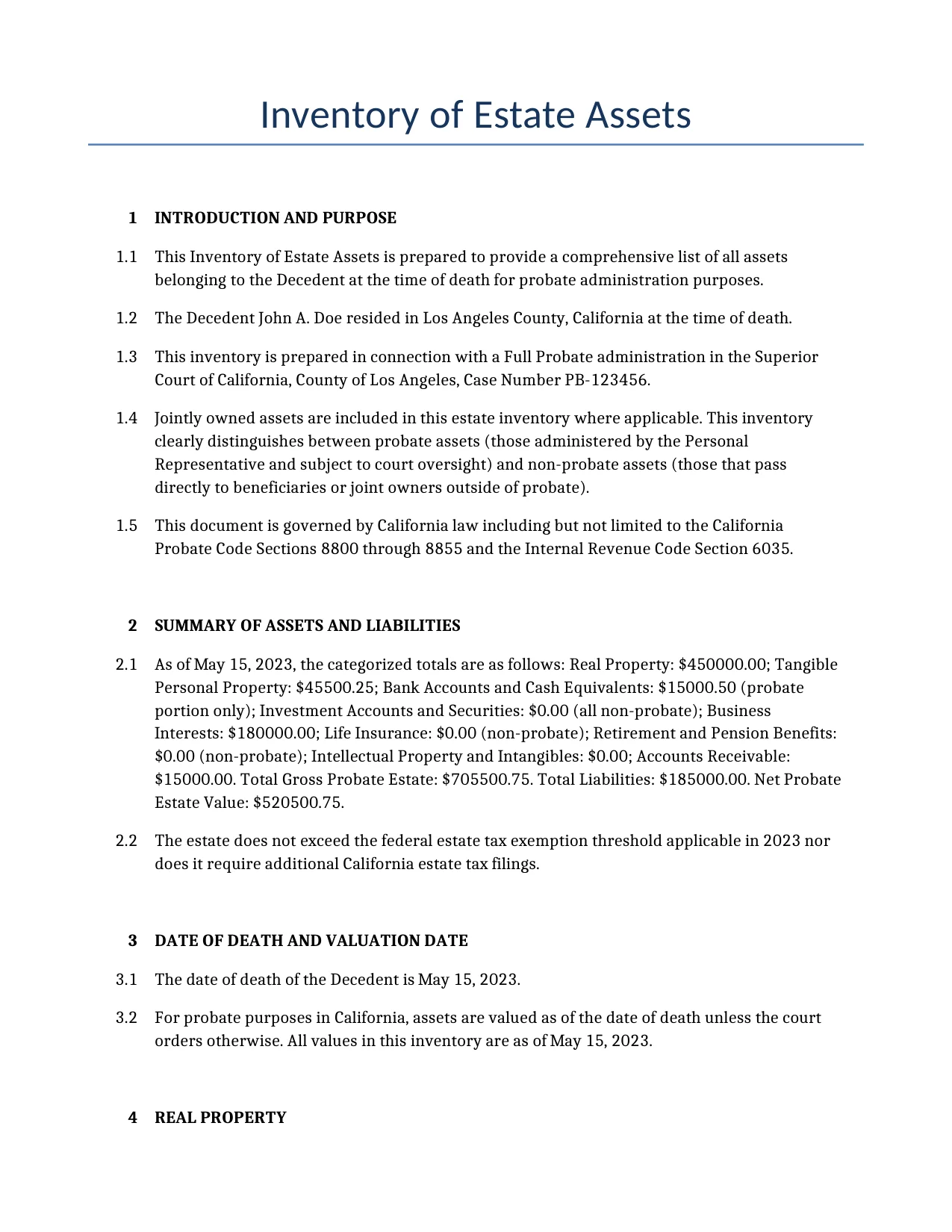
Inventory of Estate Assets
1INTRODUCTION AND PURPOSE
This Inventory of Estate Assets is prepared to provide a comprehensive list of all assets belonging to the Decedent at the time of death for probate administration purposes.
The Decedent John A. Doe resided in Los Angeles County, California at the time of death.
This inventory is prepared in connection with a Full Probate administration in the Superior Court of California, County of Los Angeles, Case Number PB-123456.
Jointly owned assets are included in this estate inventory where applicable. This inventory clearly distinguishes between probate assets (those administered by the Personal Representative and subject to court oversight) and non-probate assets (those that pass directly to beneficiaries or joint owners outside of probate).
This document is governed by California law including but not limited to the California Probate Code Sections 8800 through 8855 and the Internal Revenue Code Section 6035.
2SUMMARY OF ASSETS AND LIABILITIES
As of May 15, 2023, the categorized totals are as follows: Real Property: $450000.00; Tangible Personal Property: $45500.25; Bank Accounts and Cash Equivalents: $15000.50 (probate portion only); Investment Accounts and Securities: $0.00 (all non-probate); Business Interests: $180000.00; Life Insurance: $0.00 (non-probate); Retirement and Pension Benefits: $0.00 (non-probate); Intellectual Property and Intangibles: $0.00; Accounts Receivable: $15000.00. Total Gross Probate Estate: $705500.75. Total Liabilities: $185000.00. Net Probate Estate Value: $520500.75.
The estate does not exceed the federal estate tax exemption threshold applicable in 2023 nor does it require additional California estate tax filings.
3DATE OF DEATH AND VALUATION DATE
The date of death of the Decedent is May 15, 2023.
For probate purposes in California, assets are valued as of the date of death unless the court orders otherwise. All values in this inventory are as of May 15, 2023.
4REAL PROPERTY
The Decedent owned real property at the time of death.
The type of real property owned by the Decedent is residential.
The real property is described as a single-family home with three bedrooms, two bathrooms, and an attached garage.
The street address of the real property is 123 Main Street, Anytown, California 90210 located in Los Angeles County.
The Decedent held sole ownership in the real property which was acquired on May 15, 2010. This is a probate asset.
There are encumbrances, liens, or mortgages on the real property.
The property tax ID or parcel number for the real property is 123-456-789.
Community Property Aspects: The real property was acquired during the Decedent's marriage and may be characterized as community property under California law; however, the surviving spouse has consented to probate administration of Decedent's interest.
5TANGIBLE PERSONAL PROPERTY
Household furnishings: living room sofa, dining table with six chairs, and a bedroom furniture set including a king bed, dresser, and nightstands. Estimated value as of May 15, 2023: $5000.00. These are probate assets.
Vehicles: 2018 Toyota Camry sedan, blue, with 45000 miles, VIN JTNB11HK8J1234567, make Toyota, model Camry, year 2018. Estimated value as of May 15, 2023: $15000.00. This is a probate asset.
Jewelry: gold wedding band, diamond engagement ring of 1.5 carat, and a pearl necklace. Estimated value as of May 15, 2023: $8000.00. These are probate assets.
Artwork: oil painting by a local artist titled "Sunset Over Mountains" measuring 24 by 36 inches, and an abstract sculpture in bronze. Estimated value as of May 15, 2023: $12000.00. These are probate assets.
Collectibles: collection of rare United States silver coins from the 19th century (serial numbers cataloged separately) and an antique grandfather clock made of oak wood circa 1880 (serial number CLK-1880-XYZ). Estimated value as of May 15, 2023: $7500.00. These are probate assets.
Other household goods not already listed: home electronics including a 55-inch LED television (serial number TV-555LED-2020), gaming console (serial number GC-XYZ789), sound system (serial number SS-123456), tools, and workshop equipment. Estimated value as of May 15, 2023: $3000.25. These are probate assets.
6BANK ACCOUNTS AND CASH EQUIVALENTS
The Decedent held bank accounts and cash equivalents at the time of death. All values are exact balances as of May 15, 2023. Details comply with California Probate Code Sections 8800-8855.
Checking account at Chase Bank, account number 1234567890, exact balance as of May 15, 2023: $7500.25, institution address: 123 Financial Way, Los Angeles, CA 90012. This is a probate asset (Decedent's sole ownership portion).
Savings account at Chase Bank, account number 0987654321, exact balance as of May 15, 2023: $7500.25, institution address: 123 Financial Way, Los Angeles, CA 90012. This is a non-probate asset (joint ownership with right of survivorship).
Other cash equivalents: Certificate of Deposit (CD) at Wells Fargo Bank, account number CD-987654, exact balance as of May 15, 2023: $10000.00, institution address: 456 Banking Blvd, Los Angeles, CA 90017. This is a probate asset. No money market accounts.
7INVESTMENT ACCOUNTS AND SECURITIES
The Decedent held investment accounts and securities at the time of death. All values are as of May 15, 2023.
Portfolio at Fidelity Investments (full address: 100 Fidelity Way, Boston, MA 02210, local CA branch: 123 Investment Blvd, Los Angeles, CA 90071), account number XYZ-123456789. Includes 100 shares of Apple Inc. (AAPL) at fair market value $172.50 per share ($17250.00 total), 50 shares of Microsoft Corp. (MSFT) at fair market value $310.00 per share ($15500.00 total), and 200 units of Vanguard Total Stock Market Index Fund (VTSAX) at fair market value $92.50 per unit ($18500.00 total). Total value: $51300.00. Accrued dividends: $250.00. These pass by beneficiary designation and are non-probate assets.
8BUSINESS INTERESTS
The Decedent owned a 60% interest in Smith Family Enterprises LLC at the time of death. This is a probate asset to be administered in probate.
The business operates as a retail clothing store specializing in outdoor apparel with an online presence and two physical locations in California and has an Employer Identification Number of 12-3456789. Established on March 15, 2015 with principal place of business at 123 Main Street, Suite 200, Los Angeles, California 90210.
Detailed valuation of the Decedent's 60% interest as of May 15, 2023: $180000.00 (based on professional appraisal using income and market approaches). Method of valuation: capitalized earnings with minority interest discount of 20% and lack of marketability discount of 15%. Reference to professional appraisal: Appraisal report dated July 10, 2023 by Business Valuation Experts LLC.
Known business debts: $50000.00 in vendor payables and $20000.00 in loans. Known contracts: supplier agreements and commercial lease for retail space.
The business interest will be administered in probate subject to court approval for any sale or continuation of operations.
9LIFE INSURANCE POLICIES
Whole life policy issued by MetLife Insurance Company (address: 200 Park Avenue, New York, NY 10166) with policy number POL-123456789. Proceeds are payable to named beneficiaries (Jane B. Doe) and thus are non-probate assets. Not included in probate estate but reported for estate tax purposes under IRC Section 2042.
The insured individual under this life insurance policy is John A. Doe who is also the owner of the policy. Face value or death benefit: $500000.00. Issue date: May 15, 2010. Cash surrender value as of May 15, 2023: $45000.00. Loans against the policy: none.
The life insurance policy is currently active and in force. Primary beneficiary: Jane B. Doe. Contingent beneficiaries listed.
10RETIREMENT AND PENSION BENEFITS
The Decedent held retirement benefits consisting of an IRA and a 401(k) at the time of death. These have designated beneficiaries (spouse Jane B. Doe) making them non-probate assets that do not pass to the estate.
Provider: ABC Corporation (address: 789 Corporate Drive, Los Angeles, CA 90015). Account numbers: IRA-456 and 401K-789. Exact value as of May 15, 2023: $125000.00 (combined). Decedent was fully vested. Required minimum distributions: none required as of date of death.
Federal and state tax withholding implications: Distributions to beneficiaries may be subject to income tax withholding; estate may need to consider any applicable estate tax inclusion.
11INTELLECTUAL PROPERTY AND INTANGIBLES
None.
12ACCOUNTS RECEIVABLE AND NOTES
Personal loan described as an unsecured personal loan provided to a family member for home repairs. This is a probate asset.
Full name of the debtor: John A. Smith. Principal amount owed as of May 15, 2023: $15000.00. Originally incurred on May 15, 2020. Not secured by any collateral. Believed to be fully collectible. Documentation: written promissory note.
13SAFE DEPOSIT BOXES
The Decedent had no safe deposit boxes.
14LIABILITIES AND DEBTS
Mortgage debt: Creditor Wells Fargo Home Mortgage, account number MTG-987654321, balance as of May 15, 2023: $150000.00, secured by real property at 123 Main Street. This is a probate liability.
Credit card debt: Creditor Chase Visa, account number CC-11223344, balance as of May 15, 2023: $5000.00, unsecured. This is a probate liability.
Funeral expenses: $10000.00 (estimated, to be paid by estate). Last illness expenses (medical bills): Creditor ABC Hospital, account number MED-556677, balance as of May 15, 2023: $15000.00, unsecured. Administrative expenses: estimated $5000.00 (attorney and filing fees).
Total liabilities: $185000.00. Net estate calculation: Total gross probate assets $705500.75 minus total liabilities $185000.00 equals net probate estate $520500.75.
15APPRAISALS AND VALUATIONS
Real estate appraisal for property at 123 Main Street, Anytown, California 90210 (single-family home). Appraiser: Smith Appraisal Services LLC. Methodology: sales comparison approach. Appraisal date: June 15, 2023 (post-death appraisal used to confirm date-of-death value of $450000.00).
Personal property appraisals: Jewelry, artwork, and collectibles appraised by Certified Appraiser Jane Expert on June 20, 2023, confirming values as of May 15, 2023 totaling $27500.00. Vehicles appraised by Auto Appraisal Co. on June 10, 2023 at $15000.00.
Summary of all asset values: Real property $450000.00, tangible personal property $45500.25, financial accounts and investments (probate only) $32500.25, business interests $180000.00, accounts receivable $15000.00. Total gross estate value (including non-probate for tax purposes): $1,200,000.00 (approximate).
16EXEMPTIONS AND NON-PROBATE ASSETS
Joint tenancy property: None in addition to bank accounts cross-referenced above. Joint owner for any joint tenancy real property would be surviving spouse but none applies here.
POD/TOD accounts: Investment accounts cross-referenced in section 7 pass to beneficiary Jane B. Doe.
Trust assets: Revocable living trust dated January 1, 2015 named Doe Family Trust; no assets titled in trust at date of death (all listed assets are outside trust). Life insurance and retirement accounts cross-referenced in sections 9 and 10 are non-probate.
17VERIFICATION
I, John A. Doe, Personal Representative of the Estate of John A. Doe, deceased, hereby verify under penalty of perjury under the laws of the State of California that the foregoing inventory, including any attachments, is true and correct to the best of my knowledge. Executed on July 15, 2023 at Los Angeles, California. Personal Representative: John A. Doe, Address: 456 Probate Lane, Los Angeles, CA 90210, Phone: (213) 555-0123.
This example shows approximately 70% of a typical document and is provided for illustrative purposes only. The remaining content has been omitted.
Every document generated by Docaro is tailored to your specific circumstances, jurisdiction and the information you provide. The completed document includes all applicable clauses and provisions required for your situation.
To generate the full, personalised document, answer a short series of questions and your document will be created instantly.