
AI Generated American Security Agreement
PDF & Word - 2026 Updated
Docaro Pricing
When Do You Need a Security Agreement in the United States?
American Legal Rules for a Security Agreement
Using the wrong type of security agreement can fail to properly secure collateral or comply with state-specific UCC requirements.
What a Proper Security Agreement Should Include
- Parties InvolvedIdentify the lender and borrower clearly with their full names and addresses.
- Collateral DescriptionList the specific assets, like equipment or inventory, that secure the loan in detail.
- Loan DetailsOutline the loan amount, interest rate, repayment schedule, and any fees.
- Borrower's PromisesState what the borrower must do, such as maintaining the collateral and making timely payments.
- Lender's RightsDescribe the lender's options if the borrower defaults, including taking possession of the collateral.
- Default EventsDefine situations like missed payments or bankruptcy that trigger default.
- Default RemediesExplain steps the lender can take upon default, such as selling the collateral to recover the debt.
- Governing LawSpecify the state law that applies to the agreement.
- SignaturesInclude spaces for both parties to sign and date the document.
Generate Your Document in 4 Easy Steps
Why Use Docaro?
 United States
Free Example Security Agreement Template
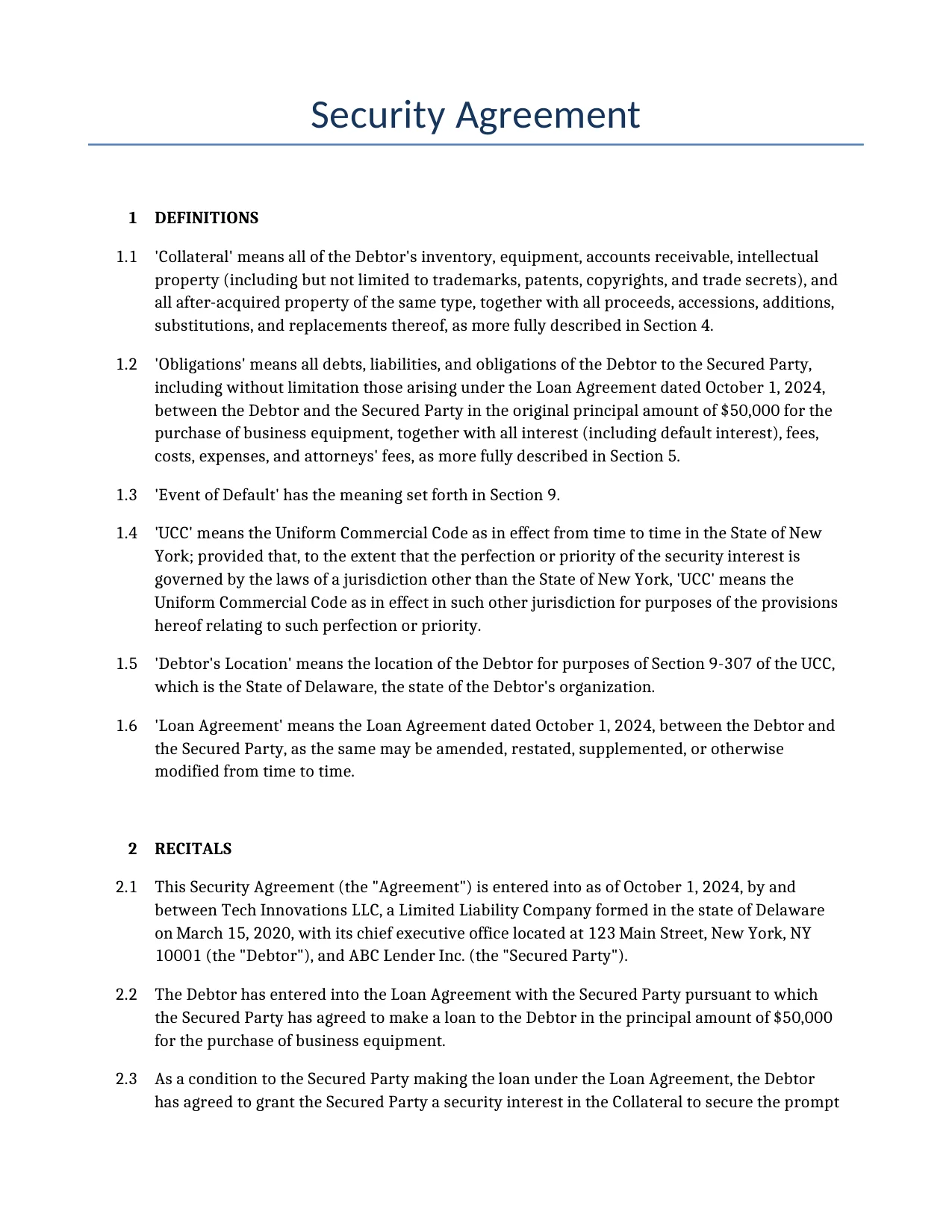
Below is a free template example of a Security Agreement for use in the United States generated by our AI model.
The clauses in your actual Security Agreement will vary from this example as they will be entirely bespoke to your requirements as set out in the questionnaire you complete.
Security Agreement
1DEFINITIONS
'Collateral' means all of the Debtor's inventory, equipment, accounts receivable, intellectual property (including but not limited to trademarks, patents, copyrights, and trade secrets), and all after-acquired property of the same type, together with all proceeds, accessions, additions, substitutions, and replacements thereof, as more fully described in Section 4.
'Obligations' means all debts, liabilities, and obligations of the Debtor to the Secured Party, including without limitation those arising under the Loan Agreement dated October 1, 2024, between the Debtor and the Secured Party in the original principal amount of $50,000 for the purchase of business equipment, together with all interest (including default interest), fees, costs, expenses, and attorneys' fees, as more fully described in Section 5.
'Event of Default' has the meaning set forth in Section 9.
'UCC' means the Uniform Commercial Code as in effect from time to time in the State of New York; provided that, to the extent that the perfection or priority of the security interest is governed by the laws of a jurisdiction other than the State of New York, 'UCC' means the Uniform Commercial Code as in effect in such other jurisdiction for purposes of the provisions hereof relating to such perfection or priority.
'Debtor's Location' means the location of the Debtor for purposes of Section 9-307 of the UCC, which is the State of Delaware, the state of the Debtor's organization.
'Loan Agreement' means the Loan Agreement dated October 1, 2024, between the Debtor and the Secured Party, as the same may be amended, restated, supplemented, or otherwise modified from time to time.
2RECITALS
This Security Agreement (the "Agreement") is entered into as of October 1, 2024, by and between Tech Innovations LLC, a Limited Liability Company formed in the state of Delaware on March 15, 2020, with its chief executive office located at 123 Main Street, New York, NY 10001 (the "Debtor"), and ABC Lender Inc. (the "Secured Party").
The Debtor has entered into the Loan Agreement with the Secured Party pursuant to which the Secured Party has agreed to make a loan to the Debtor in the principal amount of $50,000 for the purchase of business equipment.
As a condition to the Secured Party making the loan under the Loan Agreement, the Debtor has agreed to grant the Secured Party a security interest in the Collateral to secure the prompt and complete payment and performance of all Obligations.
3GRANT OF SECURITY INTEREST
The Debtor hereby grants to the Secured Party a first-priority security interest in all of the Collateral to secure the prompt and complete payment and performance of all Obligations. This security interest is granted pursuant to Article 9 of the UCC and shall attach upon the Debtor's acquisition of rights in the Collateral.
4DESCRIPTION OF COLLATERAL
The Collateral subject to this security interest consists of all of the following, whether now owned or hereafter acquired: (i) all inventory; (ii) all equipment (including but not limited to computers and machinery); (iii) all accounts receivable; (iv) all intellectual property (including but not limited to trademarks, patents, copyrights, trade secrets, and related rights, together with all goodwill associated therewith); (v) all general intangibles; and (vi) all books and records relating to the foregoing.
The Collateral includes all after-acquired property of the same type as described above that the Debtor may acquire at any time after the date of this Agreement and all proceeds, products, accessions, additions, substitutions, and replacements of any of the foregoing, including without limitation insurance proceeds, payments, and any commercial tort claims related thereto.
Attached hereto as Exhibit A is a schedule describing specific items of Collateral, including specific descriptions of material intellectual property and inventory. The Collateral is located at the locations specified in Exhibit B.
5OBLIGATIONS SECURED
The Obligations secured by this Agreement consist of all indebtedness, obligations, and liabilities of the Debtor to the Secured Party arising under the Loan Agreement dated October 1, 2024, in the original principal amount of $50,000 for the purchase of business equipment, together with all accrued and unpaid interest (including default interest at the rate specified in the Loan Agreement), fees, costs, and expenses (including attorneys' fees and collection costs).
The Obligations include all future advances or other extensions of credit made by the Secured Party to or for the benefit of the Debtor, whether or not such advances are contemplated as of the date hereof.
The Obligations also include all obligations of the Debtor under this Agreement and all other agreements, instruments, and documents executed in connection herewith or with the Loan Agreement.
6REPRESENTATIONS AND WARRANTIES
The Debtor represents and warrants to the Secured Party that the Debtor is a limited liability company duly organized, validly existing, and in good standing under the laws of the State of Delaware, with its chief executive office located at 123 Main Street, New York, NY 10001. The Debtor's exact legal name is 'Tech Innovations LLC' and its Delaware organizational identification number is [insert if available, e.g., 1234567].
The Debtor represents and warrants that the Collateral is located at the addresses set forth on Exhibit B attached hereto, and that no Collateral is located in any jurisdiction other than those listed without prior written notice to the Secured Party.
The Debtor represents and warrants that it owns the Collateral free and clear of any liens, security interests, or encumbrances except as disclosed to the Secured Party in writing prior to the date hereof, and that the security interest granted herein will constitute a valid, first-priority perfected security interest upon the filing of appropriate financing statements.
The Debtor represents and warrants that there are no pending or threatened legal proceedings that could adversely affect the Collateral or the Debtor's ownership of it, that the execution and performance of this Agreement will not violate any law, regulation, or organizational document applicable to the Debtor, and that the Debtor has full power and authority to grant the security interest granted herein.
The Debtor represents and warrants that there are no prior security interests or liens on the Collateral of which the Secured Party should be aware other than those expressly disclosed, and that all of the Debtor's representations and warranties in this Agreement, the Loan Agreement, and any other related documents are true and correct as of the date of this Agreement.
The Debtor represents and warrants that the Debtor has not filed for bankruptcy and that there are no insolvency proceedings pending against the Debtor.
7COVENANTS OF THE DEBTOR
The Debtor covenants that it shall pay all taxes and assessments on the Collateral when due, maintain insurance on the Collateral in amounts and with insurers acceptable to the Secured Party, defend the title to the Collateral against all claims and demands of all persons, preserve and maintain the Collateral in good condition and repair, and not create any additional liens on the Collateral or sell or transfer the Collateral without the prior written consent of the Secured Party.
The Debtor covenants that it shall promptly notify the Secured Party of (i) any Event of Default or any event that with notice or lapse of time would constitute an Event of Default, (ii) any change in the Debtor's name, identity, corporate structure, chief executive office, or location of the Collateral, and (iii) any loss or damage to the Collateral.
The Debtor covenants that it shall take all actions reasonably requested by the Secured Party to ensure the attachment, perfection, and priority of, and the ability of the Secured Party to realize upon, the security interest granted herein, including executing and delivering any further instruments, documents, or agreements, and filing any financing statements or amendments thereto (collectively, 'Further Assurances').
The Debtor covenants that it shall comply with all applicable laws, including without limitation all federal, state, and local laws, in all material respects.
8EVENTS OF DEFAULT
Each of the following shall constitute an Event of Default: (a) the failure to pay any amount due under the Loan Agreement, this Agreement, or any other document executed in connection therewith when due; (b) any material misrepresentation or breach of any representation or warranty made by the Debtor in this Agreement or any other Loan Document; (c) the breach of any covenant or agreement by the Debtor in this Agreement or any other Loan Document (subject to any applicable notice and cure periods); (d) the commencement of a voluntary bankruptcy proceeding by the Debtor, the filing of an involuntary bankruptcy petition against the Debtor that is not dismissed within sixty (60) days, or the appointment of a receiver or trustee for the Debtor or any of the Debtor's property; (e) any unsatisfied judgment against the Debtor in an amount exceeding $100,000 that remains undischarged for thirty (30) days; (f) any cross-default under any other agreement between the Debtor and the Secured Party or any of the Debtor's affiliates; and (g) the dissolution, liquidation, or termination of existence of the Debtor.
The Debtor shall have thirty (30) days after receipt of written notice of a non-monetary default to cure such default, to the extent such default is capable of being cured within such period; provided, however, that no notice or cure period shall be required for payment defaults or bankruptcy-related defaults.
9REMEDIES
Upon the occurrence and during the continuance of an Event of Default, the Secured Party may exercise all rights and remedies available under the UCC, this Agreement, the Loan Agreement, at law, in equity, or otherwise, including without limitation the rights and remedies set forth in Part 6 of Article 9 of the UCC, all of which are cumulative and may be exercised concurrently or separately.
Upon the occurrence and during the continuance of an Event of Default, after any required notice and expiration of any applicable cure period under New York law and the UCC, the Secured Party may (a) accelerate all Obligations so that they become immediately due and payable; (b) take possession of the Collateral wherever located; (c) sell, lease, or otherwise dispose of the Collateral at public or private sale in compliance with Section 9-610 and other applicable provisions of the UCC; (d) accept the Collateral in full or partial satisfaction of the Obligations in accordance with Section 9-620 of the UCC; and (e) exercise all other rights and remedies available under the UCC or other applicable law, including the right to sue the Debtor directly on the underlying debt independently of any remedies with respect to the Collateral.
The Secured Party shall provide any notices required under the UCC or New York law, including reasonable notification of the time and place of any public sale or the time after which any private sale or other disposition is to be made. The Debtor agrees that a notice period of ten (10) days is reasonable under the circumstances.
10DEBTOR'S LOCATION AND ORGANIZATIONAL INFORMATION
The Debtor's Location for purposes of Section 9-307 of the UCC is the State of Delaware. The Debtor's exact legal name, as registered with the Delaware Secretary of State, is 'Tech Innovations LLC'. The Debtor's Delaware file number is [insert if available]. The Debtor shall not change its name, organizational structure, jurisdiction of organization, or location of its chief executive office without providing the Secured Party at least thirty (30) days' prior written notice.
11PERFECTION AND PRIORITY
The Debtor hereby authorizes the Secured Party to file UCC-1 financing statements and any amendments, continuations, or termination statements with respect thereto, in such form and in such offices as the Secured Party shall determine to be necessary or advisable to perfect, maintain, and protect the security interest granted herein. The Debtor specifically authorizes the filing of financing statements that describe the Collateral by general category (such as 'all assets' or 'all personal property') or using any other description permitted under the UCC. The Debtor further ratifies and confirms any financing statements filed prior to the date hereof.
The Debtor authorizes the Secured Party to file this Agreement or any facsimile or copy thereof as a financing statement in any jurisdiction where the Secured Party deems it appropriate. The Debtor shall execute and deliver to the Secured Party any additional documents, including control agreements with respect to any Collateral in which a security interest may be perfected by control, as the Secured Party may reasonably request to perfect and maintain the security interest granted herein.
The Debtor represents and warrants that upon the filing of the financing statements authorized hereunder in the appropriate filing offices (including the Delaware Secretary of State as the proper office for filing under Section 9-501 of the UCC given the Debtor's Location in Delaware), the security interest granted to the Secured Party will constitute a valid, perfected, first-priority security interest in the Collateral to the extent such security interest can be perfected by filing a financing statement under the UCC.
12POWER OF ATTORNEY
The Debtor hereby irrevocably constitutes and appoints the Secured Party as the Debtor's true and lawful attorney-in-fact, with full power of substitution, in the name of the Debtor or its own name, to execute, deliver, and file any financing statements, amendments, control agreements, notices, or other documents (including this Agreement), and to take any other actions necessary or desirable to perfect, maintain, protect, or enforce the security interest granted herein or to enable the Secured Party to exercise its rights and remedies hereunder, including without limitation to endorse the Debtor's name on any checks, notes, or other instruments payable to the Debtor. This power of attorney is coupled with an interest and is irrevocable until all Obligations are indefeasibly paid in full.
13RIGHTS OF THE SECURED PARTY
The Secured Party shall have the right to inspect the Collateral at reasonable times and places upon reasonable notice to the Debtor. The Secured Party shall have the right to access the Debtor's premises to take possession of the Collateral upon an Event of Default and after the expiration of any applicable notice and cure period in accordance with the UCC and New York law.
14INDEMNIFICATION
The Debtor agrees to indemnify, defend, and hold harmless the Secured Party and its officers, directors, employees, agents, and affiliates from and against any and all losses, claims, damages, liabilities, expenses (including reasonable attorneys' fees), and settlement costs arising out of or relating to this Agreement, the Collateral, or the transactions contemplated hereby, except to the extent such losses result solely from the Secured Party's gross negligence or willful misconduct as determined by a final non-appealable judgment of a court of competent jurisdiction. The Secured Party shall have sole control over the defense of any indemnified claims, but shall not settle any claim without the Debtor's prior written consent (which shall not be unreasonably withheld).
15EXPENSES AND FEES
The Debtor shall pay or reimburse the Secured Party for all reasonable out-of-pocket expenses incurred by the Secured Party in connection with the preparation, negotiation, execution, delivery, filing, recording, administration, enforcement, or collection of this Agreement, the Loan Agreement, or any other Loan Document, including without limitation all filing fees, search fees, attorneys' fees, court costs, and other expenses. All such amounts shall be added to the Obligations and shall bear interest at the default rate specified in the Loan Agreement until paid.
16GOVERNING LAW; JURISDICTION; JURY TRIAL WAIVER
This Agreement shall be governed by and construed in accordance with the laws of the State of New York, including but not limited to the provisions of the Uniform Commercial Code Article 9 - Secured Transactions and Uniform Commercial Code Article 1 - General Provisions, without regard to conflict of laws principles that would require the application of the laws of another jurisdiction. The parties agree that the provisions of the UCC of the State of New York shall apply to this Agreement to the extent applicable.
Each party irrevocably submits to the exclusive jurisdiction of the state and federal courts located in New York County, New York, for any action or proceeding arising out of or relating to this Agreement, and waives any objection to venue or inconvenient forum. Service of process may be made in accordance with the Notices section hereof.
EACH PARTY HERETO HEREBY IRREVOCABLY WAIVES, TO THE FULLEST EXTENT PERMITTED BY APPLICABLE LAW, ANY RIGHT IT MAY HAVE TO A TRIAL BY JURY IN ANY LEGAL PROCEEDING DIRECTLY OR INDIRECTLY ARISING OUT OF OR RELATING TO THIS AGREEMENT OR THE TRANSACTIONS CONTEMPLATED HEREBY. EACH PARTY CERTIFIES THAT NO REPRESENTATIVE, AGENT, OR ATTORNEY OF ANY OTHER PERSON HAS REPRESENTED, EXPRESSLY OR OTHERWISE, THAT SUCH OTHER PERSON WOULD NOT, IN THE EVENT OF LITIGATION, SEEK TO ENFORCE THE FOREGOING WAIVER.
17NOTICES
All notices and other communications under this Agreement shall be in writing and shall be deemed duly given (i) when delivered personally, (ii) five (5) days after being mailed by certified or registered mail, return receipt requested, or (iii) one (1) business day after being sent by a nationally recognized overnight courier, in each case to the addresses set forth below (or to such other address as a party may designate by notice to the other party): Debtor: Tech Innovations LLC, 123 Main Street, New York, NY 10001, Attention: [insert]; Secured Party: ABC Lender Inc., 456 Oak Avenue, Los Angeles, CA 90210, Attention: [insert]. Notices may also be given by electronic mail and shall be deemed received upon confirmation of receipt if sent during normal business hours, otherwise on the next business day.
18MISCELLANEOUS
If any provision of this Agreement is held to be invalid or unenforceable, such invalidity or unenforceability shall not affect the validity or enforceability of the remaining provisions of this Agreement (severability).
The failure of either party to enforce any provision of this Agreement shall not constitute a waiver of such provision or any other provision. No waiver shall be effective unless in writing and signed by the party against whom enforcement is sought.
This Agreement constitutes the entire agreement between the parties with respect to the subject matter hereof and supersedes all prior agreements and understandings, oral or written. This Agreement may only be amended by a written instrument signed by both the Debtor and the Secured Party.
This Agreement may be executed in counterparts, each of which shall be deemed an original, but all of which together shall constitute one and the same instrument. Delivery of an executed counterpart by facsimile or electronic transmission shall be effective as delivery of a manually executed counterpart.
This Agreement and the security interest granted hereunder shall be binding upon the Debtor and its successors and assigns and shall inure to the benefit of the Secured Party and its successors and assigns. The Debtor may not assign any of its rights or obligations hereunder without the prior written consent of the Secured Party. The Secured Party may assign its rights and interests hereunder without the consent of the Debtor to the extent permitted under the Loan Agreement.
Time is of the essence with respect to all obligations of the Debtor hereunder.
This Agreement shall become effective on October 1, 2024.
19SIGNATURES
IN WITNESS WHEREOF, the parties have executed this Security Agreement as of the date first above written.
Debtor: Tech Innovations LLC
By: _______________________________
Name: _____________________________
Title: ______________________________
Date: ______________________________
Secured Party: ABC Lender Inc.
By: _______________________________
Name: _____________________________
Title: ______________________________
Date: ______________________________
This example shows approximately 70% of a typical document and is provided for illustrative purposes only. The remaining content has been omitted.
Every document generated by Docaro is tailored to your specific circumstances, jurisdiction and the information you provide. The completed document includes all applicable clauses and provisions required for your situation.
To generate the full, personalised document, answer a short series of questions and your document will be created instantly.