
AI Generated Party Wall Agreement for use in the United States
PDF & Word - 2026 Updated
Docaro Pricing
When Do You Need a Party Wall Agreement in the United States?
American Legal Rules for a Party Wall Agreement
Using an inappropriate structure for a party wall agreement may fail to adequately protect property rights or resolve boundary disputes.
What a Proper Party Wall Agreement Should Include
- Identification of NeighborsClearly state the names and addresses of the property owners sharing the wall.
- Description of the Shared WallProvide details about the wall's location, length, and condition to avoid any confusion.
- Planned Work DetailsOutline the specific construction or modifications that will affect the shared wall.
- Construction TimelineSpecify the start and end dates for the work to set clear expectations.
- Access PermissionsAgree on the times and conditions under which the neighbor can access the property for inspections.
- Protection MeasuresDescribe steps to safeguard the shared wall and adjacent property during construction.
- Cost and Payment ResponsibilitiesDetail who pays for what, including any shared expenses or potential damages.
- Dispute Resolution ProcessInclude a simple method for resolving disagreements, like mediation, before court.
- Duration and TerminationState how long the agreement lasts and how it can be ended.
- Signatures and DatesRequire both parties to sign and date the document to make it official.
Generate Your Document in 4 Easy Steps
Why Use Docaro?
 United States
Free Example Party Wall Agreement Template
Below is a free template example of a Party Wall Agreement for use in the United States generated by our AI model.
The clauses in your actual Party Wall Agreement will vary from this example as they will be entirely bespoke to your requirements as set out in the questionnaire you complete.
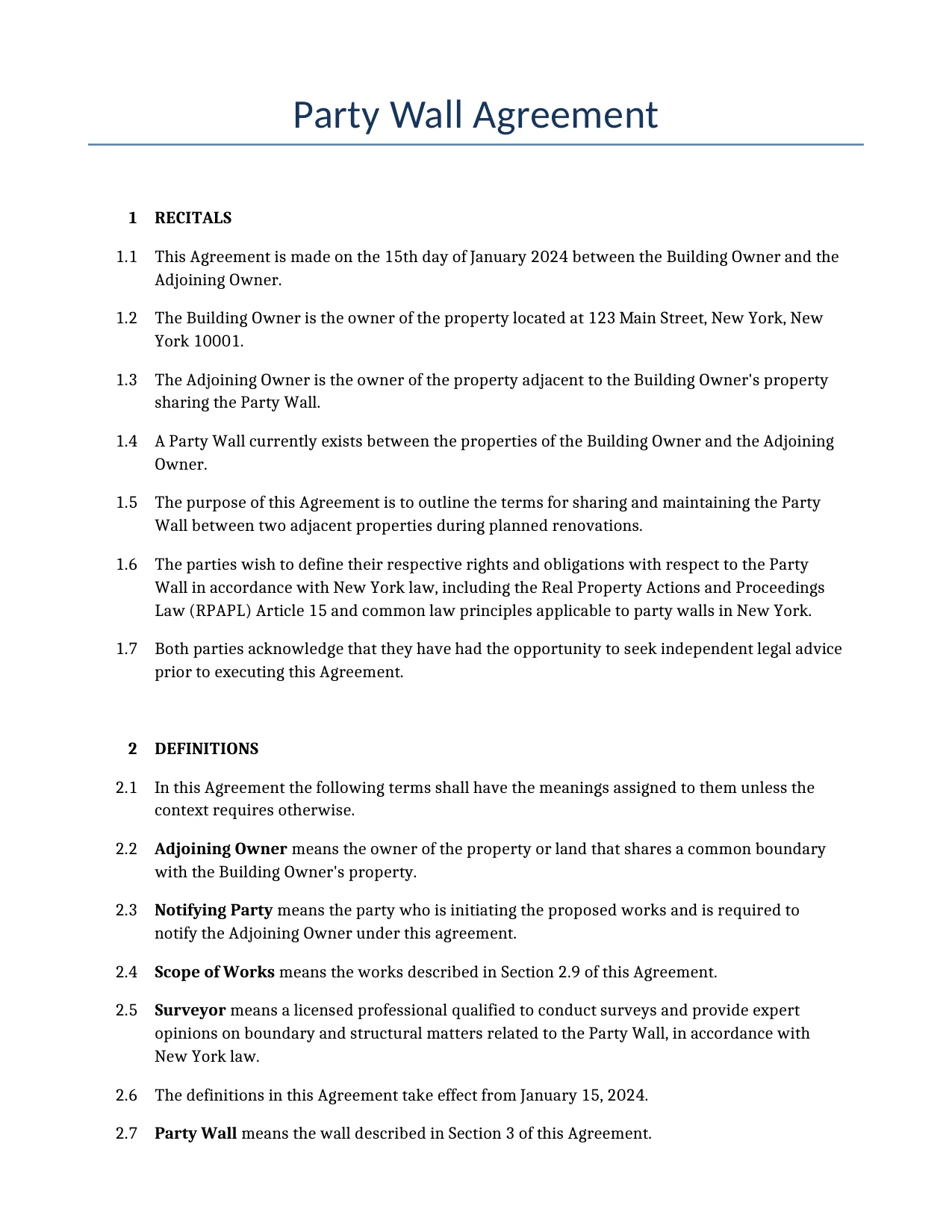
Party Wall Agreement
1RECITALS
This Agreement is made on the 15th day of January 2024 between the Building Owner and the Adjoining Owner.
The Building Owner is the owner of the property located at 123 Main Street, New York, New York 10001.
The Adjoining Owner is the owner of the property adjacent to the Building Owner's property sharing the Party Wall.
A Party Wall currently exists between the properties of the Building Owner and the Adjoining Owner.
The purpose of this Agreement is to outline the terms for sharing and maintaining the Party Wall between two adjacent properties during planned renovations.
The parties wish to define their respective rights and obligations with respect to the Party Wall in accordance with New York law, including the Real Property Actions and Proceedings Law (RPAPL) Article 15 and common law principles applicable to party walls in New York.
Both parties acknowledge that they have had the opportunity to seek independent legal advice prior to executing this Agreement.
2DEFINITIONS
In this Agreement the following terms shall have the meanings assigned to them unless the context requires otherwise.
Adjoining Owner means the owner of the property or land that shares a common boundary with the Building Owner's property.
Notifying Party means the party who is initiating the proposed works and is required to notify the Adjoining Owner under this agreement.
Scope of Works means the works described in Section 2.9 of this Agreement.
Surveyor means a licensed professional qualified to conduct surveys and provide expert opinions on boundary and structural matters related to the Party Wall, in accordance with New York law.
The definitions in this Agreement take effect from January 15, 2024.
Party Wall means the wall described in Section 3 of this Agreement.
Building Owner means the party initiating works on the Party Wall under this Agreement.
Scope of Works: The Building Owner intends to reinforce the Party Wall by adding steel beams to support a new second-story extension on the Building Owner's property. This includes excavation within 3 feet of the boundary, structural alterations, and related improvements. The works shall be carried out in accordance with the drawings and plans prepared by licensed New York architects and engineers, dated February 1, 2024, specifically identified as Drawing Nos. PW-01 through PW-05, and specifications attached hereto as Exhibit A. The timeline for the works is as follows: commencement on or after June 1, 2024, with substantial completion targeted for December 31, 2024, subject to extensions for Force Majeure or delays caused by the Adjoining Owner. The Building Owner shall obtain all necessary permits and approvals from the New York City Department of Buildings (NYC DOB), including but not limited to a building permit under the New York City Building Code (particularly Chapter 33 on safeguards during construction). All works shall comply with applicable New York City zoning regulations, the New York City Building Code, New York State Real Property Law, and common law principles for party walls. The parties acknowledge that the works must not violate any covenants, restrictions, or environmental regulations applicable to the properties.
3DESCRIPTION OF THE PARTY WALL
The Party Wall is constructed of red brick, stands 10 feet high, and runs 30 feet in length along the shared boundary.
The Party Wall is located on the boundary line between the properties of the Building Owner and the Adjoining Owner.
The length of the Party Wall is 30 feet.
The height of the Party Wall is 10 feet.
The thickness of the Party Wall is 8 inches.
The primary material used in the construction of the Party Wall is brick.
The current condition of the Party Wall is good.
The Party Wall is load-bearing.
4OWNERSHIP AND RIGHTS IN THE PARTY WALL
There are no existing encumbrances, easements, or prior agreements affecting the Party Wall, other than as provided in this Agreement.
The Building Owner and Adjoining Owner hold joint ownership interests in the Party Wall consistent with New York common law and RPAPL Article 15.
Each owner has the right to use the Party Wall for supporting their respective building structures, subject to the terms of this Agreement and New York law.
Each owner has the right to inspect the Party Wall upon reasonable notice to the other owner.
Either owner has the right to repair or rebuild the Party Wall if it becomes damaged, with costs allocated as provided in this Agreement and in accordance with New York law.
There are no existing encumbrances, liens, or easements affecting the owners' rights in the Party Wall, other than as provided herein.
5CONSTRUCTION AND ALTERATION OF THE PARTY WALL
The Building Owner shall serve formal written notice (Notice of Intent to Perform Work on Party Wall) to the Adjoining Owner at least 30 to 90 days in advance of commencing any works, in accordance with New York practices under RPAPL Article 15 and common law. The notice shall include detailed plans, specifications, and the proposed timeline.
The Adjoining Owner has the right to appoint their own surveyor within 14 days of receiving the notice. The surveyors shall confer and prepare a surveyor's report or agreement detailing the scope, methods, and protections for the works.
If the Adjoining Owner dissents or fails to respond, or if the surveyors cannot agree, a third surveyor shall be appointed jointly or by a New York court upon application under RPAPL. The decision of the third surveyor shall be binding unless appealed in accordance with New York law.
The Building Owner shall obtain any necessary license for access to the Adjoining Owner's property and shall provide temporary protections, shoring, and weatherproofing as required by the New York City Building Code (Chapter 33) and this Agreement.
The Building Owner plans to undertake construction, alteration, repair, or modification to the Party Wall as described in the Scope of Works (Section 2.9).
The proposed construction, alteration, repair, or modification to the Party Wall consists of reinforcing the Party Wall by adding steel beams to support a new second-story extension on the Building Owner's property, all in compliance with New York City Building Code and RPAPL Article 15.
The Building Owner anticipates starting the work on the Party Wall on or after June 1, 2024, following all required notices, permits, and surveyor agreements.
Mutual consent, as evidenced by this Agreement or surveyor award, is required for any modifications to the Party Wall by either the Building Owner or the Adjoining Owner.
6PERMITS AND REGULATORY COMPLIANCE
The Building Owner shall obtain all necessary permits and approvals from the New York City Department of Buildings (NYC DOB), New York State agencies, and any other relevant authorities prior to commencing the works. This includes compliance with the New York City Building Code (including Chapter 33 on safeguards during construction), local zoning laws, environmental regulations, and noise ordinances.
The works shall not violate any covenants, restrictions, or easements affecting either property. The Building Owner shall indemnify and hold harmless the Adjoining Owner from any fines, penalties, violations, or liabilities arising from the Building Owner's failure to comply with these requirements.
The Adjoining Owner shall reasonably cooperate in obtaining permits where their consent or signature is required by law, without waiving any rights under this Agreement.
7MAINTENANCE AND REPAIRS
Routine maintenance of the Party Wall (e.g., painting, cleaning) shall be shared equally between the Building Owner and Adjoining Owner and performed as needed but no less than annually.
Repairs due to the proposed works under this Agreement shall be the responsibility of the Building Owner, including any damage caused to the Adjoining Owner's property or the Party Wall itself.
Emergency repairs necessary to prevent imminent harm to persons or property may be undertaken by either owner without prior notice, but the initiating party shall notify the other as soon as practicable. Costs for emergency repairs shall be allocated based on causation, with the party whose use or neglect caused the emergency bearing primary responsibility.
If the parties cannot agree on cost allocation or responsibility for any repairs, a neutral surveyor shall determine the allocation in accordance with Section 13 of this Agreement. All repairs shall be performed by licensed contractors authorized to work in New York City.
The party performing repairs shall complete them within a reasonable time, not to exceed 60 days unless extended by agreement or surveyor award, and shall restore the Party Wall and affected areas to their prior condition.
8COST ALLOCATION
Costs for the Scope of Works, including construction, shall be borne solely by the Building Owner unless the works confer a measurable increase in value to the Adjoining Owner's property, in which case a surveyor may determine a reasonable contribution not to exceed 50% of the incremental benefit.
Routine maintenance and repair costs (not attributable to the works) shall be shared equally. Emergency repair costs shall be allocated based on causation as determined by a surveyor if disputed.
The Building Owner shall provide a security deposit or bond in the amount of $25,000 (or such other amount as determined by the surveyors) to the Adjoining Owner prior to commencing works, to secure payment of any damages or costs owed to the Adjoining Owner. This shall be held in escrow and returned upon final accounting, less any valid claims.
The Building Owner shall provide the Adjoining Owner with a detailed accounting of costs within 30 days of completion of the works. Any dispute over costs shall be resolved by a neutral surveyor whose determination shall be binding unless appealed under New York law.
30 days' written notice shall be required before one party can request contribution for Party Wall costs from the other party.
9ACCESS RIGHTS
The Building Owner and their contractors shall have access to the Adjoining Owner's property as reasonably necessary to perform the Scope of Works, subject to the protocols in this Section.
Access shall be minimized to reduce disruption. The Building Owner shall maintain commercial general liability insurance with limits of at least $1,000,000 per occurrence, naming the Adjoining Owner as an additional insured, and shall provide certificates of insurance prior to access.
Any damage to the Adjoining Owner's property caused by access or the works shall be restored by the Building Owner at their sole expense within 30 days of completion or as otherwise agreed.
Access is permitted only on weekdays between 8:00 AM and 6:00 PM, in compliance with New York City noise ordinances and construction hour restrictions. No access on weekends or holidays without the Adjoining Owner's prior written consent. Access shall be coordinated at least 48 hours in advance.
The Adjoining Owner shall have reciprocal access rights to the Building Owner's property for inspection, maintenance, or repairs related to the Party Wall, on the same terms.
All access shall be accompanied by a representative of the property owner unless waived in writing.
10INSURANCE AND LIABILITY
Prior to commencing any works, both parties shall maintain adequate property and liability insurance with minimum limits of at least $1,000,000 per occurrence. Each party shall name the other as an additional insured on their respective policies and provide certificates of insurance to the other party at least 14 days prior to the start of works.
The policies shall include waivers of subrogation in favor of the other party. The Building Owner's insurance shall specifically cover the Scope of Works and potential damage to the Adjoining Property.
The Building Owner shall be liable for all damages to the Adjoining Owner's property or the Party Wall caused by the works, negligence, or breach of this Agreement. This includes direct damages, consequential losses, and reasonable attorneys' fees. The Adjoining Owner shall be liable for damages caused by their own negligence or interference with the works.
Liability for damages shall be several, not joint, based on each party's proportionate fault as determined under New York law.
11DISPUTE RESOLUTION
The parties shall first attempt to resolve any disputes arising from this Agreement through good-faith negotiation.
If negotiation fails, the parties shall proceed to non-binding mediation administered by a mutually agreed mediator in New York County.
If mediation is unsuccessful, disputes shall be resolved by binding arbitration in accordance with the rules of the American Arbitration Association or by litigation in the courts of the State of New York located in New York County. Litigation is available as a remedy and is not disfavored.
The prevailing party in any arbitration or litigation shall be entitled to recover reasonable attorney's fees and costs from the losing party, in accordance with New York Civil Practice Law and Rules (CPLR).
This Dispute Resolution section shall be governed by New York law.
12SURVEYOR APPOINTMENT AND ROLE
Each party may appoint a qualified surveyor licensed in the State of New York. If the appointed surveyors cannot agree on any matter, they shall jointly appoint a third surveyor within 14 days. If they fail to do so, either party may apply to a New York court for appointment of the third surveyor.
The surveyors shall act impartially and prepare an award detailing the rights, obligations, methods of work, cost allocations, and protections. The award of the surveyor(s) shall be binding on the parties unless appealed to a New York court under applicable law (including RPAPL Article 15).
Fees of the surveyors shall be allocated equally unless the surveyor(s) determine that one party acted unreasonably, in which case the unreasonable party may bear a greater share as determined in the award.
The parties shall cooperate with the surveyors and provide all necessary access and information.
13PROTECTION OF ADJOINING PROPERTY
The Building Owner shall take all necessary precautions to protect the Adjoining Owner's property from damage during the works, including shoring, underpinning, weatherproofing, debris protection, and security measures, in full compliance with the New York City Building Code (Chapter 33) and best practices under New York law.
The Building Owner shall monitor the Adjoining Property for any movement or damage and shall immediately cease work and notify the Adjoining Owner and surveyors if issues arise. The Building Owner shall be responsible for all costs of such protections and any resulting repairs.
14NOTICES
All notices under this Agreement shall be in writing and delivered by certified mail, return receipt requested, or by personal service in accordance with New York law. Copies of all notices shall be sent to any appointed surveyors or attorneys for the parties.
Notices shall be deemed delivered upon receipt or three business days after mailing, whichever is earlier. The addresses for notices are: For the Building Owner - 123 Main Street, New York, NY 10001; For the Adjoining Owner - [Adjoining Owner's Address].
The minimum notice period for most actions under this Agreement is 30 days, unless otherwise specified or in emergencies.
15CONFIDENTIALITY
Both parties agree to keep the terms of this Agreement and any information shared during the process (including surveyor reports, plans, and financial details) confidential, except as required by law, to enforce the Agreement, or to obtain permits.
This obligation survives termination of the Agreement.
16GOVERNING LAW
This Agreement shall be governed by and construed in accordance with the laws of the State of New York, including but not limited to the Real Property Actions and Proceedings Law (RPAPL) Article 15, New York Real Property Law, the New York City Building Code, and applicable common law principles for party walls. This Agreement is compliant with all relevant provisions of New York law and does not reference or rely upon any laws of California, Massachusetts, the Uniform Real Property Transfer on Death Act, or the International Building Code.
The parties consent to the exclusive jurisdiction and venue of the state and federal courts located in New York County, New York, for any disputes arising under this Agreement. The parties do not waive any rights, including the right to a jury trial where applicable under New York law.
17ENTIRE AGREEMENT
This Agreement represents the entire understanding between the Building Owner and the Adjoining Owner regarding the Party Wall.
This Agreement supersedes any prior agreements, understandings, or negotiations between the Building Owner and the Adjoining Owner about the Party Wall.
18SEVERABILITY
If any provision of this Agreement is held to be invalid or unenforceable by a court of competent jurisdiction in New York, the remaining provisions shall remain in full force and effect.
19AMENDMENTS
Any amendments to this Agreement must be made in writing and signed by both the Building Owner and the Adjoining Owner.
20ASSIGNMENT
The rights and obligations under this Agreement may be assigned to successors or assigns upon the sale or transfer of the respective properties, provided that the assigning party gives written notice to the other and the assignee agrees in writing to be bound by this Agreement.
This Agreement is binding on successors, heirs, and assigns.
21FORCE MAJEURE
Neither party shall be liable for any failure to perform its obligations under this Agreement if such failure is due to events beyond their reasonable control, including natural disasters, acts of war, terrorism, pandemics, government orders, or strikes, provided that the affected party provides prompt written notice and uses reasonable efforts to mitigate the effects.
The affected party shall provide written notice of any Force Majeure event to the other party within 5 business days after becoming aware of it.
22TERMINATION
This Agreement may be terminated upon (i) material breach by either party (including failure to pay allocated costs, maintain required insurance, or comply with protections), provided the breaching party is given 30 days' written notice to cure the breach; (ii) completion of the Scope of Works and final accounting; or (iii) mutual written agreement.
Upon termination, the parties shall conduct a final accounting of costs, the Building Owner shall restore any affected areas to the satisfaction of the surveyors or a New York court if disputed, and all surviving obligations (including maintenance, indemnification, confidentiality, and liability for prior acts) shall continue.
23INDEMNIFICATION
The Building Owner shall indemnify, defend, and hold harmless the Adjoining Owner from any claims, damages, losses, liabilities, fines, or expenses (including reasonable attorneys' fees) arising from the works, access, or the Building Owner's negligence or breach. The Adjoining Owner shall provide reciprocal indemnification for their own negligence or breach.
Indemnification is excluded for losses arising from the indemnified party's gross negligence or willful misconduct. The indemnified party shall notify the indemnifying party of a claim within 30 days of becoming aware of it.
24WAIVER
The failure to enforce any provision of this Agreement does not constitute a waiver of that provision. This waiver provision applies mutually to all parties involved in this Agreement.
25COUNTERPARTS
This Agreement may be executed in counterparts, each of which shall be deemed an original, and all of which together shall constitute one and the same instrument. Electronic signatures compliant with the New York Electronic Signatures and Records Act shall be valid.
26MISCELLANEOUS
This Agreement shall be recorded with the New York County Clerk's office if either party deems it necessary to provide notice to future purchasers or to perfect rights under New York law.
Time is of the essence with respect to all dates, timelines, and notice periods specified in this Agreement.
This Agreement is for the sole benefit of the parties and their successors and assigns; there are no third-party beneficiaries.
Electronic signatures shall be valid and enforceable to the extent permitted by the New York Electronic Signatures and Records Act.
27SIGNATURE SECTION
IN WITNESS WHEREOF the parties have executed this Agreement as of the date first above written.
Building Owner: _______________________________ Date: _______________
Adjoining Owner: _______________________________ Date: _______________
This example shows approximately 70% of a typical document and is provided for illustrative purposes only. The remaining content has been omitted.
Every document generated by Docaro is tailored to your specific circumstances, jurisdiction and the information you provide. The completed document includes all applicable clauses and provisions required for your situation.
To generate the full, personalised document, answer a short series of questions and your document will be created instantly.