
AI Generated American Warehouse Lease Agreement
PDF & Word - 2026 Updated
Docaro Pricing
When Do You Need a Warehouse Lease Agreement in the United States?
American Legal Rules for a Warehouse Lease Agreement
Using the wrong type of warehouse lease agreement can inadvertently trigger unintended commercial tenancy protections or regulatory requirements.
What a Proper Warehouse Lease Agreement Should Include
- Parties InvolvedClearly identify the landlord and tenant, including their full names and addresses.
- Property DescriptionProvide a detailed description of the warehouse location, size, and any included features.
- Lease DurationSpecify the start date, end date, and any options for renewal or early termination.
- Rent DetailsOutline the monthly rent amount, due dates, payment methods, and any late fees.
- Security DepositState the deposit amount, conditions for its return, and how it will be handled at lease end.
- Maintenance and RepairsDefine responsibilities for upkeep, repairs, and who covers costs for the building and equipment.
- Use of SpaceDescribe the permitted uses of the warehouse, such as storage or distribution, and any restrictions.
- Insurance RequirementsRequire proof of insurance for the property and liability, specifying coverage types and limits.
- Utilities and ExpensesClarify who pays for utilities, taxes, and other ongoing costs associated with the warehouse.
- Default and RemediesExplain what happens if payments are missed or terms are violated, including eviction processes.
Generate Your Document in 4 Easy Steps
Why Use Docaro?
 United States
Free Example Warehouse Lease Agreement Template
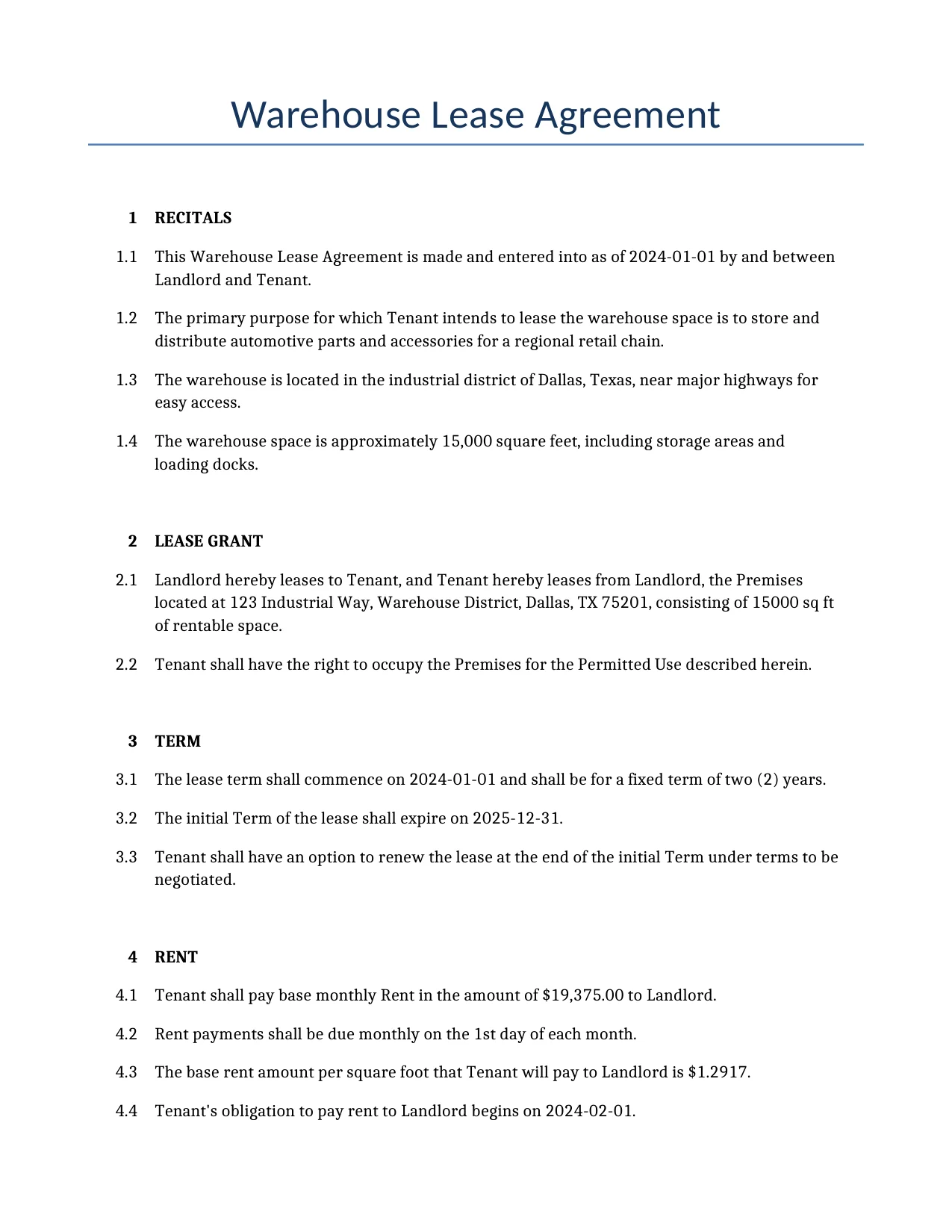
Below is a free template example of a Warehouse Lease Agreement for use in the United States generated by our AI model.
The clauses in your actual Warehouse Lease Agreement will vary from this example as they will be entirely bespoke to your requirements as set out in the questionnaire you complete.
Warehouse Lease Agreement
1RECITALS
This Warehouse Lease Agreement is made and entered into as of 2024-01-01 by and between Landlord and Tenant.
The primary purpose for which Tenant intends to lease the warehouse space is to store and distribute automotive parts and accessories for a regional retail chain.
The warehouse is located in the industrial district of Dallas, Texas, near major highways for easy access.
The warehouse space is approximately 15,000 square feet, including storage areas and loading docks.
2LEASE GRANT
Landlord hereby leases to Tenant, and Tenant hereby leases from Landlord, the Premises located at 123 Industrial Way, Warehouse District, Dallas, TX 75201, consisting of 15000 sq ft of rentable space.
Tenant shall have the right to occupy the Premises for the Permitted Use described herein.
3TERM
The lease term shall commence on 2024-01-01 and shall be for a fixed term of two (2) years.
The initial Term of the lease shall expire on 2025-12-31.
Tenant shall have an option to renew the lease at the end of the initial Term under terms to be negotiated.
4RENT
Tenant shall pay base monthly Rent in the amount of $19,375.00 to Landlord.
Rent payments shall be due monthly on the 1st day of each month.
The base rent amount per square foot that Tenant will pay to Landlord is $1.2917.
Tenant's obligation to pay rent to Landlord begins on 2024-02-01.
Tenant shall pay rent to Landlord via Electronic Funds Transfer according to the instructions: Payments should be made via Electronic Funds Transfer to Bank of America, Account Number: 123456789, Routing Number: 987654321. Acceptable forms of payment include wire transfer, ACH, or certified check.
If Tenant fails to pay rent when due, Tenant shall pay a late fee equal to five percent (5\%) of the overdue amount as additional rent. Late payments shall accrue interest at the rate of one and one-half percent (1.5\%) per month until paid. The security deposit may not be applied to rent during the lease term except upon termination.
5ADDITIONAL RENT
The Base Year for operating expenses is the First Year of Term.
Tenant shall pay additional rent for other applicable fees including administrative or operating expenses.
Tenant shall be responsible for paying a share of Landlord's operating expenses as additional rent.
Common area maintenance (CAM) fees shall be included as part of the additional rent.
The categories of expenses included in the common area maintenance (CAM) fees are Exterior Maintenance, Utilities for Common Areas, Property Management Fees (including but not limited to those categories).
Tenant's pro-rata share shall be calculated based upon the total square footage of the leased warehouse space of 15000 sq ft.
Tenant shall have the right to audit the Landlord's CAM expense records.
Additional rent payments shall be due on the 1st day of each month.
6SECURITY DEPOSIT
The security deposit shall be in the amount of $38,750.00 and shall accrue interest to the Tenant at the maximum rate permitted by Texas law.
Within 30 days after lease termination, Landlord shall return the security deposit or provide an itemized statement to Tenant.
Landlord shall be permitted to deduct from the security deposit for unpaid rent or charges, damages beyond normal wear, and cleaning costs.
Landlord shall not apply the security deposit partially towards rent during the lease term.
7USE OF PREMISES
The Permitted Use of the Premises is that the premises shall be used solely for the storage and distribution of non-perishable goods, including packaging and light administrative activities, specifically for storing and distributing automotive parts and accessories.
The specific permitted use of the warehouse premises is that the tenant intends to use the warehouse for warehousing and logistics operations, specifically for storing automotive parts and accessories and related inventory.
The following activities are explicitly prohibited on the premises: Storage of Explosives or Flammables, Manufacturing or Assembly Operations, Retail Sales to the Public (including but not limited to those activities).
Tenant shall comply with all applicable laws and regulations regarding the use of the premises.
Tenant shall be permitted Exterior Signage with Approval on the premises.
8IMPROVEMENTS AND ALTERATIONS
Tenant shall be allowed to install trade fixtures or alterations to the premises.
Tenant is granted the right to make alterations to the Premises.
Tenant shall obtain Landlord's prior written approval for any improvements or alterations.
Landlord's approval of Tenant's improvements or alterations shall not be unreasonably withheld and shall be subject to conditions.
All improvements and alterations by Tenant shall comply with applicable laws, building codes, and regulations (including but not limited to those requirements).
Tenant shall use licensed and insured contractors for all improvements and alterations.
Tenant shall protect Landlord from liens arising from Tenant's improvements or alterations by delivery of lien waivers.
Improvements and alterations made by Tenant shall become the property of Landlord upon installation.
9MAINTENANCE AND REPAIRS
Tenant shall be responsible for maintenance costs related to the interior of the warehouse.
Tenant shall be responsible for maintenance of the Premises and shall handle all routine maintenance.
Landlord shall be responsible for maintenance of the common areas and shall maintain all common areas.
Landlord shall be responsible for structural repairs to the Premises.
Tenant shall be responsible for maintaining the HVAC systems.
Landlord shall handle repairs to electrical systems.
Tenant shall provide written notice to Landlord for any needed repairs.
Tenant must obtain Landlord approval for repairs that exceed the threshold amount of $1,000.
Maintenance obligations begin on 2024-01-01.
10UTILITIES AND SERVICES
Tenant shall be responsible for paying all utilities for the leased warehouse space.
Tenant shall be responsible for paying the utilities such as electricity, water, and gas for the leased premises.
Tenant shall install separate meters for utilities if not already present. Tenant shall be responsible for the installation, maintenance, and repair of such meters.
Landlord shall not be liable for utility interruptions beyond its control. In the event of any interruption lasting more than five (5) business days that materially interferes with Tenant's use, Tenant shall have the right to an abatement of rent for each day thereafter until service is restored or to terminate the lease if the interruption exceeds thirty (30) days.
11TAXES AND ASSESSMENTS
Tenant shall be responsible for paying the property taxes on the warehouse.
Tenant shall not pay any applicable sales or use taxes on the rent payments.
Tenant shall be responsible for paying the property taxes on the Premises.
Assessments on the Premises shall be paid on a shared basis.
Landlord shall be responsible for paying other levies related to the Premises.
Tenant shall pay taxes directly to the taxing authority.
Tenant shall indemnify Landlord against liens arising from unpaid taxes.
12INSURANCE
Tenant shall maintain commercial general liability insurance with limits of $1,000,000 per occurrence, $2,000,000 aggregate.
Tenant shall maintain property insurance for its personal property and improvements with limits of 500000 USD.
Landlord shall be named as an additional insured on all applicable policies of Tenant.
The parties shall include a mutual waiver of subrogation in their insurance policies. Each party hereby waives any and all rights of recovery against the other for loss or damage to its property arising out of or incident to the occurrence of any of the perils which are covered by its respective property insurance policies, and each party shall cause its insurance carrier to endorse all applicable policies with a waiver of subrogation.
Tenant shall deliver certificates of insurance to Landlord at the address specified in the agreement within ten (10) days prior to the commencement date and upon renewal.
Tenant's insurer shall provide 30 days notice to Landlord before canceling or modifying the policy.
Landlord shall maintain property insurance on the building and improvements (including but not limited to fire, extended coverage, and commercial general liability insurance) in amounts reasonably determined by Landlord.
13INDEMNIFICATION
The parties shall include mutual indemnification provisions where both Landlord and Tenant indemnify each other for their respective negligence or willful misconduct.
Tenant's indemnification obligations to Landlord regarding claims from use of the Premises shall cover all negligence including ordinary negligence.
The indemnification obligations shall be supported by Tenant maintaining adequate insurance coverage.
Tenant shall have the obligation to defend Landlord in any lawsuits arising from Tenant's use of the Premises.
Tenant shall indemnify Landlord against claims related to the use of the Premises for personal injury to third parties, property damage to third parties, and environmental contamination.
All indemnification obligations shall survive the termination or expiration of this lease. Any claim for indemnification shall be made with prompt written notice to the indemnifying party, and the indemnifying party shall have the right to control the defense of the claim.
14SUBORDINATION, ATTORNMENT, AND ESTOPPEL
The Lease shall be subordinate to any existing or future mortgages on the property.
A nondisturbance and attornment agreement shall be a condition to subordination.
Tenant agrees to attorn to any successor landlord in the event of foreclosure or transfer of the property.
Tenant shall be obligated to deliver an estoppel certificate upon Landlord's request, prior to lease assignment or sale, and in connection with financing.
Tenant shall have a maximum of 10 days to respond to a request for an estoppel certificate.
15ASSIGNMENT AND SUBLETTING
Tenant shall be allowed to assign the lease to another party only with Landlord's prior written consent.
Tenant shall be allowed to sublet all or part of the Premises only with Landlord's prior written consent.
Landlord's approval shall be required but not unreasonably withheld over any proposed assignment or subletting by Tenant.
Tenant shall provide 30 days prior written notice to Landlord for any proposed assignment or subletting.
Financial conditions imposed in connection with an assignment or subletting shall include transferee net worth requirement and continued liability of original tenant.
If Tenant assigns or sublets and receives profit from the transaction (after deducting reasonable costs), Tenant shall pay fifty percent (50\%) of such profit to Landlord. Landlord shall have the right to recapture the space and terminate the lease upon notice of proposed assignment or subletting. Tenant shall provide all documentation reasonably requested by Landlord, including but not limited to financial statements and proposed agreements.
16DEFAULT AND REMEDIES
The custom notice period for Tenant to cure a default before Landlord can exercise remedies is as follows: Tenant shall have 5 days to cure a monetary default after receiving notice from Landlord and 30 days to cure a non-monetary default after receiving notice from Landlord. All notices shall be in writing and delivered in accordance with the Notices section.
Events that constitute a default by Tenant under the lease are failure to pay rent, breach of lease covenants, abandonment of premises, and insolvency or bankruptcy (including but not limited to those events).
Landlord shall have the right to perform self-help remedies for Tenant defaults, such as making repairs and charging back costs.
Remedies available to Landlord upon a Tenant default are to terminate the lease, recover accelerated rent, re-enter and relet premises, and sue for damages, all in accordance with Texas Property Code and other applicable Texas law (including but not limited to those remedies). Landlord may accelerate all remaining rent due for the term upon default.
The prevailing party in a default-related dispute shall be entitled to recover attorney fees and costs.
17LANDLORD DEFAULT
Events that constitute a default by Landlord under the lease are failure to provide services, breach of quiet enjoyment, and failure to repair structural issues (including but not limited to those events).
Landlord shall have 30 days to cure a default after receiving notice from Tenant.
Tenant shall wait 30 days after providing written notice before taking action for a default.
Tenant shall have the right to perform self-help remedies if Landlord defaults and fails to cure.
Tenant shall have the right to terminate the lease if Landlord defaults and does not cure within the notice period.
The Landlord default provisions are effective as of 2024-01-01.
Tenant shall be entitled to recover attorney fees and costs if Tenant prevails in a dispute over Landlord default.
18SURRENDER OF PREMISES
Tenant shall surrender the premises in broom-clean condition, free of all debris, with all systems in good working order, and in the same condition as received, normal wear and tear excepted.
Tenant shall be obligated to remove all trade fixtures and improvements upon surrender.
Tenant shall not remove all alterations made to the premises upon surrender.
Tenant shall repair any damage caused by removing property upon surrender.
The surrender date for the premises is 2025-12-31.
Tenant shall return all keys and access devices upon surrender.
19HOLDING OVER
Penalties for Tenant holding over after the surrender date shall include daily holdover rent.
The holdover rent shall be 1.5 times the monthly base rent.
Holdover shall create a tenancy at sufferance rather than month-to-month.
Tenant shall have full liability for damages or losses during holdover.
20ENVIRONMENTAL PROVISIONS
Tenant does not plan to store, use, or dispose of any hazardous materials on the premises except in compliance with all applicable laws.
The lease permits limited use of hazardous materials with landlord approval.
Landlord represents that the premises complies with all environmental laws as of the lease commencement date and that, to Landlord's knowledge, there has been no release of Hazardous Materials.
Tenant shall be responsible for ongoing compliance with environmental laws during the lease term. Tenant shall promptly notify Landlord in writing of any environmental notices, violations, or releases.
Landlord shall be responsible for environmental remediation of pre-existing contamination and Tenant shall be responsible for new contamination.
Landlord shall indemnify Tenant against environmental claims arising from conditions existing prior to the lease commencement.
Tenant shall notify Landlord immediately of notices of environmental violations during the lease term.
Prior to commencement, Landlord shall provide Tenant with a Phase I Environmental Site Assessment. All indemnity obligations shall survive termination of the lease.
21DAMAGE OR DESTRUCTION
If the Premises are damaged by fire or other casualty, Landlord shall repair the Premises using insurance proceeds (subject to the provisions below).
Tenant shall be obligated to repair any damage Tenant causes to the Premises.
Landlord shall be required to perform repairs for minor damage and partial damage.
Landlord shall have 90 days to complete repairs after damage or destruction.
Rent shall be abated or suspended during the period when the Premises are untenantable due to damage or destruction.
Tenant shall have the right to terminate the Lease if repairs are not completed within the specified period.
Landlord shall have the right to terminate the Lease if the Premises are substantially destroyed.
22CONDEMNATION
The Lease shall terminate if there is a partial taking of the Premises by eminent domain that substantially interferes with Tenant's use.
The Lease shall automatically terminate if there is a total taking of the Premises by eminent domain.
The condemnation award shall be apportioned between Landlord and Tenant based on their interests.
If a partial taking does not substantially interfere with Tenant's use, the Lease shall continue with an abatement of rent proportional to the taken portion.
23NOTICES
Notices to Landlord shall be delivered to 123 Industrial Way, Suite 100, Dallas, TX 75201.
Notices to Tenant shall be delivered to 456 Distribution Lane, Suite 200, Dallas, TX 75201.
Acceptable methods of delivery for notices under the lease are certified mail, hand delivery, and overnight courier.
Notices delivered by mail shall be deemed received after three (3) business days.
24BROKERS
Brokers are involved in this lease agreement, and commissions shall be paid as agreed separately.
25QUIET ENJOYMENT
Landlord covenants that Tenant shall have quiet enjoyment of the Premises subject to the terms of this lease.
Landlord shall provide 48 hours notice before entering the Premises for inspections or repairs.
26FORCE MAJEURE
Events included as force majeure events in the lease agreement are acts of God, strikes or labor disputes, and epidemics or pandemics (including but not limited to those events).
The force majeure clause shall apply mutually to both Tenant and Landlord.
27WAIVER
Failure by either party to enforce any provision of this lease shall not constitute a waiver of such provision.
Oral waivers of any provisions in this lease are not permitted.
Waivers shall be delivered by written notice or electronic mail.
28ENTIRE AGREEMENT
This lease constitutes the entire agreement between Landlord and Tenant, superseding all prior written and oral understandings.
This lease becomes effective on 2024-01-01.
29AMENDMENTS
Any future modifications to the lease must be in writing and signed by both Landlord and Tenant.
30SEVERABILITY
If any provision of this lease is held to be invalid or unenforceable, the remaining provisions shall remain in full force and effect. This lease is a commercial lease and is not subject to any residential protections or statutes, including but not limited to the Texas Property Code provisions applicable solely to residential tenancies.
31GOVERNING LAW
This lease shall be governed by the laws of the State of Texas.
Venue for any disputes arising from the lease shall be in the state or federal courts located in Dallas County, Texas.
32SUCCESSORS AND ASSIGNS
This lease shall bind the heirs, successors, and permitted assigns of the parties.
Assignments by Tenant are restricted to those with Landlord consent.
Subletting by Tenant is restricted to those with Landlord consent and up to a certain percentage.
The original Tenant shall remain liable for obligations after an assignment.
33NO PARTNERSHIP
This lease does not create a partnership or joint venture between Landlord and Tenant.
34TIME OF ESSENCE
Time is of the essence in performing all obligations under this lease for both Tenant and Landlord.
35HEADINGS
Section headings are for convenience only and do not affect the interpretation of this lease.
36COUNTERPARTS
This lease may be executed in counterparts, each of which shall be deemed an original.
Electronic signatures shall be valid and binding.
37EXHIBITS AND ATTACHMENTS
The following exhibits are attached to and incorporated into this lease: Exhibit A (legal description of the Premises), Exhibit B (site plan), Exhibit C (rules and regulations), Exhibit D (work letter, if applicable), and Exhibit E (guaranty, if applicable).
38COMPLIANCE WITH LAWS
The parties shall comply with the Uniform Commercial Code (UCC) Article 2A, Americans with Disabilities Act (ADA) Title III, Occupational Safety and Health Act (OSHA), Environmental Protection Agency Regulations including RCRA, Texas Commercial Landlord-Tenant Laws including Texas Property Code Chapters 91-93 (as applicable to commercial and industrial leases), and Zoning and Land Use Regulations (including but not limited to those requirements). Tenant acknowledges that this is a commercial industrial lease and is not subject to residential laws such as the URLTA or FHA. Landlord shall provide any required disclosures for industrial properties under Texas law.
39REPRESENTATIONS AND WARRANTIES
Each party represents and warrants that it has full authority to enter into this lease. Landlord represents that the Premises are suitable for the Permitted Use, in compliance with applicable laws as of the commencement date (subject to the Environmental Provisions), and that there is no pending litigation affecting the Premises that would impair Tenant's use. Tenant represents there is no pending litigation that would impair its ability to perform under this lease. This commercial lease does not provide warranties of habitability as in residential leases.
40PARKING AND ACCESS
Tenant shall have the non-exclusive right to use parking areas on the Land for its employees, visitors, and delivery vehicles, including but not limited to access to loading docks. Access to the Premises shall be available 24 hours per day, 7 days per week, subject to any security requirements and Rules and Regulations. Loading dock access shall be coordinated to avoid interference with other tenants.
41RULES AND REGULATIONS
Tenant shall comply with the Rules and Regulations attached as Exhibit C, which include but are not limited to restrictions on operations, waste disposal methods, safety protocols, hours for noisy activities, and other reasonable rules as may be amended by Landlord from time to time with notice to Tenant.
42DEFINITIONS
As used in this Lease, the following terms shall have the meanings set forth below: 'Premises' means the approximately 15,000 square foot warehouse space located at 123 Industrial Way, Warehouse District, Dallas, TX 75201, as more particularly described in Exhibit A and depicted on the site plan in Exhibit B. 'Landlord' means the party identified as such in the Recitals, and its successors and assigns. 'Tenant' means the party identified as such in the Recitals, and its permitted successors and assigns. 'Rent' means the base rent and additional rent payable under this Lease, including but not limited to base monthly rent, CAM charges, taxes, and late fees. 'Operating Expenses' means all costs and expenses incurred by Landlord in the operation, management, maintenance, and repair of the property, including but not limited to those set forth in Section 5. 'Permitted Use' means the use set forth in Section 7 for storage and distribution of automotive parts and accessories. 'Hazardous Materials' means any substance defined as hazardous under applicable environmental laws, including but not limited to those regulated under RCRA or CERCLA.
43CASUALTY
If the Premises are damaged by fire or other casualty (Casualty), Landlord shall, to the extent of available insurance proceeds, restore the Premises to substantially the same condition as existed prior to the Casualty. If the restoration cannot be completed within one hundred eighty (180) days after the Casualty, either party may terminate this Lease by written notice. Rent shall abate proportionately during the period the Premises are untenantable. Tenant shall have no claim to insurance proceeds for Landlord's building or improvements except for Tenant's personal property. If Landlord elects not to restore or if the damage is to more than fifty percent (50\%) of the Premises, Landlord may terminate this Lease. These provisions expand and supersede any conflicting terms in prior sections regarding damage or destruction.
44HAZARDOUS MATERIALS
Tenant warrants that it will not use, store, generate, or dispose of any Hazardous Materials on the Premises except in full compliance with all applicable environmental laws and only with Landlord's prior written consent for limited quantities necessary for Permitted Use. Tenant shall promptly notify Landlord of any release or violation and shall remediate at its sole cost any contamination caused by Tenant. Tenant shall provide Landlord with copies of all environmental reports, including any Phase I or Phase II ESA conducted by or on behalf of Tenant. Tenant shall indemnify, defend, and hold harmless Landlord from all claims, damages, and costs (including attorneys' fees) arising from Tenant's violation of environmental laws. This indemnity shall survive termination or expiration of the Lease. Landlord warrants that, to its knowledge, the Premises are free of contamination as of the commencement date and shall remediate any pre-existing contamination at its cost. These provisions expand and supersede any conflicting terms in prior environmental sections.
45DISPUTE RESOLUTION
Any dispute arising out of or relating to this Lease shall first be subject to mediation in Dallas, Texas, with a mediator mutually selected by the parties. If mediation fails to resolve the dispute within sixty (60) days, either party may commence litigation in the state or federal courts located in Dallas County, Texas. This section shall not limit either party's right to seek injunctive relief.
46CONFIDENTIALITY
Each party agrees to maintain the confidentiality of the terms of this Lease and any proprietary information of the other party disclosed during the term, except as required by law or to enforce the Lease. This obligation shall survive for two (2) years after termination.
47ANTI-TERRORISM
Each party represents and warrants that it is not (i) listed on any Sanctions List maintained by the U.S. government, including the OFAC Specially Designated Nationals list, or (ii) owned or controlled by any such person. Each party shall comply with all applicable anti-terrorism and anti-money laundering laws.
48RECORDING
Neither party shall record this Lease. However, upon request, either party may record a memorandum of this Lease in a form reasonably acceptable to both parties.
49ATTORNEYS' FEES
In any action or proceeding arising out of this Lease, the prevailing party shall be entitled to recover its reasonable attorneys' fees and costs from the non-prevailing party, in addition to any other relief to which it is entitled. This provision expands on any similar provisions in this Lease.
50CUMULATIVE REMEDIES
All remedies provided in this Lease are cumulative and in addition to any other remedies available at law or in equity. No remedy is intended to be exclusive.
51NO THIRD-PARTY BENEFICIARIES
This Lease is for the sole benefit of Landlord and Tenant and their permitted successors and assigns. Nothing herein shall create any rights in any third parties.
52SIGNATURES
| LANDLORD | |
| Signature: | |
| Print Name: | |
| Date: |
| TENANT | |
| Signature: | |
| Print Name: | |
| Date: |
This example shows approximately 70% of a typical document and is provided for illustrative purposes only. The remaining content has been omitted.
Every document generated by Docaro is tailored to your specific circumstances, jurisdiction and the information you provide. The completed document includes all applicable clauses and provisions required for your situation.
To generate the full, personalised document, answer a short series of questions and your document will be created instantly.