
AI Generated American Cease and Desist Letter
PDF & Word - 2026 Updated
Docaro Pricing
When do you need a Cease and Desist Letter in the United States?
American Legal Rules for a Cease and Desist Letter
Using the wrong structure for a cease and desist letter may fail to adequately preserve your legal rights or trigger unintended defenses for the recipient.
What a Proper Cease and Desist Letter Should Include
- Your Contact InformationInclude your name, address, phone number, and email at the top so the recipient knows who is sending the letter.
- Recipient's Contact InformationList the name and address of the person or company you're addressing to ensure the letter reaches the right party.
- Clear Statement of the ProblemDescribe the specific actions or behaviors you're objecting to, like unauthorized use of your work or property.
- Demand to StopExplicitly tell the recipient to immediately stop the unwanted activity to avoid further issues.
- Deadline for ResponseSet a reasonable time frame, such as 10 days, by which they must comply or reply.
- Possible Next StepsMention that failure to comply may lead to legal action, like filing a lawsuit, to emphasize the seriousness.
- SignatureEnd with your signature and date to make the letter official and authentic.
Generate Your Document in 4 Easy Steps
Why Use Docaro?
 United States
Free Example Cease and Desist Letter Template
Below is a free template example of a Cease and Desist Letter for use in the United States generated by our AI model.
The clauses in your actual Cease and Desist Letter will vary from this example as they will be entirely bespoke to your requirements as set out in the questionnaire you complete.
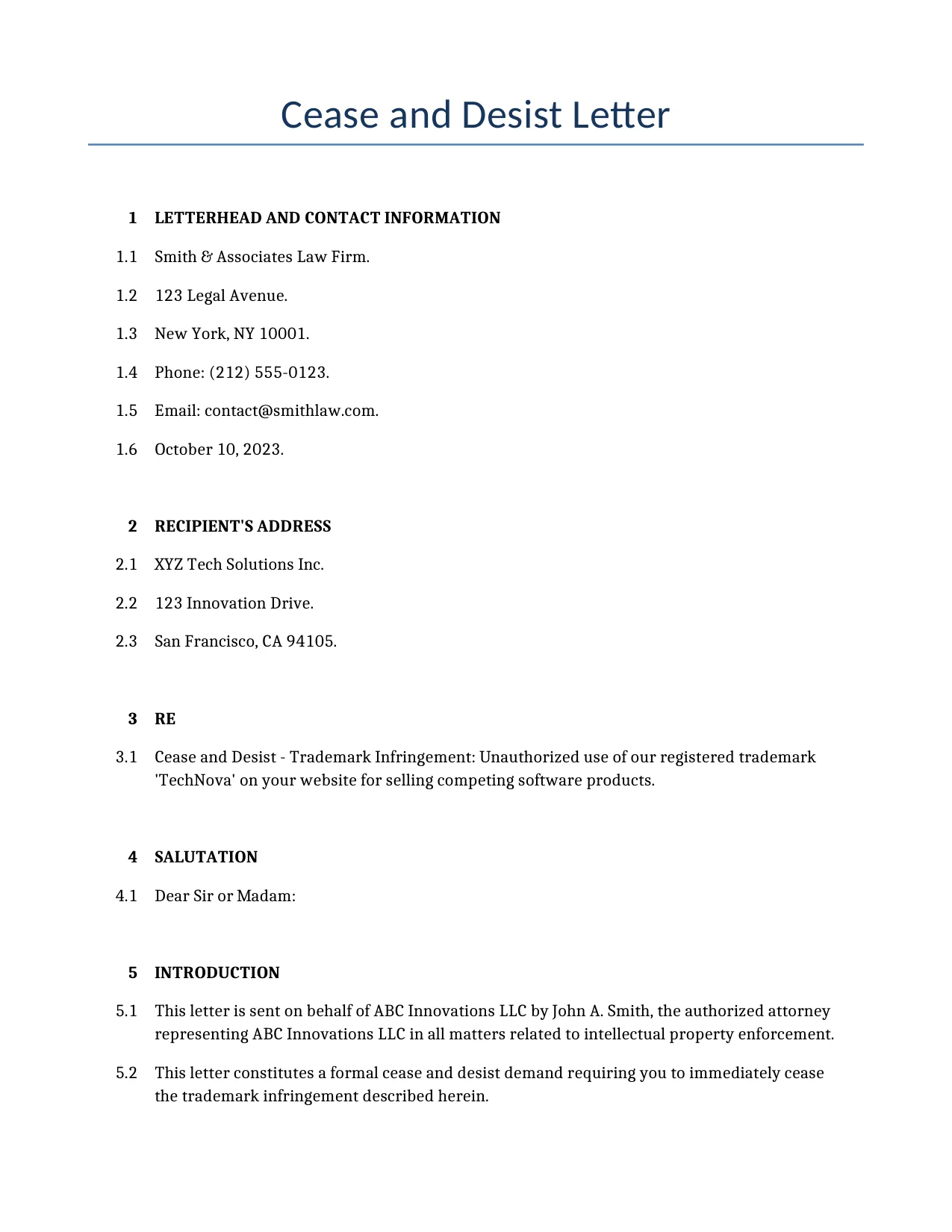
Cease and Desist Letter
1LETTERHEAD AND CONTACT INFORMATION
Smith & Associates Law Firm.
123 Legal Avenue.
New York, NY 10001.
Phone: (212) 555-0123.
Email: contact@smithlaw.com.
October 10, 2023.
2RECIPIENT'S ADDRESS
XYZ Tech Solutions Inc.
123 Innovation Drive.
San Francisco, CA 94105.
3RE
Cease and Desist - Trademark Infringement: Unauthorized use of our registered trademark 'TechNova' on your website for selling competing software products.
4SALUTATION
Dear Sir or Madam:
5INTRODUCTION
This letter is sent on behalf of ABC Innovations LLC by John A. Smith, the authorized attorney representing ABC Innovations LLC in all matters related to intellectual property enforcement.
This letter constitutes a formal cease and desist demand requiring you to immediately cease the trademark infringement described herein.
6STATEMENT OF FACTS
The trademark known as TechNova is a stylized word mark featuring a blue geometric logo used for software development services and was first used in commerce on 2020-06-01.
The intellectual property rights in TechNova were established by Federal Registration.
ABC Innovations LLC has used the TechNova trademark on its website, product packaging, advertising materials, and in commerce since 2020 to identify its software services.
The party believed to be infringing is XYZ Tech Solutions Inc. located at 123 Innovation Drive, San Francisco, CA 94105.
The specific activity by the recipient that must cease is the unauthorized use of the registered trademark TechNova on their website for selling competing software products.
The infringer is displaying the TechNova mark on their e-commerce website to market and sell software products that directly compete with ours, thereby causing consumer confusion.
The infringement was first observed on 2023-08-10 and is ongoing.
Evidence of the infringing activities includes screenshots of the website dated August 10, 2023 showing the unauthorized use of the TechNova mark along with archived web pages via Wayback Machine and sales records indicating their product listings.
The geographic scope of the observed infringing activities is online.
7DESCRIPTION OF VIOLATIONS
The violations claimed against the other party are Trademark Infringement under the Lanham Act.
The other party has been using the registered trademark TechNova on their competing website without permission, which is likely to cause confusion, mistake, or deception as to the source, sponsorship, or affiliation of their products.
The first instance of the violation occurred on or about 2023-05-15 and the most recent instance is ongoing as of the date of this letter.
The violations are ongoing as of the date of this letter.
Evidence supporting the violations includes screenshots of the infringing website and archived web pages.
Specific examples of the violations include the display on their website homepage of the TechNova mark and logo in connection with competing software products.
8LEGAL BASIS
The violations are supported by Trademark Infringement under 15 U.S.C. § 1114 and false designation of origin under 15 U.S.C. § 1125(a).
These claims are further supported by common law trademark infringement and unfair competition.
9DEMAND FOR WRITTEN ASSURANCE
The recipient must provide a written statement, signed by an authorized officer, confirming that they have ceased all infringing activities, removed all unauthorized uses of the TechNova trademark, and will not engage in similar activities in the future. This assurance must be provided no later than 14 days from receipt of this letter.
10DEMAND TO CEASE
The recipient must immediately cease all use of the TechNova trademark and any confusingly similar marks in connection with the advertising, marketing, or sale of any products or services.
11DEMAND FOR CORRECTIVE ACTIONS
The recipient must remove all infringing materials from their website and any other online platforms, including but not limited to www.faketechnova.com.
The recipient must provide an accounting of all profits derived from the infringing activities.
The recipient must complete all corrective actions and provide the written assurance no later than 14 days from receipt of this letter.
The recipient must provide proof of completion of all corrective actions to the sender.
12CONSEQUENCES OF NON-COMPLIANCE
If the recipient fails to comply with the demands of this letter, ABC Innovations LLC will pursue all available legal remedies, including filing a lawsuit in federal court seeking injunctive relief, monetary damages (including treble damages and attorneys' fees), and any other relief the court deems appropriate.
13RESERVATION OF RIGHTS
ABC Innovations LLC reserves all rights and remedies available under law and equity, and nothing in this letter shall be construed as a waiver of any claims or a limitation on future actions.
14OFFER TO DISCUSS RESOLUTION
The recipient is invited to contact the sender to discuss an amicable resolution of this matter prior to litigation.
15ENCLOSURES
Copy of the TechNova Trademark Registration Certificate.
Evidence of Infringement (screenshots and archived web pages).
16SIGNATURE SECTION
Sincerely,
John A. Smith
Attorney for ABC Innovations LLC
Smith & Associates Law Firm
123 Legal Avenue
New York, NY 10001
Phone: (212) 555-0123
Email: contact@smithlaw.com
This example shows approximately 70% of a typical document and is provided for illustrative purposes only. The remaining content has been omitted.
Every document generated by Docaro is tailored to your specific circumstances, jurisdiction and the information you provide. The completed document includes all applicable clauses and provisions required for your situation.
To generate the full, personalised document, answer a short series of questions and your document will be created instantly.