
AI Generated American Non-Compete Agreement
PDF & Word - 2026 Updated
Docaro Pricing
When Do You Need a Non-Compete Agreement in the United States?
American Legal Rules for a Non-Compete Agreement
Using the wrong type or structure of non-compete agreement can render it unenforceable or lead to unintended legal liabilities.
What a Proper Non-Compete Agreement Should Include
- Parties InvolvedClearly identify the employer and the employee who are entering into the agreement.
- Restricted ActivitiesSpecify the types of work or business activities the employee cannot engage in after leaving the job.
- Geographic LimitsDefine the specific areas or regions where the restrictions apply, such as a city or state.
- Time DurationState how long the restrictions will last, typically from a few months to a couple of years.
- Reason for ProtectionExplain why the restrictions are needed, like protecting company secrets or client relationships.
- What Happens if BrokenOutline the consequences for violating the agreement, such as paying damages or facing a lawsuit.
- Applicable LawsIndicate which state's laws govern the agreement to ensure it is enforceable.
Generate Your Document in 4 Easy Steps
Why Use Docaro?
 United States
Free Example Non-Compete Agreement Template
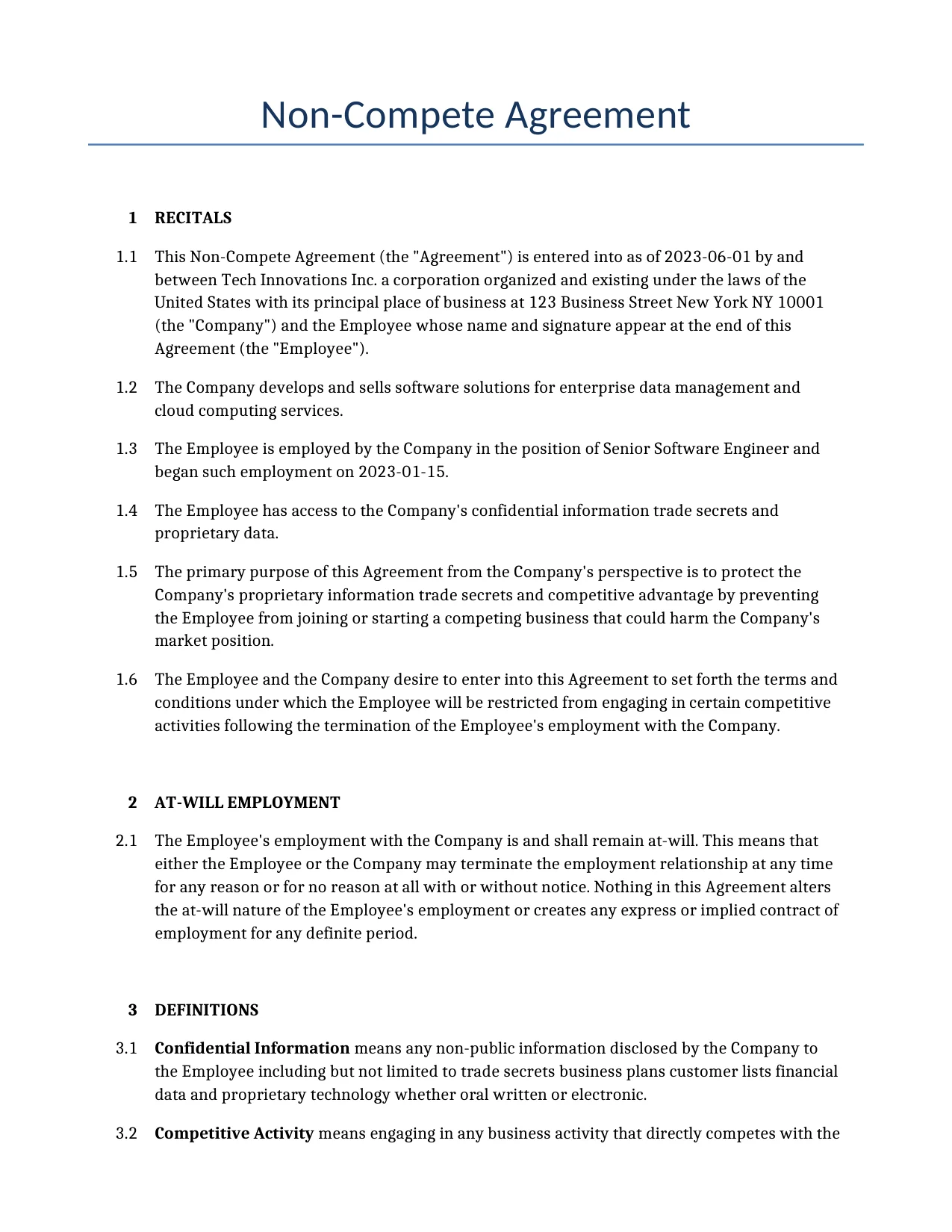
Below is a free template example of a Non-Compete Agreement for use in the United States generated by our AI model.
The clauses in your actual Non-Compete Agreement will vary from this example as they will be entirely bespoke to your requirements as set out in the questionnaire you complete.
Non-Compete Agreement
1RECITALS
This Non-Compete Agreement (the "Agreement") is entered into as of 2023-06-01 by and between Tech Innovations Inc. a corporation organized and existing under the laws of the United States with its principal place of business at 123 Business Street New York NY 10001 (the "Company") and the Employee whose name and signature appear at the end of this Agreement (the "Employee").
The Company develops and sells software solutions for enterprise data management and cloud computing services.
The Employee is employed by the Company in the position of Senior Software Engineer and began such employment on 2023-01-15.
The Employee has access to the Company's confidential information trade secrets and proprietary data.
The primary purpose of this Agreement from the Company's perspective is to protect the Company's proprietary information trade secrets and competitive advantage by preventing the Employee from joining or starting a competing business that could harm the Company's market position.
The Employee and the Company desire to enter into this Agreement to set forth the terms and conditions under which the Employee will be restricted from engaging in certain competitive activities following the termination of the Employee's employment with the Company.
2AT-WILL EMPLOYMENT
The Employee's employment with the Company is and shall remain at-will. This means that either the Employee or the Company may terminate the employment relationship at any time for any reason or for no reason at all with or without notice. Nothing in this Agreement alters the at-will nature of the Employee's employment or creates any express or implied contract of employment for any definite period.
3DEFINITIONS
Confidential Information means any non-public information disclosed by the Company to the Employee including but not limited to trade secrets business plans customer lists financial data and proprietary technology whether oral written or electronic.
Competitive Activity means engaging in any business activity that directly competes with the specific services the Employee provided to the Company including developing marketing or selling similar goods or services to the Company's customers and includes working for a direct competitor in such specific services.
Restricted Period means the period of twelve (12) months following the termination of the Employee's employment with the Company.
Territory means the geographic area in the State of Texas where the Employee actually performed work for the Company during the twelve (12) months immediately preceding the termination of the Employee's employment.
4NON-COMPETE COVENANT
The Employee shall not directly or indirectly engage in any Competitive Activity that directly competes with the specific services the Employee provided to the Company for the duration of the Restricted Period within the Territory. The restrictions set forth in this Section 4 are no broader than necessary to protect the Company's legitimate business interests in its trade secrets confidential information and customer relationships.
The Company shall be entitled to injunctive relief liquidated damages and recovery of attorney fees in the event of a breach of this Non-Compete Covenant by the Employee.
5NON-SOLICITATION OF CUSTOMERS
The Employee has direct relationships with the Company's clients or customers.
For a period of twelve (12) months after the termination of the Employee's employment with the Company the Employee shall not solicit any customer of the Company with whom the Employee personally worked in the last twelve (12) months of employment for the purpose of providing products or services that are competitive with those offered by the Company.
This non-solicitation obligation shall not apply to any pre-existing relationships of the Employee that existed prior to the Employee's employment with the Company.
In the event of a breach of this Section 5 by the Employee the Company shall be entitled to seek injunctive relief and damages.
6NON-SOLICITATION OF EMPLOYEES
For a period of twelve (12) months after the termination of the Employee's employment with the Company the Employee shall not directly solicit or recruit any employee or contractor of the Company with whom the Employee actually worked or supervised during the twelve (12) months immediately preceding the termination of employment hire or engage any such employee or contractor for a competing business or induce any such employee or contractor to terminate their employment or engagement with the Company. The restrictions set forth in this Section 6 shall apply only within the Territory.
7CONFIDENTIALITY OBLIGATIONS
The Employee shall not disclose any Confidential Information to any third party at any time.
The Employee shall not use any Confidential Information for the Employee's own benefit or for any purpose other than the business of the Company.
The obligations under this Section 7 shall last indefinitely provided however that they shall not apply to information that becomes publicly known through no fault of the Employee. The Employee's obligations with respect to trade secrets shall survive as long as the information remains a trade secret under the Defend Trade Secrets Act and applicable state law.
Upon the termination of the Employee's employment with the Company the Employee shall return to the Company all materials containing Confidential Information.
8NO CONFLICTING AGREEMENTS
The Employee represents that he is not bound by any prior non-compete agreement or other restrictive covenant that would prevent him from performing his duties for the Company or that conflicts with this Agreement. The Employee further represents that his execution of this Agreement and performance of duties will not breach any other agreement to which the Employee is a party.
9CONSIDERATION
In exchange for the Employee's agreement to the restrictions set forth in this Agreement the Employee will receive an annual base salary of $75,000 paid bi-weekly.
The Employee shall also receive standard employee benefits including health insurance and retirement contributions as additional consideration for agreeing to the terms of this Agreement. If this Agreement is signed after the start of employment continued employment constitutes sufficient consideration for the covenants herein.
10ACKNOWLEDGMENT OF CONSIDERATION AND REASONABLENESS
The Employee expressly acknowledges that the restrictions contained in this Agreement are reasonable in time geography and scope and are no broader than necessary to protect the Company's legitimate business interests. The Employee further acknowledges that he received adequate consideration for entering into this Agreement including but not limited to continued employment (if signed after the start date) the salary and benefits described in Section 9 and access to the Company's confidential information and trade secrets. The Employee acknowledges that he has had the opportunity to consult with counsel before signing this Agreement and that he fully understands its terms.
11TERM AND DURATION
This Agreement shall become effective on 2023-06-01 and shall remain in effect until terminated in accordance with its terms.
The Restricted Period shall commence upon any termination of the Employee's employment with the Company and shall last for twelve (12) months thereafter.
12SURVIVAL
The restrictive covenants confidentiality obligations and any causes of action for breach of this Agreement shall survive the termination or expiration of this Agreement.
13ENFORCEMENT AND REMEDIES
In the event of a breach or threatened breach of this Agreement by the Employee the Company shall be entitled to seek injunctive relief in addition to any other remedies available at law or in equity without the need to post a bond.
The Company shall be entitled to recover actual damages and consequential damages resulting from any breach of this Agreement by the Employee.
If the Company prevails in any action to enforce this Agreement the Company shall be entitled to recover its attorney fees and costs from the Employee.
14BLUE PENCIL REFORMATION
If any restriction or provision in this Agreement is found by a court of competent jurisdiction to be overbroad or unenforceable the court may reform the Agreement to the maximum reasonable scope permitted under applicable law and enforce it as reformed. The parties intend that the restrictions be enforced to the fullest extent possible.
15SEVERABILITY
If any individual provision of this Agreement is held to be invalid or unenforceable such invalidity or unenforceability shall not affect the validity or enforceability of the remaining provisions of this Agreement.
16GOVERNING LAW AND VENUE
This Agreement shall be governed by and construed in accordance with the laws of the State of Texas without regard to its conflict of laws principles. The parties agree that any arbitration litigation or other proceeding arising out of or relating to this Agreement shall be brought exclusively in the state or federal courts located in Travis County Texas and the parties hereby consent to the personal jurisdiction and venue of such courts.
17DISPUTE RESOLUTION
Any dispute arising out of or relating to this Agreement (except for the Company's claims seeking injunctive relief which may be brought directly in court without arbitration) shall be resolved exclusively through arbitration in accordance with the rules of the American Arbitration Association and the Federal Arbitration Act. The arbitration shall take place in Travis County Texas. The prevailing party in any such arbitration or litigation shall be entitled to recover its attorneys' fees and costs.
18COMPLIANCE WITH APPLICABLE LAW
If any provision of this Agreement violates a specific state's non-compete statute (including any salary threshold notice requirement or garden-leave pay requirement) that provision shall be modified or severed to the minimum extent necessary to comply with such statute while preserving the intent of the parties to the maximum extent possible.
19ENTIRE AGREEMENT
This Agreement constitutes the entire understanding between the parties with respect to the subject matter hereof and supersedes all prior agreements and understandings whether written or oral.
20AMENDMENTS
Any modification to this Agreement must be made in writing and signed by both the Company and the Employee.
21WAIVER
The failure of either party to enforce any provision of this Agreement shall not constitute a waiver of that provision or any other provision and shall not preclude the subsequent enforcement of that provision or any other provision.
22ASSIGNMENT
The Company may assign this Agreement to any successor or affiliate in the event of a merger acquisition or transfer to an affiliate. This Agreement shall be binding upon and inure to the benefit of the successors and assigns of the parties.
23NOTICES
All notices under this Agreement shall be in writing and shall be delivered by personal delivery certified mail or email.
Notices to the Company shall be sent to 123 Business Street New York NY 10001.
Notices to the Employee shall be sent to 456 Residential Avenue Los Angeles CA 90210.
Notices sent by certified mail shall be deemed received three (3) days after mailing.
24COUNTERPARTS
This Agreement may be executed in one or more counterparts each of which shall be deemed an original but all of which together shall constitute one and the same instrument.
25HEADINGS
The headings in this Agreement are for convenience of reference only and shall not affect the interpretation of this Agreement.
26EMPLOYEE ACKNOWLEDGMENT OF RECEIPT
By initialing here the Employee acknowledges that he received a copy of this Agreement before beginning employment or before any material change in the terms of employment: _____ .
27SIGNATURE PAGE
IN WITNESS WHEREOF the parties have executed this Agreement as of the date first above written.
Tech Innovations Inc.: _______________________________ By: _______________________________ Title: _______________________________ Date: _______________________________
Employee: _______________________________ Printed Name: _______________________________ Date: _______________________________
This example shows approximately 70% of a typical document and is provided for illustrative purposes only. The remaining content has been omitted.
Every document generated by Docaro is tailored to your specific circumstances, jurisdiction and the information you provide. The completed document includes all applicable clauses and provisions required for your situation.
To generate the full, personalised document, answer a short series of questions and your document will be created instantly.