
AI Generated American Consulting Agreement
PDF & Word - 2026 Updated
Docaro Pricing
When Do You Need a Consulting Agreement in the United States?
American Legal Rules for a Consulting Agreement
Using the wrong structure for a consultancy agreement can inadvertently create an employment relationship, triggering labor law obligations.
What a Proper Consulting Agreement Should Include
- Parties InvolvedIdentify the consultant and the client, including their full names and contact details.
- Scope of WorkDescribe the specific services the consultant will provide and any limitations on their responsibilities.
- Payment TermsOutline how much the consultant will be paid, when payments are due, and any expense reimbursements.
- Duration and TerminationSpecify the start and end dates of the agreement and the conditions under which either party can end it.
- ConfidentialityRequire the consultant to keep the client's private information secret and not share it with others.
- Independent Contractor StatusClarify that the consultant is not an employee and is responsible for their own taxes and insurance.
- Intellectual Property RightsDefine who owns any work or ideas created by the consultant during the project.
- Dispute ResolutionExplain how disagreements between the parties will be handled, such as through negotiation or mediation.
Generate Your Document in 4 Easy Steps
Why Use Docaro?
 United States
Free Example Consulting Agreement Template
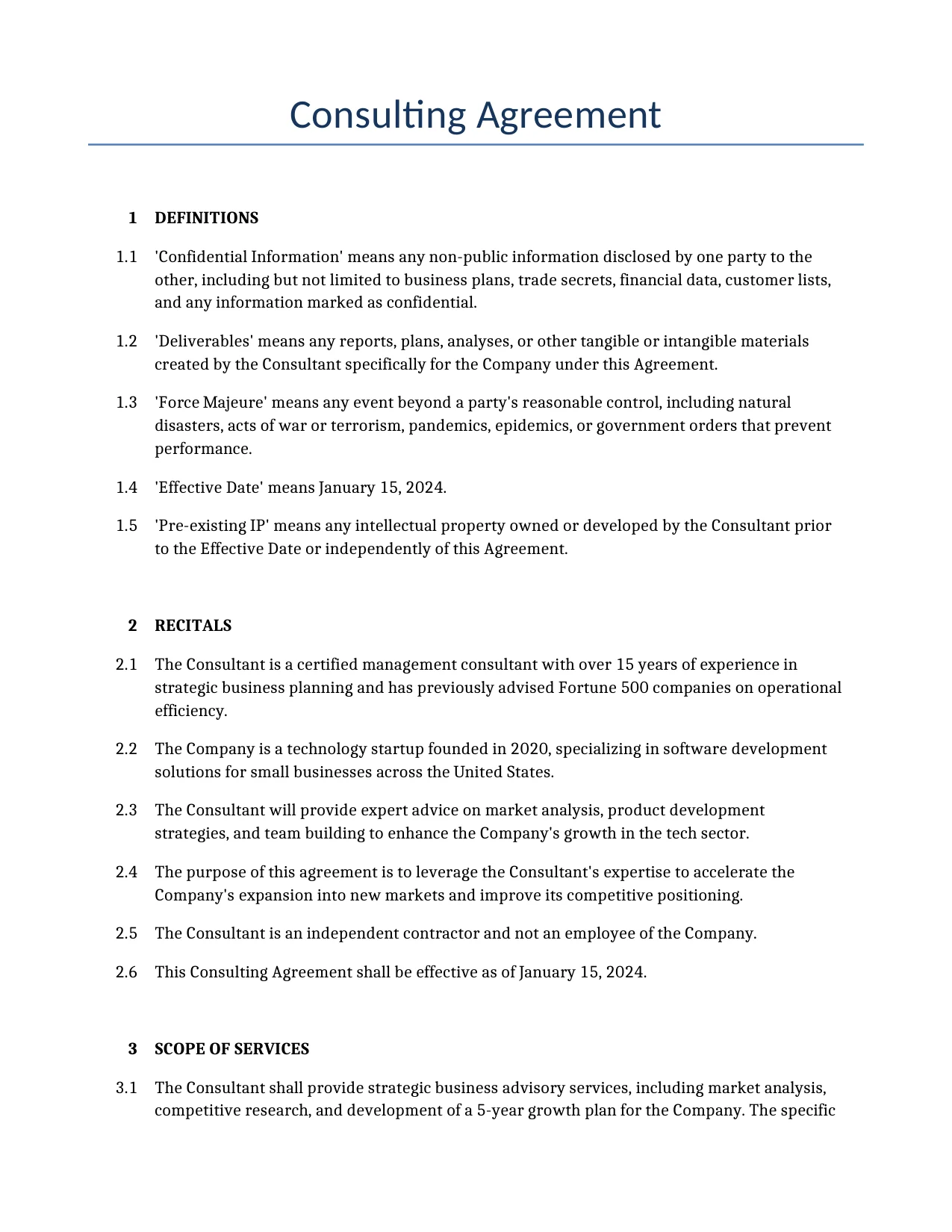
Below is a free template example of a Consulting Agreement for use in the United States generated by our AI model.
The clauses in your actual Consulting Agreement will vary from this example as they will be entirely bespoke to your requirements as set out in the questionnaire you complete.
Consulting Agreement
1DEFINITIONS
'Confidential Information' means any non-public information disclosed by one party to the other, including but not limited to business plans, trade secrets, financial data, customer lists, and any information marked as confidential.
'Deliverables' means any reports, plans, analyses, or other tangible or intangible materials created by the Consultant specifically for the Company under this Agreement.
'Force Majeure' means any event beyond a party's reasonable control, including natural disasters, acts of war or terrorism, pandemics, epidemics, or government orders that prevent performance.
'Effective Date' means January 15, 2024.
'Pre-existing IP' means any intellectual property owned or developed by the Consultant prior to the Effective Date or independently of this Agreement.
2RECITALS
The Consultant is a certified management consultant with over 15 years of experience in strategic business planning and has previously advised Fortune 500 companies on operational efficiency.
The Company is a technology startup founded in 2020, specializing in software development solutions for small businesses across the United States.
The Consultant will provide expert advice on market analysis, product development strategies, and team building to enhance the Company's growth in the tech sector.
The purpose of this agreement is to leverage the Consultant's expertise to accelerate the Company's expansion into new markets and improve its competitive positioning.
The Consultant is an independent contractor and not an employee of the Company.
This Consulting Agreement shall be effective as of January 15, 2024.
3SCOPE OF SERVICES
The Consultant shall provide strategic business advisory services, including market analysis, competitive research, and development of a 5-year growth plan for the Company. The specific services, milestones, and acceptance criteria are detailed in Exhibit A (Statement of Work).
The Consultant shall deliver to the Company the Deliverables specified in Exhibit A.
The Consultant shall complete the services in accordance with the timeline set forth in Exhibit A, commencing on the Effective Date.
4TERM AND TERMINATION
This Agreement shall commence on January 15, 2024 and shall continue for an initial term of 12 months unless terminated earlier in accordance with this Section 4.
This Agreement shall automatically renew for successive 12-month periods unless either party provides written notice of non-renewal at least 30 days prior to the expiration of the then-current term.
The Company may terminate this Agreement for convenience at any time by providing 30 days' prior written notice to the Consultant.
Either party may terminate this Agreement for cause if the other party materially breaches any provision of this Agreement and fails to cure such breach within 15 days after receiving written notice thereof.
Upon termination of this Agreement, confidentiality obligations, non-solicitation, surviving intellectual property provisions, and any unpaid fees shall survive termination.
5COMPENSATION
The Company shall compensate the Consultant at an hourly rate of 150.00 for all services rendered under this Agreement.
The Company shall pay the Consultant a retainer fee of 5000.00 upon execution of this Agreement, which shall be credited against future invoices.
The Consultant shall submit invoices to the Company on a monthly basis detailing the hours worked and services provided.
The Company shall pay all undisputed invoices within 30 days of receipt.
The Consultant shall be responsible for all applicable taxes on the compensation received from the Company.
6AUDIT RIGHTS
The Company shall have the right, upon reasonable notice and during normal business hours, to audit the Consultant's records related to hours worked, expenses incurred, and compliance with this Agreement for up to two (2) years following any invoice or payment. The Consultant shall maintain accurate records for this purpose.
7EXPENSES
The Company shall reimburse the Consultant for reasonable out-of-pocket expenses incurred in the performance of the services, including Travel Expenses, Communication Costs, and Professional Fees.
The Consultant shall not incur any individual expense exceeding 500.00 without the Company's prior written approval.
The Consultant shall submit receipts for all expenses to the Company within 30 days of incurring such expenses.
All receipts must include the date, vendor name, amount, and a brief description of the expense, and digital copies are acceptable if they are clear and legible.
The Company shall reimburse approved expenses within 15 days of receiving proper documentation.
8CONFIDENTIALITY
The Consultant shall maintain in strict confidence all Confidential Information disclosed by the Company and shall not disclose such Confidential Information to any third party without the Company's prior written consent.
The Consultant shall provide prompt notice to the Company before disclosing any Confidential Information required by law.
Upon termination of this Agreement, the Consultant shall return or destroy all Confidential Information in its possession.
The Company shall be entitled to seek immediate injunctive relief for any breach of this Section 8 without the need to post a bond.
The obligations under this Section 8 shall survive termination of this Agreement for a period of five years.
9INTELLECTUAL PROPERTY RIGHTS
Pre-existing IP remains the property of the Consultant. The Consultant grants the Company a perpetual, non-exclusive, royalty-free license to use the Consultant's Pre-existing IP solely as incorporated into the Deliverables.
Any new intellectual property created by the Consultant specifically for the Company under this Agreement (New IP) shall be assigned to the Company. All Deliverables shall be considered a work made for hire under United States copyright law. If any Deliverable does not qualify as a work made for hire, the Consultant hereby assigns all right, title, and interest in such New IP to the Company.
The Company grants the Consultant a limited, non-exclusive, royalty-free license to use the New IP solely for the Consultant's portfolio and marketing purposes, provided that such use does not disclose Confidential Information.
The Consultant hereby waives any moral rights in the New IP to the extent permitted by law.
The Consultant shall obtain written agreements from any subcontractors or third parties performing services under this Agreement that assign all rights in any IP created to the Consultant (or directly to the Company) and include equivalent waivers of moral rights and confidentiality obligations.
Trade secrets and confidential information used in the engagement shall be treated as intellectual property and protected under this Section 9 and the Confidentiality section.
The Consultant shall disclose to the Company any inventions or improvements developed specifically for the Company during the engagement.
The Consultant shall ensure that any third-party intellectual property used in the Deliverables is properly licensed and does not infringe third-party rights.
10INDEPENDENT CONTRACTOR STATUS
The Consultant is an independent contractor and not an employee of the Company. This Agreement shall be interpreted consistently with the federal common law test for independent contractor status under IRS guidelines, and to the extent any California law references are included, they are overridden by the Choice of Law and Venue section below.
The Consultant shall be solely responsible for paying all federal, state, and local taxes on compensation received under this Agreement.
The Consultant is not entitled to any employee benefits, including health insurance, retirement plans, or paid leave from the Company.
The Consultant is organized as an LLC with Taxpayer Identification Number 12-3456789.
Nothing in this Agreement shall be construed to create an employer-employee relationship, partnership, or joint venture between the parties.
11REPRESENTATIONS AND WARRANTIES
The Consultant represents and warrants that it has the full right, power, and authority to enter into and perform this Agreement.
The Company represents and warrants that it has the full right, power, and authority to enter into and perform this Agreement.
The Consultant represents and warrants that it has no existing obligations or agreements that would conflict with the services to be provided under this Agreement.
The Consultant represents and warrants that its services will comply with all applicable federal, state, and local laws, regulations, and industry standards, including but not limited to data privacy laws, trade secrets laws, and anti-bribery laws such as the Foreign Corrupt Practices Act (FCPA).
The Company represents and warrants that it will comply with all applicable federal, state, and local laws and regulations in connection with this Agreement.
The Consultant represents and warrants that its services and any Deliverables will not infringe any third-party intellectual property rights.
The Consultant shall perform the services in a professional and workmanlike manner consistent with industry standards.
The Consultant represents and warrants that there is no pending or threatened litigation against it that could materially affect performance under this Agreement.
No Implied Warranties: EXCEPT AS EXPRESSLY PROVIDED IN THIS AGREEMENT, NEITHER PARTY MAKES ANY WARRANTIES, EXPRESS OR IMPLIED, INCLUDING BUT NOT LIMITED TO ANY IMPLIED WARRANTIES OF MERCHANTABILITY, FITNESS FOR A PARTICULAR PURPOSE, OR NON-INFRINGEMENT.
12INDEMNIFICATION
The Consultant shall indemnify, defend, and hold harmless the Company from and against any claims, damages, losses, and expenses arising from: (i) the Consultant's breach of this Agreement, negligence, or willful misconduct; (ii) any claim that the Deliverables or services infringe third-party intellectual property rights (solely the Consultant's responsibility for IP infringement claims); or (iii) the Consultant's violation of applicable laws.
The Company shall indemnify, defend, and hold harmless the Consultant from and against any claims, damages, losses, and expenses arising from the Company's breach of this Agreement, negligence, or willful misconduct, excluding any claims covered by the Consultant's indemnity obligations.
The indemnified party shall notify the indemnifying party of any claim promptly (and in no event later than 30 days after becoming aware). The indemnifying party shall have the right to control the defense and settlement of any claim, provided that no settlement requiring payment or admission of liability by the indemnified party may be made without the indemnified party's prior written consent (not to be unreasonably withheld).
Indemnification obligations shall not apply to claims caused by the indemnified party's own negligence or willful misconduct.
The Consultant shall name the Company as an additional insured on its professional liability and general liability insurance policies with respect to the Consultant's indemnity obligations hereunder.
13LIMITATION OF LIABILITY
Neither party shall be liable to the other for any consequential, incidental, indirect, punitive, or exemplary damages arising out of or related to this Agreement, except for breaches of confidentiality, IP infringement, indemnification obligations, or gross negligence/willful misconduct.
The total liability of either party under this Agreement for direct damages shall not exceed 50000, except for breaches of confidentiality, IP infringement, indemnification obligations hereunder, or claims arising from gross negligence or willful misconduct.
The limitation of liability set forth in this Section 13 shall apply mutually to both the Consultant and the Company, to the maximum extent permitted by applicable law.
14INSURANCE
The Consultant shall maintain professional liability insurance with a minimum coverage of 1000000 and general liability insurance with a minimum coverage of 1000000.
The Consultant shall maintain the required insurance coverage throughout the term of this Agreement and for 2 years thereafter.
The Consultant shall provide certificates of insurance to the Company by January 15, 2024.
The Consultant shall provide 30 days' notice to the Company of any material changes or cancellations in the required insurance policies.
15NON-SOLICITATION
During the term of this Agreement and for 12 months thereafter, the Consultant shall not solicit or attempt to solicit any employees or customers of the Company.
In the event of a breach of this Section 15, the Company shall be entitled to seek injunctive relief and liquidated damages in the amount of 25000 per violation, to the extent permitted by applicable law.
16NON-COMPETE
During the term of this Agreement and for 6 months thereafter, the Consultant shall not, within the states of New York and California only, provide consulting services that are directly competitive with the specific strategic business advisory services provided under this Agreement to any direct competitors of the Company in the technology sector. This restriction is enforceable only to the extent permitted by applicable law.
The Company shall provide reasonable consideration for this non-compete covenant, including the compensation paid under this Agreement and access to the Company's Confidential Information.
The Consultant acknowledges that the restrictions in this Section 16 are reasonable in scope, duration, and geographic area (limited to New York and California) and are necessary to protect the legitimate business interests of the Company.
In the event of a breach of this Section 16, the Company shall be entitled to seek injunctive relief without posting a bond, to the extent permitted by applicable law.
17GOVERNING LAW
This Agreement shall be governed by and construed in accordance with American law, specifically the laws of the State of California without regard to its conflict of laws principles, provided however that the Choice of Law and Venue section below shall control and override any conflicting provisions.
18CHOICE OF LAW AND VENUE
This Agreement shall be governed exclusively by the laws of the State of New York without regard to its conflict of laws principles. Any disputes arising out of or related to this Agreement shall be resolved exclusively in the state or federal courts located in New York County, New York. The parties consent to the personal jurisdiction of such courts and waive any objection to venue therein. This section overrides any conflicting references to California law or jurisdiction in this Agreement, including but not limited to any references in the Independent Contractor Status, Representations and Warranties, or other sections.
19DISPUTE RESOLUTION
Any dispute arising out of or relating to this Agreement shall be resolved through binding arbitration in accordance with the rules of the American Arbitration Association, provided that this shall not apply to claims for equitable relief or where prohibited by the Choice of Law and Venue section.
Either party must provide 30 days' written notice to the other party before initiating arbitration.
20FORCE MAJEURE
Neither party shall be liable for any delay or failure to perform its obligations under this Agreement if such delay or failure is caused by a Force Majeure event, including Natural Disasters, Acts of War or Terrorism, or Pandemics or Epidemics.
The affected party shall provide written notice to the other party within 5 days of the occurrence of the Force Majeure event.
Both parties shall take reasonable steps to mitigate the effects of any Force Majeure event.
If the Force Majeure event continues for more than 60 days, either party may terminate this Agreement upon written notice to the other party.
21ASSIGNMENT
The Consultant shall not assign any rights or obligations under this Agreement without the Company's prior written consent, which shall not be unreasonably withheld. The Consultant may use subcontractors provided that the Consultant remains fully responsible for their performance, obtains equivalent confidentiality, IP assignment, and data privacy agreements from them, and complies with all terms herein.
This Agreement shall be binding upon and inure to the benefit of the parties' successors and permitted assigns.
22ENTIRE AGREEMENT
This Agreement, including all exhibits and any amendments in writing signed by both parties, constitutes the entire understanding between the Consultant and the Company and supersedes all prior agreements, understandings, and negotiations, whether written or oral. This Agreement may only be amended in a writing signed by both parties. This entire agreement shall become effective on January 15, 2024.
23SEVERABILITY
If any provision of this Agreement is held to be invalid or unenforceable, the remaining provisions shall remain in full force and effect, and the parties shall negotiate in good faith to replace the invalid provision with a valid one that achieves the original intent.
24WAIVER
The failure of either party to enforce any provision of this Agreement shall not constitute a waiver of that or any other provision.
All rights and remedies under this Agreement are cumulative and do not exclude any rights or remedies provided by law.
25NOTICES
All notices under this Agreement shall be in writing and delivered by personal delivery, certified mail, or overnight courier to the following addresses: for the Consultant, 123 Main Street, San Francisco, CA 94105; for the Company, 456 Business Avenue, New York, NY 10001.
Notices delivered by personal delivery shall be deemed received upon actual delivery.
Notices sent by certified mail shall be deemed received three business days after mailing.
Notices sent by overnight courier shall be deemed received the next business day after sending.
All formal notices shall be provided in English.
26COUNTERPARTS
This Agreement may be executed in counterparts, each of which shall be deemed an original, but all of which together shall constitute one and the same instrument.
27ANTI-BRIBERY AND COMPLIANCE WITH LAWS
Each party shall comply with all applicable anti-bribery and anti-corruption laws, including the U.S. Foreign Corrupt Practices Act (FCPA). The Consultant shall not offer, promise, or give any improper advantage or thing of value to any government official or other party in connection with this Agreement.
28EXPORT CONTROL COMPLIANCE
The parties shall comply with all applicable U.S. export control laws and regulations, including those administered by the U.S. Department of Commerce and the U.S. Department of Treasury. Neither party shall export, re-export, or transfer any items, technology, or software provided under this Agreement in violation of such laws.
29EQUITABLE REMEDIES
The parties agree that breach of the Confidentiality, Intellectual Property Rights, Non-Solicitation, or Non-Compete sections would cause irreparable harm for which monetary damages would be inadequate. Accordingly, the non-breaching party shall be entitled to seek injunctive relief or specific performance in addition to any other remedies available at law or in equity, without the need to post a bond.
30DATA PRIVACY AND SECURITY
Both parties shall comply with all applicable data protection and privacy laws, including the California Consumer Privacy Act (CCPA), and to the extent applicable, the General Data Protection Regulation (GDPR). The Company is the data controller, and the Consultant is the data processor with respect to any personal information processed under this Agreement.
The Consultant shall implement appropriate technical and organizational security measures to protect any personal information handled in connection with the services. In the event of a data breach, the Consultant shall notify the Company within 48 hours and cooperate in any investigation or remediation.
The Consultant shall not use or disclose personal information except as necessary to perform the services or as required by law.
31SIGNATURES
IN WITNESS WHEREOF, the parties have executed this Consulting Agreement as of the effective date first above written.
Company: _______________________________ By: ________________________________ Title: _______________________________ Date: ________________________________
Consultant: _______________________________ By: ________________________________ Title: _______________________________ Date: ________________________________
This example shows approximately 70% of a typical document and is provided for illustrative purposes only. The remaining content has been omitted.
Every document generated by Docaro is tailored to your specific circumstances, jurisdiction and the information you provide. The completed document includes all applicable clauses and provisions required for your situation.
To generate the full, personalised document, answer a short series of questions and your document will be created instantly.