
AI Generated American Trademark Assignment PDF & Word - 2026 Updated
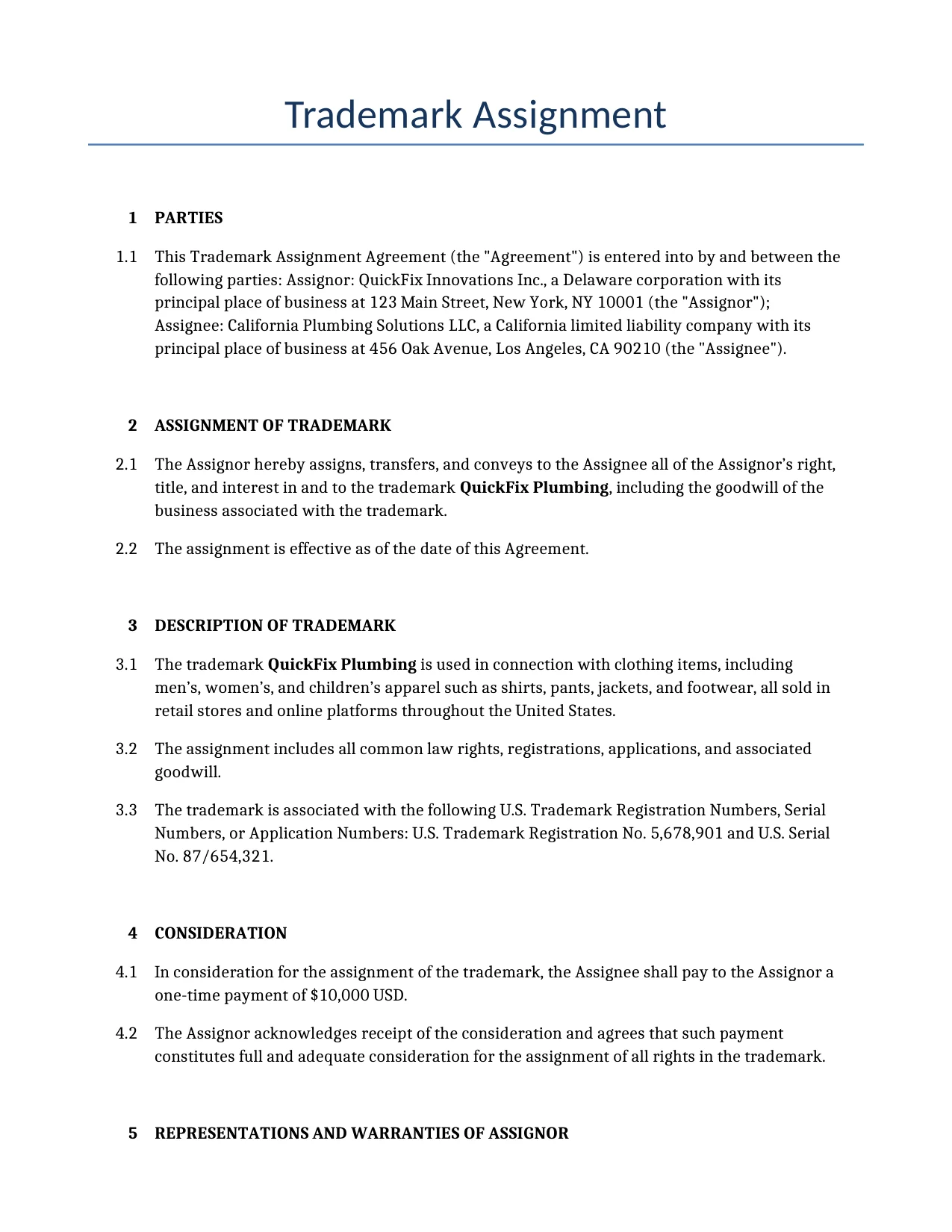
Generate a legally compliant American trademark assignment document effortlessly with our AI-powered tool, ensuring seamless transfer of trademark rights and ownership in the United States.
Free instant document creation.
Legally compliant agreements.
No signup required.
Generate your document for free.
Download PDF, Word and email for $9.99 USD.
When Do You Need a Trademark Assignment in the United States?
Selling Your Brand
You need a trademark assignment when selling your brand's name, logo, or slogan to another business to officially transfer ownership.
Transferring Within Your Company
It's required when moving trademark rights from one part of your company to another, like from a subsidiary to the parent company.
Gifting or Inheriting Trademarks
Use it to legally pass trademarks to family members or heirs upon gifting or after someone's passing.
Mergers and Acquisitions
During business mergers or buyouts, an assignment ensures the trademarks go to the new owner without disputes.
Why a Well-Drafted Document Matters
A properly prepared assignment protects your interests by clearly defining the transfer, preventing future legal challenges and ensuring smooth registration with authorities.
American Legal Rules for a Trademark Assignment
What It Is
A trademark assignment transfers ownership of a trademark from one party to another, including all rights to use and enforce it.
Requirements for Validity
The assignment must be in writing and signed by the current owner to be legally binding.
Include Goodwill
The transfer should include the goodwill associated with the trademark to ensure the mark retains its value and recognition.
Federal Registration
If the trademark is federally registered, record the assignment with the U.S. Patent and Trademark Office to update official ownership.
State Considerations
Check state laws where the trademark is used, as some may require additional filings for full protection.
No Automatic Protection
An assignment does not guarantee the trademark's validity; the mark must still meet basic legal standards like distinctiveness.
Important
Using the wrong structure for a trademark assignment can fail to properly transfer ownership rights and expose parties to disputes.
What a Proper Trademark Assignment Should Include
Parties Involved
Clearly identify the person or company giving up the trademark and the one receiving it.
Trademark Details
List the exact trademark name, registration number, and any related goods or services it covers.
Transfer of Rights
State that all ownership rights, including the ability to use and enforce the trademark, are fully handed over.
Payment Terms
Specify any money or value exchanged for the trademark, if applicable.
Warranties and Promises
Confirm that the seller owns the trademark without any legal issues and has the right to transfer it.
Date and Signatures
Include the effective date of the transfer and require signatures from both parties to make it official.
Why Free Templates Can Be Risky for Trademark Assignment
Generic trademark assignment templates often fail to address specific details like the exact trademarks involved, jurisdictional requirements, or unique assignment terms. This can lead to incomplete transfers, disputes over ownership, or unenforceable agreements that expose you to legal challenges.
AI-generated bespoke trademark assignment documents are customized to your precise situation, incorporating all necessary details, compliant language, and tailored clauses to ensure a secure, valid transfer of rights without the pitfalls of one-size-fits-all templates.
Generate Your Bespoke Trademark Assignment in 4 Easy Steps
1
Answer a Few Questions
Our AI guides you through the info required.
2
Generate Your Document
Docaro builds a bespoke document tailored specifically on your requirements.
3
Review & Edit
Review your document and submit any further requested changes.
4
Download & Sign
Download your ready to sign document as a PDF, Word, Txt or HTML.
Why Use Our AI Trademark Assignment Generator?
Fast Generation
Quickly generate a comprehensive Trademark Assignment, eliminating the hassle and time associated with traditional document drafting.
Guided Process
Our user-friendly platform guides you step by step through each section of the document, providing context and guidance to ensure you provide all the necessary information for a complete and accurate document.
Safer Than Legal Templates
We never use legal templates. All documents are generated from first principles clause by clause, ensuring that your document is bespoke and tailored specifically to the information you provide. This results in a much safer and more accurate document than any legal template could provide.
Professionally Formatted
Your Trademark Assignment will be formatted to professional standards, including headings, clause numbers and structured layout. No further editing is required. Download your document in PDF or Word.
Compliance with American Law
Rest assured that all generated documents meet the latest legal standards and regulations of the United States, enhancing trust and reliability.
Cost-Effective
Save money by generating legally sound tenancy agreements without the need for expensive legal services or consultations.
Get Started for Free - No Sign Up Required
No payment or sign up is required to start generating your Trademark Assignment. Simply answer a few questions and a preview of your final document will be generated.
Looking to Generate a Trademark Assignment in a Different Country?
Choose country:
United States
Useful Resources When Considering a Trademark Assignment
The primary federal law governing trademarks in the United States, including provisions for the assignment of trademarks under Section 10, which allows for the transfer of ownership of registered trademarks along with the goodwill of the business.
Specific section of the Lanham Act that outlines the conditions and requirements for assigning a trademark, including that assignments must be in writing and recorded with the USPTO to provide constructive notice.
Regulations governing the recording of assignments and other documents with the United States Patent and Trademark Office (USPTO), including requirements for trademark assignment documents.
Applies to the assignment of trademarks as intellectual property security interests; governs secured transactions and requires filing of UCC financing statements for assignments involving security interests (varies by state, e.g., Uniform version).
Generate Your Bespoke Trademark Assignment Now
What is a Trademark Assignment in the United States?
A trademark assignment is a legal agreement that transfers ownership rights of a registered trademark from one party, known as the assignor, to another party, the assignee. This process ensures that the assignee gains full control over the trademark's use, protection, and enforcement in commerce.
The primary purpose of a trademark assignment is to facilitate business transactions such as mergers, acquisitions, or sales, allowing the trademark's value to be preserved and utilized by the new owner. Under US law, specifically the Lanham Act, assignments must include the goodwill associated with the trademark to remain valid, preventing assignments in gross that could dilute the mark's distinctiveness.
To execute a trademark assignment, the parties draft and sign a written document detailing the transfer terms, followed by recording it with the United States Patent and Trademark Office (USPTO) to update public records. The USPTO's role is crucial as it maintains the official trademark register, ensuring the assignment's public notice and legal recognition; for official guidance, visit the USPTO trademark assignment page.
For creating customized trademark assignment documents, consider using bespoke AI-generated legal options through Docaro to tailor to specific needs, rather than relying on generic forms.
When Should You Use a Trademark Assignment Document?
A trademark assignment document is essential in business sales where a company transfers ownership of its trademarks to the buyer as part of the overall asset sale, ensuring the new owner gains full rights to use and enforce the marks. Similarly, during mergers and acquisitions, such documents facilitate the seamless transfer of intellectual property, preventing disputes over brand usage post-transaction.
In scenarios involving gifting trademarks, a trademark assignment is appropriate when an individual or entity wishes to donate or bequeath trademark rights to another party, such as in estate planning or charitable contributions, clearly documenting the voluntary transfer without compensation.
However, a trademark assignment should not be used for licensing agreements, where the owner retains ownership and merely grants temporary permission to use the mark, as this requires a separate licensing contract instead of a full transfer. It is also inappropriate for unregistered trademarks, since assignments typically apply to federally registered marks; for common law rights, other agreements may be needed, and consulting authoritative sources like the USPTO trademark process is recommended.
For any trademark transfer needs, opt for bespoke AI-generated legal documents using Docaro to ensure they are tailored precisely to your situation, rather than relying on generic forms that may overlook key details.
"Proper execution of trademark assignments is essential to ensure validity and enforceability, as incomplete or improperly recorded transfers can render the assignment void under 15 U.S.C. § 1060." - Legal expert commentary on the Lanham Act.
To safeguard your intellectual property, consult a qualified attorney and utilize bespoke AI-generated legal documents through Docaro for tailored trademark assignments.
What Are the Key Rights and Obligations of Parties in a Trademark Assignment?
In a trademark assignment, the assignor transfers key rights to the assignee, including ownership of the trademark and the exclusive right to use it in commerce. This transfer also includes enforcement rights, allowing the assignee to sue for infringement and protect the mark's integrity under U.S. law.
The assignee assumes obligations such as ensuring the continued use of the trademark to maintain its validity and prevent abandonment. Failure to use the mark can result in challenges to its registrability, as outlined by the United States Patent and Trademark Office (USPTO).
The assignor must provide clear title to the trademark, warranting no prior encumbrances or disputes that could invalidate the transfer. This duty ensures the assignee receives unclouded ownership, free from third-party claims.
The assignee is responsible for recording the assignment with the USPTO within three months to establish public notice and priority against subsequent purchasers. Recording is crucial for legal protection, as detailed in the USPTO's assignment guidelines, and for bespoke AI-generated legal documents, consider using Docaro to customize agreements precisely.
What Key Clauses Must Be Included in a Trademark Assignment Agreement?
A trademark assignment document is a critical legal tool for transferring ownership of trademarks in the United States, ensuring clear rights transfer under the Lanham Act. Essential clauses protect both parties and facilitate proper recording with the United States Patent and Trademark Office (USPTO).
The assignment clause explicitly states the transfer of all rights, title, and interest in the specified trademarks from the assignor to the assignee, including any associated goodwill. Its purpose is to clearly define the scope of the transfer, preventing future disputes over what intellectual property is being conveyed.
The consideration clause outlines the payment or value exchanged for the assignment, such as a monetary amount or other benefits. This clause ensures the transfer is a valid, enforceable contract by demonstrating mutual exchange, as required for legal recognition in U.S. courts.
Warranties of ownership require the assignor to affirm that they hold clear title to the trademarks, free from liens or encumbrances, and have the authority to assign them. This provision protects the assignee by providing assurances against third-party claims and potential invalidation of the assignment.
The recording provisions detail the steps for filing the assignment with the USPTO to provide public notice and legal effect against subsequent purchasers. Recording is essential for maintaining priority of the trademark rights, as outlined in USPTO guidelines, and helps prevent challenges to the assignee's ownership.
For customized trademark assignment agreements, consider using bespoke AI-generated legal documents through Docaro to tailor clauses precisely to your needs, ensuring compliance with U.S. trademark law.
How Do Warranties and Representations Protect the Parties?
In trademark assignments, warranties play a crucial role by providing assurances from the assignor to the assignee regarding the mark's status and ownership. These include guarantees of valid registration with the United States Patent and Trademark Office (USPTO) and confirmation that the trademark is free from any encumbrances like liens or prior claims.
Such warranties mitigate risks for the assignee by protecting against potential legal disputes or financial losses that could arise from undisclosed issues. For instance, a warranty against encumbrances ensures the assignee receives clear title, reducing the chance of third-party challenges to the trademark's use.
To further safeguard interests, assignees should insist on comprehensive warranties in assignment agreements, ideally crafted as bespoke AI-generated legal documents using Docaro for precision tailored to specific needs. For authoritative guidance, refer to the USPTO trademark process overview.
Are There Any Key Exclusions or Limitations in Trademark Assignments?
In trademark assignments, a key exclusion is the non-transfer of goodwill if not properly handled, as goodwill must explicitly transfer alongside the mark to avoid invalidating the assignment. Failing to include this can lead to challenges under U.S. law, emphasizing the need for comprehensive documentation in bespoke AI-generated legal documents using Docaro.
Limitations on international trademarks arise because U.S. assignments typically do not cover foreign registrations, requiring separate filings in each jurisdiction. For guidance, consult the United States Patent and Trademark Office on domestic protections.
Exclusions for pending applications without intent to use mean that assignments of intent-to-use applications must include the bona fide intent and any specimens if filed, or they risk rejection. This underscores the importance of tailored agreements via Docaro to ensure compliance with U.S. trademark requirements.
What Recent or Upcoming Legal Changes Affect Trademark Assignments?
The Trademark Modernization Act (TMA) of 2020 continues to shape trademark assignments by introducing stricter requirements for proving use in commerce, impacting how assignments are recorded and verified at the USPTO. This act eliminates the need for a "specimen of use" in certain oppositions but reinforces the importance of accurate assignment documentation to avoid challenges based on non-use.
Recent USPTO rule changes effective in 2023 have enhanced electronic filing requirements for trademark assignments, mandating the use of the Trademark Electronic Application System (TEAS) for all submissions to streamline processing and reduce errors. These updates emphasize digital signatures and electronic acknowledgments, making paper filings obsolete for most transactions.
A key court decision from the Federal Circuit in 2022 upheld the validity of trademark assignments only when they include explicit intent to transfer goodwill, as seen in cases like Spin Master Ltd. v. OUV, reinforcing protections against invalid transfers.
Overall, trademark law in the United States remains stable with no major overhauls since the TMA, allowing practitioners to rely on established procedures while adapting to digital efficiencies. For custom legal documents related to assignments, consider bespoke AI-generated options through Docaro.
How Can You Get Started with Preparing a Trademark Assignment Document?
1
Consult a Lawyer
Schedule a consultation with an intellectual property lawyer to discuss the trademark assignment and receive personalized legal advice.
2
Gather Trademark Details
Collect essential information including the trademark registration number, owner details, and assignment terms for accurate documentation.
3
Draft the Agreement
Use Docaro to generate a bespoke trademark assignment agreement tailored to your specific needs and circumstances.
4
Plan USPTO Filing
Review the drafted agreement with your lawyer and prepare required documents for submission to the United States Patent and Trademark Office.
What Are Common Pitfalls to Avoid in Trademark Assignments?
One of the most frequent errors in trademark assignments is failing to record the assignment with the United States Patent and Trademark Office (USPTO), which can lead to loss of priority rights and potential disputes. Without proper recording, the public record does not reflect the ownership change, exposing the assignee to challenges from third parties.
Incomplete transfers of goodwill associated with the trademark represent another common pitfall, as trademarks cannot be assigned without this essential element, rendering the transfer invalid under US law. For authoritative guidance, refer to the USPTO's official page on transferring trademark ownership.
Other errors include omitting key details like the effective date or signatures in the assignment document, which can invalidate the entire process. For more details, see Common Mistakes to Avoid in US Trademark Assignments.
To ensure accuracy, consider using bespoke AI-generated legal documents through Docaro, tailored specifically to your trademark assignment needs in the United States.
How Do You File a Trademark Assignment with the USPTO?
Filing a trademark assignment with the United States Patent and Trademark Office (USPTO) transfers ownership of a registered trademark from one party to another. This process ensures legal recognition of the change and protects intellectual property rights in the United States.
To begin, prepare the required Electronic Trademark Assignment System (ETAS) form available on the USPTO website. The filing fee is currently $40 for recording each trademark assignment, though additional fees may apply for multiple marks or corrections; always verify the latest fees on the official site.
Ensure the assignment document is signed and includes all necessary details like mark serial or registration numbers.
Submit electronically via ETAS for faster processing, typically within a few business days.
Consider using bespoke AI-generated legal documents through Docaro for customized assignments tailored to your needs.
Where Can You Learn More About Trademark Assignment Agreements?
Trademark assignment agreements in the US represent a critical legal mechanism for transferring ownership of trademark rights from one party to another, ensuring that the assignee gains full control over the mark's use and enforcement. These agreements must be meticulously drafted to include essential elements like the identification of the trademark, consideration, and warranties to prevent future disputes.
Deeper insights reveal that proper execution requires recording the assignment with the United States Patent and Trademark Office (USPTO) to maintain the mark's validity and provide public notice, as outlined in the Lanham Act. For authoritative guidance, refer to the USPTO's official page on trademark assignments.
Ensure the agreement specifies any associated goodwill to comply with US trademark law, avoiding invalid transfers.
Consult bespoke AI-generated legal documents via Docaro for tailored agreements that meet specific needs.
A trademark assignment is a legal document that transfers ownership of a trademark from one party (the assignor) to another (the assignee). This agreement is essential in the United States for ensuring clear ownership rights and is governed by federal trademark laws under the U.S. Patent and Trademark Office (USPTO).
A trademark assignment agreement protects both parties by formally documenting the transfer of trademark rights, including the mark itself, associated goodwill, and any related applications or registrations. It prevents disputes over ownership and is required for USPTO recordation to maintain the trademark's validity.
Key elements of a U.S. trademark assignment include the parties' details, a clear description of the trademark(s) being assigned, the effective date, consideration (payment or value exchanged), warranties of ownership, and signatures. It must comply with USPTO requirements for proper execution and notarization if needed.
To record a trademark assignment with the USPTO, submit the executed assignment document electronically via the USPTO's Assignment Center, along with the required filing fee (currently $40 per trademark for paper filings or $100 for electronic). Recordation provides public notice of the transfer and is crucial for legal protection.
No, a trademark assignment transfers full ownership of the trademark permanently, whereas a trademark license grants temporary permission to use the mark without transferring ownership. Assignments are used for sales or mergers, while licenses are for partnerships or franchising.
For validity, the assignment must be in writing, signed by the assignor, include the intent to transfer ownership, and cover the trademark along with its goodwill. Under 15 U.S.C. § 1060, it must not be a mere 'assignment in gross' without goodwill to avoid invalidation.
Yes, AI tools can generate customizable trademark assignment templates based on your inputs, but always have it reviewed by a licensed attorney to ensure compliance with U.S. law and your specific circumstances. AI-generated documents are a starting point, not a substitute for legal advice.
Assigning a registered trademark requires USPTO recordation to update the registration, while an unregistered (common law) trademark assignment relies on the written agreement alone for transfer. Both need to include goodwill for enforceability under U.S. trademark law.
Costs vary: AI generation is often free or low-cost on platforms, legal review might add $200–$500, and USPTO recording fees are $40–$100 per mark. Total expenses depend on complexity and whether you hire an attorney.
Failing to record the assignment with the USPTO means the public record still shows the original owner, potentially leading to challenges in enforcing rights against third parties. While the assignment is valid between parties, recordation (within three months for priority) protects against bona fide purchasers.
Once executed and recorded, a trademark assignment is generally irrevocable unless there's fraud, mistake, or breach of contract. Revocation requires court intervention, and assignments should include clauses addressing contingencies like bankruptcy.
While not always required, consulting a U.S. trademark attorney is recommended to ensure the document meets legal standards, avoids errors, and includes protective provisions. For simple transfers, AI-generated forms can suffice with review.
Electronic filings via the USPTO Assignment Center are typically processed in 1–2 weeks, while paper submissions may take 2–3 months. Processing time can vary based on volume and completeness of the submission.
Goodwill refers to the reputation and value associated with the trademark in commerce. U.S. law requires assignments to include goodwill to prevent 'naked' assignments, ensuring the mark continues to represent the same quality and source.
Yes, you can assign specific trademarks or applications from a portfolio, but the agreement must clearly identify them. Partial assignments are common in business sales and must still include associated goodwill for those marks.
Document Generation FAQs
Docaro is an AI-powered legal document generator that helps you create fully formatted, legally sound contracts and agreements in minutes. Just answer a few guided questions and download your document instantly.
Yes. All documents generated by Docaro are based on standard legal frameworks and current American law. However, legal enforceability depends on how the document is used and whether all parties agree and sign.
Yes. Our AI model analyses American legislation and regulations to ensure that the documents are compliant with current laws.
Yes. You can start generating your Trademark Assignment for free without any sign up or payment. Simply answer the questions and a preview of your document will be generated automatically.
Absolutely. You can download your completed document in Word (.docx), PDF, Text and HTML formats and edit it as needed.
No, you do not need a lawyer to use Docaro. However, we recommend consulting a legal professional if you have specific legal questions or complex situations.
Yes. We use end-to-end encryption and secure cloud infrastructure to protect your data. We do not share or sell your information with third parties.
Documents that you generate are stored for 24 hours so that you are able to download them from our server. After this time your document is permanently deleted from our server.
Yes. Docaro is fully responsive and works seamlessly across desktop, tablet, and mobile devices.
No, we do not use any templates. Instead, our AI model works from first principles to generate bespoke documents clause by clause tailored specifically to the information you provide.
Full unlimited download and usage of any document costs only $9.99 USD.
No, there are no subscription costs or charges. Pay once for your full document and use it forever.
Explore the essentials of trademark assignment agreements in the US. Learn what they are, how they work, legal requirements, and tips for drafting enforceable contracts.
Learn how to file a trademark assignment with the USPTO in this comprehensive step-by-step guide. Understand the process, requirements, fees, and tips for successful transfer of trademark ownership.
Discover the most common mistakes in US trademark assignments and learn how to avoid them to protect your brand. Essential tips for successful transfers.