
AI Generated Safeguarding Policy for use in the United States
PDF & Word - 2026 Updated
Docaro Pricing
When Do You Need a Safeguarding Policy in the United States?
American Legal Rules for a Safeguarding Policy
Using an inappropriate structure for safeguarding policies may fail to adequately protect vulnerable individuals or comply with regulatory standards.
What a Proper Safeguarding Policy Should Include
- Purpose StatementClearly explain the policy's goal to protect children, vulnerable adults, or others from harm and abuse.
- Scope and CoverageDefine who the policy applies to, such as staff, volunteers, and the types of activities or locations involved.
- Key DefinitionsProvide simple explanations of terms like safeguarding, abuse, and neglect to ensure everyone understands them.
- Roles and ResponsibilitiesOutline the duties of leaders, staff, and participants in identifying and preventing risks.
- Reporting ProceduresDescribe how to report concerns or incidents of harm quickly and safely to the right people.
- Training RequirementsSpecify the need for regular training on recognizing and responding to safeguarding issues.
- Safe Recruitment PracticesDetail steps for checking backgrounds and qualifications of anyone working with vulnerable groups.
- Risk ManagementIdentify potential dangers and outline steps to reduce them in daily operations.
- Incident ResponseExplain how to handle reports of harm, including support for those affected and follow-up actions.
- Review and MonitoringSet out how often the policy will be checked and updated to stay effective.
Generate Your Document in 4 Easy Steps
Why Use Docaro?
 United States
Free Example Safeguarding Policy Template
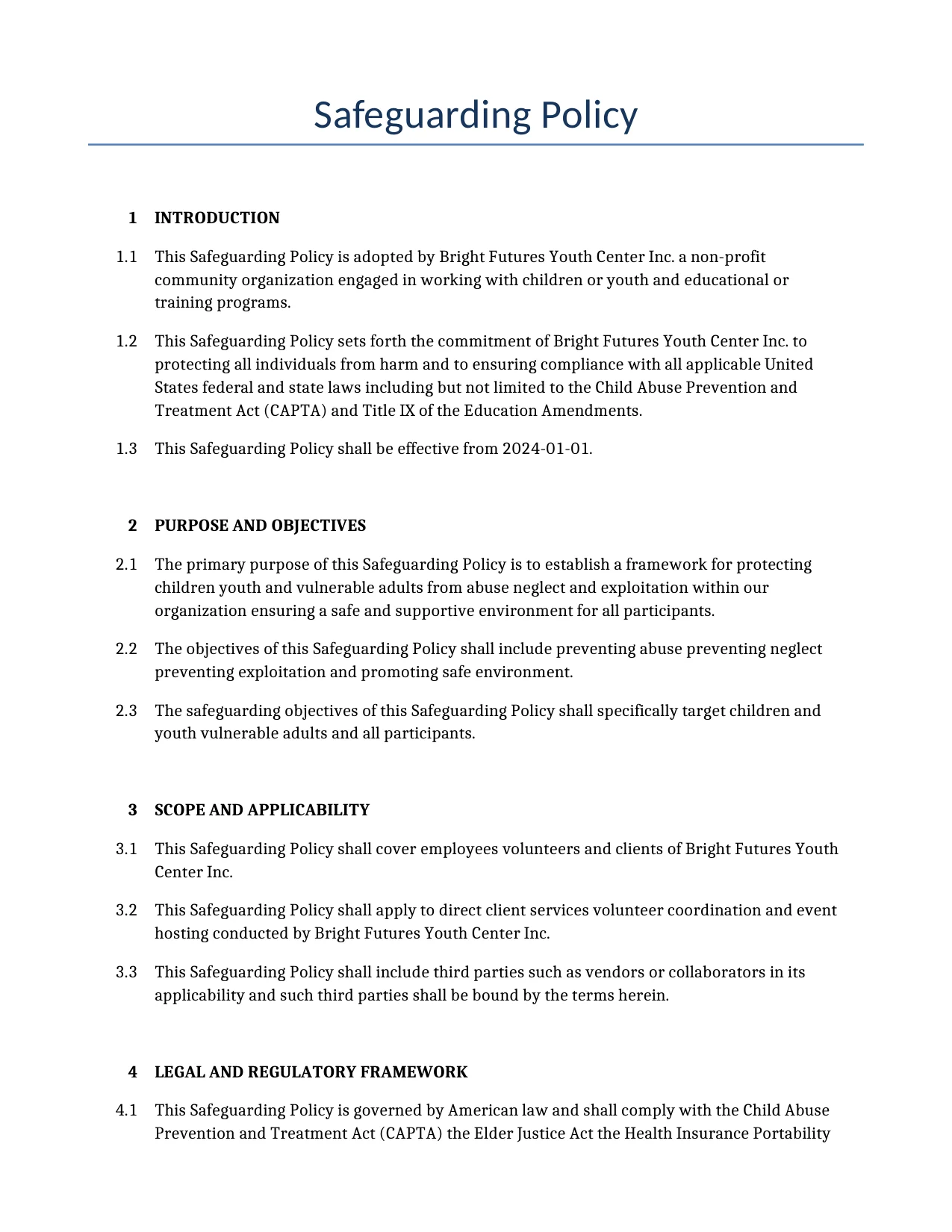
Below is a free template example of a Safeguarding Policy for use in the United States generated by our AI model.
The clauses in your actual Safeguarding Policy will vary from this example as they will be entirely bespoke to your requirements as set out in the questionnaire you complete.
Safeguarding Policy
1INTRODUCTION
This Safeguarding Policy is adopted by Bright Futures Youth Center Inc. a non-profit community organization engaged in working with children or youth and educational or training programs.
This Safeguarding Policy sets forth the commitment of Bright Futures Youth Center Inc. to protecting all individuals from harm and to ensuring compliance with all applicable United States federal and state laws including but not limited to the Child Abuse Prevention and Treatment Act (CAPTA) and Title IX of the Education Amendments.
This Safeguarding Policy shall be effective from 2024-01-01.
2PURPOSE AND OBJECTIVES
The primary purpose of this Safeguarding Policy is to establish a framework for protecting children youth and vulnerable adults from abuse neglect and exploitation within our organization ensuring a safe and supportive environment for all participants.
The objectives of this Safeguarding Policy shall include preventing abuse preventing neglect preventing exploitation and promoting safe environment.
The safeguarding objectives of this Safeguarding Policy shall specifically target children and youth vulnerable adults and all participants.
3SCOPE AND APPLICABILITY
This Safeguarding Policy shall cover employees volunteers and clients of Bright Futures Youth Center Inc.
This Safeguarding Policy shall apply to direct client services volunteer coordination and event hosting conducted by Bright Futures Youth Center Inc.
This Safeguarding Policy shall include third parties such as vendors or collaborators in its applicability and such third parties shall be bound by the terms herein.
4LEGAL AND REGULATORY FRAMEWORK
This Safeguarding Policy is governed by American law and shall comply with the Child Abuse Prevention and Treatment Act (CAPTA) the Elder Justice Act the Health Insurance Portability and Accountability Act (HIPAA) State Child Abuse Reporting Laws and State Elder Abuse Statutes.
This Safeguarding Policy shall also comply with the Family Educational Rights and Privacy Act (FERPA) and the Individuals with Disabilities Education Act (IDEA).
The Legal and Regulatory Framework section of this Safeguarding Policy shall be reviewed and updated by 2025-12-31 to account for any changes in applicable laws.
5DEFINITIONS
Abuse is defined as any intentional act or failure to act by a caregiver or authority figure that results in harm potential harm or threat of harm to a vulnerable individual including physical emotional sexual or financial exploitation.
Neglect refers to the failure to provide necessary care supervision or support to a vulnerable person leading to potential or actual harm such as inadequate food shelter medical care or emotional support.
Vulnerability is the state of being at greater risk of harm or exploitation due to factors such as age disability mental health issues or dependency on others for care and support.
Mandatory Reporting is the legal obligation of certain individuals such as professionals working with vulnerable populations to report suspected cases of abuse or neglect to the appropriate authorities without delay.
The vulnerable groups explicitly included in this Safeguarding Policy shall be children under 18 elderly individuals over 65 persons with disabilities and individuals with mental health conditions.
6ORGANIZATIONAL COMMITMENT TO ZERO TOLERANCE
Bright Futures Youth Center Inc. maintains a zero-tolerance policy toward any form of abuse neglect exploitation or misconduct. We are committed to creating a safe environment where all children youth and vulnerable adults are protected and respected. This commitment extends to preventing grooming peer-on-peer abuse and all forms of harm through proactive measures education and accountability.
7CODE OF CONDUCT FOR STAFF AND VOLUNTEERS
All staff volunteers and board members must adhere to the following code of conduct: Maintain professional boundaries at all times; Never engage in physical contact that could be misinterpreted; Avoid private communications with minors outside of program activities including via social media; Report any concerns about boundary violations immediately; Serve as positive role models and prioritize the welfare of participants above all else. Violations of this code will result in disciplinary action up to and including termination.
8ROLES AND RESPONSIBILITIES
The leadership team of Bright Futures Youth Center Inc. shall develop and approve the safeguarding policy allocate necessary resources including budget and personnel ensure all staff receive appropriate training monitor policy compliance through regular audits and lead by example in promoting a culture of safety.
Board members of Bright Futures Youth Center Inc. shall be required to complete annual safeguarding training.
Staff members of Bright Futures Youth Center Inc. shall have reporting obligations regarding safeguarding incidents that include an immediate verbal report to supervisor a written incident report within 24 hours and a direct report to external authorities if required.
The vetting process for external partners involved in safeguarding implementation shall require that all external partners must undergo background checks including criminal record verification and reference checks sign a code of conduct agreement and complete initial safeguarding training before engagement.
Board members of Bright Futures Youth Center Inc. shall assume oversight roles that include approving the annual safeguarding budget reviewing incident reports quarterly and appointing the safeguarding committee chair.
Staff of Bright Futures Youth Center Inc. shall receive safeguarding training annually with additional sessions required after any major policy updates or incidents.
External partners shall be contractually bound by this Safeguarding Policy.
Jane Doe Director of Compliance is designated as the Risk Assessment Coordinator responsible for overseeing the identification and assessment of safeguarding risks.
Dr. Jane Smith is designated as the Safeguarding Lead (also referred to as Safeguarding Coordinator or Designated Safeguarding Officer). The Safeguarding Lead has clear authority to oversee all safeguarding matters receive and manage reports initiate investigations coordinate with external agencies ensure compliance with laws and report directly to the Board on safeguarding issues. The Safeguarding Lead shall have dedicated time and resources to fulfill these duties and shall not be subject to conflicts of interest in performing this role.
All staff and volunteers shall receive ongoing supervision and performance management related to safeguarding including regular check-ins discussion of safeguarding scenarios and integration of safeguarding into annual performance reviews.
A formal complaints procedure is established for reporting violations of this policy by staff or volunteers. Complaints may be made to the Safeguarding Lead or via the anonymous hotline. All complaints will be acknowledged within 24 hours investigated impartially within 14 days and outcomes communicated to the complainant where appropriate. Retaliation against complainants is strictly prohibited.
9RISK ASSESSMENT AND MANAGEMENT
Bright Futures Youth Center Inc. shall conduct an annual risk assessment for safeguarding purposes.
Bright Futures Youth Center Inc. shall use staff surveys incident reviews and external audits for identifying safeguarding risks in operations.
The step-by-step procedure for assessing the severity and likelihood of identified safeguarding risks shall be as follows identify the risk and gather relevant data from reports and surveys evaluate the likelihood of the risk occurring on a scale of low medium or high based on historical data assess the potential severity of impact considering factors like financial loss reputational damage or harm to individuals assign a risk score by multiplying likelihood and severity ratings prioritize risks with higher scores for immediate action and document the assessment and review it with the management team.
Bright Futures Youth Center Inc. shall implement employee training programs background checks and supervision protocols for addressing identified safeguarding risks.
Bright Futures Youth Center Inc. shall include procedures for assessing risks from third-party vendors or partners in this Safeguarding Policy.
Risks shall be reported internally within Bright Futures Youth Center Inc. through a confidential internal hotline available 24/7 or via an anonymous online form on the organization’s intranet and employees can also report directly to their supervisor or the safeguarding officer and all reports will be logged and investigated promptly within 48 hours.
The Risk Assessment and Management section of this Safeguarding Policy shall be reviewed and updated by 2025-12-31.
Specific risks related to online safety digital risks grooming peer-on-peer abuse and technology use (including social media) shall be assessed and mitigated. This includes evaluation of program activities involving internet access devices and virtual interactions.
10SAFE RECRUITMENT AND VETTING
Bright Futures Youth Center Inc. serves children under 18 and persons with disabilities.
Bright Futures Youth Center Inc. shall require criminal background checks for all personnel working with vulnerable populations.
The recruitment process of Bright Futures Youth Center Inc. shall include national criminal history and sex offender registry search as types of background checks.
Bright Futures Youth Center Inc. shall require verification of 3 professional references for each candidate.
Bright Futures Youth Center Inc. shall require reference checks for all hires including volunteers interacting with vulnerable populations.
Bright Futures Youth Center Inc. shall prohibit employment for individuals with convictions related to abuse or violence.
Bright Futures Youth Center Inc. shall renew background checks and vetting for existing personnel every 2 years.
For roles involving direct contact with minors or vulnerable adults background checks shall include FBI fingerprint-based checks where required by state or federal law (e.g. under the Adam Walsh Child Protection and Safety Act). Ongoing supervision performance management and periodic re-vetting shall be integrated into safeguarding practices. International staff or volunteers (if applicable) shall undergo equivalent vetting including checks from countries of residence.
11TRAINING AND AWARENESS
Bright Futures Youth Center Inc. shall require mandatory safeguarding training for all staff members and for volunteers.
The mandatory training shall occur upon hiring and annually.
The National Center for Missing & Exploited Children (NCMEC) is designated as the provider of the mandatory safeguarding training programs.
The mandatory training programs shall be implemented from 2024-01-01.
The training shall include specific modules on recognition of abuse and neglect shall cover reporting obligations under applicable laws and shall address best practices for preventing and responding to safeguarding incidents.
The delivery method for the mandatory training programs shall be online modules and a hybrid approach.
The initial mandatory training program shall last 4 hours.
Bright Futures Youth Center Inc. shall require annual refresher training for ongoing awareness.
Training shall include detailed content on US federal laws (CAPTA reauthorization requirements Title IX FERPA HIPAA Elder Justice Act Adam Walsh Child Protection and Safety Act) state-specific mandatory reporting (e.g. California Penal Code 11165.7 or New York Social Services Law), working with minors in educational settings online safety digital risks grooming prevention peer-on-peer abuse whistleblower protections and anti-retaliation. Training shall be documented with attendance records and competency assessments. Content shall be reviewed annually for compliance and effectiveness.
12REPORTING MECHANISMS
The email address designated for receiving reports of suspected or actual safeguarding concerns shall be safeguarding@company.com.
The phone number provided for verbal reporting of safeguarding concerns shall be (555) 123-4567.
Anonymous reporting of safeguarding concerns shall be allowed.
The HR Manager and Safeguarding Coordinator are designated for handling safeguarding reports.
Reports shall be acknowledged upon receipt within 24 hours.
The step-by-step procedure for submitting a safeguarding report shall be to identify the safeguarding concern to contact the designated email or phone number to provide details of the incident if anonymous no personal information is required and to await acknowledgment within the specified timeline.
This policy includes explicit whistleblower protections and anti-retaliation clauses. No individual shall suffer adverse action for making a good-faith report of suspected abuse or policy violation. Retaliation is a serious violation subject to disciplinary action including termination. Reports of retaliation will be investigated independently.
Detailed consent procedures for information sharing shall be followed where legally permitted including obtaining written consent when not overridden by mandatory reporting obligations documenting consent and limiting sharing to necessary information under FERPA HIPAA and state laws. Cross-jurisdictional reporting protocols (e.g. if abuse occurs involving parties in different states like California and New York) shall reference applicable interstate laws and notify authorities in all relevant jurisdictions.
13INVESTIGATION PROCEDURES
This section outlines the procedures for investigating safeguarding incidents to ensure a fair thorough and confidential process.
Initial reporting of safeguarding incidents shall be allowed by hotline email or online form.
The Safeguarding Officer is designated as the primary investigator for safeguarding incidents.
Investigator training and conflict of interest disclosure shall be implemented to ensure impartiality during investigations.
All information will be kept strictly confidential shared only on a need-to-know basis and stored securely in compliance with data protection laws as the protocols for maintaining confidentiality in safeguarding investigations.
Investigations shall be completed within 30 days from the date of report.
Witness statements evidence logs and interview notes shall be required as types of documentation during the investigation process.
Relevant authorities shall be notified for all safeguarding incidents.
Local law enforcement Child Protective Services and State Department of Social Services are the specific authorities listed for coordination in this Safeguarding Policy.
The steps for concluding an investigation shall be to prepare a final report of findings to notify leadership to implement recommended actions and to follow up on any support needs for involved parties.
Accused individuals shall be subject to immediate suspension during investigations.
Procedures for handling false allegations are included: Allegations found to be intentionally false shall be documented and may result in disciplinary action against the reporter if they are within the organization. Support shall be provided to those falsely accused including reinstatement where applicable and counseling. All investigations shall presume good faith unless evidence demonstrates otherwise.
Investigation timelines shall align with CAPTA and state requirements (e.g. immediate reporting with follow-up investigations not exceeding 60 days in most states). Detailed logs data breach response plans (in compliance with state laws such as California’s CCPA) and references to the Adam Walsh Child Protection and Safety Act shall be incorporated. Non-compliant areas such as vague definitions have been clarified in Section 5.
14RESPONSE AND SUPPORT
The immediate removal of accused staff or volunteers from contact with vulnerable individuals shall be required.
Bright Futures Youth Center Inc. shall report safeguarding incidents immediately to Local Child Protective Services and Law Enforcement.
Counseling and therapy and legal aid referral shall be provided as support services to victims during investigations.
Jane Doe Safeguarding Coordinator is designated as the primary contact person for providing support to victims.
The maximum number of days set for completing internal investigations shall be 30.
Victim support and aftercare protocols shall extend beyond initial response to include long-term counseling trauma-informed care family support linkage to community resources and follow-up at 30 90 and 180 days post-incident. Crisis management and media response plans shall be activated for serious incidents including designated spokespersons scripted responses and coordination with legal counsel to protect privacy and organizational liability.
15CONFIDENTIALITY AND INFORMATION SHARING
Bright Futures Youth Center Inc. is an educational institution subject to the Family Educational Rights and Privacy Act (FERPA) and handles student education records and personal identifiable information that require confidentiality protections.
Bright Futures Youth Center Inc. has mandatory reporting obligations for child abuse or neglect under state laws.
The protocols for sharing information with third parties shall require written consent secure transmission methods and audit and logging.
The confidentiality guidelines shall be reviewed next by 2025-12-31.
In addition to the Family Educational Rights and Privacy Act (FERPA) the Children’s Online Privacy Protection Act (COPPA) and state-specific data breach notification laws like California’s CCPA apply to Bright Futures Youth Center Inc. in handling sensitive information.
Precise legal definitions are aligned with federal and state statutes (e.g. abuse as defined in CAPTA and state codes). Protocols for cross-jurisdictional reporting are addressed in Section 12.8. While GDPR does not apply in the US data protection equivalents under state laws (e.g. CCPA in California) are followed for operations across states. Record retention policies comply with state laws (e.g. minimum 7 years or longer per California or New York requirements for child abuse records).
16MONITORING AND AUDITING
A regular review of this Safeguarding Policy shall be established.
The regular policy reviews shall occur annually and the next policy review shall be set for 2024-12-31.
Bright Futures Youth Center Inc. shall conduct internal audits of this Safeguarding Policy quarterly.
External auditors shall be engaged for independent reviews of this Safeguarding Policy.
Procedures for evaluating the overall effectiveness of this Safeguarding Policy shall be included and the method for evaluating policy effectiveness shall be incident rate analysis staff feedback surveys and compliance metrics review.
Dr. Emily Carter the Compliance Officer is designated as the responsible person for overseeing monitoring and auditing.
Documentation of all audit findings and corrective actions shall be required.
17DISCIPLINARY ACTIONS
Internal sanctions referral to law enforcement and termination of employment shall be consequences for violations of this Safeguarding Policy and termination of employment will apply in cases of severe violations such as confirmed child abuse or repeated failure to report incidents.
A progressive discipline approach shall be implemented for internal sanctions with steps outlined.
Reporting to law enforcement shall be mandatory for all criminal violations under this Safeguarding Policy.
The procedure for referring violations to law enforcement involves immediately notifying the designated safeguarding officer who will assess the violation and contact local law enforcement within 24 hours if it constitutes a criminal act followed by documentation in the organization’s records.
The disciplinary actions shall primarily apply to employees volunteers contractors and board members.
A complaints procedure for policy violations is detailed in Section 8.11.
18PARTNERSHIPS AND COLLABORATION
Bright Futures Youth Center Inc. plans to collaborate with child protective services for reporting suspected abuse law enforcement for criminal investigations involving minors schools for educational support and awareness programs healthcare providers for medical evaluations in abuse cases and community organizations for family support services.
Formal written agreements shall be required with all external agencies for safeguarding collaborations.
Bright Futures Youth Center Inc. intends to partner with Child Protective Services Law Enforcement Schools or Educational Institutions and Healthcare Providers for safeguarding matters.
The specific protocols for sharing information with external agencies during safeguarding incidents shall include immediate notification to the relevant agency upon suspicion of harm secure transmission of information via encrypted channels documentation of all shared details with timestamps follow-up meetings to review incident outcomes and adherence to all applicable privacy laws such as HIPAA and FERPA.
No consent shall be required for mandatory reporting when sharing client data with external agencies in safeguarding matters.
19RECORD KEEPING
The incident report template used in documenting safeguarding incidents includes fields for date and time of incident description of events involved parties initial response actions and reporter’s signature.
Digital signatures shall be required on all safeguarding incident reports.
Safeguarding documentation shall be stored using digital cloud storage.
The access control levels for safeguarding records shall be administrators only investigative team and legal and compliance officers.
The step-by-step procedure for conducting and documenting safeguarding incident investigations shall be to report the incident immediately to the safeguarding officer to gather initial evidence and witness statements to conduct interviews with involved parties to analyze findings and determine outcomes and to document all steps in a secure log and notify relevant authorities if required.
The retention period of safeguarding records shall start from 2023-01-01 and such records shall be retained for a minimum of 7 years.
Records will be securely shredded for physical copies and permanently deleted using data wiping software for digital files in accordance with data protection regulations as the method for securely disposing of safeguarding records after the retention period.
Compliance reports on safeguarding record-keeping shall be generated annually.
Retention policies are compliant with specific state laws (e.g. extended retention for child abuse records in New York or California). Electronic monitoring of systems used for record keeping may be implemented where relevant for security and compliance.
20REVIEW AND AMENDMENT
This Safeguarding Policy shall be reviewed every 12 months and the next review shall be scheduled for 2025-01-01.
The Compliance Officer is designated as responsible for conducting the periodic reviews of this Safeguarding Policy.
Formal approval from the board shall be required after each review and amendment of this Safeguarding Policy.
Significant changes in federal or state laws incidents of safeguarding breaches or major organizational restructuring shall be included as specific triggers for initiating an unscheduled review of this Safeguarding Policy beyond the regular frequency.
Notifications for upcoming policy reviews and amendments to relevant stakeholders shall be handled by email notification and online portal update.
A detailed log including the date of amendment reasons for changes responsible parties involved and version history stored in a secure internal database shall be maintained to document the reasons and details for each amendment to this Safeguarding Policy.
21POLICY DISSEMINATION AND COMMUNICATION
This policy shall be communicated to all children youth parents/guardians staff and volunteers at the start of engagement and annually thereafter. Age-appropriate versions shall be provided to youth. The policy shall be publicly available on the organization’s website. Annual reporting on safeguarding incidents training completion and policy effectiveness shall be made to the Board of Directors and key stakeholders.
22INTEGRATION WITH ORGANIZATIONAL CODE OF ETHICS
This Safeguarding Policy is fully integrated with Bright Futures Youth Center Inc.’s Code of Ethics emphasizing principles of respect integrity accountability and protection of vulnerable populations. All ethical decision-making shall consider safeguarding implications.
23GUIDELINES FOR SAFE USE OF TECHNOLOGY AND SOCIAL MEDIA
Staff volunteers and participants shall follow strict guidelines for technology use: All digital communications with minors must be transparent (e.g. copied to supervisors); Social media interactions with program participants are prohibited; Programs shall include education on online safety digital risks and responsible technology use; Electronic monitoring of organizational devices may be used to ensure compliance. Violations shall be treated as policy breaches.
24INSURANCE AND LIABILITY
Bright Futures Youth Center Inc. maintains appropriate insurance coverage including general liability abuse and molestation coverage and directors and officers insurance to address safeguarding-related risks. References to coverage shall be reviewed annually by legal counsel.
25CONTACT INFORMATION
The full name of the primary safeguarding officer is Dr. Jane Smith whose email address is jane.smith@organization.org and whose phone number is (555) 123-4567.
Multiple safeguarding officers shall not be designated.
The internal hotline number for reporting safeguarding concerns is 1-800-555-SAFE.
The name of the primary external reporting agency is Child Protective Services and the phone number for the primary external reporting agency is (800) 422-4453.
26ACKNOWLEDGMENT AND AGREEMENT
The parties acknowledge that they have received a copy of this Safeguarding Policy that they understand the contents of this Safeguarding Policy and that they agree to comply with all provisions of this Safeguarding Policy.
The parties shall provide a signed statement as part of the acknowledgment and agreement.
The parties must renew their acknowledgment and agreement to this Safeguarding Policy both annually and upon update.
27BOILERPLATE PROVISIONS
This Safeguarding Policy constitutes the entire agreement between the parties with respect to the subject matter hereof and supersedes all prior and contemporaneous agreements and understandings whether oral or written.
If any provision of this Safeguarding Policy is held to be invalid or unenforceable such provision shall be severed from the remaining provisions which shall continue to be valid and enforceable to the fullest extent permitted by law.
This Safeguarding Policy shall be governed by and construed in accordance with American law.
All notices required or permitted under this Safeguarding Policy shall be in writing and shall be deemed duly given when delivered personally or sent by certified mail return receipt requested to the addresses set forth below or to such other address as a party may designate by notice pursuant to this section.
Any variation to this Safeguarding Policy shall be effective only if it is in writing and signed by authorized representatives of all parties.
This policy includes clauses on force majeure (excusing performance during events beyond reasonable control such as natural disasters) and dispute resolution (requiring good-faith negotiation followed by mediation in the state of incorporation before litigation).
28SIGNATURE SECTION
IN WITNESS WHEREOF the parties have executed this Safeguarding Policy as of the date first above written.
Bright Futures Youth Center Inc.: _______________________________ Date: _______________
Authorized Signatory: _______________________________ Title: _______________
Individual Acknowledgment: I have read understood and agree to comply with the terms of this Safeguarding Policy. Signature: _______________________________ Date: _______________ Printed Name: _______________________________
This example shows approximately 70% of a typical document and is provided for illustrative purposes only. The remaining content has been omitted.
Every document generated by Docaro is tailored to your specific circumstances, jurisdiction and the information you provide. The completed document includes all applicable clauses and provisions required for your situation.
To generate the full, personalised document, answer a short series of questions and your document will be created instantly.