
AI Generated American Photo Licensing Agreement
PDF & Word - 2026 Updated
Docaro Pricing
When Do You Need a Photo Licensing Agreement in the United States?
American Legal Rules for a Photo Licensing Agreement
Using the wrong structure for a photo licensing agreement can inadvertently grant unintended rights to the licensee or fail to protect the licensor's intellectual property.
What a Proper Photo Licensing Agreement Should Include
- Parties InvolvedClearly identify the photographer or owner granting the license and the person or company receiving permission to use the photo.
- Photo DescriptionProvide a detailed description of the specific photo or images being licensed to avoid any confusion.
- License TypeSpecify if the license is exclusive (only the licensee can use it) or non-exclusive (others can use it too).
- Usage RightsOutline exactly how the photo can be used, such as for websites, prints, or ads, including any limits.
- DurationState how long the license lasts, like for a set number of years or indefinitely.
- TerritoryDefine the geographic areas where the photo can be used, such as worldwide or limited to certain countries.
- Payment TermsDetail the fee for the license, including how and when payment will be made.
- Copyright NoticeInclude rules on how the copyright symbol and photographer's name must appear when the photo is used.
- RestrictionsList what the licensee cannot do with the photo, like altering it or using it in harmful ways.
- TerminationExplain the conditions under which the agreement can end and what happens afterward.
Generate Your Document in 4 Easy Steps
Why Use Docaro?
 United States
Free Example Photo Licensing Agreement Template
Below is a free template example of a Photo Licensing Agreement for use in the United States generated by our AI model.
The clauses in your actual Photo Licensing Agreement will vary from this example as they will be entirely bespoke to your requirements as set out in the questionnaire you complete.
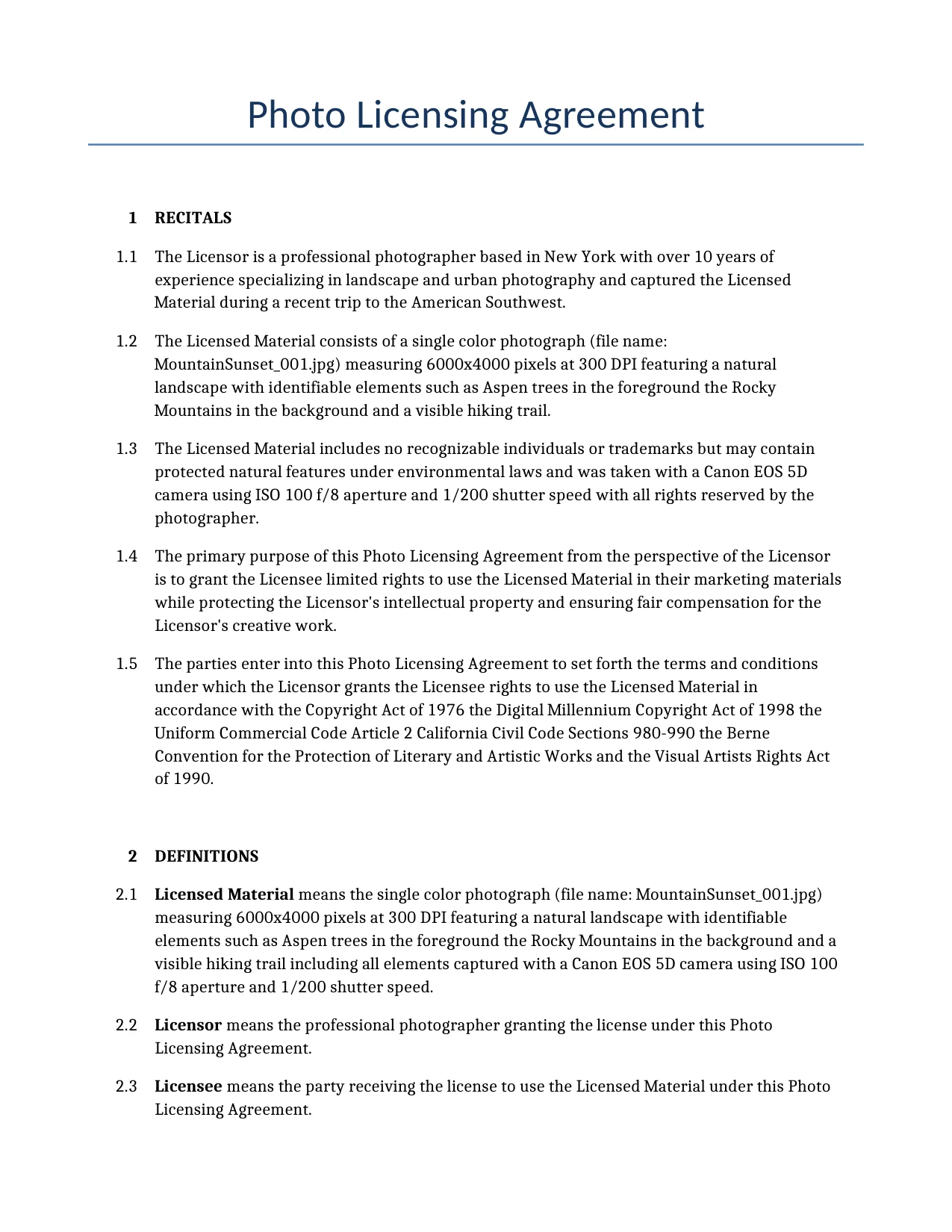
Photo Licensing Agreement
1RECITALS
The Licensor is a professional photographer based in New York with over 10 years of experience specializing in landscape and urban photography and captured the Licensed Material during a recent trip to the American Southwest.
The Licensed Material consists of a single color photograph (file name: MountainSunset_001.jpg) measuring 6000x4000 pixels at 300 DPI featuring a natural landscape with identifiable elements such as Aspen trees in the foreground the Rocky Mountains in the background and a visible hiking trail.
The Licensed Material includes no recognizable individuals or trademarks but may contain protected natural features under environmental laws and was taken with a Canon EOS 5D camera using ISO 100 f/8 aperture and 1/200 shutter speed with all rights reserved by the photographer.
The primary purpose of this Photo Licensing Agreement from the perspective of the Licensor is to grant the Licensee limited rights to use the Licensed Material in their marketing materials while protecting the Licensor's intellectual property and ensuring fair compensation for the Licensor's creative work.
The parties enter into this Photo Licensing Agreement to set forth the terms and conditions under which the Licensor grants the Licensee rights to use the Licensed Material in accordance with the Copyright Act of 1976 the Digital Millennium Copyright Act of 1998 the Uniform Commercial Code Article 2 California Civil Code Sections 980-990 the Berne Convention for the Protection of Literary and Artistic Works and the Visual Artists Rights Act of 1990.
2DEFINITIONS
Licensed Material means the single color photograph (file name: MountainSunset_001.jpg) measuring 6000x4000 pixels at 300 DPI featuring a natural landscape with identifiable elements such as Aspen trees in the foreground the Rocky Mountains in the background and a visible hiking trail including all elements captured with a Canon EOS 5D camera using ISO 100 f/8 aperture and 1/200 shutter speed.
Licensor means the professional photographer granting the license under this Photo Licensing Agreement.
Licensee means the party receiving the license to use the Licensed Material under this Photo Licensing Agreement.
Territory means worldwide.
License Term means the period commencing on 2024-10-01 and continuing for two years thereafter.
Permitted Uses means use in marketing materials website banners social media posts print media digital media broadcast media advertising and promotion direct sales and internal use only.
Effective Date means October 1 2024.
3GRANT OF LICENSE
The Licensor hereby grants to the Licensee a non-exclusive non-transferable non-sublicensable license to use the Licensed Material in the Permitted Uses within the Territory for the License Term subject to the terms and conditions of this Photo Licensing Agreement. All rights not expressly granted herein are reserved by the Licensor.
The license granted under this Section 3 is non-exclusive and does not restrict the Licensor from granting similar rights to other parties.
The Licensee may use the Licensed Material solely in Print Media Digital Media Broadcast Media Advertising and Promotion Direct Sales and Internal Use Only as expressly permitted herein.
The license granted under this Section 3 commences on the Effective Date and remains in effect for the duration of the License Term unless terminated earlier in accordance with this Photo Licensing Agreement.
The Licensee shall not sublicense the Licensed Material to any third party.
The Licensee shall not create derivative works based on the Licensed Material except for minor alterations such as cropping resizing or color correction as expressly permitted in Section 8.3. The Licensee shall not use the Licensed Material for any form of training artificial intelligence systems machine learning models or similar technologies. The Licensee shall not reverse engineer decompile or disassemble the Licensed Material or any accompanying metadata.
4LICENSE FEES AND PAYMENT TERMS
The Licensee shall pay the Licensor an upfront license fee of $2,500 on or before the Effective Date.
In addition to the upfront license fee the Licensee shall pay the Licensor royalties in an amount equal to five percent of the Licensee's gross revenues derived from the use of the Licensed Material payable quarterly within thirty days after the end of each calendar quarter.
The Licensor shall have the right upon reasonable notice to audit the Licensee's books and records related to the use of the Licensed Material and calculation of royalties no more than once per calendar year during the License Term and for two years thereafter.
Any payment not made when due shall accrue interest at the rate of 1.5 percent per month until paid in full.
All payments under this Photo Licensing Agreement shall be made in United States dollars by wire transfer or other mutually agreed method.
5REPRESENTATIONS AND WARRANTIES
The Licensor represents and warrants that the Licensor has full and exclusive ownership of all rights in the Licensed Material.
The Licensor represents and warrants that the Licensed Material is an original work and does not infringe on any third-party rights under the Copyright Act of 1976 the Digital Millennium Copyright Act of 1998 or any other applicable law.
The Licensor represents and warrants that there are no pending or threatened claims regarding the Licensed Material.
The Licensor represents and warrants that the Licensor has the full right to grant the license for the Licensed Material as described in this Photo Licensing Agreement.
The Licensed Material is a landscape photograph containing no recognizable individuals. The Licensor represents and warrants that no model or property releases are required for the Permitted Uses under applicable law and that the Licensed Material was created on 2023-05-15.
The Licensee represents and warrants that the Licensee's intended use of the Licensed Material complies with the terms of this Photo Licensing Agreement and all applicable United States laws.
Each party represents and warrants that it will comply with all applicable export control laws anti-corruption laws including the U.S. Foreign Corrupt Practices Act and that it is not insolvent or the subject of any bankruptcy proceeding.
6INDEMNIFICATION
The Licensor shall indemnify defend and hold harmless the Licensee from and against any and all claims losses damages liabilities costs and expenses including reasonable attorneys' fees arising from the Licensor's breach of any representation or warranty contained in this Photo Licensing Agreement with respect to the Licensed Material including intellectual property claims breach of representations and misuse of material. This indemnification obligation shall not apply to the extent any claim arises from the Licensee's modification of the Licensed Material or use outside the Permitted Uses.
The Licensee shall indemnify defend and hold harmless the Licensor from and against any and all claims losses damages liabilities costs and expenses including reasonable attorneys' fees arising from the Licensee's misuse of the Licensed Material modification of the Licensed Material use outside the Permitted Uses or breach of this Photo Licensing Agreement including intellectual property claims breach of representations and misuse of material.
The indemnified party shall provide prompt written notice to the indemnifying party of any claim for which indemnification is sought under this Section 6.
The indemnifying party shall have the right to control the defense and settlement of any indemnified claim provided that no settlement shall be entered into without the indemnified party's prior written consent which shall not be unreasonably withheld.
7LIMITATIONS AND RESTRICTIONS
The Licensee shall not use the Licensed Material in any political or endorsement contexts or in any adult or sensitive content.
Nothing in this Agreement shall be construed as a waiver of the Licensor's moral rights under the Visual Artists Rights Act of 1990 (VARA) or any other applicable law. The Licensee agrees to respect the Licensor's rights of attribution and integrity with respect to the Licensed Material.
The Licensee may make minor cropping resizing color correction and enhancement alterations to the Licensed Material provided that the alterations do not materially distort the original expression of the Licensed Material. Any modifications created by the Licensee shall remain the property of the Licensor and the Licensee assigns all right title and interest in such modifications to the Licensor.
The Licensee shall not sublicense the Licensed Material to any third party.
If the Licensee uses the Licensed Material for commercial purposes the Licensee shall maintain commercial general liability insurance with coverage of at least $1,000,000 per occurrence naming the Licensor as an additional insured.
8COPYRIGHT NOTICES AND CREDITS
The Licensee shall include a copyright notice in the form \© [Licensor Name] [Year] on all reproductions of the Licensed Material.
The Licensee shall include a credit to the Licensor in the form Photograph by [Licensor Name] on all reproductions of the Licensed Material.
9TERM AND TERMINATION
This Photo Licensing Agreement and the license granted hereunder shall commence on the Effective Date and continue for the License Term unless terminated earlier in accordance with this Section 9.
The Licensor may terminate this Photo Licensing Agreement upon thirty days written notice if the Licensee commits a material breach including non-payment and fails to cure such breach within the thirty-day notice period.
Upon termination or expiration of this Photo Licensing Agreement the Licensee shall immediately cease all use of the Licensed Material shall destroy or delete all copies of the Licensed Material in its possession or control (including any modifications) and shall certify such destruction in writing to the Licensor within ten days. Sections 4 6 7 8 10 11 12 15 16 and 21 shall survive any termination or expiration of this Agreement.
10CONFIDENTIALITY
Each party shall maintain the confidentiality of all confidential information disclosed by the other party during the term of this Photo Licensing Agreement where confidential information is defined broadly to include all non-public information marked or identified as confidential at the time of disclosure. This obligation shall not apply to information that becomes publicly known through no fault of the receiving party.
The confidentiality obligations under this Section 10 commence on the Effective Date and continue for five years after the termination or expiration of this Photo Licensing Agreement.
The receiving party may disclose confidential information to its legal financial or other professional advisors provided that such advisors are bound by confidentiality obligations at least as restrictive as those set forth in this Section 10.
Upon termination of this Photo Licensing Agreement or at the disclosing party's request the receiving party shall return or destroy all confidential information in its possession.
The parties agree that breach of the confidentiality obligations under this Section 10 may cause irreparable harm for which monetary damages are insufficient and that the disclosing party shall be entitled to seek injunctive relief in addition to monetary damages.
11GOVERNING LAW AND JURISDICTION
This Photo Licensing Agreement shall be governed by and construed in accordance with the laws of the State of New York without regard to its conflict of laws principles.
The parties hereby submit to the exclusive jurisdiction of the state and federal courts located in New York City New York for any dispute arising out of or relating to this Photo Licensing Agreement.
12DISPUTE RESOLUTION
Any dispute arising out of or relating to this Photo Licensing Agreement shall be resolved exclusively by binding arbitration administered by the American Arbitration Association in accordance with its Commercial Arbitration Rules. Either party may opt out of arbitration by providing written notice to the other party within thirty days of the dispute arising in which case the dispute shall be resolved in the courts specified in Section 11.
The prevailing party in any arbitration or related proceeding shall be entitled to recover its reasonable attorneys' fees and costs from the other party.
13ASSIGNMENT AND TRANSFER
Neither party shall assign or transfer any rights or delegate any obligations under this Photo Licensing Agreement without the prior written consent of the other party which shall not be unreasonably withheld. Any purported assignment in violation of this Section shall be void.
14FORCE MAJEURE
Neither party shall be liable for any delay or failure to perform its obligations under this Photo Licensing Agreement if such delay or failure results from events beyond its reasonable control including acts of God war natural disasters or governmental actions provided that the affected party gives the other party written notice within five days after the occurrence of the force majeure event.
The affected party shall use reasonable efforts to mitigate the effects of any force majeure event and to resume performance as soon as possible.
15ENTIRE AGREEMENT
This Photo Licensing Agreement constitutes the entire agreement between the parties with respect to the subject matter hereof and supersedes all prior written or oral agreements between the parties. There are no prior written or oral agreements between the Licensor and the Licensee regarding the licensing of these photos.
This Photo Licensing Agreement may be modified only by a written instrument signed by both parties.
16SEVERABILITY
If any provision of this Photo Licensing Agreement is held to be invalid or unenforceable such provision shall be severed from this Photo Licensing Agreement and the remaining provisions shall remain in full force and effect. The court shall have the authority to reform (or \“blue pencil\”) any invalid provision to make it enforceable to the maximum extent permitted by law.
The severability provision applies to the entire Photo Licensing Agreement including any schedules or exhibits attached hereto.
17WAIVER
The failure of either the Licensor or the Licensee to enforce any provision of this Photo Licensing Agreement shall not constitute a waiver of that or any other provision nor shall it preclude subsequent enforcement of that or any other provision.
18NOTICES
All notices under this Photo Licensing Agreement shall be in writing and delivered by email certified mail or overnight courier to the Licensor at 123 Main Street New York NY 10001 and to the Licensee at 456 Oak Avenue Los Angeles CA 90210.
Notices sent by certified mail shall be deemed received five days after mailing.
19COUNTERPARTS
This Photo Licensing Agreement may be executed in one or more counterparts each of which shall be deemed an original but all of which together shall constitute one and the same instrument. Electronic signatures shall be deemed original signatures.
20DATA PRIVACY AND COMPLIANCE
Each party shall comply with all applicable data privacy laws including but not limited to the California Consumer Privacy Act if applicable. The Licensee shall not use the Licensed Material in any manner that violates privacy rights.
21SCHEDULE A - LICENSED MATERIAL
The Licensed Material subject to this Agreement is more particularly described as follows: File Name: MountainSunset_001.jpg; Resolution: 6000x4000 pixels at 300 DPI; Description: Color landscape photograph featuring Aspen trees in the foreground the Rocky Mountains in the background and a visible hiking trail; Creation Date: 2023-05-15; Camera: Canon EOS 5D Mark III; Technical Details: ISO 100 f/8 1/200 sec.
22SIGNATURES
IN WITNESS WHEREOF the parties have executed this Photo Licensing Agreement as of the Effective Date.
Licensor: _______________________________ Date: _______________
Licensee: _______________________________ Date: _______________
This example shows approximately 70% of a typical document and is provided for illustrative purposes only. The remaining content has been omitted.
Every document generated by Docaro is tailored to your specific circumstances, jurisdiction and the information you provide. The completed document includes all applicable clauses and provisions required for your situation.
To generate the full, personalised document, answer a short series of questions and your document will be created instantly.