
AI Generated American Revocable Living Trust
PDF & Word - 2026 Updated
Docaro Pricing
When Do You Need a Revocable Living Trust in the United States?
American Legal Rules for a Revocable Living Trust
Using the wrong type of trust structure can lead to unintended tax consequences or invalid distribution of assets.
What a Proper Revocable Living Trust Should Include
- Trust DeclarationA clear statement that the person creating the trust is transferring their assets into it to manage during their lifetime and after.
- Identification of the GrantorDetails about the person setting up the trust, including their full name and address.
- Appointment of TrusteeNaming the person or entity who will manage the trust, often the grantor themselves initially.
- Successor Trustee DesignationSpecifying who takes over managing the trust if the initial trustee can no longer serve.
- Beneficiary ListingIdentifying who will receive the trust's benefits, such as family members or charities.
- Property ScheduleA list of assets being placed into the trust, like homes, bank accounts, or investments.
- Revocation ClauseA provision allowing the grantor to change or cancel the trust at any time while alive.
- Distribution InstructionsGuidelines on how and when the trust assets will be given to beneficiaries after the grantor's passing.
- Trustee PowersOutline of what the trustee can do, such as selling property or investing funds.
- Governing LawStatement on which state's laws will control the trust's terms and administration.
Generate Your Document in 4 Easy Steps
Why Use Docaro?
 United States
Free Example Revocable Living Trust Template
Below is a free template example of a Revocable Living Trust for use in the United States generated by our AI model.
The clauses in your actual Revocable Living Trust will vary from this example as they will be entirely bespoke to your requirements as set out in the questionnaire you complete.
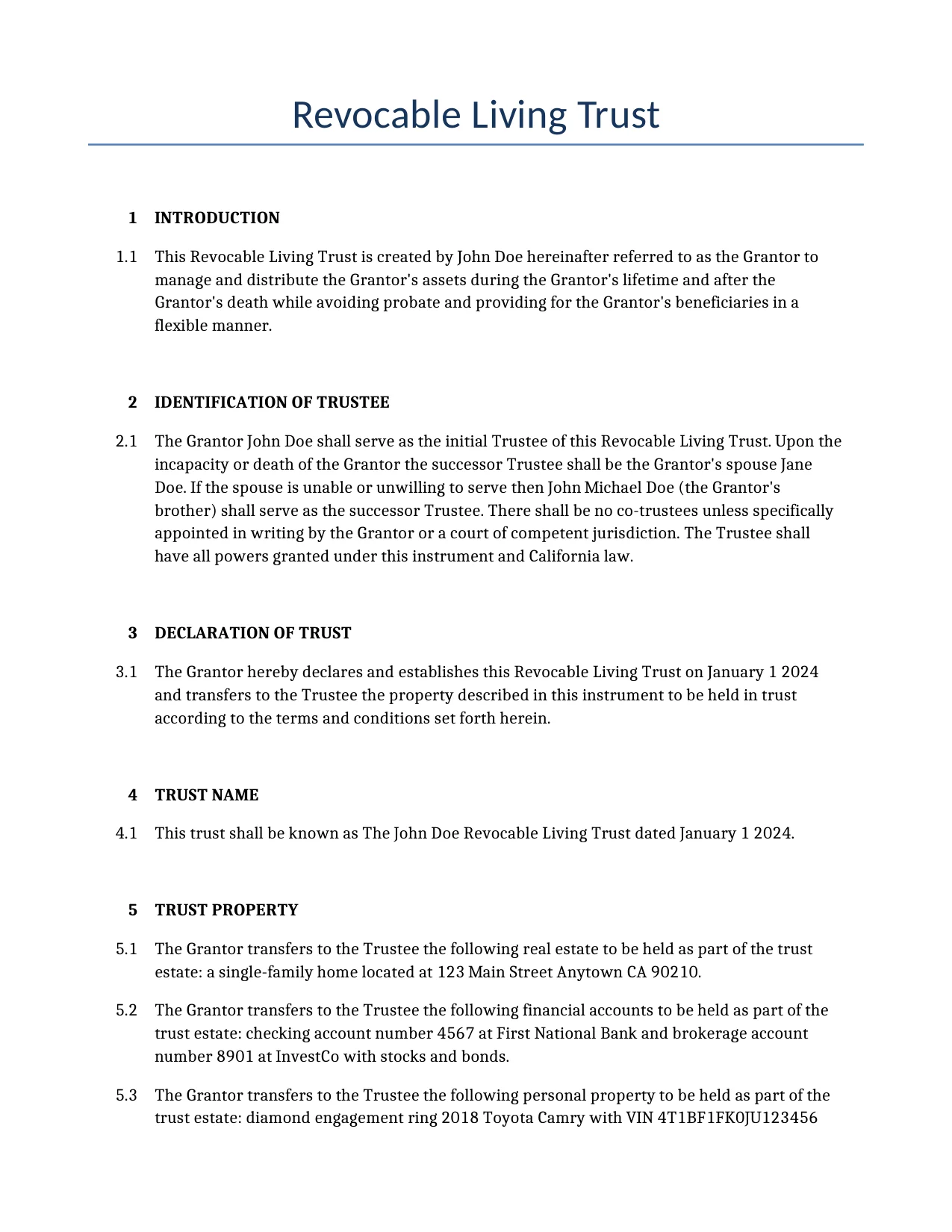
Revocable Living Trust
1INTRODUCTION
This Revocable Living Trust is created by John Doe hereinafter referred to as the Grantor to manage and distribute the Grantor's assets during the Grantor's lifetime and after the Grantor's death while avoiding probate and providing for the Grantor's beneficiaries in a flexible manner.
2IDENTIFICATION OF TRUSTEE
The Grantor John Doe shall serve as the initial Trustee of this Revocable Living Trust. Upon the incapacity or death of the Grantor the successor Trustee shall be the Grantor's spouse Jane Doe. If the spouse is unable or unwilling to serve then John Michael Doe (the Grantor's brother) shall serve as the successor Trustee. There shall be no co-trustees unless specifically appointed in writing by the Grantor or a court of competent jurisdiction. The Trustee shall have all powers granted under this instrument and California law.
3DECLARATION OF TRUST
The Grantor hereby declares and establishes this Revocable Living Trust on January 1 2024 and transfers to the Trustee the property described in this instrument to be held in trust according to the terms and conditions set forth herein.
4TRUST NAME
This trust shall be known as The John Doe Revocable Living Trust dated January 1 2024.
5TRUST PROPERTY
The Grantor transfers to the Trustee the following real estate to be held as part of the trust estate: a single-family home located at 123 Main Street Anytown CA 90210.
The Grantor transfers to the Trustee the following financial accounts to be held as part of the trust estate: checking account number 4567 at First National Bank and brokerage account number 8901 at InvestCo with stocks and bonds.
The Grantor transfers to the Trustee the following personal property to be held as part of the trust estate: diamond engagement ring 2018 Toyota Camry with VIN 4T1BF1FK0JU123456 and a collection of antique coins.
6REVOCABILITY
The Grantor reserves the right to amend or revoke this Revocable Living Trust in whole or in part at any time during the Grantor's lifetime without the consent of any beneficiary or Trustee.
7POWERS OF THE TRUSTEE
The Trustee shall have all powers conferred by California Probate Code Sections 16200 et seq. including but not limited to the power to borrow money lease property vote securities deal with digital assets handle tax elections (including QTIP elections under IRC Section 2056(b)(7) or portability under IRC Section 2010(c)(5)) and manage trust property without court approval. The Trustee is prohibited from self-dealing except as expressly permitted herein.
The Trustee shall have the power to manage and control all property belonging to the trust.
The Trustee shall have broad powers to invest and reinvest trust assets.
The Trustee shall have the authority to sell exchange or convey any trust property.
The Trustee shall have the power to distribute trust assets in kind rather than only in cash.
The Trustee shall have the power to hire and pay for attorneys accountants or other advisors from trust funds.
The Trustee shall have broad discretion without court approval to compromise or settle claims involving the trust.
8TRUST ADMINISTRATION DURING GRANTOR'S LIFETIME
The Grantor shall serve as the initial Trustee of this Revocable Living Trust.
The Trustee shall distribute all net income from the trust property to the Grantor at least annually during the Grantor's lifetime.
The Trustee shall have the authority to invade the principal of the trust for the Grantor's health education maintenance or support during the Grantor's lifetime.
9INCAPACITY OF GRANTOR
The Grantor shall be deemed incapacitated only upon written certification by two qualified physicians (licensed to practice medicine in California and who have personally examined the Grantor) that the Grantor is unable to manage the Grantor's financial affairs due to mental or physical incapacity. The determination shall be made jointly by the physicians and the successor Trustee. Notice of the determination shall be given in writing to the Grantor the successor Trustee and the Grantor's adult children if any. To restore capacity the Grantor must provide similar written certifications from two qualified physicians confirming the Grantor has regained the ability to manage financial affairs. This process includes safeguards such as requiring an independent third physician if there is disagreement and allows the Grantor to contest the determination in court to prevent abuse.
10BENEFICIARIES
The primary beneficiaries of this trust are the Grantor's spouse Jane Doe (relationship: spouse) the Grantor's son John Doe Jr. (relationship: son) and the Grantor's daughter Emily Doe (relationship: daughter). The contingent beneficiaries are the Grantor's grandchildren per stirpes. If a beneficiary predeceases the Grantor their share shall be distributed per stirpes to their descendants or if none then per capita to the surviving primary beneficiaries. Any lapsed gifts or disclaimers shall be added to the residue of the trust. A beneficiary may disclaim their interest pursuant to IRC Section 2518 and California law in which case the disclaimed interest shall pass as if the disclaiming beneficiary predeceased the Grantor without descendants.
11REVOCATION AND AMENDMENT
The Grantor retains the ability to revoke the trust entirely during the Grantor's lifetime by delivering a written notice signed by the Grantor to the Trustee.
The Grantor retains the ability to amend specific provisions of the trust during the Grantor's lifetime by delivering a written instrument signed by the Grantor to the Trustee.
12DISTRIBUTIONS DURING TRUST TERM
During the Grantor's lifetime the Trustee shall distribute all net income and such principal as the Grantor may request to the Grantor for the Grantor's benefit under the HEMS standard (health education maintenance and support).
13DISTRIBUTIONS UPON GRANTOR'S DEATH
Upon the Grantor's death the trust shall become irrevocable. The Trustee shall first pay all debts taxes and expenses of the Grantor's estate from the trust property. The Trustee shall then make specific gifts as provided in a separate memorandum if any. The residue shall be distributed as follows: one-third (1/3) to the Grantor's spouse Jane Doe outright. The remaining two-thirds (2/3) shall be held in further trust for the Grantor's children with staggered distributions of one-third (1/3) of each child's share at age 25 one-third (1/3) at age 30 and the balance at age 35. During the trust term for children the Trustee shall make discretionary distributions for the beneficiaries' health education maintenance and support (HEMS standard). There shall be no distributions of income to John Doe after the Grantor's death as he is the Grantor.
14SPECIFIC GIFTS
The Trustee shall make the following specific gifts upon the Grantor's death in accordance with any separate written memorandum or directions provided by the Grantor that is incorporated by reference herein.
15RESIDUE OF THE TRUST
After specific gifts and payment of debts the residue shall be administered as set forth in the Distributions Upon Grantor's Death section.
16TAX PROVISIONS
This trust is intended to be a grantor trust under IRC Sections 671-679 during the Grantor's lifetime with all income taxable to the Grantor. The Trustee shall file all required federal and state tax returns including Form 1041 if necessary and may make elections such as QTIP portability or allocation of GST exemption. The Trustee shall allocate income deductions and credits consistent with applicable tax laws. The trust shall consider generation-skipping transfer (GST) tax implications and the Trustee may disclaim or elect as appropriate to minimize taxes. The Trustee is authorized to handle all tax matters under federal and California law.
17TRUSTEE COMPENSATION
The Trustee shall be allowed to receive compensation for services in the form of reasonable fees.
The Trustee shall be reimbursed for reasonable expenses incurred in administering the trust.
18TRUSTEE SELECTION AND SUCCESSION
The initial Trustee is the Grantor. Successor Trustees are as named in the Identification of Trustee section. Beneficiaries holding a majority interest may remove a Trustee for cause (such as breach of fiduciary duty) by written notice and petition the court if necessary to appoint a successor. The court of competent jurisdiction in California may appoint a successor Trustee if no named successor is willing or able to serve. A successor Trustee shall have all powers of the initial Trustee.
19DIGITAL ASSETS
The Trustee is granted full authority to access manage control and distribute the Grantor's digital assets including but not limited to online accounts social media cryptocurrencies and digital files pursuant to the California Revised Uniform Fiduciary Access to Digital Assets Act (Probate Code Sections 870 et seq.). The Trustee may obtain passwords decrypt data and take all necessary actions to administer digital assets as part of the trust estate.
20DISCLAIMER OF INTERESTS
Any beneficiary may disclaim their interest in whole or in part pursuant to IRC Section 2518 and applicable California law. A disclaimer shall be treated as if the disclaiming beneficiary predeceased the Grantor without surviving descendants unless otherwise specified.
21PERPETUITIES SAVINGS CLAUSE
Notwithstanding any other provision this trust shall terminate no later than twenty-one (21) years after the death of the last surviving descendant of the Grantor living at the time of the Grantor's death in order to comply with California's rule against perpetuities under California Probate Code Section 21200 et seq. Any remaining assets shall be distributed outright to the then-current income beneficiaries in proportion to their interests.
22POUR-OVER WILL
The Grantor shall execute a corresponding pour-over will that directs any assets not already in the trust at the time of the Grantor's death to be poured over into this Revocable Living Trust to be administered according to its terms.
23FUNDING THE TRUST
The Grantor shall fund this trust by retitling assets in the name of the Trustee such as John Doe Trustee of the John Doe Revocable Living Trust dated January 1 2024. Examples include deeding real property to the Trustee transferring financial accounts into the trust's name and assigning personal property. Any assets not properly funded into the trust may be subject to probate. An updated Schedule of Trust Property shall be attached as Exhibit A and updated periodically.
24GOVERNING LAW
This Revocable Living Trust is governed by the laws of the State of California. All matters shall be determined in accordance with the California Probate Code including but not limited to Sections 15400-15414 governing revocable trusts and other relevant provisions. The trust shall comply with all applicable federal tax laws including the Internal Revenue Code.
25NO-CONTEST CLAUSE
Any beneficiary who contests or challenges the validity of this Revocable Living Trust or any of its provisions without probable cause as defined under California Probate Code Section 21310 et seq. shall be disinherited and shall receive no distribution from the trust. This clause shall be interpreted and enforced in accordance with current California law to ensure it remains enforceable and is not overly broad.
26SPENDTHRIFT PROVISION
No beneficiary shall have the power to assign encumber or otherwise transfer any interest in the trust before the distribution of such interest to the beneficiary and the Trustee shall not recognize any such assignment encumbrance or transfer.
The interests of all beneficiaries shall be protected from the beneficiaries' creditors by restricting their ability to voluntarily or involuntarily transfer those assets.
This spendthrift provision shall apply to all beneficiaries.
27MISCELLANEOUS PROVISIONS
This trust is not intended to be a community property trust unless a separate election is made in writing. Community property and separate property shall retain their character as such under California law when transferred to or held in this trust.
The situs of the trust may be changed by the Trustee to another jurisdiction if deemed advisable for tax administrative or other reasons with the governing law adjusting accordingly subject to court approval if required.
Any disputes arising under this trust shall first be subject to mediation and if unsuccessful binding arbitration before any party may initiate litigation. Mediation and arbitration shall be conducted in California under the rules of the American Arbitration Association or a similar organization.
The Grantor hereby declares that this instrument was executed freely and voluntarily after having read and understood all terms.
28TRUST PROTECTOR
The Grantor may appoint a Trust Protector in a separate written instrument. The Trust Protector shall have the power to remove and replace the Trustee for cause amend administrative provisions to comply with changes in law or tax regulations and resolve ambiguities but shall not have power to alter beneficial interests except as necessary for tax purposes. The Trust Protector shall not be liable for actions taken in good faith.
29CERTIFICATION
I John Doe the Grantor hereby certify under penalty of perjury under the laws of the State of California that this document is my Revocable Living Trust that I have read and understand all of its terms that I executed it freely and voluntarily and that it accurately reflects my intentions as of the date of execution.
30SEVERABILITY
If any provision of this Revocable Living Trust is held to be invalid or unenforceable the remaining provisions shall remain in full force and effect.
31ENTIRE AGREEMENT
This instrument constitutes the entire agreement between the parties with respect to the subject matter hereof and supersedes all prior understandings and agreements whether written or oral.
32NOTICES
Any notice required or permitted under this Revocable Living Trust shall be in writing and shall be deemed given when delivered personally or when sent by certified mail return receipt requested to the last known address of the recipient.
33VARIATION
No variation of this Revocable Living Trust shall be effective unless it is in writing and signed by the Grantor or the Trustee as applicable in accordance with the terms of this instrument.
34EXECUTION
This Revocable Living Trust is executed on January 1 2024.
This Revocable Living Trust shall be executed in two original signed copies.
35SIGNATURE SECTION
IN WITNESS WHEREOF the Grantor has executed this Revocable Living Trust on the date first above written.
Grantor: _______________________________ John Doe Date: _______________
Trustee: _______________________________ John Doe Date: _______________
The foregoing instrument was acknowledged before me this _____ day of _______________ 2024 by John Doe as Grantor and Trustee.
Notary Public: _______________________________ My Commission Expires: _______________
Witness 1: _______________________________ Print Name: _______________ Date: _______________
Witness 2: _______________________________ Print Name: _______________ Date: _______________
36SCHEDULE OF TRUST PROPERTY
Exhibit A - Schedule of Initial Trust Property. The initial property transferred to the trust includes the following real property: street address 123 Main Street city Anytown state California ZIP code 90210 legal description Lot 5 Block 3 Subdivision of Anytown Heights. The initial property transferred to the trust includes the following bank account: financial institution First National Bank account number 4567. The initial property transferred to the trust includes the following investment asset: brokerage account number 8901 at InvestCo with stocks and bonds. The initial property transferred to the trust includes the following personal property: diamond engagement ring 2018 Toyota Camry with VIN 4T1BF1FK0JU123456 and a collection of antique coins. This schedule shall be updated as assets are added or retitled into the trust.
This example shows approximately 70% of a typical document and is provided for illustrative purposes only. The remaining content has been omitted.
Every document generated by Docaro is tailored to your specific circumstances, jurisdiction and the information you provide. The completed document includes all applicable clauses and provisions required for your situation.
To generate the full, personalised document, answer a short series of questions and your document will be created instantly.