
AI Generated American Postnuptial Agreement
PDF & Word - 2026 Updated
Docaro Pricing
When Do You Need a Postnuptial Agreement in the United States?
American Legal Rules for a Postnuptial Agreement
Using the wrong structure for a postnuptial agreement can invalidate its enforceability in court.
What a Proper Postnuptial Agreement Should Include
- Identification of PartiesClearly name both spouses and include basic details like full names and addresses to establish who the agreement applies to.
- Date of MarriageSpecify the date and location of the marriage to confirm the agreement's relevance after the wedding.
- Asset and Debt DivisionList all current assets, properties, and debts, detailing how they will be divided if the marriage ends.
- Spousal Support TermsOutline any agreements on financial support or alimony one spouse might provide to the other in case of separation.
- Inheritance RightsDefine how each spouse's estate will be handled upon death, including what the surviving spouse inherits.
- Voluntary AgreementState that both parties are entering the agreement freely, without pressure, and have had the chance to seek independent advice.
- Signatures and WitnessesInclude spaces for both spouses to sign, date, and have the document notarized or witnessed to make it legally binding.
Generate Your Document in 4 Easy Steps
Why Use Docaro?
 United States
Free Example Postnuptial Agreement Template
Below is a free template example of a Postnuptial Agreement for use in the United States generated by our AI model.
The clauses in your actual Postnuptial Agreement will vary from this example as they will be entirely bespoke to your requirements as set out in the questionnaire you complete.
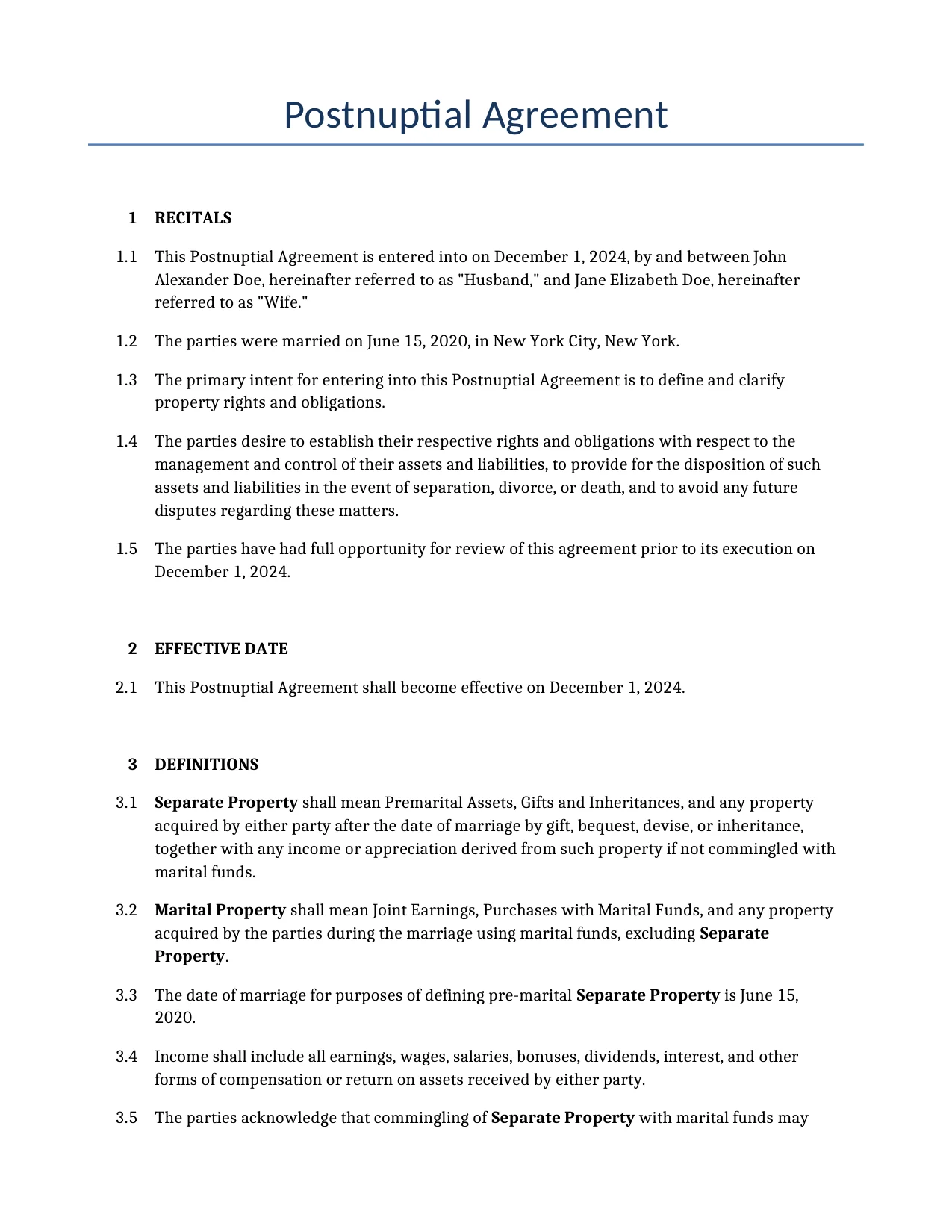
Postnuptial Agreement
1RECITALS
This Postnuptial Agreement is entered into on December 1, 2024, by and between John Alexander Doe, hereinafter referred to as "Husband," and Jane Elizabeth Doe, hereinafter referred to as "Wife."
The parties were married on June 15, 2020, in New York City, New York.
The primary intent for entering into this Postnuptial Agreement is to define and clarify property rights and obligations.
The parties desire to establish their respective rights and obligations with respect to the management and control of their assets and liabilities, to provide for the disposition of such assets and liabilities in the event of separation, divorce, or death, and to avoid any future disputes regarding these matters.
The parties have had full opportunity for review of this agreement prior to its execution on December 1, 2024.
2EFFECTIVE DATE
This Postnuptial Agreement shall become effective on December 1, 2024.
3DEFINITIONS
Separate Property shall mean Premarital Assets, Gifts and Inheritances, and any property acquired by either party after the date of marriage by gift, bequest, devise, or inheritance, together with any income or appreciation derived from such property if not commingled with marital funds.
Marital Property shall mean Joint Earnings, Purchases with Marital Funds, and any property acquired by the parties during the marriage using marital funds, excluding Separate Property.
The date of marriage for purposes of defining pre-marital Separate Property is June 15, 2020.
Income shall include all earnings, wages, salaries, bonuses, dividends, interest, and other forms of compensation or return on assets received by either party.
The parties acknowledge that commingling of Separate Property with marital funds may result in such property being reclassified as Marital Property under certain conditions as provided herein.
4FINANCIAL DISCLOSURES
Each party has previously provided the other with a full and fair financial disclosure of all assets, liabilities, income, and expenses.
Husband's current monthly gross income is six thousand dollars ($6,000.00), and his current monthly net income after taxes and deductions is four thousand eight hundred dollars ($4,800.00).
Husband is currently full-time employed.
Husband's estimated total monthly expenses are three thousand five hundred fifty dollars ($3,550.00), including monthly housing expense of one thousand five hundred dollars ($1,500.00), utilities of two hundred fifty dollars ($250.00), groceries and dining of six hundred dollars ($600.00), transportation of four hundred dollars ($400.00), insurance premiums of three hundred dollars ($300.00), and debt payments of five hundred dollars ($500.00).
Husband has additional sources of income from investment dividends.
Husband's bank and savings accounts consist of a checking account at Bank of America with an approximate balance of five thousand dollars ($5,000.00) and a savings account at Wells Fargo with an approximate balance of twenty thousand dollars ($20,000.00).
Husband's investment accounts consist of a 401(k) retirement plan with Vanguard valued at one hundred fifty thousand dollars ($150,000.00) and a stock portfolio in Fidelity with a value of fifty thousand dollars ($50,000.00).
Husband's valuable personal property consists of a 2019 Toyota Camry valued at fifteen thousand dollars ($15,000.00) and wedding ring and necklace valued at ten thousand dollars ($10,000.00) in total.
Husband's estimated total value of all assets is two hundred fifty thousand dollars ($250,000.00).
Husband's debts and liabilities consist of credit card debt with Chase in the amount of eight thousand dollars ($8,000.00), a student loan with Sallie Mae in the amount of twenty-five thousand dollars ($25,000.00), and a car loan with Toyota Financial in the amount of twelve thousand dollars ($12,000.00).
Husband's total amount of all liabilities is forty-five thousand dollars ($45,000.00).
Husband's estimated net worth is two hundred five thousand dollars ($205,000.00).
There are no pending lawsuits or legal claims against Husband, and there are no outstanding tax liabilities or audits.
Detailed schedules for Husband's assets and liabilities are attached hereto as Exhibit A and incorporated herein by reference.
Wife's current monthly gross income is five thousand five hundred dollars ($5,500.00), and her current monthly net income after taxes and deductions is four thousand two hundred dollars ($4,200.00).
Wife is currently full-time employed.
Wife's estimated total monthly expenses are three thousand two hundred dollars ($3,200.00), including monthly housing expense of one thousand two hundred dollars ($1,200.00), utilities of two hundred dollars ($200.00), groceries and dining of five hundred fifty dollars ($550.00), transportation of three hundred fifty dollars ($350.00), insurance premiums of two hundred fifty dollars ($250.00), and debt payments of four hundred fifty dollars ($450.00).
Wife has additional sources of income from freelance consulting.
Wife's bank and savings accounts consist of a checking account at Chase Bank with an approximate balance of four thousand dollars ($4,000.00) and a savings account at Citibank with an approximate balance of fifteen thousand dollars ($15,000.00).
Wife's investment accounts consist of an IRA retirement plan with Fidelity valued at one hundred thousand dollars ($100,000.00) and a bond portfolio in Schwab with a value of forty thousand dollars ($40,000.00).
Wife's valuable personal property consists of a 2021 Honda Accord valued at eighteen thousand dollars ($18,000.00), jewelry valued at eight thousand dollars ($8,000.00), and artwork valued at five thousand dollars ($5,000.00).
Wife's estimated total value of all assets is one hundred ninety thousand dollars ($190,000.00).
Wife's debts and liabilities consist of credit card debt with Discover in the amount of six thousand dollars ($6,000.00), a student loan with Navient in the amount of eighteen thousand dollars ($18,000.00), and no car loan.
Wife's total amount of all liabilities is twenty-four thousand dollars ($24,000.00).
Wife's estimated net worth is one hundred sixty-six thousand dollars ($166,000.00).
There are no pending lawsuits or legal claims against Wife, and there are no outstanding tax liabilities or audits.
Detailed schedules for Wife's assets and liabilities are attached hereto as Exhibit B and incorporated herein by reference.
Each party acknowledges receipt and understanding of the other's disclosures.
5SEPARATE PROPERTY
The real property located at 123 Main Street, Anytown, NY 12345, acquired by Husband on March 15, 2015, with a current estimated value of four hundred fifty thousand dollars ($450,000.00) and no outstanding mortgage, shall be and remain the Separate Property of Husband.
The savings account at Wells Fargo Bank, account number 1234567890, opened on July 22, 2018, with a current balance of twenty-five thousand fifty cents ($25,000.50), which is owned before marriage, shall be and remain the Separate Property of Husband.
Husband has separate debts associated with his Separate Property, and such debts shall remain his sole responsibility.
The parties have not commingled this Separate Property with marital assets.
Wife similarly retains her own Separate Property as disclosed, which shall not be subject to division or claims by Husband.
6MARITAL PROPERTY
The family home at 123 Maple Street, Anytown, USA, a single-family residence, purchased on May 15, 2020, with a current estimated value of four hundred fifty thousand dollars ($450,000.00), shall be classified as Marital Property.
The personal property acquired jointly during the marriage, consisting of two vehicles (a 2022 Toyota Camry and a 2019 Honda CR-V), a living room furniture set, and a wedding ring set, obtained on or about August 20, 2021, with a current estimated total value of thirty-five thousand fifty cents ($35,000.50), shall be classified as Marital Property.
The financial assets acquired jointly during the marriage, consisting of a joint checking account at Bank of America, a shared 401(k) retirement account, and a mutual fund investment in Vanguard S&P 500, established or funded on March 10, 2019, with a current estimated total value of one hundred twenty-five thousand seventy-five cents ($125,000.75), shall be classified as Marital Property.
There is no other property acquired jointly during the marriage not covered above.
7DIVISION OF PROPERTY
In the event of divorce or legal separation, the provisions of this section shall apply to the division of property.
Husband's Separate Property includes a house owned prior to marriage located at 123 Main Street, Anytown, USA, purchased in 2015, and a savings account with fifty thousand dollars ($50,000.00) from an inheritance received in 2020, which shall remain his sole and separate property.
Marital Property shall be subject to equal division between the parties.
Under certain conditions, such as commingling, Separate Property may become Marital Property.
All property shall be valued as of December 1, 2024, for purposes of this agreement.
Property acquired after the date of this Postnuptial Agreement shall be classified as Marital Property.
8DEBTS AND LIABILITIES
The credit card debt for household expenses incurred on May 15, 2020, with a current outstanding balance of twelve thousand five hundred seventy-five cents ($12,500.75), classified as marital debt, associated with a joint account, with creditor Visa Credit Card Services, shall be shared equally between the parties.
Each party shall be responsible for their own Separate Property debts unless otherwise specified herein.
9SPOUSAL SUPPORT
In the event of separation or divorce, Husband shall pay to Wife a fixed monthly amount of spousal support in the sum of two thousand five hundred dollars ($2,500.00), commencing on January 1, 2025.
Such spousal support shall continue until the remarriage or death of Wife.
Spousal support may be modified upon a change in income of over twenty percent or upon the cohabitation of the recipient.
10INHERITANCE AND ESTATE RIGHTS
Each party hereby waives any right to an elective share of the other's estate upon death.
Upon the death of Husband, his estate shall be distributed with the full estate to Wife.
The parties mutually waive elective shares and statutory inheritance rights.
This section shall become effective on December 1, 2024.
11INSURANCE PROVISIONS
Husband shall maintain life insurance coverage for the benefit of Wife in the minimum amount of five hundred thousand dollars ($500,000.00).
Wife shall be designated as the primary beneficiary of such life insurance policy.
If existing coverage is insufficient, Husband shall obtain a new life insurance policy to meet the requirements herein.
This life insurance coverage requirement shall commence on January 1, 2025, and shall last until the children reach the age of majority.
Husband agrees to provide periodic proof of maintained life insurance coverage to Wife upon reasonable request.
12CHILDREN AND CUSTODY
The parties have two children together.
Any provisions regarding child custody, visitation, or support shall be determined in accordance with the best interests of the children and applicable law at the time of any separation or divorce, and nothing in this agreement shall limit the court's jurisdiction over such matters.
This agreement does not address or limit child support obligations, which shall be determined solely under the New York Child Support Standards Act (NY Domestic Relations Law \§ 240).
Any custody or visitation terms will be subject to court approval based on the best interests of the children, with cross-reference to applicable New York law including NY Domestic Relations Law \§ 240.
13BUSINESS INTERESTS
Smith Tech Solutions LLC is a limited liability company formed on March 15, 2015, specializing in software development for mobile applications for small businesses, with a current estimated value of two hundred fifty thousand dollars ($250,000.00).
The business is the Separate Property of John Smith (Husband), who owns and primarily manages it, and the other spouse has not contributed to the business during the marriage.
In the event of divorce or separation, the business shall remain the Separate Property of Husband, subject to a buyout provision whereby Husband shall pay Wife a sum equal to one-half of the marital portion of any increase in value during the marriage, if any, as determined by an independent appraiser.
14TAX CONSIDERATIONS
The parties shall file joint tax returns using married filing jointly status for the years covered by this Postnuptial Agreement commencing January 1, 2025.
Tax liabilities arising from joint assets or income shall be allocated by equal split between the parties.
Each spouse shall be responsible only for their own pre-marital or Separate Property tax debts.
Tax refunds from joint returns shall be allocated by equal split between the parties.
Each spouse shall indemnify the other against tax liabilities arising from their separate actions or assets.
15GOVERNING LAW
This Postnuptial Agreement shall be governed by and construed in accordance with the laws of the State of New York, including but not limited to New York Domestic Relations Law Section 236, and relevant New York case law on postnuptial agreements such as those emphasizing full disclosure, voluntariness, and fairness.
The parties confirm that both waive the right to challenge the choice of governing law.
The parties confirm that this agreement complies with New York requirements for full disclosure of finances, voluntariness of execution, and overall fairness as required under New York Domestic Relations Law Section 236 and applicable case law.
16SEVERABILITY
If any provision of this Postnuptial Agreement is found to be invalid or unenforceable, the remainder of the agreement shall remain in full force and effect.
17SEVERABILITY AND REFORMATION
If any provision of this Postnuptial Agreement is deemed invalid or unenforceable by a New York court, the court may reform the provision to the extent possible to reflect the parties\' intent, and the remainder of the agreement shall remain enforceable.
18ENTIRE AGREEMENT
This Postnuptial Agreement constitutes the entire understanding between the parties and supersedes any prior written or oral agreements between the parties.
No prior agreements or understandings exist between the parties regarding marital property, finances, or support.
This Postnuptial Agreement can only be modified in writing and signed by both parties.
19AMENDMENTS
Any amendments to this Postnuptial Agreement must be made in writing and signed by both parties to be valid.
20WAIVER
The failure of either party to enforce any provision of this Postnuptial Agreement shall not constitute a waiver of that provision or any other right.
Such waiver provision shall apply to the specific provision and all other rights under this agreement.
21DISPUTE RESOLUTION
Any disputes arising under this Postnuptial Agreement shall be resolved first by mediation.
Mediation shall be required as the first step before proceeding to arbitration or litigation.
The costs of dispute resolution shall be shared equally between the parties.
Thirty days\' notice shall be required before initiating any dispute resolution process.
The dispute resolution provisions shall be governed by the laws of the State of New York.
22CONFIDENTIALITY
The parties agree to keep the terms of this Postnuptial Agreement private, except as required by law.
23REPRESENTATIONS AND WARRANTIES
Each party represents that he or she is of sound mind and not under any legal incapacity that would prevent entering into this Postnuptial Agreement.
Each party has fully disclosed all assets, liabilities, income, and financial obligations to the other party.
Each party is fully aware of all details of the other\'s financial situation.
Each party is entering into this Postnuptial Agreement voluntarily, without any coercion or undue influence.
Each party has received independent legal advice from a separate lawyer regarding this Postnuptial Agreement.
No threats, promises, or pressure have been used to induce either party to sign this Postnuptial Agreement.
24INDEPENDENT LEGAL ADVICE
Husband had the opportunity to consult with independent counsel and has consulted with independent counsel regarding this Postnuptial Agreement.
Wife had the opportunity to consult with independent counsel and has consulted with independent counsel regarding this Postnuptial Agreement.
25ATTORNEY CERTIFICATION
Husband\'s Attorney Certification: I, [Attorney Name], attorney for Husband, certify that I have explained the terms, implications, and rights being waived in this Postnuptial Agreement to my client. My client has signed voluntarily, and the agreement appears fair. Signature: ________________ Date: _______________ Bar Number: _______________
Wife\'s Attorney Certification: I, [Attorney Name], attorney for Wife, certify that I have explained the terms, implications, and rights being waived in this Postnuptial Agreement to my client. My client has signed voluntarily, and the agreement appears fair. Signature: ________________ Date: _______________ Bar Number: _______________
26CONSIDERATION
The mutual promises and obligations, including the spouses\' mutual promise to support each other emotionally and financially during the marriage, to maintain transparency in financial matters, and to work towards the preservation of marital assets for the benefit of the family, constitute sufficient consideration for this Postnuptial Agreement.
Wife receives financial security through guaranteed access to marital assets in the event of separation, protection of her Separate Property, and a commitment to provide ongoing financial support for her living expenses.
Husband receives protection of his business interests and pre-marital assets, assurance that his contributions to the marriage will be recognized, and the peace of mind knowing that the financial arrangements are clearly defined.
The parties include a promise of financial support and an intent for equitable distribution as part of the mutual consideration for this Postnuptial Agreement.
27ACKNOWLEDGMENT OF FAIRNESS AND VOLUNTARINESS
Each party has read and understands the terms of this Postnuptial Agreement in its entirety.
Each party believes that this agreement is fair and equitable under the circumstances.
Each party enters into this agreement voluntarily and without any duress, coercion, or undue influence.
Each party has had adequate time to consider the terms of this agreement and to seek independent legal counsel.
28NOTARIZATION
The parties agree to execute this Postnuptial Agreement before a notary public at the Local Bank in New York, NY, on December 1, 2024, in the presence of two witnesses.
29EXECUTION AND DELIVERY
This agreement is executed in multiple counterparts, each of which shall constitute an original.
This agreement may be executed via electronic signatures compliant with the U.S. ESIGN Act and New York Electronic Signatures and Records Act.
Each party must receive a fully executed copy of this agreement.
30SIGNATURES
IN WITNESS WHEREOF, the parties have executed this Postnuptial Agreement on the date first above written.
Husband: _______________________________ Date: _______________ John Alexander Doe
Wife: _______________________________ Date: _______________ Jane Elizabeth Doe
Notary Acknowledgment: State of New York, County of New York. On this 1st day of December, 2024, before me, a notary public, personally appeared John Alexander Doe and Jane Elizabeth Doe, known to me to be the persons whose names are subscribed to the foregoing instrument, and acknowledged that they executed the same for the purposes therein contained. In witness whereof, I hereunto set my hand and official seal. Notary Public: _______________________________ My Commission Expires: _______________
Witness 1: _______________________________ Date: _______________
Witness 2: _______________________________ Date: _______________
This example shows approximately 70% of a typical document and is provided for illustrative purposes only. The remaining content has been omitted.
Every document generated by Docaro is tailored to your specific circumstances, jurisdiction and the information you provide. The completed document includes all applicable clauses and provisions required for your situation.
To generate the full, personalised document, answer a short series of questions and your document will be created instantly.