
AI Generated American Commercial Lease Renewal Agreement
PDF & Word - 2026 Updated
Docaro Pricing
When Do You Need a Commercial Lease Renewal Agreement in the United States?
American Legal Rules for a Commercial Lease Renewal Agreement
Selecting the incorrect structure for a commercial lease renewal may inadvertently alter key terms like rent, duration, or termination rights.
What a Proper Commercial Lease Renewal Agreement Should Include
- Renewal TermSpecifies the length of the extended lease period, such as an additional five years.
- Rent AmountDetails the new monthly or annual rent, including any increases or fixed rates.
- Rent AdjustmentOutlines how rent may change over time, like annual increases based on inflation.
- Security DepositStates any updates to the deposit amount or its handling during renewal.
- Maintenance DutiesClarifies who is responsible for repairs and upkeep of the property.
- Use of SpaceConfirms the allowed business activities in the leased area.
- Renewal NoticeDefines how and when either party must notify the other about renewing the lease.
- SignaturesRequires both landlord and tenant to sign and date the agreement.
Generate Your Document in 4 Easy Steps
Why Use Docaro?
 United States
Free Example Commercial Lease Renewal Agreement Template
Below is a free template example of a Commercial Lease Renewal Agreement for use in the United States generated by our AI model.
The clauses in your actual Commercial Lease Renewal Agreement will vary from this example as they will be entirely bespoke to your requirements as set out in the questionnaire you complete.
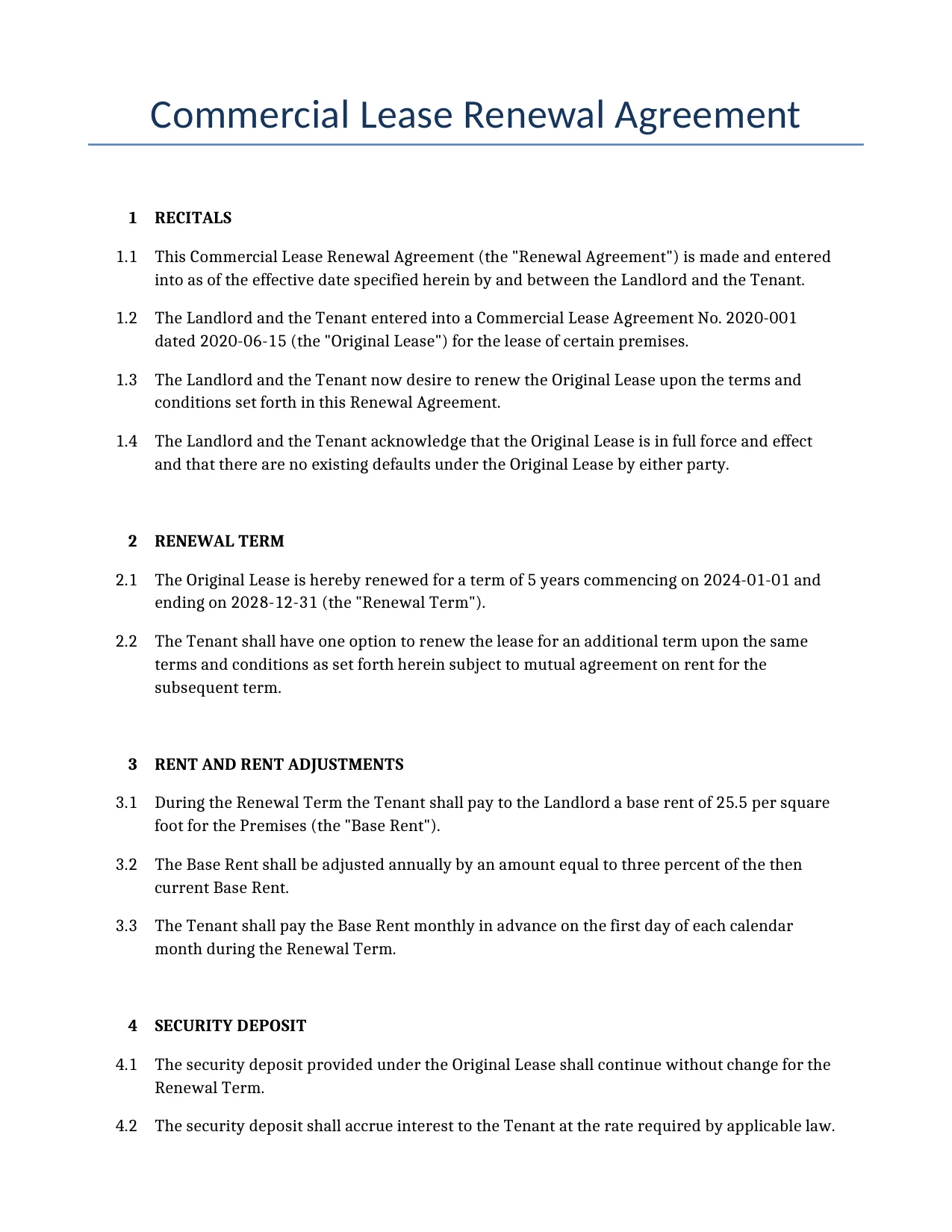
Commercial Lease Renewal Agreement
1RECITALS
This Commercial Lease Renewal Agreement (the "Renewal Agreement") is made and entered into as of the effective date specified herein by and between the Landlord and the Tenant.
The Landlord and the Tenant entered into a Commercial Lease Agreement No. 2020-001 dated 2020-06-15 (the "Original Lease") for the lease of certain premises.
The Landlord and the Tenant now desire to renew the Original Lease upon the terms and conditions set forth in this Renewal Agreement.
The Landlord and the Tenant acknowledge that the Original Lease is in full force and effect and that there are no existing defaults under the Original Lease by either party.
2RENEWAL TERM
The Original Lease is hereby renewed for a term of 5 years commencing on 2024-01-01 and ending on 2028-12-31 (the "Renewal Term").
The Tenant shall have one option to renew the lease for an additional term upon the same terms and conditions as set forth herein subject to mutual agreement on rent for the subsequent term.
3RENT AND RENT ADJUSTMENTS
During the Renewal Term the Tenant shall pay to the Landlord a base rent of 25.5 per square foot for the Premises (the "Base Rent").
The Base Rent shall be adjusted annually by an amount equal to three percent of the then current Base Rent.
The Tenant shall pay the Base Rent monthly in advance on the first day of each calendar month during the Renewal Term.
4SECURITY DEPOSIT
The security deposit provided under the Original Lease shall continue without change for the Renewal Term.
The security deposit shall accrue interest to the Tenant at the rate required by applicable law.
A portion of the security deposit in the amount of five hundred dollars shall be designated as non-refundable to cover anticipated cleaning fees.
5USE OF PREMISES
The permitted use of the Premises shall remain the same as in the Original Lease which is Retail sales of clothing and accessories.
The Tenant confirms that the proposed use of the Premises complies with all local zoning laws and regulations.
6OPERATING EXPENSES AND CAM CHARGES
The Tenant shall be responsible for paying a pro-rata share of the operating expenses during the Renewal Term.
The Tenant shall be responsible for paying common area maintenance charges during the Renewal Term.
The Tenant shall pay a pro-rata share of property taxes during the Renewal Term.
The Tenant\'s share of operating expenses and common area maintenance charges shall be calculated based on the ratio of the square footage of the leased Premises which is 2500 sq ft to the total rentable square footage of the building which is 15000 sq ft.
The Tenant shall pay the share of operating expenses and common area maintenance charges monthly in advance along with the Base Rent.
7UTILITIES AND SERVICES
The Tenant shall be responsible for paying the electricity utility during the Renewal Term.
The Landlord shall be responsible for paying the water and sewer utilities during the Renewal Term.
The gas utility shall be shared between the Landlord and the Tenant during the Renewal Term with each party paying fifty percent of the costs.
The Landlord shall be responsible for the maintenance and repair of the HVAC system during the Renewal Term.
The Landlord shall provide janitorial services for the common areas during the Renewal Term.
The Tenant shall be responsible for trash removal services during the Renewal Term.
The responsibilities for utilities and services under this Renewal Agreement differ from those in the Original Lease as specified in this Section 7.
8MAINTENANCE AND REPAIRS
The Tenant shall be responsible for the routine maintenance of the Premises during the Renewal Term.
The Landlord shall be responsible for structural repairs to the Premises including the roof foundation and exterior walls during the Renewal Term.
The Tenant shall be responsible for repairs to the HVAC system in the Premises during the Renewal Term.
The Landlord shall be responsible for plumbing repairs in the Premises during the Renewal Term.
The Tenant shall be responsible for electrical repairs to the Premises during the Renewal Term.
The Tenant shall be allowed to make improvements to the Premises during the Renewal Term provided that such improvements require the prior written approval of the Landlord.
The Tenant shall be obligated to restore the Premises to its original condition at the end of the Renewal Term excluding normal wear and tear.
The Tenant shall provide the Landlord with thirty days notice before undertaking major repairs.
The Tenant shall be allowed to perform emergency repairs without prior notice and shall seek reimbursement from the Landlord for such repairs if the Landlord is otherwise responsible for them.
9INSURANCE
The Tenant shall maintain commercial property insurance covering the Tenant\'s improvements and personal property with a limit of 500000.00.
The Tenant shall maintain commercial general liability insurance with a limit per occurrence of 1000000.00 and an aggregate limit of 2000000.00.
The Landlord shall be named as an additional insured on the Tenant\'s liability policy.
The Tenant shall provide the Landlord with thirty days prior notice for insurance policy renewals or replacements.
The Landlord shall maintain commercial property insurance and general liability insurance on the building.
The Tenant shall reimburse the Landlord for a pro-rata share of the Landlord\'s insurance premiums.
10INDEMNIFICATION
The Tenant shall indemnify the Landlord against personal injury claims and property damage claims arising from the Tenant\'s use of the leased Premises.
The Tenant shall maintain insurance covering the indemnified risks as a condition of this indemnification.
11ASSIGNMENT AND SUBLETTING
The Tenant shall be allowed to assign the lease to another party or to sublet the Premises to another party subject to the reasonable consent of the Landlord.
The Tenant shall remain liable for all obligations under the lease after an assignment.
The Tenant shall provide the Landlord with thirty days notice before requesting approval for assignment or subletting.
12DEFAULT AND REMEDIES
The Tenant shall have a grace period of 5 days to cure a monetary default before the Landlord may exercise remedies.
The Tenant shall have thirty days to cure a non-monetary default such as failure to maintain the Premises.
Failure to pay rent abandonment of premises and bankruptcy or insolvency shall each constitute an event of default by the Tenant.
Upon the Tenant\'s default the Landlord shall have the right to terminate the lease to sue for possession and to recover damages.
The Landlord may impose late fees on overdue payments as a remedy for monetary default.
The Landlord shall be entitled to recover reasonable attorney fees and costs from the Tenant in the event of default enforcement.
The Landlord shall provide written notice to the Tenant before exercising remedies for any curable default.
13SUBORDINATION AND ESTOPPEL
This Renewal Agreement and the Original Lease shall be subordinated to any existing or future mortgages on the property.
The Landlord shall provide a non-disturbance and attornment agreement to protect the Tenant\'s possession of the Premises in the event of foreclosure.
The Tenant shall provide an estoppel certificate to the Landlord within ten days after the Landlord\'s request.
The estoppel certificate shall include confirmation of the lease term status of rent payments and any defaults or disputes.
14REPRESENTATIONS AND WARRANTIES
The Original Lease commenced on 2020-01-01 and ended on 2022-12-31.
The Tenant represents that there are no existing defaults under the Original Lease by the Tenant.
The Tenant represents that to the Tenant\'s knowledge the Landlord is not in default under the Original Lease.
The Tenant represents that the Original Lease is in full force and effect without any modifications or amendments other than as expressly set forth herein.
The Tenant represents that the most recent rent payment under the Original Lease was made on 2022-11-30.
15ENTIRE AGREEMENT
This Renewal Agreement together with the original Lease Agreement dated 2020-06-15 between the Landlord and Tenant for the Premises constitutes the entire understanding between the parties.
This Renewal Agreement and the Original Lease supersede all prior representations or warranties not contained in these documents.
16AMENDMENTS
Any modifications to this Renewal Agreement must be in writing.
Any written modifications to this Renewal Agreement must be signed by both the Landlord and the Tenant.
17GOVERNING LAW
This Renewal Agreement shall be governed by American law specifically the laws of the State of California without regard to conflict of laws principles.
Any disputes under this Renewal Agreement shall be resolved exclusively in the state courts located in the State of California.
18NOTICES
All notices between the Landlord and the Tenant shall be delivered by certified mail or electronic mail.
Notices to the Landlord shall be sent to 123 Main Street New York NY 10001.
Notices to the Tenant shall be sent to 456 Elm Avenue Los Angeles CA 90001.
A copy of all notices shall be sent to the property manager at manager@example.com.
Notices shall be deemed received three business days after mailing or on the date of email transmission if sent to the designated electronic mail addresses.
19SEVERABILITY
If any provision of this Renewal Agreement is held to be invalid or unenforceable such invalidity or unenforceability shall not affect the remaining provisions of this Renewal Agreement.
20WAIVER
The failure of either the Landlord or the Tenant to enforce any provision of this Renewal Agreement shall not constitute a waiver of that provision or any other provision.
21FORCE MAJEURE
Neither the Landlord nor the Tenant shall be liable for delays in performance caused by acts of God strikes or labor disputes or epidemics or pandemics provided that payment of rent and other financial obligations shall not be excused under this clause.
The affected party shall provide written notice within five days after a Force Majeure event.
The affected party shall use reasonable efforts to mitigate the effects of any Force Majeure event.
22QUIET ENJOYMENT
The Landlord covenants that the Tenant shall have the right to quiet enjoyment of the Premises during the Renewal Term subject to the Tenant\'s full compliance with all terms and obligations of this Renewal Agreement and the Original Lease.
The Landlord shall defend the Tenant\'s quiet enjoyment only against claims arising from the Landlord\'s own title defects and only after the Landlord has cured any breaches.
23HOLDOVER
If the Tenant remains in possession after the expiration of the Renewal Term the Tenant shall pay holdover rent equal to 150 percent of the then current Base Rent.
The Tenant shall be liable for all damages caused by such holdover.
24BROKERAGE
Jane Doe Realty is the broker representing the parties in this Commercial Lease Renewal Agreement.
The total brokerage commission payable for this renewal is 5000.00 which shall be paid by the Landlord on or before 2024-12-31.
Each party shall indemnify the other against any claims by unauthorized brokers introduced by that party.
25FURTHER ASSURANCES
The Landlord and the Tenant shall each execute any additional documents necessary to effectuate this Renewal Agreement.
26COUNTERPARTS
This Renewal Agreement may be executed in counterparts each of which shall be deemed an original and all of which together shall constitute one and the same instrument.
27ELECTRONIC SIGNATURES
The parties agree that electronic signatures shall be permitted and shall have the same legal effect as original signatures.
The parties agree that delivery of this Renewal Agreement and related notices may be made via electronic means to tenant@example.com.
28COMPLIANCE WITH APPLICABLE LAW
This Renewal Agreement is intended to comply with the Uniform Commercial Code Article 2A Leases the California Civil Code Sections 1941 through 1954 the Texas Property Code Chapter 93 the Fair Housing Act at 42 U.S.C. Section 3601 et seq. the Americans with Disabilities Act at 42 U.S.C. Section 12101 et seq. and the Commercial Landlord-Tenant Act as applicable including but not limited to Arizona Revised Statutes Section 33-1301 et seq.
The Premises comply with the accessibility requirements of the Americans with Disabilities Act and the Landlord shall maintain such compliance for common areas.
29DEFINITIONS
For purposes of this Renewal Agreement and the Original Lease incorporated herein, the following terms shall have the meanings set forth below: "Premises" means the approximately 2,500 square feet of retail space located at 456 Elm Avenue, Los Angeles, California 90001, as more particularly described in the Original Lease; "Landlord" means the party identified as such in the Original Lease with its notice address as set forth in Section 18.2 herein; "Tenant" means the party identified as such in the Original Lease with its notice address as set forth in Section 18.3 herein; "Base Rent" means the rent specified in Section 3.1 herein as adjusted pursuant to Section 3.2; "Operating Expenses" means all costs and expenses incurred by Landlord in connection with the ownership, operation, maintenance, repair and management of the building and common areas as more fully set forth in the Original Lease and this Renewal Agreement, excluding certain costs as specified in Exhibit B attached hereto; "CAM" or "Common Area Maintenance" means the Tenant\'s pro-rata share of Operating Expenses; and "Renewal Term" means the period specified in Section 2.1.
30INCORPORATION OF ORIGINAL LEASE
The Original Lease dated June 15, 2020, a copy of which is attached hereto as Exhibit A and incorporated herein by this reference, is hereby renewed and extended for the Renewal Term. In the event of any conflict between the terms of this Renewal Agreement and the Original Lease, the terms of this Renewal Agreement shall control. All other terms and conditions of the Original Lease not inconsistent herewith shall remain in full force and effect during the Renewal Term.
This Renewal Agreement and the Original Lease (including all exhibits) constitute the entire agreement between the parties with respect to the leasing of the Premises, and supersede all prior agreements, understandings, representations and warranties, whether written or oral.
31RENT PAYMENT TERMS
Tenant shall pay all Rent (including Base Rent, Tenant\'s share of Operating Expenses, CAM, and any additional rent) without deduction, offset, prior notice or demand, in lawful money of the United States, at the address specified for Landlord in Section 18 or such other place as Landlord may designate. Rent shall be paid monthly in advance on or before the first (1st) day of each calendar month during the Renewal Term. If the Renewal Term commences on a day other than the first day of a calendar month, Rent for the first month shall be prorated based on the actual number of days in such partial month.
If Tenant fails to pay any Rent when due, Tenant shall pay a late charge equal to five percent (5\%) of the overdue amount to compensate Landlord for administrative costs. In addition, any Rent not paid within ten (10) days after the due date shall bear interest from the due date until paid at the rate of ten percent (10\%) per annum or the maximum rate permitted by California law, whichever is less. Acceptance of late payments or interest shall not constitute a waiver of any default.
32OPERATING EXPENSES, CAM AND TAXES
Tenant shall pay Tenant\'s Share of Operating Expenses, CAM Charges and Property Taxes during the Renewal Term. "Tenant\'s Share" shall be calculated as provided in Section 6.4. Landlord shall deliver to Tenant annually a statement of actual Operating Expenses for the prior year, and Tenant shall pay any underpayment within thirty (30) days or receive a credit for any overpayment against subsequent payments. Tenant shall have the right to audit Landlord\'s books and records relating to Operating Expenses upon reasonable notice, at Tenant\'s expense, not more than once per year. If the audit reveals an overcharge of more than five percent (5\%), Landlord shall reimburse Tenant for the audit costs. Operating Expenses shall exclude capital expenditures (except those amortized over their useful life), costs of environmental remediation not caused by Tenant, marketing expenses, Landlord\'s overhead, and other exclusions as set forth in Exhibit B. Real property taxes shall be prorated for any partial year.
33INSURANCE REQUIREMENTS
Tenant shall, at its sole cost, maintain during the Renewal Term: (i) commercial general liability insurance with limits of not less than $2,000,000 per occurrence and $4,000,000 aggregate; (ii) property insurance covering Tenant\'s improvements, trade fixtures, inventory and personal property for full replacement value; (iii) workers\' compensation insurance as required by California law; (iv) business interruption insurance; and (v) such other insurance as may be reasonably required by Landlord. All policies shall name Landlord and any mortgagee as additional insureds, shall provide for at least thirty (30) days\' prior written notice of cancellation to Landlord, and shall include a waiver of subrogation in favor of Landlord. Landlord shall maintain property and liability insurance on the building, with Tenant reimbursing its pro-rata share as an Operating Expense. Mutual waivers of subrogation are hereby agreed between Landlord and Tenant.
34MAINTENANCE AND REPAIR OBLIGATIONS
Landlord shall maintain, repair and replace the structural elements of the building, including the foundation, roof, exterior walls, and common areas (except to the extent damaged by Tenant). Tenant shall, at its sole cost, maintain the interior of the Premises, including all non-structural repairs, plumbing, electrical systems, interior walls, floors, ceilings, and HVAC systems serving the Premises exclusively. The conflicting provisions in the Original Lease and prior sections of this Renewal Agreement are superseded by this Section 34. Tenant shall obtain Landlord\'s prior written consent for any alterations exceeding $5,000. At the end of the term, Tenant shall surrender the Premises in the same condition as received, reasonable wear and tear and Landlord repairs excepted.
35ENVIRONMENTAL COMPLIANCE AND HAZARDOUS MATERIALS
Tenant shall comply with all federal, state and local environmental laws, including the California Environmental Quality Act and Hazardous Materials laws. Tenant represents and warrants that it has not used, generated, stored or disposed of any Hazardous Materials (as defined in California Health & Safety Code § 25501) in, on or about the Premises except in compliance with all applicable laws. Tenant shall indemnify, defend and hold harmless Landlord from any claims, damages, costs (including attorneys\' fees) arising from Tenant\'s violation of environmental laws or presence of Hazardous Materials introduced by Tenant. Landlord represents that, to its knowledge, the Premises are free of Hazardous Materials as of the commencement of the Renewal Term. If any release occurs, the responsible party shall remediate at its expense to the satisfaction of applicable governmental authorities.
36DEFAULT, NOTICE, CURE PERIODS AND REMEDIES
The occurrence of any of the following shall constitute an Event of Default by Tenant: (i) failure to pay Rent within five (5) days after written notice; (ii) failure to perform any other obligation within thirty (30) days after written notice (or such longer period as may be reasonably necessary if cure cannot be completed within thirty days, provided Tenant commences cure promptly); (iii) abandonment of the Premises; or (iv) insolvency, bankruptcy or assignment for benefit of creditors. These cure periods shall comply with California Civil Code §§ 1951.3 and 1951.4 and Code of Civil Procedure § 1161 et seq. Upon default, Landlord may terminate the lease, recover possession, sue for damages (including accelerated rent discounted to present value at 5\% per annum less mitigation), or pursue any other remedy at law or equity, including self-help to cure Tenant\'s obligations at Tenant\'s expense. Landlord may also impose late fees and interest as provided in Section 31.2. Tenant shall reimburse Landlord for all reasonable attorneys\' fees and costs incurred in enforcing this Renewal Agreement, and such right shall be reciprocal.
37SUBORDINATION, NON-DISTURBANCE AND ATTORNMENT
This Renewal Agreement and Tenant\'s rights hereunder shall be subordinate to any ground lease, mortgage, deed of trust or other encumbrance now or hereafter placed upon the Premises by Landlord ("Superior Interest"), provided that Landlord obtains from the holder of such Superior Interest a commercially reasonable subordination, non-disturbance and attornment agreement ("SNDA") in recordable form providing that Tenant\'s possession and rights under this Renewal Agreement will not be disturbed so long as Tenant is not in default. Tenant shall attorn to any successor landlord. Tenant agrees to execute any SNDA within ten (10) days of request.
38ESTOPPEL CERTIFICATES
Within ten (10) days after written request from Landlord or any lender or purchaser, Tenant shall execute, acknowledge and deliver an estoppel certificate certifying: (i) that this Renewal Agreement and the Original Lease are unmodified and in full force and effect (or specifying modifications); (ii) the dates to which Rent has been paid; (iii) whether Tenant has any defenses, claims, offsets or counterclaims; and (iv) such other reasonable matters as may be requested. Failure to deliver the certificate within the time required shall be conclusive upon Tenant that the lease is in full force without modification, Rent is current, and there are no defenses or offsets.
39CASUALTY AND CONDEMNATION
If the Premises or the building is damaged by fire or other casualty, Landlord shall repair the same with reasonable promptness unless Landlord elects to terminate this Renewal Agreement pursuant to California Civil Code § 1932.2 if the damage is not insured or exceeds fifty percent (50\%) of replacement cost. Rent shall abate proportionally during repair. If the Premises are taken by condemnation, this Renewal Agreement shall terminate as to the part taken, with Rent prorated. If more than twenty-five percent (25\%) of the Premises is taken, either party may terminate this Renewal Agreement. All awards shall belong to Landlord except Tenant\'s award for moving costs and business interruption.
40SURRENDER OF PREMISES
At the expiration or earlier termination of this Renewal Agreement, Tenant shall surrender the Premises to Landlord broom-clean, in good condition and repair, reasonable wear and tear excepted, with all Tenant\'s trade fixtures and personal property removed. Any alterations or improvements not removed by Tenant shall become Landlord\'s property or, at Landlord\'s election, Landlord may remove them at Tenant\'s expense. Tenant\'s obligations under this Section shall survive termination.
41RECORDATION AND TIME OF ESSENCE
Neither this Renewal Agreement nor any memorandum hereof shall be recorded without Landlord\'s prior written consent. Time is of the essence with respect to all provisions of this Renewal Agreement.
42REPRESENTATIONS, WARRANTIES AND ADDITIONAL COVENANTS
Each party represents and warrants to the other that it has full power and authority to enter into this Renewal Agreement. Tenant represents that it is in compliance with all applicable laws, has obtained all necessary permits for its use, and that the Premises comply with zoning, building codes, the Americans with Disabilities Act (42 U.S.C. § 12101 et seq.), California Civil Code §§ 1930-1954.1 and 1995.010 et seq., and all environmental laws. Landlord represents that it has title to the property and that, to its knowledge, there are no hazardous materials or violations of law affecting the Premises. Tenant shall comply with all laws relating to its use and shall obtain all required permits at its expense. Both parties waive trial by jury in any action arising out of or relating to this Renewal Agreement.
43MISCELLANEOUS
In addition to the provisions above, this Renewal Agreement incorporates all standard miscellaneous provisions required under California law, including but not limited to: (i) attorneys\' fees shall be awarded to the prevailing party in any litigation; (ii) this Renewal Agreement may be executed in counterparts, including electronic signatures which shall be deemed originals; (iii) if any provision is held invalid, the remainder shall remain enforceable; (iv) no waiver shall be effective unless in writing; (v) each party shall execute further assurances as reasonably requested; and (vi) the parties acknowledge they have been represented by counsel or had the opportunity to do so.
44SIGNATURE PAGE
| LANDLORD | |
| Signature: | |
| Print Name: | |
| Date: |
| TENANT | |
| Signature: | |
| Print Name: | |
| Date: |
This example shows approximately 70% of a typical document and is provided for illustrative purposes only. The remaining content has been omitted.
Every document generated by Docaro is tailored to your specific circumstances, jurisdiction and the information you provide. The completed document includes all applicable clauses and provisions required for your situation.
To generate the full, personalised document, answer a short series of questions and your document will be created instantly.