
AI Generated American Independent Contractor Agreement
PDF & Word - 2026 Updated
Docaro Pricing
When Do You Need an Independent Contractor Agreement in the United States?
American Legal Rules for an Independent Contractor Agreement
Using the wrong type of agreement can inadvertently create an employment relationship, subjecting the worker to labor laws and benefits obligations.
What a Proper Independent Contractor Agreement Should Include
- Parties InvolvedIdentify the hiring company and the contractor by name, address, and contact details to clearly define who is entering the agreement.
- Work DescriptionOutline the specific services or tasks the contractor will perform, including any deadlines or deliverables.
- Payment TermsSpecify how much the contractor will be paid, the payment schedule, and any expenses that will be reimbursed.
- Duration and End DateState the start and end dates of the contract or conditions under which it can be terminated early.
- Independent StatusClarify that the contractor is not an employee and handles their own taxes, insurance, and equipment.
- Confidentiality RulesRequire the contractor to keep the company's private information secret during and after the project.
- Ownership of WorkDetermine who owns the final products or ideas created by the contractor, often transferring rights to the company.
- Non-Compete LimitsPrevent the contractor from working with competitors or starting similar businesses for a set time after the contract ends.
- Dispute ResolutionDescribe how disagreements will be handled, such as through negotiation or mediation, to avoid court battles.
- SignaturesInclude spaces for both parties to sign and date the agreement to make it legally binding.
Generate Your Document in 4 Easy Steps
Why Use Docaro?
 United States
Free Example Independent Contractor Agreement Template
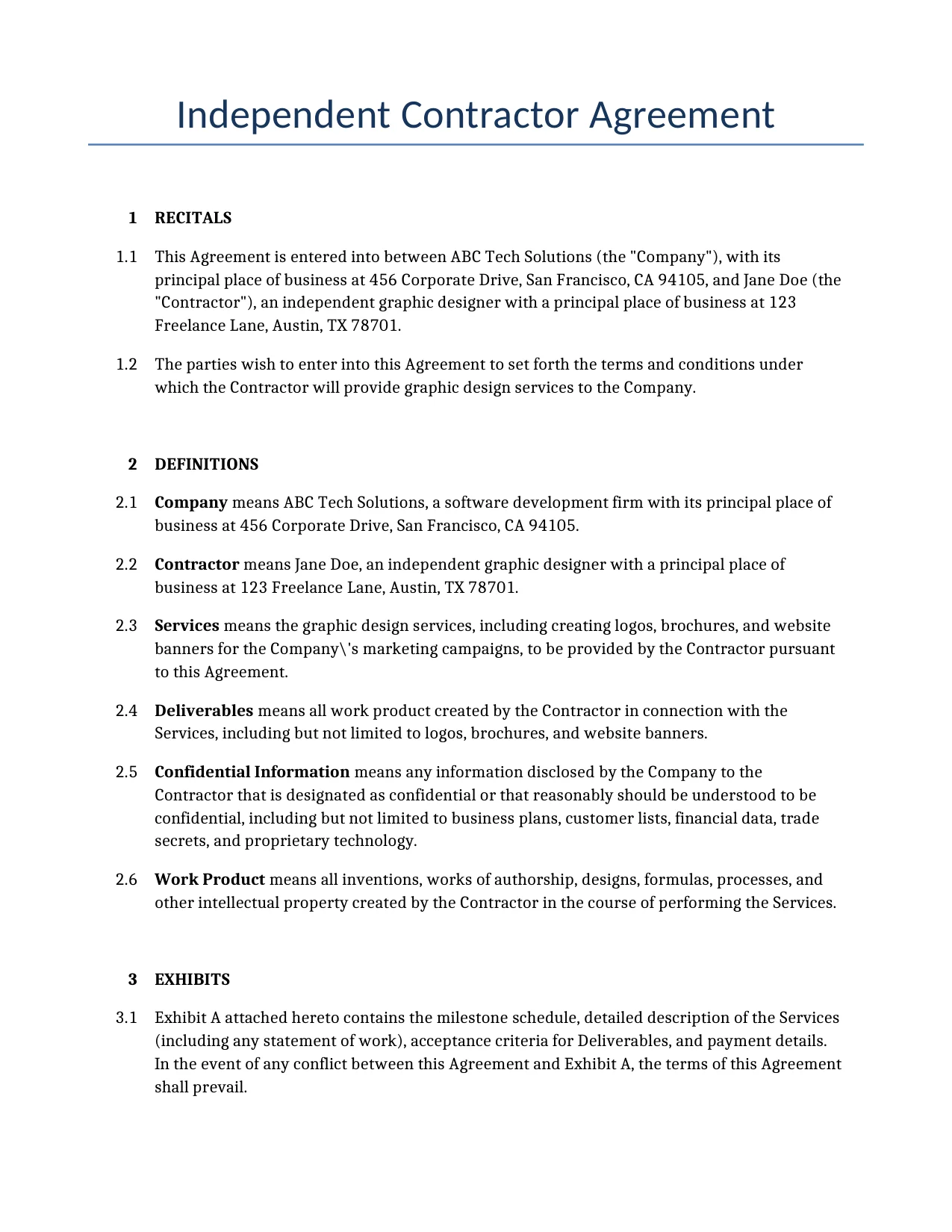
Below is a free template example of a Independent Contractor Agreement for use in the United States generated by our AI model.
The clauses in your actual Independent Contractor Agreement will vary from this example as they will be entirely bespoke to your requirements as set out in the questionnaire you complete.
Independent Contractor Agreement
1RECITALS
This Agreement is entered into between ABC Tech Solutions (the "Company"), with its principal place of business at 456 Corporate Drive, San Francisco, CA 94105, and Jane Doe (the "Contractor"), an independent graphic designer with a principal place of business at 123 Freelance Lane, Austin, TX 78701.
The parties wish to enter into this Agreement to set forth the terms and conditions under which the Contractor will provide graphic design services to the Company.
2DEFINITIONS
Company means ABC Tech Solutions, a software development firm with its principal place of business at 456 Corporate Drive, San Francisco, CA 94105.
Contractor means Jane Doe, an independent graphic designer with a principal place of business at 123 Freelance Lane, Austin, TX 78701.
Services means the graphic design services, including creating logos, brochures, and website banners for the Company\'s marketing campaigns, to be provided by the Contractor pursuant to this Agreement.
Deliverables means all work product created by the Contractor in connection with the Services, including but not limited to logos, brochures, and website banners.
Confidential Information means any information disclosed by the Company to the Contractor that is designated as confidential or that reasonably should be understood to be confidential, including but not limited to business plans, customer lists, financial data, trade secrets, and proprietary technology.
Work Product means all inventions, works of authorship, designs, formulas, processes, and other intellectual property created by the Contractor in the course of performing the Services.
3EXHIBITS
Exhibit A attached hereto contains the milestone schedule, detailed description of the Services (including any statement of work), acceptance criteria for Deliverables, and payment details. In the event of any conflict between this Agreement and Exhibit A, the terms of this Agreement shall prevail.
4SCOPE OF SERVICES
The Contractor shall provide the Services to the Company as described in Exhibit A in accordance with the terms of this Agreement. The Contractor shall deliver the Deliverables in accordance with the milestone schedule and acceptance criteria set forth in Exhibit A.
The Contractor shall determine the method, details, and means of performing the Services. The Company shall have the right to review and provide input on the results of the Services but shall not control the manner in which the Contractor performs the Services.
The Services shall commence on January 15, 2024.
5TERM AND TERMINATION
This Agreement shall commence on the Effective Date of January 1, 2024, and shall continue until completion of the Services and all Deliverables as set forth in Exhibit A, unless terminated earlier in accordance with this Section.
Either party may terminate this Agreement for convenience upon at least 30 days\' written notice to the other party.
Either party may terminate this Agreement immediately upon written notice if the other party materially breaches this Agreement and fails to cure such breach within 15 days after receiving written notice of the breach.
Either party may terminate this Agreement immediately upon written notice in the event of the other party\'s insolvency, bankruptcy, or cessation of business.
Upon termination for any reason, the Contractor shall immediately return to the Company all Company property, including Confidential Information and incomplete Deliverables, and the Company shall pay the Contractor for all Services properly performed and accepted Deliverables up to the effective date of termination on a pro-rata basis consistent with Exhibit A.
The parties\' obligations under the sections titled Confidentiality, Intellectual Property Rights, Representations and Warranties, Indemnification, Limitation of Liability, Governing Law, and any other provision that by its nature is intended to survive shall survive termination of this Agreement.
6COMPENSATION
As full compensation for the Services and Deliverables, the Company shall pay the Contractor the amounts specified in Exhibit A, which shall not exceed a total of $10,000 unless otherwise agreed in writing. This amount includes all expenses unless otherwise specified in Exhibit A as reimbursable.
Details regarding the payment schedule, milestones, and any reimbursable expenses are set forth in Exhibit A. The Contractor shall be solely responsible for the payment of all federal, state, and local taxes on any compensation received under this Agreement, and the Company shall not withhold taxes from payments made to the Contractor.
7PAYMENT TERMS
The Contractor shall submit detailed invoices to the Company via email to accounts@company.com no more frequently than monthly. Each invoice shall include a breakdown of Services performed, hours worked (if applicable), completed milestones, and any pre-approved expenses with supporting documentation.
The Company shall pay the Contractor within 30 days of receipt of a valid invoice by direct bank deposit. Late payments shall accrue interest at the rate of 1.5% per month or the maximum rate permitted by law, whichever is less.
8INDEPENDENT CONTRACTOR STATUS
The relationship between the parties is that of independent contractors. The Contractor is entering into this Agreement as an independent contractor and not as an employee, agent, or partner of the Company. Nothing in this Agreement creates an employment relationship, partnership, joint venture, or agency between the parties, and neither party shall be deemed a joint employer of the other\'s personnel.
The Contractor shall have control over the method, details, and means of performing the Services, including setting the Contractor\'s own hours, determining the work location (subject to any requirements in Exhibit A), and using the Contractor\'s own tools, equipment, and materials. The Contractor may provide similar services to other clients and is not required to work exclusively for the Company.
The Contractor is not eligible for any employee benefits from the Company, including health insurance, retirement plans, paid time off, or workers\' compensation coverage. The Contractor shall be solely responsible for all applicable taxes, insurance, and compliance with laws related to the Contractor\'s business.
The parties intend for the Contractor to be classified as an independent contractor under IRS guidelines (including but not limited to IRS Publication 15-A and Section 3508 of the Internal Revenue Code), California Assembly Bill 5 (AB5), and applicable Texas laws. The Contractor represents that the Contractor meets the criteria for independent contractor status, including behavioral control, financial control, and the relationship of the parties.
9CONFIDENTIALITY
The Contractor shall maintain the confidentiality of all Confidential Information disclosed by the Company and shall not disclose such information to any third party without the prior written consent of the Company.
The Contractor shall use at least the same degree of care to protect the Confidential Information as the Contractor uses to protect its own confidential information of a similar nature, but in no event less than reasonable care.
Upon termination of this Agreement, the Contractor shall return or destroy all Confidential Information in the Contractor\'s possession.
The obligations under this Section shall survive for a period of 5 years after the termination or expiration of this Agreement; provided, however, that with respect to any Confidential Information that constitutes a trade secret, the obligations shall continue for as long as such information remains a trade secret under applicable law.
10INTELLECTUAL PROPERTY RIGHTS
The Contractor hereby assigns to the Company all right, title, and interest in and to the Work Product created specifically under this Agreement, including all intellectual property rights therein. This assignment does not apply to any pre-existing intellectual property of the Contractor.
The Contractor warrants that the Work Product (excluding any pre-existing intellectual property) will be original and will not infringe the intellectual property rights of any third party.
The Contractor shall disclose to the Company any pre-existing intellectual property that may be incorporated into the Work Product and grants to the Company a non-exclusive, royalty-free, worldwide, perpetual license to use any such pre-existing intellectual property incorporated into the Work Product.
To the extent permitted by applicable law, including under California Civil Code Section 3344.1 and similar laws in other jurisdictions, the Contractor waives any moral rights in the Work Product.
The Contractor shall execute any further documents reasonably requested by the Company to perfect the assignment of intellectual property rights under this Section. The Contractor shall indemnify the Company against any third-party claims of intellectual property infringement related to the Work Product, subject to the limitations in the Limitation of Liability section.
11REPRESENTATIONS AND WARRANTIES
Each party represents and warrants that it has the full right, power, and authority to enter into this Agreement and perform its obligations hereunder. The execution of this Agreement does not conflict with any other agreements or obligations of either party.
The Contractor represents and warrants that the Contractor is an independent contractor and not an employee, agent, or partner of the Company. The Contractor possesses all necessary licenses, permits, and certifications required to perform the Services.
The Contractor warrants that the Services and Deliverables shall not infringe on the intellectual property rights of any third party and shall be performed in a professional and workmanlike manner consistent with industry standards.
The Contractor warrants that it will comply with all applicable anti-discrimination laws, including but not limited to Title VII of the Civil Rights Act of 1964, the Americans with Disabilities Act, and analogous state laws such as the California Fair Employment and Housing Act.
The Contractor shall comply with all applicable federal, state, and local laws in the performance of the Services, including those related to independent contractor classification under IRS guidelines, California AB5, and Texas law.
12LIMITATION OF LIABILITY
NEITHER PARTY SHALL BE LIABLE TO THE OTHER FOR ANY INDIRECT, CONSEQUENTIAL, INCIDENTAL, PUNITIVE, OR SPECIAL DAMAGES ARISING OUT OF OR RELATED TO THIS AGREEMENT, EVEN IF ADVISED OF THE POSSIBILITY OF SUCH DAMAGES.
IN NO EVENT SHALL EITHER PARTY\'S TOTAL LIABILITY UNDER THIS AGREEMENT EXCEED THE TOTAL AMOUNTS PAID OR PAYABLE TO THE CONTRACTOR UNDER THIS AGREEMENT. THIS LIMITATION SHALL NOT APPLY TO LIABILITY ARISING FROM GROSS NEGLIGENCE, WILLFUL MISCONDUCT, INTELLECTUAL PROPERTY INFRINGEMENT, BREACH OF CONFIDENTIALITY, OR INDEMNIFICATION OBLIGATIONS.
13INDEMNIFICATION
Each party (the "Indemnifying Party") shall indemnify, defend, and hold harmless the other party, its officers, directors, employees, and agents from and against any and all claims, losses, damages, liabilities, costs, and expenses (including reasonable attorneys\' fees) arising out of or related to the Indemnifying Party\'s negligence, breach of this Agreement, or willful misconduct.
The Contractor shall maintain insurance in amounts sufficient to support the indemnification obligations under this Section. The Contractor shall promptly notify the Company of any claims or lawsuits that may trigger the indemnification obligations under this Section.
14INSURANCE
The Contractor shall maintain (i) general liability insurance with a minimum coverage limit of $2,000,000 per occurrence, naming the Company as an additional insured; (ii) professional liability (errors and omissions) insurance with a minimum coverage limit of $1,000,000, given the nature of the graphic design services; and (iii) workers\' compensation insurance as required by applicable law.
The Contractor shall provide proof of insurance to the Company upon request.
15NON-COMPETE AND NON-SOLICITATION
During the term of this Agreement and for 6 months thereafter, the Contractor shall not, directly or indirectly, solicit or attempt to solicit any clients or employees of the Company with whom the Contractor had material contact in connection with the Services.
16DATA PROTECTION AND PRIVACY
In connection with performing the Services, if the Contractor handles any personal information on behalf of the Company, the Contractor shall comply with all applicable data protection and privacy laws, including the California Consumer Privacy Act (CCPA) as amended by the California Privacy Rights Act (CPRA).
The Contractor shall implement appropriate technical and organizational measures to protect personal information, shall not use or disclose such information except as necessary to perform the Services or as required by law, and shall return or delete all personal information upon termination of this Agreement or at the Company\'s request.
17AUDIT RIGHTS
Upon reasonable notice and no more than once per calendar year, the Company may audit the Contractor\'s records related to invoices and reimbursable expenses under this Agreement during normal business hours to verify accuracy and compliance. Any overpayments identified shall be refunded to the Company.
18EXPORT CONTROL AND SANCTIONS COMPLIANCE
The Contractor shall comply with all applicable U.S. export control laws and economic sanctions regulations, including those administered by the U.S. Department of Commerce, the U.S. Department of Treasury\'s Office of Foreign Assets Control (OFAC), and the International Traffic in Arms Regulations (ITAR). The Contractor represents that it is not a Sanctioned Person and shall not use or disclose any technology or data provided under this Agreement in violation of such laws.
19GOVERNING LAW
This Agreement shall be governed by and construed in accordance with the laws of the State of California and applicable United States federal law, without regard to conflict of laws principles.
The parties hereby irrevocably submit to the jurisdiction of the state and federal courts located in San Francisco County, California, for any action arising out of or relating to this Agreement. Such jurisdiction is mutual and neither party shall assert that such courts are an inconvenient forum.
20DISPUTE RESOLUTION
The parties shall first attempt to resolve any dispute arising out of or relating to this Agreement through good faith negotiations. If the dispute cannot be resolved amicably within 30 days, either party may submit the dispute to binding arbitration administered by the American Arbitration Association in accordance with its Commercial Arbitration Rules.
The arbitration shall take place in San Francisco County, California, or another location mutually agreed upon by the parties. Each party shall bear its own costs, and the arbitrator shall allocate arbitration fees and expenses in accordance with the rules. Judgment on the award may be entered in any court having jurisdiction.
21FORCE MAJEURE
Neither party shall be liable for any delay or failure to perform its obligations under this Agreement if such delay or failure is caused by a Force Majeure event, including natural disasters, acts of God, pandemics, epidemics, government orders, or other events beyond the party\'s reasonable control.
The affected party shall provide written notice of the Force Majeure event to the other party within 5 business days of its occurrence and shall take reasonable steps to mitigate the effects. If the Force Majeure event continues for more than 30 days, either party may terminate this Agreement upon written notice to the other party.
22ASSIGNMENT
Neither party may assign any of its rights or obligations under this Agreement without the prior written consent of the other party, except that the Company may assign this Agreement to an affiliate or in connection with a merger, acquisition, or sale of all or substantially all of its assets without the Contractor\'s consent. Any attempted assignment in violation of this Section shall be null and void.
23ENTIRE AGREEMENT
This Agreement, including all Exhibits, constitutes the entire understanding between the parties and supersedes all prior agreements, understandings, and negotiations, whether written or oral.
Any modifications to this Agreement must be in writing and signed by both parties.
24AMENDMENTS
Any amendments to this Agreement must be made in writing and signed by both parties.
25SEVERABILITY
If any provision of this Agreement is held to be invalid or unenforceable, the remaining provisions shall remain in full force and effect. The parties shall negotiate in good faith to replace any invalid provision with a valid one that achieves the original intent.
26WAIVER
The failure of either party to enforce any provision of this Agreement shall not constitute a waiver of that or any other provision. Any waiver must be in writing and signed by the waiving party.
27NOTICES
All notices under this Agreement shall be in writing and shall be delivered by certified mail, overnight courier, or electronic mail (with read receipt or confirmation of delivery requested) to the addresses specified below.
Notices to the Contractor shall be sent to 123 Freelance Lane, Austin, TX 78701 or contractor@example.com.
Notices to the Company shall be sent to 456 Corporate Drive, San Francisco, CA 94105 or legal@company.com.
Notices sent by electronic mail shall be deemed received upon confirmation of receipt. Notices sent by certified mail or overnight courier shall be deemed received 3 business days after sending or upon delivery, whichever is earlier.
28COUNTERPARTS
This Agreement may be executed in any number of counterparts, each of which shall be deemed an original, and all of which together shall constitute one and the same instrument. Electronic signatures (including DocuSign or similar platforms) shall be deemed original signatures for all purposes.
29MISCELLANEOUS
This Agreement is not intended to and does not create any rights in third-party beneficiaries.
The headings in this Agreement are for convenience only and shall not affect the interpretation of this Agreement.
This Agreement shall not be construed against the drafter. It has been negotiated by both parties, each with the benefit of legal counsel or the opportunity to obtain such counsel.
Electronic signatures shall be valid and binding to the same extent as original signatures.
30SURVIVAL
The following sections shall survive any termination or expiration of this Agreement: Confidentiality, Intellectual Property Rights, Representations and Warranties, Indemnification, Limitation of Liability, Non-Compete and Non-Solicitation, Governing Law, Data Protection and Privacy, and any other provision that by its nature is intended to survive.
31SIGNATURE PAGE
IN WITNESS WHEREOF, the parties have executed this Independent Contractor Agreement as of the date first above written.
Company: ABC Tech Solutions
By: _______________________________
Printed Name: _____________________
Title: _____________________________
Date: _____________________________
Contractor: Jane Doe
By: _______________________________
Printed Name: Jane Doe
Title: Independent Contractor
Date: _____________________________
This example shows approximately 70% of a typical document and is provided for illustrative purposes only. The remaining content has been omitted.
Every document generated by Docaro is tailored to your specific circumstances, jurisdiction and the information you provide. The completed document includes all applicable clauses and provisions required for your situation.
To generate the full, personalised document, answer a short series of questions and your document will be created instantly.