
AI Generated American Commercial Lease Assignment Agreement
PDF & Word - 2026 Updated
Docaro Pricing
When do you need a Commercial Lease Assignment Agreement in the United States?
American Legal Rules for a Commercial Lease Assignment Agreement
Using the wrong structure for a commercial lease assignment can invalidate the transfer of obligations and expose parties to unforeseen liabilities.
What a Proper Commercial Lease Assignment Agreement Should Include
- Parties InvolvedClearly identify the original tenant (assignor), the new tenant (assignee), and the landlord, including their full names and contact details.
- Property DetailsDescribe the leased commercial property with its exact address and any specific areas being assigned.
- Lease Assignment TermsSpecify that all rights, duties, and obligations from the original lease are transferred to the new tenant starting from a defined date.
- Rent and Payment ObligationsOutline the rent amount, due dates, and any security deposits that the new tenant must pay to the landlord.
- Landlord's ConsentInclude a statement confirming the landlord's written approval for the assignment to make it legally valid.
- Assumption of ResponsibilitiesState that the new tenant fully accepts and agrees to follow all terms of the original lease, including maintenance and insurance.
- Release of Original TenantIndicate if the original tenant is released from future liabilities or remains responsible for any breaches by the new tenant.
- Signatures and DatesRequire signatures from all parties, along with the date, to finalize and enforce the agreement.
Generate Your Document in 4 Easy Steps
Why Use Docaro?
 United States
Free Example Commercial Lease Assignment Agreement Template
Below is a free template example of a Commercial Lease Assignment Agreement for use in the United States generated by our AI model.
The clauses in your actual Commercial Lease Assignment Agreement will vary from this example as they will be entirely bespoke to your requirements as set out in the questionnaire you complete.
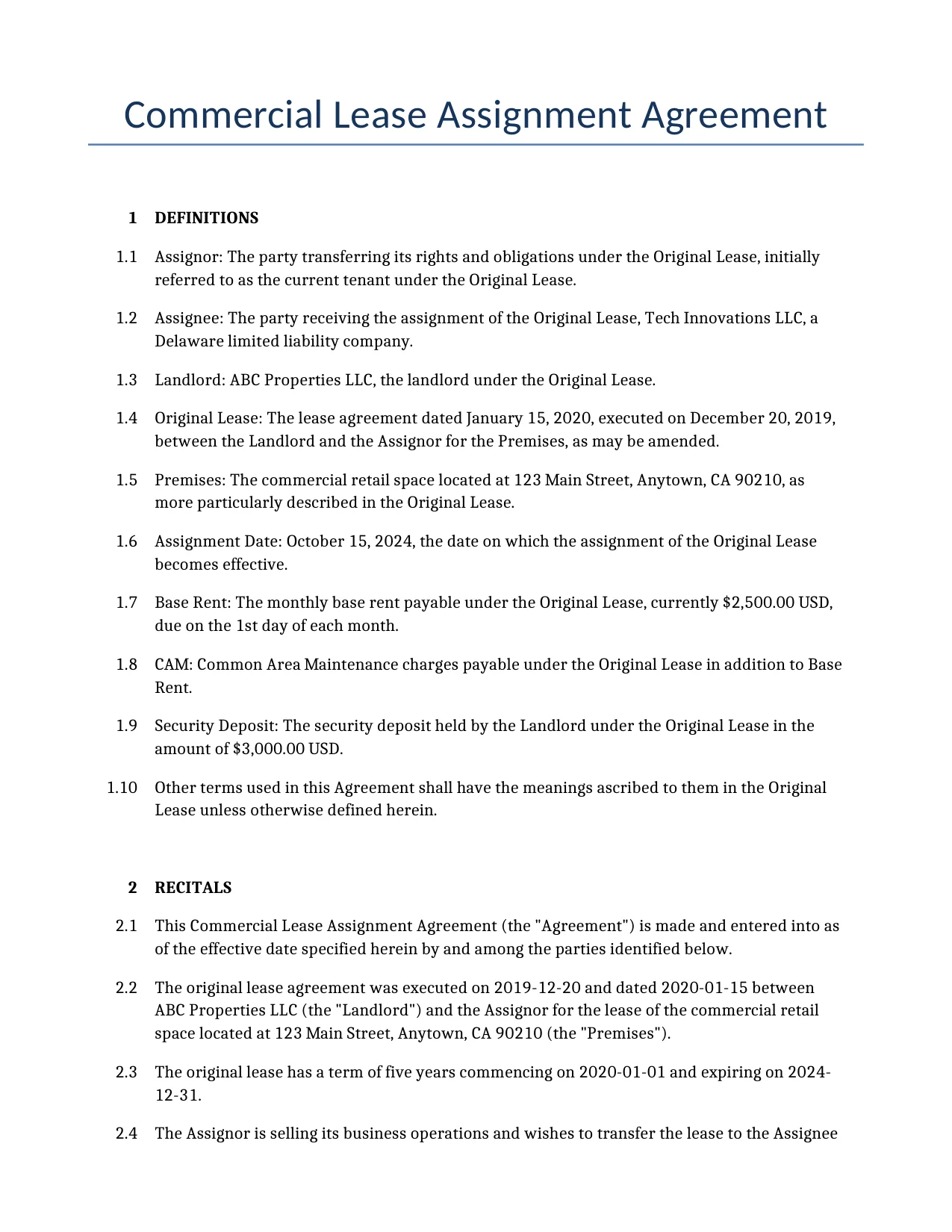
Commercial Lease Assignment Agreement
1DEFINITIONS
Assignor: The party transferring its rights and obligations under the Original Lease, initially referred to as the current tenant under the Original Lease.
Assignee: The party receiving the assignment of the Original Lease, Tech Innovations LLC, a Delaware limited liability company.
Landlord: ABC Properties LLC, the landlord under the Original Lease.
Original Lease: The lease agreement dated January 15, 2020, executed on December 20, 2019, between the Landlord and the Assignor for the Premises, as may be amended.
Premises: The commercial retail space located at 123 Main Street, Anytown, CA 90210, as more particularly described in the Original Lease.
Assignment Date: October 15, 2024, the date on which the assignment of the Original Lease becomes effective.
Base Rent: The monthly base rent payable under the Original Lease, currently $2,500.00 USD, due on the 1st day of each month.
CAM: Common Area Maintenance charges payable under the Original Lease in addition to Base Rent.
Security Deposit: The security deposit held by the Landlord under the Original Lease in the amount of $3,000.00 USD.
Other terms used in this Agreement shall have the meanings ascribed to them in the Original Lease unless otherwise defined herein.
2RECITALS
This Commercial Lease Assignment Agreement (the "Agreement") is made and entered into as of the effective date specified herein by and among the parties identified below.
The original lease agreement was executed on 2019-12-20 and dated 2020-01-15 between ABC Properties LLC (the "Landlord") and the Assignor for the lease of the commercial retail space located at 123 Main Street, Anytown, CA 90210 (the "Premises").
The original lease has a term of five years commencing on 2020-01-01 and expiring on 2024-12-31.
The Assignor is selling its business operations and wishes to transfer the lease to the Assignee to ensure continuity of the retail space usage.
The original lease is not currently in default and no party has breached its terms.
The Assignee is a Business Successor to the Assignor.
The parties desire to assign the original lease effective as of 2024-10-15.
3ASSIGNMENT OF LEASE
The Assignor hereby assigns to the Assignee all of the Assignor's right, title, and interest in and to the original lease effective as of 2024-10-15.
4CONSENT OF LANDLORD
The Landlord provided its consent to the assignment on 2024-09-01.
The Landlord has provided written consent to the assignment.
The Landlord does not agree to release the Assignor from all future obligations under the lease upon assignment.
5ASSUMPTION OF OBLIGATIONS
The Assignee hereby assumes all obligations under the original lease from the assignment date onward including but not limited to Base Rent, Common Area Maintenance (CAM), Property Taxes, maintenance obligations, lease covenants, applicable laws, and environmental standards.
6REPRESENTATIONS AND WARRANTIES OF ASSIGNOR
The Assignor represents and warrants that the lease is in full force and effect without any modifications except as disclosed.
The Assignor has not committed any defaults or breaches under the lease.
The Landlord is not in default under the lease.
The Assignor is not currently involved in any bankruptcy or insolvency proceedings.
The Assignor has full authority to assign the lease without needing further consents except as specified including Landlord consent required and prior notice to Landlord.
The Assignor warrants that there are no liens, encumbrances, or security interests affecting the Assignor’s interest in the Original Lease.
The Assignor warrants that all rent, charges, and other amounts payable under the Original Lease are paid current through the Assignment Date.
7REPRESENTATIONS AND WARRANTIES OF ASSIGNEE
The Assignee is Tech Innovations LLC, a Limited Liability Company (LLC) organized in Delaware and is in good standing in the state of organization.
The Assignee is duly organized, validly existing, and in good standing under the laws of its state of organization and is qualified to do business in the state where the leased premises are located.
The Assignee has all necessary power and authority to execute and perform under this Agreement and entering into this Agreement will not conflict with its organizational documents, other contracts, or applicable laws.
There are no pending or threatened legal proceedings against the Assignee that could materially affect its ability to perform the lease obligations.
The Assignee has working capital in the amount of 500000 and a net worth of 2500000 as evidenced by financial statements as of 2023-12-31 which are true, complete, and fairly present its financial condition in accordance with GAAP.
The Assignee has experience as a prior tenant in similar commercial property with a management team possessing leasing expertise that supports its commitment to perform lease obligations.
The Assignee intends to fully assume and perform all obligations under the original lease.
The Assignee warrants that it maintains adequate insurance coverage as required by the Original Lease and will provide evidence of such coverage to the Landlord upon request.
The Assignee warrants that it is in compliance with all applicable laws, including the Americans with Disabilities Act (ADA), and will maintain such compliance during the term of the Original Lease.
8INDEMNIFICATION
The Assignor shall indemnify, defend, and hold harmless the Assignee, the Landlord, and their respective officers, directors, employees, agents, and successors from and against any and all claims, liabilities, losses, damages, costs, and expenses (including reasonable attorneys’ fees) arising out of or related to any breach by the Assignor of the Original Lease or this Agreement occurring prior to the Assignment Date, including but not limited to payment obligations, maintenance and repair obligations, compliance with lease covenants, and environmental matters.
The Assignee shall indemnify, defend, and hold harmless the Assignor, the Landlord, and their respective officers, directors, employees, agents, and successors from and against any and all claims, liabilities, losses, damages, costs, and expenses (including reasonable attorneys’ fees) arising out of or related to any breach by the Assignee of the Original Lease or this Agreement occurring on or after the Assignment Date, including but not limited to payment obligations, maintenance and repair obligations, compliance with lease covenants, and environmental matters.
The indemnities set forth in this Section 8 shall survive the assignment of the Original Lease and any termination thereof.
The Landlord shall be entitled to enforce the indemnification obligations of both the Assignor and the Assignee as a third-party beneficiary of this Section 8.
Without limiting the foregoing, the Assignor shall indemnify, defend, and hold harmless the Assignee and the Landlord from any claims, liabilities, or costs related to the presence or release of any hazardous materials at the Premises prior to the Assignment Date, and the Assignee shall do the same for any such matters occurring on or after the Assignment Date. This environmental indemnification shall survive the assignment and any termination of the Original Lease.
Each indemnitor shall, upon request, defend the indemnitee with counsel reasonably acceptable to the indemnitee at the indemnitor’s sole expense.
9RENT AND SECURITY DEPOSIT
The monthly rent amount under the lease is 2500.00 USD and is due on the 1st day of each month.
The Assignee shall pay the prorated rent for the period from the assignment date to the end of the month directly to the Assignor.
The rent shall be prorated between the Assignor and Assignee for the month of assignment on a daily proration basis based on actual days.
The existing security deposit held under the lease is in the amount of 3000.00 USD and the Assignor shall transfer the existing security deposit to the Assignee as part of the assignment.
10POSSESSION AND CONDITION OF PREMISES
The Assignor delivered possession of the Premises to the Assignee on 2024-10-15.
The Premises were delivered to the Assignee in the condition required by the original lease.
The Assignee performed an inspection of the Premises prior to accepting possession.
The Assignor represents that there are no known defects, the Premises are compliant with lease standards, and all systems are operational.
11ASSIGNMENT OF CONTRACTS AND PERMITS
The Assignor hereby assigns to the Assignee any existing subleases, service contracts, and permits related to the Premises effective as of 2024-10-15.
The necessary consents from third parties and the Landlord for the assignment of these items have been obtained.
12COVENANTS
The Assignor covenants to cooperate with the Assignee in all matters related to the assignment.
The parties mutually covenant to provide further assurances by executing additional documents as needed.
The Assignee covenants to comply with all terms of the original lease from the assignment date onward.
The covenants shall commence effective as of 2024-10-15.
13NOTICES
All notices, demands, or communications under this Agreement shall be in writing and shall be deemed duly given (i) when delivered by hand, (ii) three (3) business days after being deposited in the United States mail, certified or registered mail, return receipt requested, with postage prepaid, (iii) the next business day after deposit with a nationally recognized overnight delivery service (such as Federal Express), or (iv) when sent by email if confirmation of receipt is obtained, to the addresses and emails set forth below or to such other address as a party may designate by notice.
Notices to the Assignor shall be sent to 123 Main Street, Suite 100, Anytown, CA 90210, Email: assignor@example.com.
Notices to the Assignee shall be sent to 456 Oak Avenue, Los Angeles, CA 90210, Email: assignee@example.com.
Notices to the Landlord shall be sent to 789 Pine Road, Chicago, IL 60601, Email: landlord@abcproperties.com.
Notices sent by certified mail shall be deemed delivered three business days after mailing. Notices sent by overnight delivery shall be deemed delivered on the next business day. Email notices shall be deemed delivered upon confirmation of receipt.
14GOVERNING LAW
This Agreement shall be governed by and construed in accordance with the laws of the State of California, including without limitation California Civil Code Sections 1995.010 through 1995.270 relating to the transfer of commercial leases.
The parties hereby consent to the exclusive jurisdiction and venue of the state and federal courts located in the county where the Premises are situated for any disputes arising out of or relating to this Agreement.
15SEVERABILITY
If any provision of this Agreement is held to be invalid or unenforceable the remaining provisions shall remain in full force and effect.
16WAIVER
The failure of any party to enforce any provision of this Agreement shall not constitute a waiver of that provision or any other provision.
This waiver provision applies to the Assignor, the Assignee, and the Landlord.
17COUNTERPARTS
This Agreement may be executed in multiple counterparts each of which shall be deemed an original and all of which together shall constitute one and the same instrument.
Execution may be in both traditional and electronic forms.
18SUCCESSORS AND ASSIGNS
This Agreement shall be binding upon and inure to the benefit of the successors of both the Assignor and the Assignee.
This Agreement shall be binding upon and inure to the benefit of the permitted assigns of both the Assignor and the Assignee with Landlord consent.
19EXPENSES AND COSTS
The Assignee shall be responsible for paying the legal fees associated with this lease assignment.
Transfer taxes related to this lease assignment shall be split equally between the parties.
The Assignee shall pay any fees charged by the Landlord for consenting to the lease assignment.
The Assignee shall be responsible for paying any recording or filing fees related to the lease assignment.
The Assignor shall not pay any broker commissions arising from this lease assignment.
20MISCELLANEOUS
The headings in this Agreement are for descriptive purposes only and shall not control or affect the interpretation of this Agreement.
All amendments to this Agreement must be in writing and signed by all parties.
If any provision of this Agreement is found invalid the remainder of the Agreement shall stay in effect.
Any waiver of a breach must be in writing and no waiver implies future waivers.
The Landlord is a third party beneficiary under this Agreement.
This Agreement may be executed in counterparts and electronic signatures shall be permitted.
This Agreement constitutes the entire agreement between the parties and supersedes all prior understandings.
21ENTIRE AGREEMENT; AMENDMENT
This Agreement, together with the Original Lease, constitutes the entire understanding and agreement between the parties with respect to the subject matter hereof and supersedes all prior and contemporaneous agreements, understandings, inducements, and conditions, express or implied, oral or written, of any nature whatsoever with respect to the subject matter hereof. This Agreement may only be amended in a writing signed by all parties, including the Landlord.
The representations, warranties, and indemnities contained in this Agreement, as well as any covenants that by their nature are intended to survive, shall survive the execution and delivery of this Agreement, the assignment of the Original Lease, and any termination thereof.
22SIGNATURES
| ASSIGNOR | |
| Signature: | |
| Print Name: | |
| Date: |
| ASSIGNEE | |
| Signature: | |
| Print Name: | |
| Date: |
| LANDLORD | |
| Signature: | |
| Print Name: | |
| Date: |
This example shows approximately 70% of a typical document and is provided for illustrative purposes only. The remaining content has been omitted.
Every document generated by Docaro is tailored to your specific circumstances, jurisdiction and the information you provide. The completed document includes all applicable clauses and provisions required for your situation.
To generate the full, personalised document, answer a short series of questions and your document will be created instantly.