
AI Generated Employee Disciplinary and Grievance Policy for use in the United States
PDF & Word - 2026 Updated
Docaro Pricing
When Do You Need an Employee Disciplinary and Grievance Policy in the United States?
American Legal Rules for Employee Disciplinary and Grievance Policies
Using an improper structure for disciplinary and grievance procedures can fail to comply with US employment laws and expose the company to legal risks.
What a Proper Employee Disciplinary and Grievance Policy Should Include
- Clear Rules and ExpectationsThe policy should outline the company's standards of behavior and performance to help employees understand what is expected of them.
- Step-by-Step Disciplinary ProcessIt must describe a fair sequence of actions, starting with warnings and progressing to possible termination, for addressing misconduct or poor performance.
- Investigation ProceduresThe policy needs to explain how complaints or issues will be promptly and impartially investigated before any decisions are made.
- Employee Rights to RespondEmployees should have the chance to explain their side, present evidence, and appeal any disciplinary decisions.
- Grievance Filing ProcessIt should detail simple steps for employees to raise concerns or complaints about their work environment or treatment.
- Timeline for ResolutionsThe policy must set reasonable deadlines for handling grievances and disciplinary matters to ensure quick and efficient outcomes.
- Confidentiality MeasuresAll proceedings should be kept private to protect the privacy and trust of everyone involved.
- Non-Retaliation AssuranceThe policy should guarantee that employees won't face negative consequences for raising a grievance or participating in a process in good faith.
- Record-Keeping GuidelinesIt needs to specify how records of disciplinary actions and grievances will be securely maintained and when they will be reviewed or destroyed.
Generate Your Document in 4 Easy Steps
Why Use Docaro?
 United States
Free Example Employee Disciplinary and Grievance Policy Template
Below is a free template example of a Employee Disciplinary and Grievance Policy for use in the United States generated by our AI model.
The clauses in your actual Employee Disciplinary and Grievance Policy will vary from this example as they will be entirely bespoke to your requirements as set out in the questionnaire you complete.
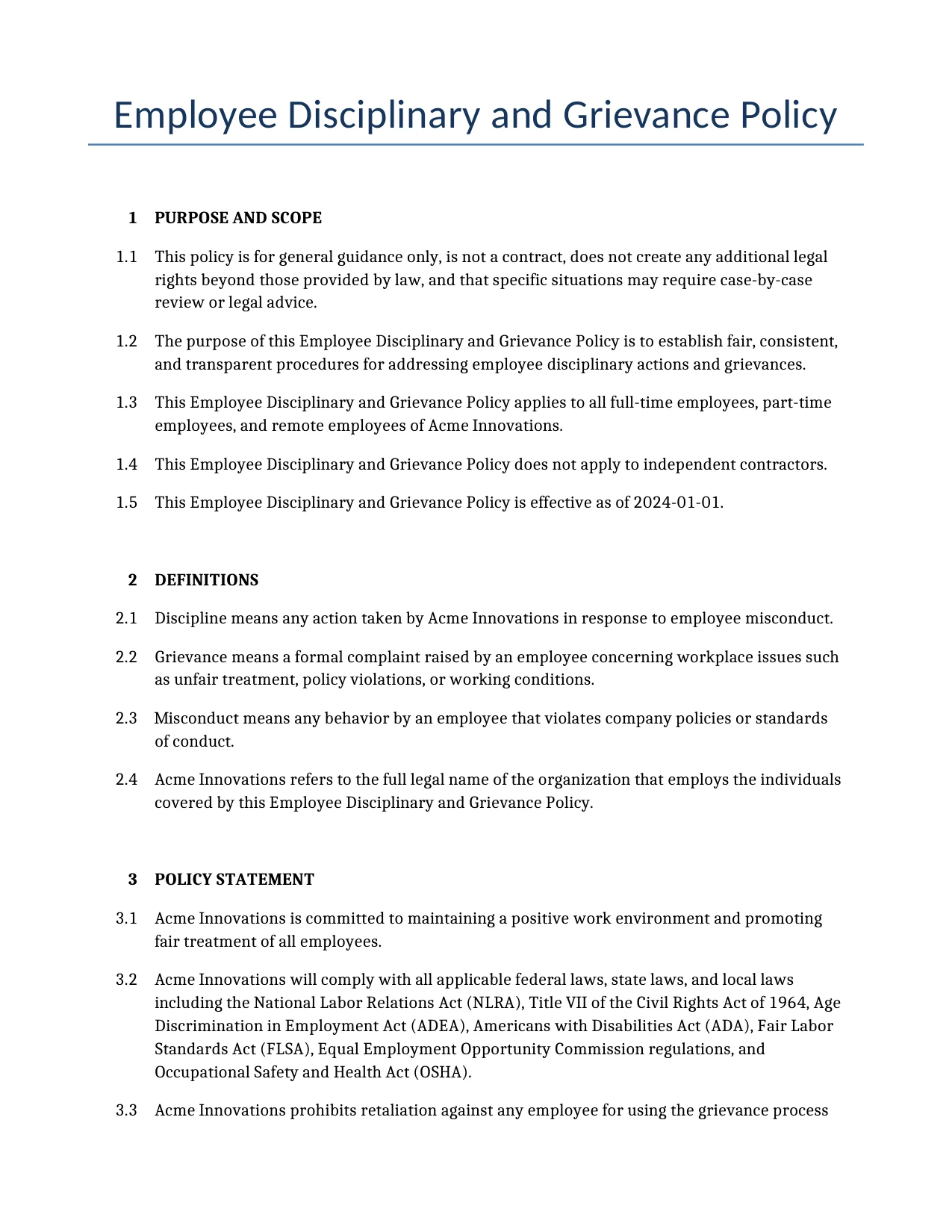
Employee Disciplinary and Grievance Policy
1PURPOSE AND SCOPE
This policy is for general guidance only, is not a contract, does not create any additional legal rights beyond those provided by law, and that specific situations may require case-by-case review or legal advice.
The purpose of this Employee Disciplinary and Grievance Policy is to establish fair, consistent, and transparent procedures for addressing employee disciplinary actions and grievances.
This Employee Disciplinary and Grievance Policy applies to all full-time employees, part-time employees, and remote employees of Acme Innovations.
This Employee Disciplinary and Grievance Policy does not apply to independent contractors.
This Employee Disciplinary and Grievance Policy is effective as of 2024-01-01.
2DEFINITIONS
Discipline means any action taken by Acme Innovations in response to employee misconduct.
Grievance means a formal complaint raised by an employee concerning workplace issues such as unfair treatment, policy violations, or working conditions.
Misconduct means any behavior by an employee that violates company policies or standards of conduct.
Acme Innovations refers to the full legal name of the organization that employs the individuals covered by this Employee Disciplinary and Grievance Policy.
3POLICY STATEMENT
Acme Innovations is committed to maintaining a positive work environment and promoting fair treatment of all employees.
Acme Innovations will comply with all applicable federal laws, state laws, and local laws including the National Labor Relations Act (NLRA), Title VII of the Civil Rights Act of 1964, Age Discrimination in Employment Act (ADEA), Americans with Disabilities Act (ADA), Fair Labor Standards Act (FLSA), Equal Employment Opportunity Commission regulations, and Occupational Safety and Health Act (OSHA).
Acme Innovations prohibits retaliation against any employee for using the grievance process in good faith.
This policy statement is effective as of 2024-01-01.
4PRINCIPLES GUIDING THE POLICY
All disciplinary and grievance procedures will be conducted in a fair manner, ensuring that employees are given a reasonable opportunity to respond to allegations and that decisions are based on evidence.
Investigations and hearings will be carried out by impartial individuals who have no personal interest or involvement in the matter, to ensure unbiased outcomes.
All information related to disciplinary and grievance matters will be treated as confidential, shared only with those who have a legitimate need to know, to protect the privacy of all parties involved.
All processes will be handled promptly to minimize disruption, with initial investigations completed within 30 business days and ongoing matters resolved without unreasonable delay.
Any disciplinary action taken will be proportionate to the nature and severity of the misconduct, ensuring that responses are appropriate and not excessive.
5TYPES OF MISCONDUCT AND DISCIPLINARY ACTIONS
Minor infractions include tardiness, minor dress code violations, and unauthorized use of company email for personal matters.
Disciplinary actions for minor infractions may include a verbal warning or a written warning.
Moderate misconduct includes repeated tardiness, insubordination, and misuse of company resources.
Disciplinary actions for moderate misconduct may include a written warning or suspension without pay.
Serious violations include theft, harassment, and violation of safety protocols leading to injury.
Disciplinary actions for serious violations may include suspension with pay pending investigation or termination of employment.
This Employee Disciplinary and Grievance Policy incorporates progressive discipline whereby Acme Innovations applies disciplinary actions in increasing levels of severity depending on the nature of the misconduct and the employee's disciplinary history. Discipline will not be imposed for engaging in protected conduct under the NLRA (such as concerted activities for mutual aid or protection, including discussions with coworkers about wages or working conditions), filing complaints with government agencies (such as the EEOC, NLRB, or OSHA), or requesting accommodations under the ADA. Examples of protected activity include joining with coworkers to complain about unsafe conditions, filing a wage claim under the FLSA, or requesting a reasonable accommodation for a disability. See the Prohibited Retaliation section for additional details.
This section is effective as of 2024-01-01.
6DISCIPLINARY PROCEDURE
The disciplinary procedure begins with a verbal warning when appropriate for the first instance of minor misconduct.
The disciplinary procedure proceeds to a written warning when the misconduct is repeated or of moderate severity.
The disciplinary procedure may include suspension when the misconduct warrants temporary removal from the workplace.
The disciplinary procedure may culminate in termination of employment for serious violations or when prior disciplinary actions have not corrected the behavior.
Acme Innovations shall complete the initial investigation within 30 days after a disciplinary issue is reported.
Acme Innovations shall provide a written notification letter to the employee before any disciplinary meeting.
Acme Innovations shall notify the employee of a disciplinary meeting at least 5 days in advance.
The employee has the right to have a representative present at disciplinary meetings.
The employee may submit a first level appeal or a second level appeal after a disciplinary decision.
The employee shall have 7 days to submit an appeal after receiving a disciplinary decision.
All parties shall maintain confidentiality during the disciplinary procedure.
Acme Innovations shall retain records of disciplinary actions for 3 years or as required by law.
Discipline will not be imposed for engaging in protected conduct under the NLRA, filing complaints with government agencies, or requesting accommodations under the ADA. See the Types of Misconduct and Disciplinary Actions section and the Prohibited Retaliation section for additional details. This policy is for general guidance only and is not a contract.
7INVESTIGATION PROCESS
Investigations shall be prompt, thorough, and impartial. The investigator shall aim to complete the investigation within 30 days from the date the allegation is received, with reasonable extensions permitted upon notice to the employee.
The Human Resources Department shall appoint an internal HR representative to serve as the investigator for allegations of misconduct.
The investigator shall gather documents and emails, witness statements, and digital records as evidence during the investigation process.
The investigator shall record interviews with witnesses during the investigation.
The employee may have a representative present during investigation interviews.
All investigation details will be shared only on a need-to-know basis, with secure storage of records and signed confidentiality agreements for all involved parties.
The investigation shall provide the employee the right to respond, an impartial investigator, and timely notification as elements of due process. Provisions for employees with disabilities to receive reasonable accommodations during the process will be made in accordance with the ADA.
Acme Innovations shall retain all investigation records for a period of 3 years after completion or as required by law in compliance with applicable laws including HIPAA where protected health information is involved.
Employees will not be disciplined for good-faith participation in investigations or grievances. This policy is for general guidance only, is not a contract, and does not create any additional legal rights beyond those provided by law.
8GRIEVANCE DEFINITION AND TYPES
A grievance may involve unfair treatment, policy violations, or working conditions.
This Employee Disciplinary and Grievance Policy distinguishes between formal and informal grievances.
Informal grievances are initial verbal or written complaints raised directly with a supervisor to seek quick resolution without formal procedures.
Formal grievances involve submitting a written complaint through the official company process, which may include investigation and escalation if needed.
9GRIEVANCE PROCEDURE
Employees should submit formal grievances in writing via email to HR or by completing the official grievance form and delivering it in person or by mail to the HR department.
The Human Resources Department shall acknowledge receipt of a grievance to the employee within 5 days.
The investigation of the grievance shall be completed within 30 days after acknowledgment, with reasonable extensions permitted upon notice to the employee.
A formal meeting between the employee and management shall be required during the grievance review.
Employees may have a representative, such as a union representative or a trusted colleague, present at any grievance meeting if they notify HR in advance and the representative is not a practicing lawyer unless the grievance involves legal proceedings. Provisions for employees with disabilities to receive reasonable accommodations during the process will be made in accordance with the ADA.
Management shall provide a written response to the employee within 7 days after the meeting or investigation.
The employee may escalate the grievance to senior management if unsatisfied with the initial response.
The Human Resources Department shall be mandatorily involved in all stages of the grievance procedure.
All parties must maintain strict confidentiality regarding the grievance details, sharing information only on a need-to-know basis with HR, management, and involved witnesses.
Breaches of confidentiality may result in disciplinary action.
Acme Innovations shall retain records of resolved grievances for 3 years or as required by law.
Retaliation against employees for filing grievances is prohibited. Employees will not be disciplined for good-faith participation in investigations or grievances. This policy is for general guidance only and does not create a contract.
10INFORMAL RESOLUTION MECHANISMS
Acme Innovations maintains an open-door policy that encourages employees to discuss concerns directly with their supervisors or higher management before initiating formal procedures.
Mediation is available as an informal resolution mechanism and shall be conducted by an external professional mediator.
Informal mediation shall be completed within 30 days.
The next review of this section shall occur on 2025-12-31.
11ROLE OF HUMAN RESOURCES
The Human Resources Department shall have overall oversight of all disciplinary and grievance processes.
The Human Resources Department provides impartial advice, procedural support, and best practices to ensure fair and consistent handling of disciplinary and grievance issues.
The Human Resources Department shall provide annual training sessions for managers, offer onboarding training for new employees, and develop and distribute training materials.
The Human Resources Department shall monitor all disciplinary and grievance processes for legal compliance with United States federal and state laws.
The Human Resources Department shall maintain all case files and records, review and approve documentation before finalization, and provide templates for standard forms.
All information related to disciplinary and grievance matters must be kept strictly confidential, shared only on a need-to-know basis, and stored securely in compliance with data protection laws.
The Human Resources Department shall handle appeals in the disciplinary and grievance processes.
12EMPLOYEE RIGHTS AND RESPONSIBILITIES
Employees will be informed of the disciplinary process in writing via email and a formal notice delivered in person, including details of the allegations and the process timeline.
Employees have the right to respond to allegations during disciplinary processes.
Confidentiality is assured in disciplinary and grievance processes.
Employees shall cooperate with investigations as a responsibility.
Employees may have a union representative or colleague support during disciplinary meetings.
Employees shall have 7 days to respond to disciplinary notices.
Employees have the right to appeal disciplinary decisions and the right to file complaints with external agencies such as the EEOC (filing deadline generally 180 or 300 days depending on state), NLRB (typically 6 months), OSHA (30 days for retaliation claims), or state labor departments without fear of retaliation. This policy is for general guidance only and does not create additional legal rights.
Employees shall maintain the confidentiality of information related to disciplinary and grievance matters.
Management shall be obligated to keep all disciplinary and grievance information confidential.
13CONFIDENTIALITY AND RECORD-KEEPING
Access to disciplinary and grievance records is authorized for the HR department only, senior management, and legal counsel.
Access to disciplinary and grievance records shall be restricted through password-protected digital files, role-based access controls in the HR management system, and locked physical filing cabinets with key access limited to authorized personnel.
Disciplinary and grievance records shall be stored using a hybrid digital and physical medium.
Acme Innovations shall retain disciplinary and grievance records for 3 years or as required by law.
This section is effective as of 2024-01-01.
14TIMELINES AND EXTENSIONS
A verbal warning shall remain valid for 180 working days.
A written warning shall remain valid for 365 working days.
A final warning shall remain valid for 730 working days.
The employee shall have 5 working days to respond to a written disciplinary notice.
Acme Innovations shall have 30 working days to complete the investigation in the disciplinary procedure.
Acme Innovations shall issue the decision within 3 working days after the disciplinary meeting.
Acme Innovations shall have 30 working days to complete the investigation in the grievance procedure.
Acme Innovations shall schedule the grievance meeting within 7 working days after acknowledgment.
Acme Innovations shall issue the decision within 5 working days after the grievance meeting.
Extensions to the timelines in the disciplinary procedure are allowed when justified by complexity or other legitimate reasons.
Extensions to the timelines in the grievance procedure are allowed when justified by complexity or other legitimate reasons.
Acme Innovations shall notify the employee of any timeline extensions in both procedures by email.
15APPEALS PROCESS
The employee shall have 10 days to submit an appeal against a disciplinary decision or grievance outcome.
The Human Resources Director shall review the appeals.
Employees shall submit appeals in writing to the Human Resources Department via email or hand delivery.
Employees may have representation during the appeal process.
Appeal hearings shall be conducted as an in-person meeting.
The reviewer shall issue a decision within 14 days after receiving the appeal.
An appeal may overturn a disciplinary decision or grievance outcome on the basis of new evidence of procedural error, bias in the original decision, or significant factual inaccuracies.
Employees shall receive written reasons for the appeal decision.
The appeal decision shall be final with no further internal recourse. Employees retain the right to file complaints with external agencies such as the EEOC, NLRB, OSHA, or state labor departments without fear of retaliation.
16PROHIBITED RETALIATION
Retaliation is defined as any adverse action such as termination, demotion, or harassment taken against an employee for engaging in protected activities.
This Employee Disciplinary and Grievance Policy explicitly references protections under Title VII of the Civil Rights Act of 1964, the NLRA for concerted activities, the ADA, OSHA, and other laws. Discipline will not be imposed for engaging in such protected conduct. See the Types of Misconduct and Disciplinary Actions section for examples of protected activity.
Employees can report suspected retaliation to the HR department via email or in-person within 30 days of the incident, ensuring confidentiality and prompt investigation. Employees also have the right to file complaints with external agencies such as the EEOC (generally within 180-300 days), NLRB (6 months), or OSHA (30 days for certain claims) without fear of retaliation.
17TRAINING AND AWARENESS
Training on this Employee Disciplinary and Grievance Policy is mandatory for all managers and all employees.
The training shall be conducted upon hiring and annually.
The mandatory training session shall last 2 hours.
The training shall be delivered through online modules and in-person sessions.
The training content shall include an overview of the disciplinary and grievance policy, identifying signs of workplace misconduct such as harassment or policy violations, step-by-step grievance filing procedures, fair investigation processes, and employee rights during disciplinary actions including protections for NLRA concerted activities, ADA accommodations, and anti-retaliation rights.
The Human Resources Department shall be responsible for organizing and overseeing the mandatory training programs.
18MONITORING AND REVIEW OF THE POLICY
Acme Innovations shall conduct a formal review of this Employee Disciplinary and Grievance Policy at least once a year. Reviews shall consider legal changes, employee feedback, effectiveness metrics (such as the number of grievances filed and resolution rates), and best practices.
The next scheduled review of this Employee Disciplinary and Grievance Policy shall occur on 2025-12-31.
Acme Innovations shall actively solicit feedback from employees on the effectiveness of this Employee Disciplinary and Grievance Policy.
Acme Innovations shall collect feedback through anonymous surveys and focus groups.
Acme Innovations shall establish a process for tracking and incorporating changes in United States employment laws into this Employee Disciplinary and Grievance Policy.
Acme Innovations shall monitor government websites and external legal counsel for updates to United States employment laws affecting this Employee Disciplinary and Grievance Policy.
Any material changes will be communicated to employees in writing and may require updated acknowledgments. This policy is for general guidance only and may be amended.
19COMPLIANCE WITH LAWS AND REGULATIONS
This Employee Disciplinary and Grievance Policy adheres to Equal Employment Opportunity Commission guidelines.
This Employee Disciplinary and Grievance Policy adheres to the Family and Medical Leave Act (FMLA). Absences related to FMLA-protected leave will be integrated into disciplinary processes and will not be used as a basis for discipline.
This Employee Disciplinary and Grievance Policy adheres to state-specific employment regulations including wage payment laws during suspensions.
This Employee Disciplinary and Grievance Policy requires legal consultation for complex disciplinary or grievance matters.
This Employee Disciplinary and Grievance Policy is governed by American law.
The policy explicitly recognizes NLRA protections for concerted activities, ADA requirements for reasonable accommodations in disciplinary processes, and prohibits discipline for protected activities. In case of any conflict between this policy and applicable law, legal requirements prevail. This policy will be interpreted in accordance with applicable federal, state, and local laws, and in case of conflict, legal requirements prevail. This policy is for general guidance only, is not a contract, and does not create any additional legal rights beyond those provided by law.
20CONTACT INFORMATION
The HR contact person for this Employee Disciplinary and Grievance Policy is Jane Smith, who may be reached at jane.smith@company.com or (555) 123-4567.
The grievance officer for this Employee Disciplinary and Grievance Policy is John Doe, who may be reached at john.doe@company.com or (555) 987-6543.
Employees may also contact the Equal Employment Opportunity Commission (www.eeoc.gov), National Labor Relations Board (www.nlrb.gov), Occupational Safety and Health Administration (www.osha.gov), or appropriate state labor departments for external assistance regarding employment rights. This policy is for general guidance only.
21AT-WILL EMPLOYMENT DISCLAIMER
This policy does not alter the at-will nature of employment and nothing in it creates a contract or guarantee of continued employment.
This policy is not intended to modify any at-will employment agreements.
Employees may still be terminated with or without cause as permitted by law. This policy is for general guidance only and does not create any contractual rights.
22POLICY ACKNOWLEDGMENT AND DISTRIBUTION
The policy shall be provided to all employees upon hire and after any material updates.
A process for obtaining signed acknowledgments from each employee is required.
Failure to acknowledge does not invalidate the policy.
Record retention for acknowledgments shall be for the period required by law (at least 3 years).
23LEGAL COMPLIANCE AND AMENDMENTS
The policy is intended to comply with all applicable U.S. federal and state employment laws including the NLRA, Title VII, ADA, ADEA, FLSA, FMLA, OSHA, and relevant state analogs.
It does not cover every possible situation.
Acme Innovations reserves the right to amend the policy at any time with proper notice to employees.
Consultation with legal counsel is required for updates or complex cases. This policy is for general guidance only, is not a contract, and does not create any additional legal rights beyond those provided by law.
24ACKNOWLEDGMENT
I hereby acknowledge that I have received, read, and understood the Employee Disciplinary and Grievance Policy. I agree to comply with its terms and procedures.
I confirm my understanding of the disciplinary and grievance procedures in this Employee Disciplinary and Grievance Policy.
This Employee Disciplinary and Grievance Policy is effective as of 2024-01-01.
Acme Innovations shall retain records of employee acknowledgments of this Employee Disciplinary and Grievance Policy for 3 years or as required by law.
25SIGNATURES
Employee Name: _______________________________
Employee Signature: _______________________________ Date: _______________
Representative of Acme Innovations: _______________________________
Signature: _______________________________ Date: _______________
This example shows approximately 70% of a typical document and is provided for illustrative purposes only. The remaining content has been omitted.
Every document generated by Docaro is tailored to your specific circumstances, jurisdiction and the information you provide. The completed document includes all applicable clauses and provisions required for your situation.
To generate the full, personalised document, answer a short series of questions and your document will be created instantly.