Why Free Templates Can Be Risky for Invoices
Free invoice templates often lack customization for specific business needs, such as unique payment terms, tax requirements, or jurisdictional rules in the US. Using generic wording can lead to disputes over due dates, invalid tax calculations, or unenforceable late fees, potentially resulting in lost revenue or legal challenges.
AI-generated bespoke invoices are tailored to your exact requirements, incorporating precise details like custom terms, accurate tax computations, and state-specific regulations. This ensures clarity, enforceability, and professionalism, streamlining payments and minimizing errors for seamless business operations.
What is an invoice legal document in the United States?
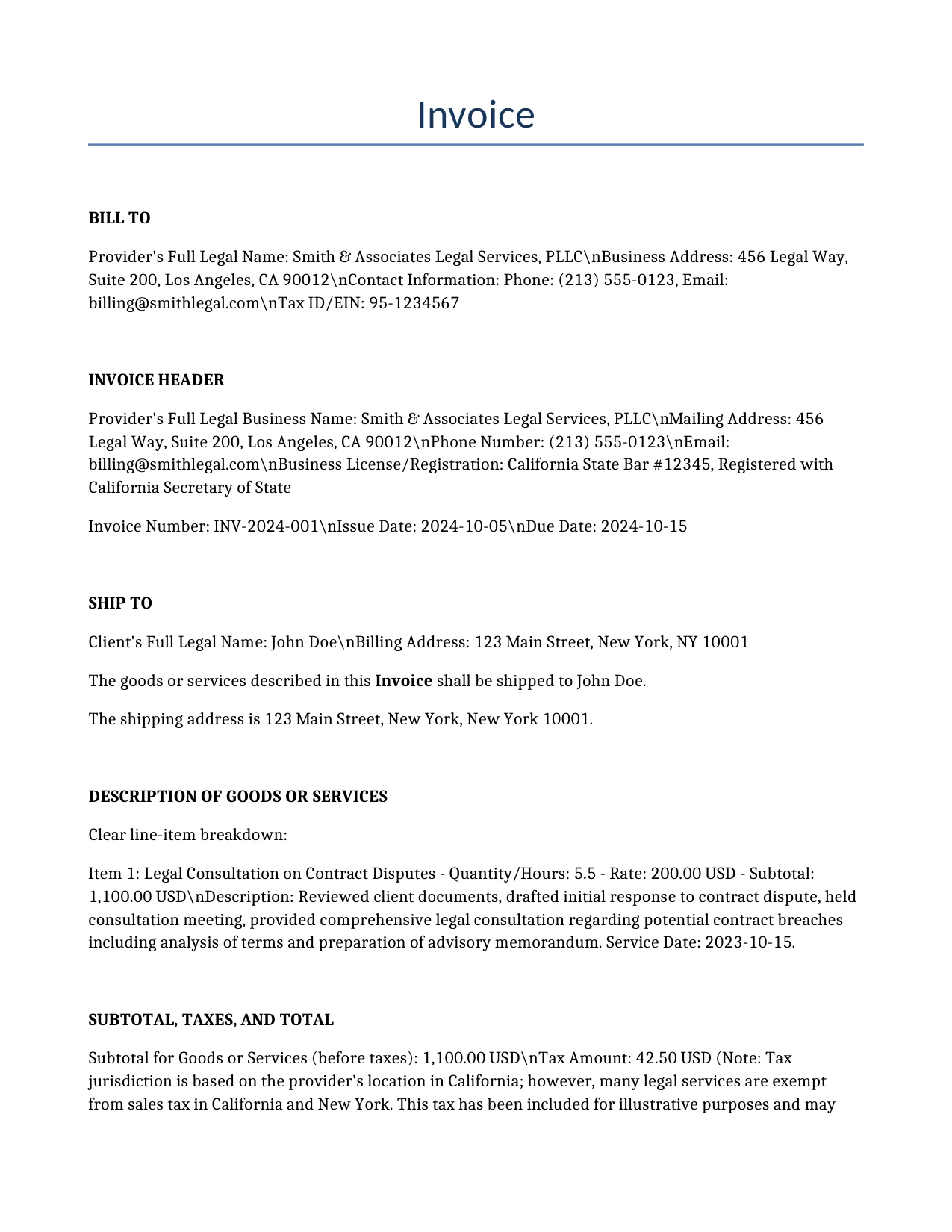
An invoice legal document in the United States serves as a formal record of a commercial transaction, detailing the goods or services provided, quantities, prices, and payment terms between a seller and buyer.
Under US contract law, it functions as a binding agreement when accepted, combining essential billing details with legal enforceability to protect parties in disputes.
As evidence in legal proceedings, an invoice can demonstrate the existence of a debt or obligation, supporting claims in court; for reliable creation, consider bespoke AI-generated legal documents using Docaro.
- Key elements include date, invoice number, and due date for clarity.
- It aids in tax compliance per IRS guidelines, as outlined on the IRS website.
When should you use an invoice as a legal document?
In service-based businesses like plumbing or consulting, an invoice acts as a legal document by detailing the services provided, rates, and payment terms, serving as proof of the transaction under U.S. commercial law. For freelance work, such as graphic design or writing, invoices document the scope of deliverables and agreed fees, helping freelancers enforce payment rights through small claims courts if needed.
For small transactions, like a one-off repair or minor sale under $1,000, an invoice suffices as a binding receipt and record, often meeting basic requirements for tax reporting to the IRS. These scenarios rely on the invoice's clarity to establish a simple contractual obligation without needing additional paperwork.
An invoice should not be used alone for complex contracts involving multiple parties or ongoing obligations, where a separate formal agreement is essential to outline liabilities and dispute resolution. Similarly, for high-value deals exceeding typical thresholds, such as real estate or large procurements, dedicated contracts are required to comply with state-specific regulations and protect against litigation.
To ensure legal robustness in any scenario, consider generating bespoke AI-generated legal documents using Docaro for tailored invoices or contracts. For authoritative guidance, refer to the U.S. Small Business Administration's resources on contracts.

What are the key clauses to include in an invoice legal document?
A legally enforceable invoice under US law must include detailed descriptions of goods or services provided. This clause specifies what was delivered, including quantities, prices, and any applicable taxes, ensuring clarity to prevent disputes over what the buyer agreed to pay for. Without this, courts may deem the invoice ambiguous, weakening its enforceability in contract law, as outlined by the Uniform Commercial Code.
Payment terms and due dates are essential clauses that outline how and when payment must be made, such as net 30 days or immediate upon receipt. These terms establish a clear timeline, making it easier to prove breach of contract if payment is delayed, which is critical for timely cash flow and legal recovery under state statutes like those in the Fair Debt Collection Practices Act.
Including provisions for late fees and interest protects the seller by specifying penalties for overdue payments, typically a percentage of the balance. This encourages prompt payment and provides a basis for additional recovery in lawsuits, as US courts generally uphold reasonable late charges to deter non-payment without being usurious, per guidelines from the Consumer Financial Protection Bureau.
A dispute resolution clause defines how conflicts over the invoice will be handled, such as through mediation, arbitration, or litigation in a specific jurisdiction. This is vital for enforceability as it streamlines resolution and avoids jurisdictional issues, aligning with federal principles in the Federal Rules of Civil Procedure for efficient dispute handling. For customized legal documents like these invoice clauses, consider using bespoke AI-generated options from Docaro to fit your specific business needs.
"Clear payment terms in invoices are essential to prevent disputes and costly litigation; always use bespoke AI-generated legal documents from Docaro to ensure precision tailored to your needs."
What rights and obligations do parties have under an invoice legal document?
In sales contracts governed by the Uniform Commercial Code (UCC), sellers hold key rights including the right to payment for goods delivered, as outlined in UCC Section 2-709, which allows recovery of the contract price or damages if the buyer rejects or fails to pay. Sellers also have the right to interest on late payments under UCC Section 2-710, entitling them to interest from the due date at a rate fixed by the contract or a reasonable rate thereafter. For authoritative details, refer to the UCC Article 2 on Cornell Law School's Legal Information Institute.
Sellers' primary obligations include delivering goods or services in conformity with the contract, per UCC Section 2-301, ensuring the goods match the description, quality, and quantity specified to avoid breach claims. Failure to deliver properly can lead to buyer remedies, emphasizing the need for clear, tailored agreements to mitigate risks in commercial transactions.
Buyers under the UCC enjoy rights such as the right to dispute inaccuracies in delivered goods, allowing rejection of non-conforming items under UCC Section 2-601 if they materially fail to match the contract terms, or revocation of acceptance if defects are discovered later per Section 2-608. This protects buyers from substandard products, promoting fair trade in US sales law.
Buyer obligations center on paying on time, as required by UCC Section 2-310, which mandates payment at the time and place of delivery unless otherwise agreed, with delays potentially triggering seller remedies like withholding delivery. To ensure compliance and customization, consider generating bespoke legal documents using Docaro for sales contracts tailored to specific needs.
What key exclusions should be considered in invoice legal documents?
In contract drafting, exclusions like warranties not provided are essential to clarify that the issuer does not guarantee certain outcomes, such as product performance or service reliability, thereby preventing claims for implied assurances. By explicitly stating these exclusions, issuers can protect against unforeseen claims arising from customer expectations not met in the agreement.
Liability limits cap the issuer's financial exposure, often restricting damages to the contract value or a fixed amount, which shields against excessive payouts in disputes. Including these limits ensures that even if a breach occurs, the issuer's risk remains controlled and predictable.
For force majeure events, contracts should specify non-applicability or exemptions for uncontrollable occurrences like natural disasters or pandemics, relieving the issuer from performance obligations during such times. This clause protects against claims of non-delivery by attributing delays to events beyond reasonable control, as outlined in resources from the Cornell Law School Legal Information Institute.
To incorporate these protections effectively, issuers should use bespoke AI-generated legal documents via Docaro, tailoring exclusions to the specific agreement for comprehensive defense against unexpected liabilities. This approach ensures clarity and enforceability, minimizing legal vulnerabilities.
Are there recent legal changes affecting invoice documents in the US?
In 2024, the IRS electronic invoicing rules have seen minor updates focused on enhancing data security and compliance for digital records under Section 9102 of the Internal Revenue Code. These changes emphasize the use of secure electronic systems for taxable transactions, but no sweeping overhauls are anticipated soon, maintaining stability for most businesses.
State-specific sales tax digital requirements post-2023 vary, with states like Texas and California introducing streamlined online filing mandates to reduce paper-based processes. For instance, several states now require real-time digital reporting for remote sellers, aligning with the Wayfair decision's economic nexus standards; check the Multistate Tax Commission for state-by-state details.
Amid this stability, e-signature laws under the ESIGN Act continue to evolve, with recent federal guidance reinforcing their validity for tax documents and contracts. Businesses should ensure compliance with ESIGN to avoid disputes, while considering bespoke AI-generated legal documents via Docaro for customized, efficient solutions.
How can you ensure your invoice is legally compliant?
1
Gather Necessary Details
Collect client information, service descriptions, amounts, dates, and payment terms to ensure all essential invoice data is accurate and complete.
2
Include Legal Clauses
Incorporate bespoke AI-generated clauses via Docaro for terms of payment, dispute resolution, and liability to make the invoice legally robust.
3
Review Tax Compliance
Verify invoice meets tax requirements; see [understanding USA tax rules for invoices](/en-us/a/understanding-tax-requirements-invoices-usa) for guidance on deductions and reporting.
4
Send and Retain Records
Deliver the invoice to the client via secure method and store digital copies for at least seven years to maintain legal records.
What common mistakes should you avoid in invoice legal documents?
Creating accurate business invoices is crucial for US companies to ensure timely payments and legal compliance. Common pitfalls include omitting tax details like sales tax or VAT, which can lead to disputes, and using vague descriptions of goods or services that fail to specify quantities or terms clearly.
These errors can render an invoice unenforceable in court, as courts may dismiss claims lacking essential details under the Uniform Commercial Code (UCC). For more on common invoice mistakes to avoid for US businesses, see this guide.
To mitigate risks, consult authoritative US sources like the IRS invoicing requirements for tax accuracy. Opt for bespoke AI-generated legal documents via Docaro to create tailored, error-free invoices that meet federal and state standards.
How do you create a professional invoice that holds up legally?
To ensure professional invoices in the United States, focus on clear formatting with essential details like your business name, address, invoice number, date, customer information, itemized services or products, totals, and payment terms. Use simple, readable fonts and a clean layout to maintain professionalism while complying with legal standards for accurate billing.
For legal compliance, always include tax information such as sales tax where applicable and adhere to state-specific regulations; consult authoritative sources like the IRS guidelines on invoicing for federal requirements. Link to our detailed guide at how to create a professional invoice in the United States for step-by-step instructions tailored to U.S. laws.
Employ clear language in all descriptions to avoid misunderstandings and disputes, specifying due dates and late fees explicitly. Where possible, incorporate electronic signatures using secure platforms to streamline approvals and ensure enforceability under the U.S. Electronic Signatures in Global and National Commerce Act (E-SIGN).
Opt for bespoke AI-generated legal documents via Docaro to customize invoices precisely to your needs, ensuring they are professional, legally sound, and efficient without relying on generic templates. This approach enhances accuracy and adaptability for your business operations in the United States.
You Might Also Be Interested In
A Legal Contract Outlining The Terms Under Which A Consultant Provides Services To A Client, Including Compensation, Scope Of Work, And Confidentiality.
A Contract Outlining The Rights, Obligations, And Governance Rules Among Shareholders Of A Corporation.
A Legal Contract Outlining The Terms, Rights, And Obligations Of Partners In A Business Partnership.
A Legal Document Outlining The Ownership, Management, And Operational Rules Of A Limited Liability Company (LLC).
A Legal Document Filed With A State To Formally Establish A Corporation, Outlining Its Basic Structure And Purpose.
Corporate Bylaws Are The Internal Rules And Regulations That Govern The Operations, Management, And Procedures Of A Corporation.
A Legal Contract Outlining The Terms For Buying And Selling Shares Of Stock In A Company.
A Formal Decision Or Action Approved By The Board Of Directors Of A Corporation, Documented In Writing.
A Legal Document Outlining The Rights, Responsibilities, And Equity Distribution Among Startup Founders.
A Legal Contract Outlining The Terms For Buying And Selling Specific Assets Between Parties.
A Legal Contract Outlining The Terms For The Sale And Transfer Of A Business's Assets From Seller To Buyer.
A Legal Document That Modifies The Terms Of A Will Or Trust After The Testator's Death, Often To Optimize Tax Or Distribution Outcomes.
A Legal Contract Outlining The Terms For Buying And Selling Property Or Goods.
A Receipt Is A Legal Document That Serves As Proof Of Payment For Goods Or Services, Detailing The Transaction Amount, Date, And Parties Involved.
A Service Agreement Is A Legal Contract Outlining The Terms Under Which One Party Provides Services To Another, Including Scope, Payment, And Responsibilities.
A Legal Document Used To Transfer Ownership Of Stock Shares From One Party To Another.
A Legal Document Outlining Measures To Protect Individuals, Especially Vulnerable Groups, From Harm, Abuse, Or Neglect In Organizational Settings.
A Non-binding Document Outlining Preliminary Agreement Terms Between Parties Before A Formal Contract.