Docaro

AI Generated American Articles of Incorporation - 2026 Updated

A professional illustration of a business handshake between two entrepreneurs in a modern office setting, symbolizing the formation and partnership of a new company, with subtle American flag elements in the background to represent the United States.
Effortlessly create legally compliant Articles of Incorporation with our advanced AI technology.
Free instant document creation.
Legally compliant agreements.
No signup required.
Generate your document for free.
Download PDF, Word and email for $9.99 USD.

Generate Your Articles of Incorporation in 4 Easy Steps

1
Answer a Few Questions
Our AI guides you through the info required.
2
Generate Your Document
Docaro builds the document based on your requirements.
3
Review & Edit
Review your document and submit any further requested changes.
4
Download & Sign
Download your ready to sign document as a PDF, Word, Txt or HTML.

Why Use Our AI Articles of Incorporation Generator?

Fast Generation
Quickly generate a comprehensive Articles of Incorporation, eliminating the hassle and time associated with traditional document drafting.
Guided Process
Our user-friendly platform simplifies the document creation process, enabling you to complete agreements with just a few clicks.
Professionally Formatted Document
Your Articles of Incorporation will be formatted to professional standards, including headings, clause numbers and structured layout. No further editing is required.
High Accuracy
Our AI ensures high accuracy by using advanced algorithms to craft agreements that perfectly cater to your specific requirements.
Compliance with American Law
Rest assured that all generated documents meet the latest legal standards and regulations of the United States, enhancing trust and reliability.
Cost-Effective
Save money by generating legally sound tenancy agreements without the need for expensive legal services or consultations.
Get Started for Free - No Sign Up Required
No payment or sign up is required to start generating your Articles of Incorporation. Simply answer a few questions and a preview of your final document will be generated.
Looking to Generate a Articles of Incorporation in a Different Country?
Choose a different country:

Compliance Legislation

Your AI Generated Articles of Incorporation will be checked for compliance against the following legislation and regulations:
The primary body of law governing the formation, operation, and dissolution of corporations in Delaware, including requirements for articles of incorporation (called Certificate of Incorporation in Delaware).
A uniform act developed by the American Bar Association that provides a standard framework for state corporation laws, including provisions for articles of incorporation. Adopted in whole or part by many states.
Governs the incorporation of corporations in California, with Division 1 outlining the requirements for articles of incorporation.
Regulates the formation of business corporations in New York, including the contents and filing of the certificate of incorporation (equivalent to articles of incorporation).
Federal law requiring certain disclosures for publicly traded companies, which impacts the corporate governance provisions in articles of incorporation.
Provides tax-exempt status for nonprofit corporations, influencing the structure and purpose clauses in articles of incorporation for such entities.

Example Articles of Incorporation

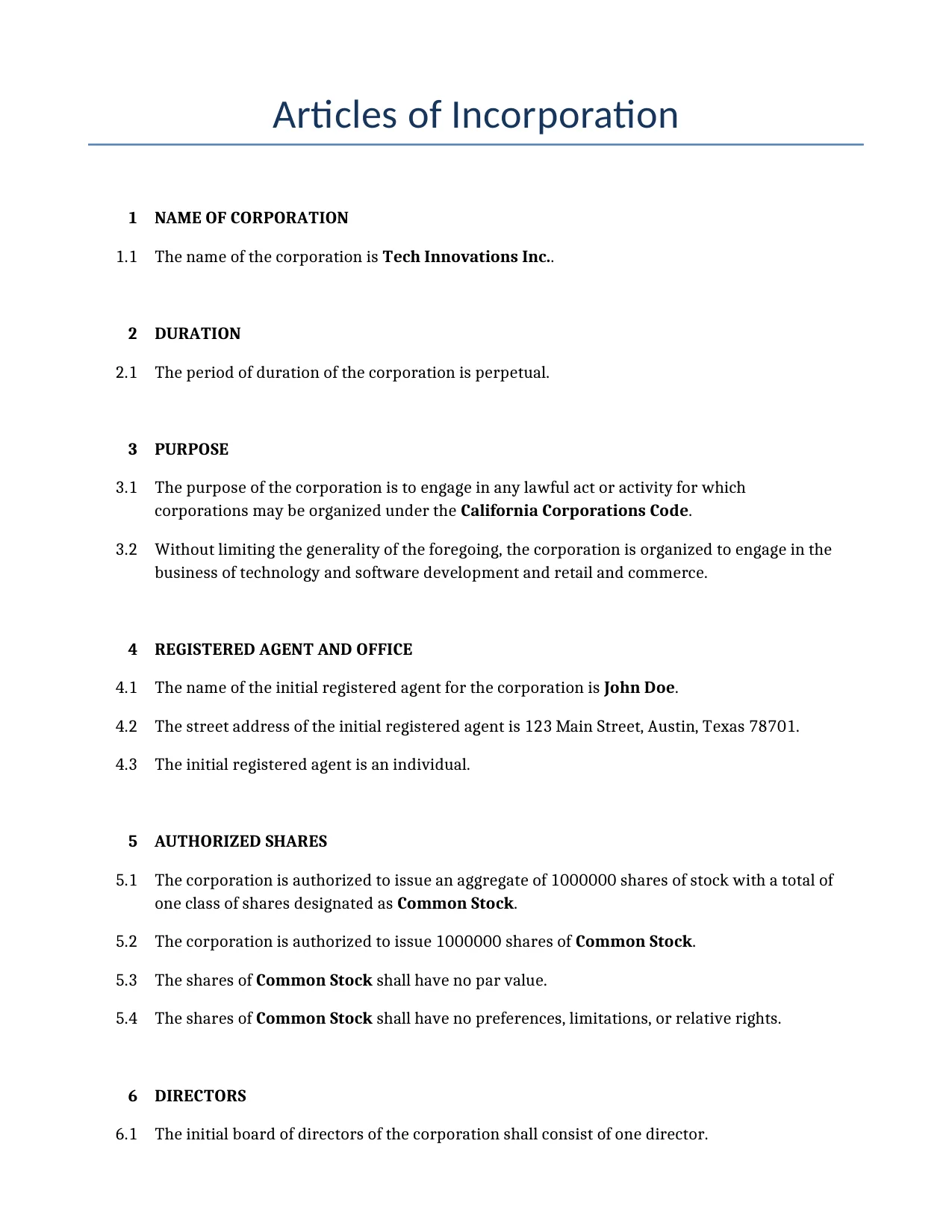
Below is an example of a Articles of Incorporation generated by our AI model. The clauses in your Articles of Incorporation will vary from this example as they will be entirely bespoke to your requirements as set out in the questionnaire you complete.
Page 1

What are Articles of Incorporation?

Articles of Incorporation serve as the foundational legal document for establishing a corporation in the United States, often referred to as the corporate charter. Their primary purpose is to formally create the corporation as a separate legal entity, outlining its basic structure and governance to comply with state laws. By filing these articles, business owners gain limited liability protection and the ability to issue stock, making them essential for corporate formation.

The Articles of Incorporation detail key elements such as the corporation's name, purpose, registered agent, authorized shares of stock, and incorporators' information, thereby establishing its core framework. This document sets the initial bylaws and operational boundaries, distinguishing the corporation from its owners and enabling it to enter contracts, own assets, and sue or be sued independently. Once approved, the state issues a certificate of incorporation, officially bringing the entity into existence. For detailed guidance on filing Articles of Incorporation, refer to authoritative resources like the Nolo legal encyclopedia or your state's official business portal.

Professional signing incorporation documents

When should you use Articles of Incorporation?

Articles of Incorporation are essential legal documents for forming a corporation, providing limited liability protection to shareholders by separating personal assets from business debts. They should be used when starting a corporation to raise capital through stock issuance, as this formal structure attracts investors and enables access to funding sources like venture capital. For businesses engaging in activities requiring corporate status, such as entering contracts, owning property, or operating across state lines, filing Articles of Incorporation ensures compliance and credibility, as outlined by the U.S. Small Business Administration.

However, Articles of Incorporation are not suitable for sole proprietorships, where a single owner operates without formal separation of personal and business liabilities, avoiding the complexity and costs of incorporation. They should also be avoided for simple partnerships that don't require limited liability or stock-based fundraising, opting instead for less formal agreements like partnership deeds. Businesses with minimal risk or short-term operations can forgo incorporation to save on filing fees and administrative burdens, focusing on simpler structures for easier management.

"Properly filing Articles of Incorporation is the foundational step in establishing a corporation and securing limited liability protection for shareholders, shielding their personal assets from business debts and lawsuits—failure to do so can expose owners to unlimited personal risk." – Dr. Elena Vargas, Corporate Law Professor, Harvard Law School
Gavel and legal documents on desk

What are the key clauses in Articles of Incorporation?

The Articles of Incorporation form the foundational legal document for establishing a corporation, outlining its core structure and governance under state laws. Essential clauses typically include the corporation's name, which must be unique and compliant with naming regulations to avoid conflicts, and the purpose clause, detailing the business objectives to define the scope of operations. These elements ensure clarity and legal recognition, as explained in resources from the U.S. Small Business Administration.

Another critical provision is the registered agent, designating an individual or entity responsible for receiving legal documents on behalf of the corporation, ensuring reliable communication with authorities. The authorized shares clause specifies the number and classes of stock the corporation can issue, impacting ownership and financing options. Additionally, incorporator details identify the person or persons filing the document, providing accountability during formation.

Optional provisions may include the duration of the corporation, often set as perpetual unless specified otherwise, and liability limitations for directors or shareholders to protect personal assets. These clauses allow customization based on the corporation's needs, such as in professional corporations, and are detailed in state-specific guidelines from authoritative sources like the Nolo legal encyclopedia.

Business team reviewing incorporation forms

What rights and obligations do parties have under Articles of Incorporation?

The Articles of Incorporation form the foundational legal document for a corporation, outlining essential shareholder rights such as ownership stakes and voting privileges on major decisions like mergers or director elections. These rights ensure shareholders have a voice in corporate governance, protecting their investments under state laws. For deeper insights, refer to the U.S. Small Business Administration's guide on business structures.

Directors, appointed through shareholder votes, hold key governance roles in the corporation, including setting strategic direction and overseeing management, as defined in the Articles. Their obligations include fiduciary duties of care, loyalty, and obedience to state laws, ensuring decisions benefit the company and its shareholders. This framework promotes accountability; explore more at the SEC's resources on corporate governance.

Both shareholders and directors must comply with state-specific regulations embedded in the Articles, such as annual reporting and dissolution procedures, to maintain corporate status. Non-compliance can lead to penalties or loss of limited liability protections, underscoring the importance of legal adherence in corporate law. Bullet-point summaries of core obligations include:

  • Fiduciary duties: Acting in the best interest of the corporation.
  • Compliance with state laws: Filing required documents and paying fees.
  • Governance transparency: Providing shareholders with access to records.

Are there key exclusions or limitations in Articles of Incorporation?

The Articles of Incorporation serve as the foundational legal document for forming a corporation, but they come with specific exclusions to keep the filing concise and focused. Detailed operational rules, such as internal governance procedures or day-to-day management protocols, cannot be included here; these belong in the bylaws, which provide flexibility for future amendments without refiling with the state. For more details on structuring these documents, refer to the U.S. Small Business Administration's guide on business structures.

State-specific requirements impose additional limitations on what can be outlined in the Articles, including prohibitions on unlawful or against-public-policy business purposes like illegal activities or those conflicting with state regulations. For instance, corporations cannot pursue purposes that violate federal or state laws, and some states mandate including clauses on registered agents or initial directors. Always consult your state's secretary of state website, such as California's or New York's, to ensure compliance with local incorporation laws and avoid rejection of your filing.

What recent or upcoming legal changes affect Articles of Incorporation?

The Corporate Transparency Act (CTA), enacted as part of the 2021 National Defense Authorization Act, represents a significant federal change impacting how companies, including those filing Articles of Incorporation, must report beneficial ownership information. Effective January 1, 2024, the CTA requires most new and existing entities formed or registered in the United States to file reports with the Financial Crimes Enforcement Network (FinCEN) disclosing individuals with substantial control or ownership. This aims to combat illicit finance by enhancing corporate transparency, with non-compliance penalties including fines up to $500 per day and potential criminal charges; for more details, visit the FinCEN Beneficial Ownership Information page.

At the state level, several jurisdictions have updated filing requirements for Articles of Incorporation to promote efficiency and digital adoption. For instance, as of 2023, states like Delaware and California have expanded electronic filing mandates, allowing online submissions for faster processing and reduced paperwork, which is crucial for business formation and compliance. These changes streamline incorporation processes but vary by state, so businesses should check resources like the California Secretary of State website for specific state filing requirements.

While no sweeping nationwide overhaul to Articles of Incorporation is imminent beyond the CTA, ongoing state-level tweaks focus on corporate governance and remote notarization for filings. Upcoming in 2024, some states may introduce further electronic filing incentives to support small businesses amid economic recovery. Overall, these evolutions emphasize transparency and accessibility in US corporate law, with no major disruptions expected for standard incorporations.

How do Articles of Incorporation differ from Bylaws?

When forming a corporation, understanding the key differences between Articles of Incorporation and Bylaws is essential for proper governance and compliance. The Articles of Incorporation serve as the foundational legal document filed with the state to establish the corporation's basic structure, including its name, purpose, and initial directors. These public state filings are accessible to anyone and outline the core identity of the entity.

In contrast, Bylaws function as internal rules that guide the corporation's day-to-day operations, such as meeting procedures, officer roles, and decision-making processes. Unlike the Articles, Bylaws are not filed with the state and remain private to the organization, allowing flexibility in internal management. For a detailed breakdown, explore our resource on the Key Differences Between Articles of Incorporation and Bylaws.

To further your knowledge on corporate formation, refer to authoritative sources like the U.S. Small Business Administration for guidelines on legal structures.

What common mistakes should you avoid when preparing Articles of Incorporation?

Drafting Articles of Incorporation requires precision to ensure legal compliance and avoid costly revisions. One common pitfall is using incorrect naming conventions, such as failing to include required designators like "Inc." or "Corporation" in the company name, which can lead to rejection by state authorities. Another frequent error is omitting essential clauses, like the purpose statement or registered agent details, potentially invalidating the filing and delaying incorporation.

Share structure issues also pose significant risks in drafting Articles of Incorporation, including failing to specify the number of authorized shares or types of stock, which can limit future business flexibility. For instance, not detailing par value or classes of shares might complicate fundraising efforts later. To navigate these common mistakes to avoid when drafting Articles of Incorporation, consult resources like the U.S. Small Business Administration guide for authoritative insights.

Addressing these pitfalls early can safeguard your corporate formation process. For a deeper dive, explore our detailed guide on Common Mistakes to Avoid When Drafting Articles of Incorporation, which outlines best practices and checklists.

How can you get started with filing Articles of Incorporation?

1
Choose a State
Select the state for incorporation based on business needs, tax laws, and regulations. Each state has specific filing requirements.
2
Select a Corporate Name
Choose a unique name that complies with state rules. Check availability through the state\'s business name database.
3
Appoint a Registered Agent
Designate a registered agent with a physical address in the state to receive legal documents on behalf of the corporation.
4
Prepare the Document
Draft the Articles of Incorporation including required details. For full guidance, see [How to File Articles of Incorporation in the United States](/en-us/a/how-to-file-articles-of-incorporation-united-states).

Articles of Incorporation FAQs

Articles of Incorporation are legal documents filed with the state to formally create a corporation in the United States. They outline the corporation's basic structure, including its name, purpose, registered agent, and authorized shares, establishing it as a separate legal entity.

Document Generation FAQs

Docaro is an AI-powered legal document generator that helps you create fully formatted, legally sound contracts and agreements in minutes. Just answer a few guided questions and download your document instantly.
You Might Also Be Interested In
Consultancy Agreement
Shareholders' Agreement
Business Sale Agreement
Asset Purchase Agreement
Founders' Agreement
Board Resolution
Stock Purchase Agreement
Corporate Bylaws
LLC Operating Agreement
Partnership Agreement

Related Articles

A vibrant illustration of a diverse group of entrepreneurs shaking hands in a modern office space, symbolizing the formation and launch of a new business, with subtle elements like a growing plant or upward arrows representing growth and incorporation.
Learn how to file articles of incorporation in the United States with our comprehensive guide. Discover the steps, requirements, fees, and tips for forming your corporation successfully.
A symbolic illustration representing the foundational structure of a business organization, featuring a blueprint or architectural model of a corporate building with layered components, evoking the establishment and internal governance of a company without showing actual legal documents.
Discover the main differences between articles of incorporation and bylaws. Learn how these documents shape your business structure and ensure compliance in corporate governance.
A dynamic illustration of a business professional confidently starting a new venture, symbolizing the successful formation of a company without common pitfalls. The scene features a person standing at the helm of a ship navigating through calm waters towards a bright horizon with emerging city skyline, representing smooth incorporation and growth, in a vibrant and motivational style.
Discover the most common mistakes to avoid when drafting articles of incorporation. Learn essential tips to ensure your business formation documents are accurate and compliant with legal requirements.