
AI Generated Stock Transfer Form for use in the United States
PDF & Word - 2026 Updated
Docaro Pricing
When Do You Need a Stock Transfer Form in the United States?
American Legal Rules for a Stock Transfer Form
Using the wrong type of stock transfer form can invalidate the transfer or expose parties to unintended tax or regulatory liabilities.
What a Proper Stock Transfer Form Should Include
- Transfer DetailsClearly state the date of the transfer, the number of shares being moved, and the type of stock involved.
- Parties InvolvedIdentify the full names and contact information of both the seller (transferor) and the buyer (transferee).
- Share InformationSpecify the company name, stock certificate number, and any relevant class or series of shares.
- SignaturesInclude signed authorizations from both the seller and buyer to confirm agreement on the transfer.
- NotarizationProvide space for a notary public to witness and verify the signatures for legal validity.
- ConsiderationNote the price or value exchanged for the shares, even if it's a gift or no payment.
- RepresentationsInclude basic assurances that the shares are free of liens and that the seller has the right to transfer them.
Generate Your Document in 4 Easy Steps
Why Use Docaro?
 United States
Free Example Stock Transfer Form Template
Below is a free template example of a Stock Transfer Form for use in the United States generated by our AI model.
The clauses in your actual Stock Transfer Form will vary from this example as they will be entirely bespoke to your requirements as set out in the questionnaire you complete.
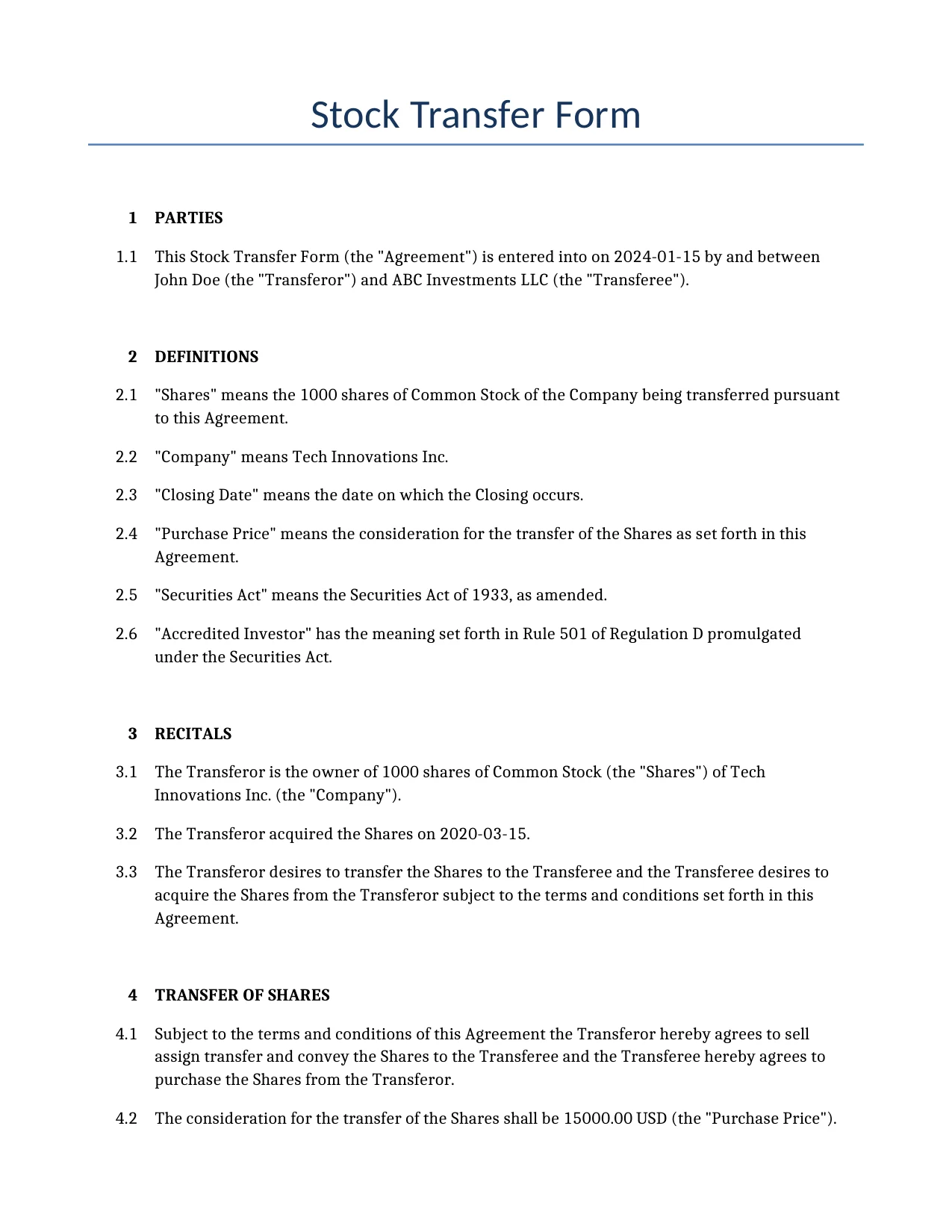
Stock Transfer Form
1PARTIES
This Stock Transfer Form (the "Agreement") is entered into on 2024-01-15 by and between John Doe (the "Transferor") and ABC Investments LLC (the "Transferee").
2DEFINITIONS
"Shares" means the 1000 shares of Common Stock of the Company being transferred pursuant to this Agreement.
"Company" means Tech Innovations Inc.
"Closing Date" means the date on which the Closing occurs.
"Purchase Price" means the consideration for the transfer of the Shares as set forth in this Agreement.
"Securities Act" means the Securities Act of 1933, as amended.
"Accredited Investor" has the meaning set forth in Rule 501 of Regulation D promulgated under the Securities Act.
3RECITALS
The Transferor is the owner of 1000 shares of Common Stock (the "Shares") of Tech Innovations Inc. (the "Company").
The Transferor acquired the Shares on 2020-03-15.
The Transferor desires to transfer the Shares to the Transferee and the Transferee desires to acquire the Shares from the Transferor subject to the terms and conditions set forth in this Agreement.
4TRANSFER OF SHARES
Subject to the terms and conditions of this Agreement the Transferor hereby agrees to sell assign transfer and convey the Shares to the Transferee and the Transferee hereby agrees to purchase the Shares from the Transferor.
The consideration for the transfer of the Shares shall be 15000.00 USD (the "Purchase Price"). The Purchase Price is fair market value as determined by the parties.
The Purchase Price shall be paid in full in cash by wire transfer on the Closing Date as defined below.
The parties agree to special payment terms consisting of installments for the Purchase Price only if specified in an attached payment schedule which forms part of this Agreement; otherwise full payment shall be made on the Closing Date.
5REPRESENTATIONS AND WARRANTIES OF THE TRANSFEROR
The Transferor represents and warrants to the Transferee that the Transferor is currently in good standing to transfer the Shares with no legal impediments.
The Transferor represents and warrants to the Transferee that the Transferor has sole and beneficial ownership of all the Shares being transferred.
The Transferor represents and warrants to the Transferee that the Transferor has full authority to transfer the Shares without needing approval from any other party.
The Transferor represents and warrants to the Transferee that there are no liens pledges or encumbrances on the Shares being transferred.
The Transferor represents and warrants to the Transferee that the Transferor has complied with all applicable U.S. federal and state securities laws regarding the transfer of these Shares including but not limited to the Securities Act of 1933 the Securities Exchange Act of 1934 and applicable state blue sky laws.
The Transferor represents and warrants to the Transferee that the transfer is being made for investment purposes without intent to distribute the Shares.
The Transferor represents and warrants to the Transferee that the Transferor is not aware of any violations of transfer restrictions in the Company\’s governing documents for these Shares.
The Transferor represents and warrants that the Shares represent [X]% of the Company\’s issued and outstanding shares that there are no outstanding options warrants or rights affecting the Shares and that the transfer will not trigger any preemptive rights or rights of first refusal (or that such rights have been waived).
6REPRESENTATIONS AND WARRANTIES OF THE TRANSFEREE
The Transferee represents and warrants to the Transferor that the Transferee is a legal entity incorporated in Delaware on 2020-05-15.
The Transferee represents and warrants to the Transferor that the Transferee qualifies as an accredited investor under U.S. securities laws.
The Transferee represents and warrants to the Transferor that the Transferee has over 10 years of experience investing in private equity stocks and bonds including purchases of startup equity and mutual funds.
The Transferee represents and warrants to the Transferor that the Transferee has a current net worth excluding the value of the primary residence of 1500000 and an annual income for the most recent year of 250000.
The Transferee represents and warrants to the Transferor that the Transferee has sufficient financial resources to bear the economic risk of holding these securities indefinitely.
The Transferee represents and warrants to the Transferor that this purchase complies with all applicable U.S. federal and state securities laws including but not limited to the Securities Act of 1933 the Securities Exchange Act of 1934 and applicable state blue sky laws.
The Transferee represents and warrants to the Transferor that the Transferee\’s intent regarding the purchase of these securities is for long-term investment.
The Transferee represents and warrants to the Transferor that there are no legal restrictions such as injunctions or orders that would prevent the Transferee from purchasing or holding these securities.
7COMPANY REPRESENTATIONS
The Company represents and warrants that it has the corporate power and authority to approve the transfer, that the transfer will not violate its articles of incorporation, bylaws, or any shareholders' agreement, and that the Shares are duly authorized, validly issued, fully paid, and non-assessable.
8CONDITIONS PRECEDENT
The obligations of the parties under this Agreement are subject to the condition that the board of directors of the Company approves the transfer of the Shares.
The parties may waive any conditions precedent to the stock transfer by mutual written agreement.
9CLOSING
The closing of the transfer of the Shares (the "Closing") shall take place on 2024-03-15 at New York City NY (the "Closing Date").
At the Closing the Transferor shall deliver the stock certificates representing the Shares to the Transferee in person.
At the Closing the Transferee shall make payment of the Purchase Price to the Transferor by wire transfer.
At Closing, the Transferor shall also deliver a duly executed stock power form, any required company consents or board resolutions approving the transfer, and a certificate confirming the accuracy of representations and warranties as of the Closing Date.
10INDEMNIFICATION
The Transferor shall indemnify defend and hold harmless the Transferee its officers and directors from and against any and all losses claims damages liabilities costs and expenses including reasonable attorneys\’ fees arising from breaches of representations and warranties third-party claims arising from the Transferor\’s actions prior to Closing and any taxes or penalties related to undisclosed liabilities.
The Transferee shall indemnify, defend, and hold harmless the Transferor from any losses arising from breaches of the Transferee's representations and warranties or from the Transferee's actions after the Closing.
11TAXES
The Transferor shall be responsible for and shall pay all transfer taxes, stamp duties, and similar charges arising from the transfer of the Shares.
The parties shall cooperate in filing any required tax forms or reports with relevant authorities, including IRS Form 1099 if applicable.
12BROKER FEES
Each party represents that no brokers or finders were used in connection with the transfer and each shall indemnify the other against any claims for commissions or fees.
13COMPLIANCE WITH SECURITIES LAWS
The parties acknowledge that this transfer is made in compliance with the Securities Act of 1933, the Securities Exchange Act of 1934, applicable state blue sky laws and all other applicable federal and state securities laws.
14RESTRICTIVE LEGENDS
The Shares are subject to transfer restrictions under applicable securities laws and the Company's governing documents. The stock certificates shall bear a legend substantially as follows: 'THESE SECURITIES HAVE NOT BEEN REGISTERED UNDER THE SECURITIES ACT OF 1933, AS AMENDED. THEY MAY NOT BE SOLD, OFFERED FOR SALE, PLEDGED OR HYPOTHECATED IN THE ABSENCE OF A REGISTRATION STATEMENT IN EFFECT WITH RESPECT TO THE SECURITIES UNDER SUCH ACT OR AN OPINION OF COUNSEL SATISFACTORY TO THE COMPANY THAT SUCH REGISTRATION IS NOT REQUIRED.'
15NO REGISTRATION
The parties acknowledge that the Shares are being transferred without registration under the Securities Act of 1933 or any state securities laws in reliance on exemptions therefrom, and the Transferee agrees not to resell or transfer the Shares except in compliance with such laws.
16TERMINATION
The Agreement may be terminated by mutual written consent or by either party if the Conditions Precedent are not satisfied by the Closing Date. Upon termination, the parties shall have no further obligations except for confidentiality and any liability for prior breaches.
17GOVERNING LAW
This Agreement shall be governed by and construed in accordance with the laws of the State of New York without regard to its conflict of laws principles.
Any disputes arising under this Agreement shall be resolved exclusively in the state or federal courts located in New York County, New York, and each party consents to the personal jurisdiction and venue therein.
Each party hereby waives its right to a jury trial in any action or proceeding arising out of or relating to this Agreement.
18ENTIRE AGREEMENT
This Agreement constitutes the entire agreement between the parties with respect to the subject matter hereof and supersedes all prior agreements understandings and negotiations both written and oral.
19SEVERABILITY
If any provision of this Agreement is held to be invalid or unenforceable such provision shall be severed from the Agreement and the remaining provisions shall continue in full force and effect.
20ASSIGNMENT
Neither party may assign its rights or delegate its obligations under this Agreement without the prior written consent of the other party.
Any assignment without such consent shall be null and void and the assigning party shall remain liable for all obligations hereunder.
21NOTICES
All notices required or permitted under this Agreement shall be in writing and shall be delivered by personal delivery certified mail or email (with read receipt or confirmation of delivery).
Notices shall be deemed received upon actual delivery for all methods of delivery.
For notices sent by mail such notices shall be deemed received three business days after mailing.
Notices to the Transferor shall be sent to 123 Main Street Anytown CA 90210 or john.doe@example.com.
Notices to the Transferee shall be sent to 456 Oak Avenue Othertown NY 10001 or abc.investments@example.com.
All notices shall be provided in English only.
22COUNTERPARTS
This Agreement may be executed in one or more counterparts each of which shall be deemed an original but all of which together shall constitute one and the same instrument.
23CONFIDENTIALITY
The Transferor and the Transferee agree to keep the terms of this transfer confidential.
Confidential Information means the terms and conditions of this stock transfer including the number of shares transferred the purchase price and any related agreements but excludes information that is publicly available or required to be disclosed by law.
24FURTHER ASSURANCES
The Transferor agrees to execute additional documents as needed to effectuate the transfer.
The Transferee agrees to execute additional documents as needed to effectuate the transfer.
25AMENDMENTS
This Agreement may only be amended by a written instrument signed by both parties and, if required, approved by the Company's board of directors.
26SURVIVAL
The representations, warranties, and indemnification obligations shall survive the Closing and transfer of the Shares for a period of two years (or as applicable under law).
27SIGNATURES
IN WITNESS WHEREOF the parties have executed this Agreement as of the date first above written.
Transferor: _______________________________ Printed Name: _______________ Title (if applicable): _______________ Date: _______________
Transferee: _______________________________ Printed Name: _______________ Title (if applicable): _______________ Date: _______________
Company Consent (if required): _______________________________ Printed Name: _______________ Title: _______________ Date: _______________
Witness: _______________________________ Date: _______________
This example shows approximately 70% of a typical document and is provided for illustrative purposes only. The remaining content has been omitted.
Every document generated by Docaro is tailored to your specific circumstances, jurisdiction and the information you provide. The completed document includes all applicable clauses and provisions required for your situation.
To generate the full, personalised document, answer a short series of questions and your document will be created instantly.