
AI Generated Community Guidelines for use in the United States
PDF & Word - 2026 Updated
Docaro Pricing
When Do You Need Community Guidelines in the United States?
American Legal Rules for Community Guidelines
Using an incorrect structure for community guidelines can fail to adequately protect the platform from legal liabilities or user disputes.
What Proper Community Guidelines Should Include
- IntroductionStart with a welcoming statement that explains the purpose of the guidelines and the community's shared values.
- User ResponsibilitiesOutline what members must do, like being respectful and following platform rules.
- Prohibited BehaviorsList actions that are not allowed, such as harassment, hate speech, or sharing illegal content.
- Content RulesDescribe acceptable and unacceptable types of posts, including restrictions on spam or misinformation.
- Reporting IssuesExplain how and why members should report violations to keep the community safe.
- Enforcement ActionsDetail consequences for breaking rules, from warnings to account suspension.
- Updates and ContactNote that guidelines may change and provide ways to contact moderators or admins.
Generate Your Document in 4 Easy Steps
Why Use Docaro?
 United States
Free Example Community Guidelines Template
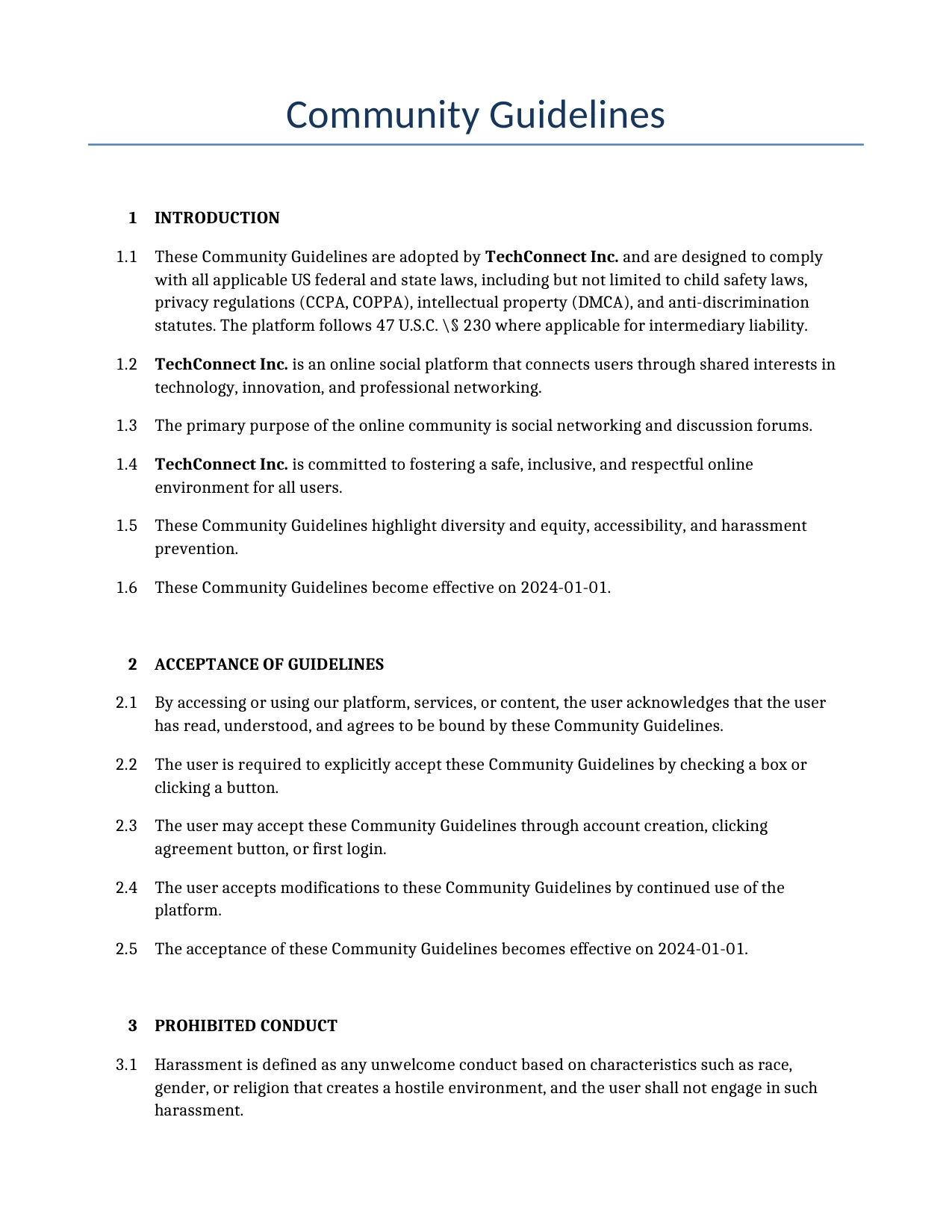
Below is a free template example of a Community Guidelines for use in the United States generated by our AI model.
The clauses in your actual Community Guidelines will vary from this example as they will be entirely bespoke to your requirements as set out in the questionnaire you complete.
Community Guidelines
1INTRODUCTION
These Community Guidelines are adopted by TechConnect Inc. and are designed to comply with all applicable US federal and state laws, including but not limited to child safety laws, privacy regulations (CCPA, COPPA), intellectual property (DMCA), and anti-discrimination statutes. The platform follows 47 U.S.C. \§ 230 where applicable for intermediary liability.
TechConnect Inc. is an online social platform that connects users through shared interests in technology, innovation, and professional networking.
The primary purpose of the online community is social networking and discussion forums.
TechConnect Inc. is committed to fostering a safe, inclusive, and respectful online environment for all users.
These Community Guidelines highlight diversity and equity, accessibility, and harassment prevention.
These Community Guidelines become effective on 2024-01-01.
2ACCEPTANCE OF GUIDELINES
By accessing or using our platform, services, or content, the user acknowledges that the user has read, understood, and agrees to be bound by these Community Guidelines.
The user is required to explicitly accept these Community Guidelines by checking a box or clicking a button.
The user may accept these Community Guidelines through account creation, clicking agreement button, or first login.
The user accepts modifications to these Community Guidelines by continued use of the platform.
The acceptance of these Community Guidelines becomes effective on 2024-01-01.
3PROHIBITED CONDUCT
Harassment is defined as any unwelcome conduct based on characteristics such as race, gender, or religion that creates a hostile environment, and the user shall not engage in such harassment.
The user shall not engage in hate speech.
The user shall not engage in illegal activities such as drug trafficking, human trafficking, and copyright infringement.
The user shall not engage in threats of violence, defamation, or incitement to illegal acts.
The user shall not engage in spam and unsolicited communications.
The user shall not engage in impersonation, doxxing, cyberbullying, or scams and fraud.
The user shall not share illegal content.
The user shall not engage in any child sexual exploitation, including but not limited to the creation, possession, distribution, or promotion of child sexual abuse material (CSAM), grooming, or any content or conduct involving minors in a sexual context. Such activities will result in immediate account termination and mandatory reporting to law enforcement as required by US laws like 18 U.S.C. \§ 2258A.
4CONTENT RESTRICTIONS
The user shall not post content that depicts or promotes violence.
The user shall not post nudity or sexually explicit content.
The user shall not post content that spreads misinformation.
A review for prohibited content is triggered by 5 reports.
The user shall not post, share, or promote child sexual abuse material (CSAM), any sexual content involving minors, or content that sexualizes children. The platform will comply with mandatory reporting obligations under US federal law.
Any violation involving CSAM or exploitation of minors will result in immediate content removal, account termination, and reporting to authorities.
5USER ACCOUNTS AND PROFILES
The user must be at least 13 years old to create an account. Users under 13 are explicitly prohibited from creating accounts or using the platform.
The user must verify the user account through email or phone during creation.
Usernames must be at least 3 characters in length.
Usernames must not exceed 20 characters in length.
The user shall not create accounts that impersonate others.
The platform will detect potential impersonation in user profiles through automated keyword scanning and a user reporting system.
User profile biographies must not exceed 500 characters in length.
The user may upload photos to the user profile.
Passwords must meet a minimum length of 8 characters, require uppercase and lowercase letters, and require numbers and symbols.
The platform may temporarily suspend user accounts for violations of profile rules.
For any users claiming to be under 18, the platform will implement verification methods compliant with COPPA, such as parental consent where required.
If users are found to be under 13, their accounts will be immediately terminated in compliance with US child protection laws.
6INTELLECTUAL PROPERTY
The user must include a notice in the user-generated content acknowledging that the content may be subject to copyright laws.
The user shall not use third-party trademarks in the user username, profile, or content without permission.
The user retains full ownership of the user-generated content and grants a license to the platform.
The user may report and request takedown of potentially infringing content through the established procedure.
The user must provide attribution for any third-party content the user incorporates into the user-generated content.
These intellectual property guidelines become effective on 2024-01-01.
The platform maintains a repeat infringer policy under the DMCA, which may result in termination of accounts for repeated copyright violations.
7PRIVACY AND DATA PROTECTION
The legal name of the company operating the community platform is TechConnect Inc..
The designated Data Privacy Officer is Jane Doe.
The email address for contacting the Data Privacy Officer is jane.doe@techconnect.com.
TechConnect Inc. collects personal information from users of the community platform.
The types of personal information collected include identifiers (such as name, email, or IP address), internet activity data (such as browsing history, interactions, and search data), geolocation data, and inferred data from user profiles or preferences.
TechConnect Inc. collects and uses the personal information for providing and managing community services, communicating with users via newsletters or updates, analyzing usage patterns for platform improvement, and preventing fraud and ensuring security.
TechConnect Inc. does not share personal information with third parties except as required by law or with explicit consent.
The user has the right to access the user personal information under the California Consumer Privacy Act (CCPA).
The user has the right to request deletion of the user personal information.
The user may opt out of the sale or sharing of the user personal information.
TechConnect Inc. will not discriminate against users who exercise their privacy rights.
The retention periods are as follows: user profiles for 5 years after account deletion, activity logs for 2 years, and payment information for 7 years for tax purposes.
TechConnect Inc. implements reasonable security measures to protect personal information.
This privacy policy takes effect on 2024-01-01.
The community platform does not target children under 13, and no special measures are needed.
Users have the right to correct inaccurate personal information. California residents have additional rights under CCPA/CPRA, including the right to know, delete, and opt-out of sales/sharing. For non-California residents, applicable state privacy laws govern. In the event of a data breach, TechConnect Inc. will notify affected users and regulators within required timelines under US law (e.g., within 30 days or as mandated).
Users may opt-out of any automated decision-making that produces legal or significant effects, if applicable to our processing activities.
8HOW TO REPORT VIOLATIONS
Employees and community members are encouraged to report any suspected violations of these guidelines promptly to ensure a safe and compliant environment.
Reports can be submitted through the designated channels outlined below.
Anonymous reporting of violations is permitted.
Reporting channels include email, online form, and hotline phone number.
When submitting a report, the user should include the following details if available: description of the violation, date and time it occurred, individuals involved, and any supporting evidence such as screenshots or documents.
These reporting instructions become effective on 2024-01-01.
To report child sexual exploitation or CSAM, users should use the dedicated reporting channel at reportcsam@techconnect.com or our in-app hotline, which complies with US legal requirements. We encourage anonymous reporting for safety concerns involving minors.
All reports of child exploitation will be reviewed immediately and forwarded to the National Center for Missing & Exploited Children (NCMEC) as required by law.
9ENFORCEMENT AND MODERATION
The moderation team consists of trained professionals who review reported content and proactively monitor the platform to ensure compliance with community guidelines.
The process involves initial triage, detailed review, and escalation to senior moderators when necessary.
A warning system is enabled before taking stricter enforcement actions, except for severe violations such as those involving minors, CSAM, or exploitation.
Content removal is included as part of the moderation process.
Content is removed based on clear violation of specific guidelines, user reports and review, automated detection tools, or legal or regulatory requirements.
Account suspensions are enabled as an enforcement measure.
Suspension durations include temporary suspension of 24 hours, temporary suspension of 7 days, temporary suspension of 30 days, and permanent suspension.
An appeal process for moderation decisions is included.
These enforcement and moderation policies become effective on 2024-01-01.
Any content or conduct involving child sexual exploitation, CSAM, or grooming will result in immediate permanent account suspension, content removal, and mandatory reporting to law enforcement and NCMEC as required by US law.
10APPEALS PROCESS
The user may submit appeals through an online form available in the user account dashboard.
If the user cannot use the online form, the user should submit appeals to appeals@techconnect.com.
The platform will acknowledge receipt of an appeal within 2 days.
The platform will provide a final decision on an appeal within 14 days.
No fee is charged for submitting an appeal.
The appeals process includes multiple levels of review consisting of initial review and managerial review.
Successful appeals automatically reverse the enforcement action.
The user is notified of the appeal decision via email and in-app notification.
The user may pursue further appeals after the initial process to external bodies.
This appeals process policy becomes effective on 2024-01-01.
11SAFETY AND SECURITY
User identity verification measures are implemented to promote safety.
Two-factor authentication is required for user accounts.
The platform encrypts user data transmissions and storage.
The user has access to in-app reporting tool and email reporting channel for safety issues.
The safety policy prioritizes user protection by requiring identity verification for all accounts, enforcing two-factor authentication, and encrypting all data transmissions and storage.
The safety policy prohibits scams, threats, and malware, with swift responses to reports to maintain a secure community environment.
The user shall not post scam promotions, threatening messages, or malware distribution.
The target response time for addressing reported safety incidents is 24 hours.
The platform is committed to protecting minors from exploitation and strictly prohibits any predatory behavior toward children or teens.
Reports involving children will trigger immediate review and response protocols compliant with US mandatory reporting laws, including potential notification to law enforcement or NCMEC within 24 hours.
All users must report suspected exploitation of minors; failure to do so may result in account restrictions.
12ACCESSIBILITY AND INCLUSIVITY
TechConnect Inc. includes a formal commitment to accessibility in these Community Guidelines.
TechConnect Inc. commits to complying with WCAG 2.1 AA and Section 508 of the Rehabilitation Act, as well as the Americans with Disabilities Act (ADA) for public accommodations where applicable.
The platform provides screen reader compatibility, keyboard navigation support, alternative text for images, and captioning for videos.
The platform promotes inclusivity and welcomes all users regardless of background.
The guidelines explicitly cover race and ethnicity, gender and sexual orientation, disability status, age and religion for inclusivity, as well as all protected classes under federal and state law including veteran status, pregnancy, genetic information, and national origin.
The platform provides a clear mechanism for users to report accessibility or inclusivity violations.
The platform offers reasonable accommodations for users with disabilities upon request, in line with ADA best practices.
13COMMERCIAL USE AND ADVERTISING
Commercial use of the community by members is allowed.
Advertising and promotions by members in the community are permitted.
The user shall not engage in selling illegal goods, pyramid schemes, or unsolicited spam.
All commercial posts must include a clear disclosure such as \'#ad\' or \'sponsored\' at the beginning of the post to ensure transparency.
The following types of promotions are allowed: sponsored content, affiliate links, and event promotions.
These commercial use and advertising rules become effective on 2024-01-01.
14LEGAL COMPLIANCE
The user must comply with the U.S. Foreign Corrupt Practices Act and other anti-corruption laws.
The user must comply with U.S. data privacy laws such as HIPAA or the California Consumer Privacy Act (CCPA) where applicable.
The user must respect and not infringe on intellectual property rights under U.S. copyright and trademark laws.
The user must comply with the U.S. export control laws including EAR and OFAC.
The user shall not engage in discrimination in community activities under U.S. civil rights laws.
The initial review of these legal compliance provisions is set for 2025-01-01.
Community members may report potential legal compliance violations through an online portal.
The platform complies with federal child protection laws including COPPA (for users under 13) and all laws prohibiting CSAM under 18 U.S.C. \§\§ 2251-2260A. The platform also adheres to Section 230 of the Communications Decency Act for intermediary liability protection while taking proactive steps against illegal content.
As an online platform, we maintain policies for prompt removal of illegal content, including CSAM, and cooperate with law enforcement as required by US regulations.
15AMENDMENTS TO GUIDELINES
Amendments to these Community Guidelines are allowed.
Amendments to these Community Guidelines are permitted as needed.
Amendments will be reviewed and approved by the company legal team and senior management before being implemented.
Notice to users is required before implementing amendments to these Community Guidelines.
Notice of amendments is provided to users through email notification and in-app or website posting.
Notice is provided to users 30 days in advance for amendments to these Community Guidelines.
Certain amendments to these Community Guidelines may take effect immediately without prior notice in emergency situations.
16GOVERNING LAW
These Community Guidelines are governed by and construed in accordance with American law, specifically the laws of the State of Delaware without regard to its conflict of laws principles.
17CONTACT INFORMATION
The full legal name of the company is TechConnect Inc.
The email address for primary support inquiries regarding the community guidelines is support@techconnect.com.
The following methods of support are available for questions about the community guidelines: email, online form, and live chat.
18DMCA PROCEDURES
The platform complies with the Digital Millennium Copyright Act (17 U.S.C. \§ 512). Designated DMCA Agent: Legal Department, TechConnect Inc., 123 Tech Way, San Francisco, CA 94105. Email: dmca@techconnect.com.
Takedown notices must include: identification of the copyrighted work, contact information of the complaining party, a statement of good faith belief that use is unauthorized, and a signature.
Upon valid notice, we will expeditiously remove or disable access to infringing material.
Counter-notice process: Users may submit a counter-notice with required elements under 17 U.S.C. \§ 512(g), after which we may restore content in 10-14 business days unless legal action is taken.
We maintain a repeat infringer policy and will terminate accounts of users who repeatedly infringe copyrights in appropriate circumstances.
This DMCA policy is effective as of 2024-01-01.
19CHILD SAFETY AND PROTECTION
The platform strictly prohibits any CSAM or child sexual exploitation on the service. All such content or conduct is banned and will result in immediate account termination.
We maintain mandatory reporting to authorities including the National Center for Missing & Exploited Children (NCMEC) for any known instances of CSAM, consistent with 18 U.S.C. \§\§ 2251-2260A and successors to 42 U.S.C. \§ 13032.
Age verification processes compliant with COPPA are used where appropriate for users under 18.
Parental controls are available for accounts of minor users, including content filtering and activity monitoring options.
The platform cooperates fully with law enforcement investigations related to child safety and exploitation as required by US federal law.
This Child Safety and Protection policy becomes effective on 2024-01-01.
This example shows approximately 70% of a typical document and is provided for illustrative purposes only. The remaining content has been omitted.
Every document generated by Docaro is tailored to your specific circumstances, jurisdiction and the information you provide. The completed document includes all applicable clauses and provisions required for your situation.
To generate the full, personalised document, answer a short series of questions and your document will be created instantly.