
AI Generated American Residential Lease Agreement
PDF & Word - 2026 Updated
Docaro Pricing
When do you need a Residential Lease Agreement in the United States?
American Legal Rules for a Residential Lease Agreement
Ensure the residential rental agreement complies with state-specific landlord-tenant laws, as using an inappropriate structure may inadvertently grant tenants additional rights or obligations.
What a Proper Residential Lease Agreement Should Include
- Parties InvolvedClearly state the full names and contact details of the landlord and tenant to identify everyone entering the agreement.
- Property DescriptionProvide a detailed description of the rental property, including its address and any included furnishings or amenities.
- Lease TermSpecify the start and end dates of the lease, whether it's fixed-term or month-to-month.
- Rent Amount and Due DateOutline the monthly rent amount, when it's due, and acceptable payment methods.
- Security DepositDetail the amount of the security deposit, its purpose, and conditions for its return at the end of the lease.
- Utilities and MaintenanceClarify which utilities the tenant pays for and who is responsible for repairs and upkeep of the property.
- Rules and RestrictionsList any house rules, such as pet policies, smoking bans, or guest limits, to set expectations for behavior.
- Termination ConditionsExplain how and when either party can end the lease, including notice periods and reasons for early termination.
- SignaturesInclude spaces for both landlord and tenant to sign and date the agreement to make it legally binding.
Generate Your Document in 4 Easy Steps
Why Use Docaro?
 United States
Free Example Residential Lease Agreement Template
Below is a free template example of a Residential Lease Agreement for use in the United States generated by our AI model.
The clauses in your actual Residential Lease Agreement will vary from this example as they will be entirely bespoke to your requirements as set out in the questionnaire you complete.
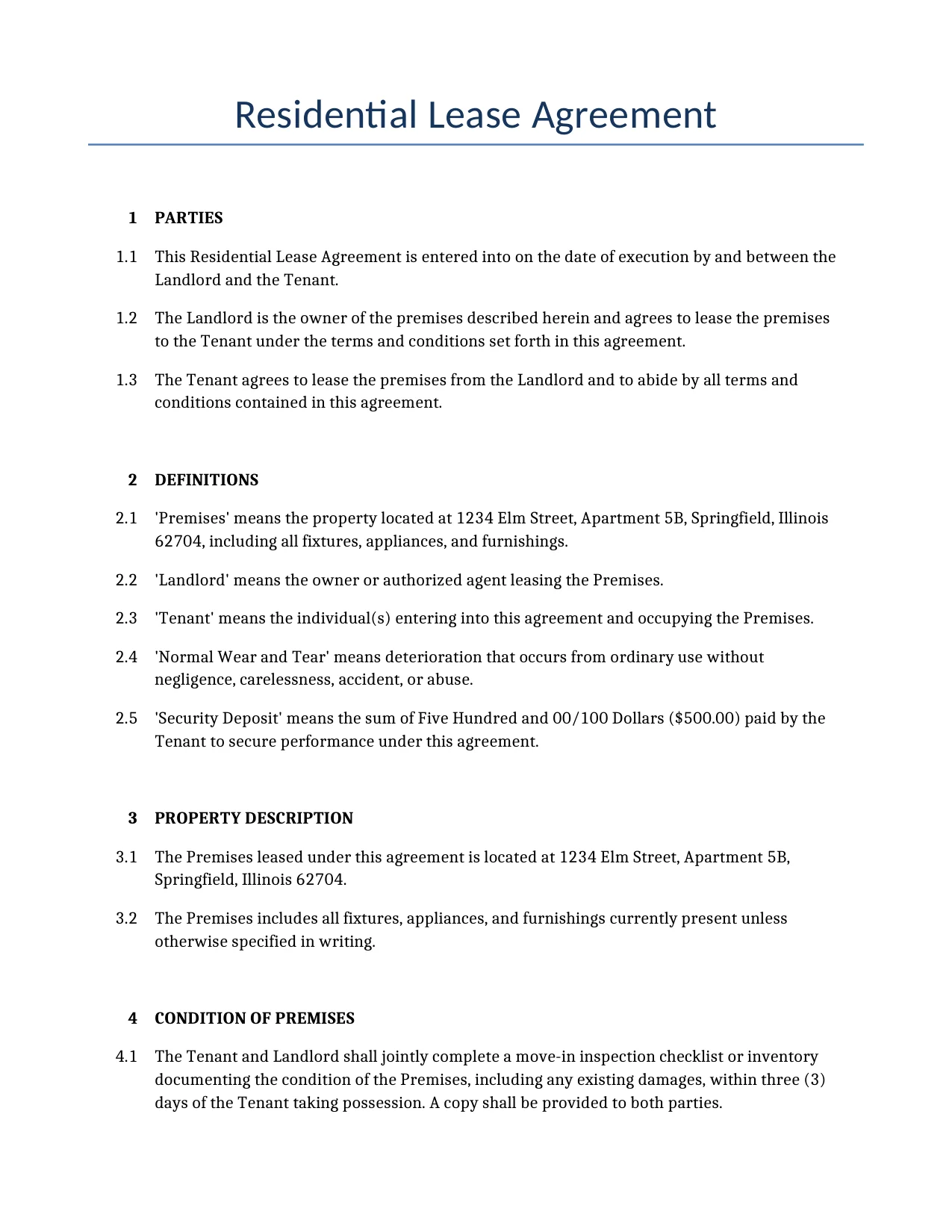
Residential Lease Agreement
1PARTIES
This Residential Lease Agreement is entered into on the date of execution by and between the Landlord and the Tenant.
The Landlord is the owner of the premises described herein and agrees to lease the premises to the Tenant under the terms and conditions set forth in this agreement.
The Tenant agrees to lease the premises from the Landlord and to abide by all terms and conditions contained in this agreement.
2DEFINITIONS
'Premises' means the property located at 1234 Elm Street, Apartment 5B, Springfield, Illinois 62704, including all fixtures, appliances, and furnishings.
'Landlord' means the owner or authorized agent leasing the Premises.
'Tenant' means the individual(s) entering into this agreement and occupying the Premises.
'Normal Wear and Tear' means deterioration that occurs from ordinary use without negligence, carelessness, accident, or abuse.
'Security Deposit' means the sum of Five Hundred and 00/100 Dollars ($500.00) paid by the Tenant to secure performance under this agreement.
3PROPERTY DESCRIPTION
The Premises leased under this agreement is located at 1234 Elm Street, Apartment 5B, Springfield, Illinois 62704.
The Premises includes all fixtures, appliances, and furnishings currently present unless otherwise specified in writing.
4CONDITION OF PREMISES
The Tenant and Landlord shall jointly complete a move-in inspection checklist or inventory documenting the condition of the Premises, including any existing damages, within three (3) days of the Tenant taking possession. A copy shall be provided to both parties.
By taking possession, the Tenant acknowledges that the Premises is in the condition documented in the move-in inspection checklist, except for any latent defects.
The Landlord warrants that at the commencement of the tenancy, the Premises complies with all applicable building, housing, and health codes of the City of Springfield and the State of Illinois, including but not limited to the Illinois Habitability Standards under 765 ILCS 742/ and common law implied warranty of habitability.
5TERM OF THE LEASE
This agreement creates a fixed-term tenancy commencing on January 1, 2024, and ending on December 31, 2024, unless sooner terminated according to the provisions herein.
The Tenant shall vacate the Premises at the end of the term unless a new agreement is executed in writing by both parties.
6RENT
The Tenant shall pay to the Landlord monthly rent in the amount of One Thousand Five Hundred and 00/100 Dollars ($1,500.00), due on the 5th day of each month.
Rent shall be paid by check, electronic transfer, or other method agreed upon in writing by the Landlord.
If rent is not received by the 10th day of the month, a late fee of Fifty and 00/100 Dollars ($50.00) shall apply, and an additional Ten and 00/100 Dollars ($10.00) shall accrue for each day thereafter until paid. This late fee structure complies with Illinois law.
The Landlord may increase rent upon renewal of this lease by providing the Tenant with written notice at least 60 days prior to the end of the term, in accordance with 735 ILCS 5/9-201 et seq.
7SECURITY DEPOSIT
The Tenant shall pay to the Landlord a security deposit in the amount of Five Hundred and 00/100 Dollars ($500.00) upon execution of this agreement.
The Landlord may withhold from the security deposit amounts for unpaid rent, damages beyond normal wear and tear, and cleaning costs.
The Landlord shall return the security deposit or any remaining balance, along with an itemized statement of deductions, within forty-five (45) days after the Tenant vacates the Premises, provides a forwarding address, and complies with the requirements of 765 ILCS 710/ and 765 ILCS 742/.
8USE OF PREMISES
The Tenant shall use the Premises solely as a single-family dwelling and for no other purpose. This is a residential lease only and shall not be construed as a commercial lease.
The Tenant shall not engage in any illegal activities on the Premises.
Occupancy is limited to the Tenant and up to two additional occupants unless prior written consent is obtained from the Landlord.
The Tenant shall have the right to quiet enjoyment of the Premises, and the Landlord covenants that the Tenant shall be entitled to peaceful possession free from interference, subject to the terms of this agreement.
9MAINTENANCE AND REPAIRS
The Landlord shall maintain the Premises in compliance with all applicable housing codes, including Illinois habitability requirements under 765 ILCS 742/, and shall make all necessary repairs to the structure and major systems.
The Tenant shall keep the Premises clean and sanitary and shall promptly notify the Landlord of any needed repairs.
The Tenant shall be responsible for any damages caused by the Tenant or the Tenant's guests beyond normal wear and tear.
10RIGHT OF ENTRY
The Landlord or Landlord's agents may enter the Premises upon providing at least twenty-four (24) hours' reasonable notice for inspections, repairs, alterations, or to show the Premises to prospective tenants or purchasers, in accordance with Illinois law (765 ILCS 742/).
In case of emergency, the Landlord may enter without notice.
11UTILITIES
The Tenant shall be responsible for payment of all utilities including electricity, gas, water, sewer, and trash removal unless otherwise agreed in writing.
12PARKING
No parking spaces are provided with the Premises.
The Tenant and guests shall not park in any unauthorized areas. Any vehicles parked on the property must be operable, currently licensed, and in good repair.
The Landlord assumes no liability for damage, theft, or loss to any vehicle or its contents parked on or near the Premises. The Tenant assumes all risk.
13LEAD-BASED PAINT DISCLOSURE
The Premises was built before 1978 and may contain lead-based paint.
The Landlord has provided the Tenant with the EPA pamphlet titled "Protect Your Family from Lead in Your Home" and any known information regarding lead-based paint hazards, in compliance with federal EPA requirements (42 U.S.C. 4852d).
The Tenant acknowledges receipt of the lead-based paint disclosure and has been given an opportunity to inspect the Premises for such hazards.
14PROHIBITED CONDUCT
The Tenant shall not smoke or permit smoking of any substance inside the Premises or common areas.
The Tenant shall not store or use any dangerous, flammable, or explosive materials on the Premises.
The Tenant shall not create excessive noise or disturbances that interfere with the quiet enjoyment of other residents.
The Tenant shall comply with all community rules, homeowners association (HOA) regulations, or local ordinances applicable to the Premises.
Pets: The Tenant shall not keep pets on the Premises without the prior written consent of the Landlord. If approved, only dogs or cats under thirty (30) pounds are permitted (no aggressive breeds). An additional non-refundable pet deposit of Two Hundred Fifty and 00/100 Dollars ($250.00) is required. The Tenant is liable for all damages caused by the pet(s) and must comply with all applicable laws regarding pet ownership.
The Tenant shall not make alterations to the Premises without the prior written consent of the Landlord.
The Tenant shall not sublet the Premises or assign this agreement without the prior written consent of the Landlord.
15TENANT INSURANCE REQUIREMENTS
The Tenant is required to maintain renter's insurance with minimum liability coverage of One Hundred Thousand and 00/100 Dollars ($100,000.00) for personal liability. The policy shall name the Landlord as an additional insured where possible and include a waiver of subrogation in favor of the Landlord.
The Tenant is solely responsible for insuring their own personal property against loss, damage, or theft. The Landlord's insurance does not cover the Tenant's belongings.
16COMPLIANCE WITH STATE LAWS
This agreement complies with the applicable provisions of the Illinois Compiled Statutes, including but not limited to 735 ILCS 5/9-201 et seq. (Forcible Entry and Detainer), 765 ILCS 742/ (Residential Tenant Landlord Ordinance where applicable or general provisions), 765 ILCS 710/ (Security Deposit Return Act), and all other relevant Illinois landlord-tenant laws. The Premises is located in Springfield, Illinois, and this lease is governed exclusively by Illinois law.
17DEFAULT AND REMEDIES
If the Tenant fails to pay rent or otherwise breaches this agreement, the Landlord may provide written notice and pursue all remedies available under Illinois law, including eviction proceedings under 735 ILCS 5/9-201 et seq.
If the Landlord breaches this agreement, the Tenant may provide written notice and pursue all remedies available under Illinois law, including remedies for breach of the implied warranty of habitability.
In any action arising out of this agreement, the prevailing party shall be entitled to recover reasonable attorney fees and court costs from the non-prevailing party.
If the Tenant abandons the Premises before the end of the term, the Landlord may re-enter, take possession, and recover damages as provided under Illinois law. The Tenant remains liable for any deficiency in rent.
18SUBORDINATION AND ATTORNMENT
This lease is subordinate to any existing or future mortgages, deeds of trust, or ground leases on the property. The Tenant agrees to attorn to any purchaser or lender acquiring the property through foreclosure or deed in lieu thereof, provided the Tenant's rights under this lease are not disturbed.
19CASUALTY DAMAGE
If the Premises is substantially damaged or destroyed by fire, flood, or other casualty not caused by the Tenant, either party may terminate this agreement upon written notice. Rent shall abate during the period the Premises is untenantable.
The Landlord shall have a reasonable time (not to exceed sixty (60) days) to repair the Premises. If repairs are not completed within that time, the Tenant may terminate the lease.
20INDEMNIFICATION
The Tenant agrees to indemnify, defend, and hold harmless the Landlord from any claims, damages, losses, or liabilities arising from the Tenant's use of the Premises, negligence, or breach of this agreement, except to the extent caused by the Landlord's negligence.
21FORCE MAJEURE
Neither party shall be liable for delays or failure to perform obligations (except payment of rent) caused by events beyond their reasonable control, including but not limited to acts of God, fire, flood, or governmental orders.
22NOTICES
All notices required under this agreement shall be in writing and delivered personally or sent by certified mail to the addresses provided by each party.
23GOVERNING LAW
This agreement shall be governed by the laws of the State of Illinois.
Any disputes arising under this agreement shall be resolved exclusively in the courts located in Sangamon County, Illinois.
24ADDITIONAL DISCLOSURES
Radon Disclosure: The Premises may present elevated levels of radon gas. The Tenant should consult with a qualified professional for testing. (Pursuant to Illinois Radon Awareness Act.)
Carbon Monoxide and Smoke Detectors: The Premises is equipped with functioning smoke and carbon monoxide detectors. The Tenant is responsible for testing them monthly and notifying the Landlord of any malfunctions.
Bed Bug Disclosure (if applicable per local Springfield ordinances): Information regarding bed bug prevention and responsibilities is attached as an exhibit.
Mold: The Tenant must notify the Landlord immediately of any visible mold or moisture issues.
Energy Efficiency: Any applicable energy efficiency disclosures have been provided.
25ENTIRE AGREEMENT
This document constitutes the entire agreement between the Landlord and the Tenant and supersedes all prior understandings or agreements.
26SEVERABILITY
If any provision of this agreement is held to be invalid or unenforceable, the remaining provisions shall remain in full force and effect.
27VARIATION
No variation of this agreement shall be effective unless it is in writing and signed by both the Landlord and the Tenant.
28EXHIBITS AND ADDENDA
The following exhibits and addenda are attached hereto and incorporated by reference as if fully set forth herein: (a) Move-In Inspection Checklist/Inventory; (b) Lead-Based Paint Pamphlet Acknowledgment; (c) Rules and Regulations; (d) Any local Springfield or Illinois-mandated addenda (e.g., radon, bed bug disclosure). All exhibits form a part of this agreement.
29SIGNATURES
| LANDLORD | |
| Signature: | |
| Print Name: | |
| Date: |
| TENANT | |
| Signature: | |
| Print Name: | |
| Date: |
This agreement may be executed in counterparts, each of which shall be deemed an original, and electronic signatures and delivery (including via email or electronic signature platforms) shall be deemed originals. Each party shall receive a fully executed copy of this agreement.
This example shows approximately 70% of a typical document and is provided for illustrative purposes only. The remaining content has been omitted.
Every document generated by Docaro is tailored to your specific circumstances, jurisdiction and the information you provide. The completed document includes all applicable clauses and provisions required for your situation.
To generate the full, personalised document, answer a short series of questions and your document will be created instantly.