
AI Generated American Advance Healthcare Directive
PDF & Word - 2026 Updated
Docaro Pricing
When Do You Need an Advance Healthcare Directive in the United States?
American Legal Rules for an Advance Healthcare Directive
Using an incorrect format for an advance healthcare directive may render it invalid or unenforceable in your state.
What a Proper Advance Healthcare Directive Should Include
- Your Overall Health WishesState your general preferences for medical care, such as favoring treatments that extend life or focusing on comfort and quality of life.
- Specific Treatment ChoicesSpecify decisions about procedures like life support, feeding tubes, or resuscitation if your heart or breathing stops.
- Appointing a Healthcare AgentName a trusted person to make medical decisions for you if you cannot speak for yourself, including alternates.
- Organ and Tissue DonationIndicate whether you want to donate organs, tissues, or your body for medical research or education after death.
- Pain and Symptom ManagementExpress your desires for relief from pain and other symptoms, even if it might shorten your life.
- Mental Health InstructionsOutline your preferences for mental health treatments, including any medications or therapies you do or do not want.
- When the Document Takes EffectDefine the conditions under which this directive becomes active, such as if you are unable to communicate or make decisions.
Generate Your Document in 4 Easy Steps
Why Use Docaro?
 United States
Free Example Advance Healthcare Directive Template
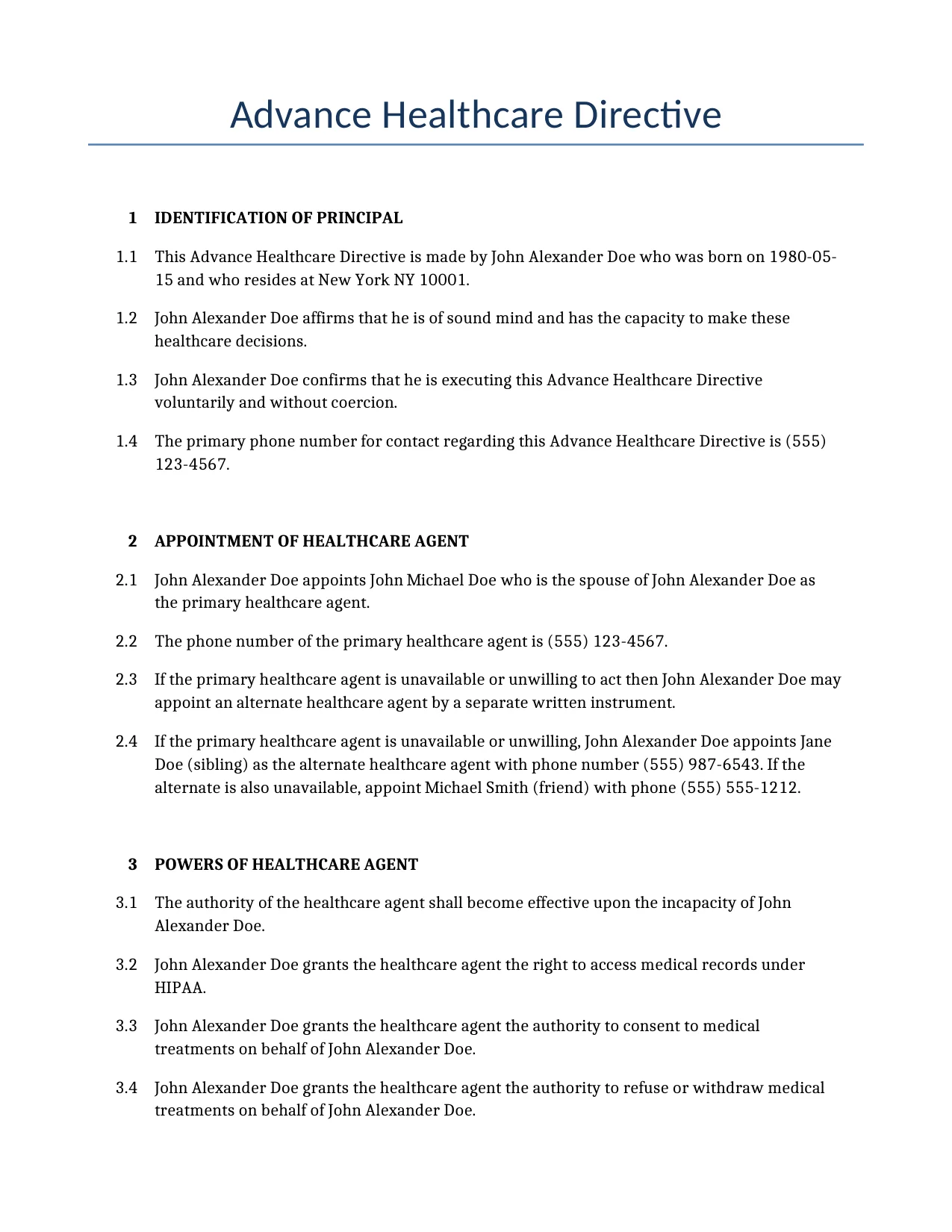
Below is a free template example of a Advance Healthcare Directive for use in the United States generated by our AI model.
The clauses in your actual Advance Healthcare Directive will vary from this example as they will be entirely bespoke to your requirements as set out in the questionnaire you complete.
Advance Healthcare Directive
1IDENTIFICATION OF PRINCIPAL
This Advance Healthcare Directive is made by John Alexander Doe who was born on 1980-05-15 and who resides at New York NY 10001.
John Alexander Doe affirms that he is of sound mind and has the capacity to make these healthcare decisions.
John Alexander Doe confirms that he is executing this Advance Healthcare Directive voluntarily and without coercion.
The primary phone number for contact regarding this Advance Healthcare Directive is (555) 123-4567.
2APPOINTMENT OF HEALTHCARE AGENT
John Alexander Doe appoints John Michael Doe who is the spouse of John Alexander Doe as the primary healthcare agent.
The phone number of the primary healthcare agent is (555) 123-4567.
If the primary healthcare agent is unavailable or unwilling to act then John Alexander Doe may appoint an alternate healthcare agent by a separate written instrument.
If the primary healthcare agent is unavailable or unwilling, John Alexander Doe appoints Jane Doe (sibling) as the alternate healthcare agent with phone number (555) 987-6543. If the alternate is also unavailable, appoint Michael Smith (friend) with phone (555) 555-1212.
3POWERS OF HEALTHCARE AGENT
The authority of the healthcare agent shall become effective upon the incapacity of John Alexander Doe.
John Alexander Doe grants the healthcare agent the right to access medical records under HIPAA.
John Alexander Doe grants the healthcare agent the authority to consent to medical treatments on behalf of John Alexander Doe.
John Alexander Doe grants the healthcare agent the authority to refuse or withdraw medical treatments on behalf of John Alexander Doe.
John Alexander Doe grants the healthcare agent the authority to make decisions about life-sustaining procedures such as ventilators or feeding tubes.
John Alexander Doe grants the healthcare agent the authority to make decisions regarding admission to hospitals and nursing homes.
The powers granted to the healthcare agent shall apply to mental health treatment decisions.
The healthcare agent shall not have authority to make decisions that the principal has specifically limited in this directive or in any separate mental health advance directive.
The agent must follow any known wishes of the principal expressed orally or in writing.
4LIVING WILL PROVISIONS
In the event of a terminal condition or permanent unconsciousness John Alexander Doe directs that life-sustaining treatments such as mechanical ventilation or artificial nutrition shall be withheld or withdrawn.
If John Alexander Doe becomes permanently unconscious then John Alexander Doe directs that life-sustaining treatments to keep the body functioning shall be withheld or withdrawn after a specified period.
John Alexander Doe directs that artificial nutrition such as tube feeding shall not be provided if John Alexander Doe is unable to eat in a terminal or permanently unconscious condition.
John Alexander Doe directs that artificial hydration such as IV fluids shall not be provided if John Alexander Doe is unable to drink in a terminal or permanently unconscious condition.
John Alexander Doe directs that mechanical ventilation or a breathing machine shall not be used if John Alexander Doe cannot breathe on his own in a terminal or permanently unconscious condition.
John Alexander Doe directs that cardiopulmonary resuscitation (CPR) shall not be administered if his heart stops or he stops breathing in a terminal or permanently unconscious condition.
In a terminal or permanently unconscious condition John Alexander Doe requests full pain relief even if it may hasten death.
If John Alexander Doe is unable to communicate his needs then aggressive pain relief even if it hastens death shall be provided.
In the event John Alexander Doe is diagnosed with a terminal condition John Alexander Doe directs that life-sustaining treatments to prolong life shall be withheld or withdrawn.
Terminal condition means an incurable or irreversible condition that will result in death within a relatively short time. Permanent unconsciousness means a condition where the individual has no reasonable expectation of regaining consciousness.
If John Alexander Doe is a pregnant woman and the fetus is viable, life-sustaining treatments shall not be withheld or withdrawn if it would result in the termination of the pregnancy, to the extent permitted by law.
5MENTAL HEALTH TREATMENT INSTRUCTIONS
If John Alexander Doe is unable to make decisions for himself then all recommended mental health treatments shall be authorized.
Antidepressants and mood stabilizers are authorized if recommended by the provider.
Electroconvulsive therapy (ECT) shall not be authorized.
Voluntary hospitalization for mental health treatment is authorized if necessary.
Restrictive interventions like seclusion or restraints during mental health treatment shall be authorized only in life-threatening emergencies.
6ORGAN AND TISSUE DONATION
John Alexander Doe declares that his entire body shall be donated for medical or scientific purposes.
John Alexander Doe authorizes donation of organs, tissues, or eyes for transplantation, therapy, research, or education, but excludes donation of the entire body if specific organs are chosen. This authorization may be revoked by notifying the appropriate organ procurement organization.
7POST-MORTEM DECISIONS
John Alexander Doe authorizes an autopsy on his body after death.
The preferred method for disposition of the remains of John Alexander Doe after death is cremation.
The ashes of John Alexander Doe shall be scattered at sea in a location of the family\'s choosing.
The contact person responsible for handling decisions about the remains is the spouse Jane Doe whose phone number is (555) 123-4567.
These instructions are preferences only and may be overridden by the healthcare agent or next of kin if necessary under applicable law.
8EFFECTIVE DATE AND REVOCATION
This Advance Healthcare Directive is executed on 2023-10-15 and becomes effective on 2023-10-15.
This Advance Healthcare Directive may be revoked or amended by written notice or by a new directive.
9DURATION OF DIRECTIVE
This Advance Healthcare Directive remains valid indefinitely unless revoked by John Alexander Doe.
John Alexander Doe understands that this Advance Healthcare Directive can be revoked at any time regardless of its duration.
10GUARDIAN DESIGNATION
John Alexander Doe appoints John Michael Doe who is the spouse of John Alexander Doe as the guardian of the person and guardian of the estate in the event guardianship proceedings are initiated.
11RELIANCE BY THIRD PARTIES
Healthcare providers and others are authorized to rely on this Advance Healthcare Directive and the agent designations in good faith.
The reliance authorization by healthcare providers and third parties shall be full reliance without inquiry.
Healthcare providers and third parties are protected from liability when relying in good faith on this Advance Healthcare Directive.
12SEVERABILITY
If any provision of this Advance Healthcare Directive is held to be invalid or unenforceable then the remaining provisions shall remain in full force and effect.
13GOVERNING LAW
This Advance Healthcare Directive shall be governed by and construed in accordance with the laws of the State of New York.
14ENTIRE AGREEMENT
This Advance Healthcare Directive constitutes the entire agreement between the parties with respect to the subject matter hereof and supersedes all prior understandings and agreements whether written or oral.
15NOTICES
Any notice required or permitted under this Advance Healthcare Directive shall be in writing and shall be delivered personally or sent by certified mail return receipt requested to the principal or the healthcare agent at the addresses provided herein.
16VARIATION
No variation of this Advance Healthcare Directive shall be effective unless it is in writing and signed by John Alexander Doe.
17ACKNOWLEDGMENT OF PRINCIPAL
John Alexander Doe acknowledges this Advance Healthcare Directive on 2023-10-15.
John Alexander Doe confirms that he is executing this Advance Healthcare Directive of his own free will without any undue influence or coercion.
John Alexander Doe confirms that he fully understands the purpose scope and consequences of this Advance Healthcare Directive.
John Alexander Doe believes that he currently has the mental capacity to make this healthcare decision and has full capacity.
18SIGNATURE SECTION
IN WITNESS WHEREOF John Alexander Doe has executed this Advance Healthcare Directive on the date first above written.
Principal Signature: _______________________________ Date: _______________ Printed Name: John Alexander Doe
Healthcare Agent Signature: _______________________________ Date: _______________ Printed Name: John Michael Doe
Witness Signature: _______________________________ Date: _______________ Printed Name: _______________________________
Witness Signature: _______________________________ Date: _______________ Printed Name: _______________________________
19WITNESSES AND NOTARY
This Advance Healthcare Directive must be witnessed by two witnesses who are not the agent, not related to the principal by blood, marriage, or adoption, and not beneficiaries of the principal\'s estate. We declare that the principal is personally known to us, signed in our presence, appears of sound mind, and is not under duress.
Witness 1: Signature _______________________________ Name _______________________________ Date _______________ Address _______________________________
Witness 2: Signature _______________________________ Name _______________________________ Date _______________ Address _______________________________
Notary Acknowledgment: State of New York, County of _______________ This document was acknowledged before me on _______________ by John Alexander Doe. Notary Signature: _______________________________ Printed Name: _______________________________ My Commission Expires: _______________
20AGENT ACCEPTANCE
I, John Michael Doe, accept the appointment as healthcare agent and agree to act in accordance with the principal\'s wishes as stated in this directive to the best of my ability.
Agent Signature: _______________________________ Date: _______________ Printed Name: John Michael Doe
21COPIES AND DISTRIBUTION
This Advance Healthcare Directive shall be distributed to the healthcare agent, primary physician, family members, and any healthcare facilities. A copy has the same effect as the original.
Intended recipients: Jane Doe (sibling), phone (555) 987-6543; Michael Smith (friend), phone (555) 555-1212; Primary physician at New York NY 10001.
This example shows approximately 70% of a typical document and is provided for illustrative purposes only. The remaining content has been omitted.
Every document generated by Docaro is tailored to your specific circumstances, jurisdiction and the information you provide. The completed document includes all applicable clauses and provisions required for your situation.
To generate the full, personalised document, answer a short series of questions and your document will be created instantly.