
AI Generated American Commercial Sublease Agreement
PDF & Word - 2026 Updated
Docaro Pricing
When Do You Need a Commercial Sublease Agreement in the United States?
American Legal Rules for a Commercial Sublease Agreement
Using the wrong type of sublease agreement can lead to unintended liabilities or invalidation of the sublease.
What a Proper Commercial Sublease Agreement Should Include
- Parties InvolvedIdentify the original tenant (sublessor), the new tenant (sublessee), and the property owner (lessor) with their full names and contact details.
- Property DescriptionProvide a clear description of the commercial space being subleased, including its location, size, and any specific features.
- Lease TermSpecify the start and end dates of the sublease, ensuring it does not exceed the original lease's duration.
- Rent and PaymentsOutline the rent amount, due dates, payment method, and any additional fees like utilities or maintenance.
- Use of SpaceDefine how the sublessee can use the property, such as for a specific business type, and any restrictions.
- Responsibilities and MaintenanceDetail who handles repairs, cleaning, and upkeep of the space during the sublease period.
- Original Lease ComplianceState that the sublessee must follow all terms of the original lease and obtain any required approvals from the owner.
- Insurance and LiabilityRequire the sublessee to carry appropriate insurance and clarify responsibility for any damages or injuries.
- Termination ConditionsExplain how the sublease can end early, including notice periods and any penalties.
- Dispute ResolutionDescribe steps for handling disagreements, such as mediation or arbitration, to avoid court.
Generate Your Document in 4 Easy Steps
Why Use Docaro?
 United States
Free Example Commercial Sublease Agreement Template
Below is a free template example of a Commercial Sublease Agreement for use in the United States generated by our AI model.
The clauses in your actual Commercial Sublease Agreement will vary from this example as they will be entirely bespoke to your requirements as set out in the questionnaire you complete.
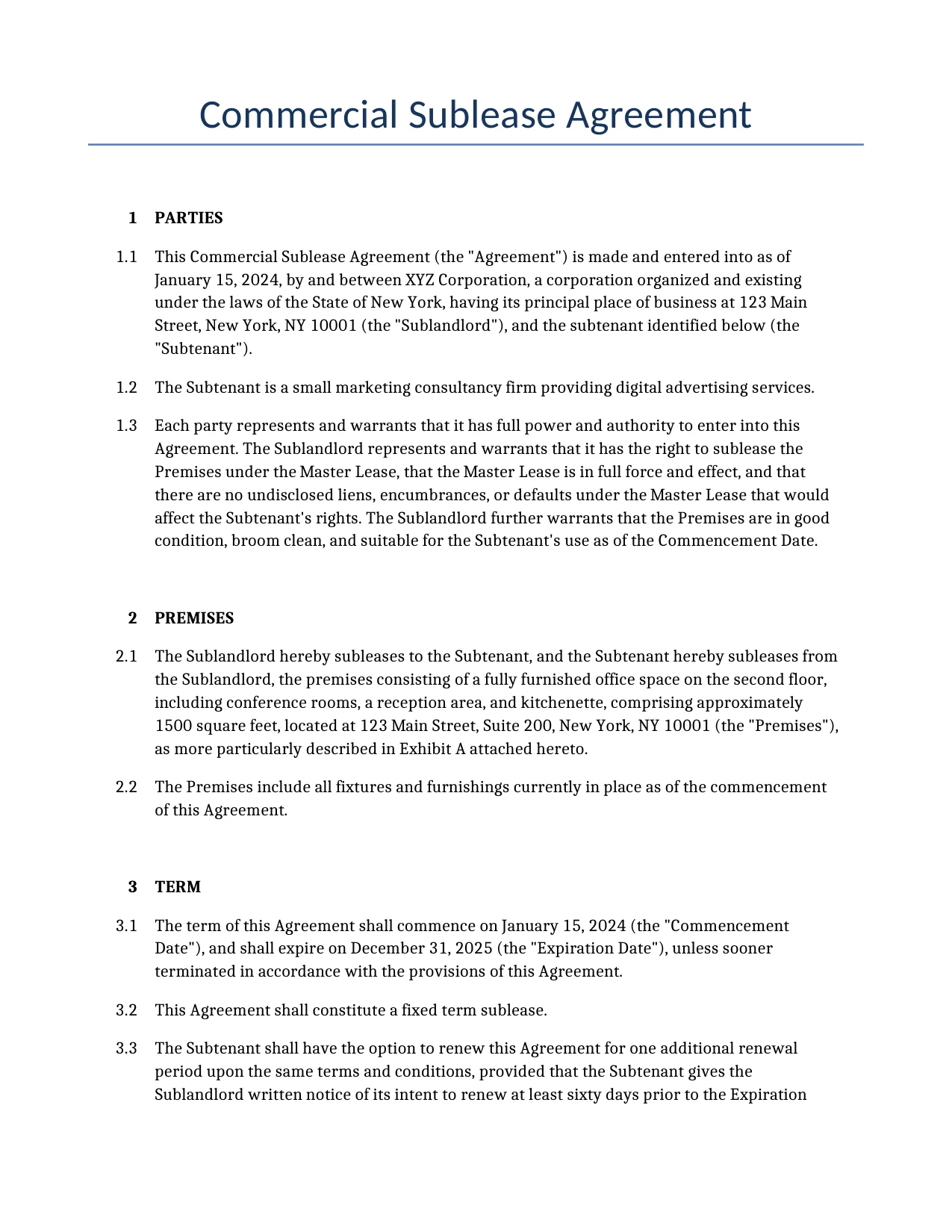
Commercial Sublease Agreement
1PARTIES
This Commercial Sublease Agreement (the "Agreement") is made and entered into as of January 15, 2024, by and between XYZ Corporation, a corporation organized and existing under the laws of the State of New York, having its principal place of business at 123 Main Street, New York, NY 10001 (the "Sublandlord"), and the subtenant identified below (the "Subtenant").
The Subtenant is a small marketing consultancy firm providing digital advertising services.
Each party represents and warrants that it has full power and authority to enter into this Agreement. The Sublandlord represents and warrants that it has the right to sublease the Premises under the Master Lease, that the Master Lease is in full force and effect, and that there are no undisclosed liens, encumbrances, or defaults under the Master Lease that would affect the Subtenant's rights. The Sublandlord further warrants that the Premises are in good condition, broom clean, and suitable for the Subtenant's use as of the Commencement Date.
2PREMISES
The Sublandlord hereby subleases to the Subtenant, and the Subtenant hereby subleases from the Sublandlord, the premises consisting of a fully furnished office space on the second floor, including conference rooms, a reception area, and kitchenette, comprising approximately 1500 square feet, located at 123 Main Street, Suite 200, New York, NY 10001 (the "Premises"), as more particularly described in Exhibit A attached hereto.
The Premises include all fixtures and furnishings currently in place as of the commencement of this Agreement.
3TERM
The term of this Agreement shall commence on January 15, 2024 (the "Commencement Date"), and shall expire on December 31, 2025 (the "Expiration Date"), unless sooner terminated in accordance with the provisions of this Agreement.
This Agreement shall constitute a fixed term sublease.
The Subtenant shall have the option to renew this Agreement for one additional renewal period upon the same terms and conditions, provided that the Subtenant gives the Sublandlord written notice of its intent to renew at least sixty days prior to the Expiration Date.
4RENT
The Subtenant shall pay to the Sublandlord a monthly base rent in the amount of $2500.00 (the "Base Rent"). The Base Rent does not include utilities or common area maintenance (CAM) charges, which shall be paid as additional rent as set forth in this Agreement.
Rent payments shall commence on the Commencement Date and shall be paid monthly in advance on the first day of each month thereafter. The first month's rent shall be prorated based on the actual days from the Commencement Date to the end of the calendar month.
Payments shall be made via electronic transfer to Bank of America, Account Number: 123456789, Routing Number: 026073150, or by check mailed to 123 Main Street, New York, NY 10001.
If any rent payment is not received within ten (10) days after the due date (consistent with New York law), the Subtenant shall pay a late fee equal to five percent of the overdue amount. Overdue amounts shall bear interest at the lesser of 1.5 percent per month or the maximum rate permitted under New York law.
The Base Rent shall escalate by three percent on each anniversary of the Commencement Date.
The Subtenant shall also pay as additional rent its pro rata share of utilities, CAM charges, taxes, and any other charges under the Master Lease.
5USE OF PREMISES
The Subtenant shall use the Premises solely for the purpose of operating a small marketing consultancy firm providing digital advertising services, which shall constitute general office use.
The Subtenant shall have full access to the common areas of the building as permitted by the building rules.
The Subtenant shall not use the Premises for any nuisance, illegal, immoral, or objectionable purpose.
6MASTER LEASE
This Agreement is subject to and incorporates by reference all terms and conditions of the Master Lease dated January 15, 2020, between ABC Properties Inc. and XYZ Corp., as amended (the "Master Lease"). A redacted copy of the Master Lease is attached as Exhibit B.
The Subtenant shall comply with the terms of the Master Lease regarding use of premises, maintenance and repairs, and insurance requirements. To the extent of any conflict between this Agreement and the Master Lease, the terms of the Master Lease shall control with respect to the prime landlord's rights.
The Subtenant acknowledges receipt and understanding of the Master Lease.
7LANDLORD CONSENT
This Agreement and the Subtenant's rights hereunder are expressly conditioned upon obtaining the prior written consent of the prime landlord (also referred to as the master landlord) under the Master Lease, which consent shall be obtained by the Sublandlord at its sole cost and expense. The Sublandlord shall use commercially reasonable efforts to obtain such consent within thirty (30) days of the date of this Agreement. If such consent is not obtained, either party may terminate this Agreement upon written notice with no further liability.
The prime landlord's consent, if granted, may be subject to reasonable conditions, which the Subtenant agrees to comply with.
8SUBORDINATION
This Agreement is subordinate to the Master Lease and to any mortgage or deed of trust encumbering the property, subject to the terms of the SNDA required under Section 9 below.
9SUBORDINATION, NON-DISTURBANCE, AND ATTORNMENT AGREEMENT (SNDA)
The Sublandlord shall obtain a commercially reasonable subordination, non-disturbance, and attornment agreement (SNDA) from the prime landlord and any mortgagee or superior interest holder, which shall provide that the Subtenant's possession and rights under this Agreement shall not be disturbed in the event of foreclosure, termination of the Master Lease, or other superior claims, provided the Subtenant is not in default. The sublease shall not be subordinate to any superior interest unless and until such SNDA is delivered to the Subtenant.
10UTILITIES AND SERVICES
The Subtenant shall be responsible for paying all utilities serving the Premises during the term of this Agreement.
Utilities shall be allocated using separate metering where available.
11MAINTENANCE AND REPAIRS
The Subtenant shall be responsible for all maintenance and repairs to the Premises during the term, including interior non-structural repairs. The Subtenant shall also maintain and repair the HVAC and mechanical systems serving the Premises, unless such systems are covered under the Master Lease as the responsibility of the prime landlord, in which case the Subtenant shall reimburse the Sublandlord for its pro rata share.
The Sublandlord shall be responsible for all structural repairs, including the roof and foundation, to the extent required under the Master Lease.
The Subtenant's pro rata share of common area maintenance costs shall be 25 percent, determined based on the leased area.
The Subtenant shall notify the Sublandlord in writing within 7 days of any needed repairs that are the Sublandlord's responsibility.
The Subtenant shall obtain the Sublandlord's prior written approval, which shall not be unreasonably withheld, before making any alterations that could affect maintenance obligations.
The Sublandlord shall coordinate all emergency repairs that pose immediate safety risks.
12ALTERATIONS AND IMPROVEMENTS
The Subtenant shall not make any alterations or improvements to the Premises without the prior written consent of the Sublandlord and the prime landlord, which consent shall not be unreasonably withheld.
All alterations and improvements shall be owned by the prime landlord upon installation, subject to the terms of the Master Lease.
At the end of the term, the Subtenant shall remove all alterations and improvements required to be removed under the Master Lease and restore the Premises to its original condition, at the Subtenant's sole expense.
The Sublandlord shall not reimburse the Subtenant for any approved alterations or improvements.
13INSURANCE
The Subtenant shall maintain the following insurance: (i) commercial general liability insurance with a minimum limit of $1,000,000 per occurrence and $2,000,000 in the aggregate; (ii) property insurance for its improvements and contents with a minimum limit of $500,000 on an all-risk basis; (iii) workers' compensation insurance as required by New York law if the Subtenant has employees; and (iv) business interruption insurance in an amount sufficient to cover at least six months of Base Rent and additional rent. All policies shall be primary and non-contributory with respect to any insurance carried by the Sublandlord or prime landlord. The Sublandlord and prime landlord shall be named as additional insureds on the Subtenant's liability policies.
The Subtenant shall provide certificates of insurance evidencing the above coverages to the Sublandlord prior to the Commencement Date and at least 30 days prior to any renewal or replacement. The Subtenant shall provide at least 30 days written notice of any policy cancellation or material change.
Each insurance policy shall include a waiver of subrogation in favor of the Sublandlord and the prime landlord.
The Sublandlord shall maintain all insurance required of it as tenant under the Master Lease and shall name the Subtenant as an additional insured where appropriate under the Master Lease.
14INDEMNIFICATION
The Subtenant shall indemnify, defend, and hold harmless the Sublandlord from and against all claims, liabilities, damages, and expenses, including those for personal injury or death, property damage, and environmental liabilities, arising from the Subtenant's use of the Premises, except to the extent caused by the Sublandlord's negligence or willful misconduct.
The Subtenant's insurance obligations shall cover the risks subject to this indemnification.
15ASSIGNMENT AND SUBLETTING
The Subtenant shall not assign this Agreement or further sublet the Premises without the prior written consent of the Sublandlord and the prime landlord, which consent shall not be unreasonably withheld, conditioned, or delayed to the extent consistent with New York law and the Master Lease.
16DEFAULT AND REMEDIES
The following events shall constitute a default by the Subtenant: failure to pay rent when due, breach of any covenant, abandonment of the Premises, or insolvency or bankruptcy.
A default under the Master Lease caused by the Subtenant shall automatically constitute a default under this Agreement.
Upon any monetary default, the Sublandlord shall provide the Subtenant with ten (10) days written notice before declaring a default (consistent with New York law), during which the Subtenant may cure the default.
Upon any non-monetary default, the Sublandlord shall provide the Subtenant with thirty (30) days written notice before declaring a default, during which the Subtenant may cure the default (or such longer period as may be required under the Master Lease).
Upon default, and subject to New York law, the Sublandlord shall have all remedies available at law or in equity, including but not limited to terminating this Agreement, re-entering the Premises, recovering damages (with a duty to mitigate damages), and, to the extent permitted, accelerating all remaining rent due under this Agreement. The Sublandlord may also exercise self-help rights where permitted under New York law.
Overdue amounts shall bear interest at the lesser of 1.5 percent per month or the maximum rate permitted under New York law.
In any action or proceeding to enforce this Agreement, the prevailing party shall be entitled to recover its reasonable attorneys' fees and costs from the non-prevailing party.
17TERMINATION
In addition to any other rights, either party may terminate this Agreement for cause upon thirty (30) days written notice if the prime landlord fails to provide consent as required, if there is a termination of the Master Lease not caused by the terminating party, or for other material breaches not cured within the applicable notice period. The Subtenant may terminate early upon sixty (60) days written notice and payment of an early termination fee equal to three (3) months' Base Rent. Upon termination, all surviving obligations, including indemnification and restoration, shall remain in effect.
18CASUALTY AND CONDEMNATION
If the Premises are damaged by fire or other casualty, the Subtenant shall immediately notify the Sublandlord. If the Master Lease provides for termination rights, the Sublandlord shall exercise or waive such rights promptly after consultation with the Subtenant. If the Premises are substantially damaged and repairs cannot be completed within ninety (90) days, either party may terminate this Agreement upon written notice. During any period of repair, Base Rent shall abate proportionately to the extent the Premises are untenantable. Insurance proceeds for Subtenant's property shall be paid to the Subtenant.
In the event of a taking by eminent domain or condemnation affecting the Premises, if the taking is of all or a substantial part of the Premises, either party may terminate this Agreement upon written notice. The award shall be allocated as follows: the Sublandlord shall receive any award for the fee interest and the Subtenant shall receive any award for its leasehold interest, improvements, relocation costs, and business interruption. If only a portion is taken and the Premises remain usable, rent shall be equitably abated.
19SURRENDER OF PREMISES
Upon termination or expiration of this Agreement, the Subtenant shall surrender the Premises in the same condition as received, subject only to reasonable wear and tear.
The Premises must be returned clean, free of debris, and in the same condition as delivered, allowing for reasonable wear and tear.
The Subtenant shall remove all alterations and improvements required to be removed, repair any damage caused by such removal, and pay all outstanding rent and charges.
The Subtenant shall return all keys and access devices to the Sublandlord.
The Subtenant shall provide the Sublandlord with 7 days notice prior to surrender to schedule a joint inspection.
Any personal property left by the Subtenant after surrender may be stored by the Sublandlord for a reasonable period at the Subtenant's expense or deemed abandoned under New York law.
20NOTICES
All notices under this Agreement shall be in writing and delivered by certified mail, overnight courier, or email with confirmation of receipt.
Notices to the Sublandlord shall be addressed to XYZ Corporation, 123 Main Street, New York, NY 10001, Attn: Legal Department, email: legal@xyzcorp.com.
Notices to the Subtenant shall be addressed to the address provided by the Subtenant in its signature block or subsequently updated.
Notices shall be deemed effective upon receipt or three (3) business days after mailing, whichever is earlier.
Either party may change its notice address by providing written notice to the other party.
21GOVERNING LAW
This Agreement shall be governed by and construed in accordance with the laws of the State of New York without regard to conflict of laws principles.
Any disputes arising under this Agreement shall be resolved exclusively in the state or federal courts located in New York County, New York. The parties hereby waive any right to a jury trial in any action or proceeding arising out of or related to this Agreement.
22ENTIRE AGREEMENT
This Agreement, together with the incorporated Master Lease and the Exhibits attached hereto, constitutes the entire agreement between the parties and supersedes all prior understandings and agreements.
Any modification to this Agreement must be in writing and signed by both parties.
23SEVERABILITY
If any provision of this Agreement is held to be invalid or unenforceable, the remaining provisions shall remain in full force and effect.
24WAIVER
The failure of either party to enforce any provision of this Agreement shall not constitute a waiver of that provision or any other provision.
25FORCE MAJEURE
Neither party shall be liable for any delay or failure to perform its obligations under this Agreement (except for payment of rent or other monetary obligations) if such delay or failure is caused by acts of God, war, terrorism, strikes, natural disasters, pandemics, governmental regulations, or other events beyond the reasonable control of the parties.
The affected party shall provide written notice of any force majeure event within a reasonable time and shall use reasonable efforts to mitigate the effects.
26QUIET ENJOYMENT
The Sublandlord covenants that the Subtenant shall have quiet enjoyment of the Premises, subject to the terms of the Master Lease and this Agreement.
The Subtenant's right to quiet enjoyment is expressly conditioned upon payment of rent and performance of all obligations under this Agreement.
27ESTOPPEL CERTIFICATE
The Subtenant shall, within ten (10) days after written request, deliver to the Sublandlord, the prime landlord, or the Sublandlord's lender or buyer, an estoppel certificate in the form attached as Exhibit C, certifying the status of this Agreement.
28BROKERS
Each party represents that it has not engaged any broker in connection with this transaction except as disclosed, and each party shall indemnify the other against claims from any undisclosed broker.
29ENVIRONMENTAL COMPLIANCE
The Subtenant shall not use, store, or handle any hazardous materials on the Premises except in compliance with all applicable laws.
The Subtenant shall comply with all environmental laws and shall indemnify the Sublandlord against any claims arising from the Subtenant's breach of environmental obligations.
30HAZARDOUS MATERIALS
The Subtenant shall not use, generate, manufacture, store, release, or dispose of any Hazardous Materials (as defined under CERCLA, RCRA, New York Environmental Conservation Law, and other applicable federal, state, or local environmental laws) on or about the Premises except for ordinary office supplies in compliance with all laws. The Subtenant shall strictly comply with all federal, state, and local environmental laws, including but not limited to the Comprehensive Environmental Response, Compensation and Liability Act (CERCLA), the Resource Conservation and Recovery Act (RCRA), and their New York equivalents. If any permitted Hazardous Materials are used, the Subtenant shall follow all proper handling, storage, and disposal procedures, maintain all required permits and records, and provide copies to the Sublandlord upon request. The Subtenant shall indemnify, defend, and hold harmless the Sublandlord, prime landlord, and their affiliates from any claims, damages, liabilities, costs, and expenses (including attorneys' fees) arising from the Subtenant's violation of this section or environmental laws. Upon request by the Sublandlord or if required by law, the Subtenant shall conduct and provide an environmental assessment or audit of the Premises at its expense.
31COMPLIANCE WITH LAWS
The Subtenant shall comply with all applicable federal, state, and local laws, regulations, and ordinances in its use of the Premises, including but not limited to the New York Real Property Law, New York Environmental Conservation Law, and applicable provisions of the New York City Administrative Code. This Agreement is intended to comply with all such laws.
The Sublandlord warrants that, to its knowledge, the Premises comply with all applicable laws as of the Commencement Date.
The Subtenant shall promptly notify the Sublandlord of any notices of violation received.
32HOLDOVER
If the Subtenant remains in possession of the Premises after the Expiration Date without the Sublandlord's consent, the Subtenant shall pay holdover rent equal to 150 percent of the then-current Base Rent, plus all additional rent, for each month or partial month of holdover. This provision shall not create any tenancy at sufferance or otherwise, and the Sublandlord may pursue all remedies available under New York law, including eviction.
33SECURITY DEPOSIT
The Subtenant shall pay a security deposit in the amount of $2500.00 USD to the Sublandlord by check on or before the Commencement Date. The Sublandlord may use the security deposit for unpaid rent, property damages beyond normal wear and tear, cleaning costs, or other amounts due under this Agreement or the Master Lease.
The security deposit need not be held in a segregated account or bear interest, consistent with New York law. Within thirty (30) days after the end of the term and Subtenant's surrender of the Premises in accordance with this Agreement, the Sublandlord shall return the security deposit or provide an itemized accounting of any deductions.
34TAXES AND ASSESSMENTS
The Subtenant shall be responsible for paying its pro rata share of real property taxes on the Premises as additional rent, consistent with the Master Lease. The Sublandlord shall be responsible for any assessments unless passed through under the Master Lease.
The Subtenant shall reimburse the Sublandlord for any taxes or assessments paid by the Sublandlord on the Subtenant's behalf within thirty (30) days of invoice.
35PARKING
The Subtenant shall have the exclusive use of two covered parking spaces located in the building's underground garage at 123 Main Street, for the term of this Agreement.
No fees shall be charged for the use of these parking spaces.
The Subtenant shall be responsible for complying with all rules regarding the parking spaces.
36SIGNAGE
The Subtenant may install signage on the Premises with the prior written consent of the Sublandlord and the prime landlord, which consent shall not be unreasonably withheld.
The Subtenant shall install, maintain, and remove the signage at its own expense in accordance with all applicable laws and building rules.
37REPRESENTATIONS AND WARRANTIES
Each party represents and warrants to the other that it has full power and authority to enter into this Agreement and perform its obligations hereunder. The Sublandlord further represents and warrants that (i) it has the right to sublease the Premises pursuant to the Master Lease, (ii) the Master Lease is in full force and effect and no default exists thereunder, (iii) there are no undisclosed liens or encumbrances affecting the Premises that would impair the Subtenant's use, and (iv) the Premises are in good working order and condition as of the Commencement Date.
38ATTORNEYS' FEES
In any action or proceeding to enforce or interpret this Agreement, the prevailing party shall be entitled to recover its reasonable attorneys' fees and costs from the non-prevailing party, to the extent permitted under New York law. This provision is mutual.
39MISCELLANEOUS
This Agreement may be executed in counterparts, each of which shall be deemed an original, and electronic signatures shall be deemed original signatures for all purposes. The headings in this Agreement are for convenience only and shall not affect the interpretation hereof. Time is of the essence with respect to all obligations under this Agreement. All defined terms shall be used consistently throughout this Agreement (e.g., "prime landlord" and "master landlord" refer to the same entity, ABC Properties Inc.). Any conflicting provisions, such as those regarding maintenance responsibilities, shall be interpreted to give effect to the Master Lease where applicable.
40EXHIBITS
Exhibit A: Detailed floor plan or description of the Premises. Exhibit B: Copy of the Master Lease (redacted version). Exhibit C: Form of Estoppel Certificate. The Exhibits are incorporated herein by reference.
41SIGNATURES
| SUBLANDLORD | |
| Signature: | |
| Print Name: | |
| Date: |
| SUBTENANT | |
| Signature: | |
| Print Name: | |
| Date: |
This example shows approximately 70% of a typical document and is provided for illustrative purposes only. The remaining content has been omitted.
Every document generated by Docaro is tailored to your specific circumstances, jurisdiction and the information you provide. The completed document includes all applicable clauses and provisions required for your situation.
To generate the full, personalised document, answer a short series of questions and your document will be created instantly.